
 MONA OS 2.0
 Partner with MONA


 Tự động hoá doanh nghiệp
 Cẩm nang SEO
 Digital Marketing
 Kinh nghiệm thiết kế website
 Hạ Tầng Server
 Giáo dục


 VI
 EN










































Message us on
Zalo Official


 ProductsNew

 ProductsProducts
 Mới ra mắtKHA AI 2027App tự edit video, tự đăng mọi mạng xã hội, 2 phút mỗi ngày










 Website designLooks good and wins customers over.
SEO servicesBrings in customers searching for exactly what you sell.
 Tư vấn digital marketingKéo khách từ nhiều kênh, đo bằng số thật.
Corporate video productionVideos introducing your company, factory and team.
 NewAI video productionCompany story films made with AI.
 Custom software developmentCRM, ERP and HRM built for your business.
 Viết AI Agent theo yêu cầuĐặt riêng một trợ lý AI cho đúng việc của mình.
 Tư vấn chuyển đổi AIĐưa AI vào vận hành của cả công ty.
NewMONA LMSManagement for centers and schools.
MONA SkillHubInternal training for company staff.
 NHTQ systemEnd-to-end China–Vietnam shipping operations.
MONA JMSManagement for gold, diamond and pawn shops.
 MONA E-LearningA website with every feature you need to sell courses.
 How to sell online courses (course)More than 30 free lessons on selling courses on autopilot.
 MONA Cloudmonacloud.vnServers to get your apps and websites running.
 MONA Basemonabase.vnPostgres database, sign-in and file storage.
 MONA Mailmonamail.vnSend OTP, order and invoice emails from your software.
 MONA Paymonapay.vnAccept bank transfers via VietQR and notify your software when the money arrives.
 MONA eInvoiceComing soonIssue e-invoices that meet tax standards.
Gấu CườiTrả lời khách 24/7 trên web, Fanpage, Zalo và thu lead cho sale.
 Gấu TeleSalesGọi điện tư vấn, chăm khách như tổng đài viên thật.
Dê CườiTư vấn và chốt đơn cho shop ngay trong khung chat.
Gấu WebmasterNhắn nhóm Zalo là website được sửa xong.
 Gấu Pháp ChếSoạn hợp đồng, rà điều khoản trong vài phút.
 Gấu Báo GiáLên báo giá đúng mẫu và gửi khách ngay.
 AI chăm sóc khách hàngTheo dõi và giữ chân khách hàng cũ.
 Gấu Tuyển DụngLọc hồ sơ, hẹn lịch, phỏng vấn ứng viên.
 Mới ra mắt
KHA AI 2027
Xây kênh chuyên gia 2 phút mỗi ngày
Quay bằng điện thoại, AI tự edit video, tự đăng lên 16 nền tảng và tự trả lời bình luận, tin nhắn.
850.780lượt xem trên kênh CEO MONA sau 29 ngày
 Anh Khánh HùngCEO MONA đang dùng mỗi ngày
Xem app làm được gì
 AI
Gấu Cười MONA ĐANG TỰ XÀITrả lời khách 24/7 trên website, Zalo OA, Messenger và thu lead về cho sale.
Dê CườiChốt đơn bán lẻ và sàn: Shopee, TikTok Shop, web. Chăm cả khách sỉ, đại lý.
Gấu WebmasterCập nhật nội dung, tối ưu SEO website mỗi ngày.
Gấu TeleSalesGọi điện tư vấn, chăm khách như tổng đài viên thật.
Gấu Tuyển DụngLọc hồ sơ, hẹn lịch, phỏng vấn ứng viên tự động.
AI chăm sóc khách hàngGiữ khách cũ, cứu lead đã rớt cho phòng kinh doanh.
Gấu Pháp ChếSoạn hợp đồng, rà điều khoản trong vài phút.
Gấu Báo GiáLên báo giá đúng mẫu, gửi khách ngay khi có yêu cầu.
 Chuyển đổi AI toàn phầnGiải pháp tổng cho doanh nghiệp, 3 lớp triển khai.
 Viết AI Agent theo yêu cầuĐặt riêng một con AI gánh đúng nghiệp vụ của bạn.
 Custom softwareCRM, ERP and HRM with built-in AI automation.
 SEO & AEO thời đại AIĐược Google lẫn AI trích dẫn, không chỉ xếp hạng.
 Kiến thức AI cho doanh nghiệpBài phân tích, hướng dẫn ứng dụng AI vào vận hành.
 Free AI courses
 AI tools at work
App mới · KHA AI 2027
Xây kênh 2 phút mỗi ngày
AI tự edit video, tự đăng mọi mạng xã hội
Free consultation, 8am–10pm every day

16 January, 2024

Search engines are where a single click can change a company's whole SEO strategy. To keep your results effective and lasting, though, SEO web, you need to understand and apply the right SEO techniques techniques correctly. That is why today MONA Media will share 30+ useful web SEO tips to help you reach potential customers more effectively.
Top keyword SEO tips are not just about dropping keywords into your content. They are about combining and spreading them naturally and with a plan. These tips will help you raise your rankings and build a solid base for your website's long-term growth.
Focusing on low-competition keywords is a smart way to lift your website's rankings fast. It makes your target customers easier to reach, and it also cuts the cost and time you need to invest.

You can use Ahrefs' Keywords Explorer to find low-competition keywords by entering a broad topic >> opening the Matching terms report >> setting the filter Keyword Difficulty (KD) ≤10. This helps you find keywords that fit your website's strength (DR), so it is easier to reach a high position in search results without needing many backlinks.
A keyword gap analysis compares the keywords your competitors rank for with the ones your website does not, so you can spot opportunities worth going after.
You can use the Keyword Gap tool from SEMrush by entering your domain and four competitor domains >> Compare. The tool analyzes them and builds a detailed report comparing the domains.

Then look at the “Untapped” tab, which lists the keywords your competitors rank for and you do not. These are the potential keywords you should target to create content and attract traffic.
Making sure your content meets search needs means it must truly match the search intent of your users, which is the reason they typed a specific query into a search engine.
Users usually have four main types of search intent:
Identifying a keyword's search intent with Keyword Overview makes it easier to plan your content. For example, for an informational keyword you can write a how-to guide, and for a commercial keyword a product comparison fits well, and so on.
-> See more: What is search intent? How to optimize for user search intent effectively
Using Google Suggest is an SEO tip that helps you discover long, specific keywords for your content. You can also use the same method on other search engines such as Wikipedia, YouTube, Bing,…
For example, when you search on YouTube, suggested keywords appear as you type your main keyword. This helps you find unique keywords and also understand search trends on different platforms.
One SEO tip that SEOers often use is looking at the organic keyword your competitors are using. Watching their keyword strategy closely helps you catch trends and opens up chances to reach potential audiences.

With just a few steps, you can see which keywords your competitor ranks for and how much traffic they bring in. Go to Ahrefs, enter your competitor's domain into “Organic Keywords”, and the tool returns a detailed report on that domain.
One effective SEO tip is to monitor the new keywords your competitors start ranking for. It helps you quickly see which topics they are focusing on.
When a competitor targets a new keyword, it is likely a keyword with potential. Spotting it early lets you build competing content or expand related topics on your own website in time.
To do this, you can use Ahrefs. In the toolbar, go to Alerts >> New keywords >> Add alert, enter your competitor's domain, choose how often you want reports, then click Add. Each time there is a new keyword, Ahrefs sends a notification to your email.
Even with this web SEO tip, you still need to write articles that both attract readers and make search engines “love” them. In detail, the content SEO tips below will help you build a content strategy that is both creative and effective, and that hooks readers from the first lines.
To make SEOmore effective, you need more than unique content. It also has to be easy to read and engaging. Here are some top SEO tips to optimize your content so readers can get to it more easily:
Not everyone understands complex terms, so use simple, easy-to-understand language. Avoid jargon or abstract wording unless you are sure your audience has in-depth knowledge of the topic. One simple SEO tip is to use SEO tools on devices such as SEMrush SEO Writing Assistant to check how readable your article is and to improve the hard-to-follow parts.

Long sentences and paragraphs tire readers out. Instead of writing one long sentence, break your message into short, clear sentences. This SEO tip makes content easier to take in and more comfortable to read, especially on mobile devices.
Text that is too small makes readers strain their eyes, while text that is too large can throw the article off balance. For best results, you can use a font size of 18px-24px for desktop and 16px-20px for mobile. Also make sure your fonts are easy to read and not too fancy.
One of the most important things in optimizing an article for SEO is using headings (headings) correctly. Use H1 for the article's main title, then H2, H3 and so on for subheadings to organize your content logically and help readers find the information they need. Don't forget to include your main keyword in the subheadings to improve SEO.
Lists separate content clearly and make it easy to read. Instead of long paragraphs, you can break content into lists so readers can grasp the information quickly. This SEO tip can also help your article appear in Google's Featured Snippets, which raises your chances of showing up in search results.
Images do more than make your article lively. They also help illustrate complex ideas. Adding images related to the content helps readers understand and absorb the information. Images also play an important part in improving user experience and making your article more appealing. Make use of this SEO trick in your articles!

After the concept of EAT SEO now focuses more on content, with content optimized under the new criteria EEAT (Experience, Expertise, Authoritativeness, Trustworthiness). Applying these criteria not only improves your Google rankings but also builds strong trust with users. Specifically, you can apply them in these ways:
When you tell your own story, readers feel that you don't just talk theory but truly understand the problem and have experience with it. For example, when writing about “Web SEO tips”, you can share the SEO strategies you applied in specific projects, the results you got, and even the failures and lessons you learned.
To show expertise, you need to give detailed and in-depth information on the topic you are writing about. Offer studies, statistics or quotes from reputable sources to support your points.
Example: When talking about SEO, you can share case studies, keyword research methods, or results from real SEO campaigns.
Another SEO essential is a detailed author bio that mentions certifications, work experience or industry recognition. This helps readers and Google see you as a real expert in the field.
To be recognized as a trustworthy source, you need to build lasting credibility with readers. You can do this by publishing quality articles consistently, giving useful and practical information, and engaging directly with readers across different channels. You can also invite other experts to give feedback on your content or share useful information from authoritative sources.

One important SEO tip you should not skip is using real case study in your content. Adding case studies makes your content more credible, more lively and easier for readers to follow. They also serve as concrete proof of the results your product or service delivers.
In any article, the first sentences play a decisive role in drawing readers in. MONA believes this is an important SEO tip that many content writers overlook. An engaging opening line that sparks curiosity will keep readers glued to your article.
Ask an interesting question, share a surprising number, or start with a real story. For example, if you write about SEO, you could open with a question like: “Do you know why your website can't reach the top of Google?” instead of just writing “How to do SEO”.
Whether you work in a “hard” field or one that gets little attention, exploring related topics will make your content more appealing. The key is to find related areas that are easy to reach and have strong sharing potential, so you can build a stronger presence on search engines.
Example: If you run a pest control service, instead of focusing only on pest control, you can create content about pest control for gardens, keeping pests away from the family, or new pest control technology. These topics are close to readers and easily attract their interest.

This top SEO tip makes your article more convincing and improves user experience. Statistics give an objective, evidence-based view that backs up your points, making your content more trustworthy to both readers and search engines.
When you write about a specific topic, adding numbers, percentages or charts makes the article livelier and easier to understand. It also lets readers feel that your information has real practical value. Google also values content that is useful and transparent. Adding statistics to your articles improves content quality and your website's ranking potential.
One of the most effective SEO tips in a content strategy is building and running Topic Content. By organizing your content into big topics (pillar topics) and supporting articles (cluster content), you can build authority for your website.

Specifically, each topic cluster has one main topic page where you give an overview and details about the topic. The supporting articles cover smaller aspects of the topic and link closely to each other.
Example: If you write about “SEO Onpage”, the main topic article covers all the on-page SEO methods and tips, while the supporting articles can cover keyword research, page speed optimization or improving URL structure.
You can also use SEMrush to put this tip into practice with these steps: Enter up to 5 keywords you want to work on >> choose Create list >> the tool returns detailed reports.
Depending on your needs, you can then use filters to get the keywords that match user search intent. After filtering carefully, click Export to download the data to your computer.
-> Read more: What is a Content Pillar? Steps to build a content pillar effectively
Linking out to quality, relevant pages helps Google understand the topic you are covering better. Many experts recommend this as one of the SEO tips worth applying.

Specifically, using outbound links the right way gives readers more reliable sources to refer to. It also shows that your content is built on verified information with real expertise. As a result, your content is valued by both Google and users.
Next, as you optimize your website, on-page SEO tips are an important piece that completes the picture. This is the process of optimizing the internal elements of your website so Google can easily “understand” and “ratings” your content. To do this, you need to:
Choosing the right keywords is not enough. You also need to place them in strategic spots to get the most from search.
However, avoid keyword stuffing. Make sure keywords fit in naturally and sensibly for the best user experience.
-> See also: Keyword density is right and gives the best SEO results!
Repeating the main keyword is no longer enough to meet Google's current requirements. The update to the Google Hummingbird algorithm changed how search engines understand and judge content. Hummingbird doesn't only look for the main keyword. It tries to understand the overall topic of an article. So to optimize your content for Google, you need to use synonyms, related phrases or secondary keywords connected to the topic.

A small SEO tip from MONA: search your main keyword on Google, then scroll down to the “Related Searchs” hay “People also search for” section to find more related keywords. Then work them into your article naturally. This makes your content richer and helps Google understand the topic you are covering.
The article title is the first thing users see when they search on Google. A good title attracts clicks and also improves your ranking in search results. To write an effective title, keep these points in mind:
Optimizing content to rank high on search engines is necessary, but without proper CTA , you will miss the chance to turn visitors into potential customers.
Every page on your website offers a chance to convert, so place CTAs that fit the user's purpose on each page.
Example: In SEO articles, you can add a CTA inviting readers to download a guide or sign up for a course.
To improve your organic click-through rate (CTR) and bring in more visits from search results, make sure your page title and meta description are appealing and relevant to searchers.

One especially useful SEO tip is to use questions in your title tags. This catches attention and also encourages users to click through to find the answer.
Example: Instead of the title “Benefits of learning English,” you could write “Why should you learn English today?”. Try it and watch how your CTR changes.
When users are interested and find useful information, they stay on the page longer, which lowers your bounce rate (bounce rate) and raises average time on page. To get there, you can follow SEO tips like these:
A great SEO trick to pay attention to is the article's URL. A short URL is easy to remember and friendly to both users and search engines. Even when short, a URL should still include keywords directly related to the page's content.
Example: If your article is about “how to optimize on-page SEO“, an ideal URL you can use is: yourwebsite.com/toi-uu-seo-on-page. Avoid special characters and unnecessary numbers in the URL.

Featured snippets are short excerpts from a web page shown at the top of search results. They answer user questions quickly and attract many clicks.
Here are some SEO tips to optimize your content for featured snippets:
Also, snippet paragraphs are usually short, around 200-300 characters. So put the most important information at the start of the paragraph, under a fitting heading. This helps searchers find what they need quickly.
Image optimization is an important SEO tip that improves user experience and your website's search rankings. To optimize images, pay attention to the following:
An image title helps users understand the content better and adds interaction. When users hover over an image, they see the title, which helps them grasp the context or meaning of the image without reading the whole text. It also helps keep users on the page longer.

Alt Text (image description) is an important factor in Image SEO. Use your main keyword in the alt text to help Google understand what the image shows. This tip improves your page's visibility in image search results, and it also helps users when an image fails to load. For example, if an image does not display, the alt text tells users what the image is about.
Before uploading an image to your website, rename the file so it describes the image accurately and briefly, and include a keyword if needed. File names should be clear and specific, for example: “ban-do-ha-noi.jpg” instead of “IMG1234.jpg“. Using hyphens to separate words in the file name makes it easier for search engines to read and understand.
Internal link does more than help Googlebot understand your website's structure. It also increases how long users stay. When internal linking is done properly, it leads readers to explore more related content, which raises engagement and lowers the bounce rate.
You have probably heard a lot about on-page SEO, but SEO Technical is another “photography” that calls for finesse and deep understanding from SEOers. Technical SEO tips cover deeper optimization strategies that affect your website's speed, structure and indexability:

When you have several pages with similar content, keeping all of them can dilute authority and hurt your search rankings. In this case, using Redirect 301 to redirect the duplicate pages to one main page is a sensible fix.
This tip not only keeps Google from judging this content as “duplicate content”, but also strengthens the main page's authority, concentrates resources and helps you rank better.
Website structure A sound structure not only helps users navigate easily but also makes it easier for search engines to index (index) and evaluate your website's content. To optimize your website structure, you can use methods like:
Page load speed directly affects user experience and your website's rankings, yet not everyone knows the SEO tips to improve it. You can apply the SEO tips below to optimize your website's speed:

CDN delivers your website's content from the servers closest to the user, which cuts page load time. With a CDN, users get a copy of your content from a local server instead of the origin server. Popular CDN providers such as Cloudflare and Akamai can improve your page load speed considerably.
One simple but effective way to speed up page loading is to reduce the size of your JavaScript and CSS files. Removing unnecessary code such as comments, spaces and blank lines cuts load time. You can use tools like Minifier or Toptal to do this.
External scripts can slow your website down. If you don't need them, remove them or limit how many you use. For example, tools like A/B testing can slow your pages if they are not used often.
Dedicated hosting is a great option for improving page load speed. With this service, your website sits on its own server and does not share resources with other websites, which improves performance and lowers the risk of slowdowns caused by load from other sites.

Large image files are one of the things that slow page loading. To fix this, you can use image compression tools such as Kraken or Optimizilla to reduce file size without lowering image quality.
Using too many fonts, or fonts with large file sizes, can slow page loading. MONA suggests using the system fonts already on users' devices to speed things up, or reducing the number of fonts you use on your website.
By answering common questions about your product, service or topic, you can optimize your content for long-tail keywords (long-tail keywords). This is a popular SEO tip that many SEOers use because it works well.
Example: You can use an FAQ to answer detailed questions such as “How do I optimize SEO for a website?” hay “What is on-page SEO?”. These answers help you rank higher on search engines for searches related to long-tail keywords.

One important SEO tip that many people overlook is fixing pages with broken links (404). These pages don't just hurt user experience. They also lower your website's SEO quality.
To find pages with 404 errorserrors, you can use a tool like Ahrefs. Just enter your website into Site Explorer, then check the “Best by Links” report and filter pages with the HTTP code “404 not found“. Then fix them, for example by setting a 301 redirect to a suitable page or restoring the lost pages.
Google AI Overviews is changing how users search. Instead of clicking each link, they read a summarized answer right on the results page. To appear in this summary, you need more than keyword optimization. You also need quality, on-point content that AI can easily “cite”. Here are SEO tips for AI Overviews to increase visibility and attract quality traffic.
Today, Google AI doesn't only care which keywords you write. It also checks whether you truly answer the user's question. Content that solves the problem, goes deep enough and is easy to follow is more likely to be chosen by AI for display.

For example, when writing about “What is HTTPS”, besides the basic definition, you should also cover the benefits, the difference between HTTP and HTTPS, the impact on SEO, and real situations when a website hasn't moved to HTTPS. Also cover the questions users care about, such as “Is HTTPS mandatory?” and “Does moving to HTTPS affect traffic?”
When content has the right context, real depth and a clear problem-solving purpose, it is more likely to be cited and prioritized by Google AI, and it creates real value for readers.
AI Overviews usually appear when users search with specific, conversational questions instead of short keywords. So optimizing for long-tail keywords and natural questions makes your content easier for AI to pick and cite.
Instead of focusing only on broad keywords, go after long queries that reflect real user questions. Sources like People Also Ask, Autocomplete or in-depth keyword research tools will help you find these groups of questions.

Examples of long-tail keywords and natural questions about SEO with AI:
When you write, use these questions as H2 or H3 subheadings, then answer them directly and clearly in the first paragraph. This format helps readers grasp the information quickly, and it also helps AI understand the context and pick your content for AI Overviews.
Schema Markup helps Google and AI tools understand what type of information your website content is, so they can classify it and show it more accurately in AI Overviews. When structured data is set up correctly, AI can quickly tell which part is a question, which is a guide and which is a trustworthy source.
For example, for an article about “What is SEO with AI”, using FAQPage schema for questions like “Will SEO with AI replace traditional SEO?” helps AI cite the answer easily. Likewise, for a guide like “How to optimize content to appear in AI Overviews”, HowTo schema helps AI see it as step-by-step content.
In addition, schemas such as Article, Person and Organization clearly identify the author and publisher, which adds credibility under the E-E-A-T criteria. When Schema Markup is applied consistently, your website improves its overall SEO and also has a better chance of appearing rankings in AI Overviews.
Optimizing for keywords alone is no longer enough in SEO. What matters more is understanding what users really want when they run a query. Every search has a specific purpose behind it, whether it is to learn something, compare solutions or get ready to make a decision. Your content needs to go straight to that purpose and give a clear answer that fits the need, rather than just repeating keywords.

Beyond content, user experience also plays an important role in how Google AI evaluates a website. Time on page, bounce rate and mobile readability all reflect how satisfied visitors are. So make sure your website loads fast, is easy to use and runs smoothly. That meets search intent and also raises your chances of being prioritized by AI.
Google always favors fresh content so users get accurate information that fits the current context. This also directly affects whether AI picks your content and shows it in AI Overview.
Tracking performance in Google Search Console helps you spot early which articles are losing impressions, which keywords are shifting and which information is out of date. From there, you can update data, adjust structure or clarify the main points.
As you can see, SEO is not a fixed formula. It is a creative game that never stops. Beyond the basic SEO tips, there are many other strategies that can improve your website's SEO. You can look at these SEO tips as well:
Zombie Pages are pages that bring no traffic and only “take up space” on your website. Removing them lets you focus on quality content and makes your website stronger in Google's eyes. In practice, many websites have seen a clear rise in traffic after deleting unneeded pages. So “clean up” your website to boost SEO results and optimize your pages.

This is a fairly effective SEO tip that few people notice: create a keyword that is distinctly your brand's. Simply turn a familiar idea into your own by adding a bit of creativity.
Example: If you coin a new term, such as “Guestographics”, a blend of guest post and infographic, you have created a keyword that can build authority and lead your industry. Don't forget to “that promotes” your keyword by sharing case studies or writing blog posts about it.
When users search for a new term or concept, they usually want to understand what it means. For example, if you are writing about “Content Marketing”, put an explanation of “What is content marketing?” right at the start. By including a detailed explanation for these keywords, you give readers value and also make it easier for your content to rank higher on Google.
As your website grows, not every article keeps performing as well as it did at first. Some articles may not attract the traffic, backlinks (backlinks) or conversions you expected. So reviewing and “pruning” the weak articles is a necessary step.
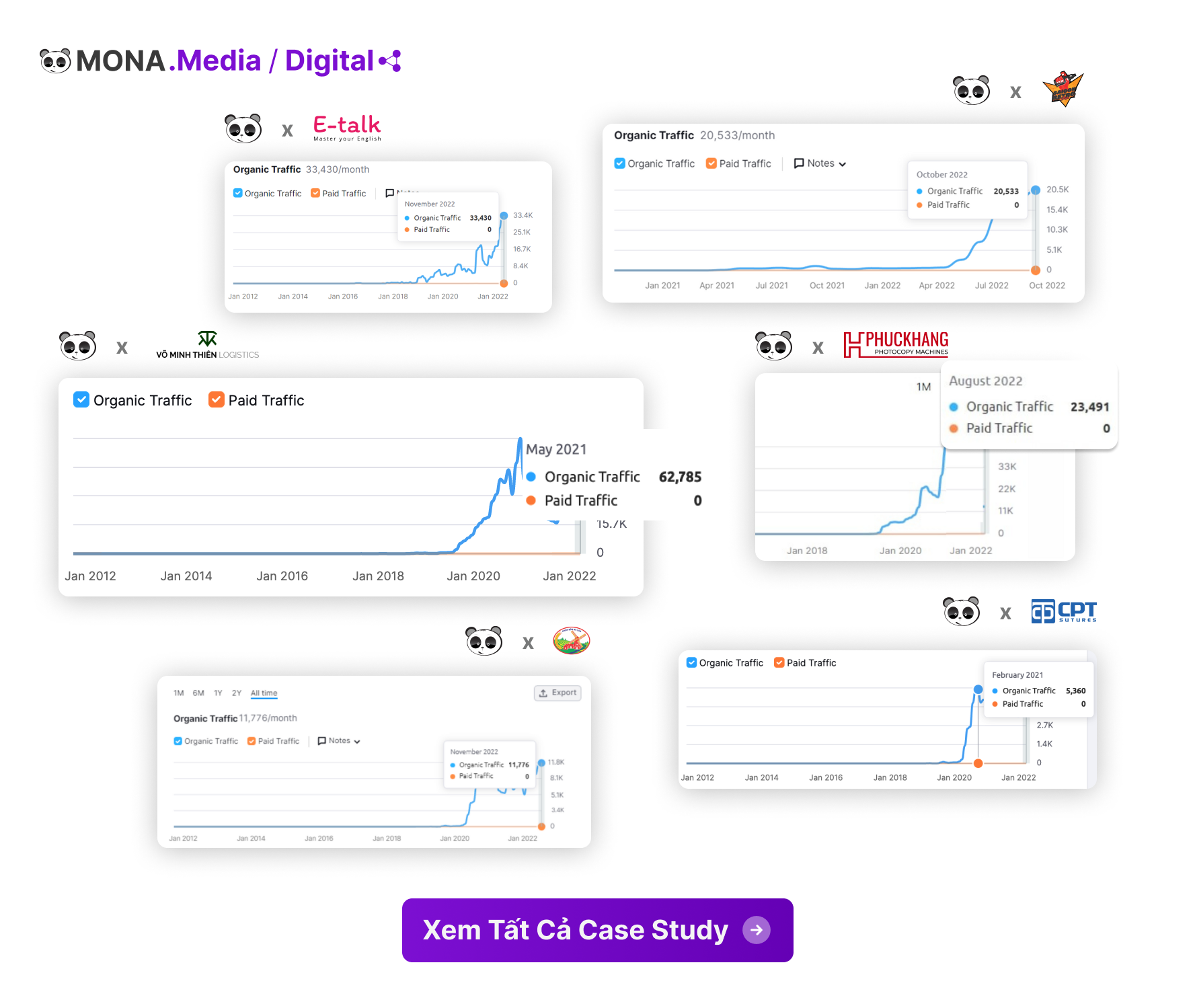
MONA Media is confident it is one of the top 1 SEO companies in providing MONA’s full-scope website SEO service for all types of business today. The proof is that MONA currently holds the TOP 1 Google position for competitive keywords such as SEO services, website design and hosting.

MONA holds Top 1 in competitive fields such as SEO Services, Website Design and Web Hosting
Highlights of SEO services at MONA:
Why you should choose MONA Media for web SEO services:

You may also like…
MONA's success story: from SME to Top 3 market leader
MONA Media understands each business's specific needs and is committed to delivering full-scope SEO solutions that fit best, helping your business not only grow strongly on Google but also improve sales noticeably. Please CONTACT US with us to receive the full-scope SEO quote and start your successful SEO journey today.
Applying refined and effective SEO techniques is the golden key that helps your website shine and rank ON TOP. These strategies will help you improve your rankings, but to reach lasting success you need patience and a sharp eye for the latest SEO trends. We wish you success in applying them and in improving your website's SEO results soon!

CEO & Founder · The MONA
Founder of The MONA, who built a services company of 200+ staff with 14,000+ projects delivered. Khánh Hùng shares how he thinks about building systems that run themselves, automating a business, and the real lessons from delivering projects at MONA.
 1,6K




Professional website
design services
Own a website with a beautiful, 100% exclusive design and a lifetime warranty, with the ability
to expand features flexibly as your business grows, starting today!



NHẬN TƯ VẤN SEO MIỄN PHÍ !






 MONA will never sell your information or send you spam


 MONA will never sell your information or send you spam
