
 MONA OS 2.0


 Tự động hoá doanh nghiệp
 Cẩm nang SEO
 Digital Marketing
 Kinh nghiệm thiết kế website
 Hạ Tầng Server
 Giáo dục



 VI
 EN












Message us on
Zalo Official


 ProductsNew

 ProductsProducts
 Mới ra mắtKHA AI 2027App tự edit video, tự đăng mọi mạng xã hội, 2 phút mỗi ngày










 Website designLooks good and wins customers over.
SEO servicesBrings in customers searching for exactly what you sell.
 Tư vấn digital marketingKéo khách từ nhiều kênh, đo bằng số thật.
Corporate video productionVideos introducing your company, factory and team.
 NewAI video productionCompany story films made with AI.
 Custom software developmentCRM, ERP and HRM built for your business.
 Viết AI Agent theo yêu cầuĐặt riêng một trợ lý AI cho đúng việc của mình.
 Tư vấn chuyển đổi AIĐưa AI vào vận hành của cả công ty.
NewMONA LMSManagement for centers and schools.
MONA SkillHubInternal training for company staff.
 NHTQ systemEnd-to-end China–Vietnam shipping operations.
MONA JMSManagement for gold, diamond and pawn shops.
 MONA E-LearningA website with every feature you need to sell courses.
 How to sell online courses (course)More than 30 free lessons on selling courses on autopilot.
 MONA Cloudmonacloud.vnServers to get your apps and websites running.
 MONA Basemonabase.vnPostgres database, sign-in and file storage.
 MONA Mailmonamail.vnSend OTP, order and invoice emails from your software.
 MONA Paymonapay.vnAccept bank transfers via VietQR and notify your software when the money arrives.
 MONA eInvoiceComing soonIssue e-invoices that meet tax standards.
Gấu CườiTrả lời khách 24/7 trên web, Fanpage, Zalo và thu lead cho sale.
 Gấu TeleSalesGọi điện tư vấn, chăm khách như tổng đài viên thật.
Dê CườiTư vấn và chốt đơn cho shop ngay trong khung chat.
Gấu WebmasterNhắn nhóm Zalo là website được sửa xong.
 Gấu Pháp ChếSoạn hợp đồng, rà điều khoản trong vài phút.
 Gấu Báo GiáLên báo giá đúng mẫu và gửi khách ngay.
 AI chăm sóc khách hàngTheo dõi và giữ chân khách hàng cũ.
 Gấu Tuyển DụngLọc hồ sơ, hẹn lịch, phỏng vấn ứng viên.
 Mới ra mắt
KHA AI 2027
Xây kênh chuyên gia 2 phút mỗi ngày
Quay bằng điện thoại, AI tự edit video, tự đăng lên 16 nền tảng và tự trả lời bình luận, tin nhắn.
310.136lượt xem trên kênh CEO MONA sau 17 ngày
 Anh Khánh HùngCEO MONA đang dùng mỗi ngày
Xem app làm được gì
 AI
Gấu Cười MONA ĐANG TỰ XÀITrả lời khách 24/7 trên website, Zalo OA, Messenger và thu lead về cho sale.
Dê CườiChốt đơn bán lẻ và sàn: Shopee, TikTok Shop, web. Chăm cả khách sỉ, đại lý.
Gấu WebmasterCập nhật nội dung, tối ưu SEO website mỗi ngày.
Gấu TeleSalesGọi điện tư vấn, chăm khách như tổng đài viên thật.
Gấu Tuyển DụngLọc hồ sơ, hẹn lịch, phỏng vấn ứng viên tự động.
AI chăm sóc khách hàngGiữ khách cũ, cứu lead đã rớt cho phòng kinh doanh.
Gấu Pháp ChếSoạn hợp đồng, rà điều khoản trong vài phút.
Gấu Báo GiáLên báo giá đúng mẫu, gửi khách ngay khi có yêu cầu.
 Chuyển đổi AI toàn phầnGiải pháp tổng cho doanh nghiệp, 3 lớp triển khai.
 Viết AI Agent theo yêu cầuĐặt riêng một con AI gánh đúng nghiệp vụ của bạn.
 Custom softwareCRM, ERP and HRM with built-in AI automation.
 SEO & AEO thời đại AIĐược Google lẫn AI trích dẫn, không chỉ xếp hạng.
 Kiến thức AI cho doanh nghiệpBài phân tích, hướng dẫn ứng dụng AI vào vận hành.
 Free AI courses
 AI tools at work
App mới · KHA AI 2027
Xây kênh 2 phút mỗi ngày
AI tự edit video, tự đăng mọi mạng xã hội
Free consultation, 8am–10pm every day

18 March, 2023

If you work in marketing, and especially if you are an SEO, you have probably heard of the E-A-T criteria. Now E-A-T has gained an extra letter, "E", and has become E- E-A-T SEO. So what is E-E-A-T in SEO, and how does it differ from E-A-T? Read on to find out in MONA Media the article below.

E-E-A-T stands for the 4 main factors Google uses to judge the quality of a web page or of the people who create content, especially on topics that can affect a user's happiness, health, finances or safety (known as YMYL topics, Your Money or Your Life), it stands for 4 English words:
– Experience (Experience)
– Expertise (Expertise)
– Authoritativeness (Authoritativeness)
– Trustworthiness (Trustworthiness)
E-E-A-T adds one more letter, E at the start, compared with E-A-T. To understand E-A-T better, you can read more: What is E-A-T in SEO? How to improve E-A-T for an SEO-friendly website
This is the criterion for judging content on a website, such as comments, service reviews, articles or any other content. It is understood as the user's Experience (Experience). And the content has to show that it was produced by someone with a certain amount of experience.
An example makes this easier to see: If a page says service ABC is very good, has that person really used service ABC? If a creator says dish XYZ is delicious, have they actually eaten it?
Many customers value an article more when its author really has experience with, and has used, the services or products it mentions. Put simply, experience means real, first-hand experience from people who have been through it and are sharing what they learned.

Element Expertise in E-E-A-T is how readers and search engines judge whether your website has "what it takes" to provide information on a topic, and whether you are an expert in the field you are writing about. Prove it through the quality of the content you provide.
Example: A business lawyer can write about legal issues in business because they have the expertise. A food specialist can use their knowledge to write and share experience from their field.
However, if you are not an expert and need to write about a topic, research it across several reliable sources. You can also ask experts in that field to help you write. That way your content is credible, useful to readers and valued by search engines.
Authoritativeness is one of the factors in the E-E-A-T criteria in SEO and refers to the reputation of your brand or website in its industry or field. Google's quality evaluation system looks at the authority of your content, your writers and your website.
In practice, you build authority for your website or articles when your content draws strong attention from readers or is mentioned by experts in the field. It also helps when highly reputable websites send readers to your page. Ideally, though, your website is recommended by related sites in the same industry.
Trustworthiness is considered the most important factor in E-E-A-T and has a big effect on a website's ranking. It checks that readers and users can trust the information they come across.
The criteria for judging trustworthiness are the author, the quality of the content, and the website itself.
Specifically, state clearly who wrote each article, cite information and content from reliable sources, and avoid covering your website in ads. Your articles and pages also need to be accurate and updated regularly.
Showing that your business website meets E-E-A-T criteria can noticeably improve your ranking on SERPs. The reason is that search engines like Google will see your site as trustworthy, well regarded by users and legitimate. Google also uses E-E-A-T to protect users from harmful content and to make sure it only serves quality results that best match what people are searching for.
Topic pages YMYL (Your Money Your Life) and pages that share first-hand daily life experience are the most affected by Google's E-E-A-T criteria. Because these topics are sensitive and have a big impact, Google sets an extremely high E-E-A-T standard for this kind of content.
Examples of YMYL pages: pages with medical information (symptoms, treatments), or pages about personal finance, investing and banking

The most important factor in E-E-A-T SEO is Trustworthiness, because if your website is not trustworthy enough, strong scores on the other factors still will not earn the trust of customers or of Google's algorithm. Trust is the foundation for deciding whether a site is truly safe. To improve security and user trust when people visit your site, you can buy an SSL certificate to encrypt the data on your website and keep users safe.
Here are a few examples of websites that lack E-E-A-T, which MONA Media has collected and wants to share with you:
To optimize your website to E-E-A-T standards in SEO, you need a few strategies that improve content quality, author credibility and user experience.
Create a separate author page for each author who writes for you. On it, state clearly the author's experience, degrees, expertise, certifications and related photos.

For example, if your website is about Digital Marketing and author B writes on your site, you need to create a page introducing author B. Include things such as which university they graduated from, with proof of the degree, or, if the author is well liked in the marketing community, link to that community.
When you write articles for your website, add reference links to related articles on your own site, or cite evidence from reputable external websites related to your field, to optimize for E-E-A-T.
Example: if your article is about full-scope SEO you can link to material related to SEO HCM.

Positive customer feedback on your website helps Google rate it higher than other sites. Customers sharing your articles on social media also sends positive E-E-A-T signals to Google. To get there, your website needs clear text and call-to-action (CTA) buttons that encourage users to interact.
Note: Do not create fake feedback or reviews. Google will detect it and you will be penalized.
Google also looks at your website design when judging E-E-A-T. If a site has too many popups or too many ads, or does not meet UI/UX standards, its trustworthiness suffers. That is why optimizing a website is important work to do right from the design stage.
Business websites that do not give full contact and customer support details can be seen as untrustworthy. So make sure your business's necessary contact information is on your website.

As in the image above, the website shows a phone number and a quick chat option so customers can reach the business as quickly as possible, and this information adds to the site's credibility.
Search engines tend to treat backlinks from high-authority sites as an endorsement, a quality signal. So when your website earns links from such sites, it rises in search results and draws quality traffic. Users also tend to trust reliable sources and are ready to click a backlink from them.
A website that meets E-E-A-T standards matters, but to turn visits into customers and revenue you need a proper SEO strategy strategy, carried out by a professional team. That is why many businesses choose MONA Media, as we are a pioneer in hands-on SEO services built to Google's E-E-A-T standards, delivering sustainable growth on Google.
At MONA, every SEO project starts with a full analysis, from website structure, page speed and indexability to user experience. Our specialists then optimize the technical side, the content and the internal links so the website reaches the highest quality score. Alongside that, we build your brand and online credibility, so you reach the top and keep your reputation for the long term.
We go beyond get your website to the top, and MONA Media commits to delivering real value:
Please CONTACT US with a reputable SEO provider – MONA Media by clicking the button below to get the most complete SEO service website and help your business succeed in the digital era.

The business's Ads on a website can earn money for many businesses, but if ads interfere too much with the user experience, they hurt the overall quality of the site. Put simply, a website should only show ads that relate directly to the page's content and main topic, to keep things balanced and give users the best experience.

E-E-A-T is one of the factors Google uses to judge the overall quality of a website. But E-E-A-T is not a Google ranking factor. Google has confirmed that the E-E-A-T principles were created to help the people involved in search rating evaluate how well its ranking systems perform, and they do not directly affect a website's ranking.
With the arrival of AI Search, the way Google understands, evaluates and displays content is also changing fast. Many users have even started searching with AI tools such as ChatGPT, Gemini or Perplexity instead of traditional Google, which seriously affects website SEO results.
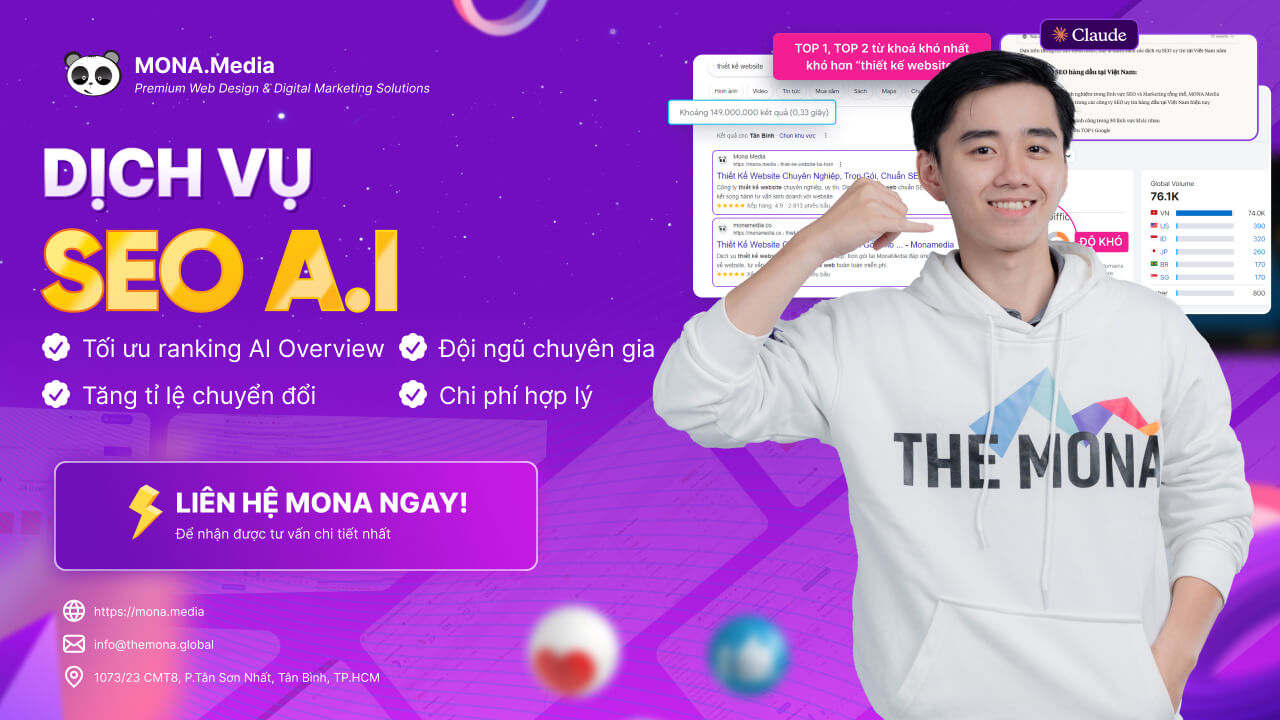
The answer to this problem is SEO AI , a content optimization strategy based on data and smart analysis of search behavior. MONA Media is proud to be a pioneer in rolling out AI SEO services in Vietnam, helping businesses not only hold their rankings on Google but also appear prominently on AI Search platforms. With in-depth analysis systems and a hands-on SEO team, MONA helps you:
If you want to move up the rankings in the age of AI Search, let MONA Media work alongside your business. Call the HOTLINE 1900 636 648.
In its latest update, Google's Quality Rater Guidelines (QRG) changed in several notable ways, mainly clarifying the role of the website owner and the content creator.

Specifically, section 2.5 sets out a 2-step process: first, Google works out who is behind the website and who is responsible for the content. Then it looks more closely at the identity and credibility of those people.
Over section 2.5.2, Google goes deeper into the difference between the website owner and the content creator, and adds a table for classifying types of website: sites where the owner produces the content, sites with content contributed by users or other authors, and sites that represent a person or organization on a social platform.
At section 3.0, the way page quality is rated has also been updated into a clear 3-step process: identify the purpose of the page, assess its potential for harm or its trustworthiness, and finally rate quality by whether the page achieves its stated goal.
Next, section 3.2 explains how to judge the quality of the main content on 4 criteria: effort, originality, expertise and accuracy. Section 3.3 stresses that Google will look at many sources to judge a website's reputation based on the topic it is building. Websites that do not specialize in one field are more likely to be seen as less trustworthy.
Section 3.3.4 focuses on the reputation of the content creator, with 3 separate groups: experts, influencers and non-expert individuals. In section 3.4, Google continues to update E-E-A-T, especially stressing the role of "Experience" and "Trustworthiness".
Beyond that, section 3.4.1 gives concrete examples to separate when real-life experience is needed and when deep expertise is needed in YMYL (Your Money or Your Life) topics such as health, finance and elections.
In section 4.2, Google adds a more detailed breakdown of content that may harm individuals or the community, along with examples of misinformation and unsupported claims.
Finally, in section 5.1, Google makes the role of each E-E-A-T factor more concrete and updates its wording throughout the document, for example changing "webmaster" to "website owner" and trimming gendered pronouns to be more inclusive.
Do Google's guidelines sound complicated at first? Don't worry, watch the video "SEO from zero", where Huy shows you each SEO tip in a way that is easy to follow and that anyone can learn!
Through this article, MONA Media we hope you now understand why E-E-A-T SEO matters and how to optimize these criteria effectively to reach your goals. Getting E-E-A-T right in SEO is not hard, but it takes patience, effort and time. With more than 10 years of experience in SEO and having helped 300+ businesses reach the top of search results, MONA is confident it can help your website grow sustainably on Google, Bing, Cốc Cốc and more.
Contact MONA through the channels below to talk in more detail:
References:

CEO & Founder · The MONA
Founder of The MONA, who built a services company of 200+ staff with 14,000+ projects delivered. Khánh Hùng shares how he thinks about building systems that run themselves, automating a business, and the real lessons from delivering projects at MONA.
 1,6K



Professional website
design services
Own a website with a beautiful, 100% exclusive design and a lifetime warranty, with the ability
to expand features flexibly as your business grows, starting today!



NHẬN TƯ VẤN SEO MIỄN PHÍ !






 MONA will never sell your information or send you spam


 MONA will never sell your information or send you spam
