
 MONA OS 2.0


 Tự động hoá doanh nghiệp
 Cẩm nang SEO
 Digital Marketing
 Kinh nghiệm thiết kế website
 Hạ Tầng Server
 Giáo dục



 VI
 EN















Message us on
Zalo Official


 ProductsNew

 ProductsProducts
 Mới ra mắtKHA AI 2027App tự edit video, tự đăng mọi mạng xã hội, 2 phút mỗi ngày










 Website designLooks good and wins customers over.
SEO servicesBrings in customers searching for exactly what you sell.
 Tư vấn digital marketingKéo khách từ nhiều kênh, đo bằng số thật.
Corporate video productionVideos introducing your company, factory and team.
 NewAI video productionCompany story films made with AI.
 Custom software developmentCRM, ERP and HRM built for your business.
 Viết AI Agent theo yêu cầuĐặt riêng một trợ lý AI cho đúng việc của mình.
 Tư vấn chuyển đổi AIĐưa AI vào vận hành của cả công ty.
NewMONA LMSManagement for centers and schools.
MONA SkillHubInternal training for company staff.
 NHTQ systemEnd-to-end China–Vietnam shipping operations.
MONA JMSManagement for gold, diamond and pawn shops.
 MONA E-LearningA website with every feature you need to sell courses.
 How to sell online courses (course)More than 30 free lessons on selling courses on autopilot.
 MONA Cloudmonacloud.vnServers to get your apps and websites running.
 MONA Basemonabase.vnPostgres database, sign-in and file storage.
 MONA Mailmonamail.vnSend OTP, order and invoice emails from your software.
 MONA Paymonapay.vnAccept bank transfers via VietQR and notify your software when the money arrives.
 MONA eInvoiceComing soonIssue e-invoices that meet tax standards.
Gấu CườiTrả lời khách 24/7 trên web, Fanpage, Zalo và thu lead cho sale.
 Gấu TeleSalesGọi điện tư vấn, chăm khách như tổng đài viên thật.
Dê CườiTư vấn và chốt đơn cho shop ngay trong khung chat.
Gấu WebmasterNhắn nhóm Zalo là website được sửa xong.
 Gấu Pháp ChếSoạn hợp đồng, rà điều khoản trong vài phút.
 Gấu Báo GiáLên báo giá đúng mẫu và gửi khách ngay.
 AI chăm sóc khách hàngTheo dõi và giữ chân khách hàng cũ.
 Gấu Tuyển DụngLọc hồ sơ, hẹn lịch, phỏng vấn ứng viên.
 Mới ra mắt
KHA AI 2027
Xây kênh chuyên gia 2 phút mỗi ngày
Quay bằng điện thoại, AI tự edit video, tự đăng lên 16 nền tảng và tự trả lời bình luận, tin nhắn.
354.973lượt xem trên kênh CEO MONA sau 21 ngày
 Anh Khánh HùngCEO MONA đang dùng mỗi ngày
Xem app làm được gì
 AI
Gấu Cười MONA ĐANG TỰ XÀITrả lời khách 24/7 trên website, Zalo OA, Messenger và thu lead về cho sale.
Dê CườiChốt đơn bán lẻ và sàn: Shopee, TikTok Shop, web. Chăm cả khách sỉ, đại lý.
Gấu WebmasterCập nhật nội dung, tối ưu SEO website mỗi ngày.
Gấu TeleSalesGọi điện tư vấn, chăm khách như tổng đài viên thật.
Gấu Tuyển DụngLọc hồ sơ, hẹn lịch, phỏng vấn ứng viên tự động.
AI chăm sóc khách hàngGiữ khách cũ, cứu lead đã rớt cho phòng kinh doanh.
Gấu Pháp ChếSoạn hợp đồng, rà điều khoản trong vài phút.
Gấu Báo GiáLên báo giá đúng mẫu, gửi khách ngay khi có yêu cầu.
 Chuyển đổi AI toàn phầnGiải pháp tổng cho doanh nghiệp, 3 lớp triển khai.
 Viết AI Agent theo yêu cầuĐặt riêng một con AI gánh đúng nghiệp vụ của bạn.
 Custom softwareCRM, ERP and HRM with built-in AI automation.
 SEO & AEO thời đại AIĐược Google lẫn AI trích dẫn, không chỉ xếp hạng.
 Kiến thức AI cho doanh nghiệpBài phân tích, hướng dẫn ứng dụng AI vào vận hành.
 Free AI courses
 AI tools at work
App mới · KHA AI 2027
Xây kênh 2 phút mỗi ngày
AI tự edit video, tự đăng mọi mạng xã hội
Free consultation, 8am–10pm every day

18 March, 2023

Long-tail keywords have long been one of the most popular SEO terms and methods. They also bring real benefits to a website and to SEO specialists. So what is a long-tail keyword? Why is it called "long tail", and how do you recognize one? What are the benefits of long-tail keywords? Let's MONA Media answer all these questions in the article below.
A long-tail keyword is generally understood as a long keyword of 3 or more words. It is usually an extended phrase of a short keyword, also called a "head" keyword. Long-tail keywords are longer and describe the user's search intent in more detail and more precisely.

For example, the keyword "website design" (website design) is a short keyword with just 3 words in Vietnamese. A long-tail keyword built from this head could be "thiết kế website bán hàng online" (website design for online selling), "thiết kế website giá rẻ" (cheap website design), or even "online WordPress website design đơn giản nhưng vẫn đẹp” (simple but still beautiful)…
Long-tail keywords have traits that are the opposite of short keywords, including:
Lower search volume: Because long-tail keywords are more specific and detailed, fewer people search for the exact phrase, so search volume is lower.
Lower SEO difficulty: With low search volume and low competition combined, long-tail keywords usually reach the top 10 results more easily than short keywords.
From these points, you can see that short keywords usually draw larger search volume and bring a lot of traffic to a website. However, SEO web on top for these keywords is harder because of the fierce competition.
Long-tail keywords, on the other hand, bring less traffic each, but they are easier to rank for. More importantly, they usually convert better, because people who search with a long phrase usually already have a specific, clear need.
Read the SEO case study: Bình Mỹ nursing home network x MONA
Bình Mỹ is a high-end nursing home network in Vietnam, providing care for the elderly and for children with disabilities. When it started SEO with MONA, the challenge was how to grow online visibility in a fairly specialized field.
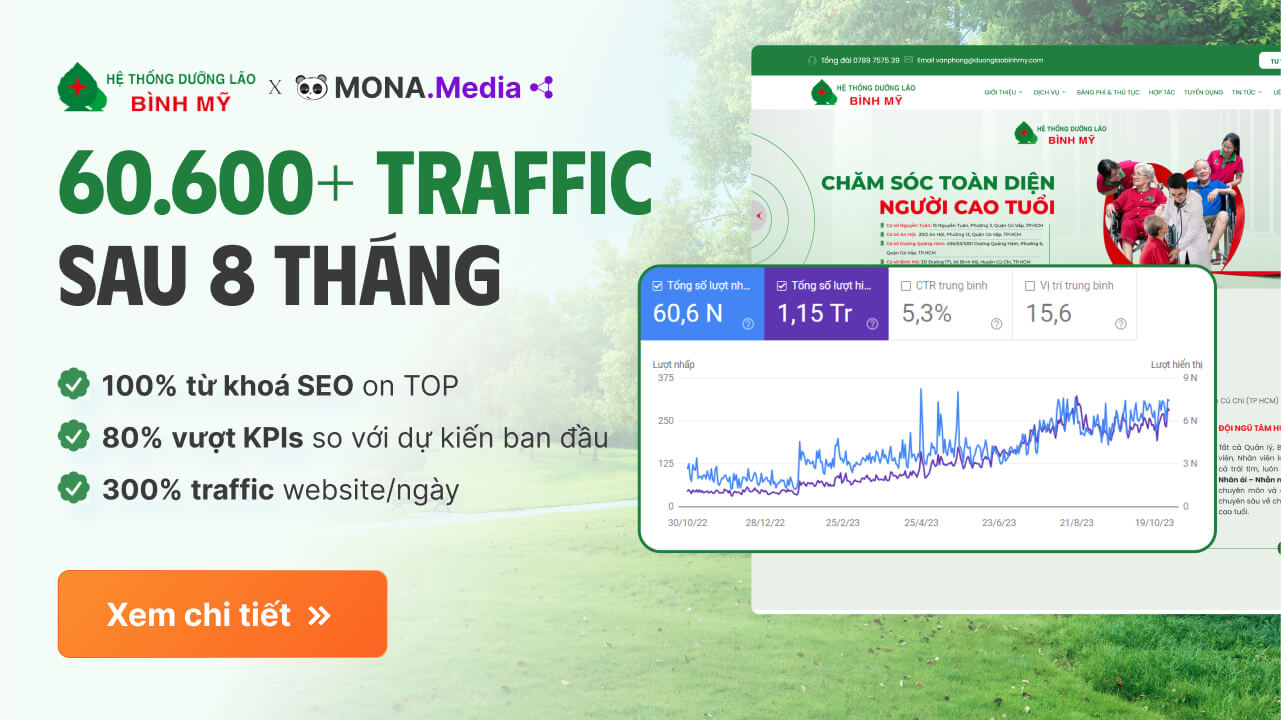
The MONA team built a clear Keyword SEO strategy that blends short keywords, long-tail keywords and niche groups matched to each service. As a result, the nursing home website beat its target, with 100% of target keywords now showing in Google's top results, bringing Bình Mỹ's website the right audience, more quality traffic and a stronger position online. It is a clear example of how well-planned, well-targeted SEO delivers real value to a business.
Many people assume long-tail keywords are called that because they are "long". In fact, the name has nothing to do with how many words a keyword has. It comes from the shape of the search demand distribution chart used in web SEO and marketing.
Here is a simple way to see it:
The head of the chart: These are short, popular keywords like "giày" (shoes), "amazon", "netflix" and "art", with hundreds of thousands to millions of searches a month. They are called the Fat Head.
The middle: These are medium-length keywords with a few thousand searches a month, called the Chunky Middle.
The "long tail" at the end: These are very specific keywords with low search volume (usually under 100 searches a month). There are a huge number of them, stretching toward the end of the chart, so they form the shape of a "long tail". That is where the term long-tail keyword comes from.

"Long tail" describes where a keyword sits on the search demand chart, not how long the phrase is. A keyword of just 1 or 2 words can still be a long-tail keyword if its search volume is low. Targeting the right long-tail keywords reaches more specific customers, with less competition and a higher conversion rate in SEO.
Knowing where the "long tail" comes from helps you build a more suitable SEO strategy as a whole, so you don't miss opportunities from small queries that are extremely high in quality.
If you have ever SEO, you have surely heard of short keywords, mid-tail keywords and long-tail keywords. But out of the billions of searches made every day, which type is the biggest?
According to analysis from Ahrefs, one of the leading keyword research tools today, as many as 94,74% of searches in the US are long-tail keywords. Short keywords (such as "giày" (shoes) or "máy tính" (computer)), by contrast, account for only 0,0008%. That is a surprising number, isn't it?
The data shows that most users don't search with generic words. Instead they type something more specific and detailed to get the right answer straight away, for example "mua giày chạy bộ nam dưới 1 triệu ở Hà Nội" (buy men's running shoes under 1 million VND in Hanoi) instead of just "running shoes".

From this, you can see that short keywords can bring a lot of traffic, but competing for the top spot with them is extremely hard.
Long-tail keywords, meanwhile, bring few searches each, but they are easier to rank for, so the rate of purchases, sign-ups and other desired actions is higher too.
Using long-tail keywords in SEO has many benefits: more visibility, more precise targeting, less competition and better conversion rates.
As mentioned, long-tail keywords usually have low search volume (under 100 searches a month) and very low difficulty and competition. Choosing long-tail keywords doesn't just make website SEO easier. It also lowers your Google Ads costs.
Like rare goods, short keywords tend to be "expensive" because so many people compete for them. Long-tail keywords face less competition, so their CPC is much lower.

Even though the cost per click is cheap, when you run a campaign with many long keywords the total cost can come out much lower than focusing on short keywords. That is worth weighing carefully in your SEO and advertising strategy.
A long keyword is more than a longer string of words. It shows clearly and specifically what the searcher actually needs. When someone types a phrase like "men's waterproof sports shoes under 2 million VND", it shows they know exactly what they want, unlike a short, vague keyword such as "sports shoes".
That is your chance to have your website appear at the right moment for the right need, without fierce competition from a crowd of other websites.
Long keywords help you reach the right potential customers, people who are really interested and ready to act, whether that means reading a post, getting in touch or buying. Content built around long keywords is also more focused and solves a specific problem, which builds trust and keeps readers on the page longer.
Google also rewards pages that "understand" their users, so over the long run, optimizing for long keywords brings quality traffic and also lifts your ranking in a lasting way.
Long-tail keywords make up most of what people search on Google because they reflect specific user needs. Thousands of different phrases are searched every day, and they rarely repeat exactly.
Thanks to this variety, you can expand your content from one short keyword into many more detailed variations.

For example, "sữa rửa mặt" (face wash) can grow into "sữa rửa mặt cho da dầu mụn dưới 200k" (face wash for oily, acne-prone skin under 200k VND) or "sữa rửa mặt không cồn cho nam" (alcohol-free face wash for men).
This is a big advantage in a long-term full-scope SEO service. You always have new topics to write about, you reach the right customers, and you face less competition while still getting results. Short keywords bring in the first visits, while long keywords keep users engaged and raise conversions.
In any SEO campaign, keyword research and strategy is the foundation that decides long-term results. If this step is rushed or goes in the wrong direction, all the effort on content, technical work or promotion is easily wasted. SEO that is wrong from the start doesn't just keep your site off the top. It reaches the wrong audience, wastes time and budget, and misses business opportunities.
With more than 10 years experience delivering SEO services full-scope SEO, MONA Media understands every step needed to help a business not only reach the top quickly but also hold that position for the long term.

Why many businesses trust MONA's SEO Traffic service:
100% real traffic, no tools, nothing fake: Visits come from real users with real needs, and each IP interacts only once a day, which keeps your site fully credible with Google's algorithm.
Quality traffic, lasting ranking gains: We don't just raise traffic for a while. We focus on holding the top spot long term, with real visits from your target customers.
Traffic comes from people who really care about the content: Every visit has a reasonable time on site, showing real interest. We don't use "task" schemes or fake traffic to fool the algorithm.
Transparent process, clear reports: MONA provides detailed reports: traffic sources, IPs, average time on site and more, so you can easily control and evaluate each stage.
If you want SEO that is done properly, grows steadily and carries no risk with Google, contact MONA Media for advice on strategy and a SEO services quote that suits your business best.
To find long keywords for a structured full-scope or for running ads, you can use tools such as:
The Google search bar is one of the free tools for finding long keywords. Besides searching, it also suggests related phrases. It is a free and very fast way to find long-tail keyword ideas.

Google's suggestions are based on words related to the phrase you type, either by meaning or by what people around the world search for.
That makes Google Search suggestions very good keyword sources, and ideas you shouldn't skip when looking for long-tail keywords for SEO.
This tool uses Google's autocomplete to produce a large number of long-tail keywords related to the seed keyword you enter. Compared with Google Keyword Planner, Keyword Tool gives more suggestions and doesn't require an ads account login. It has both free and paid versions, which is handy for beginners.
As one of the leading SEO tools professional tools, SEMrush not only finds long-tail keywords but also analyzes difficulty, search volume and your competitors' keyword strategy. That makes it easy to spot keyword opportunities that nobody has gone deep on yet.

Like SEMrush, Ahrefs is a powerful helper in keyword research. It stands out for its huge database, which lets you explore hundreds of long keyword variations, analyze competitors and track keyword rankings over time, all in one platform.
This is a free tool from Google that lets you follow search trends over time and by region. Besides seeing which keywords are "hot" or fading, you can explore related keywords, many of them long-tail keywords that reflect what users really need.
In SEO, long-tail keywords play an important role in optimizing content and drawing traffic with the intent to buy or find specific information.

These are some common types of long-tail keywords in SEO:
Finding the right long-tail keywords is only the first step. What matters more is how you use them well.
Stuffing keywords into an SEO post is not success. To get the most from long-tail keywords, you need to put them in the right places, write content that matches the need, and link them naturally within your overall SEO strategy.
Put the long keyword at the start of the title to catch the attention of readers and search engines quickly. This tells users right away that your post is about what they are looking for. Make sure the long keyword is placed and appears naturally and sensibly in the title.

This helps search engines understand that your post is about that specific keyword and rank it better on Google, and it makes the title read naturally and clearly for users.
Write an engaging description that includes the long keyword sensibly near the start, to catch the attention of users and search engines. Describe your page with unique content and set it apart from competing sites, using related keywords to widen the range of the description.

To optimize a long-tail keyword, you don't need to stuff it in or repeat it too often. What matters is using it naturally and sensibly in the post.
Insert it in the main content: Work the long keyword into paragraphs naturally, as part of the story or useful information. Don't overuse it, or the post will repeat itself and lose its flow.
Put it in subheadings: You can use the long keyword in the smaller headings of the post. This helps both readers and Google understand each section better.
Create internal links: If the post mentions the long keyword, you can link to another related post on your website. This helps readers explore more and is good for SEO.
Repeat it in the conclusion: At the end of the post, you can mention the long-tail keyword once more when you wrap up. This increases the relevance of the whole piece.

Let the long-tail keyword appear naturally as part of the content, not as something you "forced in to hit a count". That way the post is friendly to readers and well rated by Google.
You can optimize the long keyword in the ALT attribute of the images in your post. When you upload an image, give the file a meaningful name related to the long-tail keyword. This helps search engines understand what the image shows and makes the image more likely to appear in search results.

Avoid writing image descriptions that are too long or unnecessary. Focus instead on giving relevant, necessary information, and optimize the description with the long keyword or with the main or secondary keyword.
Look into the variations of a long-tail keyword, including synonyms, related words and similar phrases. Use these variations in your content, in H2 and H3 headings and in descriptions, to raise the chance that your post appears in search results for related keywords.
You can also use long-tail keyword variations by building a separate landing page for each variation. Create in-depth content related to that long-tail keyword on the landing page to improve your ranking and draw traffic with the intent to buy or find specific information.
Is your website SEO-ready, with all the keywords in place, but still not reaching the top? You may be spamming keywords without realizing it. Watch the video "4 Core Factors That Get Your Website to the Top of Google" to learn how to optimize keywords more naturally, correctly and effectively.
Should you focus entirely on long-tail keywords?
Focusing entirely on long-tail keywords, or on any single type of keyword, is not a good strategy. In an SEO campaign, both long-tail keywords and general keywords matter.
Long-tail keywords can get you ranking results faster and make your site easier to find in specific searches. General keywords are still needed to cover and widen the scope of your content. Combining both gives you a more complete and varied SEO strategy.
Do long-tail keywords change over time?
Yes, long-tail keywords can change over time. User search trends and industry changes can affect how popular they are and how often they are used.
So you need to keep watching new search trends and what users need, to optimize your content and find suitable long-tail keywords. Keyword research tools make it easier to follow changes in long-tail keywords for SEO.
That is our answer to what a long-tail keyword is, where the name comes from, and other details about this special type of keyword. Long-tail Keyword is a solution that makes it easy to rank keywords on Google, and even on Bing and other search engines. If you want an SEO strategy with lasting, sustainable results, rather than a faster turnaround, consider MONA's SEO service. Contact us to get the full-scope SEO price list with full details.

CEO & Founder · The MONA
Founder of The MONA, who built a services company of 200+ staff with 14,000+ projects delivered. Khánh Hùng shares how he thinks about building systems that run themselves, automating a business, and the real lessons from delivering projects at MONA.
 1,6K




Professional website
design services
Own a website with a beautiful, 100% exclusive design and a lifetime warranty, with the ability
to expand features flexibly as your business grows, starting today!



NHẬN TƯ VẤN SEO MIỄN PHÍ !






 MONA will never sell your information or send you spam


 MONA will never sell your information or send you spam
