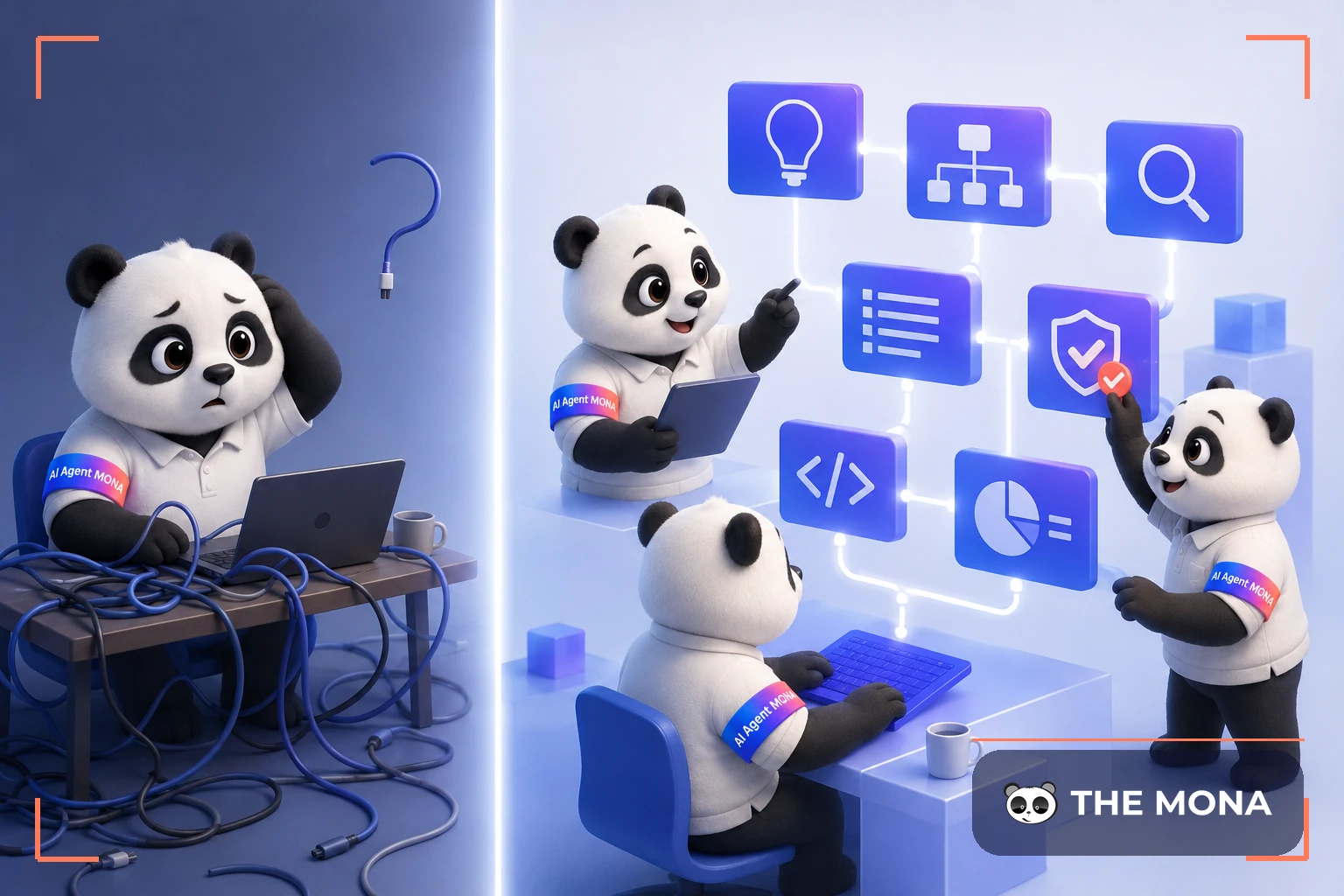
| Building the knowledge base | You gather the documents, split them up and reload them yourself every time something changes. Nobody removes outdated documents. | MONA builds a knowledge base around your business processes, with a scheduled auto-update. Gấu Cười refreshes its knowledge base every 15 minutes. |
| Checking answer quality | No checking layer. Whatever the AI says, the customer reads; if it's wrong, nobody knows until the customer complains. | A review layer before answers reach the customer, plus a dashboard tracking which answers are rated poorly so they can be fixed. |
| Fitting into existing processes | The API returns a block of text. Connecting it to your CRM, call center, inventory software or orders is up to you. | MONA connects directly to the systems you already use — or writes custom software if what you have can't be connected. |
| Responsibility when the AI gets it wrong | It's yours. The model provider's terms don't cover this. | It's MONA's, within the delivered scope. A real person picks up the phone when the system has problems. |
| Where the data lives | Depends on your configuration. It is very easy to send customer data outside without realizing it. | In line with Decree 13/2023, hosted on infrastructure MONA runs itself — including a dedicated VPS for the AI Agent. |
| First-year cost | Cheap. Mostly token costs plus your own staff's time. | Noticeably higher — this is the build cost. |
| Cost from the second year | Usually climbs: the person who built it leaves, flows break when the API changes, and nobody dares to touch it. | Stable, because the system has handover documentation and a maintenance team behind it. |



 MONA OS 2.0







































 Free AI courses
 AI tools at work

 Tự động hoá doanh nghiệp
 Cẩm nang SEO
 Digital Marketing
 Kinh nghiệm thiết kế website
 Hạ Tầng Server
 Giáo dục




 VI
 EN