
 MONA OS 2.0
 Partner with MONA


 Tự động hoá doanh nghiệp
 Cẩm nang SEO
 Digital Marketing
 Kinh nghiệm thiết kế website
 Hạ Tầng Server
 Giáo dục


 VI
 EN











Message us on
Zalo Official


 ProductsNew

 ProductsProducts
 Mới ra mắtKHA AI 2027App tự edit video, tự đăng mọi mạng xã hội, 2 phút mỗi ngày










 Website designLooks good and wins customers over.
SEO servicesBrings in customers searching for exactly what you sell.
 Tư vấn digital marketingKéo khách từ nhiều kênh, đo bằng số thật.
Corporate video productionVideos introducing your company, factory and team.
 NewAI video productionCompany story films made with AI.
 Custom software developmentCRM, ERP and HRM built for your business.
 Viết AI Agent theo yêu cầuĐặt riêng một trợ lý AI cho đúng việc của mình.
 Tư vấn chuyển đổi AIĐưa AI vào vận hành của cả công ty.
NewMONA LMSManagement for centers and schools.
MONA SkillHubInternal training for company staff.
 NHTQ systemEnd-to-end China–Vietnam shipping operations.
MONA JMSManagement for gold, diamond and pawn shops.
 MONA E-LearningA website with every feature you need to sell courses.
 How to sell online courses (course)More than 30 free lessons on selling courses on autopilot.
 MONA Cloudmonacloud.vnServers to get your apps and websites running.
 MONA Basemonabase.vnPostgres database, sign-in and file storage.
 MONA Mailmonamail.vnSend OTP, order and invoice emails from your software.
 MONA Paymonapay.vnAccept bank transfers via VietQR and notify your software when the money arrives.
 MONA eInvoiceComing soonIssue e-invoices that meet tax standards.
Gấu CườiTrả lời khách 24/7 trên web, Fanpage, Zalo và thu lead cho sale.
 Gấu TeleSalesGọi điện tư vấn, chăm khách như tổng đài viên thật.
Dê CườiTư vấn và chốt đơn cho shop ngay trong khung chat.
Gấu WebmasterNhắn nhóm Zalo là website được sửa xong.
 Gấu Pháp ChếSoạn hợp đồng, rà điều khoản trong vài phút.
 Gấu Báo GiáLên báo giá đúng mẫu và gửi khách ngay.
 AI chăm sóc khách hàngTheo dõi và giữ chân khách hàng cũ.
 Gấu Tuyển DụngLọc hồ sơ, hẹn lịch, phỏng vấn ứng viên.
 Mới ra mắt
KHA AI 2027
Xây kênh chuyên gia 2 phút mỗi ngày
Quay bằng điện thoại, AI tự edit video, tự đăng lên 16 nền tảng và tự trả lời bình luận, tin nhắn.
882.681lượt xem trên kênh CEO MONA sau 36 ngày
 Anh Khánh HùngCEO MONA đang dùng mỗi ngày
Xem app làm được gì
 AI
Gấu Cười MONA ĐANG TỰ XÀITrả lời khách 24/7 trên website, Zalo OA, Messenger và thu lead về cho sale.
Dê CườiChốt đơn bán lẻ và sàn: Shopee, TikTok Shop, web. Chăm cả khách sỉ, đại lý.
Gấu WebmasterCập nhật nội dung, tối ưu SEO website mỗi ngày.
Gấu TeleSalesGọi điện tư vấn, chăm khách như tổng đài viên thật.
Gấu Tuyển DụngLọc hồ sơ, hẹn lịch, phỏng vấn ứng viên tự động.
AI chăm sóc khách hàngGiữ khách cũ, cứu lead đã rớt cho phòng kinh doanh.
Gấu Pháp ChếSoạn hợp đồng, rà điều khoản trong vài phút.
Gấu Báo GiáLên báo giá đúng mẫu, gửi khách ngay khi có yêu cầu.
 Chuyển đổi AI toàn phầnGiải pháp tổng cho doanh nghiệp, 3 lớp triển khai.
 Viết AI Agent theo yêu cầuĐặt riêng một con AI gánh đúng nghiệp vụ của bạn.
 Custom softwareCRM, ERP and HRM with built-in AI automation.
 SEO & AEO thời đại AIĐược Google lẫn AI trích dẫn, không chỉ xếp hạng.
 Kiến thức AI cho doanh nghiệpBài phân tích, hướng dẫn ứng dụng AI vào vận hành.
 Free AI courses
 AI tools at work
App mới · KHA AI 2027
Xây kênh 2 phút mỗi ngày
AI tự edit video, tự đăng mọi mạng xã hội
Free consultation, 8am–10pm every day

01 June, 2026
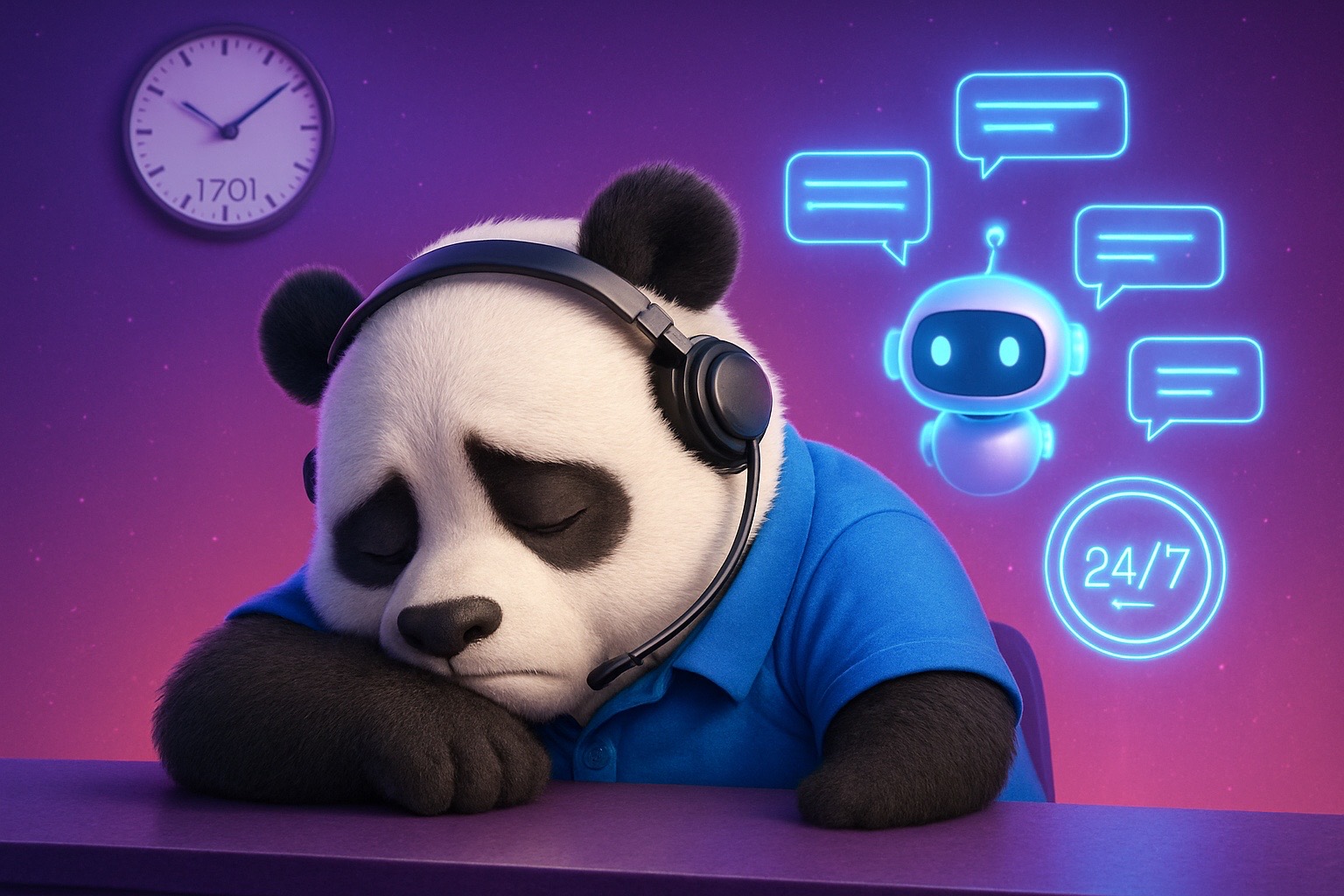
Have you ever opened the company Zalo at 9 pm and found 14 customer messages asking about prices with no reply? The next morning, accounting reports 3 lost orders because the customers called a competitor. A mid-market customer care team running 4 shifts at 12 million VND per person, a total payroll of 48 million VND a month, still cannot cover 24/7. In 2026, MONA sees that AI for customer care is now mature enough to take over 70-80% of level 1 questions, answering 24/7 on Zalo, Messenger, hotline and web chat. In this article we share how a customer service AI Agent can replace one employee across all 4 shifts. It includes a Vietnamese callbot and an automatic Zalo virtual assistant, based on the 28-branch spa chain case that saves 33 million VND a month. An AI Agent is not meant to replace the whole customer service team, but to let the remaining team do high-value work.
If you are just starting to learn about this area, read this article first: virtual call center where MONA explains the three generations of call center solutions from the ground up. With that foundation, this article will click into place.
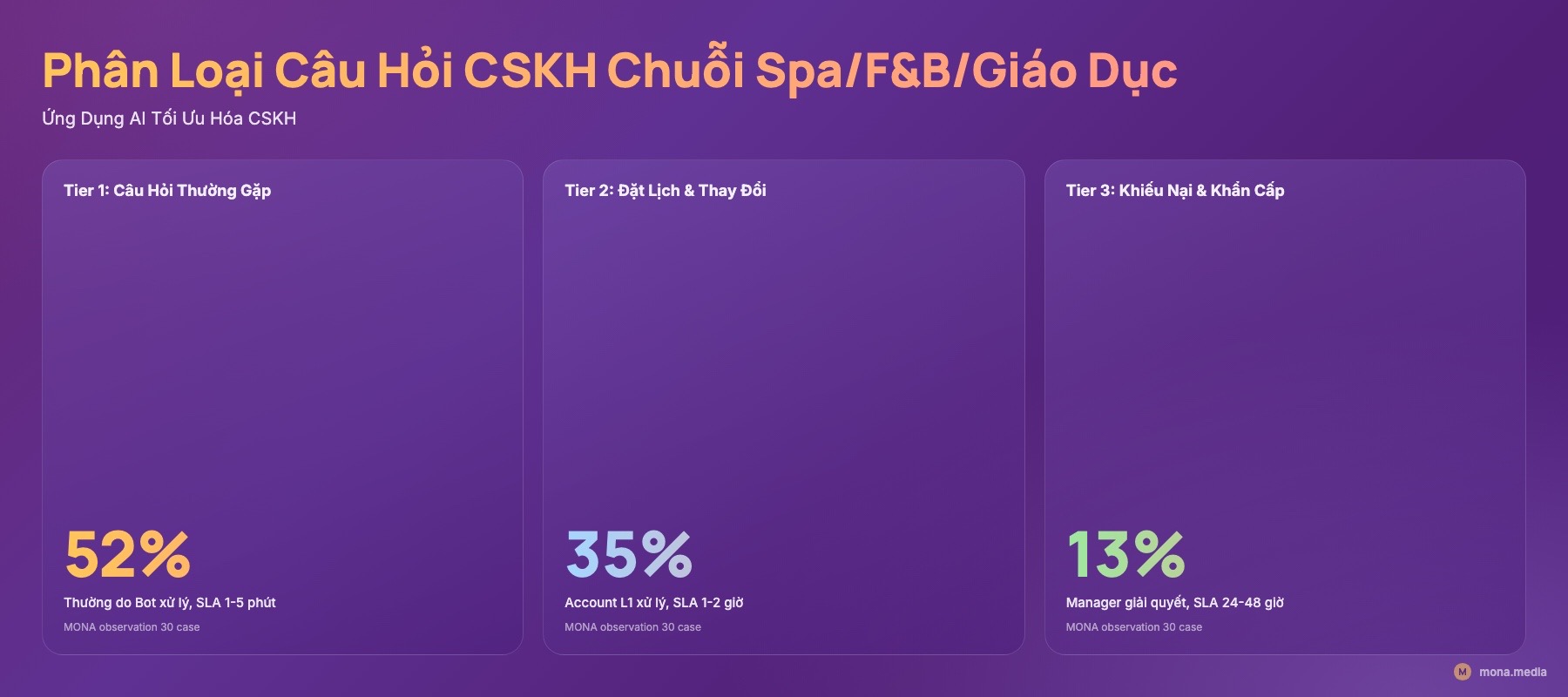
Before rolling out automation software for the customer service team, MONA always sits down with the client to sort customer questions into 3 levels. This is the key step that decides how much of the work the virtual assistant can do.
Level 1 is standard information lookup. Service prices, opening hours, branch addresses, whether there are slots left today. These make up 65-75% of messages coming into a mid-market chain's customer service team. A customer service AI Agent can handle this level completely.
Level 2 is questions that require looking things up in the client's system. Order status, today's appointments, membership card balance, purchase history. These are 15-20% of messages. A virtual assistant can handle this level if it is connected to the business's CRM and ERP.
Level 3 is questions that call for handling a situation. Complaints about a damaged product, refund demands, threats to switch to a competitor, requests to speak to a manager. These are the remaining 10-15%, and a person must answer them. Keep your customer service team for exactly this group, because this is where human value truly shows.
Read more about the framework at What is an AI Agent, What is Conversational AI, What is a chatbot to understand the difference between old rule-based virtual assistants and the 2026 generation of AI Agents.
In 2020, Zalo chatbots still used decision trees. If a customer's question was off by one word, the virtual assistant answered wrong. In 2026, a customer service AI Agent uses large language models to understand what the customer means, read the business's internal documents and write natural answers. When a customer asks “is there still a foot massage slot on Sunday afternoon at the Phu Nhuan branch?”, the customer service AI Agent reads the system schedule and replies right away: “Yes, the Phu Nhuan branch has 2 slots left on Sunday afternoon, at 3 pm and 5 pm. Which one would you like me to book?”
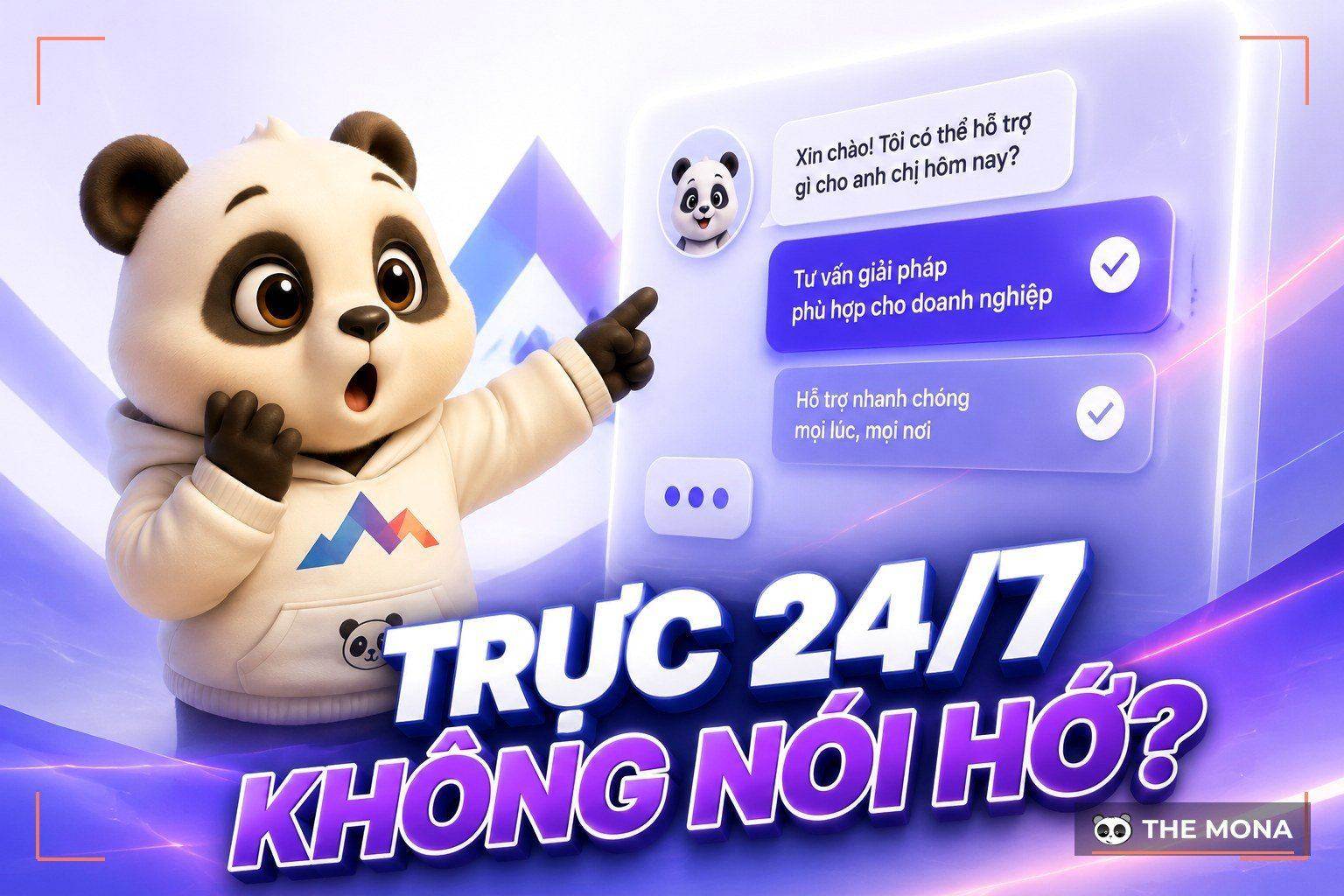
We all know Vietnamese customers like to message fast and do not like to wait. A customer service team of 4 cannot cover 24/7, let alone 6 channels at once. A customer service AI Agent runs 24/7 on 6 channels at the same time for a fixed cost of 5-15 million VND a month.
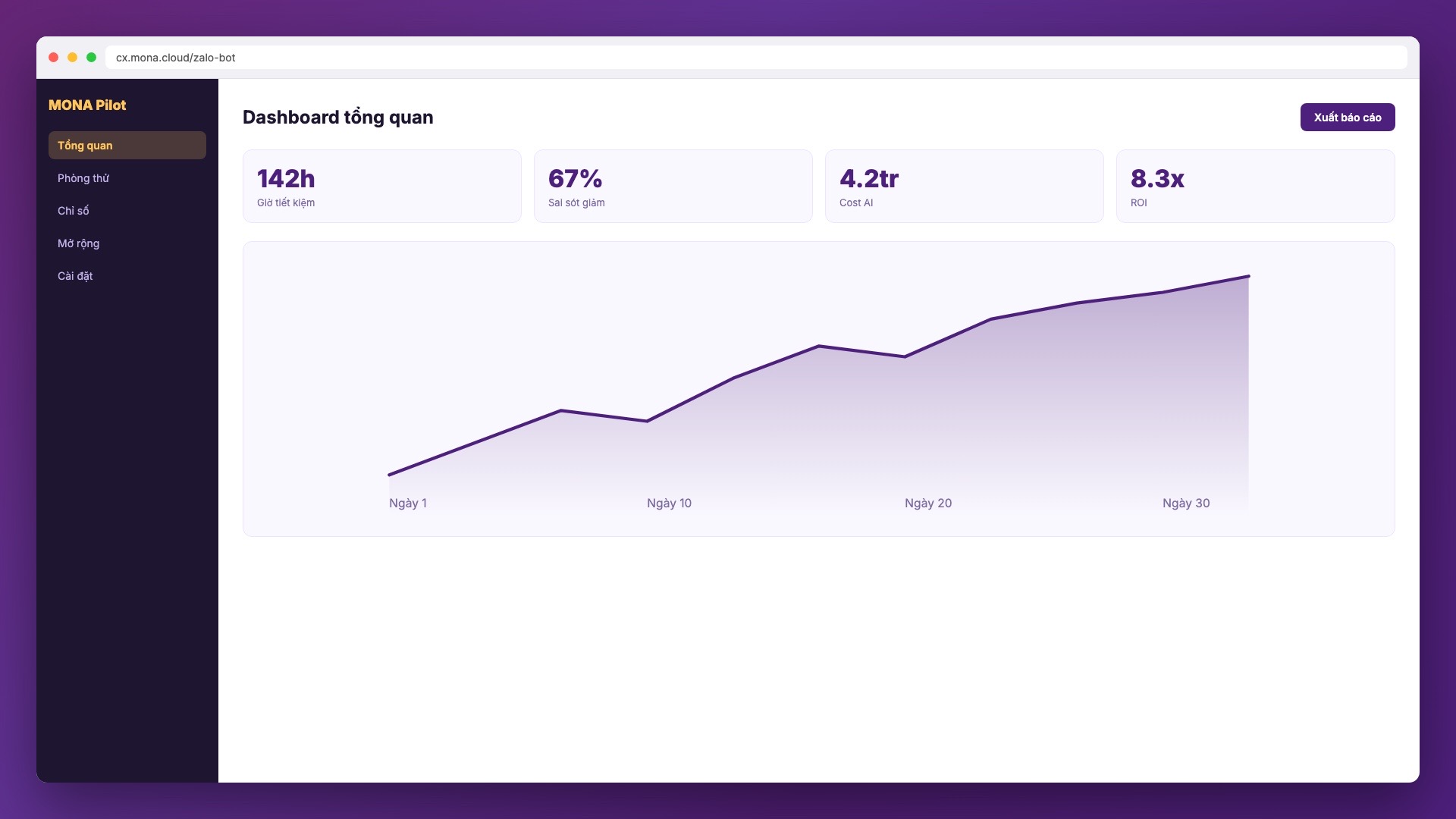
Some figures MONA has observed across 30+ clients. Share of conversations the customer service AI Agent resolves without handing over to a person: 72-78%. Average response time: 2-4 seconds instead of 8-15 minutes. Customer satisfaction after a conversation (measured by a feedback button): 7.8 out of 10, 0.6 points higher than with human staff alone.
Why is satisfaction higher? Because the virtual assistant answers fast, never gets irritated and never misses a message. A customer who asks at 9 pm gets an answer at 9:00 pm, not at 9 am the next day.
MONA's 28-branch spa client has 6 channels where customers send messages. The parent brand's Zalo OA, a separate Zalo OA for each branch cluster, the main Facebook Messenger, the Messenger of each branch Page, the phone hotline, and web chat on the booking page. Before, customer service had to open 6 windows side by side or switch between tabs, and it was easy to miss messages.
MONA wrote a customer service AI Agent that connects directly to all 6 channels and answers in one voice. A customer who asks the same question on Zalo, Messenger or the hotline gets an equivalent answer. The customer service team just watches a shared dashboard and steps in when the customer service AI Agent hands a case over to a person.
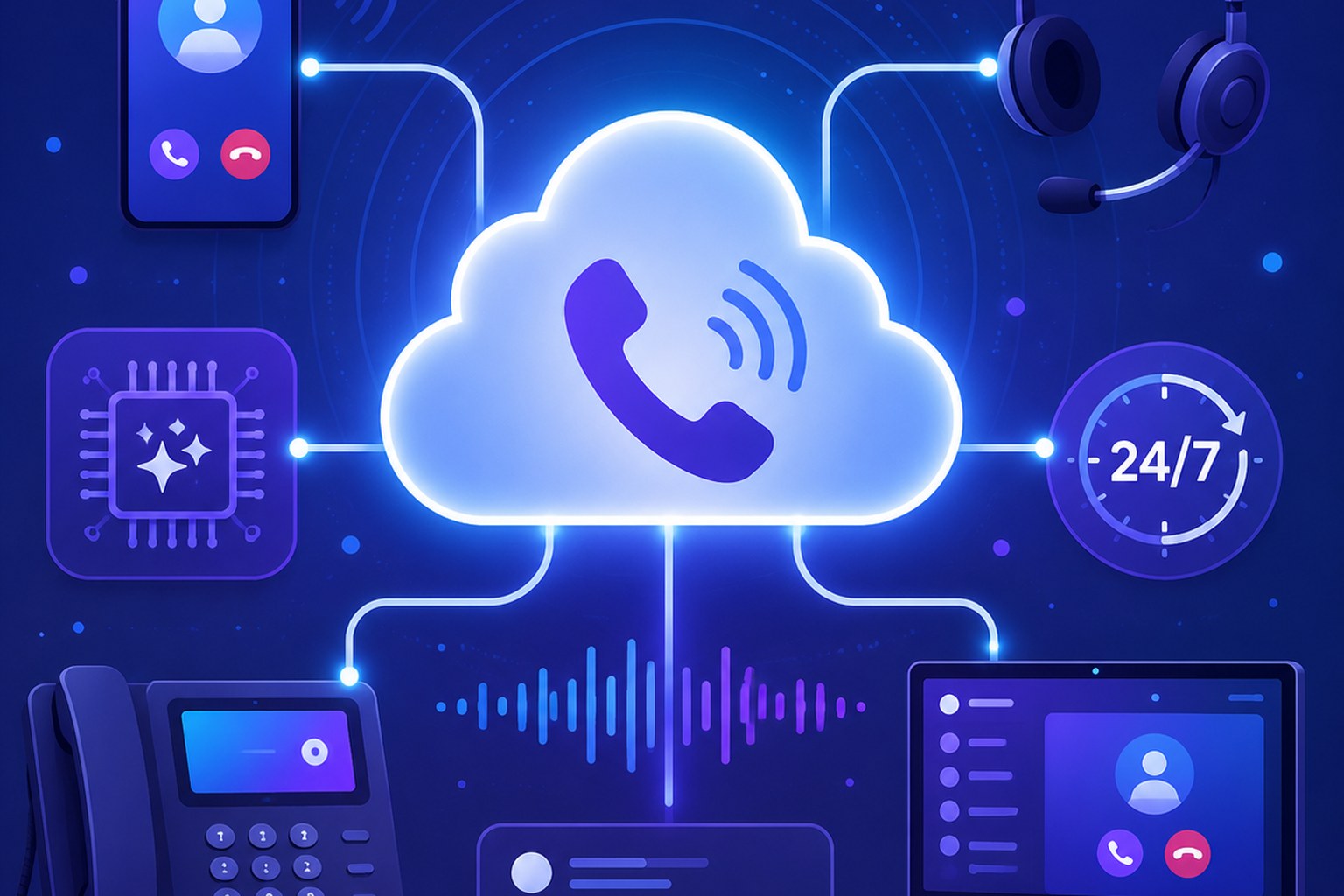
The Vietnamese callbot is the hard part of this multi-channel set. Ten years ago, callbots answered stiffly, Vietnamese customers knew right away it was a machine and hung up. In 2026, the Vietnamese callbot that MONA deploys for clients uses a natural voice, with intonation and pauses, and understands regional accents. A spa customer from the Mekong Delta calls in. The callbot still understands “cho em hỏi giờ chiều mơi còn slot không cô” (“excuse me, are there slots left tomorrow afternoon, ma'am?”) and replies in a pleasant, fitting tone.
The automatic Zalo virtual assistant and the Messenger virtual assistant are in fact the same customer service AI Agent brain. Only the connection layer to the outside differs. When product knowledge or service prices are updated, MONA updates once and all 6 channels sync. Whichever channel a customer comes through, they get the same answer. No more one branch quoting a different price from another.
This is a strength that mid-market chains often lack. Before the virtual assistant, the 28-branch chain had 4-6 customer service staff, each answering by feel, prices sometimes differed, customers noticed and lost trust. A shared brain ends this problem.
A question you often ask us when discussing AI for customer care: when does the virtual assistant hand over to a person? The answer is 3 main rules.
Rule one is by tone. When the customer service AI Agent detects negative wording above a threshold, for example “scam”, “disappointed”, “cancel my card”, “I will sue”, the system immediately hands over to senior staff. The handover takes seconds.
Rule two is by question type. When a customer asks for a refund, complains about a product or asks about a commercial contract, the virtual assistant automatically hands the case to the branch manager, with a summary of the earlier conversation.
Rule three is by confidence in the answer. When the customer service AI Agent is less than 80% sure of an answer, the system says by itself “I will pass this question to the manager to confirm, please wait a moment” and pushes it to a person.
This threshold design means customers never feel blocked by a machine. The customer service AI Agent takes the easy part, people take the hard part, and the line between the two is soft and seamless.
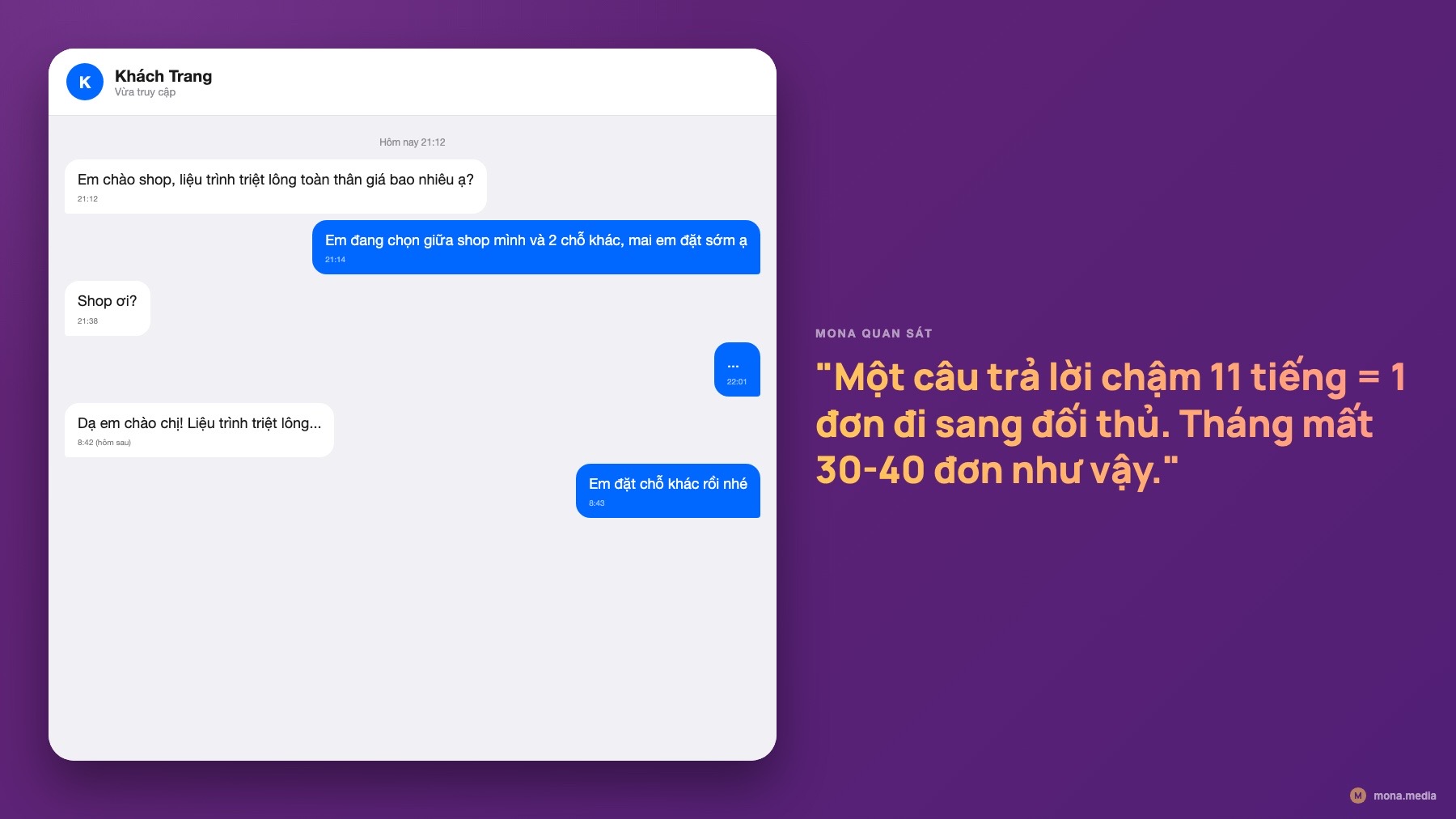
The clearest pain, where money leaks out of the customer service team, is customers arriving when the office is closed. Mid-market customer service teams usually run 8 am to 5 pm. Vietnamese customers mostly message between 7 pm and 11 pm, after work and before bed. In that golden 6-hour gap, if nobody answers, the customer walks away.
MONA once measured this for an F&B client with 35 branches: 28% of incoming messages arrive outside working hours. Of those, 41% of customers ask about prices or book a table, with intent to buy within 24 hours. If they are not answered until the next morning, half of them have already gone to a competitor.
Try a quick calculation. An F&B chain of 35 branches, average order 280 thousand VND, 200 online orders a day. 28% outside hours is 56 orders. 41% with intent to buy within 24 hours is 23 orders. Half going to a competitor is 11 lost orders a day. In a month, 330 orders lost. That works out to 92 million VND of revenue leaking every month just because customer service does not cover 24/7.
Do we really want 92 million VND to flow out every month for the reason “customer service goes home at 5 pm”? We do not think so. A customer service AI Agent is the natural way to plug this leak.
You are paying 60-100 million VND a month for 8-12 customer service staff, covering day shifts, evening shifts, weekend duty, holiday duty, plus a team lead managing 4 shifts. And it is not only the money. MONA knows you have tried many things (buying a cloud call center at 30-50 million VND a month, hiring an outsourced night-shift service company at 80-120 million VND a month for 4 fixed shifts, running a 3-month standard script training for new hires, setting a KPI of replying within 5 minutes with a 3 million VND monthly bonus, pushing a “customer first” culture, hoping the team treats every customer message like their own paycheck). But it did not work. All that effort could not bring the share of customers lost after the 5:01 pm clock-out below 30%. One team lead is a drop in the ocean when every night 280-500 Zalo messages, 100-200 Messenger messages, 50-100 missed calls and 30-60 TikTok comments arrive at the same time. One team lead cannot manage 4 shifts, train people, handle complaints and write reports all at once.
Hiring 4-6 more night-shift staff, switching to a better cloud call center, or hiring an outside night-shift service are all not the root fix. What you need is a technology solution: a layer of AI Agent that answers 70-80% of level 1 and 2 questions by itself across Zalo, Messenger, web chat and TikTok 24/7, pushes hard cases to people at level 3, and reduces dependence on people. That leaves 2-3 dedicated staff working alongside the system, instead of hiring a whole crowd of night-shift staff only to hire again 4 months later. For the phone channel specifically, which flow to hand over and which architecture to use so you do not burn money for nothing, we go through it in detail in the article AI call center.
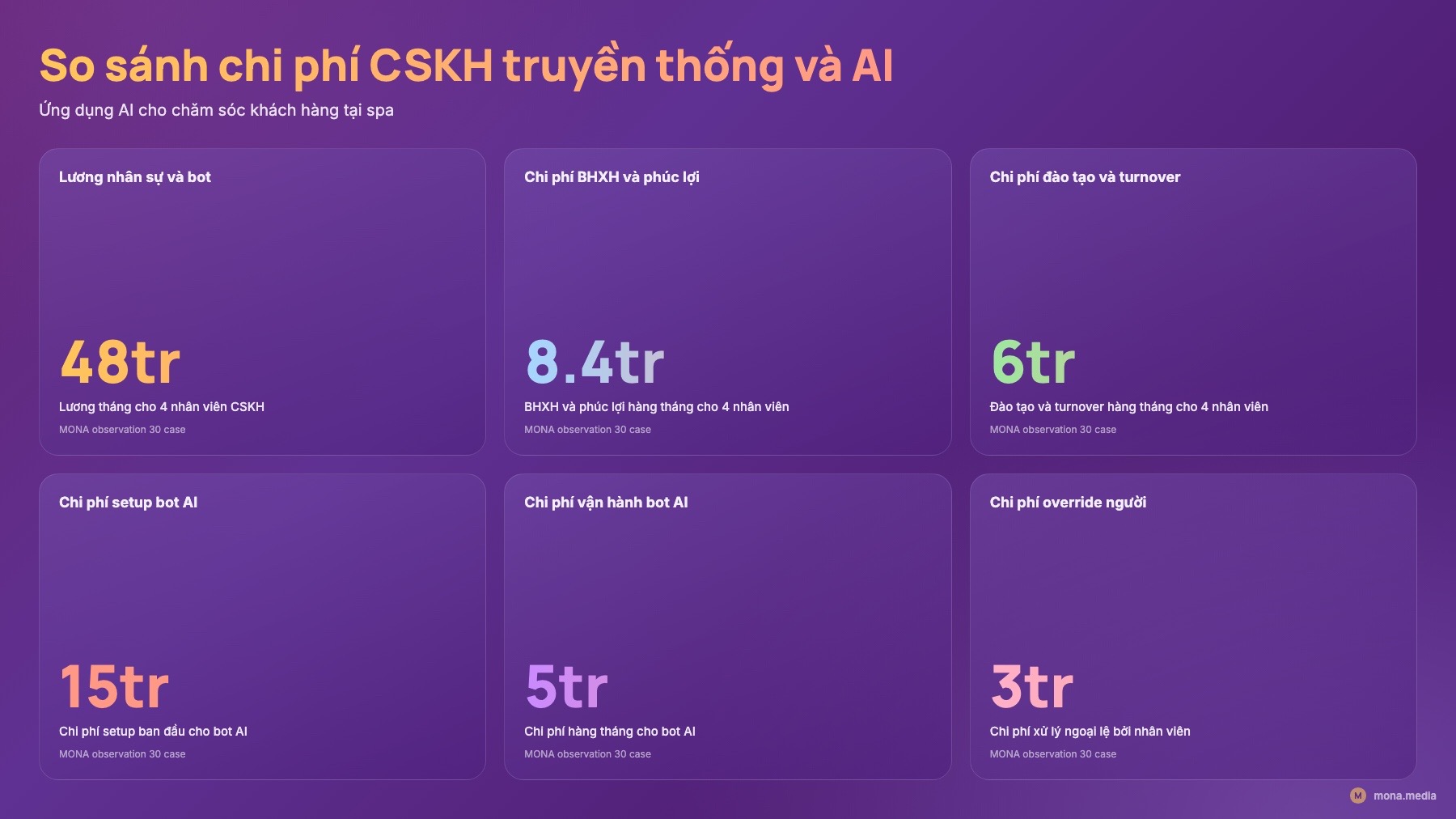
You care about numbers. We break it down clearly.
A traditional mid-market chain's customer service team has 4 staff, each paid 12 million VND, for a total payroll of 48 million VND a month. With insurance and allowances, the real total cost is about 58 million VND a month. Four people cover 2 shifts during working hours, but not evenings and Sundays.
Rolling out a customer service AI Agent takes over level 1 and most of level 2. The all-in software cost depends on scale, from 280 to 600 million VND one time. Running costs are 5-15 million VND a month depending on message volume. The team can shrink from 4 to 1 person to handle level 3. Salary 18 million VND (a step up because the job needs higher skills). Total running cost falls to 23-33 million VND a month from 58 million VND.
Direct savings are 25-35 million VND a month. The software pays back in 11-18 months. More important, revenue leaking outside working hours gets plugged. We estimate an extra 40-90 million VND of revenue a month depending on scale. Added together, the real value is 65-125 million VND a month.
See also chatbot software and using AI in sales to see how MONA combines customer service and sales into one seamless flow.
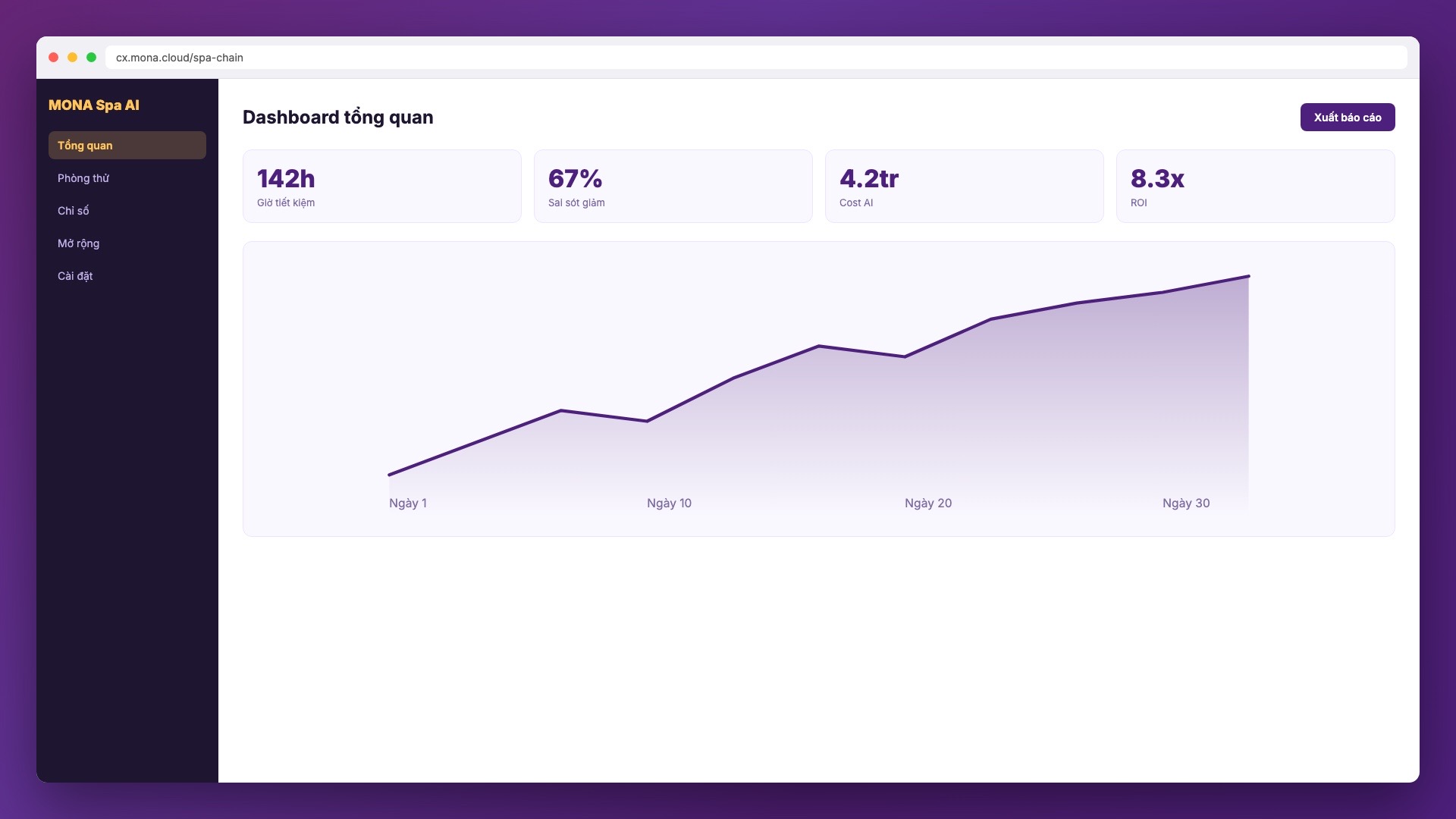
We describe MONA's spa client, a chain of 28 branches in Ho Chi Minh City, Hanoi and Da Nang, with revenue of 52 billion VND a month and a customer service team of 4 with a total payroll of 56 million VND.
Before rolling out AI for customer care, their process ran like this. The 4-person customer service team split into 2 shifts, covering 8 am to 10 pm. On weekends and after 10 pm nobody answered. After-hours messages averaged 320 a day, and most were ignored until morning. A customer asking about the same service on Zalo and Facebook got two different prices from two different staff.
MONA deployed 3 AI modules for customer care in 8 weeks. A customer service AI Agent answering level 1 and level 2 on 6 channels. A Vietnamese callbot for the hotline. A smart handover layer that passes cases to staff when needed. Software cost 420 million VND all-in, with running costs of 12 million VND a month.
After 6 months of operation, the customer service team went from 4 people to 1. The remaining person was upgraded to a specialist handling complaints and VIP customer relations, with salary rising from 12 to 22 million VND. Total customer service cost fell from 56 million VND to 23 million VND, saving 33 million VND a month.
More important than the numbers, the customer service AI Agent covers 24/7. The share of messages answered within 5 seconds rose from 34% to 96%. Online booking revenue grew 28% in 6 months by filling the after-hours gap. Customers leaving the chain after an unhandled complaint dropped 47%.
The spa chain's leadership told MONA this. Before, customer service was the department they dreaded checking the numbers for, because customers always complained about missed messages. Now it is the department they are proud to show numbers from to the board.
Readers of this article tend to split into 2 groups. Group 1 is long used to customers dropping off at 5:01 pm, 280 Zalo messages piled up on Monday morning, and the call center dying whenever the night staff is off. They have given up looking for a solution, accepted that “Vietnamese customers are just demanding”, and treat it as a “just how the service industry is”. Group 2 is the newer owners, or those who, even after 10 or 20 years in business, never stop looking for solutions. They keep an ear out for Vietnamese multi-channel AI Agents across Zalo, Messenger and TikTok that hand level 3 cases to people automatically, so that when the solution appears they bring it in and roll it out decisively, shocking the old team lead and customer service team all at once. MONA (we are business people just like you, MONA has a team of dozens of professionals and has already covered its own customer service with software we wrote ourselves) belongs to group 2, and we are completely confident we can bring a solution to those of you in group 2. What you need is now only a 45-minute call away. And it is free. MONA's specialists will deliver for you, regardless of business model, regardless of your current state (1 branch or 50 branches, a young customer service team or an older one, not tech-savvy or very tech-savvy, never used a cloud call center or already gone through 3 generations of customer service software, running a spa chain or an e-commerce business with 5,000 orders a day). In every case we have a solution. Because this is already the 10th year MONA has brought automation and software to business owners in Vietnam. Email info@themona.global or book a 45-minute call through the mona.media website.
For AI to answer up to level 3, data must flow into one place: orders, inventory and customer history live in sales management software, and the storefront is a web store with AI on duty — once the two ends are connected, the bot can answer “is it in stock, when does it arrive” in place of a person.
We have to be frank. Not every customer service team should roll out a virtual assistant right away. There are 3 cases where MONA usually advises clients to think twice.
One is a premium service business whose customers expect to be served by a person. For example, luxury real estate chains, personal financial services, high-end one-on-one spas. A customer who gets an answer from a virtual assistant may feel brushed off. In this case MONA suggests using AI as an assistant to staff, not facing the customer directly.
Two is a business with complex products that need in-depth advice. For example medical devices, industrial machinery, B2B software. Customer questions often stray far from level 1, so a virtual assistant cannot carry much. Here it is better to invest in training the customer service team instead of rolling out a virtual assistant.
Three is when current customer service staff strongly resist. If a virtual assistant is rolled out without staff on board, even a good one will fail. You need careful internal communication before rolling out. Explain clearly that a customer service AI Agent does not replace people, it only takes the easy part.
We built the customer service AI Agent in a modular structure, not tied to spas. With the same set of modules, only the knowledge and processes customized, it can run for 6 neighboring industries later, all mid-market clients MONA has served or is serving.
Is your industry on the list above? If not, message us. MONA will analyze the customer service team of your specific industry and work out which AI for customer care to roll out first. See the details in the AI First handbook for businesses.
If this article makes sense to you, MONA suggests the following 90-day roadmap. In the first month, pick 1 channel with the most messages, usually Zalo OA, and roll out an automatic Zalo virtual assistant for level 1. In the second month, expand to Messenger and web chat and connect the CRM so the virtual assistant can answer level 2. In the third month, add the Vietnamese callbot and the handover layer for level 3 complaints.
MONA's software is written in modules, so you can start small, measure results and expand gradually. We have done it this way for 30+ regular clients. Not one client has had to invest more than 600 million VND in customer service without seeing payback within the first year.
For the big picture, read the article Applying AI in business and the MONA case study showing how MONA fully automated 30 businesses. See the glossary at AI First and the 2026 enterprise AI glossary.
You can learn more about the platforms MONA uses to build AI Agents at What is Claude AI, what ChatGPT is. When you want to build the CRM part that connects to the AI Agent, see CRM software design and AI for marketing teams.
Other foundational glossary pages: what AI is, What is AI First, What is AI Native, What is Generative AI, What is AI automation, What is marketing automation, digital transformation, What is a prompt, mistakes CEOs make when buying AI.
For an outside perspective, see the report by McKinsey State of Customer Care and Stanford AI Index. We only take the parts that fit the Vietnamese mid-market.
The MONA ecosystem for your reference: Mona Software for custom software, Mona Host for the server infrastructure that runs AI Agents, SkillHub MONA for training your customer service team to move into handling level 3, Khánh Hùng Academy for leadership to upgrade their service management thinking. If your chain also needs order management and booking software, we have MONA eCommerce and spa software, just contact us.
One last question we want to leave you with. What do you want your customer service team to look like in 2027? A customer service AI Agent answering 24/7 on 6 channels, one specialist handling VIP complaints, and a data dashboard for the board to check daily. Or still 4 staff rotating shifts, still missing 9 pm messages, still losing customers to competitors.
AI for customer care is not meant to replace the customer service team. It is meant to turn the remaining team into high-value specialists. MONA has deployed AI for customer care for 30+ regular clients. Each one is covered 24/7 across multiple channels, saving 30-50% of customer service costs while customer satisfaction goes up. Are you ready to open a new chapter for your customer service team? We are ready to sit down with you, look at where your customer service team stands, and recommend which AI for customer care to roll out first. Message MONA any time.
Vietnamese AI in 2026 already understands 90% of regional slang. It is trained for another 2-4 weeks on 500-1,000 conversations from your own business. MONA always fine-tunes with the vocabulary of the spa, F&B and education industries before going live.
It is possible if you let the virtual assistant answer 100% of messages. MONA sets a rule to hand over to a real person if the customer asks twice and the virtual assistant does not understand. Or when a hot keyword like complaint or cancel an order appears. This keeps 24/7 speed without losing angry customers.
Yes. MONA writes an integration layer for most popular CRMs in Vietnam, such as Bitrix, Hubspot, Salesforce, MISA AMIS and Base CRM. If you use a custom CRM, we write the connector in 2-3 weeks.
The rules MONA uses: hand over to a person when the order value is above 10 million VND, when the customer uses words like complaint or cancel, when the virtual assistant does not understand after 2 turns, or when the conversation goes past 8 turns without a resolution. The average handover rate is 12-18% of all conversations, and the virtual assistant closes the rest successfully on its own.
For the 28-branch spa chain MONA worked with: 350 million VND setup, 28 million VND a month to run. It paid back in 7 months by keeping 120-150 orders a month that used to be lost between 5 pm and midnight. We give the details after a 90-minute audit. See the details in the AI First handbook for businesses.
What makes call center work hard isn't talking well, it's being on-call: you can sit idle for 8 hours, as long as the phone is picked up within 2 seconds of ringing, and on time across phone, Messenger, Zalo, and website chat all at once. That's very hard for a person, and machines are made for exactly that. MONA is running this for real on its own call center 1900 636 648. Details in AI auto-reply chatbot and AI Agent telesales.
If you want to understand the groundwork behind this in more depth, the article what agentic AI is and how businesses use it explains it in detail and describes how we do it for our clients.

CEO & Founder · The MONA
The founder of The MONA built a service company of 60+ staff with 14,000+ projects delivered. Khánh Hùng shares his thinking on building self-running systems, automating a business, and the real lessons behind MONA's projects.
 406




Professional website
design services
Own a website with a beautiful, 100% exclusive design and a lifetime warranty, with the ability
to expand features flexibly as your business grows, starting today!






 MONA will never sell your information or send you spam


 MONA will never sell your information or send you spam
