
 MONA OS 2.0
 Hợp tác với MONA


 Tự động hoá doanh nghiệp
 Cẩm nang SEO
 Digital Marketing
 Kinh nghiệm thiết kế website
 Hạ Tầng Server
 Giáo dục


 VI
 EN

















Message us on
Zalo Official


 ProductsNew

 ProductsProducts
 Mới ra mắtKHA AI 2027App tự edit video, tự đăng mọi mạng xã hội, 2 phút mỗi ngày










 Thiết kế websiteVừa đẹp vừa thuyết phục được khách.
Dịch vụ SEOKéo về khách đang tìm đúng thứ anh chị bán.
 Tư vấn digital marketingKéo khách từ nhiều kênh, đo bằng số thật.
Quay video doanh nghiệpVideo giới thiệu công ty, nhà xưởng, đội ngũ.
 MớiDựng video AIDựng phim câu chuyện công ty bằng AI.
 Custom software developmentCRM, ERP and HRM built for your business.
 Viết AI Agent theo yêu cầuĐặt riêng một trợ lý AI cho đúng việc của mình.
 Tư vấn chuyển đổi AIĐưa AI vào vận hành của cả công ty.
NewMONA LMSManagement for centers and schools.
MONA SkillHubInternal training for company staff.
 NHTQ systemEnd-to-end China–Vietnam shipping operations.
MONA JMSManagement for gold, diamond and pawn shops.
 MONA E-LearningA website with every feature you need to sell courses.
 How to sell online courses (course)More than 30 free lessons on selling courses on autopilot.
 MONA Cloudmonacloud.vnServers to get your apps and websites running.
 MONA Basemonabase.vnPostgres database, sign-in and file storage.
 MONA Mailmonamail.vnSend OTP, order and invoice emails from your software.
 MONA Paymonapay.vnAccept bank transfers via VietQR and notify your software when the money arrives.
 MONA eInvoiceComing soonIssue e-invoices that meet tax standards.
Gấu CườiTrả lời khách 24/7 trên web, Fanpage, Zalo và thu lead cho sale.
 Gấu TeleSalesGọi điện tư vấn, chăm khách như tổng đài viên thật.
Dê CườiTư vấn và chốt đơn cho shop ngay trong khung chat.
Gấu WebmasterNhắn nhóm Zalo là website được sửa xong.
 Gấu Pháp ChếSoạn hợp đồng, rà điều khoản trong vài phút.
 Gấu Báo GiáLên báo giá đúng mẫu và gửi khách ngay.
 AI chăm sóc khách hàngTheo dõi và giữ chân khách hàng cũ.
 Gấu Tuyển DụngLọc hồ sơ, hẹn lịch, phỏng vấn ứng viên.
 Mới ra mắt
KHA AI 2027
Xây kênh chuyên gia 2 phút mỗi ngày
Quay bằng điện thoại, AI tự edit video, tự đăng lên 16 nền tảng và tự trả lời bình luận, tin nhắn.
869.054lượt xem trên kênh CEO MONA sau 34 ngày
 Anh Khánh HùngCEO MONA đang dùng mỗi ngày
Xem app làm được gì
 AI
Gấu Cười MONA ĐANG TỰ XÀITrả lời khách 24/7 trên website, Zalo OA, Messenger và thu lead về cho sale.
Dê CườiChốt đơn bán lẻ và sàn: Shopee, TikTok Shop, web. Chăm cả khách sỉ, đại lý.
Gấu WebmasterCập nhật nội dung, tối ưu SEO website mỗi ngày.
Gấu TeleSalesGọi điện tư vấn, chăm khách như tổng đài viên thật.
Gấu Tuyển DụngLọc hồ sơ, hẹn lịch, phỏng vấn ứng viên tự động.
AI chăm sóc khách hàngGiữ khách cũ, cứu lead đã rớt cho phòng kinh doanh.
Gấu Pháp ChếSoạn hợp đồng, rà điều khoản trong vài phút.
Gấu Báo GiáLên báo giá đúng mẫu, gửi khách ngay khi có yêu cầu.
 Chuyển đổi AI toàn phầnGiải pháp tổng cho doanh nghiệp, 3 lớp triển khai.
 Viết AI Agent theo yêu cầuĐặt riêng một con AI gánh đúng nghiệp vụ của bạn.
 Custom softwareCRM, ERP and HRM with built-in AI automation.
 SEO & AEO thời đại AIĐược Google lẫn AI trích dẫn, không chỉ xếp hạng.
 Kiến thức AI cho doanh nghiệpBài phân tích, hướng dẫn ứng dụng AI vào vận hành.
 Free AI courses
 AI tools at work
App mới · KHA AI 2027
Xây kênh 2 phút mỗi ngày
AI tự edit video, tự đăng mọi mạng xã hội
Free consultation, 8am–10pm every day

29 May, 2026

Founders and marketing directors, we at MONA wrote this article to share things straight AI for marketing teams at a level that really works in 2026. No theory, no chasing trends. We have used it ourselves for MONA's own marketing operation and shared it with about 30 close clients, cutting roughly 60-70% of marketing team costs, with output up 4-8 times. This article covers 10 specific tasks where marketing teams burn the most money, with the best tool for each in 2026, sample prompts and measured real results. After reading, you will think “this really works”, rather than just skimming past.
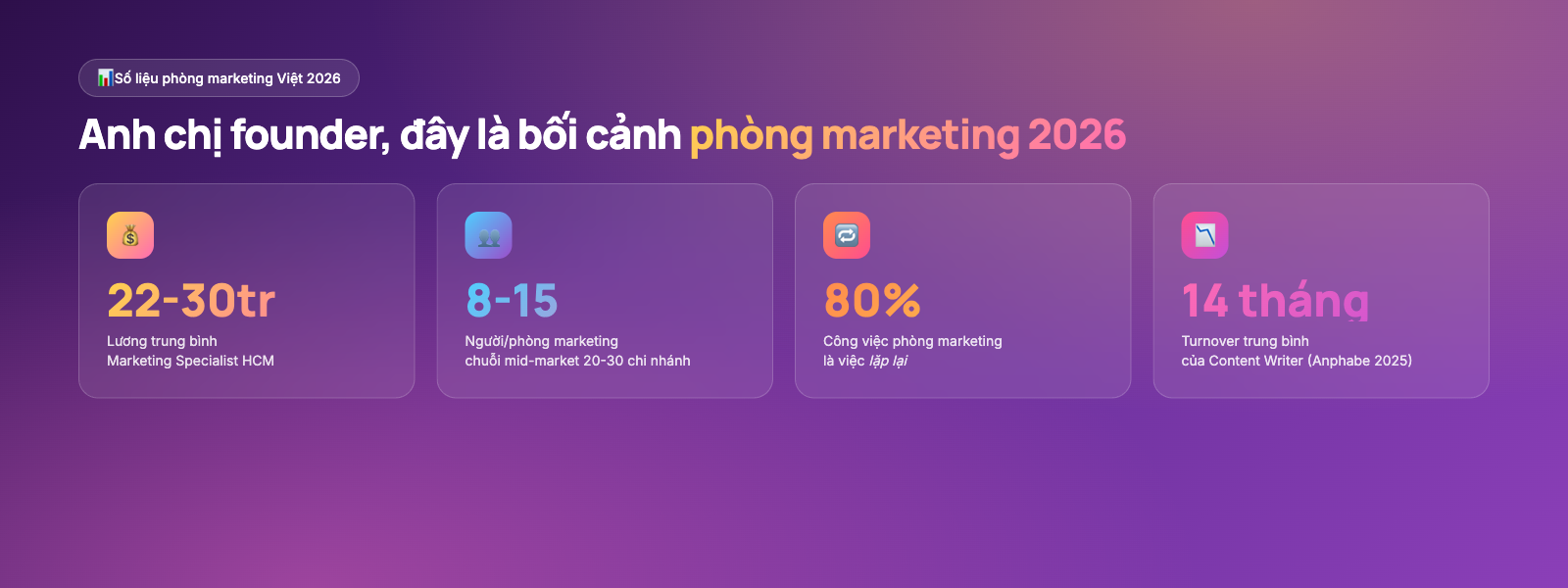
Before getting into tools, here are a few numbers so you can picture the context:
You may know this scene: you just finished training a strong content writer, and 3 months later they leave for a competitor and take the templates and brand voice doc with them. Their salary was 25 million VND/month, six months of training, and gone. We understand.
We need a different answer: not “hire more marketers” but “hand the repetitive work to automation software”. That is the whole point of this article.
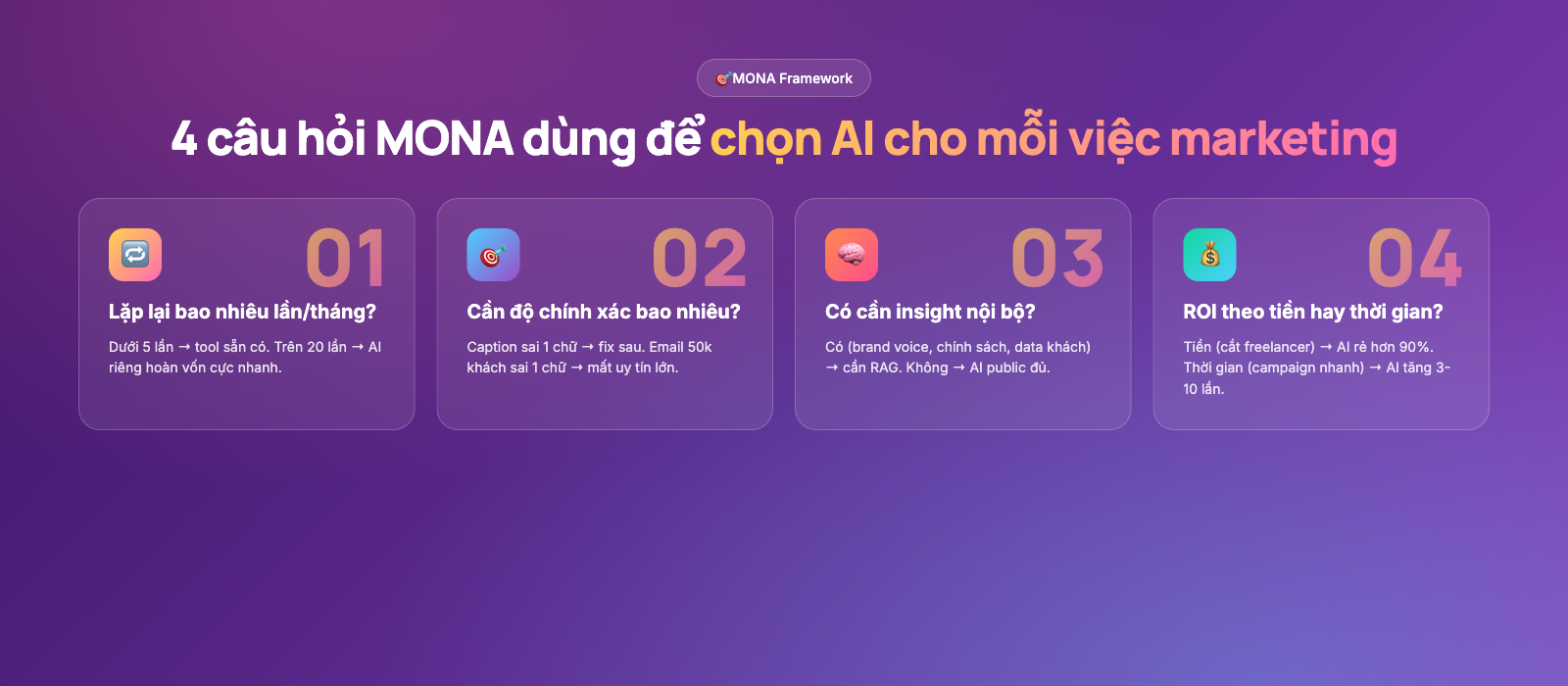
Before bringing AI into any task, we ask 4 questions, and you should ask the same:
OK. Now the 10 specific tasks.
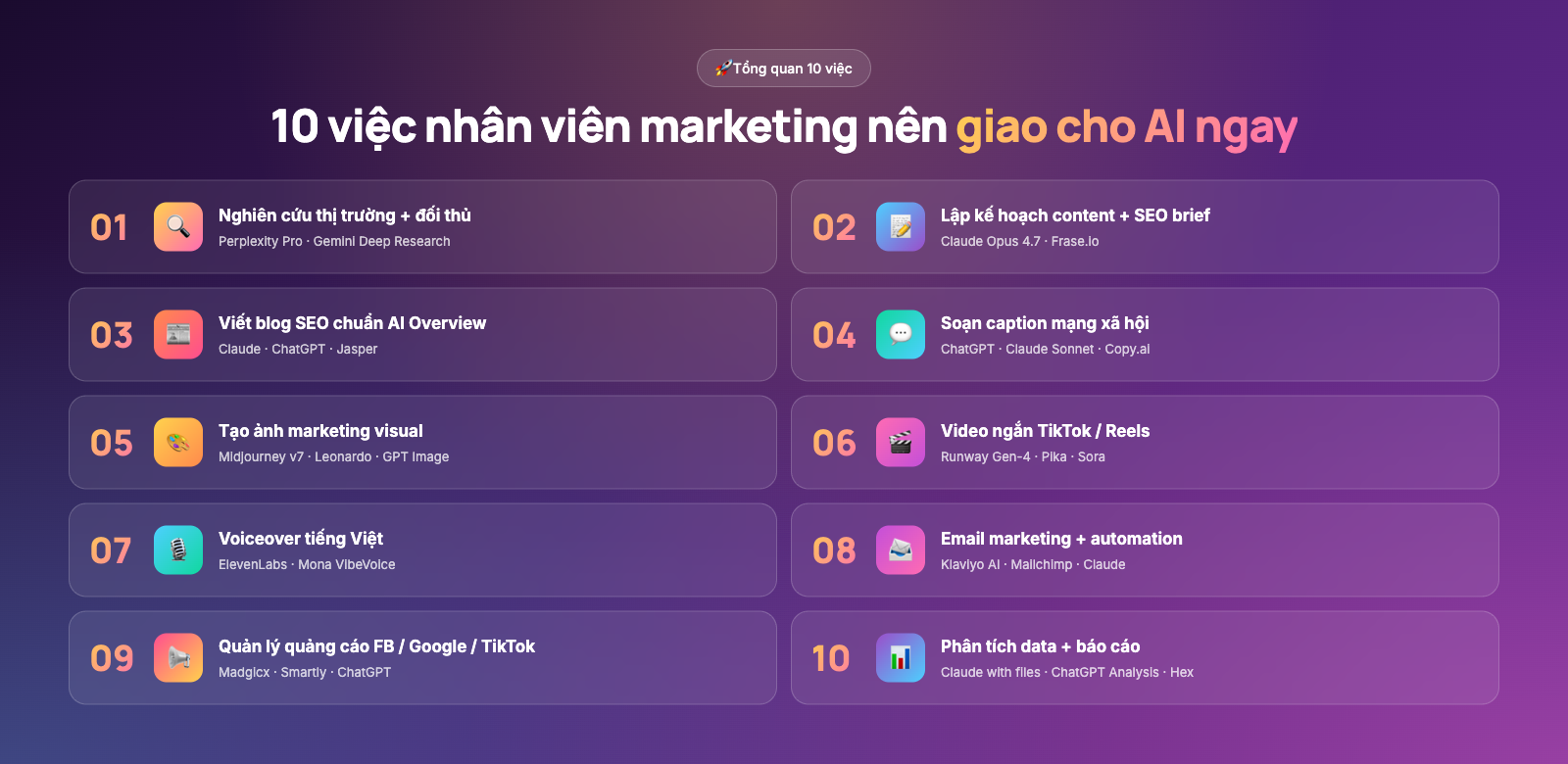
We ordered the 10 tasks along the marketing team's flow, from market research to the month-end report. Each task has:
The task: A Senior Marketing person at 35 million VND/month typically spends 1 day a week reading industry reports, checking what new products competitors launch, tracking prices and tracking ads. Sometimes it takes 3 days in a row just to write one 20-page benchmarking report.
Tool top 1: Perplexity Pro (~20 USD/month): AI search with cited sources; its Deep Research mode browses hundreds of pages in 5 minutes.
Alternative tool: Gemini Advanced with Deep Research mode (~20 USD/month) or read more about Perplexity AI.
How to use it: sample prompt:
“Give me a detailed report on the [industry/niche] market in Vietnam, updated to 2025-2026. Include: (1) Market size and growth rate. (2) Top 5 largest companies with estimated market share. (3) Hot service/product trends. (4) Notable marketing strategies of the top 3 brands. (5) End-customer pain points commonly mentioned in reviews/forums. (6) Opportunities and risks for a new mid-market chain entering. Cite all sources clearly.” See more in our practical guide to the AI First roadmap in Vietnam.
Real result: 30 minutes instead of 8 hours. You get 15-25 specific cited sources to fact-check. At MONA we run an industry benchmarking report every 2 weeks, at almost zero cost.
When not to use it: Your company's internal information (AI does not know it) or paywalled data (Statista, Euromonitor, which Perplexity cannot access).
The task: A Content Planner at 28 million VND/month needs 4-6 hours to write one proper brief for a writer: target keyword, H2-H3 outline, questions to answer, internal link suggestions, length and tone.
Tool top 1: Claude Opus 4.7 (~20 USD/month Pro): a 1M-token context window is enough to feed in the whole current website plus the brand voice doc plus competitor content, then produce a brief.
Alternative tool: Frase.io (~45 USD/month) or SurferSEO, which build content briefs automatically from the SERP.
How to use it: sample prompt:
“I am building content for the website [name + industry]. Target audience: [details]. Brand voice: [definition or upload doc]. Next article topic: ‘[main keyword]’. Write a detailed content brief: (1) Search intent of the keyword. (2) H2 + H3 outline with SEO priority. (3) 5-8 specific questions the article must answer. (4) Internal link suggestions from the URL list I attached. (5) Suggested length + reason. (6) 3 angles that differ from the top 5 articles ranking on Google for this keyword.”
Real result: 30 minutes per brief instead of 4-6 hours. At MONA we use it for content clusters AI marketing and write 8-12 SEO articles per week from proper briefs instead of 2-3.
When not to use it: Founder essays or thought leadership that need a personal viewpoint: AI output gets “generalized”.
The task: A writer at 22 million VND/month takes 1-2 working days to write one 2,000-3,000 word article. They have to research, write, optimize SEO, write the meta and add internal links.
Tool top 1: Claude Opus 4.7 with a 1M-token context window, enough to feed the brief, brand voice and 10 reference articles at the same time.
Alternative tool: ChatGPT GPT-5 (~20 USD/month) or Jasper (~49 USD/month) with ready-made SEO templates.
How to use it: a 3-step pipeline:
Real result: 1-2 hours per article instead of 1-2 days. We use this pipeline for every SEO article on mona.media, and this article is proof. To reach the standard AI Overview ready you need one last step: optimize schema + an answer-first paragraph (read more What is AI SEO). MONA has documented it in full in the article on AI replacing HR for 12 routine tasks.
When not to use it: Expert thought leadership articles need real cases and real founder quotes. AI-written ones will be generic.
The task: A social copy team of 3-5 people writes 30-50 captions a week × 4-6 platforms = 200-300 captions a week. Tone differs by platform. Team salary is 60-100 million VND/month.
Tool top 1: ChatGPT GPT-5 Plus (~20 USD/month) for 80% of regular captions.
Alternative tool: Claude Sonnet (~3-15 USD per M tokens via API, super cheap for large volume), Copy.ai (~36 USD/month).
How to use it: sample prompt:
“My brand voice: [3-4 sentences of description + 2 old caption examples]. Product/service: [details]. Generate 10 caption variants for Facebook about ‘[specific topic]’. Each caption: a strong hook in the first 8 words, under 150 words, ending with a soft CTA or an open question. Tone: friendly, not salesy. DO NOT use ‘best’, ‘number 1’, or too many emojis. Write in Vietnamese with correct diacritics.”
Real result: 200 captions a week done in 4 hours instead of 4 days. A team of 3 drops to 1 (2 move to strategy + community). Saves 40-60 million VND/month.
When not to use it: Crisis communication captions, apology messages to customers and sensitive announcements must be written by the founder/CMO by hand.
The task: A freelance graphic designer charges 500k-2 million VND per visual. A 1-month campaign needs 80-150 images = 40-300 million VND for visuals alone.
Tool top 1: Midjourney v7 (~10-60 USD/month) for photoreal images and high-quality concept art.
Alternative tool: Leonardo AI (~12-60 USD/month) for character consistency + custom models, ChatGPT GPT Image (via Plus subscription) for quick mockups + images with Vietnamese text.
How to use it: workflow:
Real result: One visual costs 5-15 USD (~120-360k VND) instead of 500k-2 million. Speed is 5 minutes per image instead of 1-2 days. At MONA we cut the visual budget from ~80 million VND/month to ~6 million VND/month for the same output.
When not to use it: Images with a real person as spokesperson, or pharma and medical images that need anatomical accuracy.
The task: A freelance video producer charges 5-15 million VND per 30-second clip. A 30-day campaign needs 30-60 clips = 150-900 million VND for video alone.
Tool top 1: Runway Gen-4 (~15-95 USD/month) for high-quality 5-10 second clips with sharp control.
Alternative tool: Pika 2 (~10-58 USD/month), OpenAI Sora (via ChatGPT Plus/Pro subscription) for a cinematic feel, HeyGen (~24-89 USD/month) for talking-head avatars.
How to use it: workflow:
Real result: 300k-1 million VND per 30-second clip instead of 5-15 million. Speed is 2-4 hours per clip instead of 3-5 days. A 30-clip campaign gets done in 1 week instead of 1 month.
When not to use it: High-end cinematic video for premium brands, real talking-head spokespeople, or documentary-style video that needs factual accuracy.
The task: A voice talent charges 500k-2 million VND per minute of voice. A 30-minute lecture video or podcast = 15-60 million VND for voice alone. Finding a good voice is hard, booking is far in advance, and any mistake means re-recording from the start.
Tool top 1: ElevenLabs (~5-99 USD/month): accurate voice cloning, with fairly good Vietnamese support since v3.
Alternative tool: Mona VibeVoice a product we built for Vietnamese clients: clone the voice of a founder or spokesperson, with native Vietnamese and correct tones, running locally (data does not leave your machine, suited to premium brands).
How to use it:
Real result: 30 seconds to generate vs. 1-2 days to book a talent. Cost is almost zero after setup. At MONA we use it for all internal training voiceovers and client podcasts, cutting 100% of voice talent costs.
When not to use it: TV commercials with celebrity endorsement, or high-creative projects that need complex emotion (laughing, crying, breathing…).
The task: An email marketer at 28 million VND/month spends 1-2 days per campaign: writing subjects and body, A/B testing, segmenting, setting up automation flows. A 7-day welcome series + abandoned cart flow + reactivation takes 2 weeks.
Tool top 1: Klaviyo (Free to $60+/month) with built-in AI Subject Line + AI Predictive Analytics.
Alternative tool: Mailchimp + AI extension, HubSpot Marketing Hub with Breeze AI, or combine Claude/ChatGPT to write the body and keep your existing ESP (Email Service Provider).
How to use it: sample prompt:
“I am building a 7-email welcome flow for new newsletter subscribers of [industry/brand]. Brand voice: [definition]. Goal at the end of the flow: convert to paying customers. Write for me: (1) Subject + preview text for each email, 3 variants per email for A/B testing. (2) Body for each email, 200-300 words, with an opening hook + 1 main value + 1 closing CTA. (3) Suggested sending frequency. (4) Trigger conditions for each email.” MONA has documented it in full in the article how salespeople use AI to close faster. MONA has documented it in full in the article on AI invoice extraction and bookkeeping. MONA has documented it in full in the article on AI replacing HR for 12 routine tasks.
Real result: A 7-email flow done in 2 days instead of 2 weeks. Average open rate up 25-40% thanks to AI Subject Line. At MONA we use this pipeline for every email flow, cutting time by 70-80%. This part connects with how salespeople use AI to close faster which MONA has covered in more depth. This part connects with AI invoice extraction and bookkeeping, which MONA has covered in more depth.
When not to use it: Transactional email (password reset, order confirmation), legal email, or sensitive notices. Devs/legal must review.
The task: An ad manager at 25-40 million VND/month runs 5-10 campaigns at once. Each campaign has 30-50 ad creatives + ad copy variants. Spend is 100-500 million VND/month. Daily optimization and A/B testing take a lot of time.
Tool top 1: Madgicx (~55-129 USD/month) for Facebook + Instagram ads: auto bid optimization, AI creative analyzer.
Alternative tool: Smartly.io (enterprise pricing), Revealbot, or a workflow with ChatGPT generating copy variants + manual bid management for small budgets.
How to use it: workflow:
Real result: ROAS (Return on Ad Spend) up 20-40% because AI finds winning combinations faster. Campaign management time down 50-60% (the ad team needs 1 person instead of 2-3).
When not to use it: Large strategic campaigns (brand launch, IPO, M&A communication) still need a human Senior Strategist. AI does execution, people do strategy.
The task: A Marketing Analyst at 30 million VND/month spends 2-3 days per monthly report: pulling data from 5-8 sources (FB Ads, Google Ads, GA4, CRM, Klaviyo…), building Excel pivot tables, drawing charts and writing insights.
Tool top 1: Claude with direct CSV file upload (Pro tier); a 1M-token context is enough to load several months of data at once.
Alternative tool: ChatGPT Advanced Data Analysis (~20 USD/month Plus), Hex (data tool with AI chat, ~30 USD/seat/month), or Looker Studio with an AI extension.
How to use it: sample prompt:
“I am uploading 3 CSV files: (1) facebook_ads_oct2025.csv, (2) google_ads_oct2025.csv, (3) shopify_revenue_oct2025.csv. Please analyze: (1) Which channel performs best by CAC and LTV. (2) Top 5 campaigns by ROAS and the bottom 5. (3) Revenue trend by day of week and hour of day. (4) 5 insights I can act on next week. (5) Draw charts with matplotlib code I can copy and run. Format: a Markdown report with clear headings, no longer than 1500 words.”
Real result: 30 minutes per monthly report instead of 2-3 days. Insight quality is comparable to a senior analyst. At MONA we automate weekly reports for all our close clients, sent to the founder on Zalo every Monday at 8am.
When not to use it: Analysis with complex business context (e.g. “why did Q3 drop”, which requires knowing about a confidential M&A negotiation): AI does not know → wrong conclusion.
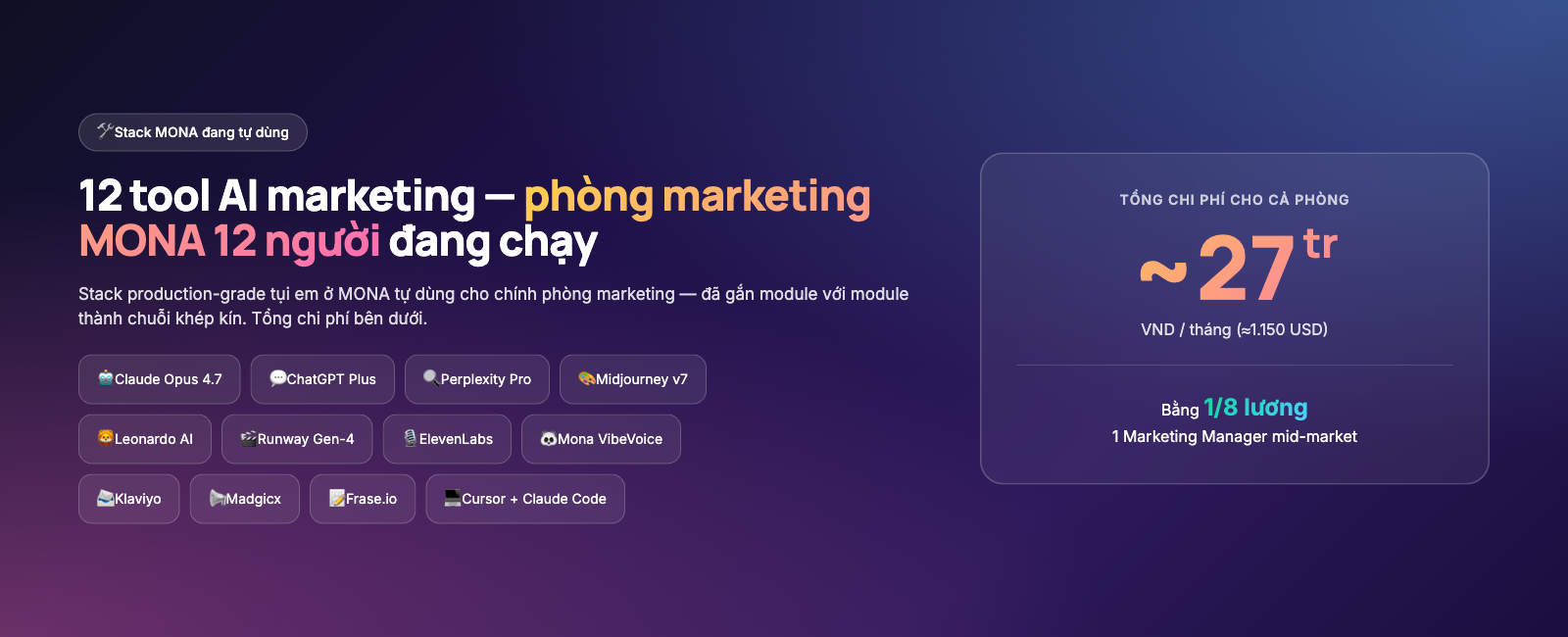
We do not just advise, we use it ourselves. This is the current stack of the MONA Group marketing team of about 12 people, costing ~1,150 USD/month (~27 million VND) for the whole team, equal to ~1/8 of one Marketing Manager’s salary:
| Tool | Used for | Price/month |
|---|---|---|
| Claude Opus 4.7 Pro | Briefs, writing, analysis, complex prompts | 20 USD × 3 seats = 60 USD |
| ChatGPT Plus | Caption, ad copy, image gen quick | 20 USD × 4 seats = 80 USD |
| Perplexity Pro | Market + competitor research | 20 USD × 2 = 40 USD |
| Midjourney | Hero visual, banner cinematic | 60 USD × 1 = 60 USD |
| Leonardo AI | Character consistency cho mascot panda MONA | 60 USD × 1 = 60 USD |
| Runway Gen-4 | Video clip 5-10s cho social | 95 USD × 1 = 95 USD |
| ElevenLabs Creator | Voiceover internal + training | 22 USD × 1 = 22 USD |
| Mona VibeVoice | Brand-safe Vietnamese voice cloning | self-host (0 USD) |
| Klaviyo | Email marketing + automation | ~150 USD/month, enterprise tier |
| Madgicx | Managing FB/IG Ads | 129 USD/month |
| Frase.io | Content brief SEO + AI Overview tracking | 45 USD/month |
| Cursor + Claude Code | Building internal landing pages | 40 USD × 2 = 80 USD |
| Total | ~1,150 USD/month ≈ 27 million VND | |
See, the software costs 27 million VND/month for a whole marketing team. A single marketing manager earns 50-80 million VND/month. The question is not “should we use AI” but “do you dare redesign your marketing team around this stack”.
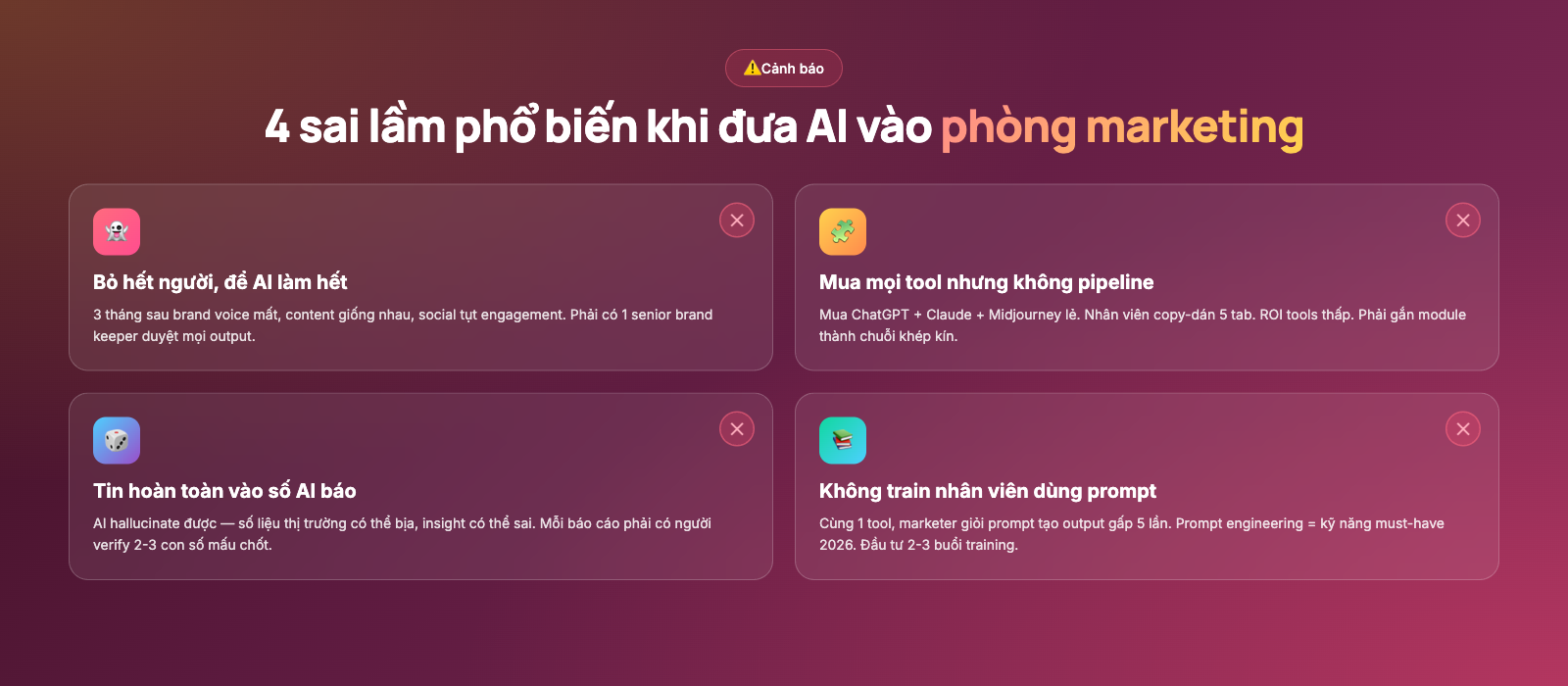
Straight from MONA’s experience and 30 close clients:
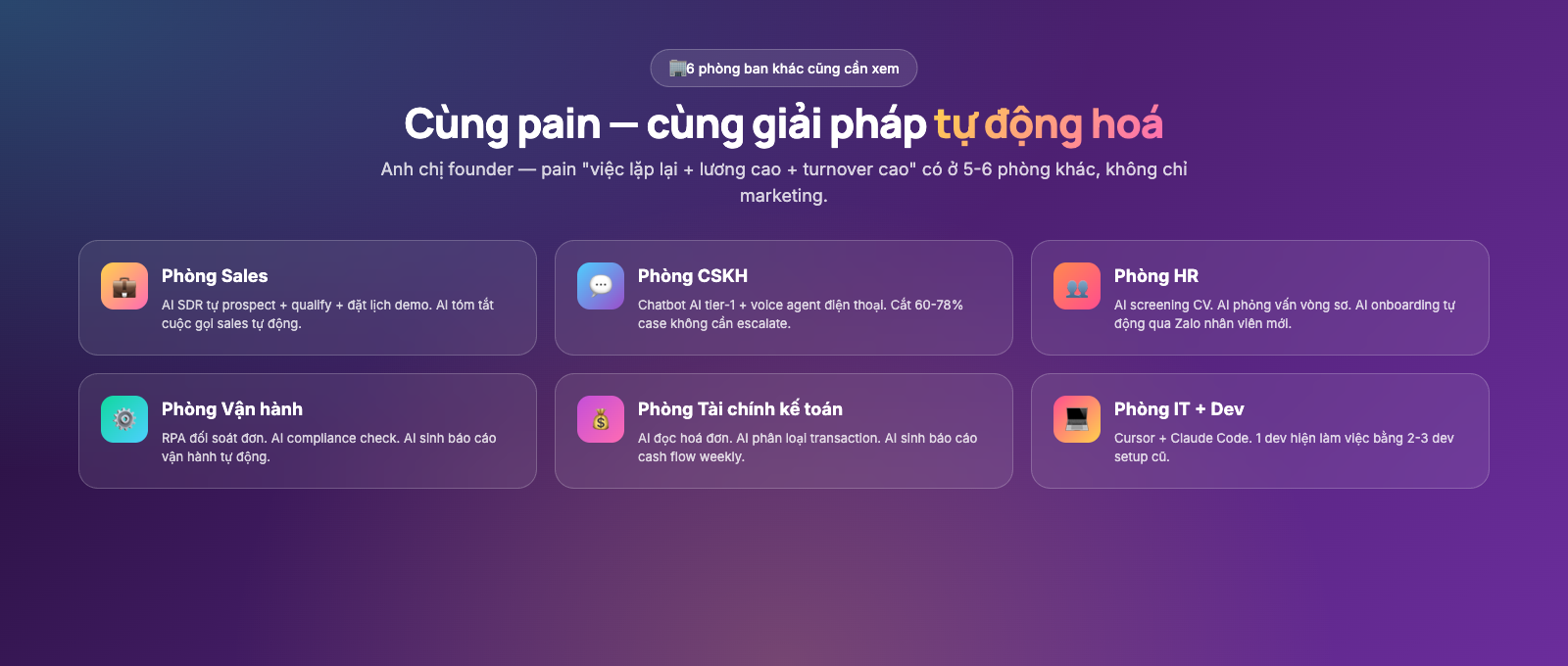
Founders, other departments beyond marketing deserve a look too, because the pain of “repetitive work + high salary + high turnover” is the same:
We will publish Part 2, “Applying AI to the sales department”, next month. You can read the AI-First 2026 article first for the big picture. See details in the guide to rolling out AI in business.
A 2026 marketing team does not need more people. A 2026 marketing team needs real automation software that links 10-12 AI tools into a closed chain, so the 3-5 best marketers can focus on strategy + brand + community, and repetitive work goes to machines.
We at MONA have been through this stage for our own operation and about 30 close mid-market clients. We cut 60-70% of marketing team costs and raised output 4-8 times. You can do it too, you just need to start.
If you want a free audit of which parts of your marketing team can be automated first, contact mona.software or MONA’s Zalo OA. We tell you straight which parts can be automated in 30 days, which need 90 days and which you should not touch yet, based on hands-on experience.
You can also browse the next articles in MONA’s Business Automation category. If you are interested in the MONA ecosystem, you can visit Khánh Hùng Academy the personal e-learning platform of MONA’s founder, with over 40,000 students.
The age of automation does not wait for anyone. But it does not leave behind anyone who dares to step forward either. We at MONA are ready to go with you.
The safest way is not to buy tools one by one and make your team stitch them together. MONA does AI transformation and business automation on a project basis: we review your current marketing process, point out which steps machines can handle (repetitive content, reports, sorting leads from ads) and which must stay with people, then build a system that really runs. We have rolled it out for over 120 businesses. Once marketing brings customers in, do not let them drop at the messaging step: an AI chatbot that closes orders covering fanpage and Zalo 24/7, so a customer asking at midnight still gets an answer.
Keep reading in the same department cluster: applying AI to HR teams.
Yes, and the smaller the team the more it makes sense, because AI carries exactly the repetitive work (base content, resizing materials, reporting numbers) so those 2-3 people can focus on strategy and creativity. The entry cost today is very low compared with hiring another person.
No. Common tools work right away; the technical part comes when you want to connect AI to internal data (CRM, orders, inventory). Hire a team like MONA to do that once, and the marketing team just uses it.
No. AI replaces repetitive work and speeds up production, while brand positioning, campaign ideas and budget decisions are still made by people. A team that knows how to use AI will replace a team that does not, and that is the accurate way to put it.

CEO & Founder · The MONA
The founder of The MONA built a service company of 60+ staff with 14,000+ projects delivered. Khánh Hùng shares his thinking on building self-running systems, automating a business, and the real lessons behind MONA's projects.
 1,6K




Professional website
design services
Own a website with a beautiful, 100% exclusive design and a lifetime warranty, with the ability
to expand features flexibly as your business grows, starting today!






 MONA will never sell your information or send you spam


 MONA will never sell your information or send you spam
