
 MONA OS 2.0
 Partner with MONA


 Tự động hoá doanh nghiệp
 Cẩm nang SEO
 Digital Marketing
 Kinh nghiệm thiết kế website
 Hạ Tầng Server
 Giáo dục


 VI
 EN














Message us on
Zalo Official


 ProductsNew

 ProductsProducts
 Mới ra mắtKHA AI 2027App tự edit video, tự đăng mọi mạng xã hội, 2 phút mỗi ngày










 Website designLooks good and wins customers over.
SEO servicesBrings in customers searching for exactly what you sell.
 Tư vấn digital marketingKéo khách từ nhiều kênh, đo bằng số thật.
Corporate video productionVideos introducing your company, factory and team.
 NewAI video productionCompany story films made with AI.
 Custom software developmentCRM, ERP and HRM built for your business.
 Viết AI Agent theo yêu cầuĐặt riêng một trợ lý AI cho đúng việc của mình.
 Tư vấn chuyển đổi AIĐưa AI vào vận hành của cả công ty.
NewMONA LMSManagement for centers and schools.
MONA SkillHubInternal training for company staff.
 NHTQ systemEnd-to-end China–Vietnam shipping operations.
MONA JMSManagement for gold, diamond and pawn shops.
 MONA E-LearningA website with every feature you need to sell courses.
 How to sell online courses (course)More than 30 free lessons on selling courses on autopilot.
 MONA Cloudmonacloud.vnServers to get your apps and websites running.
 MONA Basemonabase.vnPostgres database, sign-in and file storage.
 MONA Mailmonamail.vnSend OTP, order and invoice emails from your software.
 MONA Paymonapay.vnAccept bank transfers via VietQR and notify your software when the money arrives.
 MONA eInvoiceComing soonIssue e-invoices that meet tax standards.
Gấu CườiTrả lời khách 24/7 trên web, Fanpage, Zalo và thu lead cho sale.
 Gấu TeleSalesGọi điện tư vấn, chăm khách như tổng đài viên thật.
Dê CườiTư vấn và chốt đơn cho shop ngay trong khung chat.
Gấu WebmasterNhắn nhóm Zalo là website được sửa xong.
 Gấu Pháp ChếSoạn hợp đồng, rà điều khoản trong vài phút.
 Gấu Báo GiáLên báo giá đúng mẫu và gửi khách ngay.
 AI chăm sóc khách hàngTheo dõi và giữ chân khách hàng cũ.
 Gấu Tuyển DụngLọc hồ sơ, hẹn lịch, phỏng vấn ứng viên.
 Mới ra mắt
KHA AI 2027
Xây kênh chuyên gia 2 phút mỗi ngày
Quay bằng điện thoại, AI tự edit video, tự đăng lên 16 nền tảng và tự trả lời bình luận, tin nhắn.
882.681lượt xem trên kênh CEO MONA sau 36 ngày
 Anh Khánh HùngCEO MONA đang dùng mỗi ngày
Xem app làm được gì
 AI
Gấu Cười MONA ĐANG TỰ XÀITrả lời khách 24/7 trên website, Zalo OA, Messenger và thu lead về cho sale.
Dê CườiChốt đơn bán lẻ và sàn: Shopee, TikTok Shop, web. Chăm cả khách sỉ, đại lý.
Gấu WebmasterCập nhật nội dung, tối ưu SEO website mỗi ngày.
Gấu TeleSalesGọi điện tư vấn, chăm khách như tổng đài viên thật.
Gấu Tuyển DụngLọc hồ sơ, hẹn lịch, phỏng vấn ứng viên tự động.
AI chăm sóc khách hàngGiữ khách cũ, cứu lead đã rớt cho phòng kinh doanh.
Gấu Pháp ChếSoạn hợp đồng, rà điều khoản trong vài phút.
Gấu Báo GiáLên báo giá đúng mẫu, gửi khách ngay khi có yêu cầu.
 Chuyển đổi AI toàn phầnGiải pháp tổng cho doanh nghiệp, 3 lớp triển khai.
 Viết AI Agent theo yêu cầuĐặt riêng một con AI gánh đúng nghiệp vụ của bạn.
 Custom softwareCRM, ERP and HRM with built-in AI automation.
 SEO & AEO thời đại AIĐược Google lẫn AI trích dẫn, không chỉ xếp hạng.
 Kiến thức AI cho doanh nghiệpBài phân tích, hướng dẫn ứng dụng AI vào vận hành.
 Free AI courses
 AI tools at work
App mới · KHA AI 2027
Xây kênh 2 phút mỗi ngày
AI tự edit video, tự đăng mọi mạng xã hội
Free consultation, 8am–10pm every day

11 February, 2025

Quick summary: What is AI automation? It means letting the machine carry a whole chain of work, from intake to processing to recording, without a person touching each step. It is very different from the drag-and-drop connectors that work when small and break when customers pile in. In this article we at MONA say plainly what AI automation is, why using AI in scattered pieces still does not make money, and how a working automation system is built.
Many business owners carry a feeling that few people put into words. You paid for a ChatGPT paid plan for the whole team, plugged in a bot to reply to messages, and spent a whole evening putting together a few automated flows with drag-and-drop tools. Yet at the end of the month, people are still overloaded, orders still slip through, and the work is as messy as before. The money has been spent, but the relief has not arrived.
That feeling is not because you did something wrong. And the good news is that you are not alone. We will start from the beginning, explain what AI automation really is, why most people stop at a few scattered tools, and how a system that works for a business with lots of customers is different.
One of the easiest steps to turn into money when done right is AI customer care automation, which handles almost the whole conversation with customers across every channel by itself.
The odd thing is that the technology is all there, yet most businesses still have not turned it into money. This is not just our impression. The McKinsey State of AI report (2025) gives a number worth thinking about: 88% of surveyed companies say they already use AI in at least one department. But nearly two thirds of them have not scaled it across the company, and only about 6% are the group that truly captures major value from AI. Meanwhile, another McKinsey report estimates that generative AI alone could create 2.6 to 4.4 trillion dollars of value every year, mostly concentrated in customer care, marketing and sales. The pie is there and clearly visible, but most have not reached it.
Read that number one more time. Almost everyone has touched AI, but only six in a hundred are making visible money. The rest are in exactly the situation you are seeing: using it, paying for it, but not getting results.
Why is that? Because most stop at treating AI as scattered toys instead of building it into a connected AI automation system. One ChatGPT for drafting. One bot for answering common questions. One file that calculates by itself. Each runs in its own corner, none connected to the others, and none knows what data the others hold. A person still sits in the middle, copying here and pasting there, reminding one tool to call another. The AI is there, but the work still runs by hand.
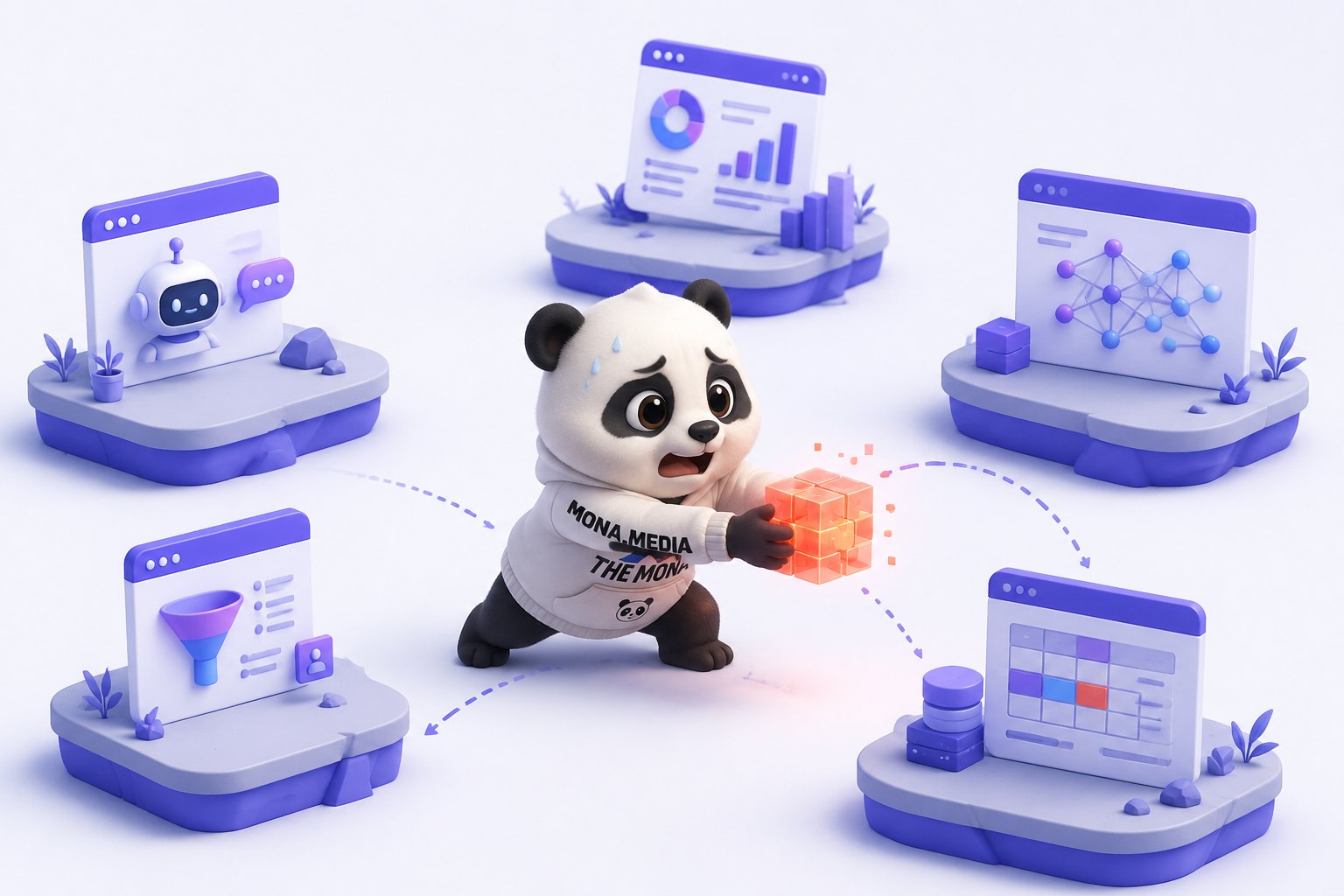
The feeling of spending money without feeling relief is persistent, because every time you try to finish the job it gets messy again. Messy because you do not know which step to start from. Messy because you fear investing big and then having it not work. Messy because your team tried a few times, saw AI give silly answers and lost faith. That mess is exactly what we want to untangle in this article, one step at a time.
The next rung that many of you have climbed is putting together an automated flow with drag-and-drop tools. Connect Google Sheets to an AI that writes content, push it to Facebook, add Zalo, plug a report into email. For the first few weeks it runs smoothly, you feel relieved, and you feel you are keeping up with the times.
Then orders grow, channels are added, rules change. At peak season, messages pour in at five times the usual volume. The flow starts breaking here and there, something is wrong in one place and off in another, and sometimes no one notices for a whole session that one link has stopped running. A customer who messages and waits three minutes with no reply is a lost customer. Orders slip away, and no one can trace where it broke.
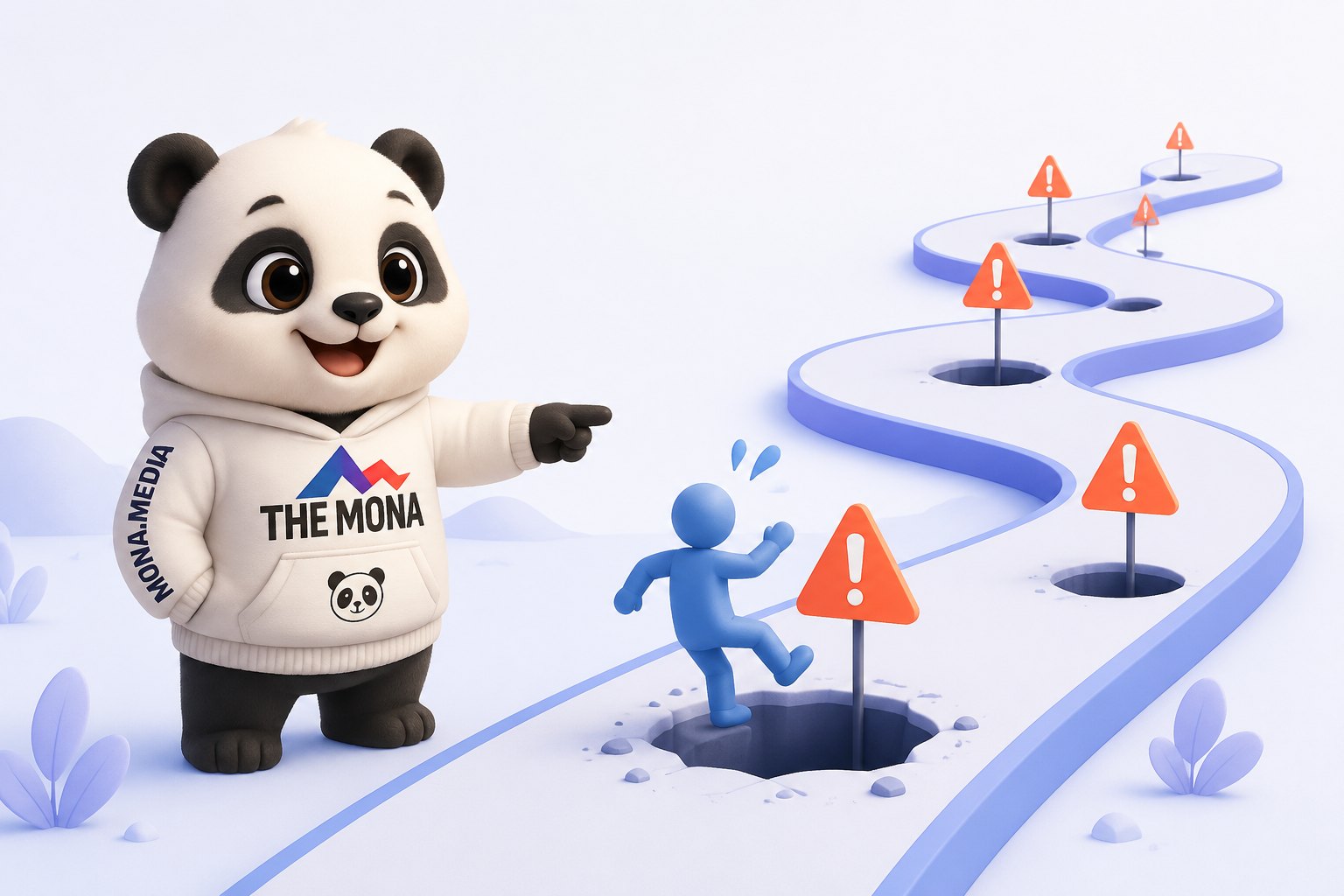
We see this all the time. And we say it plainly: the problem is not you, it is the nature of drag-and-drop tools. Those tools were made for one person doing a few light personal tasks, not for a business with lots of customers running day and night. When the data grows, the rules get complex and someone needs to be responsible when the system fails, drag-and-drop connectors reveal four fatal weaknesses.
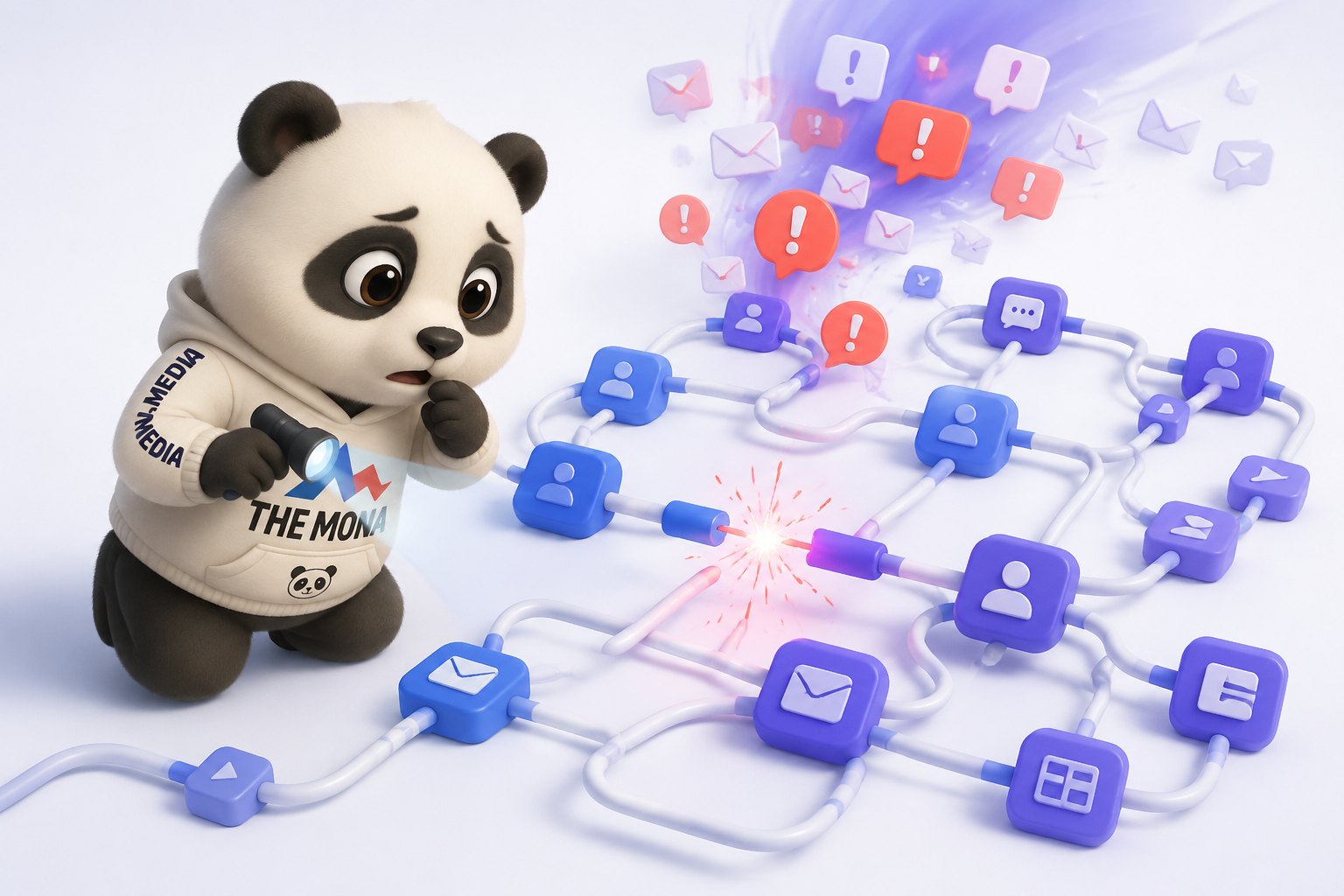
This is when real money starts leaking out of the house: lost orders, angry customers, a team firefighting by hand instead of selling. We wrote a full analysis of why hand-built flows break when they scale, and you can read more at business workflow automation. The section below makes clear what AI automation really is, so you can see how it differs from that pile of makeshift wiring.
AI automation means using artificial intelligence to let the machine carry a whole chain of work, from intake to processing to recording, without a person touching each step. Unlike old-style automation that follows one fixed script, AI automation understands context, so it can handle situations that fall outside the template.
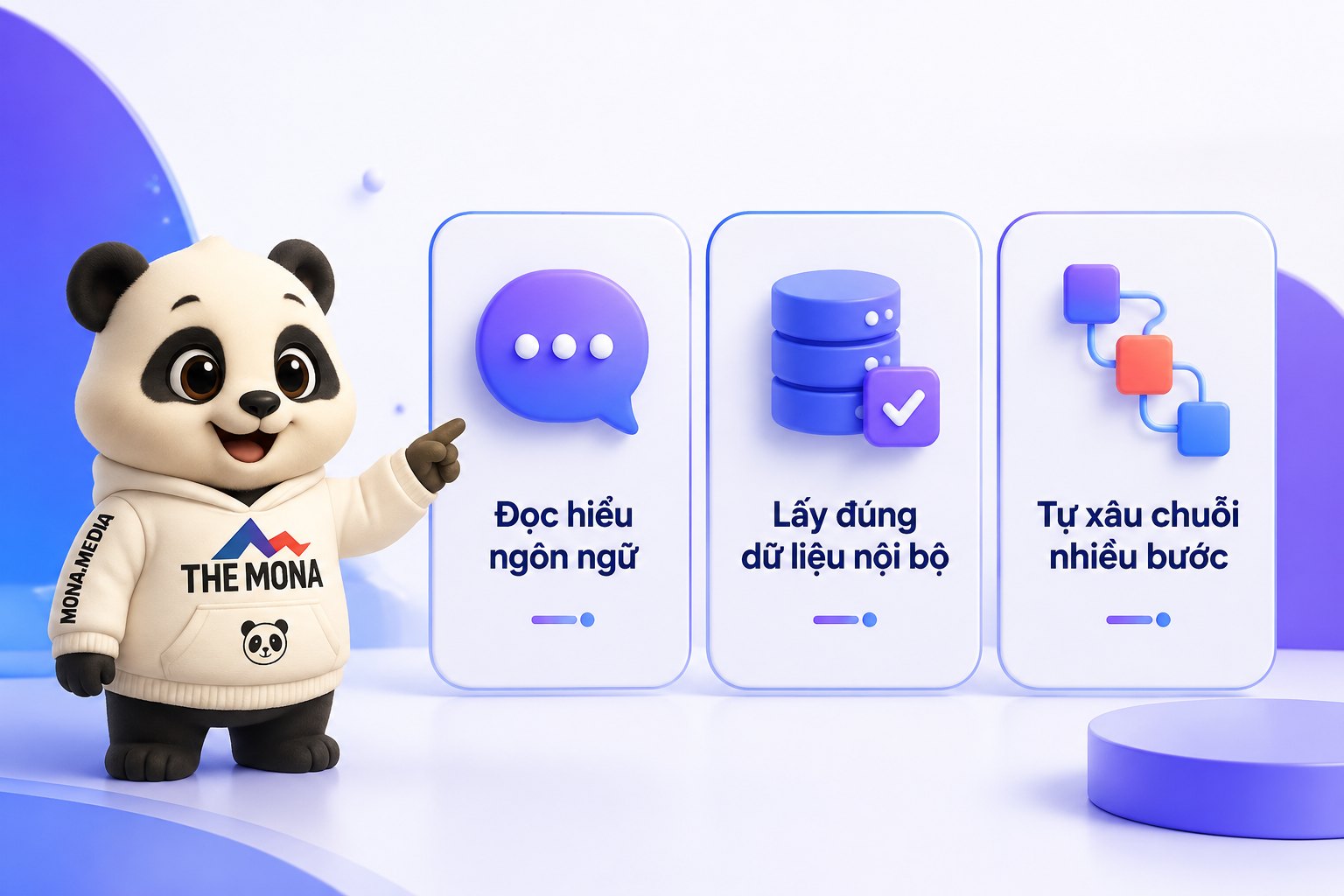
To picture it if you have never touched technology: imagine a very capable new employee who works around the clock, never forgets and never gets cranky. You give a request in ordinary words, they understand, look up the company's records themselves, and do all the steps until the job is done. To do this, an AI automation system needs three abilities.
This is also where AI automation ties closely to the way of thinking called AI first, meaning the machine goes first and people do the rest. When a business puts AI automation at the core of its processes, the machine takes the front line and the volume, while people keep judgment and final responsibility. We describe this whole picture in more detail in the article using AI in business.
These two are often called by the same name, but they work in fundamentally different ways. And the important point is that each has its own place, and neither replaces the other entirely.
Rigid-script automation is the machine doing exactly one flow that was drawn in advance. The customer presses key one and it gives answer A, presses key two and it gives answer B. It suits tasks that must never go wrong and need no thinking: confirming orders, checking balances, sending codes, reminding appointments. In these tasks, rigidity is a strength, because you know it will never answer outside the template. Its weakness shows when a customer words something slightly differently and it freezes, forcing a person to step in.
AI automation reads the meaning, works out the next step itself and can handle cases outside the script. When a customer asks in a roundabout way, asks two or three things at once or changes their mind midway, the machine can still follow. It suits work that needs an understanding of context, which used to require a person. In return, it needs clean data to rely on and careful design so it does not confidently answer wrongly.
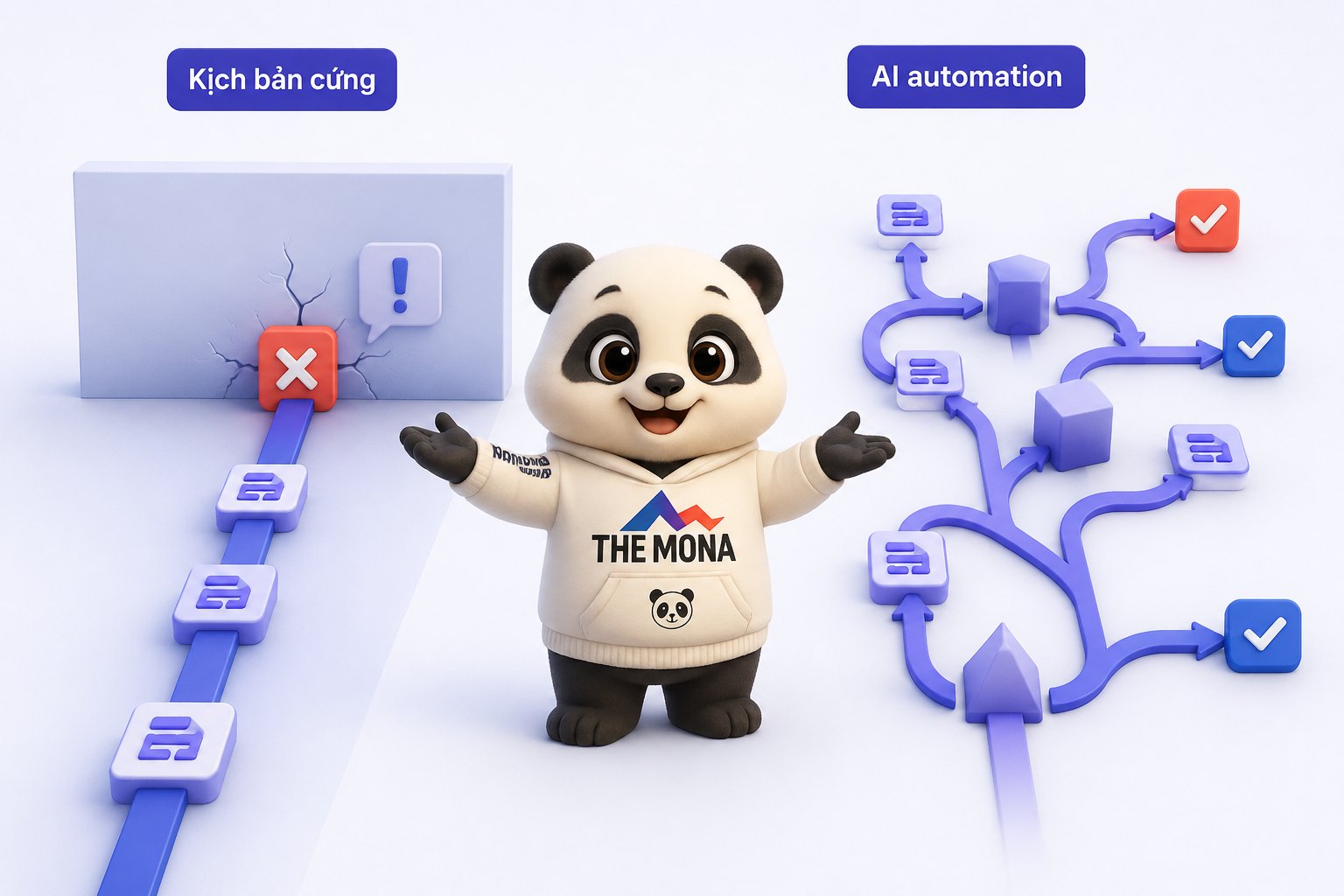
The smart approach is to combine both. Give precise tasks to the rigid script and tasks that need understanding people to AI automation, with the two layers backing each other up inside one system. We go into this boundary in more detail in the article what an AI chatbot is and how it differs from a scripted chatbot.
Not every task should go into AI automation first. We choose by a simple principle: a step that repeats a lot, has clear rules and has measurable results goes first. The four steps below usually win early and show money quickly.
Messages from the website, Zalo and Messenger are gathered in one place. The machine answers the first layer around the clock, filters needs, books appointments, and only then passes hard cases to a person. This is the step that frees up the most people. We have built this area into working software, see AI chatbot for replying and managing leads.
Scan livestream comments, collect delivery details and create orders in the middle of the night when staff are asleep. This step shows money right away, because every order kept is real money coming in. See AI agent chốt đơn tự động.
The machine gathers customer profiles, orders and interaction history in one place and standardizes them neatly. It sounds dull, but it is the foundation of everything. With dirty data the machine answers wrongly, and the team loses faith in the first week.
The machine drafts content, summarizes figures into reports, and a person only reviews and adjusts the tone. This gives the marketing and operations team many hours back every week.
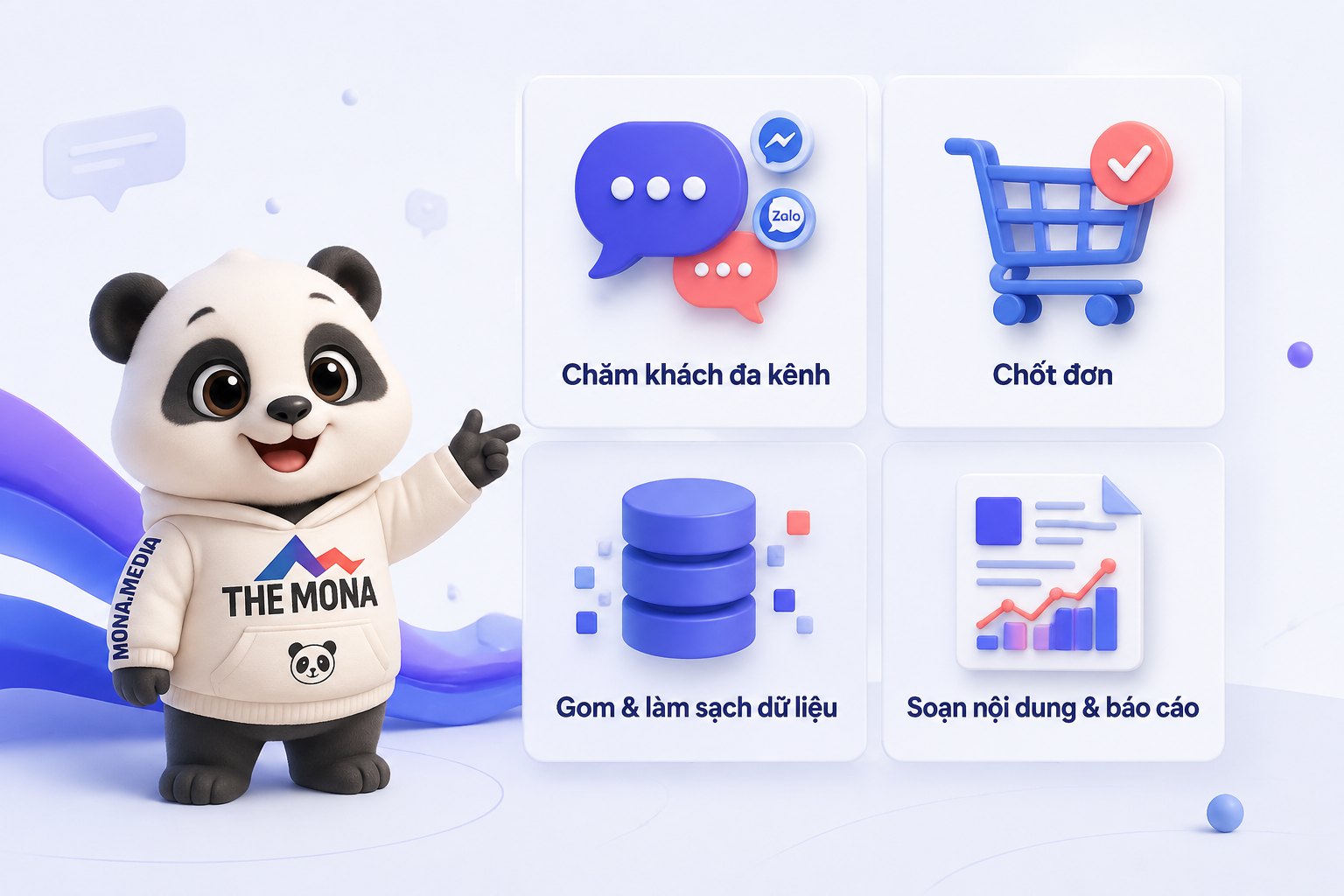
What these four steps have in common is that you can measure them after just a few weeks: how many messages the machine answered, how many orders were kept, how many work hours were saved. With numbers in hand, expanding is easy and your budget always stays in view.
If you recognize at this point that your business has a few scattered AI tools, each in its own corner, with a person still in the middle connecting them by hand, then this is exactly where 94 out of 100 businesses are stuck according to McKinsey's numbers. You do not need to tear it down and start over. Just sit down for half a session, and we will help you spot the most repetitive, people-heavy step in the house, then pick exactly one step to reconnect so it produces numbers first. Book a free digital transformation consultation session, or call the hotline 1900 636 648, we are not in a rush to sell, we help you see which step is worth doing first.
We say our position plainly. MONA does not advise you to assemble a pile of drag-and-drop tools yourself and carry the risk alone when they break. We build automation software written specially for each business, in production-grade code, running on infrastructure you can control. The difference lies in three things you will clearly see when you scale.
One, it holds up under peak-season load. Custom software is designed for your exact volume of customers, so even when orders pour in at five times the usual rate it does not clog or break in pieces like a temporary patched-together flow.
Two, your data stays in your house. You do not depend on a third-party service that can change prices or stop at any time. Customer profiles, orders and history all sit inside the business's own system, and you are in charge.
Three, when errors happen, a team is responsible. If it breaks in the middle of the night, our people fix it, and you do not have to dig around during peak season. No drag-and-drop tool can give you that.
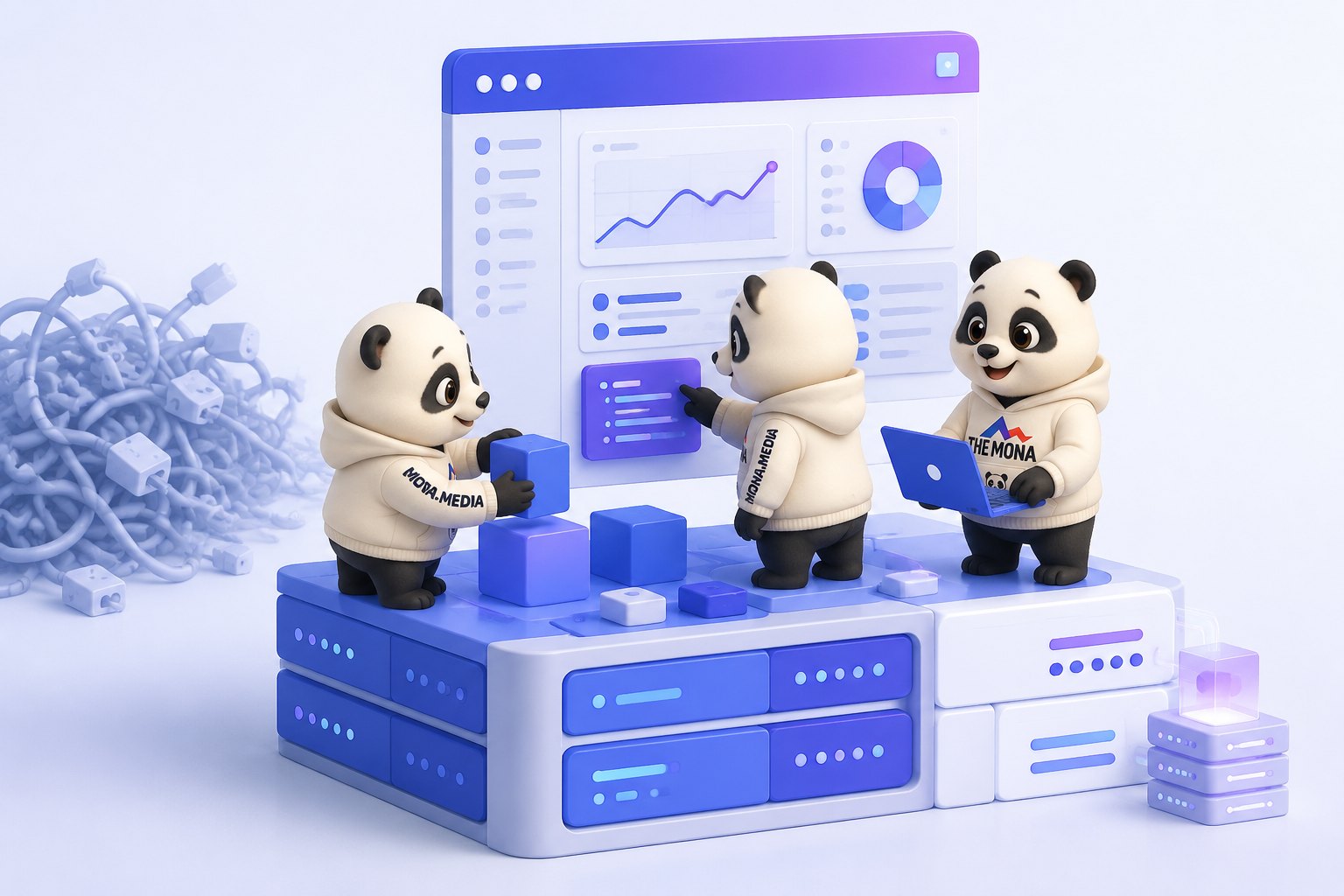
The ecosystem we run internally and for customers ranges from custom software by Mona.Software to infrastructure at Mona.Host. If you want a custom machine that carries exactly your own business process, see custom AI agent development or the bigger picture at AI transformation for businesses. This approach makes your AI automation a durable machine, not a pile of wiring waiting to break.
Here is one case, kept anonymous under an agreement. A spa chain with 28 branches in Ho Chi Minh City, Hanoi and Da Nang, with revenue around 52 billion VND a month. The owner started as a skincare technician and worked her way up from a small room in Phu Nhuan District, so she values every customer message and hates nothing more than a customer messaging and getting no reply.
The irony is that the more branches there were, the more often the thing she hated happened. Each branch replied to messages in its own way, customer data was scattered in pieces in different places, and the pre-Tet peak season brought overload. A customer messaged at ten at night asking for a treatment package price, the receptionist saw it the next morning, and by then the customer had booked elsewhere. She told us a sentence we still remember: "I'm not short of customers, I'm losing them by replying too slowly."
We did not sell her a few tools. We rebuilt the process with AI automation on the front line. Messages from every channel were gathered in one place, and the machine answered the first layer around the clock, quoting treatment prices, booking appointments and filtering needs before passing hard cases to a consultant. The machine automatically gathered customer profiles in one place, so the next time a customer messaged, we knew right away which treatments they had already had.
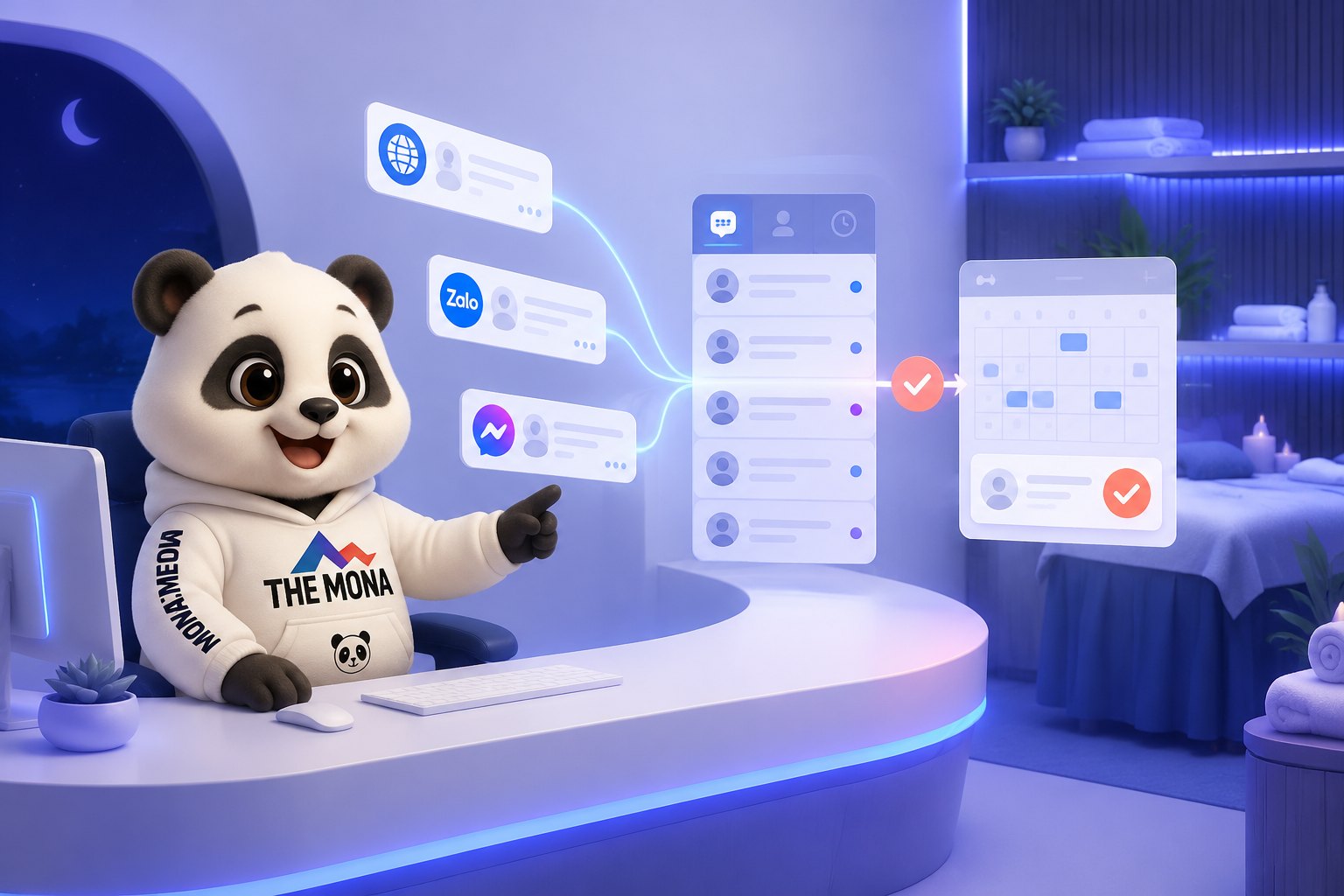
The results measured after a few months show most clearly in the night hours. Before, messages after ten at night were left until morning, and now most are answered within minutes. The number of customers lost to long waits dropped clearly, and what she likes most is that consultants no longer have to type the same price quotes again and again, so they put their time into high-value cases. We have repeated this approach for many industries, see more at spa process automation and restaurant operations automation.
AI automation is not limited to one field. Its core is to gather repetitive work in one place, let the machine carry the first layer and let people keep the hard part. That same AI automation core works for many industries that MONA has actually worked in.
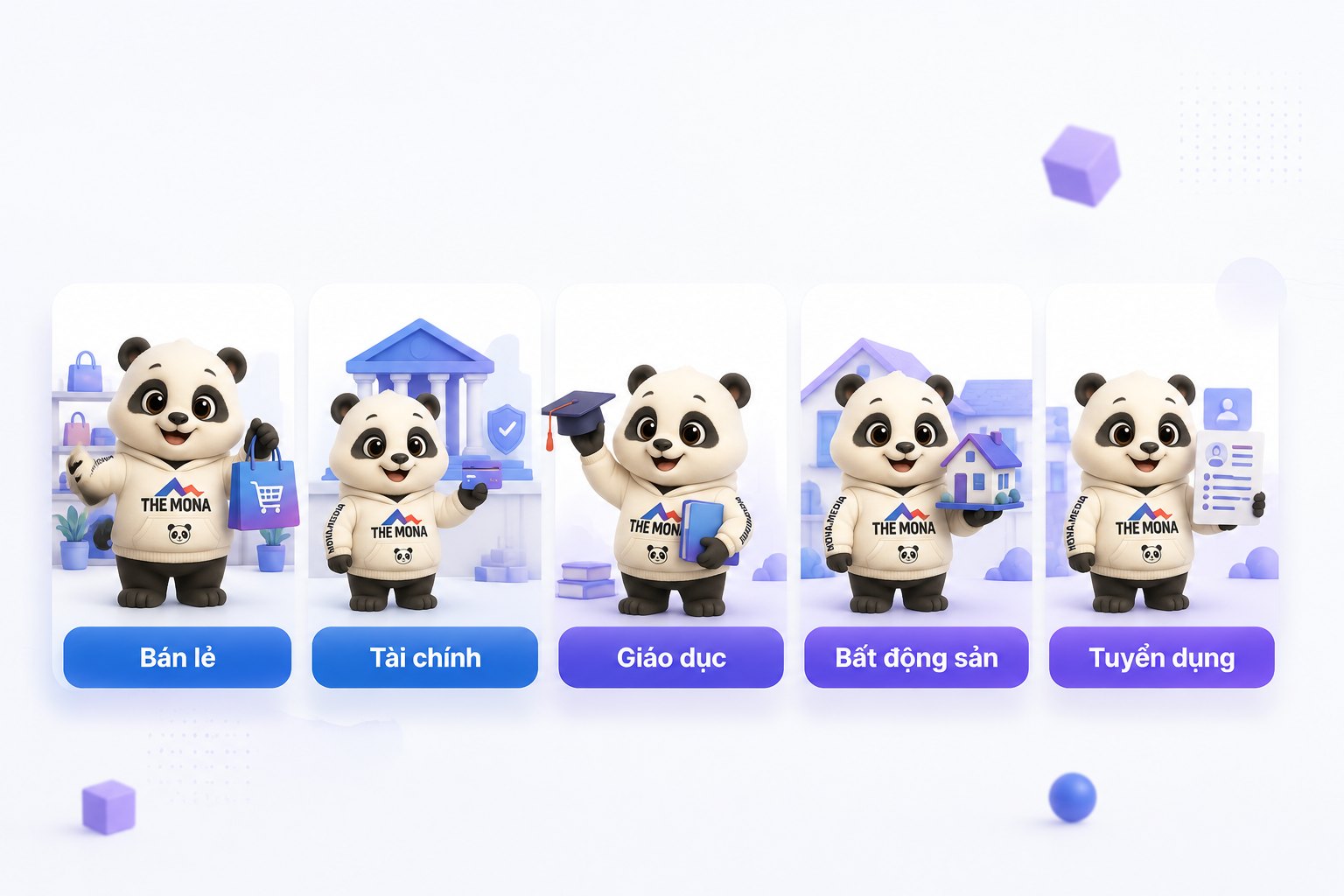
Having worked with many businesses, we see the stumbles when starting AI automation repeat in a few familiar ways. Knowing them in advance helps you avoid them and save on tuition fees.
The most common stumble is assembling tools first and fixing the process later. If you lay tools on top of a messy process, you only automate that mess faster. Reshape the process first, and the tools are just the means.
Next is neglecting the data. Dirty, scattered data makes the machine answer wrongly from the start, the team loses faith and quietly goes back to working by hand. Many businesses invest in a whole system and die right here.
Third is picking hard-to-measure work to do first. Automating a step when you cannot say at the end of the month how much it saved is easily cut from the budget midway. Always pick the step that produces numbers first.
Fourth is handing the whole business over to a third-party service. The day they change prices or stop, your whole flow halts and you do not hold the root to rescue it.
And fifth is expecting the machine to fully replace people. The machine carries the repetitive volume, but judgment and final responsibility still belong to people. Set expectations correctly and the whole team can go the long road together.
You do not need to do everything at once, and you should not. This week you only need three small things, which you can do yourself at home.
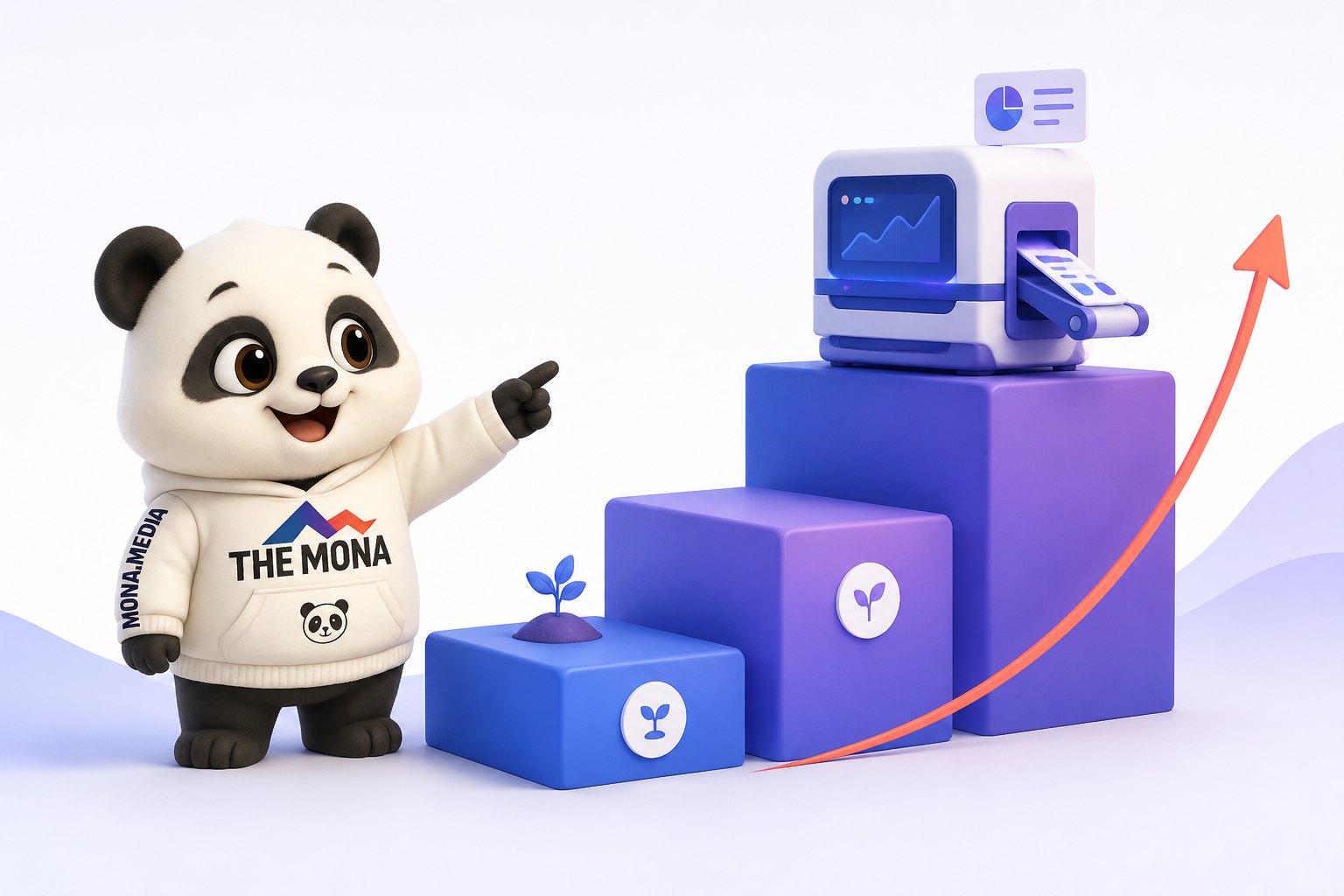
One, sit down and list the five repetitive steps that take the most people in your business. Two, score which of them have clear rules and can be measured with numbers. Three, pick exactly one step to put into AI automation first, get it producing numbers, then plan the next step.
When one step produces real results, the whole team's confidence will be very different, and scaling up then goes smoothly. Remember the McKinsey numbers at the start of this article: 88 out of 100 businesses have touched AI, but only 6 make money from it. The difference between the two groups is not who uses more AI, but who connects it into a system that runs in sequence, can be measured and has someone responsible.
If you want someone to sit with you and set the right order for your own business, instead of figuring it out alone and falling back into scattered AI that makes no money, we at MONA hold a digital transformation consultation free session. You can choose either of two ways. One is to call the hotline 1900 636 648 during office hours and tell us which step your business is stuck on. Two is to leave a few lines through the form, and we will book a half-hour session and help you spot which step is worth reconnecting first. A durable AI automation system always starts from one measurable step and then grows into a working machine, because nobody builds the whole house in one night.
RPA and regular chatbots follow rigid scripts and do exactly one pre-programmed action. AI automation understands context, so it can handle cases that fall outside the template, and it chains many steps together instead of doing a single action. In practice, a good system usually combines both layers.
Yes, and you should start early. Small businesses have fewer legacy systems, so they can reshape their processes faster. Pick one measurable step to automate first, see the numbers, then grow gradually, and your budget stays under control.
The cost depends on the scope you take on. The right way is to start small and measure step by step. Once one step shows a positive return, you expand, and you never pour money into a huge system without knowing whether it works.
Hand-assembled tools suit light personal use and the trial stage. When your business has many customers, runs day and night, needs to handle load and needs someone responsible when errors happen, custom production-grade software is far more durable and safer.
AI automation means letting the machine carry a whole chain of work from start to finish. It understands context, and it is not the kind of drag-and-drop connector that breaks when customers pile in.
About The MONA Group: Founded in 2016, with 60+ staff, 14,000+ projects delivered and an 85% client retention rate. MONA builds custom automation software, puts AI into every step, and moves businesses to full AI automation instead of scattered AI use. Consulting hotline: 1900 636 648. Explore more full-scope SEO services and AI tools at work.
If you are considering assembling flows with open-source tools before thinking about custom software, we have a separate analysis of what n8n is and how much it costs to keep running, with four milestones to tell you when to stop assembling flows.

CEO & Founder · The MONA
The founder of The MONA built a service company of 60+ staff with 14,000+ projects delivered. Khánh Hùng shares his thinking on building self-running systems, automating a business, and the real lessons behind MONA's projects.
 2,7K



Professional website
design services
Own a website with a beautiful, 100% exclusive design and a lifetime warranty, with the ability
to expand features flexibly as your business grows, starting today!












 MONA will never sell your information or send you spam


 MONA will never sell your information or send you spam
