
 MONA OS 2.0
 Partner with MONA


 Tự động hoá doanh nghiệp
 Cẩm nang SEO
 Digital Marketing
 Kinh nghiệm thiết kế website
 Hạ Tầng Server
 Giáo dục


 VI
 EN















Message us on
Zalo Official


 ProductsNew

 ProductsProducts
 Mới ra mắtKHA AI 2027App tự edit video, tự đăng mọi mạng xã hội, 2 phút mỗi ngày










 Website designLooks good and wins customers over.
SEO servicesBrings in customers searching for exactly what you sell.
 Tư vấn digital marketingKéo khách từ nhiều kênh, đo bằng số thật.
Corporate video productionVideos introducing your company, factory and team.
 NewAI video productionCompany story films made with AI.
 Custom software developmentCRM, ERP and HRM built for your business.
 Viết AI Agent theo yêu cầuĐặt riêng một trợ lý AI cho đúng việc của mình.
 Tư vấn chuyển đổi AIĐưa AI vào vận hành của cả công ty.
NewMONA LMSManagement for centers and schools.
MONA SkillHubInternal training for company staff.
 NHTQ systemEnd-to-end China–Vietnam shipping operations.
MONA JMSManagement for gold, diamond and pawn shops.
 MONA E-LearningA website with every feature you need to sell courses.
 How to sell online courses (course)More than 30 free lessons on selling courses on autopilot.
 MONA Cloudmonacloud.vnServers to get your apps and websites running.
 MONA Basemonabase.vnPostgres database, sign-in and file storage.
 MONA Mailmonamail.vnSend OTP, order and invoice emails from your software.
 MONA Paymonapay.vnAccept bank transfers via VietQR and notify your software when the money arrives.
 MONA eInvoiceComing soonIssue e-invoices that meet tax standards.
Gấu CườiTrả lời khách 24/7 trên web, Fanpage, Zalo và thu lead cho sale.
 Gấu TeleSalesGọi điện tư vấn, chăm khách như tổng đài viên thật.
Dê CườiTư vấn và chốt đơn cho shop ngay trong khung chat.
Gấu WebmasterNhắn nhóm Zalo là website được sửa xong.
 Gấu Pháp ChếSoạn hợp đồng, rà điều khoản trong vài phút.
 Gấu Báo GiáLên báo giá đúng mẫu và gửi khách ngay.
 AI chăm sóc khách hàngTheo dõi và giữ chân khách hàng cũ.
 Gấu Tuyển DụngLọc hồ sơ, hẹn lịch, phỏng vấn ứng viên.
 Mới ra mắt
KHA AI 2027
Xây kênh chuyên gia 2 phút mỗi ngày
Quay bằng điện thoại, AI tự edit video, tự đăng lên 16 nền tảng và tự trả lời bình luận, tin nhắn.
882.681lượt xem trên kênh CEO MONA sau 36 ngày
 Anh Khánh HùngCEO MONA đang dùng mỗi ngày
Xem app làm được gì
 AI
Gấu Cười MONA ĐANG TỰ XÀITrả lời khách 24/7 trên website, Zalo OA, Messenger và thu lead về cho sale.
Dê CườiChốt đơn bán lẻ và sàn: Shopee, TikTok Shop, web. Chăm cả khách sỉ, đại lý.
Gấu WebmasterCập nhật nội dung, tối ưu SEO website mỗi ngày.
Gấu TeleSalesGọi điện tư vấn, chăm khách như tổng đài viên thật.
Gấu Tuyển DụngLọc hồ sơ, hẹn lịch, phỏng vấn ứng viên tự động.
AI chăm sóc khách hàngGiữ khách cũ, cứu lead đã rớt cho phòng kinh doanh.
Gấu Pháp ChếSoạn hợp đồng, rà điều khoản trong vài phút.
Gấu Báo GiáLên báo giá đúng mẫu, gửi khách ngay khi có yêu cầu.
 Chuyển đổi AI toàn phầnGiải pháp tổng cho doanh nghiệp, 3 lớp triển khai.
 Viết AI Agent theo yêu cầuĐặt riêng một con AI gánh đúng nghiệp vụ của bạn.
 Custom softwareCRM, ERP and HRM with built-in AI automation.
 SEO & AEO thời đại AIĐược Google lẫn AI trích dẫn, không chỉ xếp hạng.
 Kiến thức AI cho doanh nghiệpBài phân tích, hướng dẫn ứng dụng AI vào vận hành.
 Free AI courses
 AI tools at work
App mới · KHA AI 2027
Xây kênh 2 phút mỗi ngày
AI tự edit video, tự đăng mọi mạng xã hội
Free consultation, 8am–10pm every day

15 July, 2026
Every month nearly a thousand Vietnamese business owners go to Google and type virtual call center. Almost all the results are ads for cloud call centers from VoIP providers. Every page shows a cheap price list and promises installation in 24 hours. None of them tells you the more important thing. A virtual call center is only the calling infrastructure, and whether a call gets answered is a human matter. In this article MONA compares 3 generations of call centers head to head, with real costs. Choose right from the start and avoid paying twice.
Quick answer: a virtual call center is a calling system that runs over the internet, with no physical switchboard to install. Each staff member is an extension on a phone or computer. The newer generation adds an AI call center operator: the machine answers 24/7, takes notes and routes the call to the right person.
A missed call is not just a missed call. It is 150,000 to 400,000 VND of ad money you just burned to let the phone ring for nothing. A customer taps to call from an ad, the phone rings for 30 seconds, nobody picks up, and the customer hangs up and taps the competitor's number right below. The whole cost of running sales script ahead of it goes to waste because of the last 30 seconds.
A familiar picture at growing companies: the hotline is one employee's mobile number. That employee goes to meetings, to the bathroom, on leave, or quits, and takes the number along. An old customer calls the saved number and the person answering now works somewhere else. At noon the calls pile up and one person can't handle three phones. At 9 p.m., when customers finally have time to call, the company is closed. Research from McKinsey on customer care shows 57% of leaders expect call volume to keep rising over the next two years. Calls go up, the people answering don't, and that gap is lost revenue.
The hidden pain is that you can't see it. Orders lost to missed calls appear in no report. Staff don't report that they missed 12 calls over lunch today. The owner only sees ad spend climbing steadily while orders stay flat, and blames the market. What actually needs fixing is the receiver.
The virtual call center for business exists to fix exactly these problems. The whole calling system runs over the internet using VoIP, meaning voice travels over the network instead of copper wire. The company uses one landline or a 1900/1800 hotline as its front door. Behind that number sit dozens of extensions, ringing all at once or one after another on each employee's phone. When an employee quits, you take back the extension and the company number stays the same. Every call is recorded, missed calls are counted, and you can see who answered how many calls.
To be fair: compared with a mobile hotline, a cloud call center is a big step forward and worth the money. The cost is light too, a few hundred thousand VND a month, with no tens of millions spent on a physical switchboard. That is why VoIP providers advertise heavily and sell well.
But there is one thing the sales pages don't mention. A plain virtual call center only routes calls, and on this end of the line a human still has to sit and answer. A customer calls at 9 p.m., the system rings all 5 extensions, and all 5 employees are having dinner with their families. On the 2nd day of Tet a customer asks about the reopening date and nobody picks up. To cover 24/7 with people, you need at least 3 shifts. Salaries and night allowances add up to tens of millions of VND a month for a position that just waits for a ring. The switchboard cabinet disappears, but the staffing problem of covering the phone stays right where it was.
Put the 3 solutions side by side and each wins in a different column. Your job is to check which column your company needs.
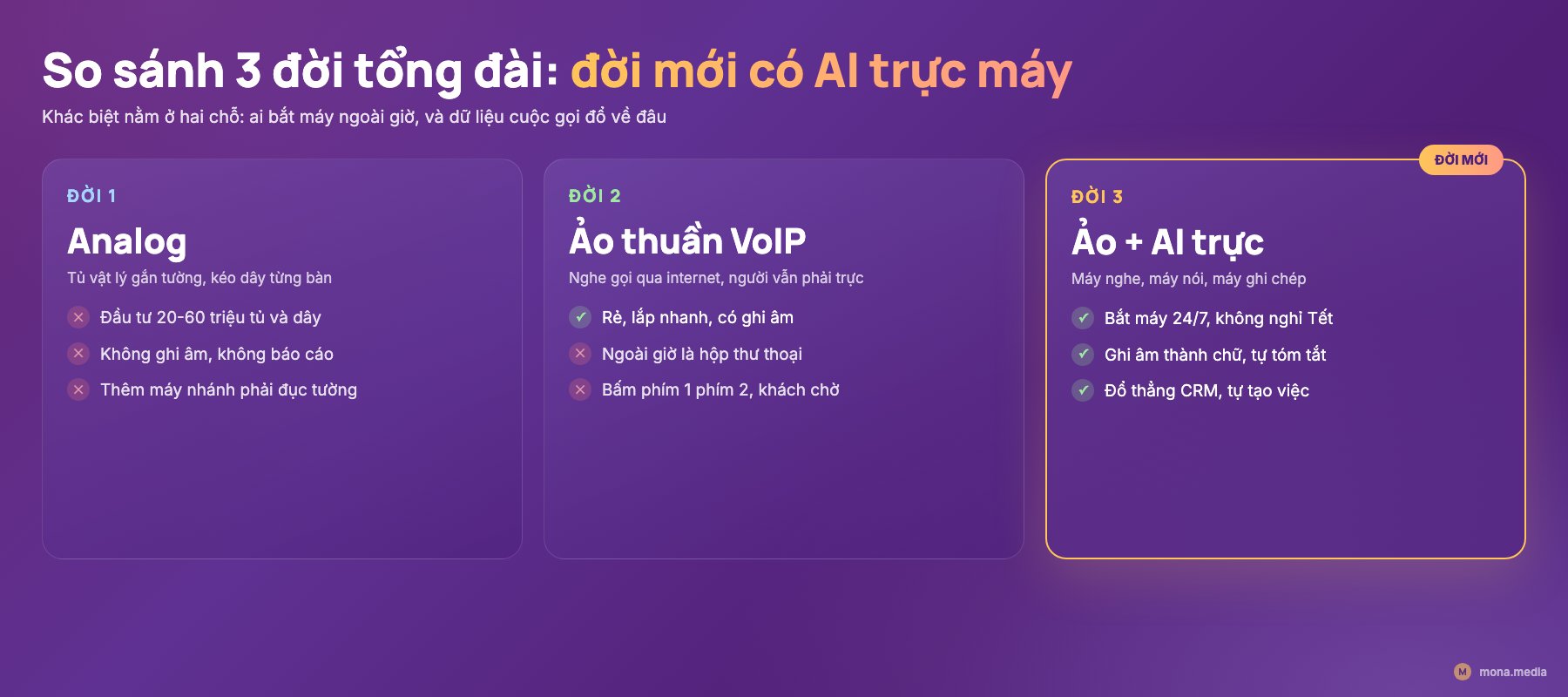
| Criterion | Analog | Plain virtual (VoIP) | Virtual with AI answering |
|---|---|---|---|
| Upfront investment | 20-60 million VND for the cabinet and wiring | Almost nothing | Almost no infrastructure cost, billed per AI minute |
| Monthly fee | Maintenance, rental per line | 100,000-300,000 VND per extension | Extension fee plus AI charges by call volume |
| Works when the internet is down | Still makes and receives calls normally | No network, no sound | No network, no sound |
| Answering after hours and on holidays | Needs someone on duty | Needs someone on duty or a night shift | AI answers 24/7, no Tet break |
| Recording and note-taking | Separate recording, manual playback | Recorded already, but you have to listen again to know the content | Recording turned into text, each call summarized automatically |
| Connection to sales software | Stands alone | Can connect, depends on the provider | Pushes straight into the CRM and creates tasks for staff automatically |
| Best suited for | Factories and warehouses in weak-network areas | Companies with enough people on duty during office hours | Companies whose customers call after hours or in bursts |
An analog call center is a physical cabinet in the technical room, with copper wire run to every desk. That copper wire is its strength: when the network drops or the power fails (with a generator), the system still makes and receives calls. Factories, warehouses and job sites with weak signal should still keep analog for their vital internal numbers, and we don't recommend ripping it out. Where it doesn't fit is offices or chains that keep opening branches, because adding one extension means calling a technician to drill walls and run wire, and a new branch means buying another cabinet. If you plan to expand, consider generation 2 or 3.
This is the virtual call center package most providers on the market sell, and it sells well because it is genuinely worth the money. It is cheap, installs in a day, can cover every branch, and includes recording and missed-call reports. It usually comes with a key-press auto-attendant called IVR. IVR firmly handles the things that must not go wrong: choosing the right department, confirming an order, checking a balance. It does what it is told and doesn't improvise. Don't give it work that needs understanding what the customer means, because callers have to listen to the whole recording and press keys through a rigid script tree. A survey by Harvard Business Review shows 81% of customers want to resolve problems quickly on their own before talking to an agent. Generation 2 fits when your customers mostly call during office hours and your company has enough people on duty.
The third generation keeps generation 2's VoIP infrastructure and replaces the person waiting for the ring with AI. A customer calls in, the AI picks up from the first second, and listens and replies in natural Vietnamese. For repeated questions such as prices, opening hours and order status, the AI answers completely on its own. It suits companies whose customers call after hours or in bursts. Negotiating prices, handling angry customers and closing big contracts should still go to a real person: the AI just transfers the call to the right department along with a written record of the conversation. You can see how 3 AI call center architectures work differently in our separate analysis, because each architecture fits a different kind of work.
Torn between a few virtual call center quotes? Send us a description of how your company currently handles incoming calls. The MONA technical team will show you, free of charge, where a machine can replace a person and where you should keep a real one. All of it before you sign any contract. Call 1900 636 648.
Five questions below filter out 80% of the risk of choosing wrong, because they force the seller to answer the parts they usually dodge.
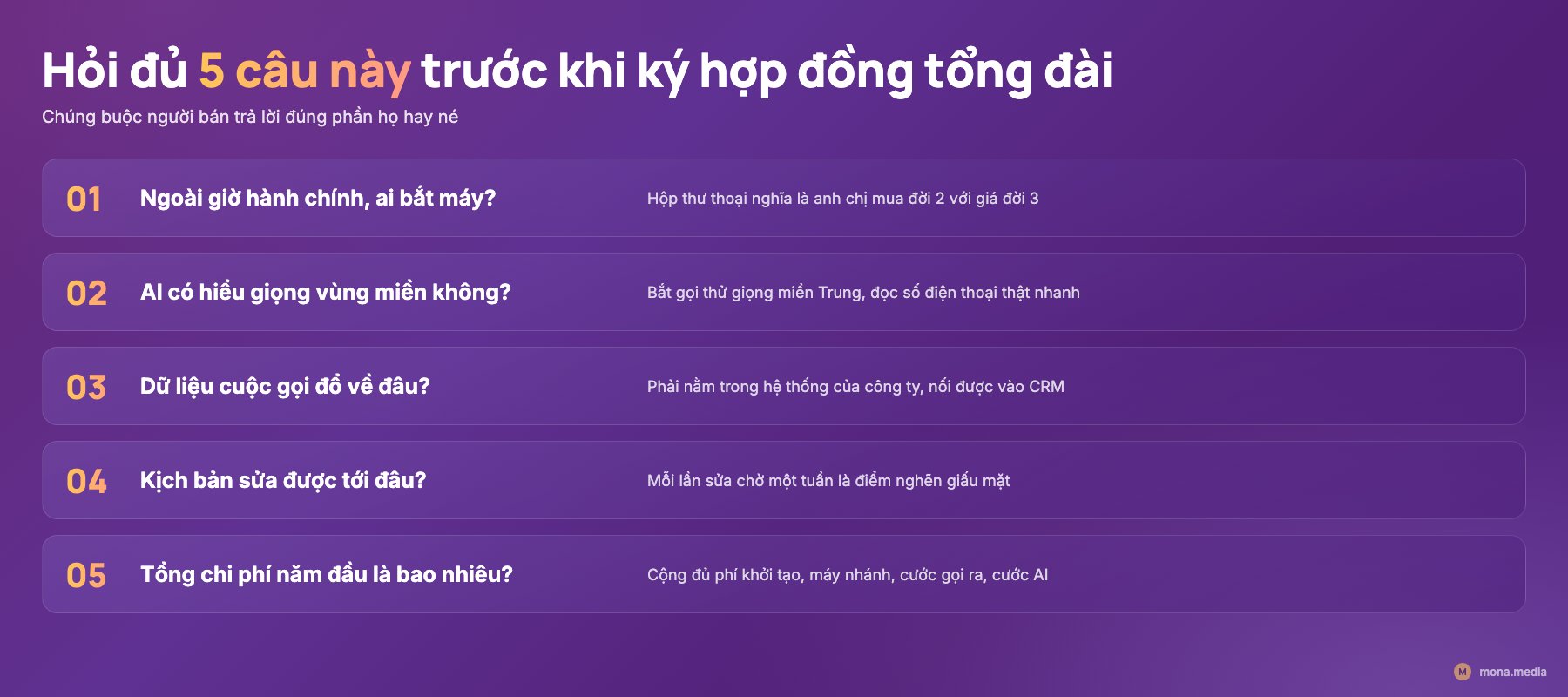
Question 3 matters twice as much as the others. Calls are a goldmine of data on what customers need, the very thing that later feeds AI customer care automation. Choosing a provider that holds your data is like hiring a warehouse guard and handing over the keys to the warehouse as well.
An AI answering the call center doesn't replace your customer care team. It takes on the work humans tend to do poorly: staying on duty consistently and keeping complete notes. Gartner predicts conversational AI will cut about 80 billion US dollars in contact center labor costs worldwide by 2026. Scaled down to a Vietnamese company, that big number comes down to four concrete jobs.
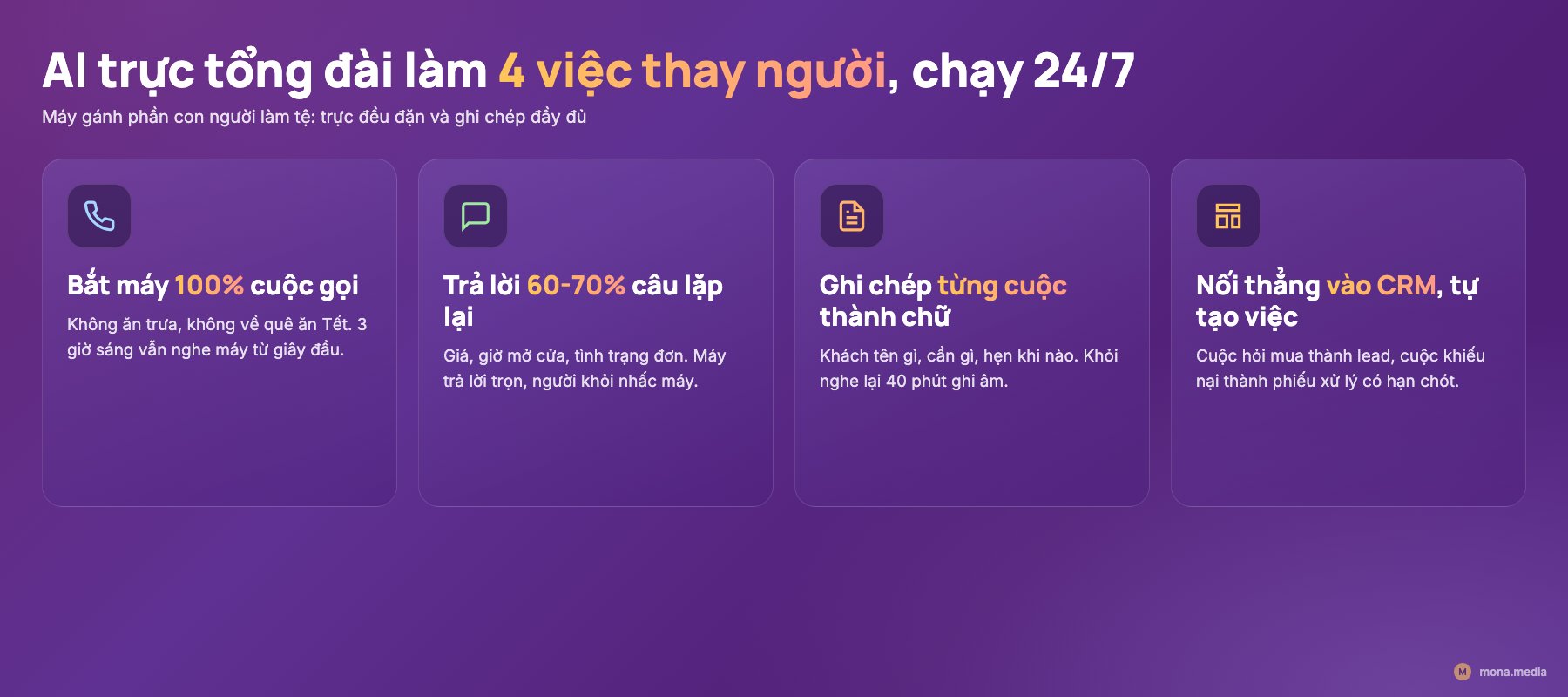
First, it answers 100% of calls. A machine doesn't go to meetings, take lunch breaks or go home for Tet. When a customer calls at 3 a.m. to report an incident, the AI still listens, records it and sends an alert to the person in charge. Second, it fully answers repeated questions, which usually make up 60-70% of all calls, from prices to warranty policy. Third, it takes notes for people. Each call becomes a text record with a summary: the customer's name, what they need, when they agreed to meet. A sales rep starting the morning shift already sees the full context and doesn't have to replay a 40-minute recording. Fourth, it connects straight into the workflow. A call asking to buy automatically becomes a lead in MONA's lead management system. A complaint call automatically becomes a ticket with a deadline, the same way we automate complaint handling for B2B teams. Those four jobs are why a modern virtual call center needs an AI answering.
A dental chain with 16 branches in Ho Chi Minh City and Hanoi, with revenue of around 31 billion VND a month. They used to hire 4 staff just to answer the phone for appointments. After we installed an AI to answer, the machine picks up about 400 calls a day from the first second, books appointments and sends reminders. Those 4 employees moved to on-site customer care, which a machine can never do. The cost of coverage dropped to a bit under half, and missed calls at peak hours fell to nearly zero.
Every industry has a time window when the phone rings nonstop, and that is exactly when analog and plain virtual call centers lose the most customers. Clinics and dental practices get a flood of appointment calls on Monday morning. Hotels get room inquiries at midnight from guests on late flights, and when connected to hotel front desk software the machine holds the room right away. Retail chains are overwhelmed by phone calls during every promotion. Transport companies take calls asking where the goods are all day long. Training centers get jammed lines in two enrollment seasons. The same feature also applies to spas, distributors, real estate exchanges and car rental businesses.
What these industries have in common: calls come in bursts, and the content repeats in patterns. That is the ideal condition for a machine to carry the heavy part. When customers message instead of calling, the same AI brain keeps answering on Zalo and Facebook via multichannel AI chatbot. It also follows up with customers for your sales team through an AI B2B sales assistant. The virtual call center is then no longer just a machine that answers the phone. It is the front door of your whole AI chatbot for business and the automation behind it.
This isn't theory: call 1900 636 648 any time of day and Gấu (our bear assistant) picks up, one brain on duty across phone, website chat, Messenger, Zalo and email at once. The running cost of the AI call center at MONA is about 3-4 million VND a month, while a call center operator is a profession of its own, hard to hire and hard to keep, paying 6-7 million VND while expecting 8-9 out of 10 in quality. See how it calls and books appointments at AI Agent telesales, and for the answering and lead collection side, see the AI Agent for automatic replies and lead management.
A plain virtual call center commonly costs 100,000 to 300,000 VND per extension per month, plus outbound call charges. The version with an AI answering adds AI charges per call minute or per call package. A company with 10 extensions usually spends 1 to 5 million VND a month depending on volume, still far below a single night shift.
Use a virtual call center early. Separating the company number from personal numbers from the start helps you keep customers when staff leave. A few hundred thousand VND a month is far cheaper than losing a regular customer just because the hotline number left with a former employee.
Yes in most cases. Both landlines and 1900/1800 hotlines can be ported between carriers or connected to a new virtual call center. You only need to ask the provider to confirm in writing before you sign, along with a specific transition time so the hotline is never down for a single day.
Vietnamese voice technology has moved past the stiff, odd-sounding stage. It sounds close to a real person and understands accents from all three regions. Real-world quality depends on how well the provider trains the machine on your industry's data. A simple way to check: ask them to let you call the live system they installed, instead of listening to a pre-recorded demo.
MONA has built software since 2016, with a team of 60+ people, over 14,000 projects delivered and 85% of customers coming back. We don't sell call centers as off-the-shelf boxes. The MONA technical team builds custom AI software and installs the AI answering on top of the virtual call center infrastructure. Then calls are connected all the way to the root of the workflow: booking appointments, creating orders, payment reminders, follow-up care. The management software behind it is Mona Software built specifically for each company's operations, running on Mona Host server infrastructure located in Vietnam. Customer data stays in your hands. As for the website and customer-facing channels, our website design team handles all of it so calls, messages and orders come together in one place. If you need a longer-term roadmap, start with a session digital transformation consultation your site overall.
You have spent years of ad budget getting customers to pick up the phone and call you, so don't let 30 seconds of an unanswered ring burn all that effort. Invest once in a virtual call center with an AI answering, and from then on every call is heard, recorded, and turned into work right afterwards. Call now 1900 636 648 or leave your number, 8 a.m. to 10 p.m. any day of the week. A MONA engineer calls back within 30 minutes and listens to how you currently receive customers. A call center design with a full-package quote reaches you within 48 hours. We quote the real price and commit to it, which is how we have kept 85% of customers coming back for over 10 years.
MONA Media is a website, software and AI solutions company founded in 2016, with a team of 60+ people. MONA has delivered over 14,000 projects with 85% of customers continuing to work with it, and specializes in installing virtual call centers integrated with a 24/7 AI answering for Vietnamese businesses. Contact the hotline now: 1900 636 648. Website: MONA Media.

CEO & Founder · The MONA
The founder of The MONA built a service company of 60+ staff with 14,000+ projects delivered. Khánh Hùng shares his thinking on building self-running systems, automating a business, and the real lessons behind MONA's projects.
 342




Professional website
design services
Own a website with a beautiful, 100% exclusive design and a lifetime warranty, with the ability
to expand features flexibly as your business grows, starting today!






 MONA will never sell your information or send you spam


 MONA will never sell your information or send you spam
