
 MONA OS 2.0
 Partner with MONA


 Tự động hoá doanh nghiệp
 Cẩm nang SEO
 Digital Marketing
 Kinh nghiệm thiết kế website
 Hạ Tầng Server
 Giáo dục


 VI
 EN












Message us on
Zalo Official


 ProductsNew

 ProductsProducts
 Mới ra mắtKHA AI 2027App tự edit video, tự đăng mọi mạng xã hội, 2 phút mỗi ngày










 Website designLooks good and wins customers over.
SEO servicesBrings in customers searching for exactly what you sell.
 Tư vấn digital marketingKéo khách từ nhiều kênh, đo bằng số thật.
Corporate video productionVideos introducing your company, factory and team.
 NewAI video productionCompany story films made with AI.
 Custom software developmentCRM, ERP and HRM built for your business.
 Viết AI Agent theo yêu cầuĐặt riêng một trợ lý AI cho đúng việc của mình.
 Tư vấn chuyển đổi AIĐưa AI vào vận hành của cả công ty.
NewMONA LMSManagement for centers and schools.
MONA SkillHubInternal training for company staff.
 NHTQ systemEnd-to-end China–Vietnam shipping operations.
MONA JMSManagement for gold, diamond and pawn shops.
 MONA E-LearningA website with every feature you need to sell courses.
 How to sell online courses (course)More than 30 free lessons on selling courses on autopilot.
 MONA Cloudmonacloud.vnServers to get your apps and websites running.
 MONA Basemonabase.vnPostgres database, sign-in and file storage.
 MONA Mailmonamail.vnSend OTP, order and invoice emails from your software.
 MONA Paymonapay.vnAccept bank transfers via VietQR and notify your software when the money arrives.
 MONA eInvoiceComing soonIssue e-invoices that meet tax standards.
Gấu CườiTrả lời khách 24/7 trên web, Fanpage, Zalo và thu lead cho sale.
 Gấu TeleSalesGọi điện tư vấn, chăm khách như tổng đài viên thật.
Dê CườiTư vấn và chốt đơn cho shop ngay trong khung chat.
Gấu WebmasterNhắn nhóm Zalo là website được sửa xong.
 Gấu Pháp ChếSoạn hợp đồng, rà điều khoản trong vài phút.
 Gấu Báo GiáLên báo giá đúng mẫu và gửi khách ngay.
 AI chăm sóc khách hàngTheo dõi và giữ chân khách hàng cũ.
 Gấu Tuyển DụngLọc hồ sơ, hẹn lịch, phỏng vấn ứng viên.
 Mới ra mắt
KHA AI 2027
Xây kênh chuyên gia 2 phút mỗi ngày
Quay bằng điện thoại, AI tự edit video, tự đăng lên 16 nền tảng và tự trả lời bình luận, tin nhắn.
884.102lượt xem trên kênh CEO MONA sau 36 ngày
 Anh Khánh HùngCEO MONA đang dùng mỗi ngày
Xem app làm được gì
 AI
Gấu Cười MONA ĐANG TỰ XÀITrả lời khách 24/7 trên website, Zalo OA, Messenger và thu lead về cho sale.
Dê CườiChốt đơn bán lẻ và sàn: Shopee, TikTok Shop, web. Chăm cả khách sỉ, đại lý.
Gấu WebmasterCập nhật nội dung, tối ưu SEO website mỗi ngày.
Gấu TeleSalesGọi điện tư vấn, chăm khách như tổng đài viên thật.
Gấu Tuyển DụngLọc hồ sơ, hẹn lịch, phỏng vấn ứng viên tự động.
AI chăm sóc khách hàngGiữ khách cũ, cứu lead đã rớt cho phòng kinh doanh.
Gấu Pháp ChếSoạn hợp đồng, rà điều khoản trong vài phút.
Gấu Báo GiáLên báo giá đúng mẫu, gửi khách ngay khi có yêu cầu.
 Chuyển đổi AI toàn phầnGiải pháp tổng cho doanh nghiệp, 3 lớp triển khai.
 Viết AI Agent theo yêu cầuĐặt riêng một con AI gánh đúng nghiệp vụ của bạn.
 Custom softwareCRM, ERP and HRM with built-in AI automation.
 SEO & AEO thời đại AIĐược Google lẫn AI trích dẫn, không chỉ xếp hạng.
 Kiến thức AI cho doanh nghiệpBài phân tích, hướng dẫn ứng dụng AI vào vận hành.
 Free AI courses
 AI tools at work
App mới · KHA AI 2027
Xây kênh 2 phút mỗi ngày
AI tự edit video, tự đăng mọi mạng xã hội
Free consultation, 8am–10pm every day

15 July, 2026
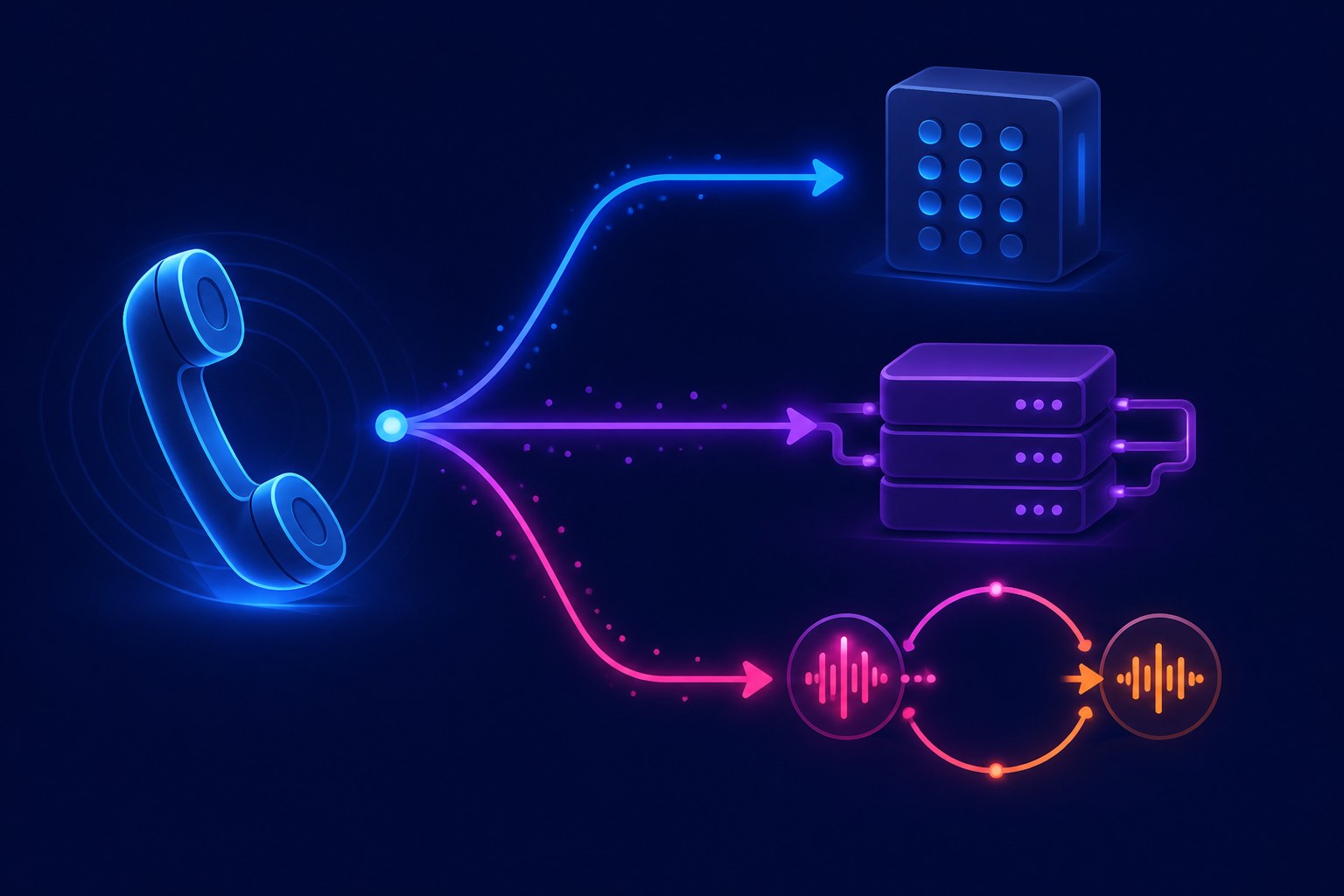
In 2026, Vietnamese business owners are being bombarded with AI calling demos. Every vendor plays a recording of a bot that sounds as smooth as a call center agent with 5 years of experience, then quotes a price with the word AI attached. What sellers rarely say: behind those demos are 3 very different architectures, running costs that differ by as much as ten times, and each architecture fits only one group of jobs.
Summary: AI call centers today come down to 3 architectures. If-else IVR suits rigid jobs like confirmations and lookups. The three-layer cascade carries most business calls. Speech-to-speech sounds as natural as a person but is expensive, worth it only for high-value calls. Choose by job, not by advertising.
In this article we break down each AI call center architecture in plain English, with a video of real recordings from the MONA call center so you can hear how the machine picks up. By the end, you will know which type your business needs, and you won't pay for the type you don't.
We see this scene again and again. A CEO of a beauty chain attends a conference and hears a demo bot advise on treatment plans so smoothly that the whole hall applauds. Back at the company, she signs a contract and pays for a year upfront.
Two weeks later, she opens the recordings from her own call center. A customer asks one question off script, and the bot repeats "sorry, I didn't understand" three times. The customer hangs up. The sales team shrugs and says the line every business owner dreads: "I told you, this AI is dumb."
The money is spent. The whole company's trust in automation goes with it. The pain isn't in the word AI. It's that those two AI call centers ran on two different architectures. The seller didn't say so, and the contract didn't either.
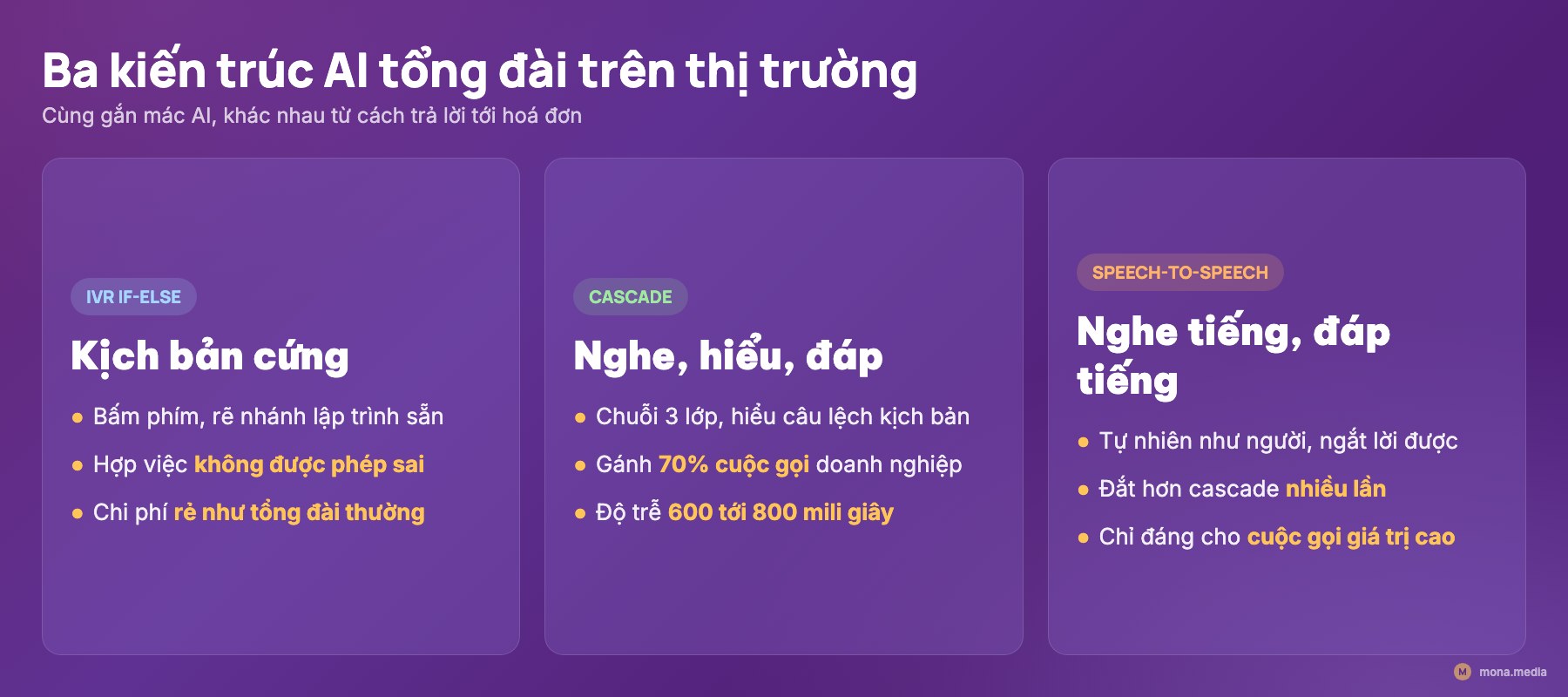
AI call centers on the market come down to exactly 3 architectures: if-else IVR running a rigid script, a three-layer cascade of listen, understand, respond, and speech-to-speech that hears audio and replies in audio. Every fancy commercial name is one of these three, or a mix of a few. The global conversational bot market has grown steadily for years according to Statistadata, which is why there are so many sellers now.
Sellers rarely open up the architecture layer, because doing so reveals two things. First, the base cost: for the same 2-minute call, one architecture costs a few hundred VND and another costs a few thousand. Second, the limits: an if-else bot will never be able to give advice, no matter how large the word AI is printed on the brochure.
You don't need to learn to code to tell them apart. You only need to understand how each type answers, as we explained the basics in the article what is conversational AI and what is an AI agent. The next three sections cover each type, in order from cheapest to most expensive.
If-else IVR is a fixed script tree: the customer presses a key or says a few keywords, and the system branches exactly as programmed, with no thinking beyond that. It's the "press 1 for accounting" call center you've heard at banks for decades, the ancestor of every modern chatbot. Most virtual call center services on the market already bundle this feature into the monthly subscription.
Many people dismiss this type as outdated. We see it the opposite way: it's the only type that should guard jobs that must never be wrong. Order confirmation, delivery status lookup, appointment reminders, confirming the amount to pay. These jobs need to be 100% right, not smooth-talking, and the rigid flow is how jobs like B2B debt collection automation run accurate to the last dong.
The costly mistake is making if-else do the advising. A customer asks "weekend room rate for 2 adults and 1 child," and the bot reads the 5-key menu again. The customer asks a second time, and the bot reads it again. That call doesn't just lose one order, it stamps "this company is awful" into the customer's mind. A rigid script is only good when the job is rigid, as we analyzed in the article phone call scripts for customers.
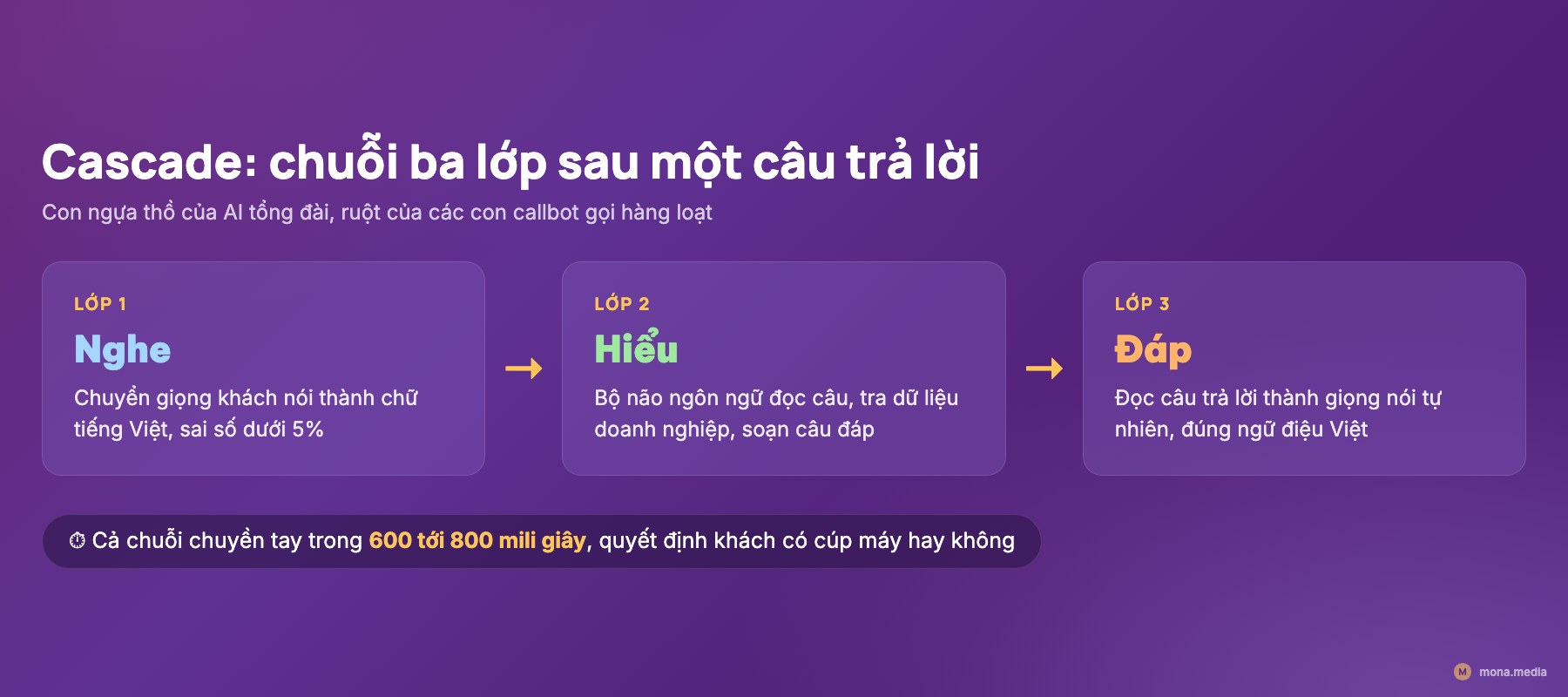
Cascade is a chain of three layers running one after another: the listening layer turns the customer's voice into text, the language brain reads the text and composes a reply, and the final layer reads that reply out as speech. We broke down these three layers in detail in the Vietnamese voice AI article, with measurements for each layer.
This is the workhorse of AI call centers, and also the core of mass outbound callbots. It understands off-script questions, looks up business data, switches regional accents, and costs little enough per minute to work through thousands of calls a day. For mid-market businesses, about 70% of call scripts can be handed to cascade. This is also the group of repetitive work that McKinsey sits in the clearly profitable zone of generative AI, especially in customer service.
The price is latency. Three layers handing off take 600 to 800 milliseconds, so there is a small pause between question and answer. Ordinary customers don't notice, but picky customers feel the line is a bit slow. The engineering that shortens this pause is the hard part, and it's what separates custom-built from off-the-shelf.
A real estate chain that MONA works with runs cascade to work through 1,000 calls a day across 28 branches, filtering out 60 to 80 hot leads a day. The real sales team works only with hot leads, and the close rate rose from 2.1% to 7.8% according to the chain's data. Every conversation is logged so quality can be monitored call by call, something a 30-person telesales room never manages.
If you want to hear real Vietnamese cascade instead of a staged demo, call 1900 636 648. Gấu Cười, the system now answering MONA's own call center, will pick up and answer like a real staff member, and even at 2 a.m. it still replies politely and fully.
Speech-to-speech (hear audio, reply directly in audio) drops the three-layer chain: a single model hears audio and generates reply audio, a typical example being OpenAI's gpt-realtime. There is no three-layer pause, the bot copes when interrupted, and its intonation rises and falls like a person's.
Many of you will want to lock in this type for the whole company. Before you do, weigh the unit price. Speech-to-speech bills per conversation minute at a rate many times higher than cascade. Use it to work through 5,000 cold numbers a month and the cost climbs past what the whole campaign's profit can carry.
It has one more weakness few people mention: it's hard to control. The model speaks on reflex, so pinning down every quoted number and every clause is much harder than with cascade, which has a control layer in the middle. Our principle: use this type for high-value calls, such as VIP care or keeping a customer about to leave, where one call is worth millions of VND in profit. It's like using your best people, and as we wrote in the article on AI replacing average staff, you don't put your best people on trivial tasks.
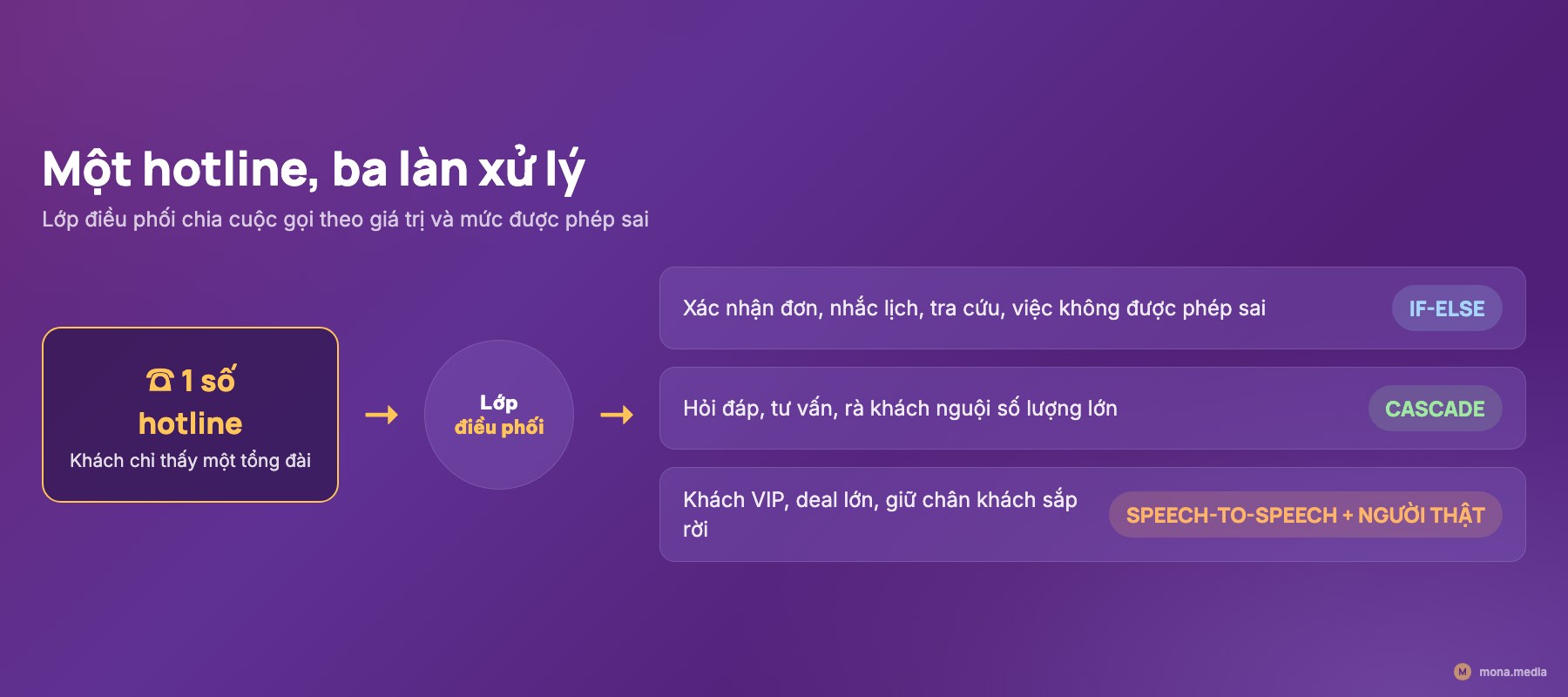
The right question when choosing an AI call center isn't "which architecture is best" but "how much is this call worth, and how wrong is it allowed to be?" Once you answer those two, the architecture reveals itself. Rigid, low-value jobs go to if-else. High-volume Q&A goes to cascade. High-value jobs go to speech-to-speech or straight to a real person.
A properly built AI call center for business has a routing layer at the front: on the same hotline number, order confirmation calls branch to the rigid flow, advisory calls branch to cascade, and VIP customers branch to a premium bot or an in-house staff member. The customer sees only one polite call center picking up from the first ring, and nothing behind it. The calling infrastructure underneath is still an internet-based call center, so if you're not yet familiar with that layer, read the article comparing 3 generations of virtual call centers first, then come back to pick an AI architecture.
This mix also solves the people problem. The call center team isn't replaced wholesale; they're pulled out of pointless repeat calls to work the calls that make money, the same human-plus-machine model that Harvard Business Review has shown works better than machines replacing people, in the spirit of the article on when to stop hiring and think about automation. New staff also reach standard faster because the machine carries all the repetitive answering. For a step-by-step rollout path, see our guide to AI-first for businesses.
The mixing principle is the same everywhere, only the proportions differ. Below are the formulas we often build for 6 familiar industries.
What all 6 industries share: the phone is just one channel. Customers message on Zalo, fanpage inbox, and website chat with the same question, and they want one consistent answer. So an AI call center should share a brain with your multichannel customer care system, not be a separate box.
What makes call center work hard isn't talking well, it's being on-call: you can sit idle for 8 hours, as long as the phone is picked up within 2 seconds of ringing, and on time across phone, Messenger, Zalo, and website chat all at once. That's very hard for a person, and machines are made for exactly that. MONA is running this for real on its own call center 1900 636 648. Details in AI chatbot for website and call center duty and AI Agent telesales.
An AI call center is a software system that automatically listens to and answers customer calls in place of on-duty staff. Depending on the architecture, it runs a rigid if-else script, a three-layer cascade of listen, understand, respond, or a speech-to-speech model that hears audio and replies in audio.
Cost depends on the architecture and call volume. If-else is as cheap as a regular call center, cascade is billed per minute at a rate low enough to work through thousands of calls a day, and speech-to-speech costs many times more than cascade, so it is only for high-value calls. MONA quotes by the specific workflow and sticks to the quoted price.
It can take over the repetitive work: working through cold leads, answering familiar questions, appointment reminders, and night and weekend coverage. Your best staff move over to closing calls and key customers, where machines cannot yet replace people.
Start when your call center has clear repetitive work and misses calls outside office hours. The safe way is to run a single workflow first, such as appointment reminders or night coverage, measure the results, then expand step by step to other workflows.
MONA doesn't sell a boxed bot and leave you to swim on your own. We survey your real call flows, build the routing layer, and write each if-else, cascade, and speech-to-speech flow separately for your business's actual jobs, then connect it to the CRM and management software you already use. For the structure of a sample product, see AI agent for auto-reply and lead management. The software runs on infrastructure operated by MONA Host and run by, the team Mona Software is responsible when something goes wrong, rather than blaming a third party.
Drag-and-drop off-the-shelf tools suit light personal use. A busy business running day and night needs production-grade software, where one wrong setting means orders drift away all night with nobody knowing. That is why we stick with custom-built software, automation all the way down, with per-call measurements so we can tune it once a week.
The living proof is Gấu Cười, the bot now covering all of MONA's own channels: web, fanpage, Zalo OA, and phone. You can hear it pick up for real at 1900 636 648, tap the chat bubble in the bottom right corner of this website, or go straight to Gấu Cười's trial chat room. We're confident enough to let you try the real thing before talking contracts, because this system covers our own duty every day.
If you've read this far, your call center is probably where money is leaking: customers calling during the lunch break and nobody answering, telesales working through cold leads with 28 calls hung up within 5 seconds, and call center payroll higher than the revenue it brings in. Don't patch it by hiring one more person, and don't bolt on yet another AI box. Call 1900 636 648 and tell us about your most painful call flow. We'll show you exactly which architecture that flow belongs to, how much it is worth investing, and run a trial of one step before you commit to anything bigger. We're ready to work with you from the survey to the day the bot answers the phone in place of a person, so take your time to look around before deciding.
MONA Media provides AI call center solutions and custom automation software for Vietnamese businesses. Operating since 2016, with a dedicated team, over 14,000 projects delivered, and 85% of customers staying on. The reference system is Gấu Cười, MONA's own multichannel duty bot. Hotline 1900 636 648, website mona.media.

CEO & Founder · The MONA
Founder of The MONA, who built a services company of 60+ staff with 14,000+ projects delivered. Khánh Hùng shares how he thinks about building systems that run themselves, automating a business, and the real lessons from delivering projects at MONA.
 278




Professional website
design services
Own a website with a beautiful, 100% exclusive design and a lifetime warranty, with the ability
to expand features flexibly as your business grows, starting today!






 MONA will never sell your information or send you spam


 MONA will never sell your information or send you spam
