
 MONA OS 2.0
 Partner with MONA


 Tự động hoá doanh nghiệp
 Cẩm nang SEO
 Digital Marketing
 Kinh nghiệm thiết kế website
 Hạ Tầng Server
 Giáo dục


 VI
 EN






Message us on
Zalo Official


 ProductsNew

 ProductsProducts
 Mới ra mắtKHA AI 2027App tự edit video, tự đăng mọi mạng xã hội, 2 phút mỗi ngày










 Website designLooks good and wins customers over.
SEO servicesBrings in customers searching for exactly what you sell.
 Tư vấn digital marketingKéo khách từ nhiều kênh, đo bằng số thật.
Corporate video productionVideos introducing your company, factory and team.
 NewAI video productionCompany story films made with AI.
 Custom software developmentCRM, ERP and HRM built for your business.
 Viết AI Agent theo yêu cầuĐặt riêng một trợ lý AI cho đúng việc của mình.
 Tư vấn chuyển đổi AIĐưa AI vào vận hành của cả công ty.
NewMONA LMSManagement for centers and schools.
MONA SkillHubInternal training for company staff.
 NHTQ systemEnd-to-end China–Vietnam shipping operations.
MONA JMSManagement for gold, diamond and pawn shops.
 MONA E-LearningA website with every feature you need to sell courses.
 How to sell online courses (course)More than 30 free lessons on selling courses on autopilot.
 MONA Cloudmonacloud.vnServers to get your apps and websites running.
 MONA Basemonabase.vnPostgres database, sign-in and file storage.
 MONA Mailmonamail.vnSend OTP, order and invoice emails from your software.
 MONA Paymonapay.vnAccept bank transfers via VietQR and notify your software when the money arrives.
 MONA eInvoiceComing soonIssue e-invoices that meet tax standards.
Gấu CườiTrả lời khách 24/7 trên web, Fanpage, Zalo và thu lead cho sale.
 Gấu TeleSalesGọi điện tư vấn, chăm khách như tổng đài viên thật.
Dê CườiTư vấn và chốt đơn cho shop ngay trong khung chat.
Gấu WebmasterNhắn nhóm Zalo là website được sửa xong.
 Gấu Pháp ChếSoạn hợp đồng, rà điều khoản trong vài phút.
 Gấu Báo GiáLên báo giá đúng mẫu và gửi khách ngay.
 AI chăm sóc khách hàngTheo dõi và giữ chân khách hàng cũ.
 Gấu Tuyển DụngLọc hồ sơ, hẹn lịch, phỏng vấn ứng viên.
 Mới ra mắt
KHA AI 2027
Xây kênh chuyên gia 2 phút mỗi ngày
Quay bằng điện thoại, AI tự edit video, tự đăng lên 16 nền tảng và tự trả lời bình luận, tin nhắn.
834.956lượt xem trên kênh CEO MONA sau 27 ngày
 Anh Khánh HùngCEO MONA đang dùng mỗi ngày
Xem app làm được gì
 AI
Gấu Cười MONA ĐANG TỰ XÀITrả lời khách 24/7 trên website, Zalo OA, Messenger và thu lead về cho sale.
Dê CườiChốt đơn bán lẻ và sàn: Shopee, TikTok Shop, web. Chăm cả khách sỉ, đại lý.
Gấu WebmasterCập nhật nội dung, tối ưu SEO website mỗi ngày.
Gấu TeleSalesGọi điện tư vấn, chăm khách như tổng đài viên thật.
Gấu Tuyển DụngLọc hồ sơ, hẹn lịch, phỏng vấn ứng viên tự động.
AI chăm sóc khách hàngGiữ khách cũ, cứu lead đã rớt cho phòng kinh doanh.
Gấu Pháp ChếSoạn hợp đồng, rà điều khoản trong vài phút.
Gấu Báo GiáLên báo giá đúng mẫu, gửi khách ngay khi có yêu cầu.
 Chuyển đổi AI toàn phầnGiải pháp tổng cho doanh nghiệp, 3 lớp triển khai.
 Viết AI Agent theo yêu cầuĐặt riêng một con AI gánh đúng nghiệp vụ của bạn.
 Custom softwareCRM, ERP and HRM with built-in AI automation.
 SEO & AEO thời đại AIĐược Google lẫn AI trích dẫn, không chỉ xếp hạng.
 Kiến thức AI cho doanh nghiệpBài phân tích, hướng dẫn ứng dụng AI vào vận hành.
 Free AI courses
 AI tools at work
App mới · KHA AI 2027
Xây kênh 2 phút mỗi ngày
AI tự edit video, tự đăng mọi mạng xã hội
Free consultation, 8am–10pm every day

18 March, 2023
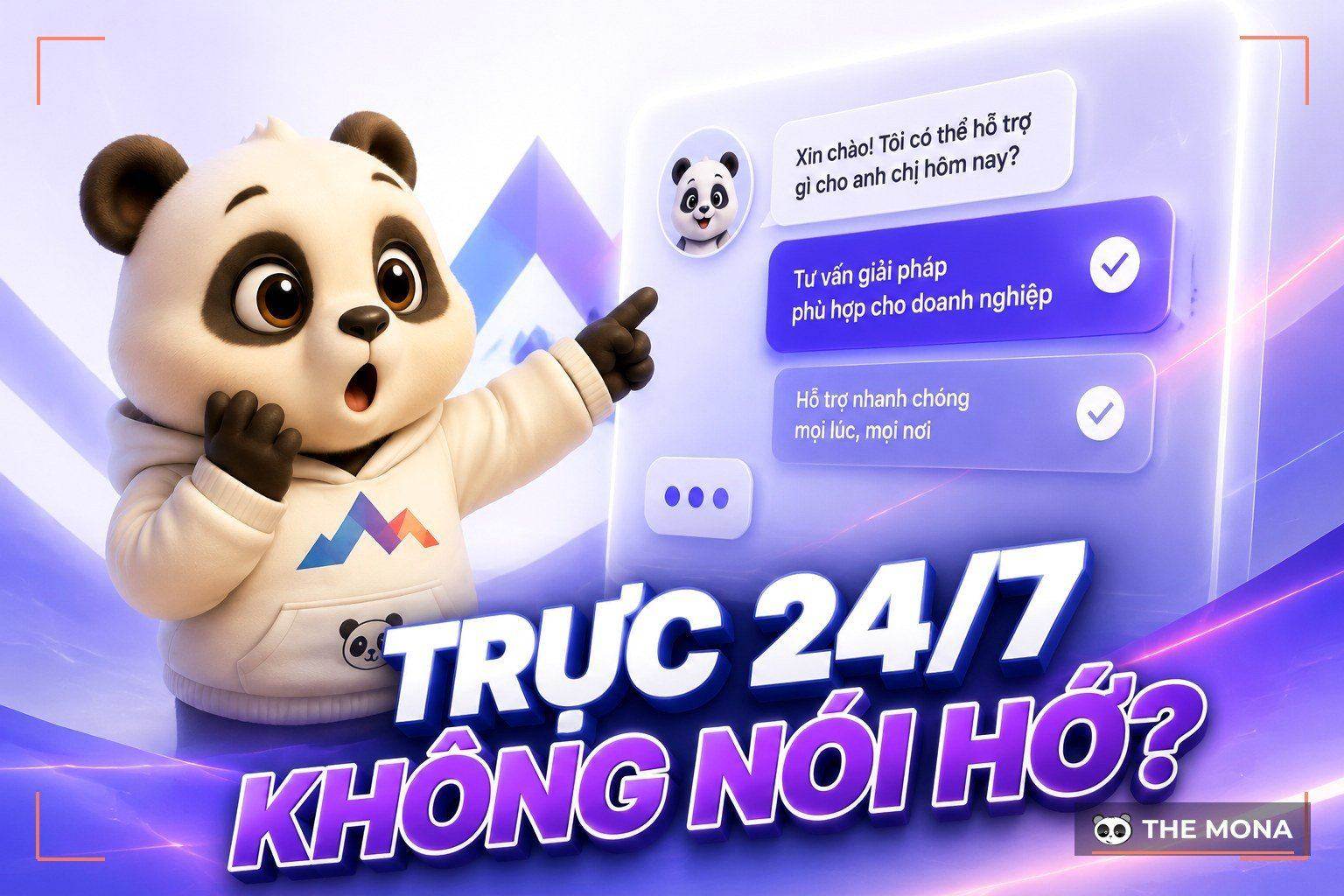
An AI chatbot is software that replies to messages automatically using a language model. It understands what customers type in natural language, instead of making them tap buttons like older scripted chatbots. It reads a business's own documents to answer correctly about its products, covers the website, Zalo and Messenger 24/7, and knows when to hand over to a real person.
MONA guesses you clicked on this article in one of two moods. One is curiosity: you keep hearing about chatbots but can't picture what they are or what they could do for your company. The other is that you have already tried a bot, found its answers silly, and now doubt the whole idea.
Both moods are fair, because two very different things on the market are called by the same name, chatbot. In this article we explain each one clearly: how an AI chatbot works, what it costs, and which industries should install one. After reading, you can decide for yourself without trusting any seller's word, ours included.
An AI chatbot is a program that uses a large language model (LLM) to understand and answer customer messages like a consultant. Unlike a scripted chatbot that only responds to preset buttons, an AI chatbot understands free-form questions, including abbreviations, spelling mistakes, and three questions in one sentence.
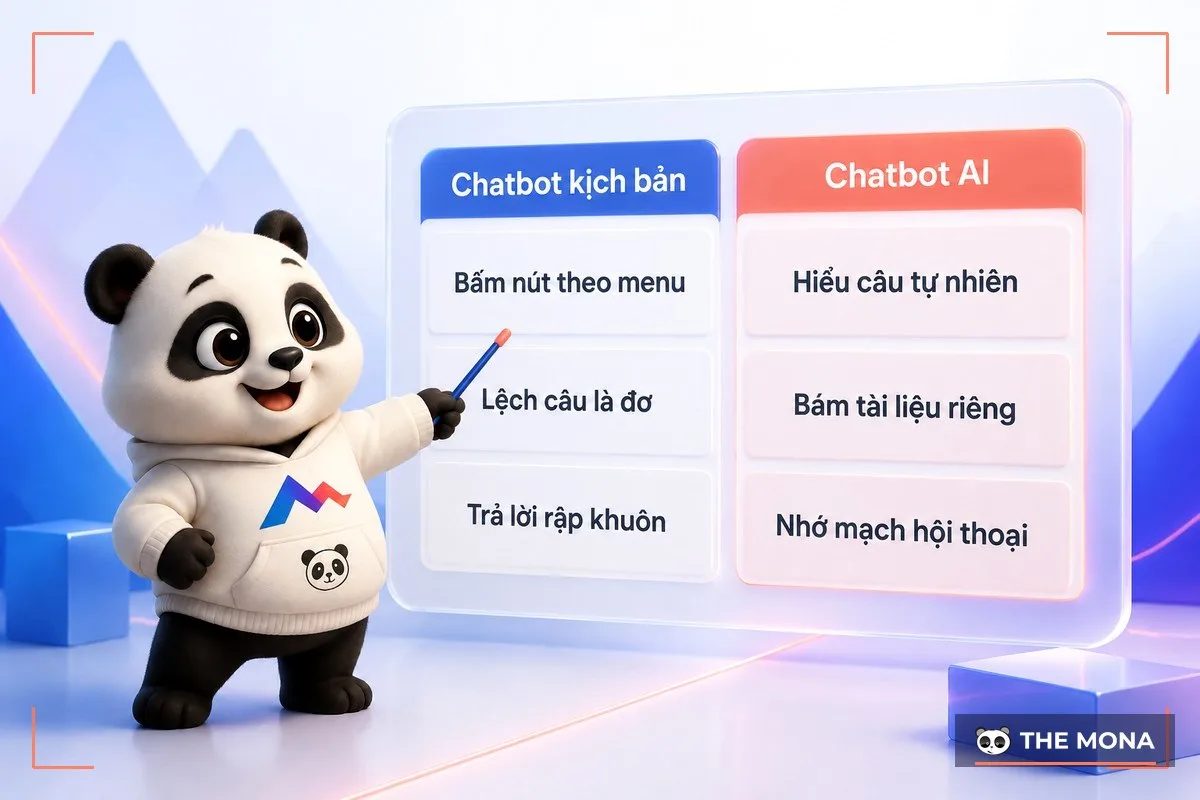
To make this easier to picture, three things on the market often get mixed up:
In software circles, an AI chatbot that can work toward goals on its own is also called an AI Agent. You don't need to remember every name. Just remember one line: the old bot takes button taps, the new bot understands human language.
A scripted chatbot isn't bad, it was just given the wrong job. It suits tasks that are fixed in advance and must not go wrong: confirming orders, announcing appointment times, looking up exam scores. Where there is only one right path, it is safe to hand the job to it.
Trouble starts when it is made to give advice. A beauty clinic chain with 20 branches in Ho Chi Minh City and Hanoi, with revenue of around 40 billion VND a month, had put a button-based bot on its fanpage before coming to us. The manager told us the story with some lingering resentment: a customer wrote, "my skin often gets hidden acne and I'm breastfeeding, which treatment can I do", and the bot replied with the menu "Press 1 for prices, press 2 for addresses". The customer typed the question again, and the bot gave the same menu again. She said the most embarrassing part was a customer who screenshotted the chat and sent it to a women's group with the words "talking to a wall".

The customer's annoyance is easy to understand. They have a real need, they tell their story, and what they get back is a vending machine. Each time, the business loses more than an order. It loses the feeling that "someone here cares about me", which is what service businesses live on.
So if you have tried a chatbot and found it disappointing, what disappointed you was a scripted bot given the wrong job of giving advice. It wasn't an AI chatbot.
A serious AI chatbot has three layers: a language model, its own knowledge base, and a bridge into the business's live data. Missing any one layer, it becomes a toy.
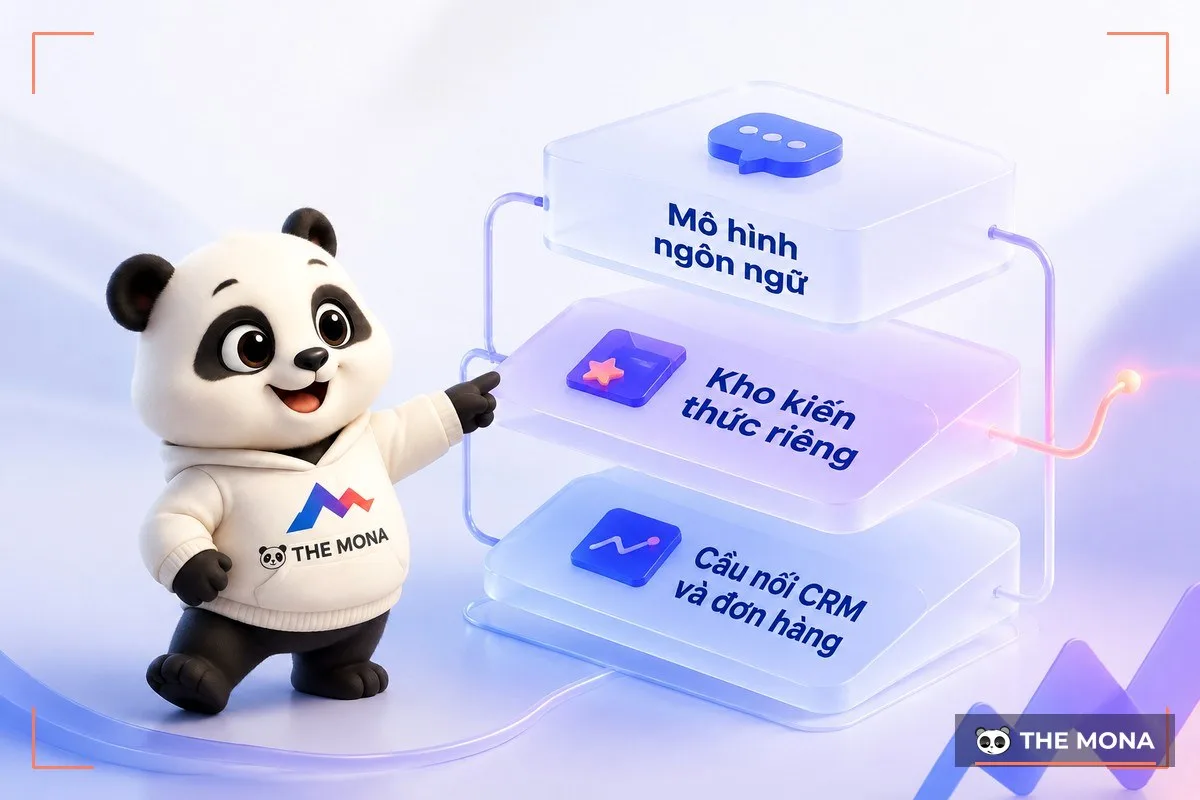
Layer one is the language model. This is the brain that understands human language, trained in advance by companies such as OpenAI, Anthropic and Google. Anyone can rent this part, so it is not any one provider's advantage.
Layer two is the knowledge base. Price lists, warranty policies, descriptions of each service, the questions customers often ask. The bot is loaded with your actual documents, so it answers with your company's information rather than generic knowledge from the internet. This layer decides whether the bot is smart or dumb, and it is also the part that takes the most work to do properly.
Layer three is the bridge into live data. The bot connects to management software, CRM, inventory and orders so it can answer with real numbers: whether an item is in stock, where an order is, which time slots are free. Without this layer the bot only makes small talk. With it, the bot starts doing real work. This is also why we always say automation has to go all the way down to the data, and that putting a chat window on a website is not enough.
Response speed isn't about politeness, it's about money. A study published in Harvard Business Review surveying 2,241 US companies found that following up within one hour of a customer leaving their details makes a real conversation seven times more likely than waiting past the second hour. Waiting until the next day is almost a lost cause.
Now look at your own customers' messaging pattern. When do people have time to look into a spa, a course or an apartment? During the lunch break, and from 9 pm to 1 am, when the kids are asleep. That is exactly when your staff have switched off. A message arrives at 11 pm and nobody reads it until 8:30 the next morning. Nine and a half hours go by, and the customer has already messaged three competitors, one of whom has already replied.
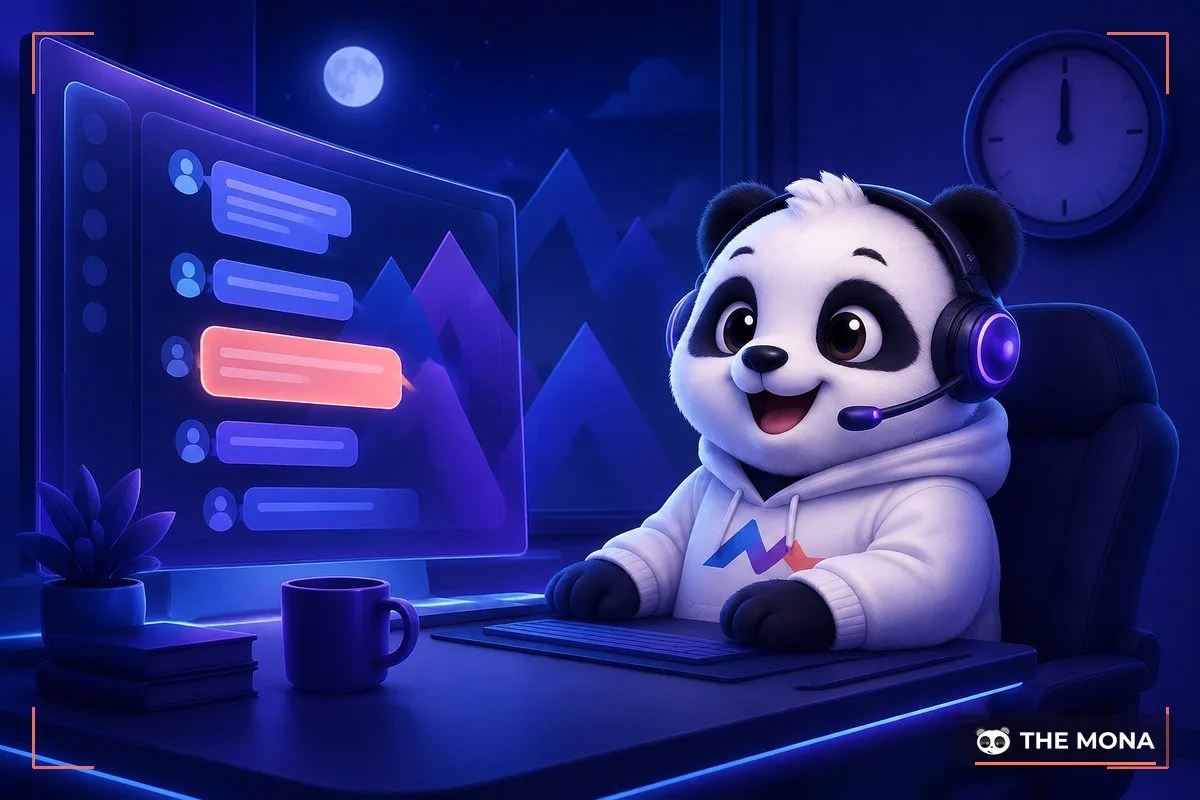
Try the math with your own numbers. How much do you spend on ads each month to get one message? Multiply that by the number of messages that arrive outside working hours each month. That is money spent on conversations nobody answered. It isn't that you are reluctant to pay for night staff. Even if you hire them it doesn't cover everything, since night-shift staff get sleepy in the morning and someone asks for leave every month.
This is exactly the kind of work to give to an AI chatbot. If you want to see what an AI chatbot on night duty really looks like, message Gấu Cười right on the MONA website. Message it at 1 am with the exact question your staff struggle with and see how it handles it. If you want to set a trickier trap, take along our chatbot demo handbook with 7 trap questions . We let it handle the sales chat window on our own site, that's how confident we are.
One AI chatbot brain can cover every channel customers message through: the website chat window, Zalo OA, Messenger, fanpage comments and e-commerce marketplaces. A customer on any channel meets the same "employee" who knows the same material, and every chat flows into one place for the sales team to follow.
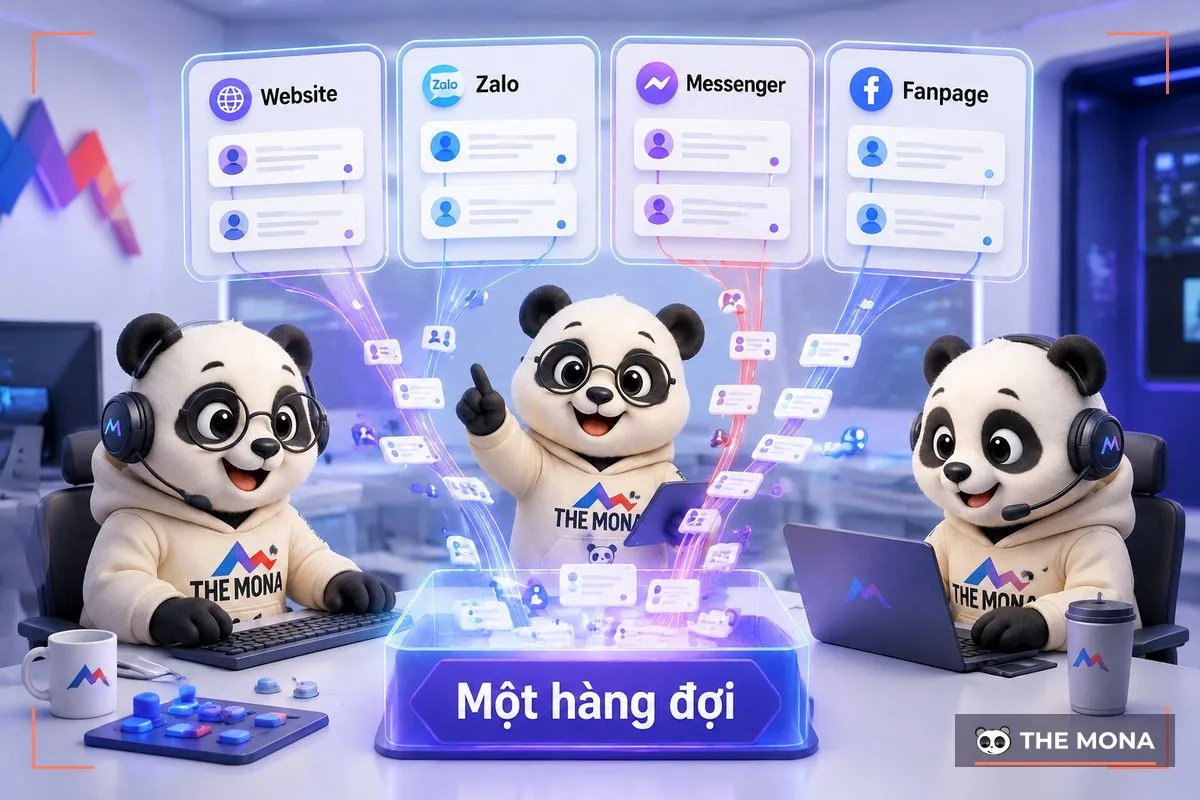
Gartner forecasts that by 2027 chatbots will be the main customer care channel for about a quarter of businesses. That's the big trend. In practice, a chatbot can handle four groups of work:
Phone calls are handled by AI telesales that calls to advise like a call center agent . Chat and calls work together: the chat bot collects information day and night, and the calling bot follows the hot list at good times.
Any industry with lots of repeated messages and customers who often message outside working hours will see the difference in the first month of installing an AI chatbot. According to the survey McKinsey's The state of AI, the area where businesses worldwide use generative AI most is marketing and sales, because that is where results show up fastest.
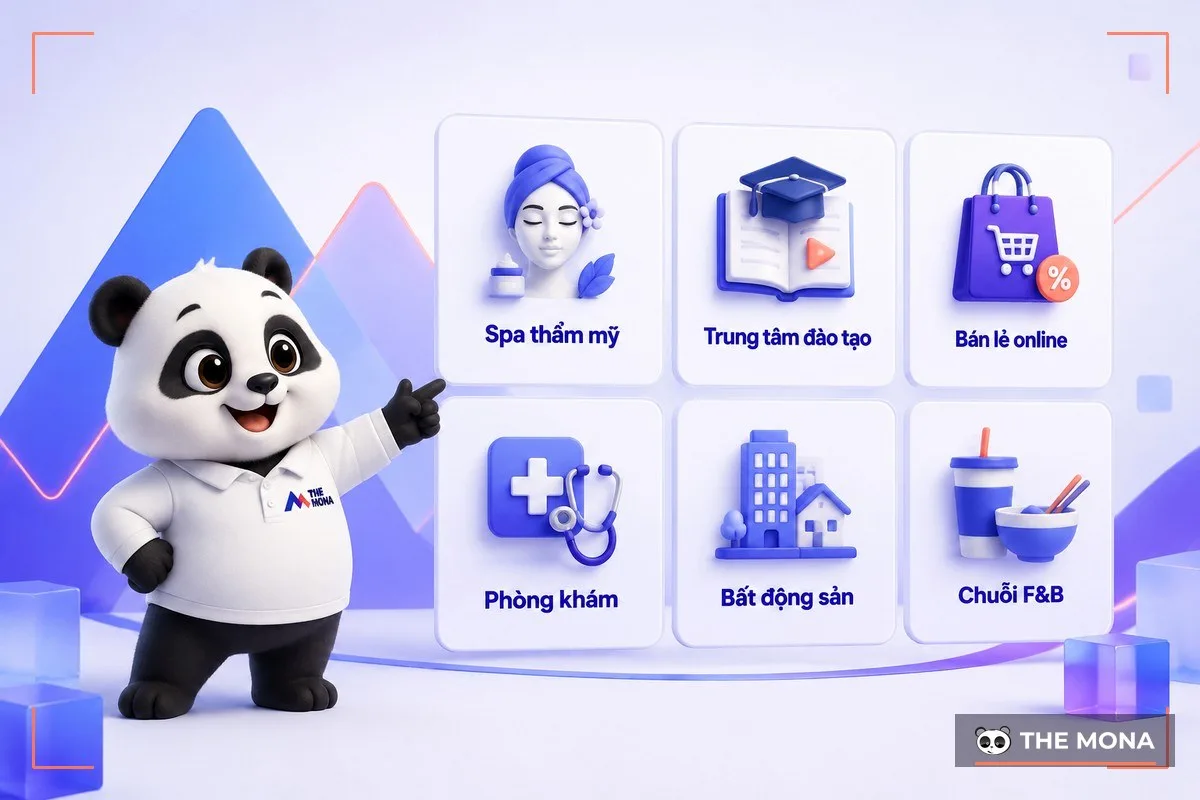
From the projects we have delivered, these six industries fit best:
If you don't see your industry above, don't jump to conclusions. The core of "answer repeated questions, collect information, pass hard cases to people" is the same in every industry. What differs is the knowledge base loaded in. However specialized the industry, we can build a custom AI around your own operations.
The Vietnamese market has three price tiers: scripted bots at a few hundred thousand VND a month, ready-made rented AI chatbots at a few million, and custom AI chatbots connected to your systems from 5 million VND a month upward. Each tier has its place. What matters is buying the right size.
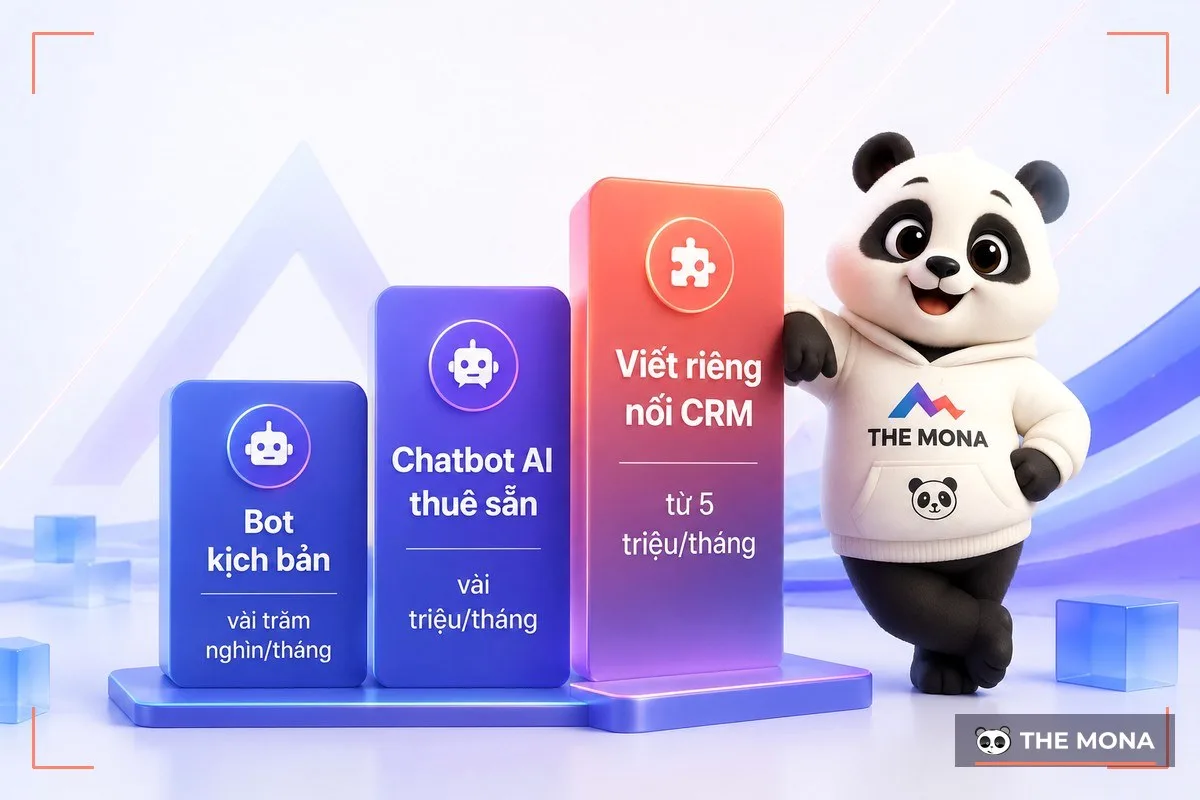
Low-cost scripted bot suits fixed tasks: confirming orders, lookups, handing out vouchers. A small shop selling one or two products can do fine with it, so don't dismiss it.
Ready-made AI chatbot on a plan answers far more naturally and sets up quickly. The trade-off is that it uses the same template for every renter, is hard to connect deeply to your own management software, and conversation data sits on another company's platform.
Custom AI chatbot is the tier for businesses that already have processes, a CRM and several branches. The bot is tailored to the business operations, connects straight into live data, and has an engineering team responsible when changes are needed. MONA's Gấu Cười plan starts at 5 million VND a month. Compare that with the cost of a night-shift employee, before insurance, holiday bonuses, and the fact that people have to sleep while machines don't, and you can judge for yourself.
One honest note: the most expensive cost is often choosing the wrong size, more than the software fee. A business with 20 branches that uses a ready-made bot that can't connect to its booking system will end up removing it and starting over three months later, paying twice.
For an AI chatbot to face customers safely, three safeguards must be in place first: hard-locked prices, blocked topics, and a threshold for handing over to a real person. This is what separates a bot built for serious business from a demo bot built for fun.
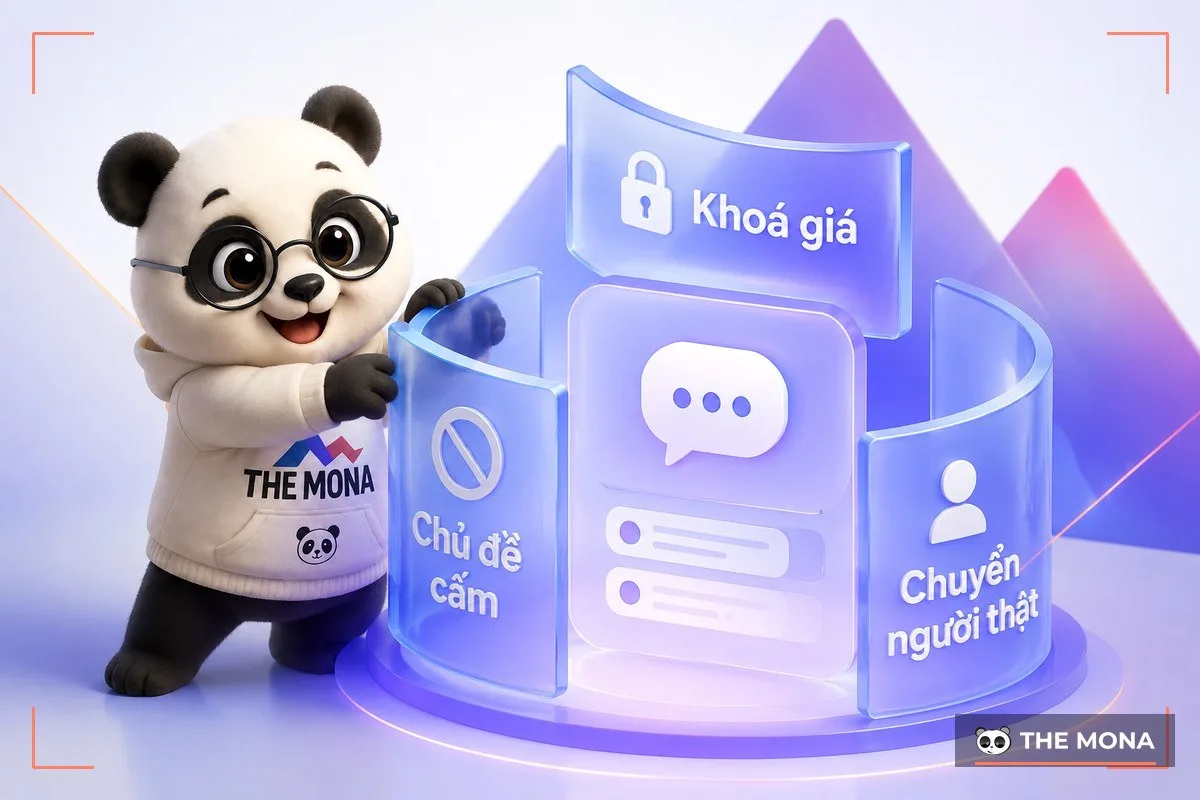
Price lock: the bot may only read prices from the official price list. It may not infer them or promise discounts. When a customer says "give me a little discount", the bot points them to the current promotion or passes them to sales, and does not invent an offer.
Off-limits topics: areas the bot must not discuss, such as disparaging competitors, giving medical advice beyond its remit, or promising results. If someone tries to bait it, the bot politely steps around. If a customer screenshots the chat and posts it online, it still has to read as a decent conversation.
When to hand over to a person: a bot has to know its limits. When a customer is angry, the case is complicated or the order is large, it brings in a real person, along with a summary of the whole conversation so the customer does not have to explain again from the start. A smart bot knows its limits and knows when to stay quiet and let a person speak.
After launch comes the loop that keeps the AI chatbot improving: reviewing the chats where it struggled, adding documents and fixing the script, a little each week. This loop is what makes the bot in month three far better than in month one. MONA runs this loop for clients as part of the plan, because we run exactly the same loop for ourselves. The whole process of MONA automating MONA's own work has been recorded in numbers: the number of customers leaving their details went up 9 times while operating costs fell 60%.
Good enough to try, not good enough to run a business on. Free AI chatbots usually limit the number of messages, cannot load much of your own documentation, do not connect to a CRM, and nobody is responsible when the bot answers wrong. Using one to understand the technology is fine, but putting it on your main fanpage risks more than the money you save.
Yes, it understands. An AI chatbot running a recent language model can read "ib mik nha" (message me), "bn tien" (how much) and "ship hcm ko" (do you ship to Ho Chi Minh City) and reply in proper Vietnamese. The condition is that the bot is loaded with the right terms for your industry, such as treatment names, product line names and the shorthand customers commonly use.
Yes, and that is the better setup. One AI chatbot shares a single knowledge base, connects to several chat channels, and every conversation flows into one unified customer record. Running a separate bot for each channel costs more and fragments your customer data.
No, and be wary of anyone who promises that. The bot takes over the on-duty work, answers repeated questions, and filters and collects information, which is about 70 to 80 percent of the message volume. Closing big deals and handling sensitive cases is still done by people. The bot frees your sales team to close, it does not put them out of work.
A ready-made AI chatbot is set up in days. A custom build connected to MONA's systems usually takes one to two weeks to get a bot that can really take over, including one session to receive your documents, a few days to load and train it, then a supervised parallel run before it goes fully automatic.
It depends on the provider. The minimum standard you should ask for: chat data stored on infrastructure you control, access permissions for viewing, and a commitment from the bot builder not to use your data to serve other customers. For projects MONA delivers, the data sits on MONA Host server infrastructure in Vietnam, separated for each client.
Reading about it is one thing, trying it is what settles the decision. We suggest a concrete plan that costs nothing to start.
Today: open the page for MONA's AI chatbot, and send Gấu Cười the exact question that customers use to trip up your staff. See how it copes, whether it slips up, and whether it knows to ask for contact details. This is the same bot that handles all of MONA's own chat window, not a separate version built for show.
During the week: collect your own numbers. How many messages you get each month, how many arrive outside working hours, and how much ad spend works out to per message. Remember the calculation above: every message outside working hours that nobody answers is ad money that benefits your competitor.
Once the numbers are clear: call us on the hotline 1900 636 648, or leave a message for Gấu Cười right away. We will listen to the problem and tell you plainly which tier fits your size, even when the answer is "you don't need an AI chatbot yet, do this first". We quote one price and keep to it.
The MONA Group has built software and automation solutions since 2016. We now have 60+ staff and have delivered more than 14,000 projects, with an 85% client return rate. The Gấu Cười AI chatbot is a product of MONA's AI Agent suite, developed by the Mona Software team and run on infrastructure in Vietnam. If you want to learn more about using AI in your work, see MONA's free AI courses or the program at Khánh Hùng Academy. AI chatbot consultation hotline: 1900 636 648, available 8:00 to 22:00 every day.
We are ready to work with you from the first test message, and you do not need to sign anything. So tonight, will anyone be answering your company's chat window?

CEO & Founder · The MONA
Founder of The MONA, who built a services company of 200+ staff with 14,000+ projects delivered. Khánh Hùng shares how he thinks about building systems that run themselves, automating a business, and the real lessons from delivering projects at MONA.
 1,5K




Professional website
design services
Own a website with a beautiful, 100% exclusive design and a lifetime warranty, with the ability
to expand features flexibly as your business grows, starting today!






 MONA will never sell your information or send you spam


 MONA will never sell your information or send you spam
