
 MONA OS 2.0
 Partner with MONA


 Tự động hoá doanh nghiệp
 Cẩm nang SEO
 Digital Marketing
 Kinh nghiệm thiết kế website
 Hạ Tầng Server
 Giáo dục


 VI
 EN










Message us on
Zalo Official


 ProductsNew

 ProductsProducts
 Mới ra mắtKHA AI 2027App tự edit video, tự đăng mọi mạng xã hội, 2 phút mỗi ngày










 Website designLooks good and wins customers over.
SEO servicesBrings in customers searching for exactly what you sell.
 Tư vấn digital marketingKéo khách từ nhiều kênh, đo bằng số thật.
Corporate video productionVideos introducing your company, factory and team.
 NewAI video productionCompany story films made with AI.
 Custom software developmentCRM, ERP and HRM built for your business.
 Viết AI Agent theo yêu cầuĐặt riêng một trợ lý AI cho đúng việc của mình.
 Tư vấn chuyển đổi AIĐưa AI vào vận hành của cả công ty.
NewMONA LMSManagement for centers and schools.
MONA SkillHubInternal training for company staff.
 NHTQ systemEnd-to-end China–Vietnam shipping operations.
MONA JMSManagement for gold, diamond and pawn shops.
 MONA E-LearningA website with every feature you need to sell courses.
 How to sell online courses (course)More than 30 free lessons on selling courses on autopilot.
 MONA Cloudmonacloud.vnServers to get your apps and websites running.
 MONA Basemonabase.vnPostgres database, sign-in and file storage.
 MONA Mailmonamail.vnSend OTP, order and invoice emails from your software.
 MONA Paymonapay.vnAccept bank transfers via VietQR and notify your software when the money arrives.
 MONA eInvoiceComing soonIssue e-invoices that meet tax standards.
Gấu CườiTrả lời khách 24/7 trên web, Fanpage, Zalo và thu lead cho sale.
 Gấu TeleSalesGọi điện tư vấn, chăm khách như tổng đài viên thật.
Dê CườiTư vấn và chốt đơn cho shop ngay trong khung chat.
Gấu WebmasterNhắn nhóm Zalo là website được sửa xong.
 Gấu Pháp ChếSoạn hợp đồng, rà điều khoản trong vài phút.
 Gấu Báo GiáLên báo giá đúng mẫu và gửi khách ngay.
 AI chăm sóc khách hàngTheo dõi và giữ chân khách hàng cũ.
 Gấu Tuyển DụngLọc hồ sơ, hẹn lịch, phỏng vấn ứng viên.
 Mới ra mắt
KHA AI 2027
Xây kênh chuyên gia 2 phút mỗi ngày
Quay bằng điện thoại, AI tự edit video, tự đăng lên 16 nền tảng và tự trả lời bình luận, tin nhắn.
883.362lượt xem trên kênh CEO MONA sau 36 ngày
 Anh Khánh HùngCEO MONA đang dùng mỗi ngày
Xem app làm được gì
 AI
Gấu Cười MONA ĐANG TỰ XÀITrả lời khách 24/7 trên website, Zalo OA, Messenger và thu lead về cho sale.
Dê CườiChốt đơn bán lẻ và sàn: Shopee, TikTok Shop, web. Chăm cả khách sỉ, đại lý.
Gấu WebmasterCập nhật nội dung, tối ưu SEO website mỗi ngày.
Gấu TeleSalesGọi điện tư vấn, chăm khách như tổng đài viên thật.
Gấu Tuyển DụngLọc hồ sơ, hẹn lịch, phỏng vấn ứng viên tự động.
AI chăm sóc khách hàngGiữ khách cũ, cứu lead đã rớt cho phòng kinh doanh.
Gấu Pháp ChếSoạn hợp đồng, rà điều khoản trong vài phút.
Gấu Báo GiáLên báo giá đúng mẫu, gửi khách ngay khi có yêu cầu.
 Chuyển đổi AI toàn phầnGiải pháp tổng cho doanh nghiệp, 3 lớp triển khai.
 Viết AI Agent theo yêu cầuĐặt riêng một con AI gánh đúng nghiệp vụ của bạn.
 Custom softwareCRM, ERP and HRM with built-in AI automation.
 SEO & AEO thời đại AIĐược Google lẫn AI trích dẫn, không chỉ xếp hạng.
 Kiến thức AI cho doanh nghiệpBài phân tích, hướng dẫn ứng dụng AI vào vận hành.
 Free AI courses
 AI tools at work
App mới · KHA AI 2027
Xây kênh 2 phút mỗi ngày
AI tự edit video, tự đăng mọi mạng xã hội
Free consultation, 8am–10pm every day

19 May, 2026

One of the AI applications with the fastest results is an AI customer care assistant, which helps a business avoid leaving any customer behind.
This article won't talk in vague theory. We will point out 9 practical applications by department, from Marketing, Sales and Customer Care to HR and Operations. More importantly, it suggests where you should start to see results fastest, and how to integrate without tearing down the whole old system that is still running.
You can skip every complicated textbook definition. For us, applying AI in business has just one goal: give software the repetitive work your employees do by hand every day.
This core difference comes from two technologies that have matured since 2023. One is the ability of large language models to read and write Vietnamese as naturally as a real person. The other is the ability of computer vision to “see” and recognize text, images and invoices.
It is very different from older software such as CRM or ERP that we are used to. Those systems are only places to record work that has already happened. Sales staff still type each customer's details into the CRM themselves. Accountants still sit down at the end of the month to reconcile and compile reports by hand. Marketing staff copy customer information from Facebook comments into Excel files manually. The software is just an electronic notebook that doesn't work by itself.
Software with AI is much more proactive. It reads, understands and carries out work by itself. For example, AI can read a paper invoice from a photo. It extracts the item names, quantities and unit prices and enters them straight into the accounting software with no data entry person. It can answer customers' repeated questions on Zalo at midnight. People only need to review the final result when necessary.
Why do you need to tell these two kinds apart? Buying an old piece of software labeled “AI” by mistake is literally burning money. The burden of data entry and report compiling stays on your team's shoulders. You pay for the software and also pay salaries to staff doing manual work that a machine could automate. A true AI application in business must reduce human work hours, not create more work for them.
AI is not a new concept. But for most Vietnamese businesses, before 2023 it almost only existed on paper. Older systems were too expensive, hard to deploy and, worst of all, didn't really understand Vietnamese. Things only changed when two foundational technology pillars matured. They turned AI from something distant into a practical business tool you can actually hold.
This is the technology that lets computers read, summarize and write text like a person. The core difference is that AI now truly understands Vietnamese. It picks up context, tone, even whether a Vietnamese speaker is being casual or formal. Because of that, software can draft emails answering customers' common questions by itself. It summarizes a 50-page contract in a few minutes and points out the clauses to watch. It can also watch messages on Zalo or Facebook 24/7 and reply to customers naturally. These are things no machine could do just 5 years ago.
This technology lets computers “see” and understand data from images or video. It used to be very expensive and only accurate in ideal conditions. Now it is cheap enough and reliable enough for everyday business. Software with computer vision can automatically read and extract information from paper invoices. You just take a photo and the system enters the data into the accounting software. It can look at a shelf through a camera and report which items are running low. It also automatically checks whether the product photos staff post on e-commerce platforms meet the standard.
When you combine these two pillars, you get software that can run repetitive processes by itself. The software reads email, understands the request, finds information in images, then drafts a reply. This is the essence of modern using AI in business . They don't replace the decision-maker; they cut the cost of work that doesn't create new revenue. This approach produces practical AI systems, also known as AI Native which MONA has covered in a detailed analysis. That is why the period from now to 2026 is the golden window for rolling out automation.
When we talk about AI applications, you don't need to think about robots or anything complicated. It's simply using software to automatically do the repetitive tasks that staff spend hours on every day. We have put together 9 specific jobs that AI software can take over, spread across departments from sales and operations to HR.
The biggest pain for retail chains and service businesses is missing customers who message outside office hours. A message asking for a price at 10 p.m. on Saturday usually sits “hanging” until Monday morning. By then the customer has bought from a competitor. LLM technology now lets you build virtual assistants that reply automatically on Zalo, Facebook and your website in Vietnamese as natural as a real person. It doesn't just reply by script; it understands the customer's intent, advises on products and books appointments. This fully replaces 2 to 3 night-shift staff, making sure no potential customer is left behind.
Accounting teams spend a huge number of hours typing data from paper invoices, contracts and payment slips into software by hand. This work creates no new value and is easy to get wrong. Computer Vision (machine vision) combined with OCR can read, understand and automatically extract every piece of information on a document. The software fills in the supplier name, tax code, amount and date in the right fields of your accounting system. Errors drop to almost zero, and accountants are freed from data entry to focus on financial analysis.
Are you tired of waiting 3 days at the end of every month for department heads to compile business reports? Every decision ends up based on last week's or last month's data. AI can connect straight to your data sources (sales, inventory, CRM) and automatically assemble them into a clear tracking dashboard. Every metric updates in real time, second by second. You can see at once which branch is losing revenue and which product is selling well, and decide immediately with no delay.
Sales teams often waste resources calling every customer on a list without knowing who really needs the product. AI can analyze interaction history, demographics and customer behavior to score how “hot” each lead is. The system automatically ranks them and hands the highest-scoring customers to your salespeople first. This keeps the sales team focused on the right people at the right time and raises the closing rate noticeably.
Sudden stockouts cost revenue. Too much stock ties up cash. AI solves this in two ways. First, Computer Vision lets cameras in the warehouse recognize and count products on the shelves and update the system automatically. Second, it analyzes historical sales data and market trends to forecast exactly how much to order next week and next month. The system also warns you automatically when raw materials or products are running low.
Customer care staff often do a manual chore: copy customer details (name, phone number, address) from Zalo or Facebook and then create the order in the CRM or sales system by hand. This is slow, error-prone, and information gets lost. Software with an integrated LLM can read and understand the conversation, recognize the customer's order details and push them straight into your management software. Everything happens instantly with no human involved, so 100% of the data is recorded correctly.
Each job post can bring in hundreds or even thousands of applications (CVs). HR has to read every one to pick out a few suitable candidates, which takes a great deal of time. AI can read and analyze a whole batch of CVs in a few minutes. It matches the experience and skills in each CV against the job requirements and returns a shortlist of the 5-10 best fits. That way, the hiring team can focus on interviewing only the strongest people.
For businesses selling on e-commerce marketplaces, making sure thousands of product images follow the rules (white background, correct size, no stray logos) is a real challenge. Instead of having staff check each image, Computer Vision can scan and approve them in bulk. The system automatically detects images that fail the standard and sends them back for fixing. This keeps your shop consistent and professional, and saves dozens of work hours every week.
New employees, and long-time ones too, keep asking the same questions about company procedures, leave policy and how to use internal software. These questions interrupt managers and HR. A virtual assistant “taught” all of the company's documents, handbooks and rules can answer them around the clock. Employees just type a question, and the AI finds and returns an accurate answer from official sources, keeping the information consistent.
Most of the 9 jobs above are fixed salaries you pay every month, yet they do not directly produce new revenue. These are the most practical and effective uses of AI in business, because they cut wasteful operating costs. If you want to automate these processes in your own company, you can see how MONA did it for large chains on the page business automation.
We see many of you in a hurry to roll out AI to every department at once. A little for marketing, a little for accounting, a little for HR. This scattered approach usually leads to one result: money gets burned, processes get messier, and staff are confused about which tool to follow. We should not start this way.
The smartest starting point is to pick work that meets three conditions. First, it repeats every day. Second, it eats a lot of staff hours. Third, its result can be measured right away. The most typical examples are answering customer messages on Zalo and Facebook, typing hundreds of invoices a week by hand in accounting, or compiling business reports from dozens of branches at the end of each day.
The goal of your first AI project is not to change the whole company. The goal is a small but clear win within 90 days. When salespeople see a chatbot answering 80% of basic questions by itself, they worry less about losing their jobs. When accounting no longer has to stay late to enter data, they become the ones who push for automation. A visible result persuades better than any meeting.
That is the theory, but how do you know exactly which task is “burning” the most work hours in your business? The only way is to sit down and review it systematically. You need a clear list: which department, which task, how many hours a week, how many people doing it. From that list, we can identify which one using AI in business brings the fastest payback. If you need a framework to start with, we have a detailed process ready. You can look at the process business AI Audit that MONA has built.
That is the theory, but what about in practice? Let us share a few specific cases where MONA built automation software directly for businesses in Vietnam. These are not distant visions, but real money and real work hours you can calculate yourself.
Have you ever winced at the report of Zalo and Facebook messages piling up from 10 pm Saturday to Monday morning? A spa chain with 28 branches in Ho Chi Minh City and Hanoi was in exactly that spot. Potential customers messaged to ask about lifting treatments and hair removal packages. But the consultants had already gone home. On Monday morning the customer would say “I booked somewhere else.” Each message like that meant a loss of several million to tens of millions of VND in revenue.
We built them an AI assistant integrated directly into Zalo and Messenger. This AI was trained on their own data: services, price list, and the open slots of all 28 branches. When a customer asks at midnight, it answers automatically, recommends a suitable package and books the appointment straight into the system. As a result, 90% of after-hours messages are handled instantly, recovering roughly 400-500 million VND in lost revenue every month.
A system of 35 F&B restaurants was struggling with operating costs. Every day, hundreds of paper invoices from suppliers poured into the accounting department. They needed 3 employees just to type every line by hand, from “10kg Australian beef” to “5kg lettuce”, into the inventory software. The work cost fixed salaries, invited mistakes, and did not bring in a single extra dong of revenue.
The solution was software using computer vision. Warehouse staff just take a photo of the invoice with their phone. The system reads it automatically, extracts item names, quantities and unit prices, and pushes them straight into the ERP. It even warns you if a purchase price is higher than last week. This let the restaurant chain cut all 3 data entry positions, saving more than 70 million VND a month in salaries and insurance, with no more manual typing errors.
With an education system of more than 40,000 online students, the academic affairs office was always overloaded. They spent thousands of work hours a month just grading multiple-choice tests, then sending emails and Zalo messages to remind each student to log in and do their assignments. This took up all their time and kept them from the more important job of giving in-depth support and keeping students enrolled.
MONA integrated an AI module into their LMS, MONA EduCenter. The AI grades multiple-choice tests automatically as soon as students submit them. Based on each person's progress, it also sends personalized messages to remind and encourage them. As a result, the academic affairs office cut 70% of its manual workload and gained time to truly look after students and improve training quality.
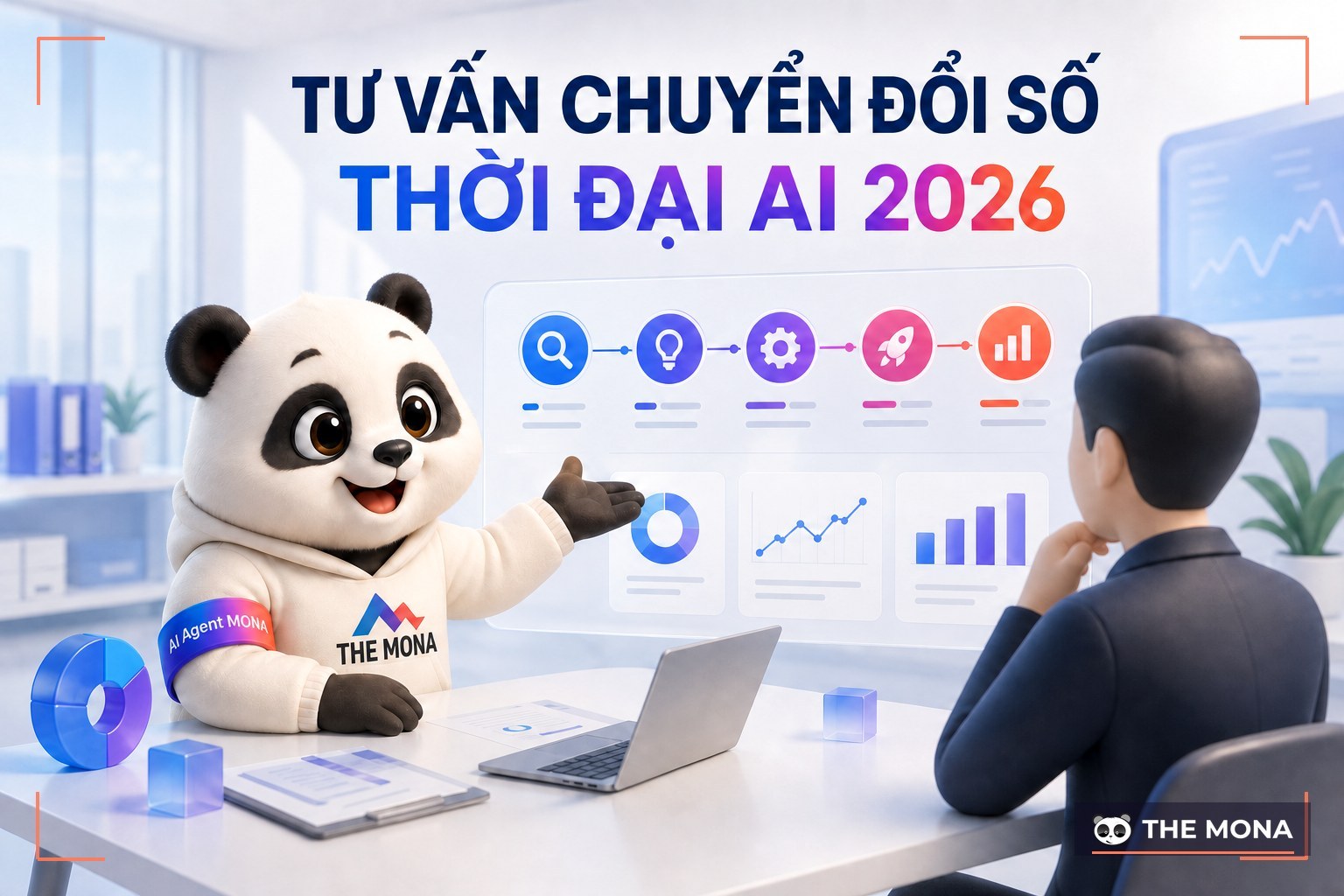
What do the examples above have in common? The most using AI in business effective ones are nothing fancy. They simply let machines do the repetitive work that follows clear rules. This frees people to focus on work that needs creativity, judgment and human connection. So in your operation, which step uses the most staff on repetitive work? To find out exactly which department can be automated and save costs, you can look at the service digital transformation consultation package from MONA?
Many of you assume that adopting AI means tearing down your old systems. That you have to rebuild your management software, CRM and ERP from scratch. This is the most mistaken and most expensive way of thinking, and it keeps many business owners from ever starting. The truth is you do not need a major operation costing billions of VND. Your current system is still a solid foundation.
Instead of thinking big, look straight at the manual tasks that eat your staff's time every day. That is where to apply AI first. Does your customer service team answer the same questions about price, address and warranty policy every single day? Does accounting type hundreds of invoices by hand every week? Those are perfect places to start.
We can start with ready-made AI tools, or simply connect the APIs of large language models to the software you already use. A few specific examples:
After about 30 to 60 days, when one or two small processes are automated and you can clearly see the cost savings, it is time to think about the next step. At this point, we analyze together and build specialized AI modules designed for your business's particular operations. That could be an inventory forecasting system, a customer behavior analysis tool, or an AI that checks product quality from images.
The biggest difficulty for business owners is not choosing which technology or how to write the code. The real challenge is that you have to decide alone, with no one you trust enough to ask, while employees quietly resist out of fear of losing their jobs. They will never back a project that could make their position redundant. We spoke frankly about this loneliness CEOs face in the article AI-First Handbook for Businesses. That is the real obstacle to remove when rolling out AI in a business, not servers or algorithms.
The upfront cost of building a custom system can be higher than off-the-shelf software. But you need to do the long-term math.
An automated system cuts salaries for many repetitive positions, such as data entry or answering basic messages. Typically, a business pays back its investment within 6 to 12 months, depending on the size and complexity of the process.
The answer is yes, very much. AI helps small businesses work in an organized, professional way from day one and avoids clumsiness when they scale.
You do not necessarily have to build your own software right away. You can start with ready-made AI tools to get used to the new way of working. Once the process is stable, that is the time to think about an automation system of your own.
AI does not replace all employees, especially roles that need judgment, creativity and strategic decisions. It replaces repetitive tasks and middleman roles that only pass data along.
Examples include an employee who enters orders from email into the system, or one who compiles reports by hand at the end of each day. Applying AI in business frees good people to focus on higher-value work.
This is a common and completely valid worry. With MONA's solutions, we build separate software for each business.
All of your data sits on your own server infrastructure and is not shared with any third party. You have full control over your business data.
If you pick the right priorities, you can see clear results within the first 90 days. We usually start with “easy wins” like automating customer replies or automatically extracting invoice information.
These changes cut staff work hours right away. They also build momentum and confidence for rolling out deeper automation across the whole company.
The first step is to identify which process in your company wastes the most time and manpower. You can contact MONA for a free review session.
We will go through your current process with you and point out where automation brings the biggest return. Call MONA on the hotline 1900 636 648 or email info@themona.global.
We understand that applying AI is not a trend you follow for show. It is a practical way to cut operating costs and remove repetitive work hours. But applying it in the wrong place or the wrong way is the fastest way to burn money, and it causes needless disruption for your team.
MONA was founded in 2016 with a team of dozens of professionals. We have completed more than 9,600 projects for more than 12,000 customers, with 85% coming back to use our services. The difference is that we both advise and have our own team that builds the custom software. You will not have to look for another company to do the programming after hearing our advice.
This week, try listing the 5 tasks that eat the most work hours in your company. Then mark which of them repeat daily or weekly. Send that list to info@themona.global or call 1900 636 648 so MONA can set up a review session. Or you can first look at our digital transformation consulting service . In the first session we sell nothing. We simply work with you to point out exactly where applying AI in your business can replace manual effort and save money.

CEO & Founder · The MONA
The founder of The MONA built a service company of 60+ staff with 14,000+ projects delivered. Khánh Hùng shares his thinking on building self-running systems, automating a business, and the real lessons behind MONA's projects.
 1,6K




Professional website
design services
Own a website with a beautiful, 100% exclusive design and a lifetime warranty, with the ability
to expand features flexibly as your business grows, starting today!






 MONA will never sell your information or send you spam


 MONA will never sell your information or send you spam
