
 MONA OS 2.0
 Partner with MONA


 Tự động hoá doanh nghiệp
 Cẩm nang SEO
 Digital Marketing
 Kinh nghiệm thiết kế website
 Hạ Tầng Server
 Giáo dục


 VI
 EN












Message us on
Zalo Official


 ProductsNew

 ProductsProducts
 Mới ra mắtKHA AI 2027App tự edit video, tự đăng mọi mạng xã hội, 2 phút mỗi ngày










 Website designLooks good and wins customers over.
SEO servicesBrings in customers searching for exactly what you sell.
 Tư vấn digital marketingKéo khách từ nhiều kênh, đo bằng số thật.
Corporate video productionVideos introducing your company, factory and team.
 NewAI video productionCompany story films made with AI.
 Custom software developmentCRM, ERP and HRM built for your business.
 Viết AI Agent theo yêu cầuĐặt riêng một trợ lý AI cho đúng việc của mình.
 Tư vấn chuyển đổi AIĐưa AI vào vận hành của cả công ty.
NewMONA LMSManagement for centers and schools.
MONA SkillHubInternal training for company staff.
 NHTQ systemEnd-to-end China–Vietnam shipping operations.
MONA JMSManagement for gold, diamond and pawn shops.
 MONA E-LearningA website with every feature you need to sell courses.
 How to sell online courses (course)More than 30 free lessons on selling courses on autopilot.
 MONA Cloudmonacloud.vnServers to get your apps and websites running.
 MONA Basemonabase.vnPostgres database, sign-in and file storage.
 MONA Mailmonamail.vnSend OTP, order and invoice emails from your software.
 MONA Paymonapay.vnAccept bank transfers via VietQR and notify your software when the money arrives.
 MONA eInvoiceComing soonIssue e-invoices that meet tax standards.
Gấu CườiTrả lời khách 24/7 trên web, Fanpage, Zalo và thu lead cho sale.
 Gấu TeleSalesGọi điện tư vấn, chăm khách như tổng đài viên thật.
Dê CườiTư vấn và chốt đơn cho shop ngay trong khung chat.
Gấu WebmasterNhắn nhóm Zalo là website được sửa xong.
 Gấu Pháp ChếSoạn hợp đồng, rà điều khoản trong vài phút.
 Gấu Báo GiáLên báo giá đúng mẫu và gửi khách ngay.
 AI chăm sóc khách hàngTheo dõi và giữ chân khách hàng cũ.
 Gấu Tuyển DụngLọc hồ sơ, hẹn lịch, phỏng vấn ứng viên.
 Mới ra mắt
KHA AI 2027
Xây kênh chuyên gia 2 phút mỗi ngày
Quay bằng điện thoại, AI tự edit video, tự đăng lên 16 nền tảng và tự trả lời bình luận, tin nhắn.
886.120lượt xem trên kênh CEO MONA sau 36 ngày
 Anh Khánh HùngCEO MONA đang dùng mỗi ngày
Xem app làm được gì
 AI
Gấu Cười MONA ĐANG TỰ XÀITrả lời khách 24/7 trên website, Zalo OA, Messenger và thu lead về cho sale.
Dê CườiChốt đơn bán lẻ và sàn: Shopee, TikTok Shop, web. Chăm cả khách sỉ, đại lý.
Gấu WebmasterCập nhật nội dung, tối ưu SEO website mỗi ngày.
Gấu TeleSalesGọi điện tư vấn, chăm khách như tổng đài viên thật.
Gấu Tuyển DụngLọc hồ sơ, hẹn lịch, phỏng vấn ứng viên tự động.
AI chăm sóc khách hàngGiữ khách cũ, cứu lead đã rớt cho phòng kinh doanh.
Gấu Pháp ChếSoạn hợp đồng, rà điều khoản trong vài phút.
Gấu Báo GiáLên báo giá đúng mẫu, gửi khách ngay khi có yêu cầu.
 Chuyển đổi AI toàn phầnGiải pháp tổng cho doanh nghiệp, 3 lớp triển khai.
 Viết AI Agent theo yêu cầuĐặt riêng một con AI gánh đúng nghiệp vụ của bạn.
 Custom softwareCRM, ERP and HRM with built-in AI automation.
 SEO & AEO thời đại AIĐược Google lẫn AI trích dẫn, không chỉ xếp hạng.
 Kiến thức AI cho doanh nghiệpBài phân tích, hướng dẫn ứng dụng AI vào vận hành.
 Free AI courses
 AI tools at work
App mới · KHA AI 2027
Xây kênh 2 phút mỗi ngày
AI tự edit video, tự đăng mọi mạng xã hội
Free consultation, 8am–10pm every day

01 June, 2026
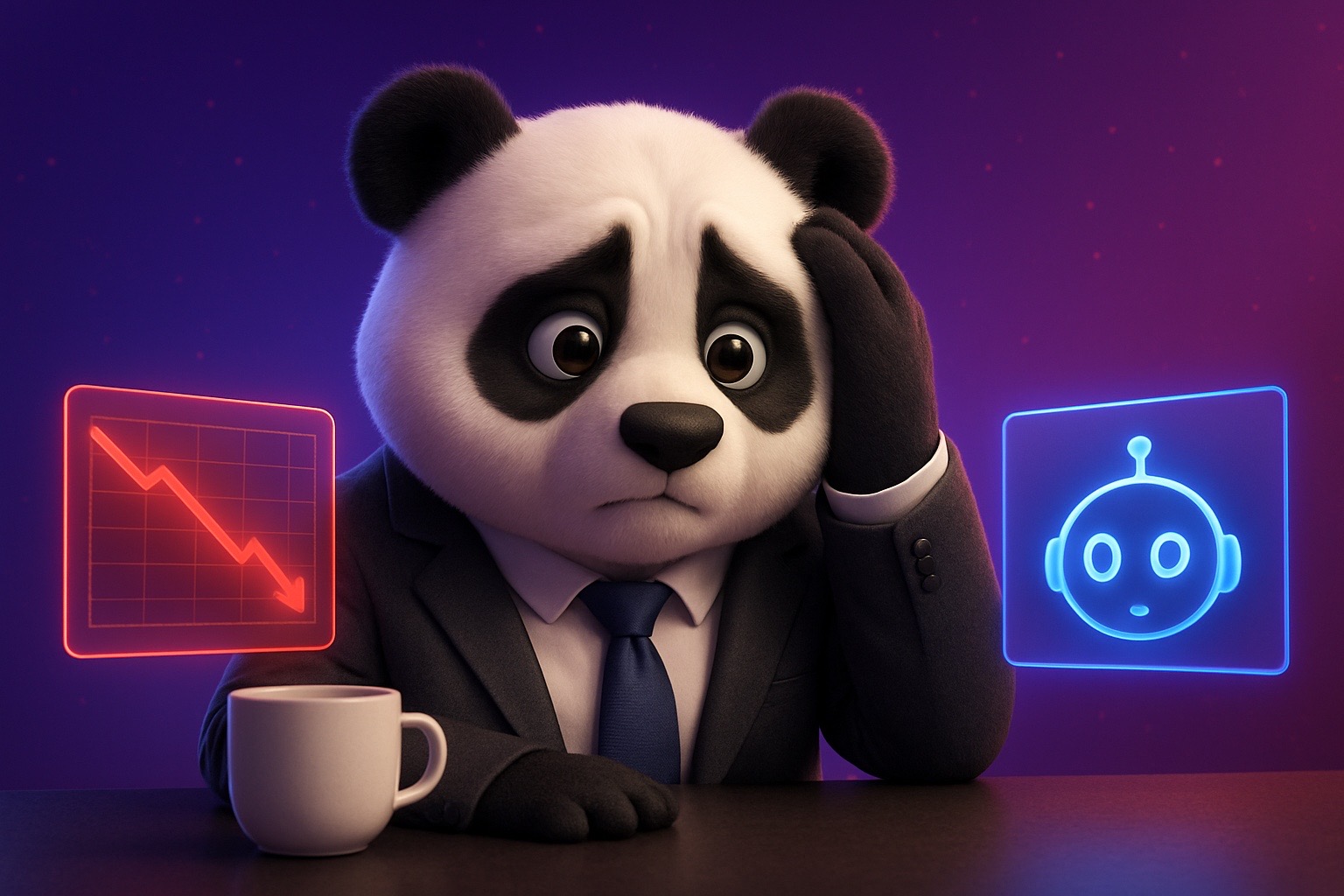
Why do 80% of Vietnamese businesses fail at rolling out AI? In early 2026, MONA sat down and counted nearly 30 mid-market Vietnamese businesses we had worked with over 18 months. The number was a bit harsh: about 80% of them had bought AI and paid for ChatGPT Team and Claude Pro, yet were still doing AI halfway, the old Vietnamese way, with no numbers to show. You can check it yourself: marketing uses AI to write posts, but the old process is unchanged; customer care has a chatbot, yet still has 4 people on the phones; the boss posts on LinkedIn “my company has adopted AI”, but the revenue report doesn't move. Why Vietnamese businesses fail at rolling out AI comes down to 5 specific mistakes. See more how employees react when you roll out AI. Any business owner can fix them in 30 days without hiring outside help. We'll say it straight, no beating around the bush.

See more: AI chatbot demo: chat with a real MONA bot, free
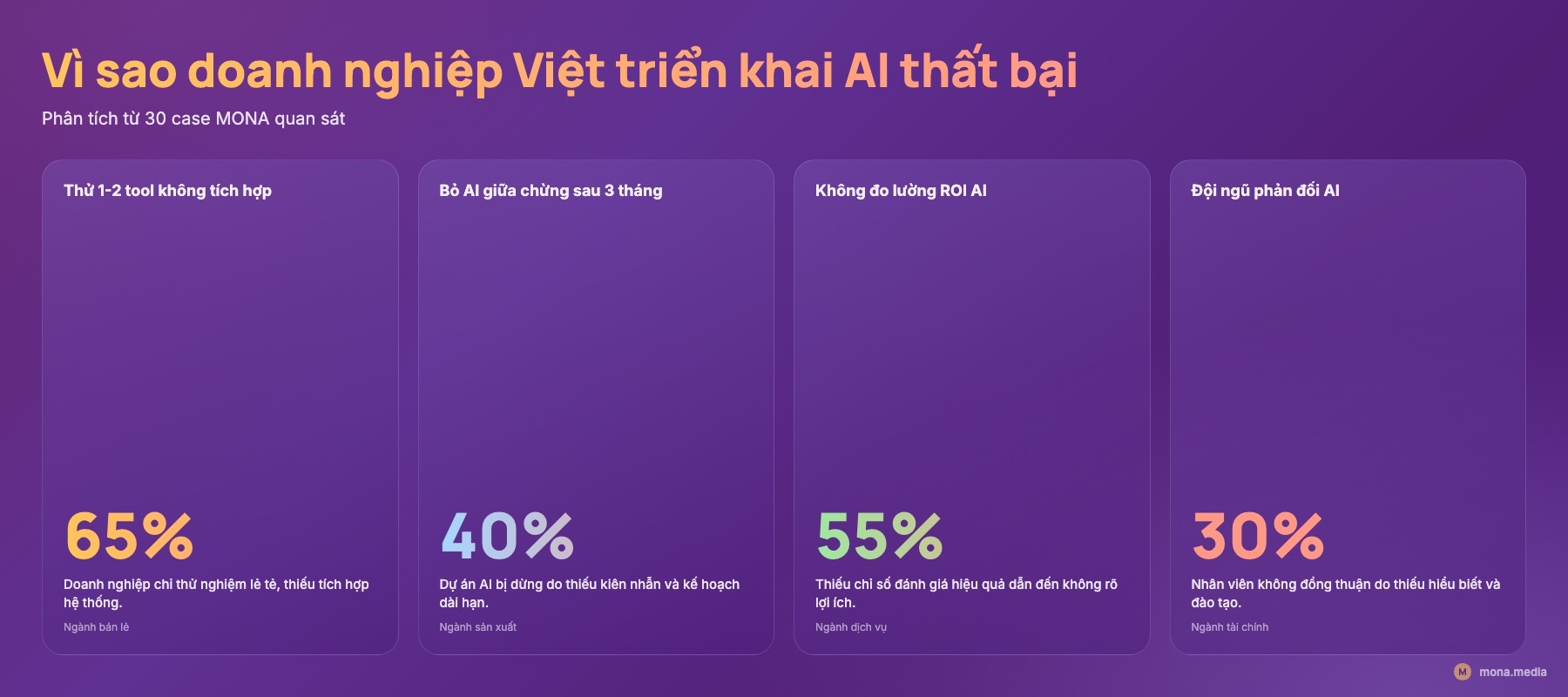
Before arguing about the 80% figure, you need to agree on what “halfway” means. We define it this way: a business that has spent money on AI for at least 6 months, but has NO measurable cost-reduction metric, NO new process that ties AI into the chain of modules, and NO one specifically accountable day to day. The State of AI 2025 report by McKinsey shows that 78% of businesses worldwide have tried at least one AI use case, but only 22% moved to running it for real. The numbers we see in Vietnam are even worse. The pressure to buy tools just to follow the trend is higher.
MONA sorted 30 close clients into 4 levels. Level 1 is “signed up just to have it”: 12 businesses, 40%. They bought ChatGPT Team and let it gather moss, with staff using it ad hoc. Level 2 is “scattered experiments”: another 12 businesses, 40%, with a few departments using AI but no metrics. Level 3 is “partly running for real”: 5 businesses, 17%, which measured 1-2 cost-reduction metrics. Level 4 is “AI-native”: only 1 case, with AI tied into the whole chain of modules. Levels 1 and 2 together add up to exactly 80%.
We need to understand that this is not the business owners' fault. It is the fault of a market that talks about AI the wrong way. For the past 18 months, trendy blogs, 9-million-VND courses and community fanpages have all hyped AI as magic. You heard “just one prompt and AI does everything” so often that your expectations were wrong from the start. When reality hit, AI didn't connect itself to the accounting software or send reports by itself. It didn't screen CVs in the brand voice on its own, and you lost faith. We analyzed this angle in CEO sai AI across 4 specific wrong roles.
Compared with Southeast Asia, Vietnamese businesses have 3 factors that make the rate of half-hearted AI clearly higher.
Add these 3-4 factors together. The reason AI fails in Vietnam is not the technology but how it is rolled out. This is also the view MONA wants you to understand before going further.

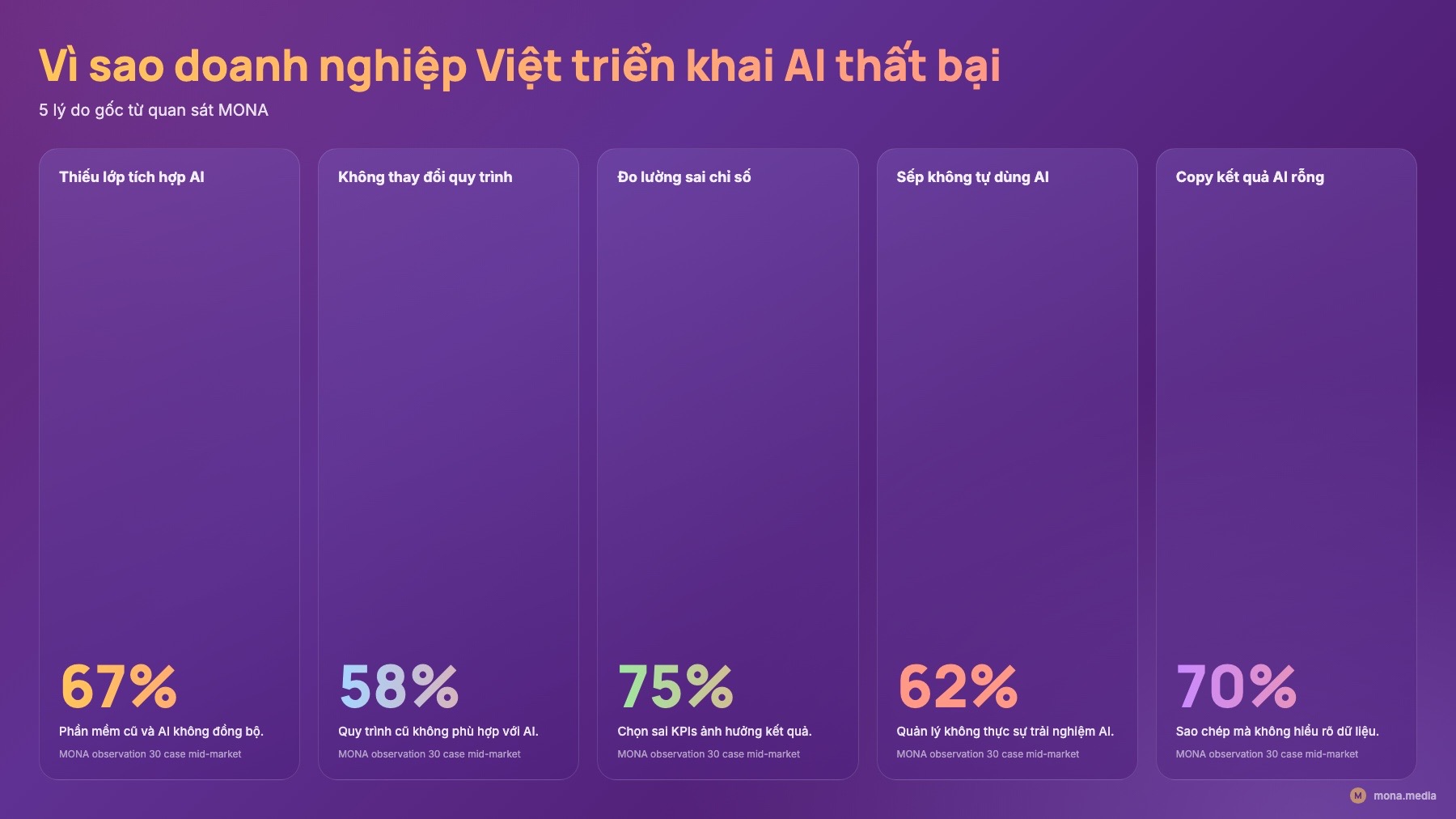
This is the heaviest reason, accounting for 45% of half-hearted AI cases in MONA's observation. You buy ChatGPT Team and open it in the browser, and staff copy text back and forth between Word, the CRM and accounting. Each employee loses 30-40 minutes a day just copying. Across a 20-person department that adds up to 10 hours a day. AI was supposed to save time, and it ended up costing more.
We once worked with a chain of 22 preschools across HCMC, Binh Duong and Dong Nai, with revenue of about 38 billion VND per month. Before MONA came in, the chain had been on Claude Team for 8 months. Customer care staff used Claude to draft replies to parents, but had to copy them to Zalo OA by hand. They copied figures into the CRM, and copied good replies into the internal Workplace group. One customer care employee lost 45 minutes a day just on copying. The boss thought AI was running, but the truth was that staff were running in place of AI.
MONA's fix was to write custom automation software. We connected the Claude API to the chain's CRM through an integration layer. A reply is generated, sent to Zalo automatically, logged into the CRM automatically, and a report is pushed to the department head at 5 pm every day. After 90 days, response time dropped from 4 hours to 38 minutes. One customer care employee saved 45 minutes a day, enough to handle 30% more of the important consulting calls. You can see a similar pattern in automating 30 businesses part 1.
The takeaway: AI is not a standalone product. AI is one module in a business automation chain. Without an integration layer, AI will always be a personal tool and never becomes a company asset.
This reason accounts for about 25% of half-hearted AI cases. You keep the old 10-step process, attach AI to 1 step, and hope costs fall. In truth, the other 9 steps keep eating time as before, and AI only prettifies 1 step. The total saving is close to zero.
For example, an 18-branch restaurant chain in Saigon with revenue of 52 billion VND per month, which came to MONA for advice in November 2025. The boss had bought ChatGPT Team for 6 months so the marketing team could write dish descriptions and Facebook posts. Writing speed doubled. But the content approval process still had 4 layers: staff write, team lead edits, brand director approves, the boss signs. Each layer takes 1 day. That is 5 days for 1 post. AI writes faster but still gets stuck in the approval process.
MONA proposed merging the 4 approval layers into 2. Authority was handed to the team lead within a standardized brand voice. At the same time, AI was tied into the CMS so the brand director only approves templates, not every post. After 60 days, the time from idea to publish dropped from 5 days to 1 day. The 12-person marketing team produced 3 times as much content, and digital channel revenue rose 41% in the quarter.
You need to do 3 things in order. One, draw the current process on paper and count the steps. Two, cross out duplicate steps and unnecessary multi-layer approvals. Three, attach AI to the remaining steps that have a clear format. Skip this order and half-hearted results are guaranteed.
This accounts for about 15% of half-hearted cases. You set a metric like “applying AI to raise marketing department productivity by 30%”. This metric can't be measured, has no owner and has no deadline. After 6 months, nobody knows what numbers AI is producing. The whole company loses faith.
We shared the right metric framework in the article the CEO's wrong AI roadmap. A correct AI metric has 4 parts: the number before, the number after, the timeframe and the person accountable. For example: “reply time to customer messages drops from 4 hours to under 1 hour in 60 days, Ms. Trang, head of customer care, in charge”. A metric like this avoids arguments and leaves no room for gut feeling.
A COO of a chain of 26 dental clinics across HCMC and Hanoi, with revenue of 44 billion VND per month, set the wrong AI metric in the first 5 months of 2025. The boss said “AI helps cut marketing costs”. After 5 months, marketing costs hadn't dropped. The marketing team still spent on ads as before and only saved time writing posts. MONA helped change the metric to “cost per new appointment drops from 380,000 VND to 220,000 VND in 90 days”. This time the metric was measurable, and the marketing team knew to retest the ads and write automated follow-up scripts with AI. After 90 days they hit 245,000 VND, close to the target.
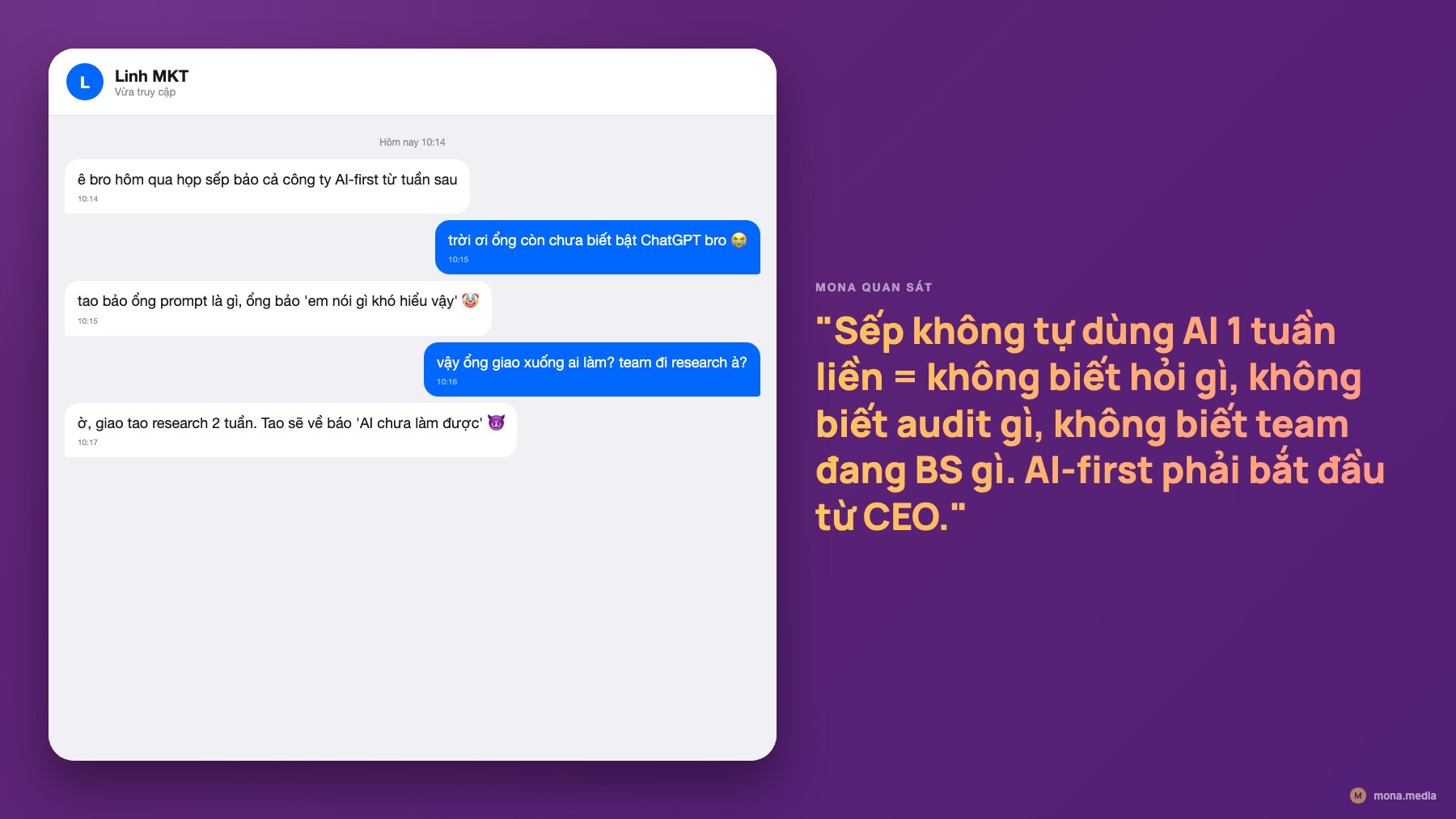
This reason accounts for about 10% of cases, but it is the most dangerous because it spreads across the whole company. You buy AI tools, hand it straight to the departments, and don't use it yourself for 30 days. Staff get the order to “apply AI” but nobody shows how, and there is no standard brand voice from the boss. After 2 weeks, everyone uses it their own way, the results don't match, and the boss gets angry that “staff don't know how to use it”.
The truth is staff are guessing because the boss has never used it. MONA observed that among the 30 close clients, in 7 cases the CEO had never opened Claude. They hadn't used ChatGPT for even 1 real task of their own in the first 30 days. All 7 of those cases ended up half-hearted. By contrast, 5 CEOs were at level 3. Level 4 cases all share one pattern: the CEO used AI for 30 minutes every morning in the first week, before talking to staff.
Triet, founder of an industrial e-commerce marketplace with 60 technical staff and revenue of 31 billion VND per month, did it right. The boss sat with Claude for 30 minutes every morning for the first 4 weeks and wrote his own prompt templates for 5 common tasks: summarizing reports, writing replies to partners, drafting board meeting content, analyzing revenue by product group, and writing technical requirements. After 30 days, the boss had 5 templates in the brand voice and handed them to 3 departments. 6 months later, this company sat at level 3 in MONA's classification, with 4 specific cost-reduction metrics measured.
The root mechanism is that AI has no brand voice unless the boss supplies one. AI generates content from the internet's average template. When staff type “write an intro for a spa” with an empty prompt, AI returns clichéd copy. That voice is not your company's. A regular customer reads one sentence and thinks “this isn't the spa I usually go to”. You lose the connection, you lose conversions, and you lose the marketing money burned on that post.
MONA came across a 24-branch spa chain in Q4 2025. Its Facebook posts changed voice abruptly in mid-October. Regular customers commented “why does the tone feel off lately”. The boss called the marketing head, who admitted the team pasted ChatGPT output straight in, without a single editing pass. 3 months later, Facebook engagement fell 40%. Ads with the same budget saw cost per lead go up 1.8 times.
The damage didn't stop at Facebook. Customer care emails, call center scripts, SEO blog posts and product descriptions were all raw pasted AI. After 6 months, the brand voice was so diluted that loyal customers couldn't tell their own spa from 10 competitors. By then, fixing it took another 6-9 months of retraining staff, plus the cost of hiring outside editors to rebuild the brand voice from scratch.
MONA does the opposite. Before staff type any prompt, the boss sits down and writes a 3-page “brand voice sample”: 10 opening lines, 10 closing lines, 20 banned words and 20 preferred words. This goes into the system prompt of Claude or GPT. When staff type a task, the output already comes out in the spa's voice. One editing pass takes 5 minutes instead of 30 minutes of rewriting. The top 10% of staff are freed up to do bigger things.
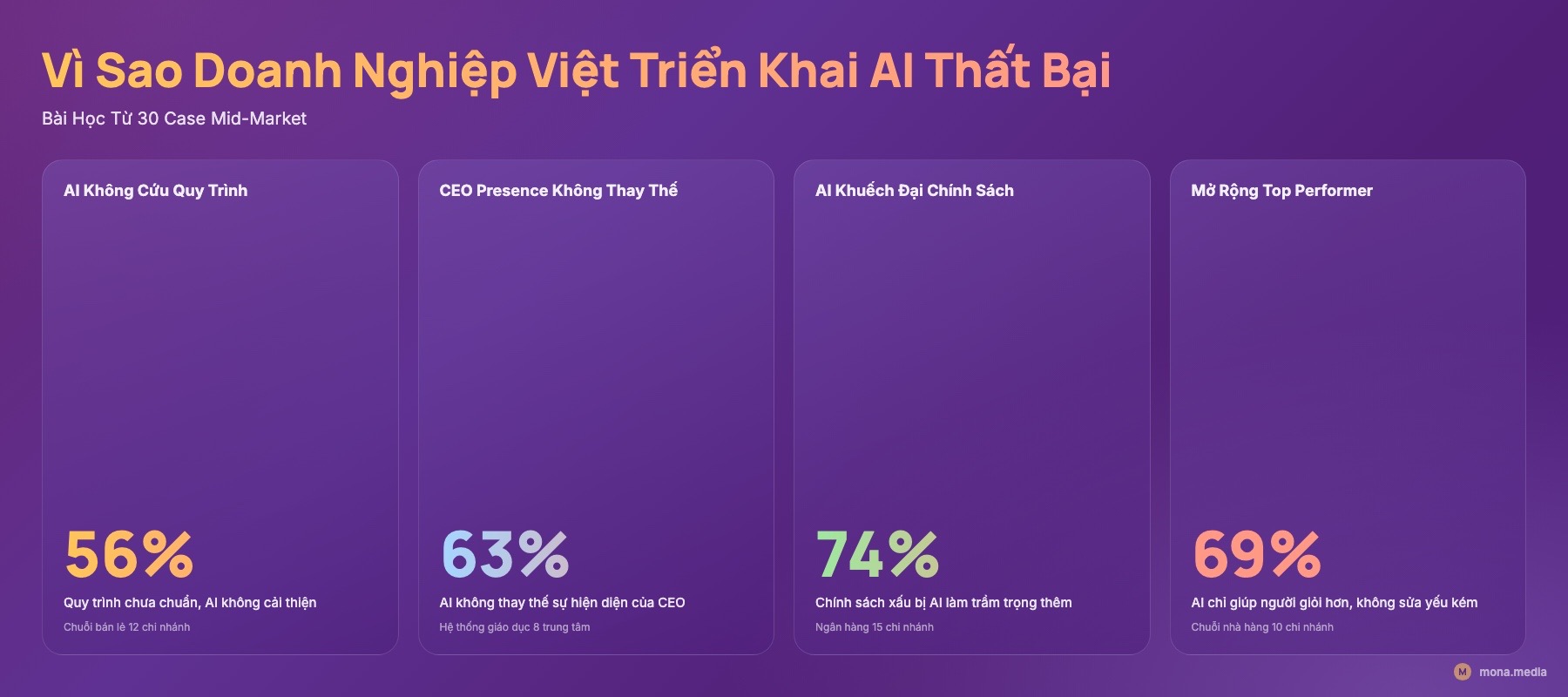
This is the bitterest lesson we drew. AI can't save a company with weak management. AI only speeds up a company that already runs well. Anyone expecting “buying AI will overhaul the business” will be disappointed. The truth is that with a tangled process, vague metrics and undisciplined staff, adding AI only adds to the mess. See the details in the article AI First handbook.
Of the 30 MONA cases, 5 businesses are at level 3. The level 4 case had 3 traits in common before adding AI. One, it had a measurement system for the company for at least 1 year. Two, it had clearly written processes for at least 3 departments. Three, the boss was already used to a weekly review discipline. If you lack even 1 of these 3 traits, AI only makes the old problems bigger. See the details in the article AI First handbook.
By contrast, all 25 businesses at levels 1 and 2 had 1 of 3 serious management flaws. Flaw 1: departments have no clear metrics. Flaw 2: processes are passed between departments by word of mouth, not written down. Flaw 3: the boss assigns work by mood, with no review discipline. When AI comes in, these flaws show up more clearly, staff blame AI, and the boss loses faith. This is the vicious cycle MONA sees most often.
MONA wrote up the philosophy “only a well-managed company can use AI” in the article What is AI-First. For Vietnamese mid-market business owners, you need to see it this way: prepare management first. Buying AI matters more than choosing which tool. This is also the difference between MONA and other AI sellers.
We don't just talk theory, MONA has done it for real. Since April 20, 2026, MONA has rolled out automation decisively across the whole company. Every day feels like a new company. You can read the details of this philosophy: AI loses to the top 10-20% of strong people, but beats the 60-80% of average staff. Applied correctly, MONA can automate 100% of the repetitive work departments, and the top 10% of strong people do bigger things. This is not a slogan, it is how we live every day.
You are paying 300-600 million VND for 3-5 department heads plus 1 outsourced AI project, and 800 million to 1.5 billion VND for foreign consultants or an agency. And it isn't only about money, MONA knows you have tried many things (inviting experts for internal training, sending department heads to a 30-million-VND AI course, putting AI usage KPIs into staff reviews, hanging “AI-first company” posters all over the office, forcing marketing to report a ChatGPT case every week). But no. 6-12 months later you are still in the 80% doing it halfway. One owner can't drag 60 staff who fear AI will replace them. Out there, 100 mid-market chains of the same size are stuck in the same place. The problem is not hiring another AI department head. What you need is closed-loop automation software hand-written by MONA, plugged into your existing CRM and ERP, reducing reliance on average staff and leaving the top 10% of strong people to do bigger things, not burning another 1.5 billion VND on an agency promising a “12-month AI transformation”.
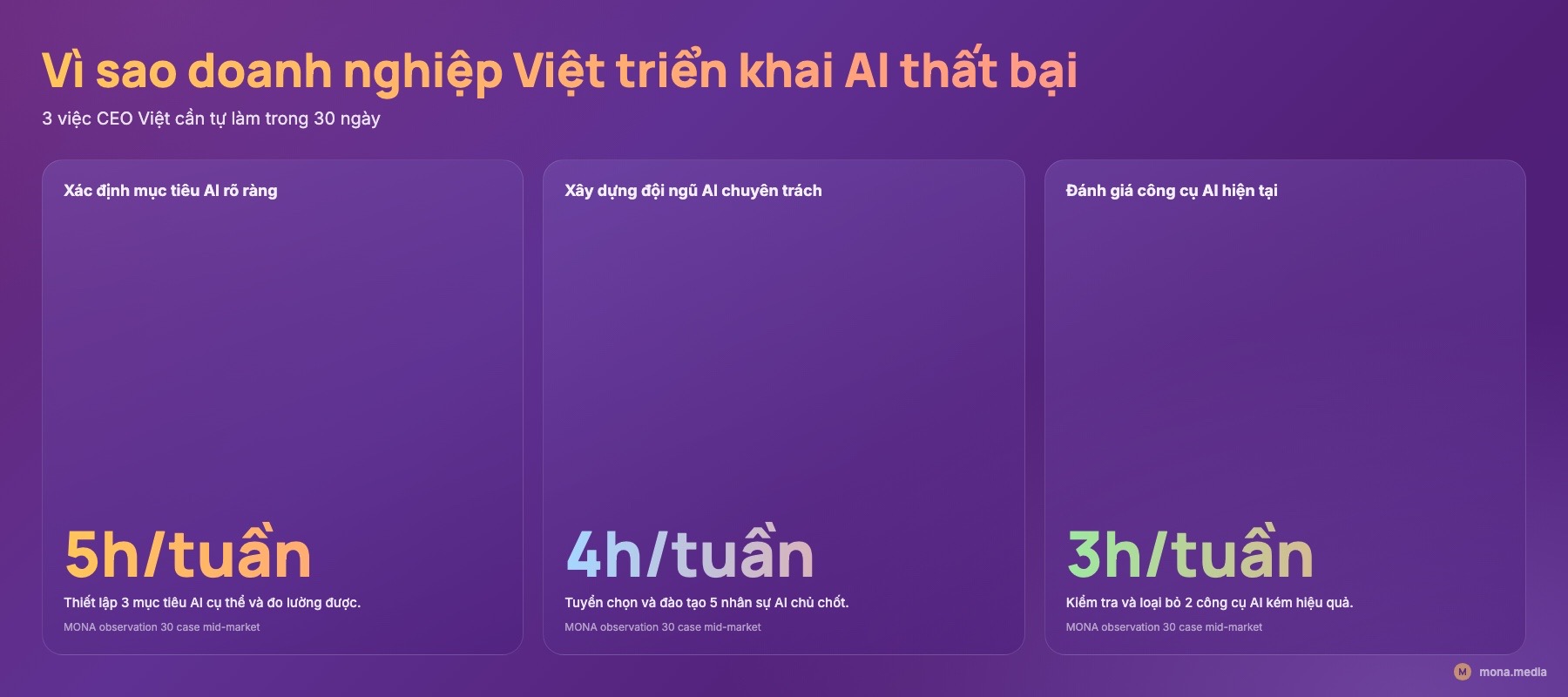
If you have diagnosed yourself as part of the 80% doing it halfway, here are 3 things to do in the next 30 days. We wrote them in order, don't swap them.
Thing one: the boss uses AI for 30 minutes every morning for 14 days straight. No meetings about AI, no announcement to staff. Just sit with Claude or ChatGPT and do 1 real task of the boss: summarizing reports, drafting partner emails, analyzing revenue. After 14 days, the boss has 3-5 prompt templates that fit the brand voice. This is the weapon for talking to staff in week 3.
Thing two: draw one department's process on paper and cross out the extra steps. Pick 1 department with a lot of repeated work (customer care, content marketing, CV screening). Draw out the current 10 steps. Count the approval layers. Cross out the duplicate steps. Only after crossing them out do you attach AI to the remaining steps. If you attach AI to a process you haven't trimmed, you are back at the second reason above.
Thing three: set 1 AI metric with all 4 parts. Pick one single metric for the next 30 days. It needs a number before, a number after, a timeframe and a person in charge. For example: reply time to customer messages drops from 4 hours to 1 hour in 30 days, Ms. Trang in charge. Measure at the end of each week and share it with the whole department. Avoid vague metrics like “applying AI to raise productivity”.
The analysis of 5 reasons for half-hearted AI above isn't only true for education services. F&B, dental, spa and industrial e-commerce are the ones we just mentioned. We see the same pattern in the 5 adjacent industries below. One, fashion retail chains with 20-40 stores. Two, gold and jewelry chains with 10-25 branches (see also the package JMS gold shop management software). Three, restaurant and F&B chains with 15-50 branches (the package Nhahang AI software). Four, training and education centers with many campuses (the package MONA EduCenter). Five, clinics and healthcare chains with 10-30 branches. All 5 industries fall into the 5 mistakes we analyzed, and the way out is similar.
We'll split it straight. You can do the 3 things above to escape half-hearted AI yourself if your company has fewer than 80 staff, fewer than 10 branches, clearly written processes, and the boss has 5 hours a week to invest in AI. The MONA community on mona.guide shares many prompt templates and short processes.
You need MONA to step in when the company has more than 100 staff and more than 15 branches. Also if you have spent money on AI for more than 12 months and it is still half-hearted, or you need to tie AI into an existing CRM, ERP or LMS. We write custom automation software for each client and don't use drag-and-drop tools like n8n or Zapier. Mona.Software has 10+ packaged products (full list) as the base framework. We customize deeply to your process. See also how MONA approaches automation at business automation category.
MONA recommends private AI hosting through mona.host with VPS built for AI workloads. For a course that trains the boss to use AI personally, see Khánh Hùng Academy. You can find MONA's internal digital transformation documents on mona.academy.
See more of the articles MONA has written. To understand the automation framework: CEO sai AI, What is AI-First. MONA fully automated 30 businesses, part 1, the CEO's wrong AI roadmap. business automation category, MONA homepage, AI for sales teams. business website design, full-scope SEO services, business management software, contact MONA.
If you want to go deeper on people management, you can read more about adding AI to HR management software. digital transformation solutions for businesses. For software needs in a specific industry, see the articles spa management software. restaurant software on our blog.
We come back to our core view: why Vietnamese businesses fail at rolling out AI halfway isn't because AI is weak. It's because of how the company applies it. Check the 5 early signals yourself, do the 3 things in 30 days, then come back and measure. That is the process we have seen work for more than 5 Vietnamese businesses that brought AI up to level 3 and level 4. See also other Vietnamese business AI cases MONA has shared, and we are ready to work alongside you if needed.
Why do Vietnamese businesses fail at rolling out AI, up to 80%? Now that MONA has laid out the 5 root reasons, you have a self-diagnosis framework. We hope you will set aside one afternoon this week. Sit still for 90 minutes and check the 5 early signals we listed. If your company hits 3 or more signals, apply the 3 things in 30 days above right away. Don't wait until next quarter, because your competitors in the industry are standing at level 3, and level 4 is speeding up too.
MONA shares this article not to sell services. We share it because MONA itself went through the half-hearted stage in 2024-2025, fixed it ourselves from April 20, 2026, and now lives by the philosophy of “every day is a new company”. If you need company, we are ready. If you can do it yourself, we are happy for your company. What matters is that we don't stand still another 6 months in the 80% doing it halfway.
One last question we want you to answer for yourself. If in the next 12 months 1-2 competitors in your market escape the 80% group, tie AI into a real automation chain and cut operating costs by 40-60%, can your company still compete? Why Vietnamese businesses fail at rolling out AI halfway, now you understand the root. Whether to take the next step out is your decision this week.
Readers of this article usually fall into 2 groups. Group 1 is already used to it and has completely given up on finding a solution, accepting "money lost to average staff" as part of life, as in "that's just how our industry is". Group 2 is the owners, new or with 10 or 20 years in business, who never stop looking for solutions, keep an ear on technology, AI progress and automation, so that when a solution appears they bring it in right away, and once they deploy it they do it decisively, shocking old and new staff alike. MONA (we're business people just like you, and our team of 60+ has automated 100% of its repetitive departments since April 20, 2026) belongs to group 2, and we're fully confident we can bring a solution to the group 2 owners among you. What you need is just a 45-minute call away. And it's free: a MONA specialist will always deliver it, whatever your business model or current state (1 branch or 50 branches, mostly young staff or mostly older staff, no tech knowledge or very tech-savvy, no CRM yet or already on ERP, revenue of 5 billion VND a month or 80 billion VND a month). We have a solution for every case. This is already our 10th year bringing automation solutions and software to mid-market business owners in Vietnam.
How to contact MONA
Email: info@themona.global
Website: mona.media · mona.software
MONA took it from 30 mid-market chain owners we know well over the past 18 months. Of those 30 chains, 24 (80%) had no clear ROI metric after 12 months of rolling out on their own. This figure matches the VnEconomy report on 70-80% of AI projects failing globally. MONA didn't make it up.
From what MONA has seen, the biggest root cause is a missing integration layer between AI and the existing software. You buy ChatGPT and other AI tools, but no developer writes the layer that connects them to the CRM, ERP and internal accounting. The result is staff copying and pasting by hand, which doesn't scale and doesn't last.
Yes. MONA saw that in 24 of the 30 failed chains, the CEO hadn't used AI daily. When the boss doesn't use it, the boss doesn't understand AI's limits or how to write requirements for developers. The boss hands work down with vague expectations and the developers miss the mark. That is why MONA always advises CEOs to use AI themselves for at least 30 days before deciding on a large budget.
One, the CEO uses ChatGPT or Claude for 30 minutes every morning for 4 weeks. Two, invite a third party to audit the company's AI readiness instead of letting departments grade themselves. Three, pick 1 quick-win use case for the quarter, measure it with 3 metrics of money, hours and errors, and expand only after the results are clear.
You can do it yourself if you have fewer than 100 staff, fewer than 3 departments, and a CEO with a tech background. You need MONA at 200-500 staff. Also when there are many internal systems to integrate, or after 1-2 failed attempts. MONA only works with mid-market chains with revenue above 50 billion VND per year, not small SMEs.
See the overall solution: Full AI transformation and automation for businesses.

CEO & Founder · The MONA
The founder of The MONA built a service company of 60+ staff with 14,000+ projects delivered. Khánh Hùng shares his thinking on building self-running systems, automating a business, and the real lessons behind MONA's projects.
 438




Professional website
design services
Own a website with a beautiful, 100% exclusive design and a lifetime warranty, with the ability
to expand features flexibly as your business grows, starting today!






 MONA will never sell your information or send you spam


 MONA will never sell your information or send you spam
