
 MONA OS 2.0
 Partner with MONA


 Tự động hoá doanh nghiệp
 Cẩm nang SEO
 Digital Marketing
 Kinh nghiệm thiết kế website
 Hạ Tầng Server
 Giáo dục


 VI
 EN
















Message us on
Zalo Official


 ProductsNew

 ProductsProducts
 Mới ra mắtKHA AI 2027App tự edit video, tự đăng mọi mạng xã hội, 2 phút mỗi ngày










 Website designLooks good and wins customers over.
SEO servicesBrings in customers searching for exactly what you sell.
 Tư vấn digital marketingKéo khách từ nhiều kênh, đo bằng số thật.
Corporate video productionVideos introducing your company, factory and team.
 NewAI video productionCompany story films made with AI.
 Custom software developmentCRM, ERP and HRM built for your business.
 Viết AI Agent theo yêu cầuĐặt riêng một trợ lý AI cho đúng việc của mình.
 Tư vấn chuyển đổi AIĐưa AI vào vận hành của cả công ty.
NewMONA LMSManagement for centers and schools.
MONA SkillHubInternal training for company staff.
 NHTQ systemEnd-to-end China–Vietnam shipping operations.
MONA JMSManagement for gold, diamond and pawn shops.
 MONA E-LearningA website with every feature you need to sell courses.
 How to sell online courses (course)More than 30 free lessons on selling courses on autopilot.
 MONA Cloudmonacloud.vnServers to get your apps and websites running.
 MONA Basemonabase.vnPostgres database, sign-in and file storage.
 MONA Mailmonamail.vnSend OTP, order and invoice emails from your software.
 MONA Paymonapay.vnAccept bank transfers via VietQR and notify your software when the money arrives.
 MONA eInvoiceComing soonIssue e-invoices that meet tax standards.
Gấu CườiTrả lời khách 24/7 trên web, Fanpage, Zalo và thu lead cho sale.
 Gấu TeleSalesGọi điện tư vấn, chăm khách như tổng đài viên thật.
Dê CườiTư vấn và chốt đơn cho shop ngay trong khung chat.
Gấu WebmasterNhắn nhóm Zalo là website được sửa xong.
 Gấu Pháp ChếSoạn hợp đồng, rà điều khoản trong vài phút.
 Gấu Báo GiáLên báo giá đúng mẫu và gửi khách ngay.
 AI chăm sóc khách hàngTheo dõi và giữ chân khách hàng cũ.
 Gấu Tuyển DụngLọc hồ sơ, hẹn lịch, phỏng vấn ứng viên.
 Mới ra mắt
KHA AI 2027
Xây kênh chuyên gia 2 phút mỗi ngày
Quay bằng điện thoại, AI tự edit video, tự đăng lên 16 nền tảng và tự trả lời bình luận, tin nhắn.
882.681lượt xem trên kênh CEO MONA sau 36 ngày
 Anh Khánh HùngCEO MONA đang dùng mỗi ngày
Xem app làm được gì
 AI
Gấu Cười MONA ĐANG TỰ XÀITrả lời khách 24/7 trên website, Zalo OA, Messenger và thu lead về cho sale.
Dê CườiChốt đơn bán lẻ và sàn: Shopee, TikTok Shop, web. Chăm cả khách sỉ, đại lý.
Gấu WebmasterCập nhật nội dung, tối ưu SEO website mỗi ngày.
Gấu TeleSalesGọi điện tư vấn, chăm khách như tổng đài viên thật.
Gấu Tuyển DụngLọc hồ sơ, hẹn lịch, phỏng vấn ứng viên tự động.
AI chăm sóc khách hàngGiữ khách cũ, cứu lead đã rớt cho phòng kinh doanh.
Gấu Pháp ChếSoạn hợp đồng, rà điều khoản trong vài phút.
Gấu Báo GiáLên báo giá đúng mẫu, gửi khách ngay khi có yêu cầu.
 Chuyển đổi AI toàn phầnGiải pháp tổng cho doanh nghiệp, 3 lớp triển khai.
 Viết AI Agent theo yêu cầuĐặt riêng một con AI gánh đúng nghiệp vụ của bạn.
 Custom softwareCRM, ERP and HRM with built-in AI automation.
 SEO & AEO thời đại AIĐược Google lẫn AI trích dẫn, không chỉ xếp hạng.
 Kiến thức AI cho doanh nghiệpBài phân tích, hướng dẫn ứng dụng AI vào vận hành.
 Free AI courses
 AI tools at work
App mới · KHA AI 2027
Xây kênh 2 phút mỗi ngày
AI tự edit video, tự đăng mọi mạng xã hội
Free consultation, 8am–10pm every day

01 June, 2026

Have you noticed that this month our sales team's payroll went up 15%? See also how employees react when AI is rolled out. But the number of contracts closed is still hovering around the old figure? This is a very familiar pain for owners of mid-market chains when talking about AI for sales teams. We have sat down with nearly 30 Vietnamese business owners over the past 12 months. Most agree on one thing: well-paid salespeople aren't costly because they are lazy. It's because 60% of their time goes to admin work. Entering CRM data, cold-calling, writing template emails, screening potential customers, compiling weekly summaries. All work a machine could carry, so salespeople can focus on closing. In this article MONA shares the framework AI for sales teams we are running successfully for real estate chains, spa chains and education chains, along with a framework case of an 18-branch chain that grew its opportunity funnel 3.2 times with two thirds of the sales team. The framework includes AI lead scoring, a callbot for Vietnamese cold leads and a CRM note-taking module, all part of the sales process automation software group. After reading, you will see clearly which parts of the sales team machines should carry and which parts people should keep.
Have you noticed an uncomfortable truth? The cost of paying one experienced salesperson in Ho Chi Minh City or Hanoi has now reached 22 to 28 million VND a month. Before commission. Meanwhile, according to the report McKinsey In 2026, sales reps in emerging markets spend 55% to 65% of their working hours on tasks that don't directly generate revenue. Entering data into the CRM, writing call summaries, drafting emails, sending quotes from templates, forwarding PDF files over Zalo. In other words, we are paying negotiation-level salaries for people to type most of the day. You can read more in our guide to the AI First enterprise.
And that's before counting turnover: sales teams losing 30% of their people every year is nothing unusual. Each time you bring in someone new, you retrain for 6 weeks and it takes a full quarter before they get comfortable with the scripts. The hidden cost is huge.
We see mid-market Vietnamese business owners stuck in a tough spot. The bigger the sales team, the more working hours leak away. That's when AI for sales teams is no longer a trend but an urgent step to protect profit margins. Looking at the bigger picture, applying AI to the sales department is becoming the new operating standard for chains with 15 to 30 branches, much like CRM became the standard 10 years ago. Since 2024, MONA has run this model for nearly 30 close-knit businesses, and the results repeat consistently: the same sales team, with closed output rising from 2x to 3.5x within 3 quarters.
You can also read using AI in sales to understand the foundation, and applying AI to the marketing department to see the top of the funnel.
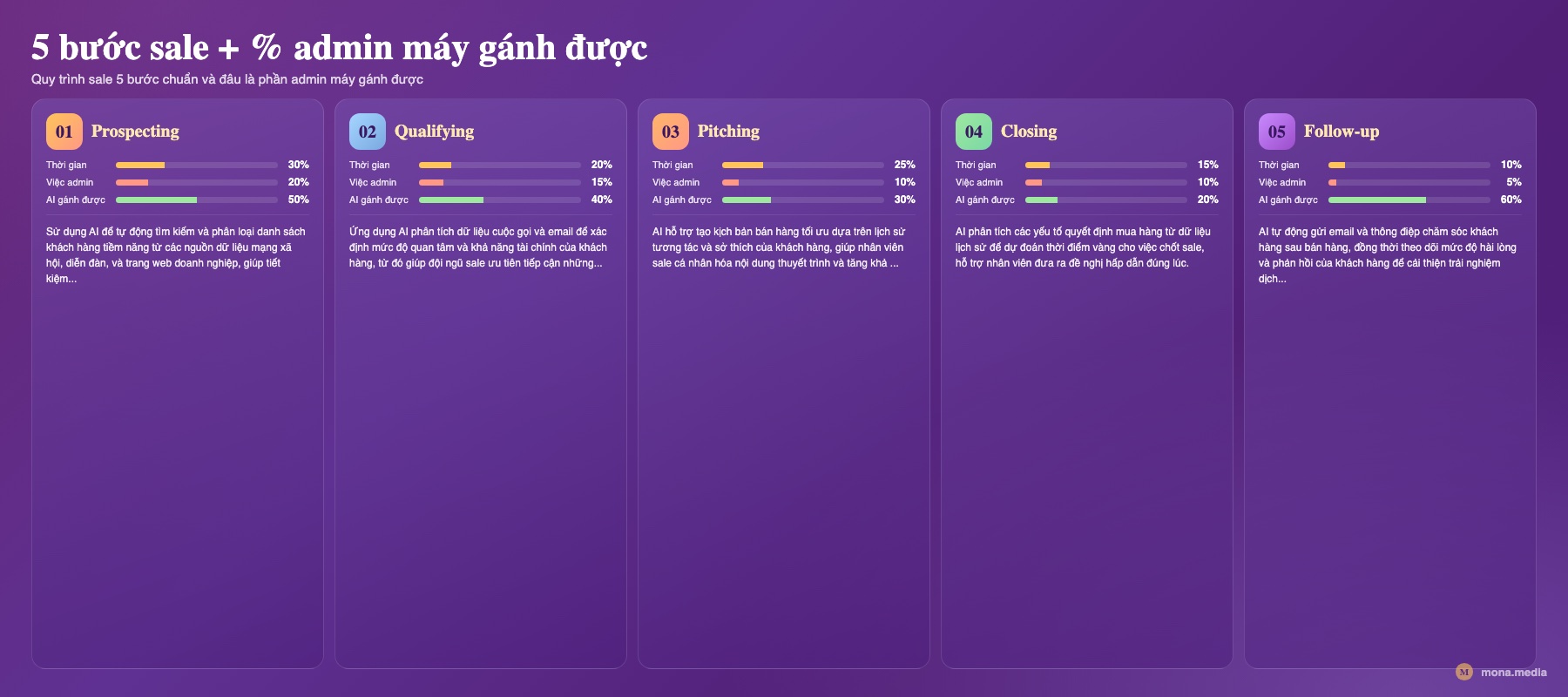
MONA usually starts by redrawing your chain's sales process into 5 steps, before proposing any software. This is the framework we've used for an 18-branch real estate chain, a 25-center language school chain, and a 12-showroom furniture chain.
Step 1, screening incoming leads. Leads pour in from the website, Facebook, Zalo OA, livestreams and affiliates. Your sales reps currently take them all and call them all, wasting 70% of their hours on leads that are cold or duplicated. Machines can handle this part entirely. You can read more in our guide to the AI First enterprise.
Step 2, the first cold-call pass. The goal is to filter out people with real needs. Machines can handle 70% of this through a Vietnamese callbot, and sales only take the calls already confirmed as interested.
Step 3, in-depth consultation, booking meetings, sending quotes. People carry most of this part, with machines assisting by drafting content and pulling up the customer's history.
Step 4, long-term follow-up. A customer promises to think it over for 2 weeks, and sales must remind them at the right time and in the right tone. Machines can handle 80% of this through personalized emails and scheduled Zalo messages.
Step 5, closing and handing over to customer care. People carry this part, with machines helping to compile notes.
In summary: across the 5 steps, machines can take most of steps 1, 2 and 4, plus all the back-office data entry. Pure negotiation by sales only covers steps 3 and 5. That is why AI for sales teams is not about replacing sales but about freeing them from admin work. Think of applying AI to the sales department as a tool for redistributing work, not a tool for replacing people.
We split it AI for sales teams into 4 software layers. Layer 1 is AI lead scoring, which scores and screens leads. Layer 2 is a Vietnamese callbot for cold-call screening. Layer 3 is a module that writes and sends follow-up content. Layer 4 is a module that automatically writes notes into the CRM. Each layer stands on its own, and MONA writes custom code for each chain rather than patching things together with n8n or Zapier. Sales in large chains need production-grade stability and can't afford a break during peak hours. This framework AI for sales teams is repeatable, with about 70% of modules shared and 30% tuned for each industry.
AI lead scoring is the first module in a rollout AI for sales teams. Every morning your chain's sales team is flooded with leads. 800 to 1,500 leads pour in overnight, and sales split them up to call. The problem is that most are cold, have no real need, or have already bought elsewhere. Sales finish the calls, complain they're tired, and top-of-funnel performance drops.
AI lead scoring solves exactly this pain. MONA's model scores leads using your chain's historical data: lead source, click behavior, time spent on product pages, search keywords, purchase history, and demographics. The next morning, sales open the software and see 50 hot leads ranked from highest to lowest, with a suggested reason each one is hot. Sales call these 50 first. The close rate is 5 times higher than calling blindly from the top of the list.
One 18-branch real estate chain we work with has 47 billion VND in monthly revenue and a 64-person sales team. Before running AI lead scoring, its lead-to-viewing-appointment rate was only 4.2%. After 4 months of rollout, it rose to 13.8%. Same 64 sales reps, same lead sources, and the only change was how the top of the funnel was screened. If you want to understand the logic of AI for sales departments in more depth, keep reading sales management software and what is an AI agent.
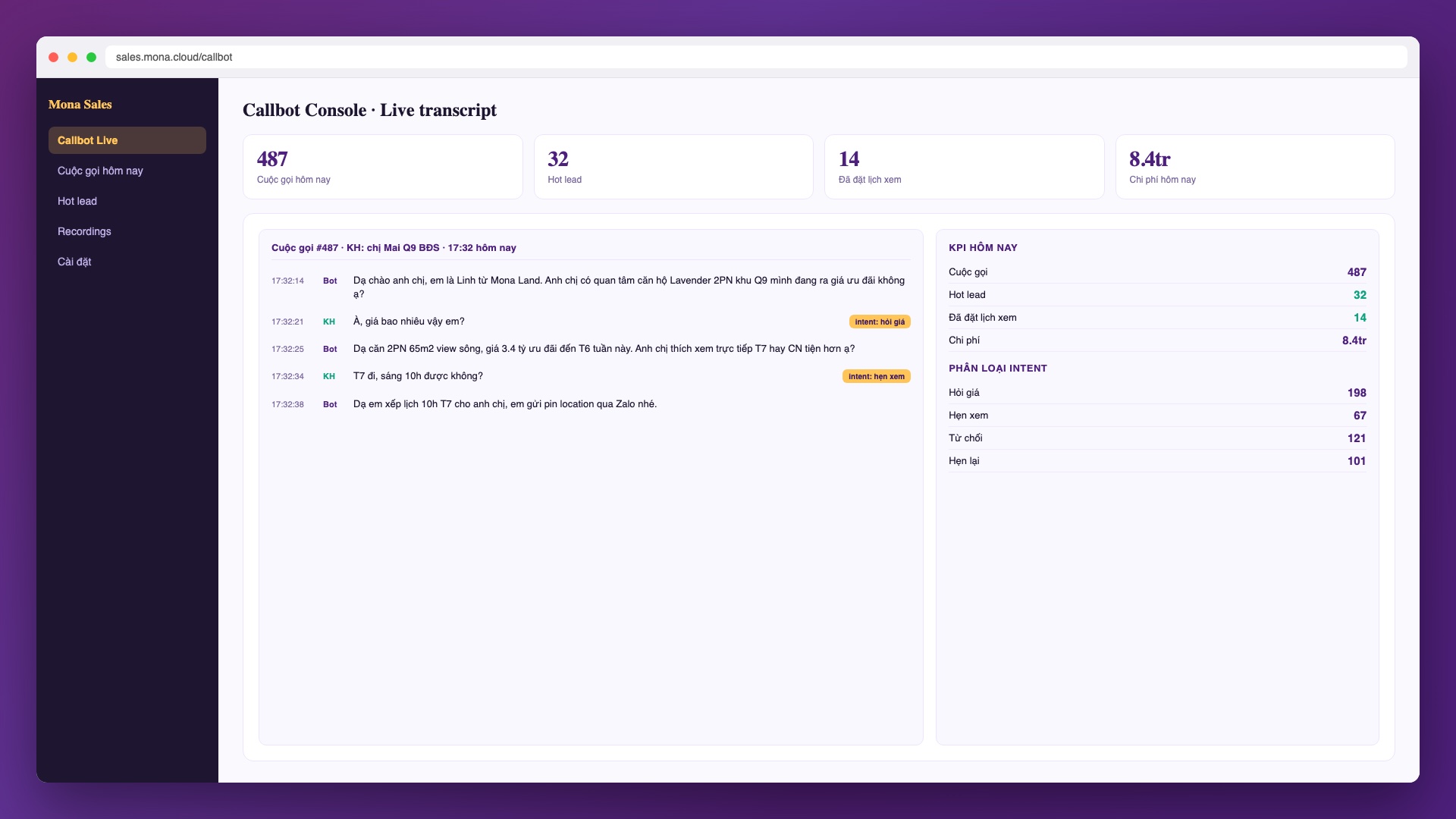
Do you remember watching a young sales rep sit and cold-call 80 numbers a day, then quit after 2 weeks from burnout? We understand. Cold-calling wears down a sales rep's spirit very fast.
Natural-sounding Vietnamese callbots have now reached the level needed for first-line screening conversations. A callbot calls 500 numbers a day, asks 4 to 5 questions to screen for need, recognizes the answers, writes a call summary, and passes the 30 calls worth closing to sales for a callback. The remaining 470 calls are marked cold and automatically scheduled for a callback in 60 to 90 days.
At the 18-branch real estate chain mentioned above, before the callbot, 64 sales reps each cold-called 80 numbers every day. After the callbot, sales only receive the 30 calls that have been screened. They spend all the remaining time on in-depth consultation and property viewings. Closing productivity rose 3.2 times, and sales turnover dropped from 32% to 11% in 6 months. See the pattern? Machines take the grinding work, and people take the work that earns revenue.
Old IVR plays a recorded script and the customer presses keys. An auto dialer only dials numbers and hands them to sales. The callbot in AI for sales teams from MONA understands the customer's voice, holds a two-way conversation on a dynamic script, and knows when to stop and when to hand over to a real person. That's the difference between production-grade automation software and mass-market marketing automation tools. See also phone call scripts for customers to standardize your content before handing it to machines.
How do your chain's sales reps send follow-up emails today? We'd guess: open a template in Drive, change the customer's name, send. The customer feels like one of 2,000 people on a list. A 1.8% reply rate is already considered high.
MONA's AI follow-up writing module reads back through the customer's history. At the first meeting, what the customer asked, what sales answered, and which points the customer cared about. After 7 days of silence, the machine drafts a personalized email reminding them of exactly what they asked about, sent at the time the customer usually reads email. Zalo messages work the same way, only shorter and friendlier in tone.
A 25-center language school chain we worked with has 31 billion VND in monthly revenue and 38 sales reps. Previously its follow-up email reply rate was 2.1%. After 3 months with the personalization module, it rose to 11.4%, and trial class sign-ups grew 2.6 times.
An important note. When it comes to AI for sales teams, MONA does not sell AI as a category. We sell software that automates the follow-up process. AI is just the means to write better content than the old templates. You need to be clear on this, because many vendors sell AI without tying it to a specific job. People use it for a few weeks, find it dumb, and drop it.
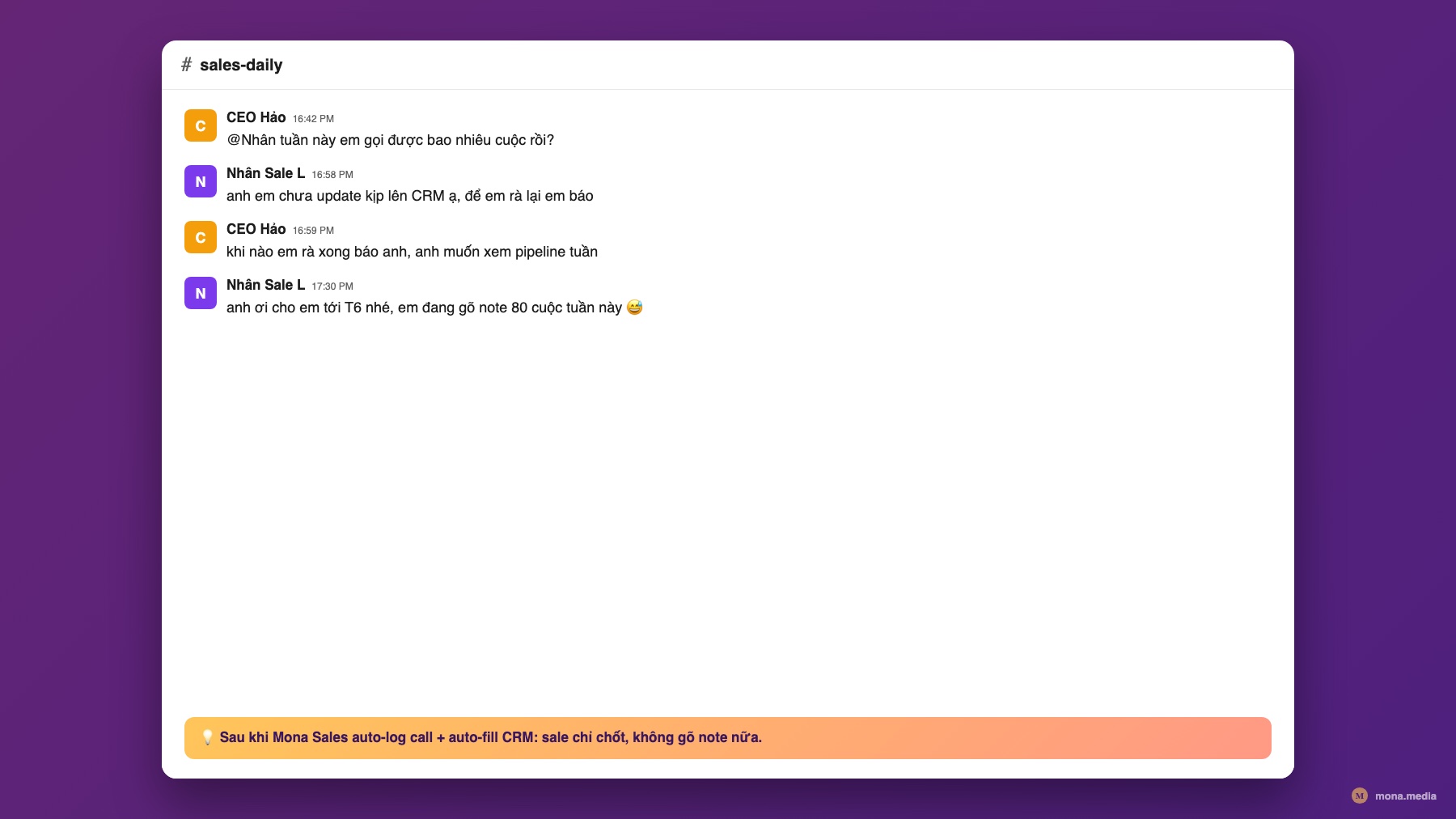
The old question from chain owners: why is our CRM always missing data? Because sales are lazy about entering it, because sales are busy meeting customers. Because typing a 30-minute call back into 5 lines feels exhausting. We understand that feeling.
MONA's automatic note module listens to Zalo calls, switchboard calls, and recordings at the showroom. When a call ends, the machine converts the voice to text, summarizes 5 key points, and writes them into the CRM right on the customer's profile. Sales only need to reread for 30 seconds, fix anything wrong, and save. On average each sales rep saves 90 minutes a day.
90 minutes per rep, a team of 64 reps, 22 working days a month. Quick math: 64 times 90 minutes times 22 days equals 2,112 hours saved every month. At a sales salary of 25 million VND a month for 176 hours, that equals 12 full-time sales reps. In other words, with the same 64 sales reps, you gain the capacity of 12 more people without paying extra salary. It's simple math any chain owner can do.
Last month we sat down with the founder of a 23-branch F&B chain. He was honest with us: that month the sales payroll was 1.6 billion VND and closed revenue was 28 billion VND. Yet the CRM report showed 62% of sales hours going to data entry and sending template quotes. He said: I don't blame the sales reps, I blame the model. Over drinks, we told him he'd read it right.
This is a pain that 100% of mid-market chain owners face. Internal bureaucracy means time clocks, quote templates, email templates, CRM entry templates, and weekly report templates. They create work that earns no revenue, but sales have to do it because the process requires it. The bigger you get, the heavier it gets.
MONA does not advise you to drop your processes. We advise handing the process to automation software, and sales keep only negotiating and closing. This is the backbone logic of AI for sales teams at mid-market: break the work apart, give each task to the right actor, and let people do only what people do best. Every sound application of AI to the sales department starts with this breakdown, not with buying a tool.
Read more in our piece on automating 30 businesses to see how we work in practice, and on digital transformation for businesses for the big picture.
You're paying 80-130 million VND a month for 10-15 sales staff, including lead sales, admin sales, telesales, and regional team leads. And it's not just money. MONA knows you've tried many approaches: buying a 50-100 million VND all-in CRM, hiring a sales expert to train for 3 months, raising commission to 8-12% for the top closers, pushing a KPI of 50 cold calls a day, and trying to build a culture where closing deals is in the blood so the team runs numbers as hard as ride-hailing drivers. But no. All that effort never pulled the share of sales time spent on admin below 50%. A sales team lead is like a stone thrown into a pond of water hyacinth when every day brings 200-400 new leads, 800-1,200 old follow-ups waiting for care, 50-80 quotes to produce, 30-60 missed calls to return, and 100-200 CRM notes to enter. One team lead alone can't do it all: coaching the team, scoring leads, approving quotes, and reporting headcount at the same time.
Hiring 4-6 more fresh-graduate sales reps, switching to a pricier CRM, or outsourcing 200-500 telesales calls a day are all just patches. What you need is a technology solution: a set of AI lead scoring, plus a Vietnamese cold-call callbot, plus a follow-up writing module, plus automatic CRM notes. It cuts the dependence on people for administrative work and leaves your strong sales reps focused 100% on closing, instead of hiring a whole crowd of admin sales that you'll have to hire again 3 months later.
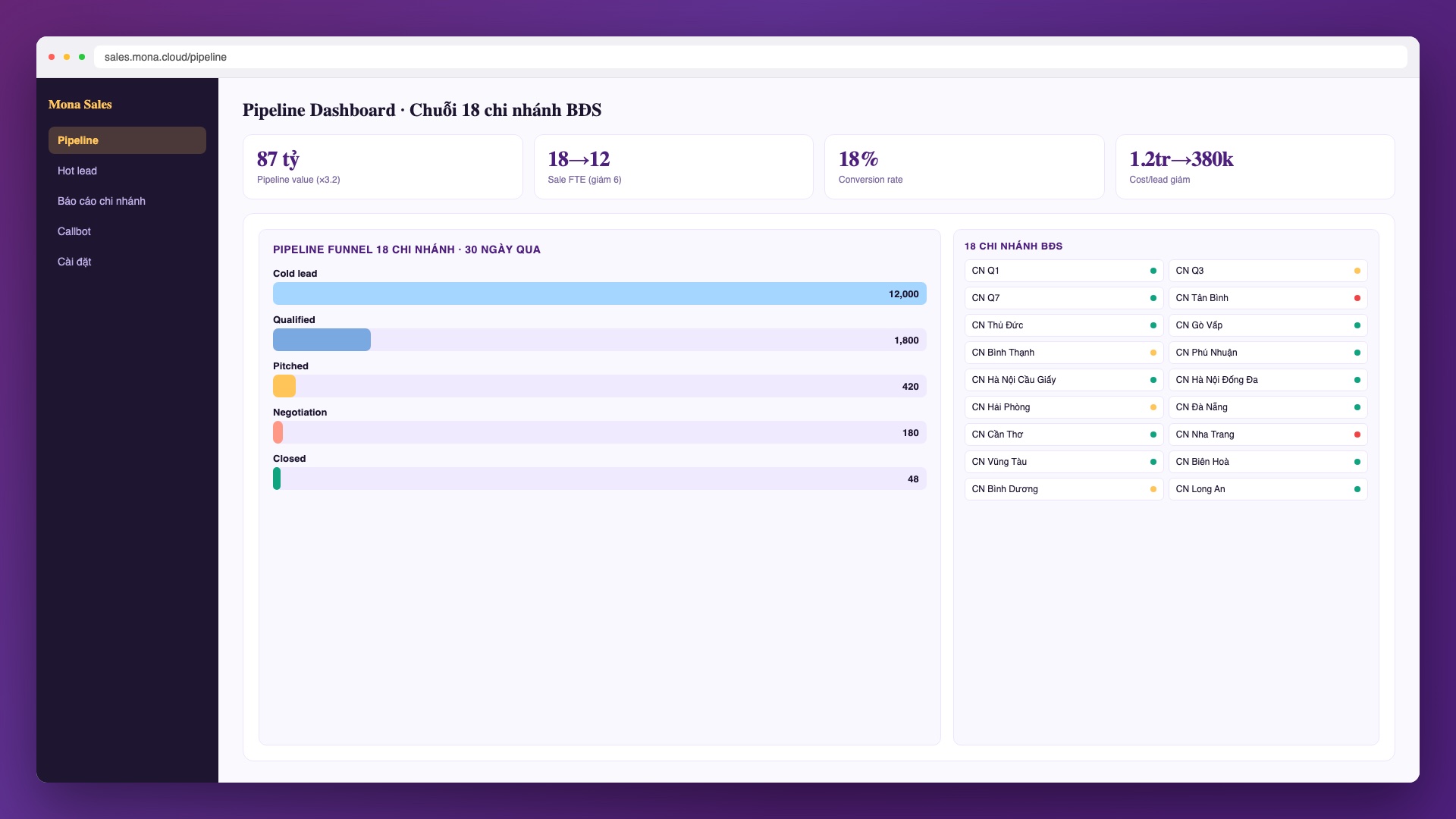
Here is a case we share in detail. A real estate brokerage chain with 18 branches across Ho Chi Minh City, Binh Duong, Dong Nai and Long An. Brokerage revenue is 47 billion VND a month. The sales team has 64 people, with an average salary of 24 million VND a month and a commission of 0.8% to 1.2% of transaction value. The top of the funnel receives 1,200 leads a day from Facebook Ads, internal websites, livestreams, and an affiliate network.
The pain before meeting MONA. Sales spent 6 hours a day entering CRM data, writing summaries, and cold-calling. The lead-to-viewing-appointment rate was 4.2%. The viewing-to-deposit rate was 18%. Sales turnover was 32% a year. Training a new sales rep cost 18 million VND. The CEO said it bluntly: I can't scale, because every time I hire 10 sales reps, 3 quit.
MONA rolled out 4 modules over 5 months. Lead scoring in month 1. The Vietnamese callbot in month 2. The follow-up writing module in month 3. The automatic note module in month 4. Month 5 was for tuning and retraining the sales team on the new process.
Results after 6 months. The lead-to-appointment rate rose to 13.8%. The appointment-to-deposit rate rose to 24%. Brokerage revenue grew from 47 billion VND to 89 billion VND a month. The sales team shrank to 42 people because 22 were moved to a new investment arm. That means the chain grew revenue 1.9 times with two thirds of its old sales team. Turnover fell to 11%. Savings on training and salary came to about 720 million VND a month.
These are numbers we measured in this chain's internal report. MONA does not disclose the chain's name because of our confidentiality commitment. Any founder who wants to see a dashboard demo and the model logic can contact MONA, and we'll open a dedicated 90-minute session.
Lesson 1: don't roll out all 4 modules for applying AI to the sales department at the same time. Spread them across months so the sales team gets used to them gradually and the CEO can measure each variable.
Lesson 2: the callbot must come after lead scoring. If the callbot calls leads that haven't been screened, the results are still poor.
Lesson 3: retraining the sales process is the hard part. Veteran sales reps are used to doing admin, and when machines suddenly take it over, they feel lost because they don't know what to do. We spent 4 weeks training the sales team to focus on level-2 negotiation skills and long-term customer care.
Readers of this article tend to split into 2 groups. Group 1 is used to sales reps on 25 million VND salaries doing 60% admin work, leads piling up with nobody following them, and a CRM always empty of notes. They have given up on finding a fix and accepted that this is just how sales in Vietnam is, treating it as something the business has to put up with. Group 2 is made up of new owners, or owners who after 10 or 20 years in business are still always looking for solutions. They keep an ear out for AI lead scoring, Vietnamese cold-call callbots, and automatic CRM notes, so that when a solution appears they bring it in and roll it out decisively, shocking both team leads and the old sales team at once. MONA (we are business people just like you, and MONA has run its own sales department with software we wrote ourselves, with a team of 60+) belongs to group 2, and we are fully confident we can bring a solution to those of you in group 2. What you need is just a 45-minute call away, and it's free. A MONA specialist will bring it to you whatever your business model and whatever your current situation (1 branch or 50 branches, a team of young sales reps or many veterans, no tech knowledge or very tech-savvy, never used a CRM or already replaced sales software three times, project real estate or enterprise SaaS). We have a solution for every case, because this is already the 10th year MONA has been bringing automation solutions and software to businesses in Vietnam. Email info@themona.global or book a 45-minute call through the mona.media website.
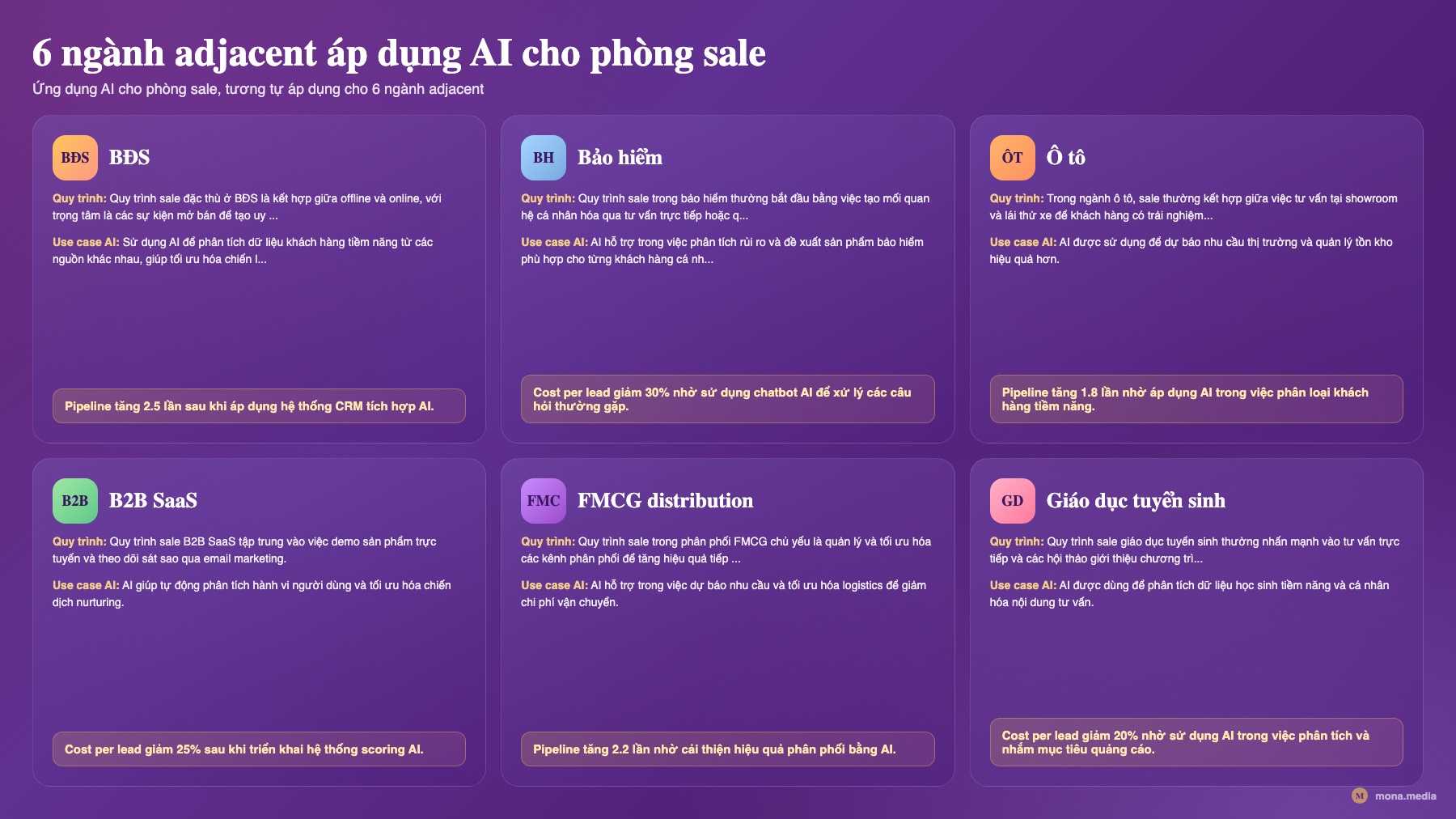
We see that this model AI for sales teams can be carried over to many other mid-market industries without much rewriting. The logic behind applying AI to the sales department is shared, and only the lead sources and call scripts change.
The general rule: chains of 15 branches or more, monthly revenue of 30 billion VND or more, and a sales team of 25 people or more. This is the scale at which AI for sales teams produces a clear return on investment. It is the scale where applying AI to the sales department makes a clear difference. See more industry-specific cases at spa and salon management software, restaurant management software, English center management software, furniture management software, and clinic management software.
We don't advise running just one module for applying AI to the sales department and stopping there. The sales department is only one stretch of a chain's operations. After automating the sales process, MONA usually continues with 3 branches of work.
Branch 1, connecting the sales department to customer care. When sales close a deal, the customer data flows straight into the customer care module with no re-entry. The customer care module uses AI to send reminders, birthday gifts, and collect feedback. See chatbot software and customer care software.
Branch 2, connecting sales to operations. Once a contract is closed, it is pushed to the ERP, accounting, and warehouse systems. This is where MONA writes custom-coded business automation software for each industry. See more Mona.Software to understand our custom development capability.
Branch 3, feeding data so the AI lead scoring model gets more accurate over time. After 6 months, once your chain has accumulated enough data, MONA tunes the model for your narrow industry. The system runs on Mona.Host and Mona Cloudinfrastructure, with 99.9% stability.
For outside references, read Stanford AI Index 2026 for the industry picture, and Anthropic to understand the model foundation we often use for language tasks. The team at Khánh Hùng Academy also shares many sessions on operations automation for business owners.
Question 1: how much does the initial rollout cost AI for sales teams ? We don't share specific figures in a blog post because every chain has a different scale. Contact MONA and we'll quote based on the scope of rollout.
Question 2: will the sales team resist? Yes, but the resistance fades quickly after month 2, when sales see they're closing more and their commission goes up. We always set aside 4 weeks to retrain the process.
Question 3: how do you know which module to roll out first? MONA audits the sales department for 3 days and measures the hours lost at each step. From there we propose a priority order. Some chains need lead scoring first, and some need CRM notes first.
If you've read this far, your sales department's pain is hot enough. We don't promise miracles. We'll be honest and say that AI for sales teams only pays off when you accept rewriting the process, retraining the sales team, and re-measuring your metrics. MONA accompanies you on the software, the data, and the operational training. Strategic decisions remain yours. Together we can get past the stage where a large chain with highly paid sales reps leaks hours, and turn the sales department back into a real revenue machine. Applying AI to the sales department Is it something you should prioritize in the next 12 months? Applying AI to the sales department Is your chain ready to roll it out? Our team is ready for a free 90-minute audit session. Are you ready to hand the admin work to machines and keep negotiation for your sales reps?
Most of the losses in a sales department are not from a lack of leads but from lost deals whose real reasons never show up in the reports. MONA runs AI for customer care and sales support (Account Helper) on exactly that logic: the machine closely follows every multi-source account, spots customer messages left unanswered for 2 days, customers sending a competitor's quote over Zalo, and tense lines like “if this isn't fixed, I'll demand a refund”, so the boss knows immediately instead of waiting for the weekly meeting. At the lead intake stage, MONA's AI chatbot covers the website, Messenger, Zalo and the switchboard with one brain. Operating cost at MONA is about 3-4 million VND a month, far cheaper than a human on duty.
No. AI replaces average sales reps and the admin part of good sales reps' work. Your best sales reps stay. Applying AI lead scoring plus a cold-call callbot gives them 80% of their working hours for negotiating and closing, instead of the current 60% on admin. A good sales rep's pay usually goes up after 6 months because commission rises with the chain.
Not in the first month. The AI needs 3-6 months to learn from your real closing data. After the learning phase, it ranks 1,000 leads down to 50 hot ones with 75-85% accuracy, beating the personal judgment of junior sales reps. Senior sales reps should still review the AI's list before handing it to the team.
In 2026, Vietnamese voice AI is natural enough that 70-80% of customers don't notice in the first 30 seconds. MONA always sets a rule to hand over to a real salesperson when a customer is genuinely interested, avoiding a bad final experience. The complaint rate is usually under 2%.
Yes. MONA writes standard connectors for Zalo OA, Facebook Messenger, Instagram DM, VoIP hotlines, and website live chat. Messages from every channel are pushed into the CRM automatically, and AI lead scoring scores them together. Sales don't have to open 5 different tabs.
Case of an 18-branch real estate chain: 450 million VND to set up AI lead scoring + callbot + integrated CRM. Operating cost is 35 million VND a month. The chain grew 3.2 times after 4 months and recouped the investment in 6 months. Sales headcount went from 32 to 21 people, and those who stayed earn 35% more.
Keep reading in the same department cluster: applying AI in the marketing department · applying AI to HR teams.

CEO & Founder · The MONA
The founder of The MONA built a service company of 60+ staff with 14,000+ projects delivered. Khánh Hùng shares his thinking on building self-running systems, automating a business, and the real lessons behind MONA's projects.
 416




Professional website
design services
Own a website with a beautiful, 100% exclusive design and a lifetime warranty, with the ability
to expand features flexibly as your business grows, starting today!






 MONA will never sell your information or send you spam


 MONA will never sell your information or send you spam
