
 MONA OS 2.0
 Hợp tác với MONA


 Tự động hoá doanh nghiệp
 Cẩm nang SEO
 Digital Marketing
 Kinh nghiệm thiết kế website
 Hạ Tầng Server
 Giáo dục


 VI
 EN














Message us on
Zalo Official


 ProductsNew

 ProductsProducts
 Mới ra mắtKHA AI 2027App tự edit video, tự đăng mọi mạng xã hội, 2 phút mỗi ngày










 Thiết kế websiteVừa đẹp vừa thuyết phục được khách.
Dịch vụ SEOKéo về khách đang tìm đúng thứ anh chị bán.
 Tư vấn digital marketingKéo khách từ nhiều kênh, đo bằng số thật.
Quay video doanh nghiệpVideo giới thiệu công ty, nhà xưởng, đội ngũ.
 MớiDựng video AIDựng phim câu chuyện công ty bằng AI.
 Custom software developmentCRM, ERP and HRM built for your business.
 Viết AI Agent theo yêu cầuĐặt riêng một trợ lý AI cho đúng việc của mình.
 Tư vấn chuyển đổi AIĐưa AI vào vận hành của cả công ty.
NewMONA LMSManagement for centers and schools.
MONA SkillHubInternal training for company staff.
 NHTQ systemEnd-to-end China–Vietnam shipping operations.
MONA JMSManagement for gold, diamond and pawn shops.
 MONA E-LearningA website with every feature you need to sell courses.
 How to sell online courses (course)More than 30 free lessons on selling courses on autopilot.
 MONA Cloudmonacloud.vnServers to get your apps and websites running.
 MONA Basemonabase.vnPostgres database, sign-in and file storage.
 MONA Mailmonamail.vnSend OTP, order and invoice emails from your software.
 MONA Paymonapay.vnAccept bank transfers via VietQR and notify your software when the money arrives.
 MONA eInvoiceComing soonIssue e-invoices that meet tax standards.
Gấu CườiTrả lời khách 24/7 trên web, Fanpage, Zalo và thu lead cho sale.
 Gấu TeleSalesGọi điện tư vấn, chăm khách như tổng đài viên thật.
Dê CườiTư vấn và chốt đơn cho shop ngay trong khung chat.
Gấu WebmasterNhắn nhóm Zalo là website được sửa xong.
 Gấu Pháp ChếSoạn hợp đồng, rà điều khoản trong vài phút.
 Gấu Báo GiáLên báo giá đúng mẫu và gửi khách ngay.
 AI chăm sóc khách hàngTheo dõi và giữ chân khách hàng cũ.
 Gấu Tuyển DụngLọc hồ sơ, hẹn lịch, phỏng vấn ứng viên.
 Mới ra mắt
KHA AI 2027
Xây kênh chuyên gia 2 phút mỗi ngày
Quay bằng điện thoại, AI tự edit video, tự đăng lên 16 nền tảng và tự trả lời bình luận, tin nhắn.
879.625lượt xem trên kênh CEO MONA sau 35 ngày
 Anh Khánh HùngCEO MONA đang dùng mỗi ngày
Xem app làm được gì
 AI
Gấu Cười MONA ĐANG TỰ XÀITrả lời khách 24/7 trên website, Zalo OA, Messenger và thu lead về cho sale.
Dê CườiChốt đơn bán lẻ và sàn: Shopee, TikTok Shop, web. Chăm cả khách sỉ, đại lý.
Gấu WebmasterCập nhật nội dung, tối ưu SEO website mỗi ngày.
Gấu TeleSalesGọi điện tư vấn, chăm khách như tổng đài viên thật.
Gấu Tuyển DụngLọc hồ sơ, hẹn lịch, phỏng vấn ứng viên tự động.
AI chăm sóc khách hàngGiữ khách cũ, cứu lead đã rớt cho phòng kinh doanh.
Gấu Pháp ChếSoạn hợp đồng, rà điều khoản trong vài phút.
Gấu Báo GiáLên báo giá đúng mẫu, gửi khách ngay khi có yêu cầu.
 Chuyển đổi AI toàn phầnGiải pháp tổng cho doanh nghiệp, 3 lớp triển khai.
 Viết AI Agent theo yêu cầuĐặt riêng một con AI gánh đúng nghiệp vụ của bạn.
 Custom softwareCRM, ERP and HRM with built-in AI automation.
 SEO & AEO thời đại AIĐược Google lẫn AI trích dẫn, không chỉ xếp hạng.
 Kiến thức AI cho doanh nghiệpBài phân tích, hướng dẫn ứng dụng AI vào vận hành.
 Free AI courses
 AI tools at work
App mới · KHA AI 2027
Xây kênh 2 phút mỗi ngày
AI tự edit video, tự đăng mọi mạng xã hội
Free consultation, 8am–10pm every day

01 June, 2026
10 p.m. on a Sunday night. The CEO sits stranded in the office, the desk covered with documents on rolling out AI for the business. A perennial problem for many Vietnamese business owners is that 80% start off wrong in the very first week. Technology upgrades cost 6-12 months of opportunity without delivering clear results. Nearly 30 mid-market chains have come to us at MONA in the past 18 months for the same reason. They were all looking for an effective AI First roadmap, but got lost in a mess of information. Rolling out AI in a business is not as simple as imagined. Many people mistakenly think that bringing in AI is all it takes, but the harsh reality isn't like that. To avoid burning more precious time, we are sharing a 6-step handbook, an AI First roadmap, straight and practical from MONA. Are you ready to rise together with MONA?
11 p.m. on a Thursday. You sit in your office on the 18th floor in District 1, with only a dim desk lamp lighting a stack of files. You scroll LinkedIn and stop at a post from a competitor. It's a spa chain of similar size. The post announces: “Just completed an AI-First rollout for 22 branches, a 24/7 customer care callbot, cutting operations costs by 35%.” You freeze for 10 seconds. Read the post twice. A chill runs down your spine. A thought flashes: “Standing still is falling behind.” Every month you delay, that competitor has gone another stretch further. A chill down your spine.
Every morning, you read the news on VnExpress, CafeF, ICTNews. FPT has just announced a Gen AI solution for large enterprises. MISA AMIS integrates an AI module into its HR and Accounting software. Base Automation expands to the 200 largest businesses in Vietnam. You realize the Vietnamese software industry is moving faster than at any time in the past decade. Meanwhile, your chain still relies on Excel, Google Sheets, and handwritten notebooks. The feeling that you're 18-24 months behind competitors of the same size gets clearer by the day. I'm 18 months behind.
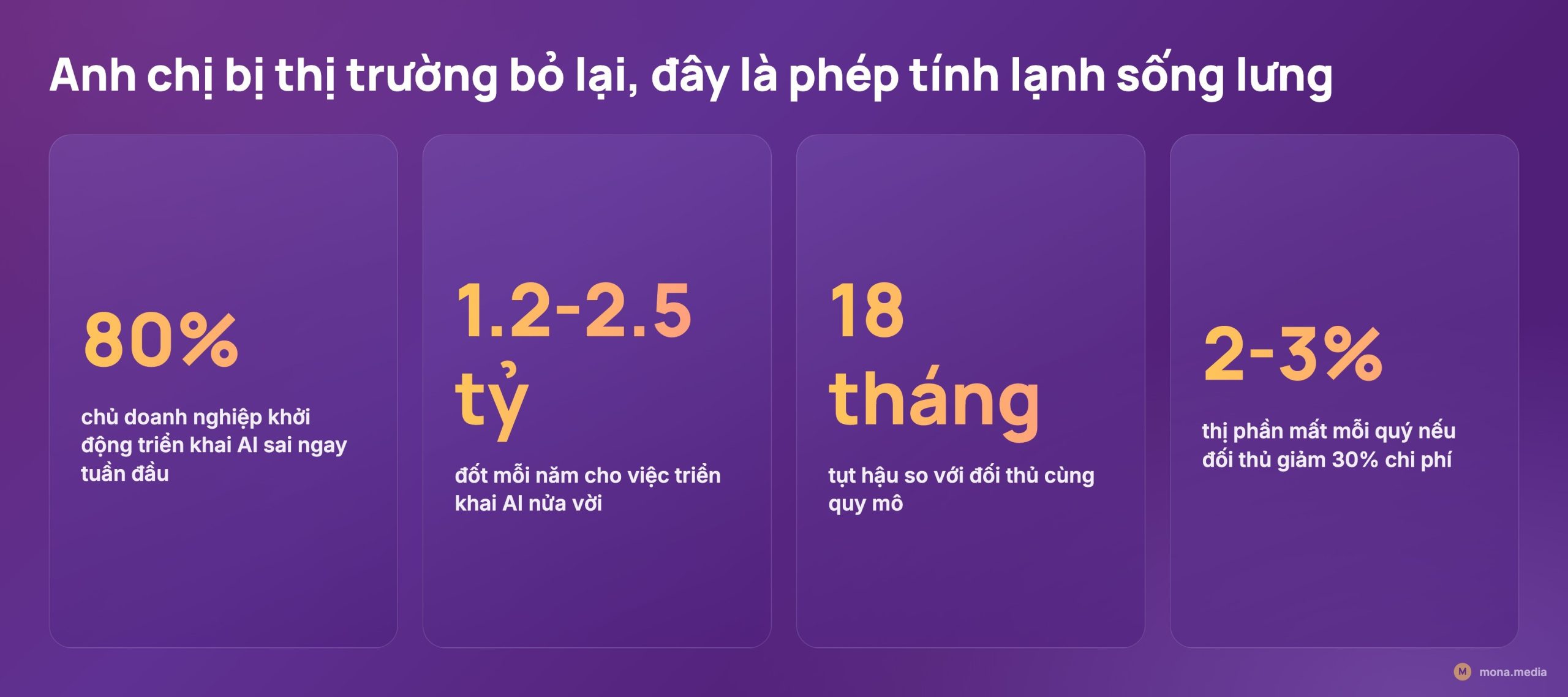
Last week, at an industry conference at Diamond Plaza, you heard the CEO of that very 22-branch chain speak on a panel. He said: “We just signed a 12-month rollout contract with a Vietnamese automation provider. Phase 1 ships in 90 days, focused on the customer care module and a sales qualifier.” You went back to the office and opened the market share comparison. That competitor now holds 12%, while your chain has 9%. If they cut operating costs by 30% within six months, they can drop prices 8-12% lower, making you lose 2-3% of market share each quarter. You haven't even held this month's board meeting. The board meets next month. By then, they will have shipped Phase 1.
In truth, you are not afraid of AI. You've read more than 30 articles about AI and used ChatGPT personally. You understand clearly what AI can do and where its limits are. What you fear is being left behind. Fear that in six months you can't catch up with competitors. Fear that your chain slips from the top 3 in the industry to the top 7-8. Fear of waking up one morning, walking into the office, and realizing 30% of your customers have moved to a competitor. Alone. Standing still. Is falling behind.
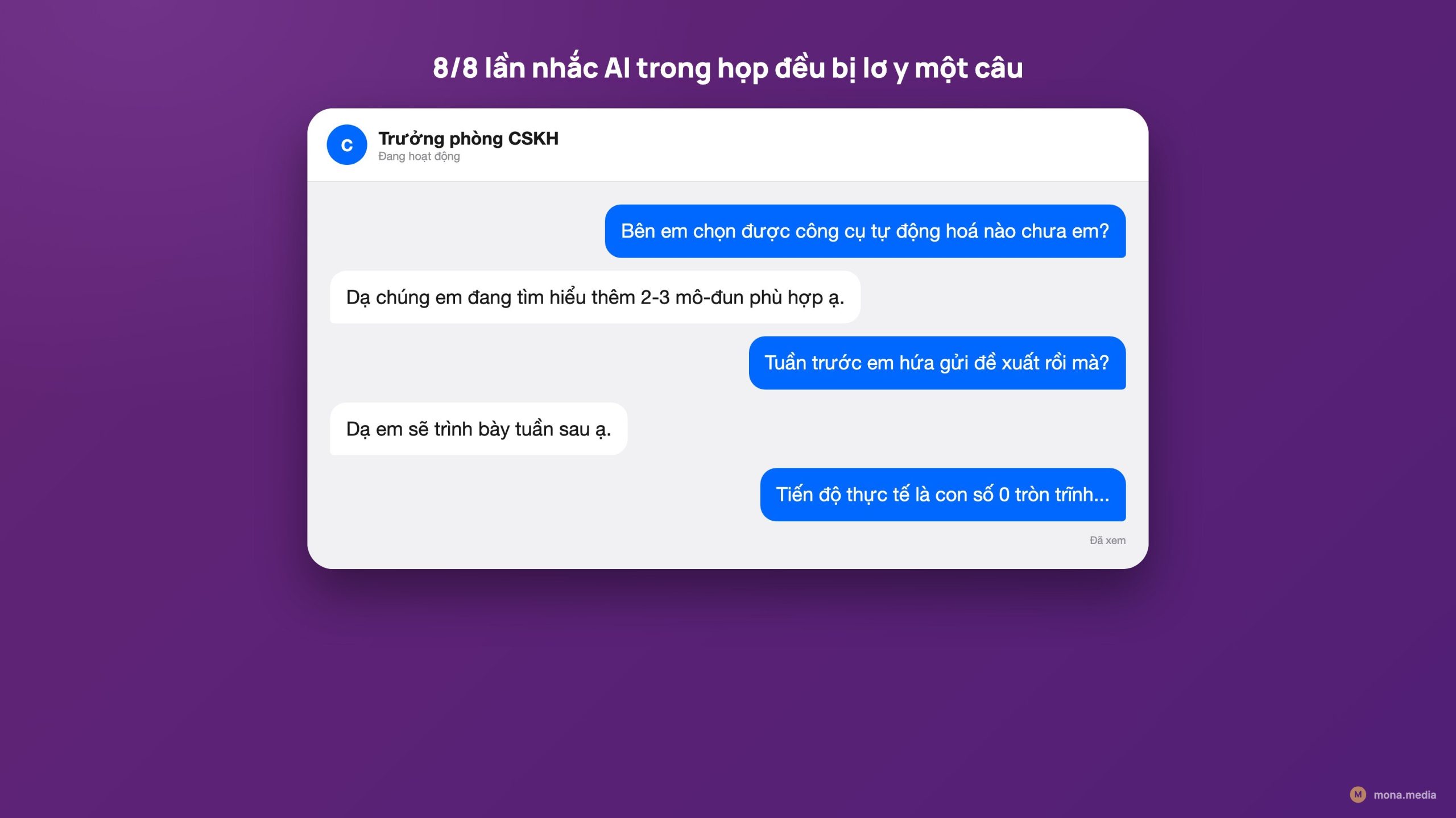
9 a.m. on Monday. The weekly meeting in the meeting room on the 5th floor. 11 department heads and the division director sit solemnly. You say: “Next month let's try automating the customer care department with AI. I heard a competitor, a 28-branch spa chain in HCM, has already rolled it out, so we need to act now.” The whole room looks down at their laptops. The silence lasts 5 seconds. 5 seconds that feel like 5 minutes. The customer care head looks up: “Yes, we will research it further.” A textbook answer. Not a single commitment to a deadline. No mention of which tool will be piloted. You nod. The meeting moves on to other topics. The AI story is gently slipped into a drawer.
In the fourth week after that meeting, you call the customer care head into your private office. “Have you picked an automation tool yet? Any update?” you ask. The head replies: “We are still looking into 2-3 suitable modules. I will send you a proposal next week.” Next week, no email. The week after, nothing either. You ask a second time. The answer is word for word the same as before. Staff don't say “we can't do it”. They say “we are researching” indefinitely. You can't blame anyone. But real progress is a perfectly round zero.
A few days later, your assistant goes out for lunch and overhears someone from marketing whispering: “The boss is pushing this AI automation thing, he probably wants to get rid of us. If I show that AI can write the captions for me, I lose my job.” Mid-level staff hold a private meeting with the head of marketing: “Tell the boss our industry isn't ready yet. Let's stall another 3-6 months.” A week later the head of marketing has a 1-on-1 with you: “Boss, the team feels AI isn't a fit for our industry. Cosmetics content needs emotion. I suggest we postpone 6 months to research more.” You can't tell whether that's the truth about your industry, or just your staff buying time.
The same script plays out in 5 of 8 departments. Every department that hears about AI automation comes back with “not a fit for our industry”, “still researching tools”, “I'll present next week”. Over 6 months you brought up AI at least 8 times in management meetings. All 8 times, it was ignored. All 8 times, you got the same promise: “Yes, we'll look into it.” You get no support from your own people. Every time you mention AI, you get brushed off. Every time you get brushed off, you feel alone. Five seconds of silence. 8 out of 8 times. Alone.

Linh, 27, works in operations and comes to the office every morning. See more employee reactions to AI. She opens her laptop and two personal tabs right away. One is ChatGPT Plus, which she pays 20 USD a month for herself. The other is Claude Pro, also out of her own pocket. The weekly report used to take 30 minutes. Now Linh finishes it in 5. All thanks to AI. She spends the other 25 minutes scrolling Facebook and TikTok, and ordering cosmetics on Shopee. The boss still thinks each report takes Linh 30 minutes. He's happy with the results. Linh doesn't tell him. She doesn't suggest the company buy a ChatGPT Team plan. If the company did, everyone would get to use it. Linh's edge would disappear. Her job would be exposed as something that takes 5 minutes to automate. Linh keeps the secret. To keep her job.
Hung, 32, has worked in accounting for 4 years. He knows the 2025 version of MISA AMIS Accounting has an AI module that reconciles bank transactions automatically. It also has OCR to digitize invoices. Hung read MISA's white paper last month. He didn't tell you, the business owner. He didn't send a link either. He didn't suggest a 30-day trial of the AI edition of MISA AMIS. The reason is simple. If the boss knows, the boss will buy it. Once the boss buys it, the AI module handles 80% of bank reconciliation on its own. The accounting department has 4 people now. It would only need 2. Hung could be cut. So you end up Googling it yourself. Searching “accounting software with AI 2026”. Asking in Facebook groups like “Vietnam Accountants”. The boss's job becomes hunting for information. The staff sit on it.
Vy, 25, is a Gen Z marketer. She writes every Facebook description with Claude Sonnet. It takes 5 minutes. Then she edits lightly for another 5. Ten minutes in total. Vy hands the description to her manager 2 hours later. She logs it on the timesheet: “writing description: 2 hours 00 minutes”. Her manager believes it. You read the month-end report and think the team is working hard. 2 hours per description times 30 descriptions. That's 60 hours of work. In reality Vy spends 5 hours on all of the month's descriptions. She uses the other 55 hours for freelance work on the side. She earns an extra 8 to 12 million VND a month. Vy tells no one. If she did, the boss would cut the marketing team from 6 people to 2. Vy would be one of the 4 let go.
To sum up the cases of Linh, Hung and Vy: in a company with 80 staff, at least 15 to 20 people are estimated to be secretly using personal AI. They deliberately hide it from the boss. You don't know what AI your own team already uses, how far they take it, or how much work it replaces. This is an information gap that your staff create on purpose, and it keeps getting deeper, to protect their jobs. The younger the employee, the more carefully they hide it. The easier a skill is to automate, the more they conceal it. You have to research AI from zero, while 15 to 20 people inside already know it very well. The boss is left outside the technology game in his own company. 15-20 people know. The boss doesn't.
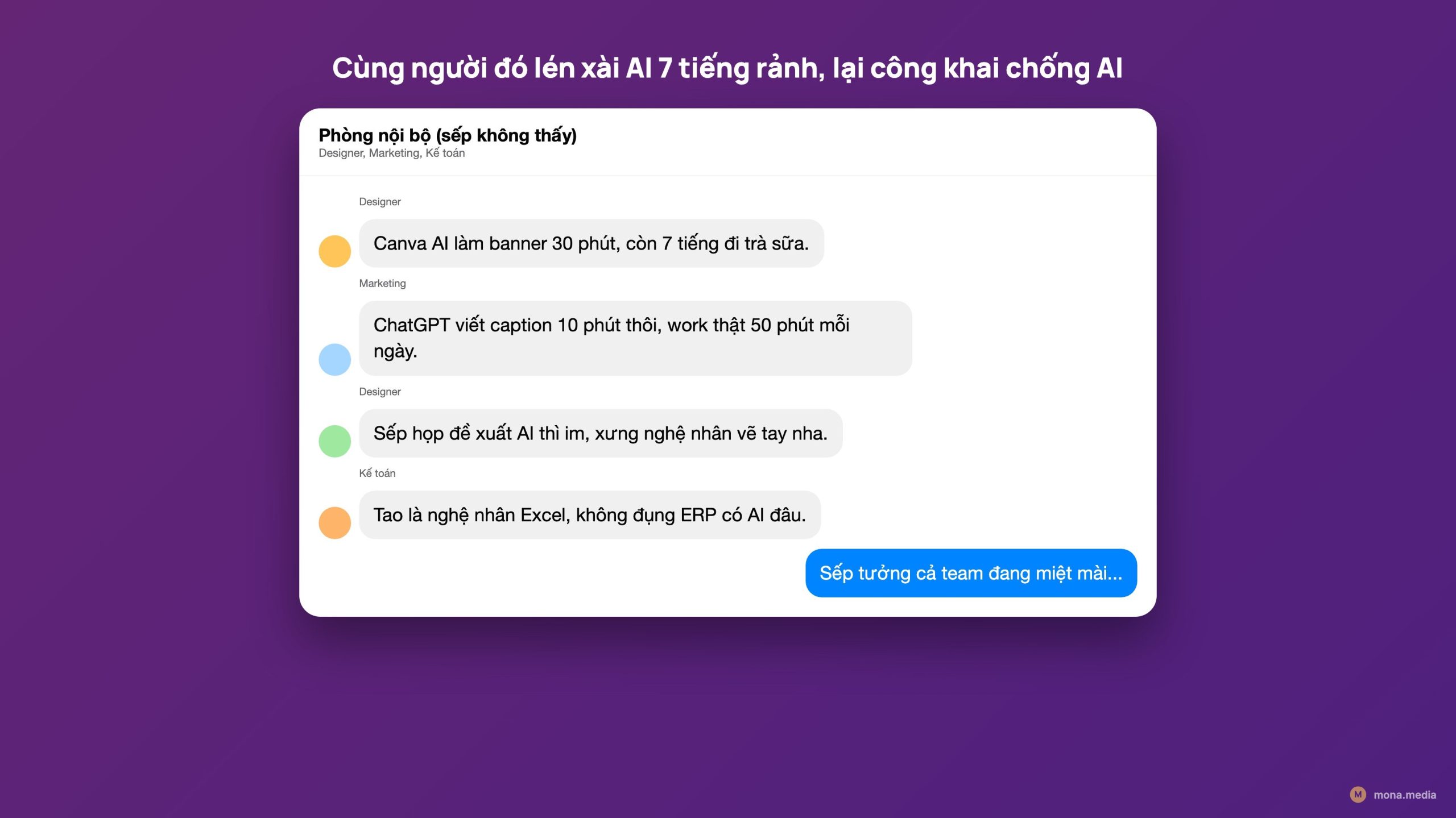
A designer uses Canva AI to make banners. A job that used to take 5 hours now takes 30 minutes. They don't report this to the boss. For the other 7 hours of the day they scroll TikTok and go out for bubble tea and coffee. The boss comes into the office, sees them sitting there, and assumes they're working hard. The employee gets the reputation of “secretly using AI to slack off”. All that idle time opens a big gap you can't control. It's a hidden problem that quietly eats away at performance.
A marketer uses ChatGPT to write captions. A 2-hour job is now 10 minutes. They sit in the office for 8 hours, but real work is only about 50 minutes a day. At the end of the week they hand in 5 captions. The boss still thinks the whole team is grinding. A salesperson drafts outreach emails in 3 minutes instead of 30. They spend the other 27 minutes on Instagram. Fake productivity creates fake results. Payroll stays high. Real output stays low. You're paying for idle time, and that money could go to something else.
These same employees are also the ones who push back. When you hold a meeting to propose AI for the department, they stay silent. The designer calls themselves a “hand-drawing craftsperson” and refuses Canva AI. “It has to be drawn by hand to have soul,” they say. The marketer calls themselves a “word craftsperson” and won't use AI suggestions. “You have to feel it yourself for it to be authentic,” they say. The dev is a “Notepad/Vim craftsperson” who turns down Cursor and Copilot. “IDEs are for noobs, coding by hand is cool,” they insist. The accountant is a “manual Excel craftsperson” who won't use an ERP with AI. The title “craftsperson” is an excuse. It protects the job, not any real value.
This is the paradox you face. The same employee does two opposite things. They secretly use personal AI, which gives them 7 hours of sitting around. AI works faster than they ever expected. But they openly oppose AI. When you propose it, they refuse. They're afraid of exposing that their work can be automated. The two actions contradict each other, yet they follow the same logic: hide the truth. The truth being “what I do can already be automated”. They want to protect their position. You have no idea. You keep fumbling on your own. The isolation continues.

You don't have a solid technology foundation. Your business has been running for 10-15 years. Customer data is scattered across 3 main Excel files from 3 different departments. There are another 12 separate Google Sheets on the side. Paper sales notebooks sit in 28 branches, and every store uses its own format. You have no clean CRM. The same customer shows up under different names in 5 systems. Nobody has a unique ID. Purchase history is split up. A customer from 5 years ago may or may not still be active, and nobody knows. AI has nothing to learn from. AI needs clean, labeled data with a clear schema, and your business doesn't have that yet. Buy an AI tool and plug it into Excel, and it answers wrong in 40-60% of cases. You feel like you're standing in a sea of messy information. You know AI needs data, but you don't know where to start cleaning. Cleaning takes 6-12 months and costs 800 million to 1.5 billion VND. It needs 2-3 full-time data engineers you don't have.
You also lack support from your team. Staff are indifferent and used to the old way of working. Employees deliberately hide information from AI. Mid-level managers talk with their teams to stall and delay. Every department head gives the same reason: “not a fit for our industry”. Or says “still researching”, “the team isn't ready”. 5 of 8 departments gave the exact same reply over 6 months. You research alone, decide alone, and persuade every employee alone. You carry all the pushback alone. Every meeting about AI is a small battle. 8 meetings, 8 battles, and you lost 8 out of 8. It feels like walking down a one-way street. No response, nobody pushing from behind. You have to push yourself and brace yourself. Exhausted, but you can't stop.
On top of that, you have no advisor you trust. You don't know the consulting firms outside MONA. You already tried hiring 2-3 other AI consultancies. They handed over a beautiful 80-page slide deck and an 18-month roadmap. The contract cost 50-80 million VND a month. They have no code, and they don't stay around when your staff push back. You go for coffee with fellow CEOs in your industry and ask, “How's AI going at your place?” The answer is usually, “Fumbling around just like you.” 5 out of 5 fellow CEOs are lost in exactly the same way. Nobody can point to a concrete path. You ask the “AI thought leaders” of Vietnam on LinkedIn. They only post theory. No hands-on experience. They don't follow through when you message them privately. Vendors are selling, with obvious bias. Then there's MONA: we have 30 close mid-market clients who have deployed successfully. We have stayed with them through this hard stage. But you don't know MONA yet. That's why we wrote this guide for you.
You alone. Lost. Researching alone, deciding alone. Persuading alone, budgeting alone. Taking responsibility alone when it fails. Lost in the fastest-moving AI market of the past 10 years. Lost among a team that is indifferent and hides information. Lost among a forest of consultants who only know how to sell. Lost inside the very company you have built over 15 years. Completely lost. This is the structure that is killing you. The structure of being lost. The structure of being alone.

Next month you go to the board and get approval for a budget of 800 million to 1.5 billion VND for automation software across 5 departments. We often see chains sign yearly contracts. In the first month and the second, the whole team is excited. Staff are forced into 16 hours of training. By the third and fourth month, they drift back to the old process. The head of customer service doesn't track adoption. You check the software dashboard and see 18% of staff using it and 82% dropping out. Return on investment is negative.
Each person who does use it carries 12 million VND a month in tool costs. The board reviews the Q2 report: “The 800 million automation software shows no real figures.” By month seven or nine, you've lost the board's trust. The board cuts the automation budget a second time. You cover 1.5 billion VND yourself. You stay quiet. Next year when you ask for more automation budget, the board refuses outright. The door to automation closes for 2-3 years.
Or you take a harder line. You issue an order: “Next month, anyone who doesn't use the automation tools the company provides gets 20% off their KPI.” Two or three key people in marketing and customer service, with 10-15 years of tenure, feel threatened. They quit within 30 days. They are the ones who keep everything running smoothly. You spend 60-80 million VND hiring replacements, lose 3 months on initial onboarding for the new staff, and another 6 months before they work independently. During those 9 months, department operations stumble, customers complain, and sales drop 12-18%. By the time the new staff settle in, the company has lost 9 months and 1.5-2 billion VND in indirect costs. The automation tool still isn't in use, because the new staff don't understand your processes well enough to know where to put it. Back to square one.
Or you may simply get tired. “Let's take it slow, we'll do automation in a year, no rush.” You push the decision to Q4 2027. In those 12 months, a 22-branch competitor finishes phase 2 of automation (customer service + sales + operations + HR). They cut operating costs by 30-35%. They price 10-15% lower in Tet promotions. In Q1 2027, the competitor's market share rises from 12% to 17%. Yours falls from 9% to 5%. Revenue drops 35-40%. Cash flow gets tight. In Q2 2027 you're forced to close 5-8 underperforming branches and cut 15-20% of staff. By the time you return to automation, there's no budget left. Low revenue makes borrowing hard. The competitor has taken the lead in market share and you can't catch up. Your chain slides from top 3 in the industry to 7th or 8th.
Three paths. Three deaths. The first path dies from losing the board's trust. The second dies from losing key staff. The third dies from losing market share. Three different deaths with the same root: you are on your own. No solid technology foundation, no strong enough team, no trusted advisor. The structure of being alone is itself a force that kills a business, with no outside factor needed. There's no way out unless that structure changes. You can't escape by trying harder. Trying harder just takes you deeper into one of the three deadly paths. Three paths. Three deaths. No way out. Unless the structure of being alone is broken.
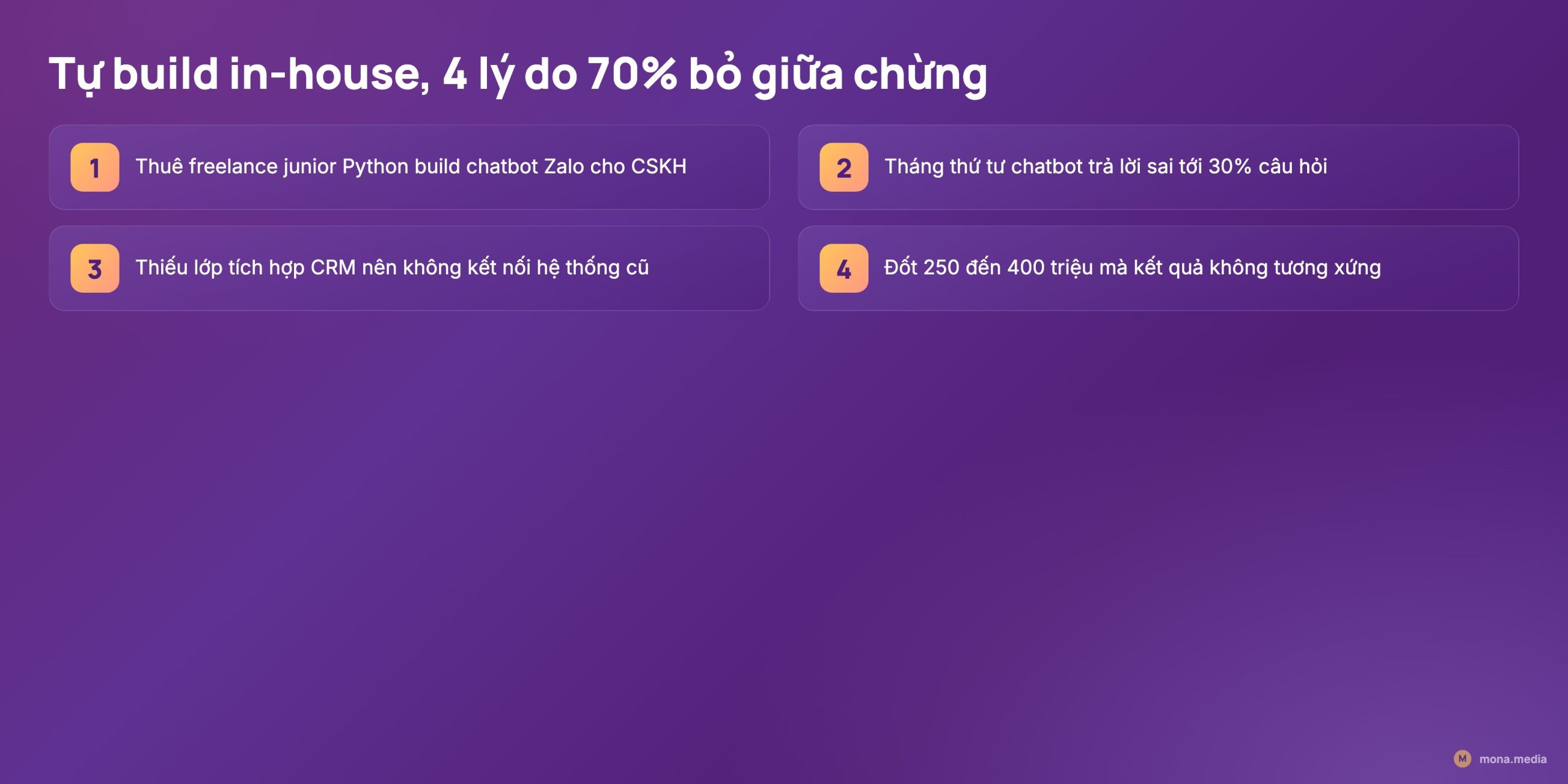
For the first three months, everything looks stable and positive. You've invested 9 million VND in an AI course and hired a junior Python freelancer to build a chatbot on Zalo for your customer service team. But by month four, things start to fail. The chatbot not only answers up to 30% of questions wrong, it also lacks the CRM integration you need.
The bigger problem is that costs climb without producing results. Total spending has reached 250 to 400 million VND, and the results don't match. Many businesses hit this wall when they build in-house systems without proper support.
The main reason 70% of businesses quit halfway is the missing integration layer. They tend to focus only on the technology and forget about connecting to existing systems. Trying out new technology without a long-term plan is a risk.
An effective solution is to work with professionals. At MONA, we have built many successful automation solutions for similar businesses. What matters is having support from people with experience and a longer view.
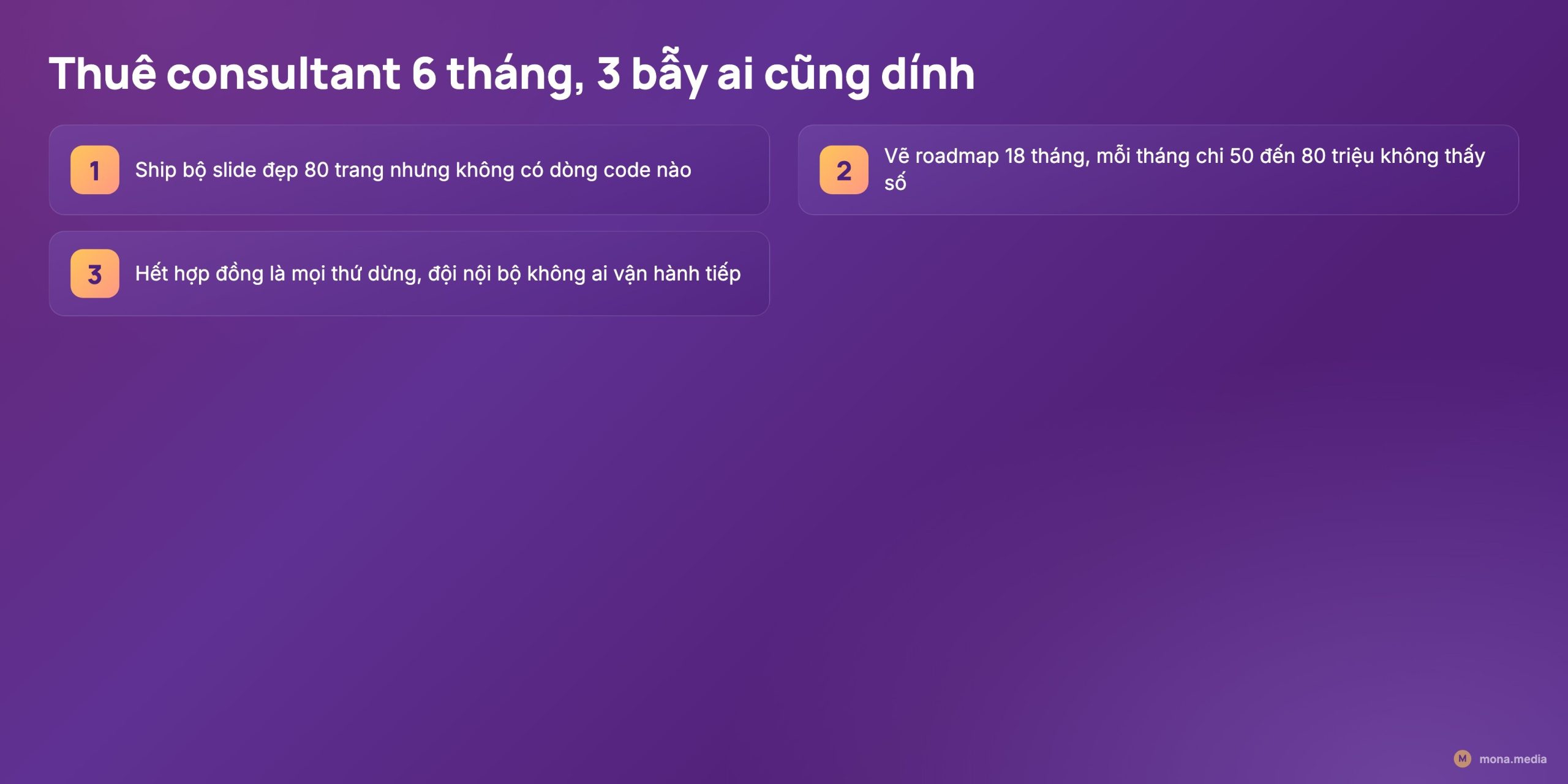
Usually when you hire an AI consultant, the first thing they do is ship a pretty 80-page slide deck. The deck lays out lots of ideas, a strategy map and tempting promises. But the problem is that there isn't a single line of code behind it. You've probably been in this situation more than once.
Second, the consultant draws up an 18-month roadmap. Throughout that time you pay 50-80 million VND a month without seeing any clear numbers or concrete results. The long wait and confusion grow when you don't know how it will end.
The last trap: when the contract ends, everything stops. Nobody on your internal team is able to keep running it. The consultants usually leave without a detailed plan or specific operating instructions. Sound familiar?
MONA has seen these traps and works to avoid them. Instead of shipping slides, MONA offers practical software that is easy to deploy. We put results first, not just nice ideas on paper.
From experience, we know that only simplicity and practicality let you see a return on your investment. So are you ready to put your trust in real results rather than relying on slides alone?
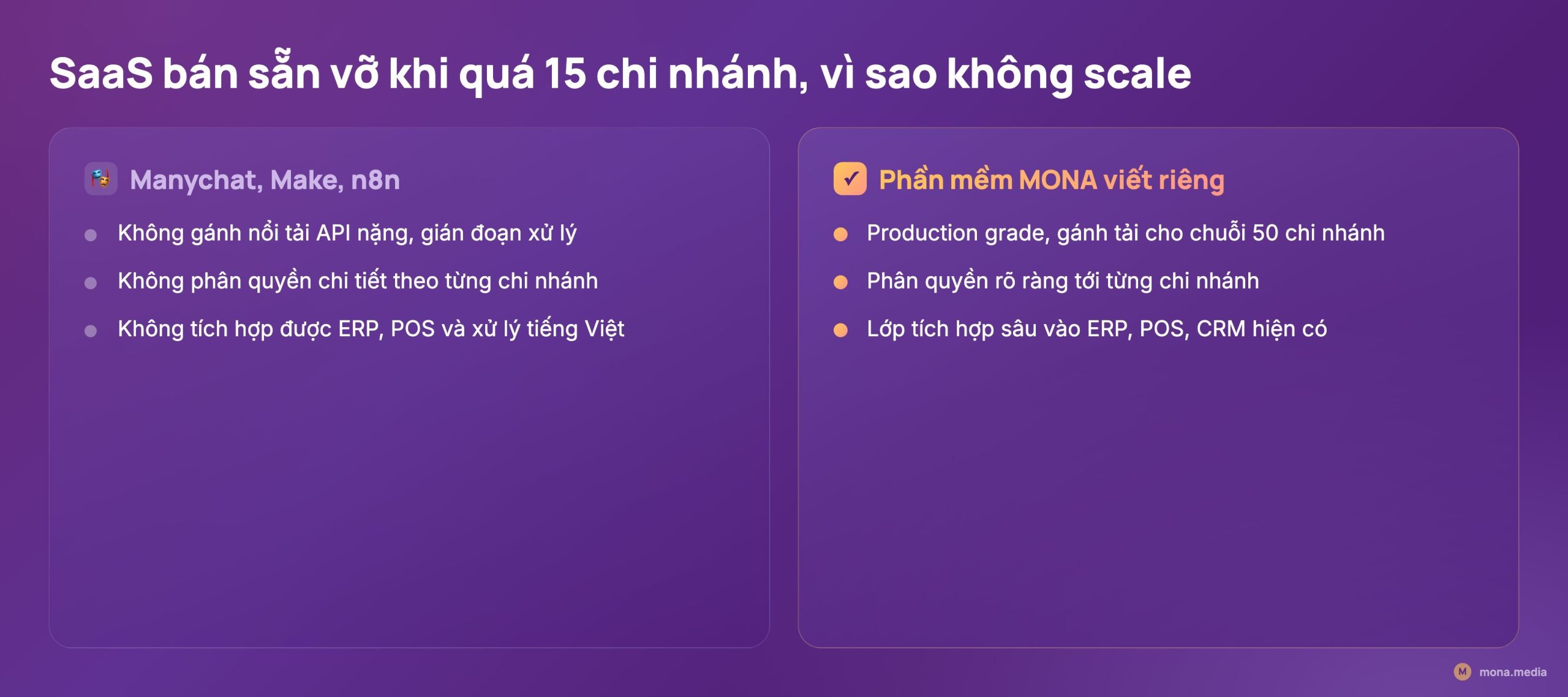
We often hear about the convenience of SaaS services like Manychat, Make or n8n. But once they're applied to a system with more than 15 branches, their limits start to show. These services often can't handle heavy API loads, which leads to interruptions in processing.
Many of you have struggled with being unable to set detailed permissions for each branch. This causes real trouble when every branch needs a different level of access. On top of that, there is no easy way to integrate with your current ERP or POS system. We've seen many businesses struggle to keep their data in sync.
Another problem is handling complex Vietnamese data. Foreign SaaS tools are often not optimized for Vietnamese diacritics and characters. This is a big concern for Vietnamese businesses that want to automate their processes through these platforms.
It doesn't stop there. SaaS tools like Manychat, Make or n8n are also inflexible when it comes to customizing for the specific needs of each industry. That leaves you hunting for workarounds or inefficient solutions. These patchwork fixes only make things messier and can't solve your current pain at the root.
With these challenges in mind, we at MONA built automation software that helps you get past the barriers SaaS can't handle. It's clear that to scale a chain successfully, you need a more customized and professional solution.
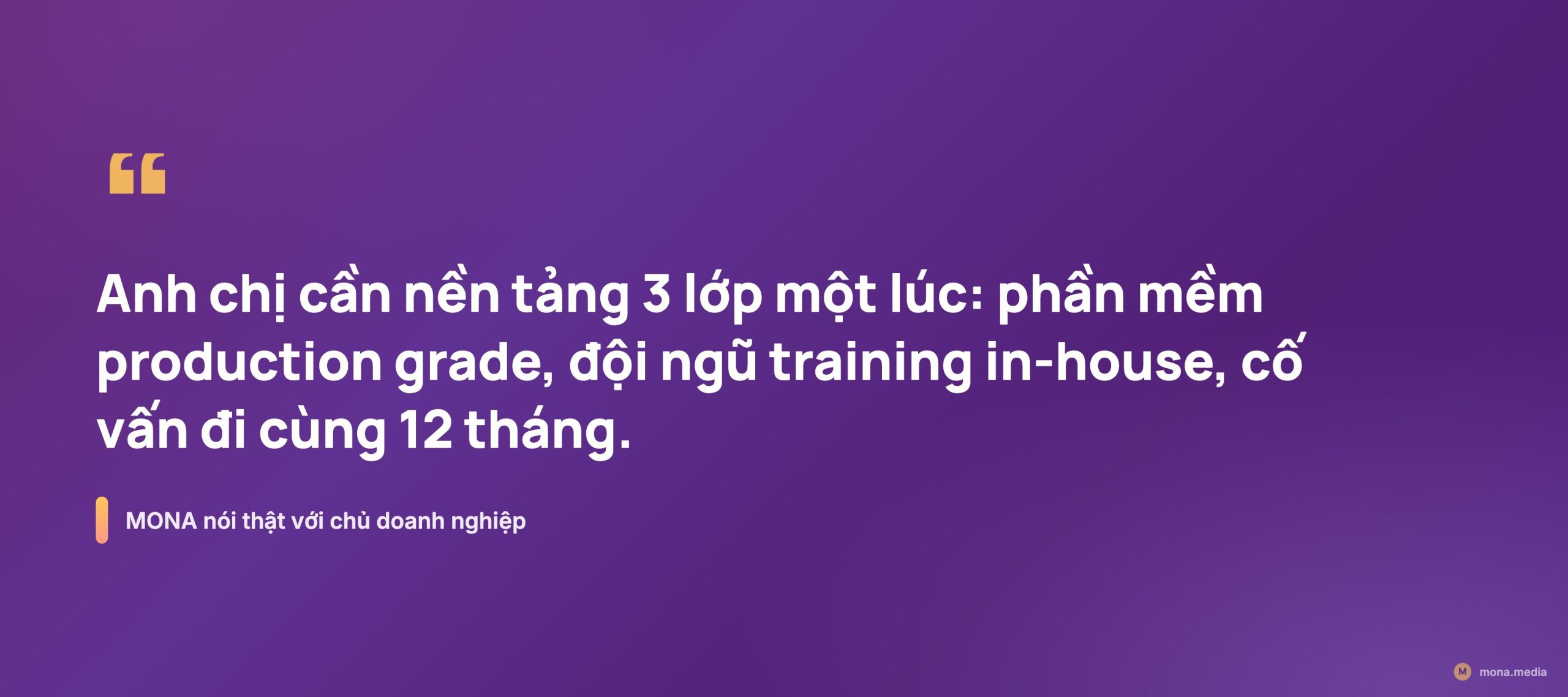
You are burning something far more expensive than money: 6 to 12 months of missed opportunity during the fastest-moving automation market in the past 10 years. In that time, a 22-branch competitor in your industry gains 2 to 3% of market share every month, opens 4 to 6 more branches every quarter with only a third of the operations staff your chain needs thanks to automation software it has already locked in, and climbs 1 to 2 more places in the industry rankings every half year. And it's not only time. MONA knows you have already tried a great many ways to escape this lonely position (reading 30 English blog posts a week to keep up with Anthropic, OpenAI and Google, buying 9 to 19 million VND AI courses for yourself and your department heads, inviting 3 to 4 AI vendors for demos over 6 months costing 40 hours of meetings, hanging “AI-First” posters across the office, pushing a “every department must use AI” KPI to all 5 departments at once and getting 5 silent departments back, asking 4 to 5 fellow CEOs how they do it and finding they're all just as lost as you, downloading MISA AMIS and Base yourself to test for a week and then shelving them, trying to convince a 28-year-old head of marketing that “AI will help you, not replace you” and still getting ignored). But no. One person pushing the whole company to adopt AI, with an indifferent team that deliberately hides AI use, with no trusted advisor, with data scattered across Excel, Google Sheets and notebooks, is simply not possible, and every month you delay is another month your competitor pulls further ahead. Trying to hire a senior AI engineer, hiring an outside consultant with a low close rate, or buying more SaaS is not the answer. What you need is a complete foundation with all 3 layers at once: closed, production-grade software business automation written by MONA around your processes (the technology layer), MONA placing people next to you for in-house training that turns staff from indifferent to champions (the team layer), and MONA going with you through 12 months of rollout with clear accountability (the advisory layer), not going it alone and then, 12 months later, sitting there counting the branches your competitor just opened.
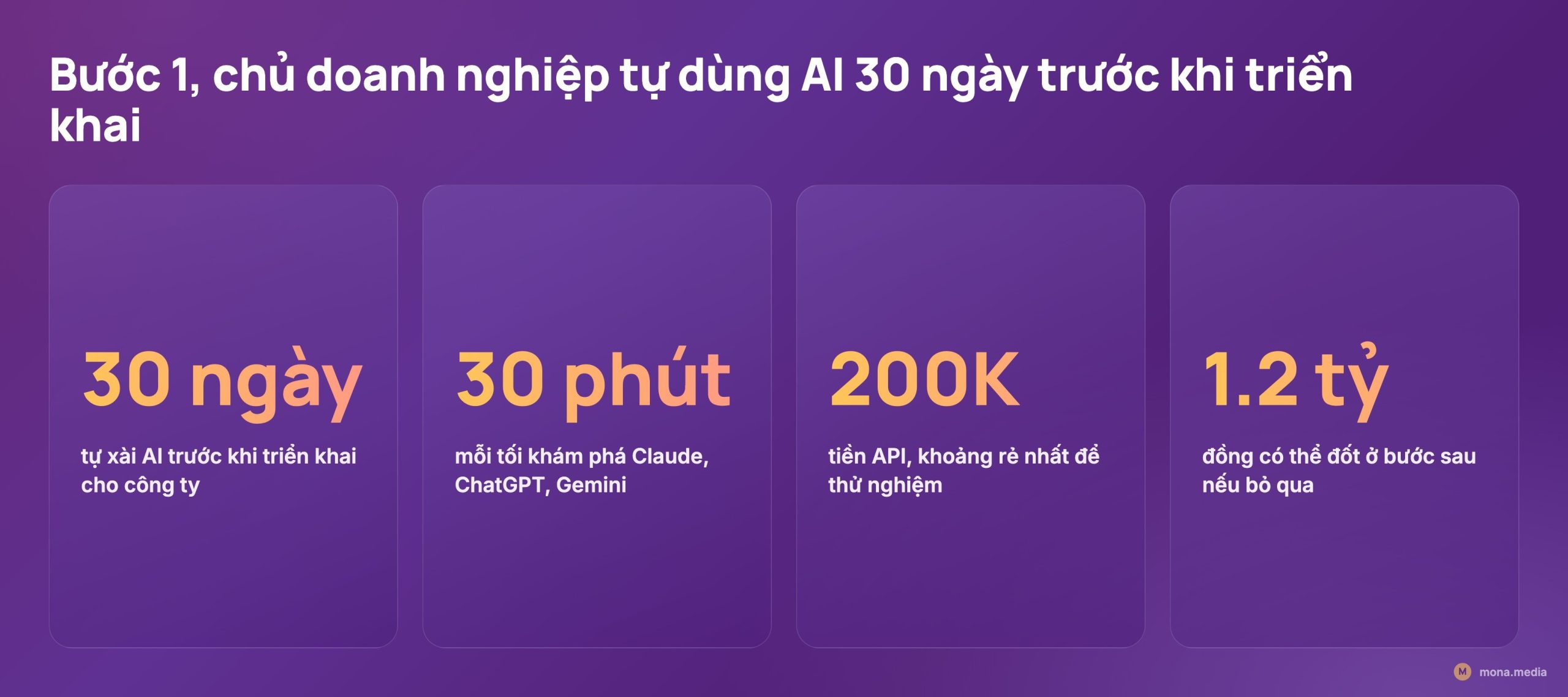
First, you surely understand that using AI yourself for 30 days before rolling it out to the company is critical. If you don't truly understand AI, your staff will know. That can cost you their trust or, worse, leave you open to being taken advantage of by outside consultants. And without a real understanding of AI, you're likely to push your staff to use AI tools for tasks they don't suit, which wastes time and resources.
So what should you do in those 30 days? Just spend 30 minutes each evening exploring. From day 1 to 10, use tools like Claude, ChatGPT or Gemini for personal tasks such as writing emails, translating documents or summarizing reports. From day 11 to 20, try applying AI to company work, like writing job descriptions for recruiting or analyzing revenue reports. Days 21 to 30 are for harder challenges: hand it more complex tasks to measure what it can and can't do.
After 30 days, there are three measures to track. First, how much time you save each evening. Second, where AI is still weak and needs improvement. Third, whether you now know how to ask so that AI really helps you get the result you want. These measures will help you judge how effective AI is in real work.
If you skip this first step, you will very likely face serious consequences. Picking the wrong tool, encouraging staff to use it the wrong way, setting the wrong KPIs, even getting a negative return on investment for the first 6 months. The MONA team has seen 18 of the 30 chains we know well skip this step, and 80% of them had to start over.
For more detail on each step of the 30 days, you can read the article 30-day roadmap for CEOs to use AI from MONA. In it, we lay out clearly what you need to do each day to build a deep understanding of AI.
A common mistake among Vietnamese founders is using AI only for fun, like writing Facebook captions or summarizing movies, instead of applying it to real work. To get real insight, you need to force yourself to use AI on critical tasks. The article CEO sài AI from MONA lists 4 specific wrong roles you should avoid.
Finally, remember that these first 30 days are the cheapest time to test AI, with just 15 hours and 200,000 VND in API fees. Skip this step and you could burn up to 1.2 billion VND in later steps. It's a sound investment in knowledge and a deep understanding of AI.
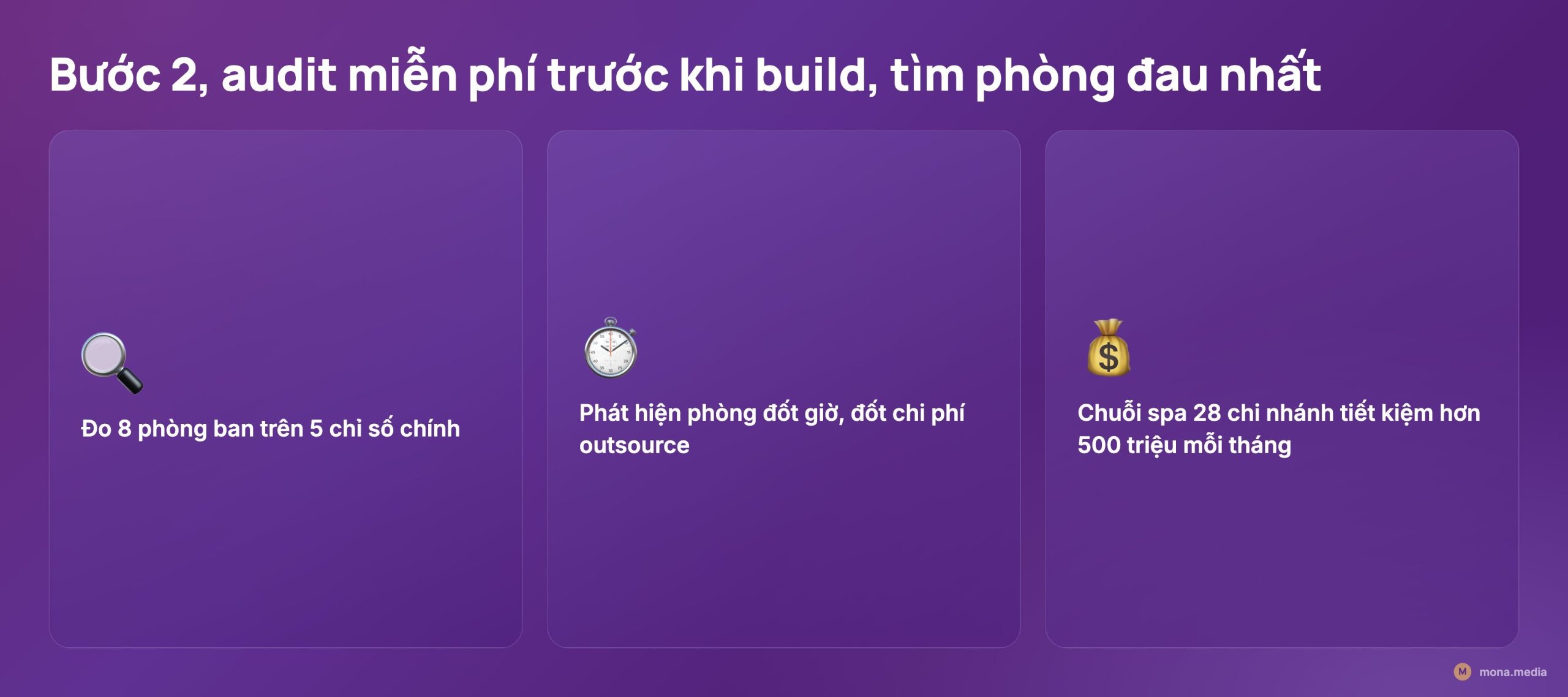
When money flows out and you can't tell where, you tend to feel confused and out of control. To fix that, we at MONA offer a free audit session. The goal is to find out which department in your business consumes the most resources. You no longer need to grope around in the dark.
In the audit, we measure with a scorecard of 8 departments across 5 key metrics. This helps you see which departments are burning hours, outsourcing costs, and which processes are ready. The result is not just data but a clear picture of how each department performs.
To pick the right pilot department, a careful audit is necessary. A department that burns a lot of resources may be the best place to improve. Time and cost can drop sharply when you choose precisely. Read more about our audit method here.
MONA successfully deployed this for a spa chain with 28 branches across HCM, Hanoi and Da Nang. The result was savings of over 500 million VND a month by auditing in the right place. You'll see clearly which department to focus on. Don't miss this opportunity. Let's transform together with more confidence.
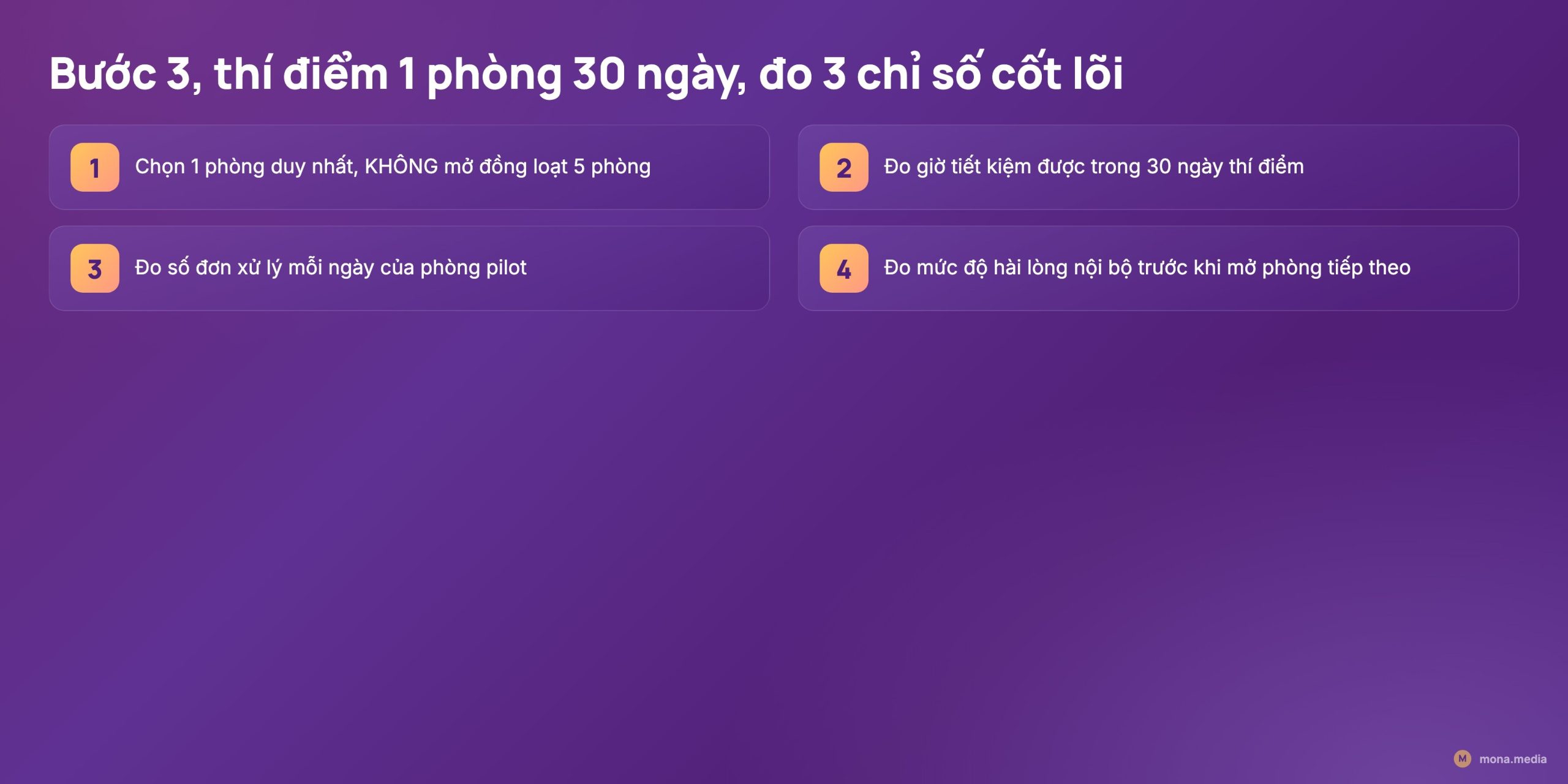
When rolling out AI, a common mistake businesses make is expanding to too many departments at the same time. Each department ends up with only half a solution, and results fall short of expectations. Have you seen this in your own company?
Instead of chasing that approach, we recommend starting with a pilot in just one department for 30 days. Pick one department for the trial and measure three key metrics: hours saved, orders processed per day, and internal satisfaction.
Choosing the right pilot department matters a lot. For example, if you choose HR, you can see how AI is applied there in detail here. Likewise, the sales department has its own benefits from AI, with details here.
If results look good after 30 days, that is the right time to roll out to the next department. For every new department, keep evaluating the same metrics. An AI project isn't only about technology but also a cultural shift in the business. Does that make sense to you?
For more perspective on applying AI effectively in your business, you can read about other departments such as accounting and customer service in the detailed articles from MONA.
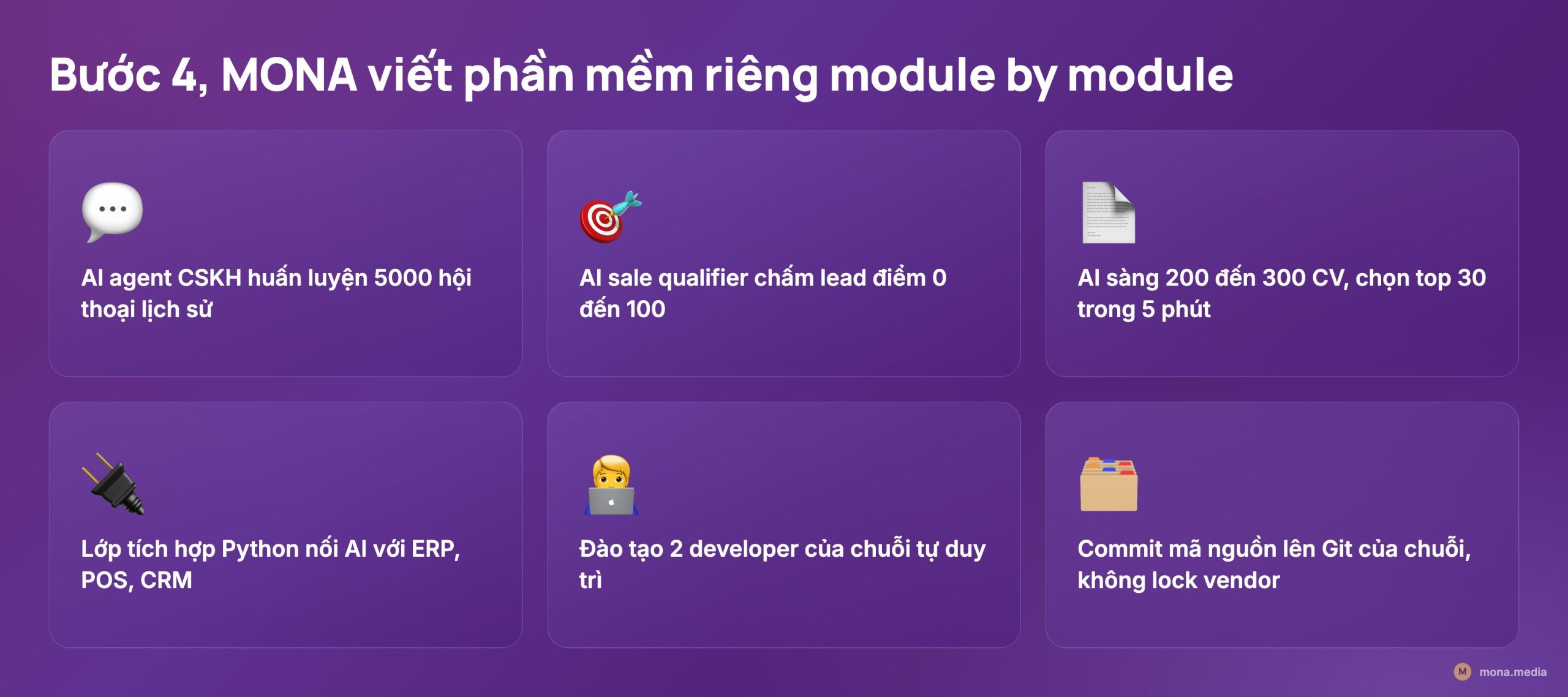
For a chain of 15+ branches with its own distinct processes like yours, you'll find drag-and-drop SaaS has many limits. Your current ERP or POS often has no public API to connect to easily. Vietnamese data is complex and requires clear permissions between branches. That's why MONA chooses to write production-grade code to build software specific to each module. This not only gives you more control but also optimizes the processes your chain already has.
The first module we deploy is the customer service AI agent. We start by integrating Zalo OA and your CRM as the base. In the first week, MONA does the basic setup to prepare for training the AI on 5,000 historical conversations from your own chain. Over the next two weeks, we test at one branch. We pick this module first because it delivers the quickest and most measurable return on investment. Improving customer service not only improves the customer experience but also lifts revenue right away.
The next module is the AI sales qualifier. For inbound leads from Facebook Ads, Google Ads and your chain's landing pages, the AI asks 5 questions and scores each lead from 0 to 100. Only high-scoring leads get passed to sales staff. This module needs three weeks to code and one week to train the AI. That way your sales team can focus on the most promising prospects, raising the close rate and making better use of resources.
Your HR department receives 200-300 CVs a month, which calls for fast AI screening. The AI CV screening and onboarding module can pick the top 30 CVs in 5 minutes, schedule interviews automatically, and write offer letters in your chain's brand voice. Deploying this module takes only 4 weeks, shortening hiring time and streamlining the HR process.
The middle integration layer is MONA's strength. We write an intermediary service in Python or Node that connects the AI with your chain's existing ERP, POS and CRM. This is completely different from SaaS tools like Manychat or n8n. Those SaaS tools usually lack deep integration into a company's internal systems, which is what keeps everything running smoothly without replacing your old ERP.
When it's done, the source code is committed to your chain's own Git. We also train 2 of your developers on site so they can maintain the software themselves after 12 months. If needed, your chain can keep working with MONA without being locked in to a vendor. The software we build is production-grade and self-contained, not a pile of small workflows stitched together like other automation solutions.
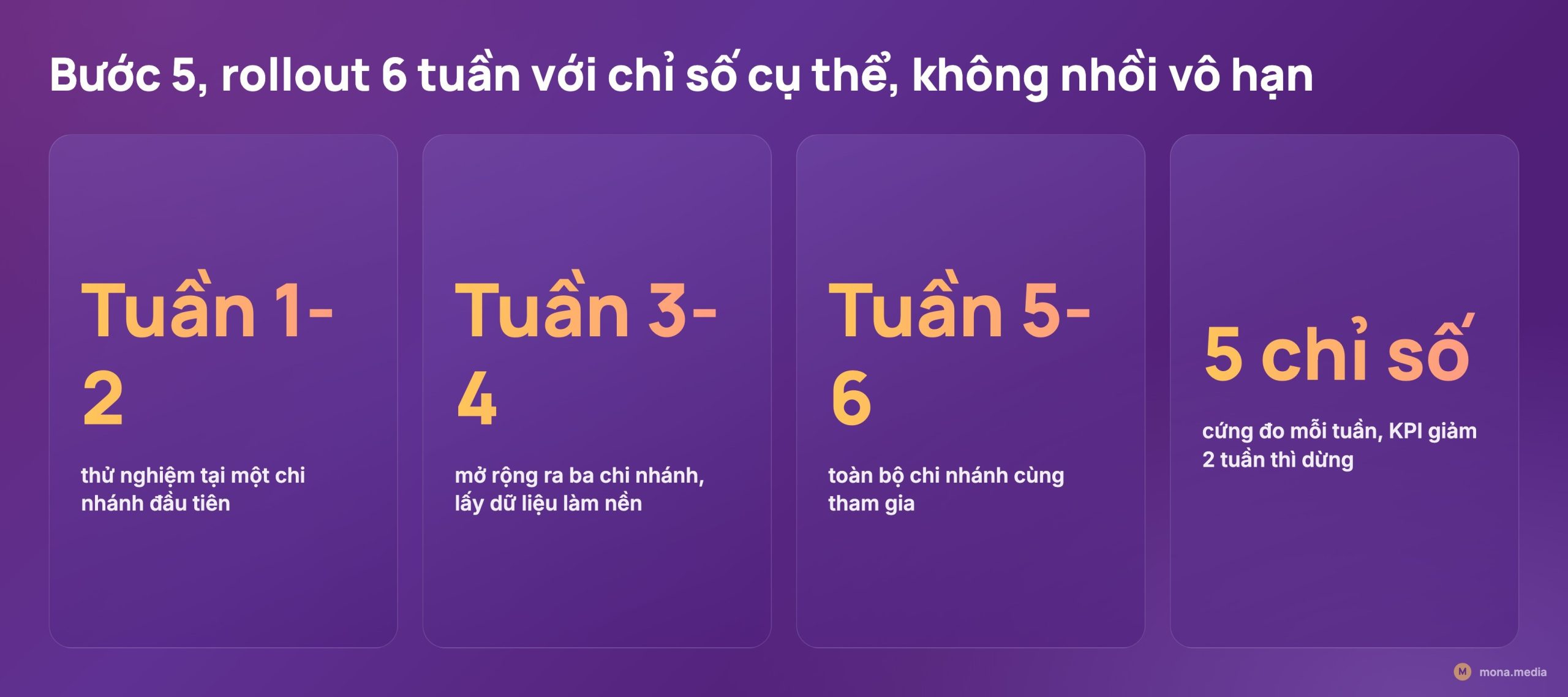
During AI deployment, tracking metrics is essential. In weeks 1 and 2, you test at one branch. Measure processing time, conversion rate, cost per order, and customer and staff satisfaction.
In weeks 3 and 4, expand to three branches. The data collected in the first weeks is your foundation. If the metrics aren't met, adjust right away.
In weeks 5 and 6, all branches join. You can clearly see how the metrics move as you scale up. If KPIs fall for two weeks in a row, consider stopping to make adjustments.
To avoid a bloated headcount, we have streamlined the rollout process. What sets MONA apart is a tight measurement system and timely adjustments.
A question you might ask: can different branches keep up their performance as AI expands? With a specific measurement plan, we can be confident about this future.
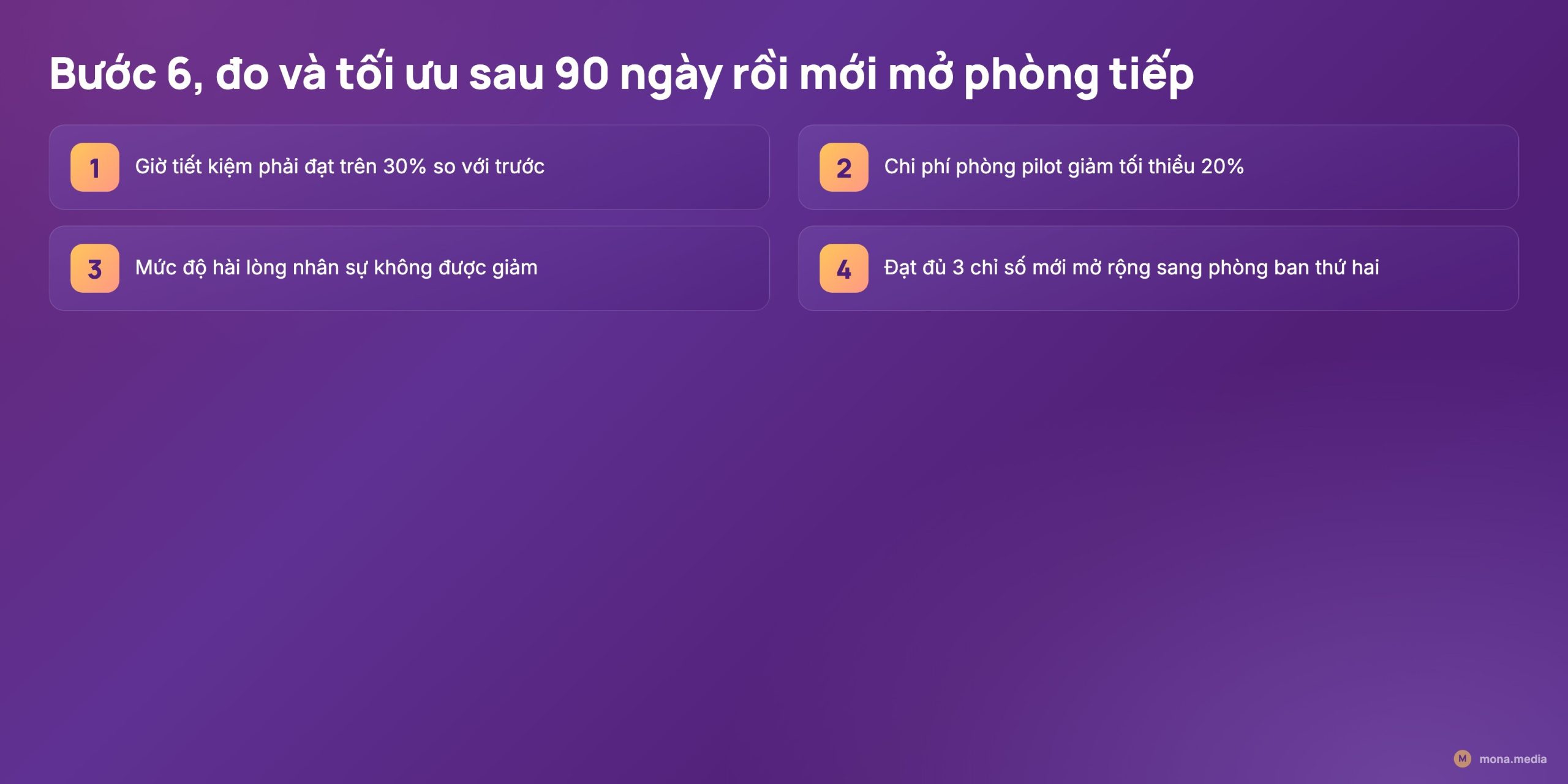
After 90 days of rollout, it's time to evaluate the concrete results of the pilot department. The committed metrics are: over 30% hours saved, costs down at least 20%, and staff satisfaction not lower. These are the key criteria that make sure the pilot succeeds.
In the early period, some waste is unavoidable. You may have seen more money flowing out than expected. That's a sign the current solution isn't optimized yet. Some businesses try to adjust on their own but don't get the results they want. These limits come from a lack of experience in analyzing and tuning the system.
At MONA, we have built a framework to help you optimize your processes after the pilot phase. Expanding to the next department also needs to be planned clearly and in detail. MONA commits to staying with you so every metric meets the target standard. After 90 days, once the first department is stable, you can confidently extend the model to the second.
This roadmap doesn't stop at one department. It's the start of rolling out AI-First across the whole company. In one year, you can expand to 3-4 departments. After two years, the AI-First model can be applied across the board. You're probably thinking that's a big goal. But with consistency and the right strategy, it's entirely achievable. Do you believe in this change?
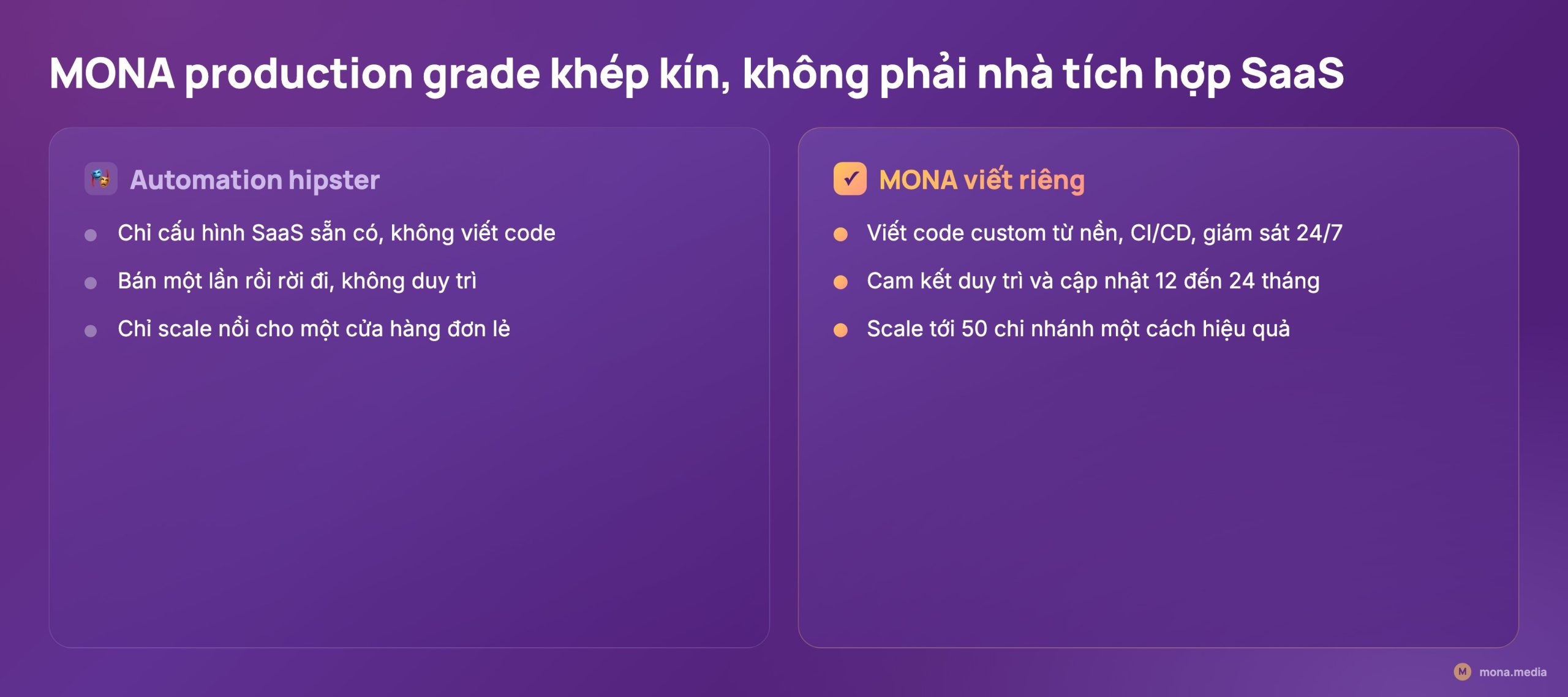
MONA isn't just a SaaS integrator; we write closed, end-to-end business automation software from scratch. We build everything with custom code in a chain of connected modules. This keeps every business process continuous and optimized. CI/CD enables continuous deployment, DevOps keeps infrastructure stable, and 24/7 monitoring keeps everything under control. If something goes wrong, we roll back immediately. MONA doesn't use n8n, Zapier or Make as the core. AI, LLMs, Computer Vision and Voice are just tools that unlock what “machines can do”.
MONA differs from automation hipsters in three big ways. First, while hipsters only configure SaaS, MONA writes code from the foundation. Second, hipsters often sell once and leave, while we commit to maintaining and updating the software for 12 to 24 months. Finally, hipsters may only support scaling for a single store, while MONA can help you scale to 50 branches effectively.
MONA's process for building software for a chain is well structured. In the first week, we run the audit and define the necessary technical specs. From week 2 to week 4, we design the architecture and integrate the base layer. Weeks 5 to 12 are for building each module and testing with real data from the chain. Then weeks 13 to 18 are the rollout phase. Finally, weeks 19 to 52 are for maintaining and optimizing the system.
The MONA team has clearly assigned roles. Backend engineers write the core. Frontend handles the dashboard. DevOps deploys the system. AI engineers focus on training Vietnamese-language models. Sales closers handle closing contracts with clients. In particular, the Customer Success team stays with the chain for the full 12 months to make sure results are as strong as possible.
The reasons automation hipsters usually fail when rolling out to chains of 15 branches or more are very clear. You can read the details in business automation workflows from MONA on the differences between enterprise automation workflows and platforms like n8n and Zapier. There are 8 specific reasons why they can't stay effective in a complex environment.
MONA has applied this model to its own internal operations. Our team runs 100% of its automation functions itself. From accounting, customer service and recruiting to operating MONA Host, everything is automated. It's clear proof that MONA's system isn't just theory but already works in practice, with high efficiency, for us.
Before rolling out MONA's 6 steps, the 28-branch spa chain across HCM, Hanoi and Da Nang was carrying huge operating costs in its customer service department. With 38 customer service staff in two shifts and 30 receptionists, the monthly cost came to 250-300 million VND. Receptionists usually shut down at 5 pm, so on Monday morning there were often 280 Zalo messages piled up. The close rate was under 33%. Does your sales team run like this too?
In the first month, the spa chain's founder tried Claude and Gemini on his own for 30 days. Then MONA ran a free audit and produced a scorecard of 8 departments and 5 key metrics. Customer service was picked as the pilot because it used the most working hours.
In the second month, the pilot started in customer service at one branch in District 7. MONA built an AI callbot integrated with Zalo OA and the internal CRM. In the first week it only handled 30% of routine questions, but by week four it handled 78%, taking a lot of load off staff.
The rollout took 6 weeks from March to April. It began with one branch, then expanded to 8 branches in weeks three and four. Finally, all 28 branches were connected to the new system. Every week, the team measured 5 hard metrics to make adjustments in time.
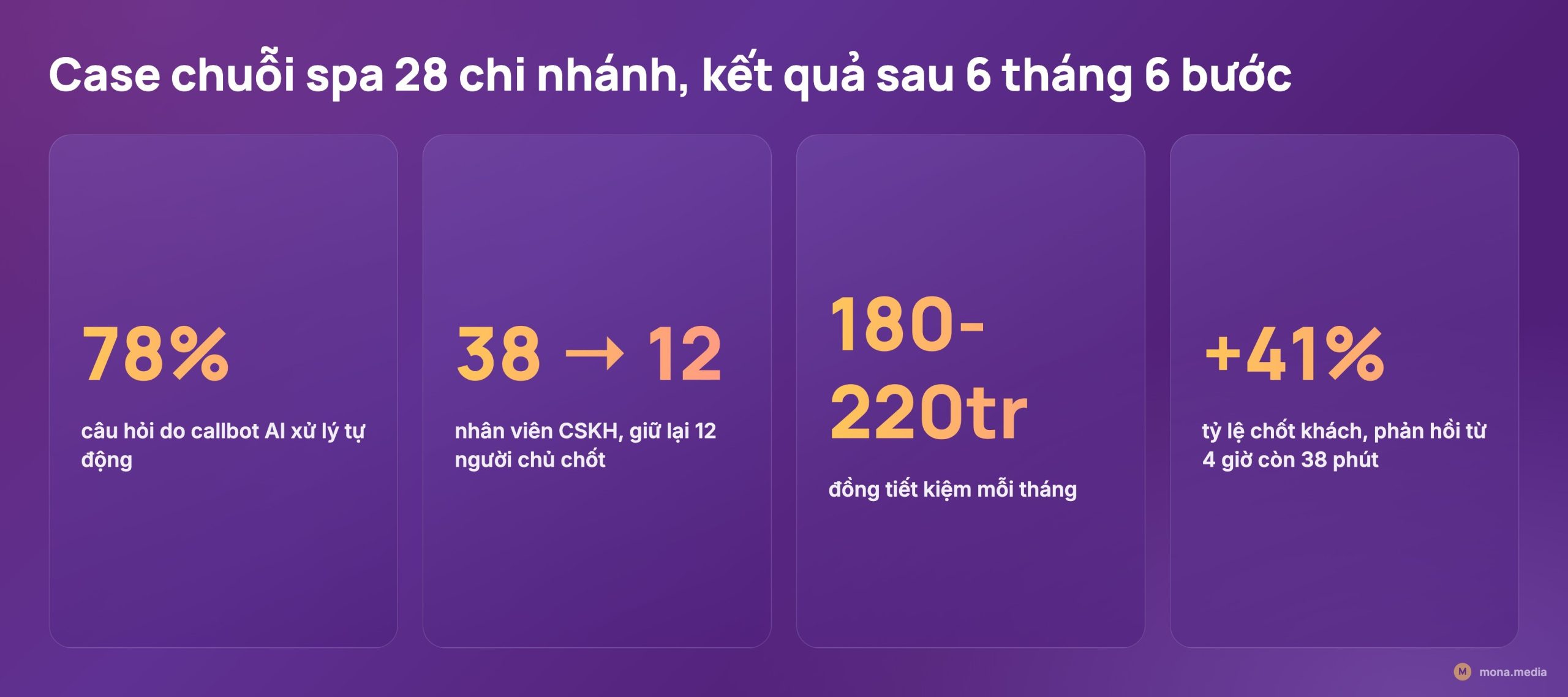
Month six was the key checkpoint. Customer service headcount dropped from 38 to 12 core staff. The AI callbot handled 78% of questions automatically, and response time fell from 4 hours to 38 minutes. Savings were 180-220 million VND a month, while the close rate rose 41%. All of this was supported by MONA's spa and salon management software. See more about the spa and salon management software.
This model isn't only for the spa industry. Similar features can be applied in many other industries. For example, a 22-branch F&B restaurant chain cut service costs by 35%. In retail, a fashion chain cut customer care time by 28%. In education, a 12-branch center raised its parent close rate by 31%. A 20-clinic dental chain cut no-shows by 40%. A logistics chain with 30 drivers increased daily orders by 22%.
Finally, we should mention that MONA has fully automated 30 other businesses. automating 30 businesses. These 6 rollout steps aren't a one-off invention; they have been carried out successfully across many mid-market chains. You can apply this framework with just a little tailoring for your own industry.
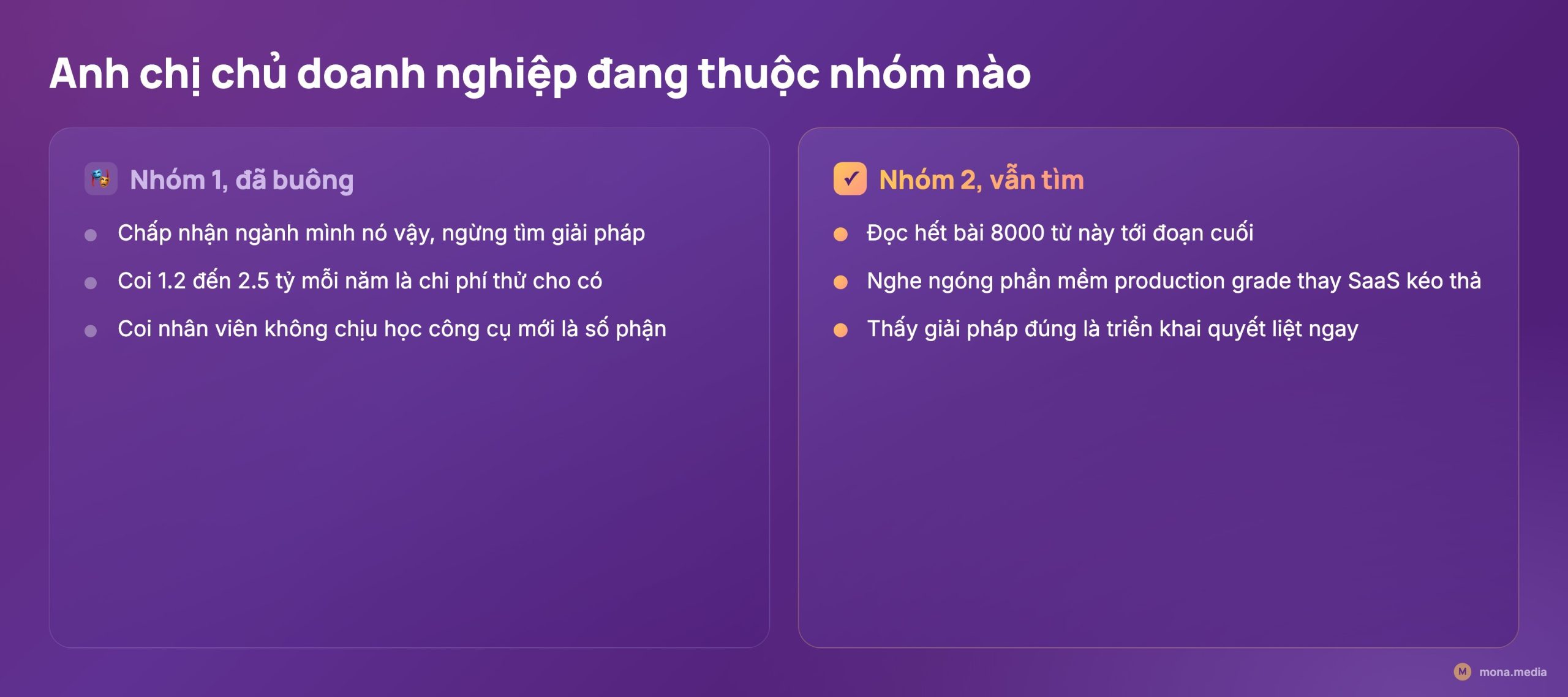
The mid-market chain founders reading this article tend to fall into 2 clear groups. Group 1 is used to staff refusing to use AI no matter how hard the boss pushes, departments blaming each other (“AI doesn't fit our industry”), a ChatGPT Team bill that keeps being charged every month while nobody can measure the benefit, and has completely given up on finding a serious way to roll out AI. They accept “that's just how our industry is”, treat 1.2 to 2.5 billion VND a year as a token experiment cost, and see staff aged 30 to 50 refusing to learn new tools as fate. Group 2 is the founders who, even after 5, 10 or 20 years in business, never stop looking for solutions. They read this 8,000-word enterprise AI rollout guide to the end, look into production-grade automation software instead of drag-and-drop SaaS, ask peers in their industry how MONA did it for the 28-branch spa chain, try the CEO dashboard demo of the 6-step AI rollout, and once they see the right solution, act on it immediately and decisively, shocking all 5 old departments at once in the first month of the switch, just as MONA did internally on 20/4. MONA (we're business people like you, and MONA Software runs its own team and has automated 100% of its internal functions since 2026, from accounting to customer service to recruiting to customer care to operating MONA Host) is in group 2, and we bring this enterprise AI rollout guide to you, group 2. What you need is just 45 minutes away, by calling the hotline or emailing info@themona.global to request a free audit. And it really is free: MONA specialists bring solutions to you whatever your business model (a single spa in District 7, a nationwide chain of 28 cosmetic clinics, a 22-restaurant F&B chain, a real estate brokerage with 200 sales staff, an English center with 12 branches, a logistics company with 50 drivers, lots of young Gen Z staff, plenty of older staff used to Excel, a tech-savvy founder who codes Python himself, a founder who never touches a computer and only signs papers, and so on). For every case, we have an enterprise AI rollout guide that fits. This is MONA's 10th year bringing automation and production-grade software to founders doing business in Vietnam, and we have successfully automated 30 mid-market chains we know well.
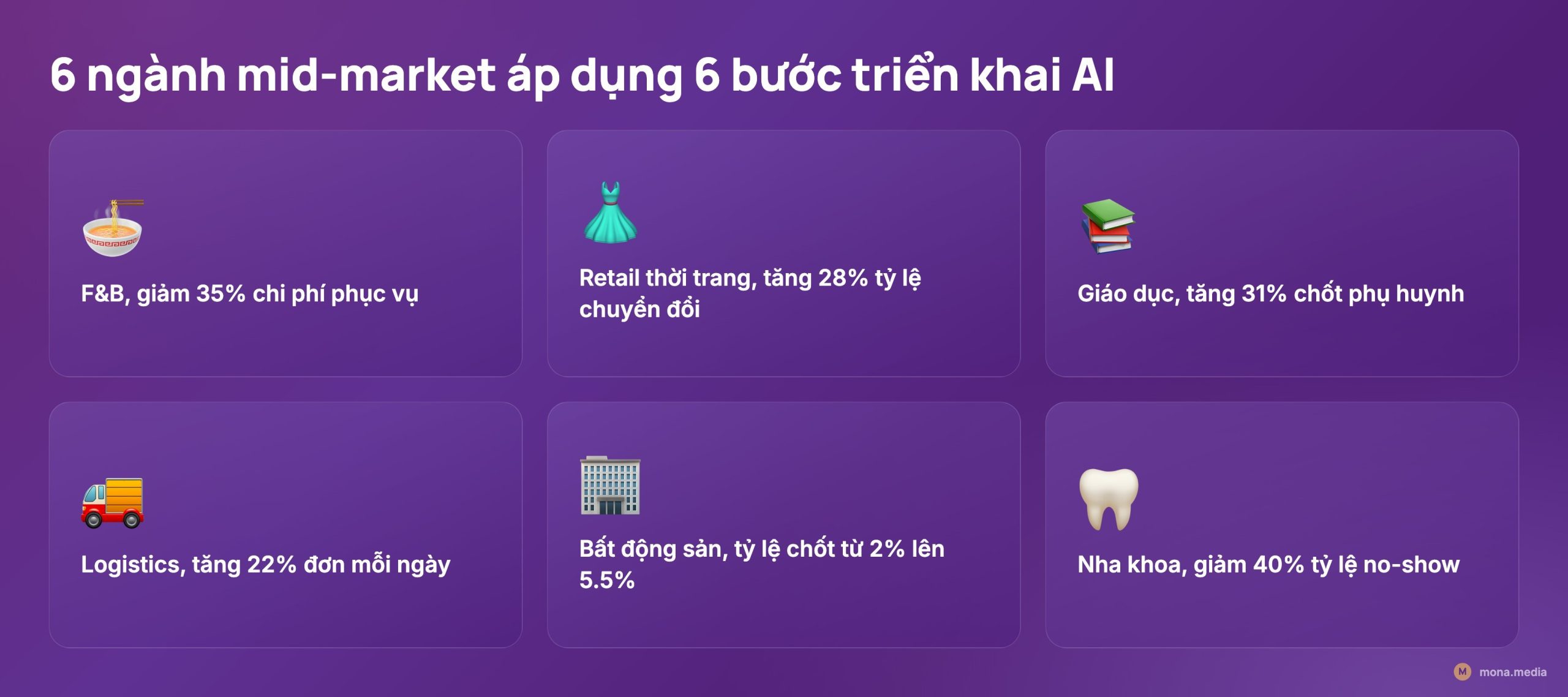
Bringing AI into business operations isn't only a trend; it's a way to solve the pressing problems of many industries. Here is how 6 mid-market industries successfully applied the 6-step AI rollout process to streamline operations and improve business results.
F&B industry: For restaurant and cafe chains with 15 to 50 branches, managing last-minute shift changes and laggy kitchen displays are common challenges. We applied steps 1 and 2 to audit operations, then steps 3 and 4 to roll out a callbot that suggests dishes and an automated KDS. After 6 months, service costs were down 35%. You can learn more about how restaurant operations automation to see the impact clearly.
Fashion and cosmetics retail: For chains of more than 20 stores, sales staff turnover reaches 50% a year and stock mismatches are a big problem. The first step is to have the founder use AI for 30 days, followed by step 3, a pilot in 1 store with AI for customer care and screening. This raised the conversion rate by 28% after 6 months.
Education: In English center chains with 12 to 30 branches, advisors jumping ship and taking parent lists with them is a perennial problem. Step 2 audits the advising department, and step 4 uses a 24/7 AI enrollment advisor along with an AI writing grader. After 6 months, parent closings were up 31% and student retention reached 78%. See details on automation for English centers.
Transport and logistics: For a chain with 30+ drivers, manual routing and order-taking errors at peak hours were improved with step 3, a pilot with an AI team for order forecasting and automatic routing. After 6 months, daily orders rose 22% and fuel costs fell 18%. See more at AI in logistics for details.
Real estate: Brokerages with 50 to 200 sales staff struggle with a close rate of just 2% and leads that cost 30 million VND each, which they can't keep up with. In step 4, MONA wrote an AI sales qualifier and a callbot that re-engages cold leads 24/7. The close rate rose from 2% to 5.5% after 6 months.
Dental: A chain of 20+ dental clinics faced a 25% no-show rate, with receptionists reminding patients manually. In step 4, MONA built an AI that sends appointment reminders and follows up with patients after treatment. The result: no-shows fell 40% and the return rate rose 35% in 6 months.
The 6-step AI rollout framework doesn't depend on your industry; it depends on how committed you are. It's not a solution we stumbled on. MONA has carried it out and delivered results for the 30 chains we know well across these 6 industries.
The six steps above are not a process drawn up to sell services. They are the exact sequence MONA applied to its own sales department: we also started from one pilot department, picked the most painful spot, which is receiving customers, rather than doing everything at once, and measured each number before expanding to other departments. That means every trap we warn you about in steps 2 and 3, we have already stepped into ourselves.
MONA's current system after going through all 6 steps: customers who message the fanpage, Zalo, email or call 1900 636 648 are all received by AI first. It replies even at midnight, asks the right questions about what they need, scores each lead as hot or cold, and only then hands over to a salesperson with a summary. More than 4,000 interested customers flow through this system every month. Nobody loses their job, which is what your staff fear: MONA's sales team is still all there, they just no longer spend their days as human answering machines. They've moved fully to what machines can't do: meeting customers, understanding their industry, and closing contracts.
So when you reach the audit or pilot step with MONA, what you get is not the promise of a consultant who has never operated anything. You get to see with your own eyes the machine that keeps MONA itself running, ask directly about the numbers at every stage, and only then decide whether to go on. If you want to see it in person, you can book a session at the MONA office : we open the live system for you to see, and the first session is free.
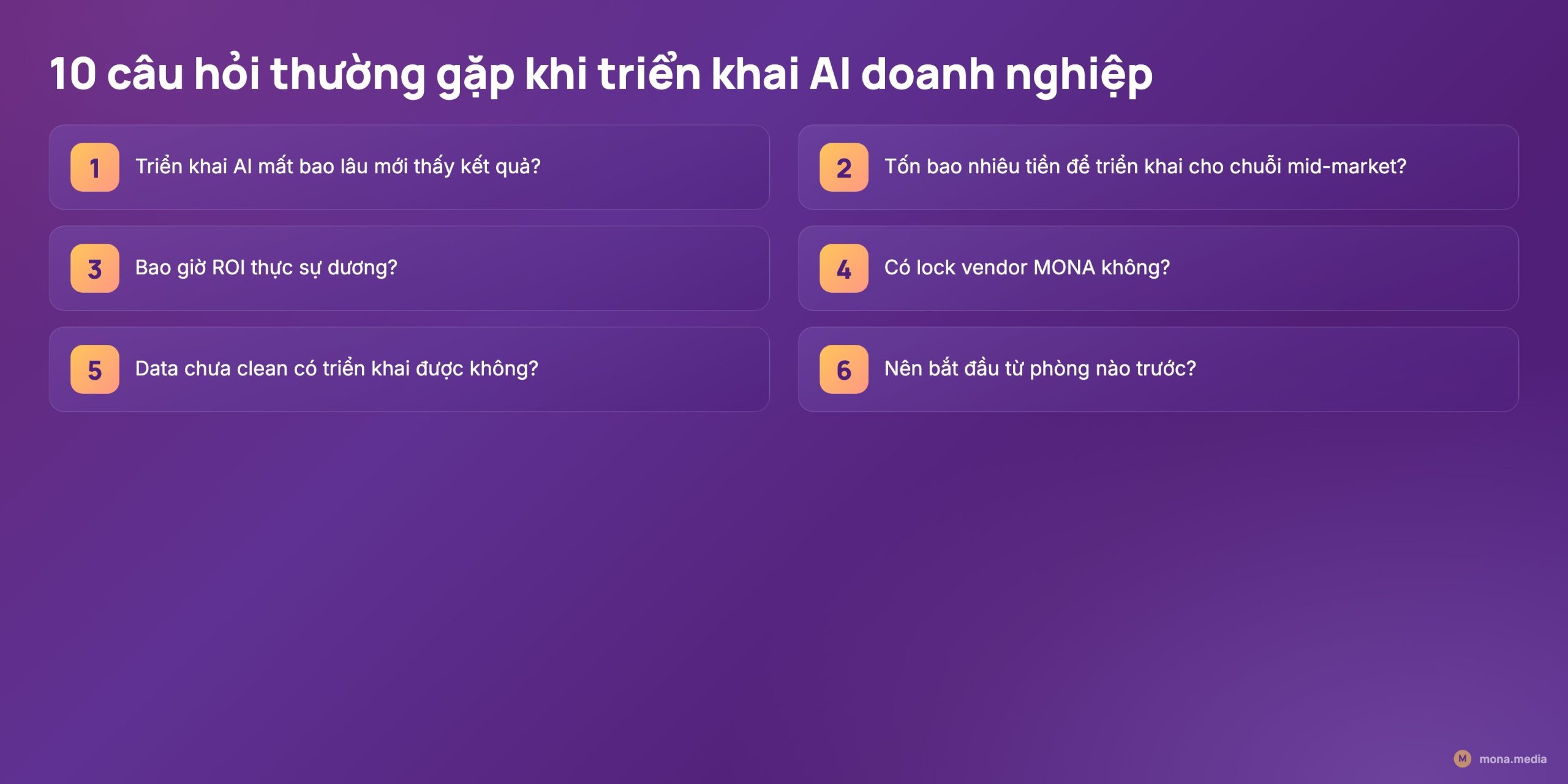
How long it takes to see results depends on the size of your business and the department you choose. The first pilot phase in one department usually takes 90 days. From there, it takes 6 months to roll out fully in one department. Covering 3-5 departments takes 12-24 months. That timeline makes sure the results truly reflect how well AI works in your business.
Rolling out AI for a mid-market chain usually starts with a free audit. The first department pilot costs 200-400 million VND over 3 months. A full rollout within a year ranges from 800 million to 1.5 billion VND, depending on the industry. Roll out AI the wrong way and you can burn 1.2-2.5 billion VND a year with no results to show.
Typically, return on investment (ROI) turns positive after 6-9 months if you choose the right pilot department. If you don't, it can stretch to 12-18 months. Some chains never reach positive ROI if the initial structure is poorly set up. That's why choosing the right pilot department matters so much.
With MONA, you don't need to hire an in-house AI lead. We provide hands-on staff and in-house training for 12 months. This saves your business recruiting and training costs, and makes sure your people know the processes and technical skills needed to run the AI system well.
Pushback from existing staff is likely. We suggest you pick a champion in the department and give them clear KPIs. When they see results and are given clear authority, other staff will have a reason to follow. MONA has used this approach successfully for more than 30 business chains.
You can roll out AI even when data isn't clean. Choose a pilot department that doesn't depend on old data, such as inbound customer service. Then we use AI to clean up the backlog of data. This shortens the rollout and doesn't disrupt your business operations.
MONA's software is production-grade, which means the source code is pushed to your chain's own Git. You can hire anyone else to maintain it without being tied to MONA. This keeps your business flexible and in ownership of how the system is managed and run.
Yes. MONA's 6-step framework doesn't depend on the industry. Our modules can be reused 60-70% when moving to a related industry. That saves you time and money when you expand or change industries.
Start with the department that burns the most working hours and spends the most on outsourcing. That's usually customer service, accounting, or the sales qualification team. These departments have clear processes and show results quickly when AI is applied.
You should audit your AI system every 90 days in the first year. Once it's running stably, audit every 6 months. Regular audits catch problems early and let you adjust in time to keep results at their best.

In today's digital transformation, hesitating can leave your business behind. The first thing to do this week is to spend 30 minutes each evening exploring Claude or ChatGPT yourself. Hands-on experience will help you understand AI's capabilities and how it can be applied to your business.
Second, send an email to info@themona.global to request a free audit from us at MONA. It's a chance to see more clearly the strengths and weaknesses in your business processes, and then step onto an effective improvement path.
Finally, don't forget to read the article 30-day roadmap for CEOs to use AI. It's a valuable resource that will give you more perspective and concrete strategies for rolling out AI.
Each of these steps not only builds your foundation in AI but also creates strong momentum in your business. The first step is almost laid out for you. What are you waiting for? Don't miss the chance.
See the overall solution: Full AI transformation and automation for businesses.

CEO & Founder · The MONA
The founder of The MONA built a service company of 60+ staff with 14,000+ projects delivered. Khánh Hùng shares his thinking on building self-running systems, automating a business, and the real lessons behind MONA's projects.
 385




Professional website
design services
Own a website with a beautiful, 100% exclusive design and a lifetime warranty, with the ability
to expand features flexibly as your business grows, starting today!






 MONA will never sell your information or send you spam


 MONA will never sell your information or send you spam
