
 MONA OS 2.0
 Hợp tác với MONA


 Tự động hoá doanh nghiệp
 Cẩm nang SEO
 Digital Marketing
 Kinh nghiệm thiết kế website
 Hạ Tầng Server
 Giáo dục


 VI
 EN












Message us on
Zalo Official


 ProductsNew

 ProductsProducts
 Mới ra mắtKHA AI 2027App tự edit video, tự đăng mọi mạng xã hội, 2 phút mỗi ngày










 Thiết kế websiteVừa đẹp vừa thuyết phục được khách.
Dịch vụ SEOKéo về khách đang tìm đúng thứ anh chị bán.
 Tư vấn digital marketingKéo khách từ nhiều kênh, đo bằng số thật.
Quay video doanh nghiệpVideo giới thiệu công ty, nhà xưởng, đội ngũ.
 MớiDựng video AIDựng phim câu chuyện công ty bằng AI.
 Custom software developmentCRM, ERP and HRM built for your business.
 Viết AI Agent theo yêu cầuĐặt riêng một trợ lý AI cho đúng việc của mình.
 Tư vấn chuyển đổi AIĐưa AI vào vận hành của cả công ty.
NewMONA LMSManagement for centers and schools.
MONA SkillHubInternal training for company staff.
 NHTQ systemEnd-to-end China–Vietnam shipping operations.
MONA JMSManagement for gold, diamond and pawn shops.
 MONA E-LearningA website with every feature you need to sell courses.
 How to sell online courses (course)More than 30 free lessons on selling courses on autopilot.
 MONA Cloudmonacloud.vnServers to get your apps and websites running.
 MONA Basemonabase.vnPostgres database, sign-in and file storage.
 MONA Mailmonamail.vnSend OTP, order and invoice emails from your software.
 MONA Paymonapay.vnAccept bank transfers via VietQR and notify your software when the money arrives.
 MONA eInvoiceComing soonIssue e-invoices that meet tax standards.
Gấu CườiTrả lời khách 24/7 trên web, Fanpage, Zalo và thu lead cho sale.
 Gấu TeleSalesGọi điện tư vấn, chăm khách như tổng đài viên thật.
Dê CườiTư vấn và chốt đơn cho shop ngay trong khung chat.
Gấu WebmasterNhắn nhóm Zalo là website được sửa xong.
 Gấu Pháp ChếSoạn hợp đồng, rà điều khoản trong vài phút.
 Gấu Báo GiáLên báo giá đúng mẫu và gửi khách ngay.
 AI chăm sóc khách hàngTheo dõi và giữ chân khách hàng cũ.
 Gấu Tuyển DụngLọc hồ sơ, hẹn lịch, phỏng vấn ứng viên.
 Mới ra mắt
KHA AI 2027
Xây kênh chuyên gia 2 phút mỗi ngày
Quay bằng điện thoại, AI tự edit video, tự đăng lên 16 nền tảng và tự trả lời bình luận, tin nhắn.
879.625lượt xem trên kênh CEO MONA sau 35 ngày
 Anh Khánh HùngCEO MONA đang dùng mỗi ngày
Xem app làm được gì
 AI
Gấu Cười MONA ĐANG TỰ XÀITrả lời khách 24/7 trên website, Zalo OA, Messenger và thu lead về cho sale.
Dê CườiChốt đơn bán lẻ và sàn: Shopee, TikTok Shop, web. Chăm cả khách sỉ, đại lý.
Gấu WebmasterCập nhật nội dung, tối ưu SEO website mỗi ngày.
Gấu TeleSalesGọi điện tư vấn, chăm khách như tổng đài viên thật.
Gấu Tuyển DụngLọc hồ sơ, hẹn lịch, phỏng vấn ứng viên tự động.
AI chăm sóc khách hàngGiữ khách cũ, cứu lead đã rớt cho phòng kinh doanh.
Gấu Pháp ChếSoạn hợp đồng, rà điều khoản trong vài phút.
Gấu Báo GiáLên báo giá đúng mẫu, gửi khách ngay khi có yêu cầu.
 Chuyển đổi AI toàn phầnGiải pháp tổng cho doanh nghiệp, 3 lớp triển khai.
 Viết AI Agent theo yêu cầuĐặt riêng một con AI gánh đúng nghiệp vụ của bạn.
 Custom softwareCRM, ERP and HRM with built-in AI automation.
 SEO & AEO thời đại AIĐược Google lẫn AI trích dẫn, không chỉ xếp hạng.
 Kiến thức AI cho doanh nghiệpBài phân tích, hướng dẫn ứng dụng AI vào vận hành.
 Free AI courses
 AI tools at work
App mới · KHA AI 2027
Xây kênh 2 phút mỗi ngày
AI tự edit video, tự đăng mọi mạng xã hội
Free consultation, 8am–10pm every day

01 June, 2026

Day 1. You hold an all-hands meeting and announce: "Next month we'll try AI in the sales department". The whole room is silent for 5 seconds. The head of sales stands up. "Yes, we'll look into it". Then nobody moves. This scene is familiar to most business owners. Employees show strange reactions every time AI comes up, but you can't name what they are. Every employee reaction to an AI rollout has a name. We at MONA have summed up these 15 reactions from working with more than 30 familiar mid-market chains.
This article isn't theory. Each type comes with a real scene, 5 to 7 signs to recognize it, the psychological motive behind it, and the specific financial consequence after 6 months. Catch it in the first week and you can fix it within the first 6 months.
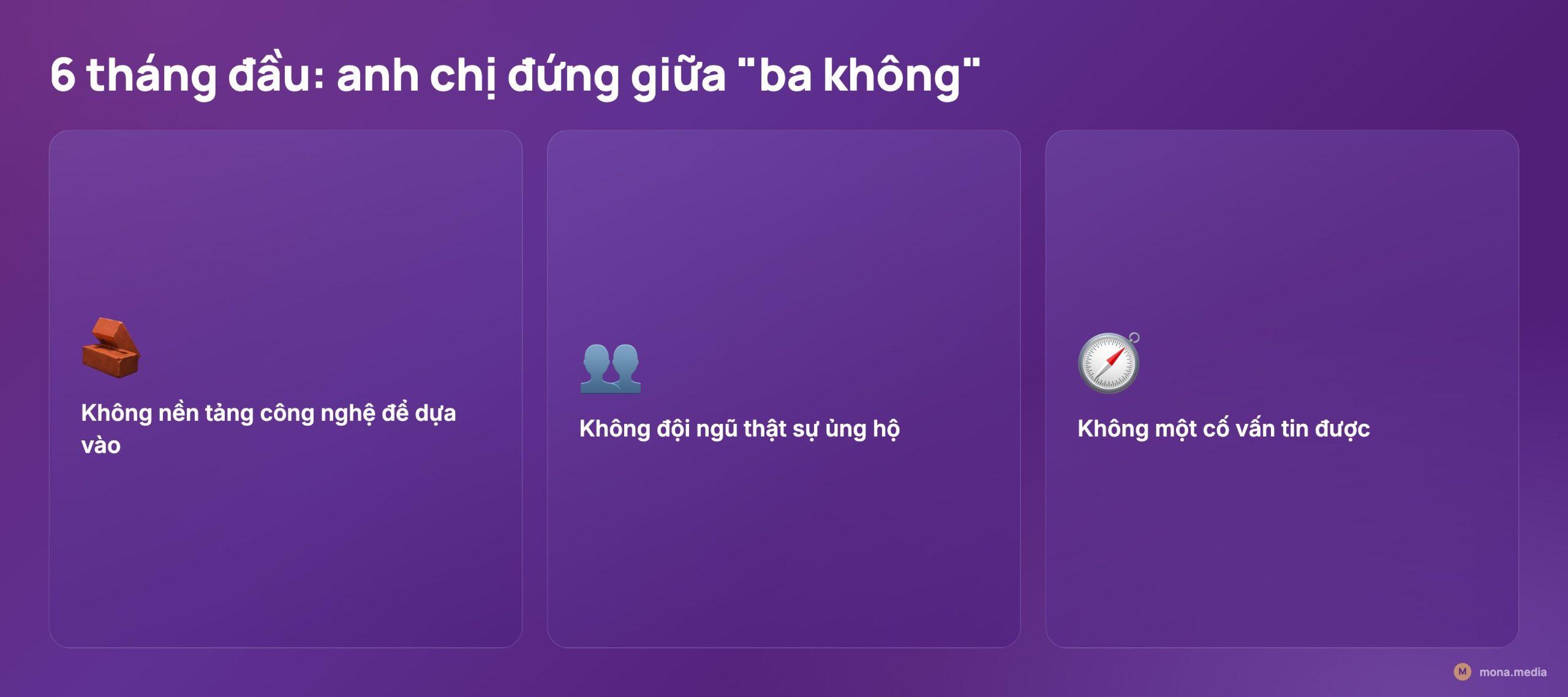
We understand how you feel right now. You stand in the middle of three "nones": no technology foundation, no supportive team, and no adviser you can truly trust. In the meeting room, staff nod obediently. They promise to "look into it". But behind your back, everything stays still. Some even use AI in secret to work faster, then deliberately hide it for fear of being found out. You're struggling alone. Lost.
But this article won't dig deeper into that loneliness. We've analyzed this psychology in detail in a separate document. You can read the full version at the AI First handbook for businesses. This article has a different, more practical goal: to name the 15 employee reactions MONA has recorded across more than 30 projects for large chains, so you have a list to check behavior against.
The first six months are decisive because employees never say what they really think. And you don't have a specific list to check their behavior against. Everything is vague. This is the most important period for observing employee reactions to an AI rollout. Catch the right kind of quiet resistance in the first week and you can clear it before it spreads across the department. Leave it until the second month and a whole department can freeze and refuse to cooperate.
For each type below, we'll break it into four layers. Layer one is a concrete scene you've met or are about to meet. Layer two is 5 to 7 early warning signs. Layer three is the real psychological motive behind the surface. And layer four is the specific money and operations consequence after 6 months if you don't step in.
This type of employee is very common. They don't openly oppose you. They just quietly make all your efforts pointless. They don't sabotage, they just don't cooperate, by hiding the most important things: data and processes.
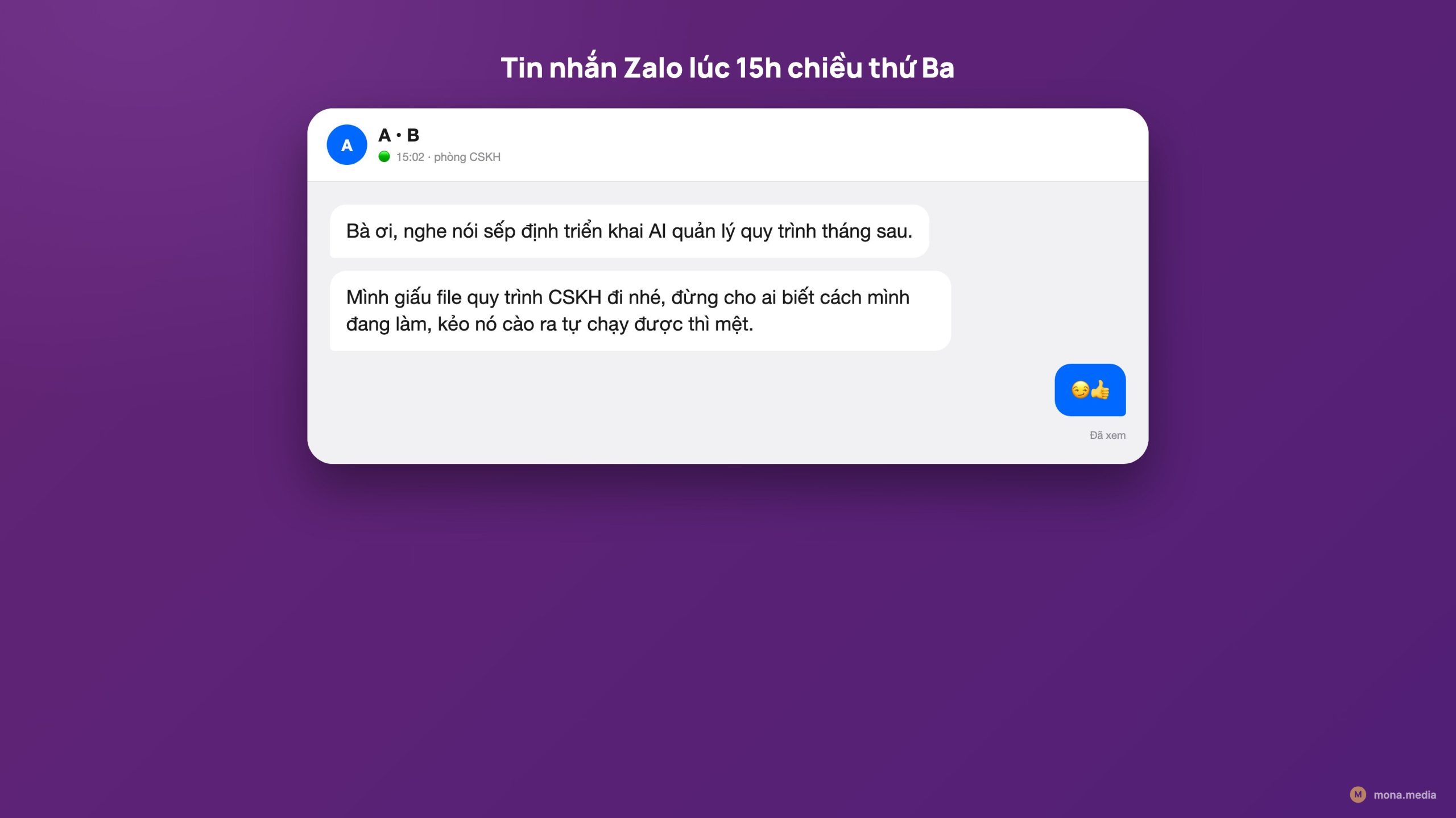
On Tuesday afternoon, employee A sends employee B a Zalo message. It's one short line: "Hey, I heard the boss plans to roll out AI to manage processes next month. Let's hide the customer support process files and not let anyone know how we do it, or it'll scrape everything and run by itself and we'll be in trouble". Employee B doesn't reply in words. She just sends a smiling, nodding emoji.
One message. One nod. Your whole automation project, worth hundreds of millions of VND, starts to drift off course right here. There's no opposing meeting. There's no email argument. The resistance happens in silence, in private conversations you'll never see.
The first motive isn't laziness. It's the fear of having to do more work. In their minds, AI is a smart machine. It will take the interesting, analytical, reasoning-heavy parts. For example, AI will automatically analyze customer data and produce detailed reports on buying behavior.
So what do people do? They imagine they'll be left with the leftover manual work: entering data for AI by hand, checking every line AI outputs, and handling odd cases AI doesn't understand. They fear becoming the machine's assistant. From a skilled professional, they become the person who cleans up data. The workload doesn't shrink, it grows in a boring, low-value way.
This is a deeper fear that touches professional pride. An accountant has spent the past 3 years taking 2 days at the end of every month to compile debt reports from 28 branches. The work demanded care and patience, and it's the measure of her carefulness. Everyone in the company knows how hard it is.
Now you bring in software that can do exactly that in 2 minutes with a single click. What goes through the accountant's mind? "So what value have I created over the past 3 years?". This fear isn't only about losing the job. It's the fear that all her experience and diligence suddenly mean nothing. Hiding the report template or the debt reconciliation rules is a self-defense move to protect her sense of worth. She doesn't want to admit her work can be fully replaced.
Picture a warehouse employee with 5 years on the job. He knows every item code by heart. He has a homemade Excel system that works extremely well for him personally. Everything is under his control, inside his comfort zone. He is the expert in his field.
Rolling out AI warehouse management means he has to throw away that whole familiar system. He has to learn a new interface, a new process, a new way of thinking. From an expert, he suddenly becomes a trainee. The feeling of losing control and starting again from zero is a huge psychological barrier. Hiding the warehouse Excel files, or not sharing his "tricks" for arranging goods, is how he clings to his comfort zone and his status as an expert.
Not every employee thinks like a pioneer. For many people, when a big change comes from above, the first reflex is to defend, not to embrace. They don't see a chance to become the leader, the person who guides coworkers in using new technology. They only see a risk to their current stability.
The idea of "becoming an internal hero" doesn't exist in their heads. They don't think that sharing the process would make them a key person in the project, recognized by the company with room to grow. Instead, their logic is simple: what I know is mine, and sharing it means losing it. So hiding information is a natural self-protection reflex, an act that happens almost without thinking.
This type of employee acts very discreetly, but they still leave traces in daily operations. We've put together a few clear signs you can watch for in your own business:
The cost of this is extremely high. Say you invest 80 million VND in a CRM with AI features and another 40 million VND in rollout and training. In the first month everything looks fine. Employees attend the meetings and nod as if they understand.
In the second month, you start asking the AI system for its first reports. The result is a mess. Revenue is wrong, customer information is missing, and the process throws errors constantly. The reason is that employees never loaded the historical data into the system. They entered information just to get by, with gaps everywhere. The AI system has no clean data to learn from, so its analysis is badly wrong.
In the third month, frustration peaks. Leadership looks at the meaningless numbers and concludes "AI doesn't work". Employees say, "See, I told you, this doesn't suit our company". Pressure from the board forces you to pause the project. The whole 120 million VND is burned. But the bigger damage is 4 months of floundering and lost trust in technology. The company is back at square one, even worse off because it now carries the scar of a failure.
To get out of this bind, you need to act decisively from the start, even before buying software. This is what MONA usually advises its clients.
First, make an official announcement: all operating processes, data files and report forms belong to the company, not to individuals. Require everything to be digitized and stored in a shared repository (such as Google Drive or SharePoint) within the first week. Whoever doesn't comply will be dealt with under company rules.
Second, tie data loading and cleanup to each employee's monthly KPI during the transition. Finish loading 100% of old customer data into the new system and earn a bonus of 10% of monthly pay. Don't just say it, turn it into a direct benefit. When the bonus is tied to action, cooperation changes completely.
Finally, identify and empower a "pioneer" in each department. This is someone open-minded who isn't afraid of technology. Give them the job of collecting, standardizing and supervising the team's data loading. Give them real authority and proper recognition. They'll be your extended arm, breaking down the silent barriers from the inside.

This type of employee is quietly dangerous. They don't oppose and they don't complain. They simply turn their brain into the company's exclusive asset. And you're paying a salary for that very risk every month.
Tuesday morning meeting. You propose digitizing the order-closing process and VIP customer care. The whole marketing and sales team sits quiet. Then a veteran who has been at the company five or six years speaks up.
Their voice is calm, with no hint of resistance. "This process is very complicated, boss. There are many exceptions that aren't in any document. Without me nobody knows how the Zalo order-closing flow works, so how could AI replace it?"
Silence. A few heads nod along. That nodding is no accident. This isn't a refusal. It's an assertion of power. They aren't avoiding the work. They're quietly saying that they are the process. Without them, this department is paralyzed. They're making themselves irreplaceable on purpose.
The first and clearest motive is financial. Every six months, during the pay review, this story comes up again. You sit down with the head of HR, and that person sits across from you. They don't need to say much.
They only need to retell a few incidents from the past quarter that only they could handle. A shipment hit a customs problem, and only they knew who to contact. A big client complained, and only they had the relationships and understanding to calm things down. Every story ends with an unspoken conclusion: "Without me, the company would have lost a few hundred million."
The operational knowledge they keep in their heads becomes a direct bargaining chip. Asking for a 25% raise or a new title is no longer a request, it's almost a condition. You're in a tough spot. Accept, and payroll balloons. Refuse, and the risk of losing a key link hangs over you.
Money is one thing, but title and standing are another. For many long-time employees, labels like "expert" and "the only one who knows how" are part of their identity at the company. They're a shield against younger, more energetic staff.
They fear that once every process is drawn out, standardized and put into software, their value will disappear. A new hire would only need training on the system to do 80% of their work. Their specialness and irreplaceability would be gone entirely.
This fear is very real. It isn't selfishness. It's a self-defense instinct when they feel their position is threatened. Keeping the process in their heads is how they hold on to their own "turf", where nobody else can step in without their permission.
When you bring up automation and AI, their fear multiplies. They understand one thing very clearly. For an AI system to replace or support a job, it has to be "taught". And the teacher is none other than them.
They're asked to describe every step, every decision and every exception to a technical team. In essence, they're taking part in decoding and copying their own brain into a machine. The big question in their heads is: "After I finish teaching the AI, what is my role?".
Once the AI system has learned all the experience they've built up over five or six years, it can do the work 24/7, without errors and without asking for raises. Their central role, their role as the information gatekeeper, will be gone. For them, refusing to cooperate on digitization is the only way to delay that day.
These people are usually very skillful and rarely show their intent. But if you watch closely, you can spot them through repeated behavior. These are the signs that CEOs in MONA's network have summed up:
The biggest risk shows up the day you receive their resignation letter. It isn't just one employee leaving. It's part of your operations collapsing. We've seen a 28-branch spa chain in HCMC and Hanoi nearly paralyze its VIP customer care department for three months because one team lead quit.
This person left and took two junior staff they had "trained" with them. The whole history of care, preferences and unofficial notes about VIP customers went with them. The CRM system had the data, but only the body. The soul, the part that made the 6-star service, was gone.
The consequence? Revenue from the VIP customer group dropped by 1.2 billion VND that quarter. The company spent six months and nearly 200 million VND to recruit and retrain from scratch. Some branches had to stop taking new customers for two weeks because the process fell apart. The price of depending on one individual is far too high.
We understand that you trust your long-serving staff. But the operations of a business of any real size can't bet on the loyalty or health of any one person. Separating the process from the person is a must for sustainable growth.
The first step isn't confrontation or pressure. What MONA usually does for chain clients is embed a business analyst in the company. This person doesn't come as a "manager" or "inspector". They come as a "trainee" who wants to learn in order to "systematize things so it's less of a hassle".
Our specialist sits beside them, observes, records their actions on video, and asks questions humbly. All the knowledge and every hidden process is digitized into documents, diagrams and videos. From there, MONA builds dedicated software modules that reproduce that operating logic exactly. The process no longer lives in one person's head, but on the company's system.
At that point the keys to the business are back in your hands. The veteran has two choices: grow into a new role managing and improving the system, or leave on their own. Either way, your business is safe.
This type of employee isn't rare, especially in companies with long-tenured staff. They don't negatively resist AI. They're not panicking about losing their jobs either. They simply don't want to learn. They've found a way to rationalize their laziness: pushing the work onto younger people.
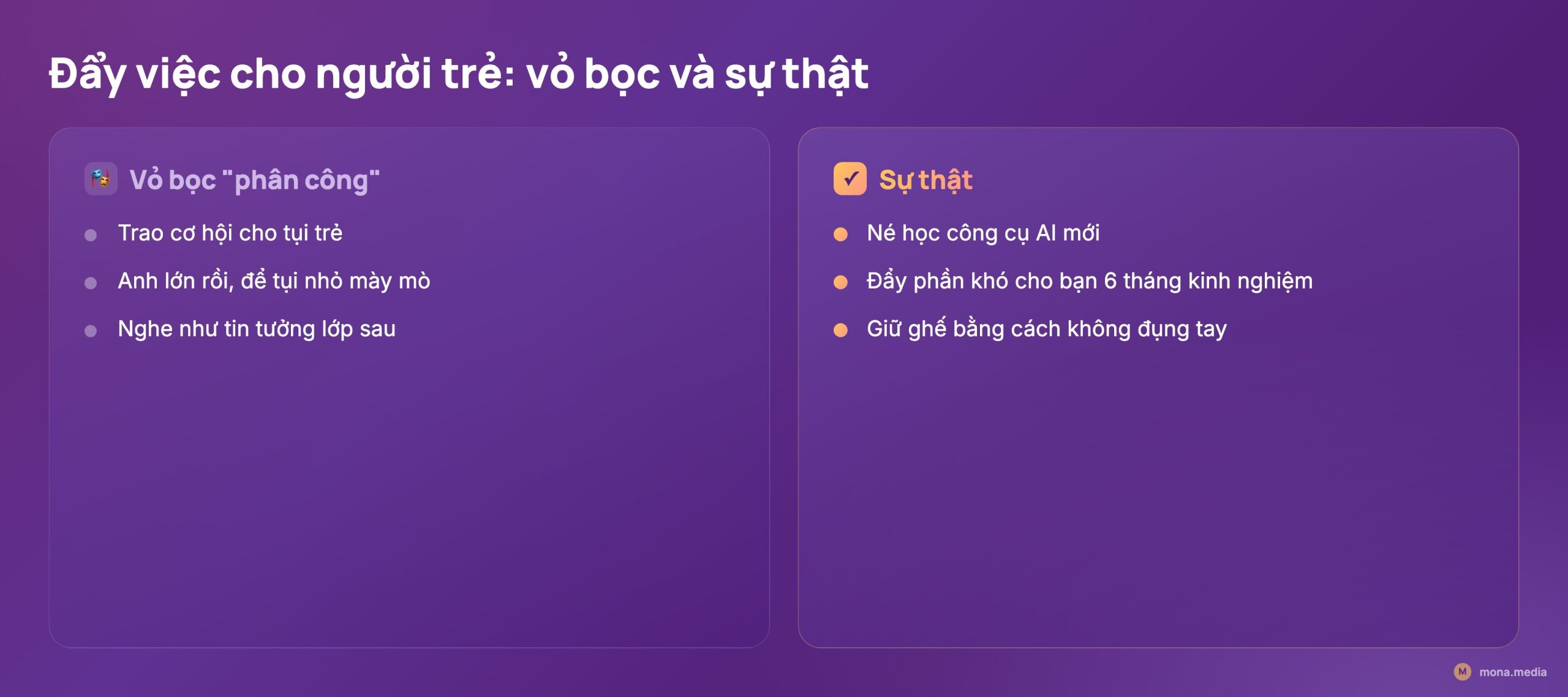
The meeting on rolling out the new AI tool has just ended. You're still excited about what it can do for the sales department. Suddenly a senior team lead, someone who's been with the company for more than a decade, turns to the young staff. He laughs it off and pats the shoulder of a new hire who's been there six months.
"You kids figure out these new AI tools. I'm older now, why bother relearning all this." The whole group laughs along. A few young staff nod awkwardly. The line is wrapped as a joke, as "giving young people a chance". But you and we both know it's a flat refusal.
Unlike the two types who fear losing their jobs, this person isn't afraid. They believe seniority and old relationships are enough to keep their seat. They just don't want to change. They see learning a new process as an unnecessary burden, an annoyance that's easy to hand to someone else.
The deepest motive is comfort in a zone built over decades. This employee has spent 10 or 15 years mastering the old process. Every step, every button, every client relationship is at their fingertips. They're an expert in their field, respected by everyone.
Learning a new AI tool means going back to being a trainee. They'd have to fumble with a new interface. They'd have to ask naive questions. They'd have to admit "I don't know this yet". That hits directly at the ego and expert status they worked hard to build. They fear being exposed as not knowing, and losing the image of the experienced senior. Pushing the work to younger people is the fastest way to protect that image.
In this type of employee's mind there is an invisible line. The old work, the core work, the work that brings in direct revenue belongs to them, the "experienced" ones. The new work, the experimental work, the "small stuff" with technology belongs to newcomers, to young people. They assume they have the right to choose their work and only do what they're used to.
This mindset is extremely dangerous. It sets a bad precedent for the whole department. It silently sends the message: stay long enough and you never need to learn again. You pay for experience, not for stagnation. But they are turning experience into an excuse not to take in anything new. The question is whether that experience still has value when the market and tools have completely changed.
Another reason they dare to push work openly is that they know they're not closely managed. As CEO, you tend to trust long-time staff. You give them more autonomy and rarely check their daily work in detail. They know it and take advantage of it.
They know that when a new AI-related task is assigned, nobody really checks whether they do it themselves. As long as there's a result at the end of the day, nobody cares who produced it. The end-of-month report stays green, because those numbers measure yesterday's performance, not readiness for tomorrow. They're hiding behind your trust to keep their own stagnation going.
This behavior usually doesn't show in early performance numbers. You need to watch the soft signs in daily operations. If you see 3-4 of the signs below in a senior employee, it's time to act.
The result isn't just one person who won't learn. It creates a domino effect that wrecks a whole department. Two or three junior staff suddenly carry double the workload. They have to do their own work and also "carry" the new-technology part for their manager. They aren't paid extra and aren't properly recognized.
After just 4-6 months, they burn out. The rate of talented young staff leaving these departments shoots up. A 28-branch chain we worked with saw its entire 5-person marketing team fall apart in a single quarter for this reason. Recruiting and retraining for 3 positions cost them nearly 400 million VND. Add the opportunity cost and stalled projects, and the real monthly damage can exceed 500 million VND. That is the price of tolerating one person who is lazy about change.
To solve this, you need decisiveness and transparency. You can't count on people doing it voluntarily. MONA suggests two specific actions.
First, tie new-tool adoption to each person's KPI. No exceptions for seniority or position. For example, a sales rep must have at least 20% of emails to customers drafted with AI support. A team lead must submit a weekly report on the level of automation in their team. When using AI becomes mandatory and tied to income, nobody can push the work away anymore.
Second, make a productivity and technology adoption tracking board public. We've helped many businesses build measurement systems like this. It shows clearly who is handling what, with which tool, and how long it takes. When everything is out in the open, nobody can hide in the shadow of seniority. Transparency is the best way to remove invisible privileges and make everyone responsible for their own growth.

Picture a Tuesday afternoon meeting. You're presenting a pilot plan for generative AI to speed up work. The air in the room thickens as you go through each department.
In the corner, the head of the programming team, with 15 years of experience, folds his arms. He speaks, not loudly, but the whole room hears: "I'm used to coding in Vim and Notepad, that's the mindset of a real programmer. Tools like Copilot are just cheating, you can't understand the problem deeply that way". A few young developers nod, looking at him with admiration.
On to the slide for the design department, and the team lead with 12 years at the company speaks up. "On my team we draw by hand in Photoshop CS6, we move every pixel, that's how a product gets its soul. Images from Midjourney look so industrial and lifeless, they lose our brand's own character". She says it while glancing at the newer designers, like a gentle warning.
At the accounting department, the chief accountant, who has been with every number in the company since day one, shakes her head. "I've done Excel by hand for years, I know every figure like the back of my hand. Now you want to bring in an ERP with AI that runs automatically in a black box. If it gets one thing slightly wrong, who takes responsibility?".
For this group, the problem isn't learning a new tool. The problem is that the old tool has become part of their identity, part of how they define their own worth. They aren't just a "designer", they're a "Photoshop master designer". They aren't just a "programmer", they're a "seasoned Vim programmer".
The tool is no longer a means. It has become a symbol of their professionalism, their mastery, and what sets them apart from everyone else. Proposing an AI tool that can produce similar results in less time is a direct blow to that professional pride. It silently says "your 15 years of experience can now be replaced by a few lines of commands".
This is a threat at the root, not just a worry about losing the job. They resist not to protect their job, but to protect themselves and the value they've built over a whole career. They feel like they're being stripped of what made their name.
Many people buy a movie ticket, realize after 30 minutes that it's terrible, and still sit through it. That is the sunk cost mindset. This group of employees has invested 10, 15, even 20 years of their lives sharpening skills on one specific tool. That's tens of thousands of hours of practice, sleepless nights fixing bugs, and expensive courses.
All that effort made them experts, earning them high pay and respect in their field. Now, switching to a new AI system feels like declaring that this huge investment has become obsolete. Giving up the old tool isn't just changing a habit, it's accepting that a whole stretch of the road was wasted.
This regret creates enormous psychological resistance. They would rather stay on the old path, even knowing it's less efficient, than face the feeling of loss and admit that their effort is no longer worth what it used to be.
The status of "senior" in a department doesn't come only from a job title. It comes from being the one who solves the hardest problems, the one young staff turn to when they're stuck. That halo is built on experience and tool mastery nobody else can match.
AI is leveling the field. A new designer, after a few hours of learning how to write prompts, can produce impressive options just as good as someone with 10 years of experience. A young developer can use AI to debug and optimize code faster than a seasoned team lead. When that happens, the halo of those who came first starts to wobble.
They fear they will no longer be the only one who holds the “secret recipe.” They fear losing the admiration of their younger colleagues. Resistance to AI, in this case, is an effort to protect an order and a hierarchy built on experience, with themselves standing at the top.
This is the strangest thing we have seen in many companies. Many people in this “craftsman” group, after pushing hard against adopting AI at work, go home at night and sneak the same tools into personal projects or small chores.
The head of programming might use ChatGPT to write a script that automates a household task. The head of design might use Midjourney to find ideas for her child’s birthday card. They know AI is useful. They admit its power in private.
But at the company, they have to hold their position. Publicly saying “this AI really works well” would be the same as tearing down the value of the “handcrafted skill” they have been so loud about. It is like a Michelin chef who keeps trashing fast food but goes home and eats a burger at night. This contradiction shows their fight is not about the quality of the work. It is a fight to protect their image and standing.
This group of employees rarely pushes back head-on. They use arguments that sound very reasonable about “quality,” “soul,” and “safety.” You can recognize them by these signs:
The danger of this group is not the people themselves but their influence. When just one respected technical lead objects, 5-10 younger people in the department will follow their lead. They will not dare to try new tools for fear of being seen as “quick-fix” and “unprofessional.”
The result is that a whole department, even a whole division, gets pulled backward. We have seen a retail chain with 32 branches whose whole team fell behind on adopting generative AI because of one “handwriting craftsman” marketing manager. Within 18 months, their competitors launched a wave of AI-personalized campaigns and took market share. The opportunity cost burned each month reached over 800 million VND, all because of one mindset bottleneck.
This stagnation is invisible at first. But after 6 months or a year, the gap in speed and creativity between your company and the market becomes obvious. By then, changing course is many times harder and more expensive.
The biggest mistake is confronting them head-on and attacking their identity. The harder you try to prove their old tools are outdated, the more fiercely they defend them. The smart approach is not to deny their experience but to lift it into a new role.
Give them the role of “quality reviewer of AI output.” Instead of asking them to use AI to create from scratch, tell them: “You are the only person in this room with 20 years of experience to know whether the AI is right or wrong. I need your experience to review, refine, and make sure the final result meets the highest standard.”
This turns them from people who feel threatened into people in control. Their experience is not thrown away. It becomes the company’s last line of quality defense. Over time, as they work with AI and “give it orders” every day, they will discover for themselves how to combine the power of the new tool with their own mastery. They will move from opposition to cooperation naturally, without feeling forced or devalued.
This is not open resistance. They do not argue in meetings. They do not refuse tasks. They just quietly watch, take screenshots, and turn your effort into a joke in group chats that do not include you. This kind of sabotage is subtle but extremely damaging. A few messages and some “haha” icons can turn early seeds of change to ash.
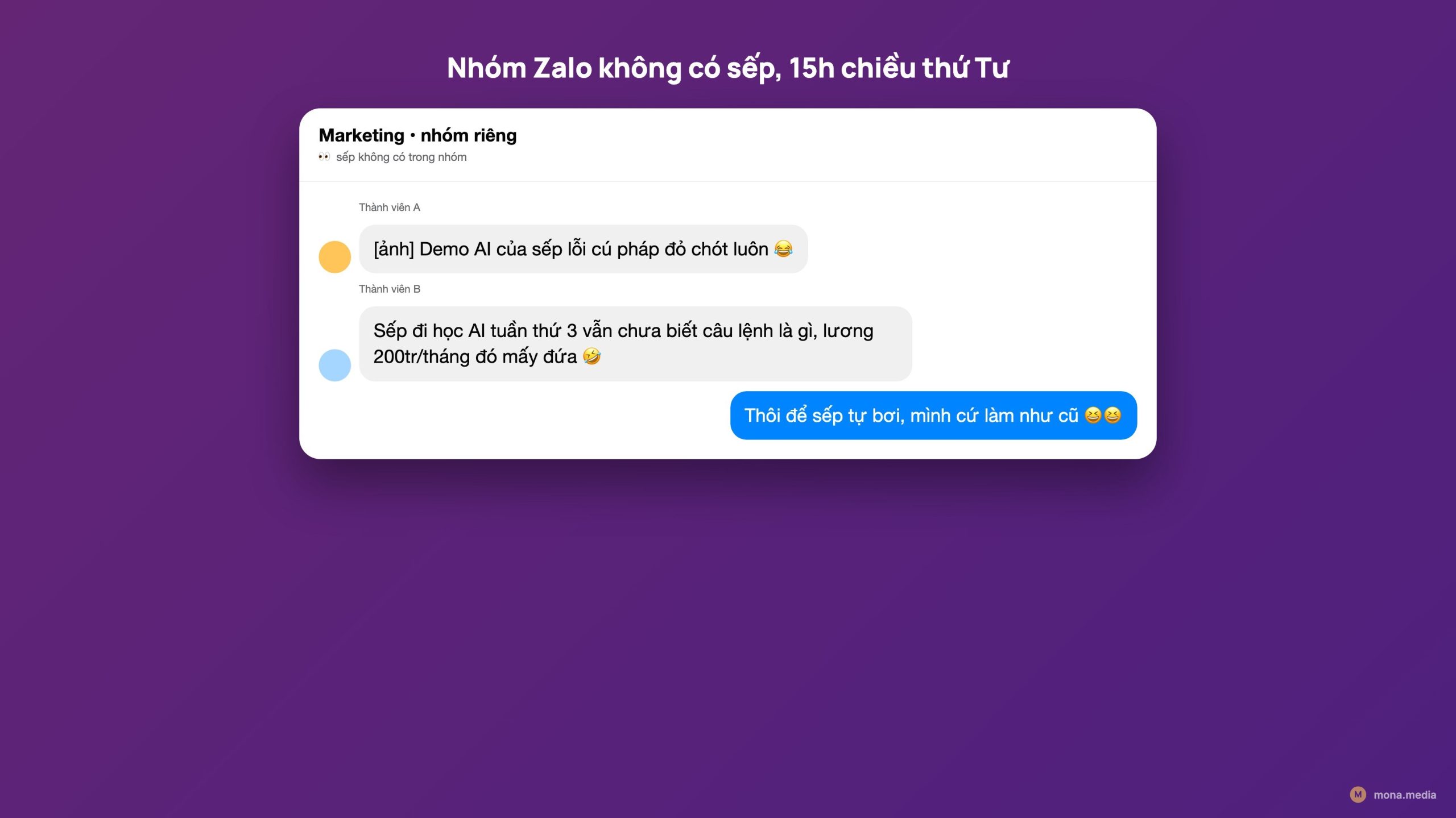
3 p.m. on Wednesday. The phones of a few people in the marketing department light up. A message in a private Zalo group, with your name not in it. Someone sends a screenshot of the AI demo you just botched, where the chatbot returned a bright red syntax error. The caption reads: “The boss is in week 3 of studying AI and still doesn’t know what a prompt is, and earns 200 million VND a month, guys.”
Below it is a long string of laughing-crying emojis. No one says another word. Just digital laughter. This laughter is not for fun. It is a quiet message of power. It says: “The boss is no better than us. The effort is laughable. Everything will go back to how it was.”
This act creates a kind of negative glue that binds a small group together. They find safety in mocking the leader together. To them, your effort to change is not an opportunity but a comedy show to comment on behind your back.
The truth is that employees feel threatened. When you, the person at the top, roll up your sleeves to learn something completely new like AI, it creates invisible pressure. The pressure that they have to change too. The pressure that their comfort zone is about to disappear. They fear they cannot keep up and will become redundant.
Instead of facing that fear by learning, they take a psychological shortcut: bring down the person creating the pressure. By mocking “the boss never finishes learning” and “the boss gets it wrong too,” they reassure themselves. They pull your image from pioneer down to their level, or even below it. “If the boss is still struggling, I don’t need to rush.”
It is a defense mechanism. Laughing at your mistakes helps them feel their current skills still have value. It levels the field and temporarily relieves the suffocating feeling of watching the boss move forward while they stand still.
Behind that hearty laughter is deep anxiety. They do not laugh because they are better than you. They laugh because they also know nothing about AI, and they are afraid of that. Laughter is a way to release tension and project their insecurity onto a safe target: the boss.
Admitting “I know nothing about AI and I’m worried about losing my job” takes courage. Joining in to mock “the boss is terrible at learning” is much easier. It does not require facing your own weaknesses. It turns a serious personal problem into a collective joke.
When the whole group laughs together, each person’s fear dissolves into the crowd. They no longer feel alone in their inadequacy. That laughter works like a temporary sedative, helping them forget the uncertain future AI is drawing right in front of them.
People tend to bond over shared emotions. And negative emotions often create stronger ties. Gossiping together and laughing at a common target creates a “secret society” with unspoken rules.
In this case, the target is you. The joke about you learning AI becomes a code word, a test of loyalty to the group. Anyone who does not laugh, or worse, defends the boss, is immediately treated as an outsider, “the boss’s person.” Peer pressure makes even people who started with no ill will go along reluctantly to be accepted.
Gradually, this group forms an invisible wall. They share information with each other, cover for each other, and together create a bubble of negative opinion about AI. Any directive from you about automation is read through this secret society’s lens of doubt and mockery.
This kind of behavior is well hidden, but not without traces. You can watch for small signs that repeat consistently:
The harm from this group is not a direct punch but a slow-acting poison. After about 6 months, you look back and face a painful truth. Four to six core employees, the ones you expected to be pioneers and to lead the change with you, are now indifferent or quietly hostile.
Their morale has been worn down by daily mockery. They fear becoming the next target if they look too enthusiastic about “the boss’s game.” They choose silence to stay safe. You have lost the only internal force you could count on. The people with the most potential have been dragged down by the negative crowd.
By now, you are completely on your own. Every rollout effort meets silence. Every plan is delayed for no clear reason. The AI project budget may reach 500 million or even billions of VND without any return, simply because no one will execute. You stand in the middle of a team and feel lonelier than ever.
You deal with this kind of sabotage not with orders or discipline. The only way is to take away their weapons: secrecy and the feeling of “the boss up high.” You need to take the initiative to turn yourself from an actor on a stage into a student in a shared classroom.
In a company-wide meeting, share openly: “Last week I tried a new AI prompt and failed completely. Here is the error screen. Has anyone hit a similar error or have an idea how to fix it?” This instantly disarms any screenshot they planned to circulate. You have made it public first.
Make learning AI a shared activity for the whole company, not the CEO’s personal task. Set up “learn together” sessions where everyone, the boss included, can share mistakes without fear of judgment. When you are not afraid to show your clumsy learning process, the mockers have nothing left to say. The stage for scrutiny becomes an open practice space for everyone.

You have just finished presenting the pilot plan for a chatbot AI. It will answer customers’ repeated questions on Zalo and Messenger. The goal is to cut customer wait time from 3 hours to 30 seconds. The whole meeting room is silent. No one says anything.
Then Hoa, 38, head of the customer care team, speaks up. “Boss, I’ve worked here for 10 years. Since our chain had just one branch in District 3. Honestly, I understand our customers better than any machine. Customers need care, they need people, not to talk to a robot.”
It sounds like a very heartfelt thing to say. But it has just slammed the automation door on an entire department. And you know this will not be the last time you hear it.
We have to be frank. Ten years of experience is a huge asset. Hoa has spent her whole youth building communication skills, crisis handling, and remembering every preference of VIP customers. Her professional value, identity, and confidence are all built on that foundation.
Now you put on the table a tool that can do 70% of that work in a few seconds. Admitting that AI can do the job, even just the manual part, feels like admitting “my last ten years can be replaced.” That is an enormous sunk cost in psychological terms. They resist not because they are lazy, but because they are protecting their own legacy.
The problem is not only skill. It is identity. For a whole decade, Hoa has been “the person who knows customers best.” For any hard case, new staff go to her. That title gave her soft power, respect, and standing in the company. It is part of who she is at work.
A piece of software with no feelings and no history suddenly threatens to take that title away. The fear here is not losing the job. The deeper fear is losing the unique value she holds. From an irreplaceable expert, she risks becoming the operator of a tool anyone can use. That is a painful demotion in how she sees herself.
This is the quiet fear that no experienced employee dares to voice. They fear a 25-year-old who joined 3 months ago could use AI to write a crisis-handling email more skillfully than they can. Experience built with sweat and tears over 10 years could be leveled by a few smart prompts.
They had to climb the ladder one slow step at a time. Now AI shows up like an elevator, taking young people straight to the top floor. The sense of unfairness and the fear of being passed over are real. They will try every way to prove that this “elevator” is dangerous and unreliable, and that taking the stairs is “the real thing.”
This group’s resistance is rarely direct. It shows up in subtle behaviors you need to recognize early in order to step in. We have observed and summarized some common patterns:
If you do not deal with this early, the consequences will be heavy. Hoa will not resist alone. She will gather a group of 3-4 colleagues of the same seniority who share her fear. This group will become a hidden drag on every improvement effort. Every new process you introduce will be slowed down or quietly undermined.
The whole department’s performance will drop. Negative energy spreads. Young employees who want to learn and grow will feel discouraged and leave. Worse, within 6-12 months, your competitors will adopt AI successfully. They keep their experienced staff and have them train the AI to serve customers better.
In the end, you do not just lose your most seasoned staff to a competitor. You also lose the loyal customers this group used to look after so well, because your competitor now serves them both fast and with real understanding, thanks to the combination of AI and people.
The answer is not confrontation or firing. That would be a huge mistake. Their 10 years of experience is a gold mine. The question is how to get them to willingly “mine” that gold together with AI tools. Here are two approaches we at MONA have advised many companies to use.
First, redefine roles clearly. AI takes on 80% of the repetitive, boring work such as answering questions about prices, opening hours, and order status. People, especially experienced staff, focus on the 20% of high-value work: handling complex complaints, caring for VIP customers, and building relationships. Show them that AI is not replacing them but freeing them from small chores so they have time for the work only experts can do.
Second, turn them from passive to active. Instead of saying “Please learn to use AI,” say “You know our customers best. Only your experience can teach this AI to talk with human warmth and care the way you do. We need you as an advisor on this project.” This gives them a new role, honors their experience, and makes them the teacher of the machine. Their experience is not denied but amplified to a new level.
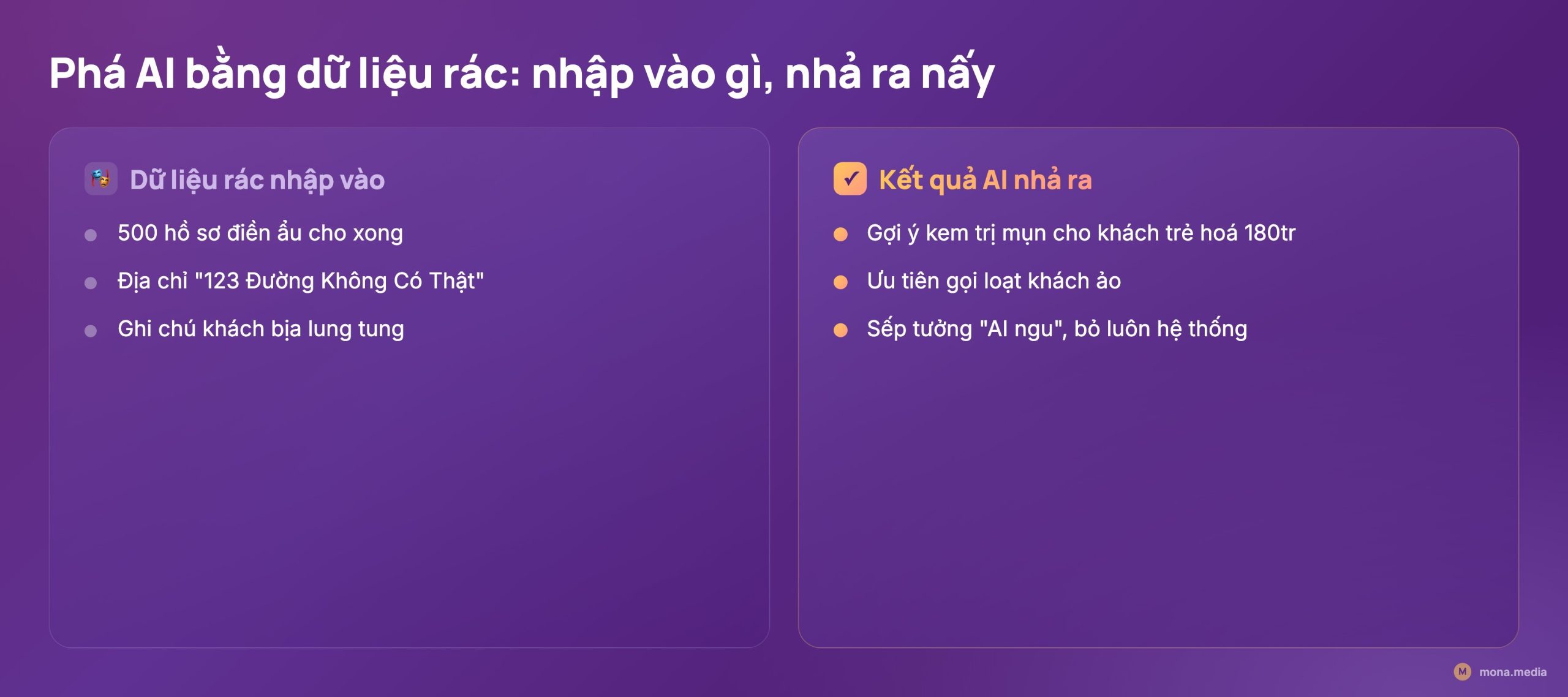
8:15 a.m. on Tuesday, you open the AI dashboard with a bit of hope. The new customer care automation system has been running for three weeks. It is expected to analyze purchase history and notes to suggest the right upsell for each customer. But the results are absurd. The AI proposes selling an acne care package to a VIP customer who just spent 180 million VND on a rejuvenation treatment. It also suggests prioritizing calls to a batch of customers with the address “123 Nonexistent Street, Unstable Ward.”
You are puzzled. The investment was not small, and the vendor is reputable. How can a machine be this “stupid”? You call in the head of customer care. She points to a diligent employee in the corner and says that he volunteered to enter 500 old customer records to “train” the AI. That employee looks up with a hint of defiance and answers quickly: “I entered it exactly as in the Excel file you gave me.”
The truth is not in the Excel file. It lies in a deliberate, quiet act of sabotage. That employee entered 100 fake addresses, added the note “difficult customer, often complains” to 80% of loyal customer records, and assigned the wrong service history. The input data was contaminated at the source. AI, however smart, only learns from what it is taught. It is learning from garbage, so of course its output is garbage too. The employee’s goal was achieved: plant doubt in your mind so that you dismantle the project yourself.
The first and most common motive is fear of change. A manual process, however inefficient, is familiar. It is the comfort zone employees have mastered over many years. They know every corner and every shortcut, and most importantly, they feel in control of their work. A new AI system is like an alien speaking a language they do not understand and threatening to break the existing order.
Feeding in junk data is not carelessness. It is deliberate resistance. By making the AI produce ridiculous, wrong decisions, they create vivid proof that “doing it the old way is better.” They want to hear you say: “Forget it. Too complicated, let’s go back to doing it by hand to be safe.”
Each time the AI makes a wrong suggestion and you frown, they see their plan succeed by one more step. They do not attack the system with viruses or malware. They attack it with a more dangerous weapon: absurdity. They turn a promising tool into a farce, so your disappointment kills it in the cradle. They want to corner you into retreating and give them back the peace of the old process.
Deeper than fear of change is fear of losing the job. This is a silent fight for survival. To them, AI is not an assistant. It is the thing that will replace them in the next 6 months or a year. Every smart suggestion and every accurate analysis from AI is a countdown for their career at the company.
This sabotage is a cold calculation. “If this system succeeds, my position won’t be needed. Better to make it fail from the start.” They try to prove their own worth by highlighting the machine’s weakness. They need you to believe there are “feelings” and “gut instincts” about customers that only people have, and AI can never reach.
By adding misleading, gut-feeling notes like “this customer seems annoyed” or “this customer is demanding,” they deliberately create situations that AI cannot handle logically. When the system fails or gives a wrong suggestion, they step in like a hero: “Let me call this one, I know this customer well.” That is how they assert a value they believe is under direct threat. Sabotaging AI is how they protect their own future.
Beyond fear, there is also professional pride. Many employees, especially long-serving ones, treat their skills and intuition as an art. They take pride in being able to “read a customer at a glance” or “guess what they want from their voice.” To them, that is an asset, the thing that has made them valuable over the last 5 or 10 years.
The arrival of AI is a slap in the face to that pride. It implies that the experience they have built can be encoded into an algorithm. This makes them feel belittled, reduced to a simple machine. Sabotaging data is their way of pushing back against this diminishment. They want to prove that human “instinct” cannot be replaced.
They will deliberately create noisy, contradictory datasets so the AI cannot learn. When you question the terrible results, they will say something loaded: “How can a machine understand people, boss?” They do not just want the project to fail. They want it to fail badly, to support their argument that human experience and finesse still come first. It is a fight to protect their professional ego.
This kind of sabotage is very subtle, but not without traces. You can notice it if you watch closely for unusual patterns in the data and in employee behavior. Here are the clearest signs we have collected from many rollouts for customers:
If these signs are ignored, the consequences after 6 months to a year will be severe, and not only in money. First, the direct cost. Suppose you invested 1.2 billion VND in software licenses and initial rollout. All of it counts as lost, because the system delivers no value. But that is only the visible part.
The bigger damage is opportunity cost. While your business struggles with junk data and loses faith in technology, competitors have rolled out successfully and started optimizing operations. They serve customers better, upsell more effectively, and save on staffing. After 12 months, the gap between the two sides is huge. You are not just standing still but being left behind.
Finally, and most damaging, is the erosion of trust inside the company. A failed AI project becomes a “scar” in the company culture. Next time you want to roll out any new technology, you will face many times more doubt and resistance. Employees will say: “Same as that AI last time.” Leadership will hesitate to approve budgets. You will have built a hidden line of defense against innovation inside your own business.
To fix this at the root, the answer is not to try to “re-educate” employees or hope they will do the right thing on their own. The answer is to remove the possibility of anonymous sabotage entirely. People only dare to do wrong when they think no one is watching. Our job is to turn the lights on in every corner.
All software MONA develops for customers is built on one fixed principle: traceability and accountability. The system must record every action. When employee A updates customer X’s record at 2:03 p.m. on Tuesday, the system automatically saves a log line: “User A, 14:03, 28/05/2024, updated the Notes field.” No one can deny it.
With total transparency, sabotage disappears on its own. There will be no more “I don’t know” or “maybe it’s a system bug.” The data will show exactly who fed in the junk information. The conversation shifts from “Why is this AI so dumb?” to “Why did employee A enter the data like this?” It restores fairness to the technology and puts responsibility where it belongs, on people. This is the only way to protect your investment and keep the automation project on track.
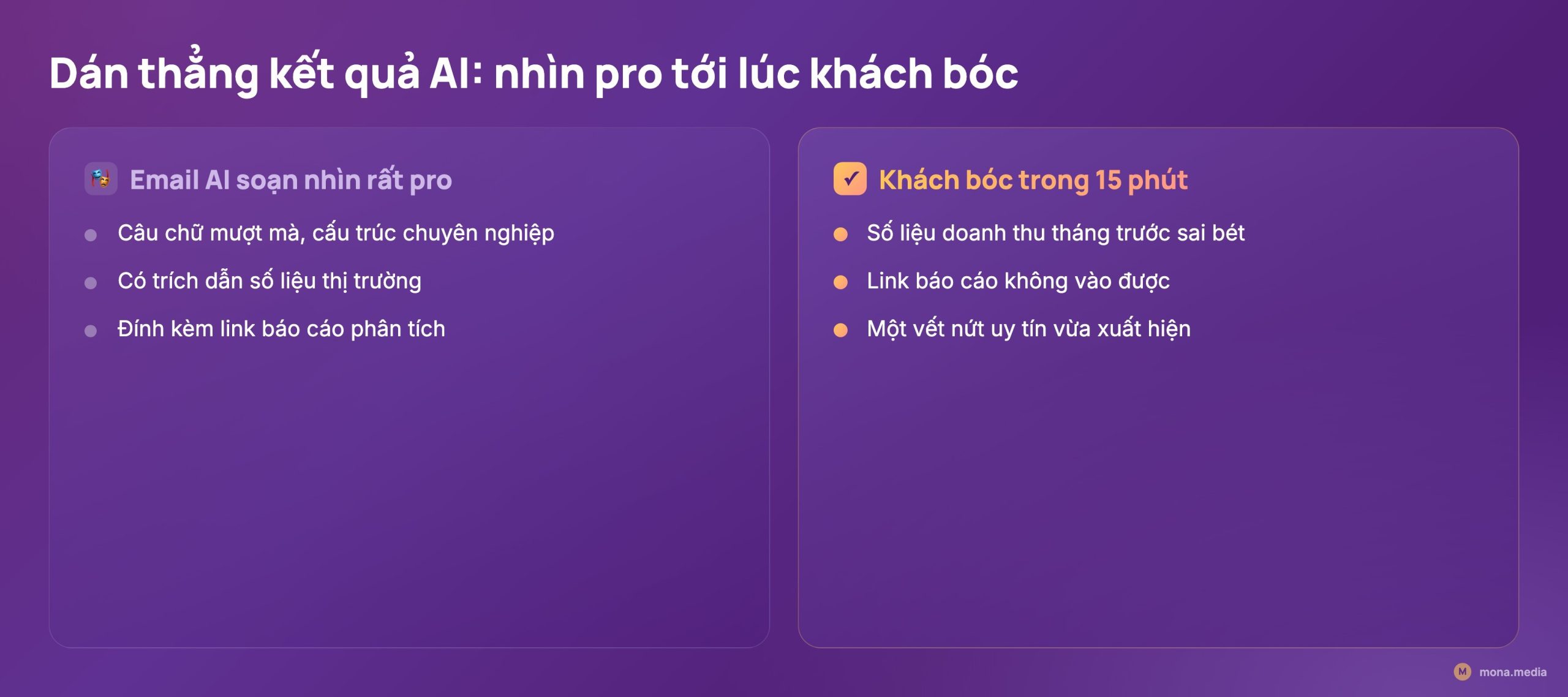
9:03 a.m. on Tuesday, a 24-year-old marketing employee sends an email to an important customer. ChatGPT wrote the content, laying out next quarter’s plan for their 32-branch retail chain. The wording is smooth and the structure professional, with cited figures and a link to a market analysis report.
Just 15 minutes later, the customer replies. Short and to the point. “Can you double-check for me? Last month’s revenue figure for our company is wrong. The report link doesn’t open either.” A gentle remark, but enough to tell you that a crack in your credibility has just appeared. That young employee simply copied and pasted, without checking for even a second.
The first motive is not malice. It comes from almost absolute faith in technology. For a generation that grew up with smartphones and the internet, machines are truth. They think, “It’s a computer, it calculates, it doesn’t go on feelings like people do, so how can it be wrong?” They treat AI’s answers like the output of a Casio calculator, always accurate.
This naivety comes from a lack of hard knocks. They have never suffered the consequences of a wrong number or had to apologize to a customer for a mix-up. In their worldview, AI is an all-knowing expert, the final reference. Checking AI’s output feels as pointless as re-adding a sum a calculator has already answered.
Double-checking an AI-generated document is a lot of work. Having AI write an email takes 5 minutes. Checking every figure, rereading every source, and clicking every link can take another 30 minutes. That 25-minute gap is fertile ground for laziness to take root.
Employees rationalize their own actions. They do not think they are lazy. They think they are working “smart” and “efficiently.” They are proud to finish work 6 times faster than others. Laziness is cleverly disguised under a cover called “productivity.” They choose to paste straight in. Faster. Easier. And they believe no one will notice.
Another, subtler reason is the spell of good presentation. AI, especially LLMs like Claude or ChatGPT, produces well-structured text with perfect grammar and a professional tone. To a young employee with little writing experience, the result looks far “better” than what they could write themselves.
They are fooled by that polished surface. They confuse a well-presented text with a text whose content is accurate. This psychological trap is very common. Because the email looks professional, they assume the information inside must be reliable too. They lack the critical thinking skills to see through the wording and question the facts inside.
This motive comes from your own management system. Are employees being measured by volume? For example, a KPI of “send 50 customer care emails a day” or “produce 10 articles a week.” When speed and quantity are rewarded, quality automatically drops to second place.
Young employees learn the rules of the game fast. To hit the target, the quickest way is to use AI and skip the review step. They are optimizing to survive and grow in the system you built. The fault does not lie entirely with them. It lies in a system that records output by quantity and ignores the impact on quality.
To spot this type of employee early, you need to watch for very specific signs. Do not wait until customers complain. Look for them in daily work.
One employee’s carelessness can cause financial damage you never expected. Run a simple calculation for a chain with 52 billion VND in revenue a year. One large customer leaving can cost 1.2 billion VND in revenue a year, which is 100 million VND a month.
Just 3-5 flawed emails sent to the wrong customers can put the credibility you built over 5 years in doubt. A senior manager earning 40 million VND/month may have to spend 50% of their time just cleaning up, fixing errors, and apologizing to customers. The opportunity cost and salary for this alone is already 20 million VND. Not to mention that other veteran employees will lose faith in the company’s AI rollout. They will look at it and think, “AI just creates more work.” The damage to morale and the quiet resistance is even more costly. Added up, one small mistake can wipe out 150-180 million VND a month.
You can absolutely stop this before it does serious damage. We at MONA have advised many businesses and found the following two actions extremely effective. You can apply them this very week.
First, set the rule “AI is an assistant, not an expert.” Communicate clearly across the company: AI is a tool for producing drafts and speeding up ideas. Final products sent to customers or published publicly must be 100% the responsibility of a person. Every AI output must be treated as “unverified” until someone checks it and signs off.
Second, set up a mandatory cross-check for important deliverables. For example, every email to tier-A customers must be read again by another person on the team. Every report must carry the team lead’s signature. This may slow the process a little, but it saves you from mistakes worth hundreds of millions of VND. Tie the error rate directly to individual performance metrics. Anyone with an error rate above 3% needs retraining immediately. Do it now. Before the next email goes out.

Tuesday morning, in the weekly kickoff meeting. You ask about the customer return rate at the District 7 branch last month. The head of sales, someone who has worked at the company for 8 years, answers right away. His voice is calm: “Boss, this number has a bit of an error in the system. Let me have the team do a manual review to be sure, and I’ll report to you by the end of the week.” You nod, because you have always fully trusted his carefulness.
But that is not carefulness. It is a staged performance. There is no system error. The data is still there, accurate to the last digit. The “manual re-check” is really a process of filtering, selecting, and re-presenting the data. He needs 3 to 5 days not to fix errors but to build a nice story out of bad numbers. He knows that if the company adopts an AI system that analyzes data in real time, the curtain will be pulled down. You would look straight at the performance of each employee, each branch, each hour. Then his role as “the person who decodes and summarizes the numbers” would no longer be needed.
For years, this department head’s power came from being the only bridge between leadership and the raw data. You are busy with strategy, external relations, and finance. You need someone trustworthy to “translate” thousands of rows of complex data into easy bullet points on report slides. He did that job very well. His position was built on the very complexity and inaccessibility of the data.
An AI system does the opposite. It democratizes data. It turns complex numbers into visual charts anyone can understand in 30 seconds. When data flows straight from the sales system and the customer care system onto the CEO’s screen, the department head’s role as “gatekeeper” suddenly becomes redundant. He is no longer the one who holds the information, just another person viewing it. This fear is not about losing the job but about losing the core value that has shaped his career.
Blocking data is not only about protecting his role. It is also a defense mechanism to hide the weak performance of a whole department. Some truths would raise a lot of hard questions if you saw them. For example, the “cooked” report shows the department’s average closing rate at 15%, a number that looks fine.
But if AI software analyzed it more deeply, it would reveal a different truth. 80% of those orders actually come from just 2 outstanding employees. The other 10 employees have a dismal closing rate under 3%. This number exposes a serious problem with the department head’s management and training ability. It shows he has not been able to lift his team. Blocking the data is how he covers this fatal weakness and keeps up the image of a talented manager in your eyes.
The fear is even more concrete in financial terms. His sales department has 12 people. Salaries, bonuses, and other benefits for the whole department can reach 350 million VND a month. This spending was approved because it matched the reported results. But the department head knows better than anyone that the department’s real working capacity is not that high.
He can work out that, with an AI system that automatically qualifies leads, drafts emails, and builds reports, the work of the current 12 people could be handled neatly by just the 4 best employees. The other eight positions would become redundant. If this truth came out, it would threaten not only the jobs of those 8 employees but also raise a big question about his own staffing judgment over many years. He is protecting a bloated, inefficient structure that he built himself.
This type of employee usually acts very subtly. But you can spot it early through very specific signs in daily work. If you see 3 or more of these signs, it is time to take a closer look:
Making decisions on filtered and steered data is extremely dangerous. You are deciding on a map someone else has redrawn to suit themselves. The consequences are not only financial. Suppose your company has 600 billion VND in revenue a year. One wrong product campaign decision based on a distorted report can easily cost 5% of revenue, which is 30 billion VND. Repeat that over several quarters and the loss can reach hundreds of billions.
But the bigger loss is time and market position. For 6 to 12 months you flounder with strategies built on “embellished truth,” while your competitors already have real-time data in hand. They see customer trends instantly. They know exactly which channel works and which product to push. They pull ahead and take your market share. By the time you notice the problem, it may be too late to win back what was lost.
Finding the problem does not mean firing this department head. You can turn their resistance into an opportunity to restructure. The answer is not punishment but changing the rules of the game. We at MONA have advised many companies who applied two simple steps successfully. One, set up a “single source of truth.” That means building a system where data from every source (sales, marketing, logistics) flows straight into one place and is shown in real time to everyone with access, from the CEO to employees.
Two, reposition the department head’s role. Instead of being the data “gatekeeper,” he becomes a performance “coach.” His KPI is no longer “reports on time” but “helping the team improve the metrics on the dashboard.” His job now is to look at the same dashboard as you and his team, then ask: “Why did your closing rate drop this week? Do you need tools or skills from me?” Then his ability goes into developing people, something AI can never replace.
This is the most common kind of quiet resistance, and the hardest to detect. It does not come from sabotage but from a mix of fear, inertia, and work pressure. You can find these people in every department, from sales and marketing to operations. They look like the most cooperative people, yet they are the ones quietly pulling the whole organization back.
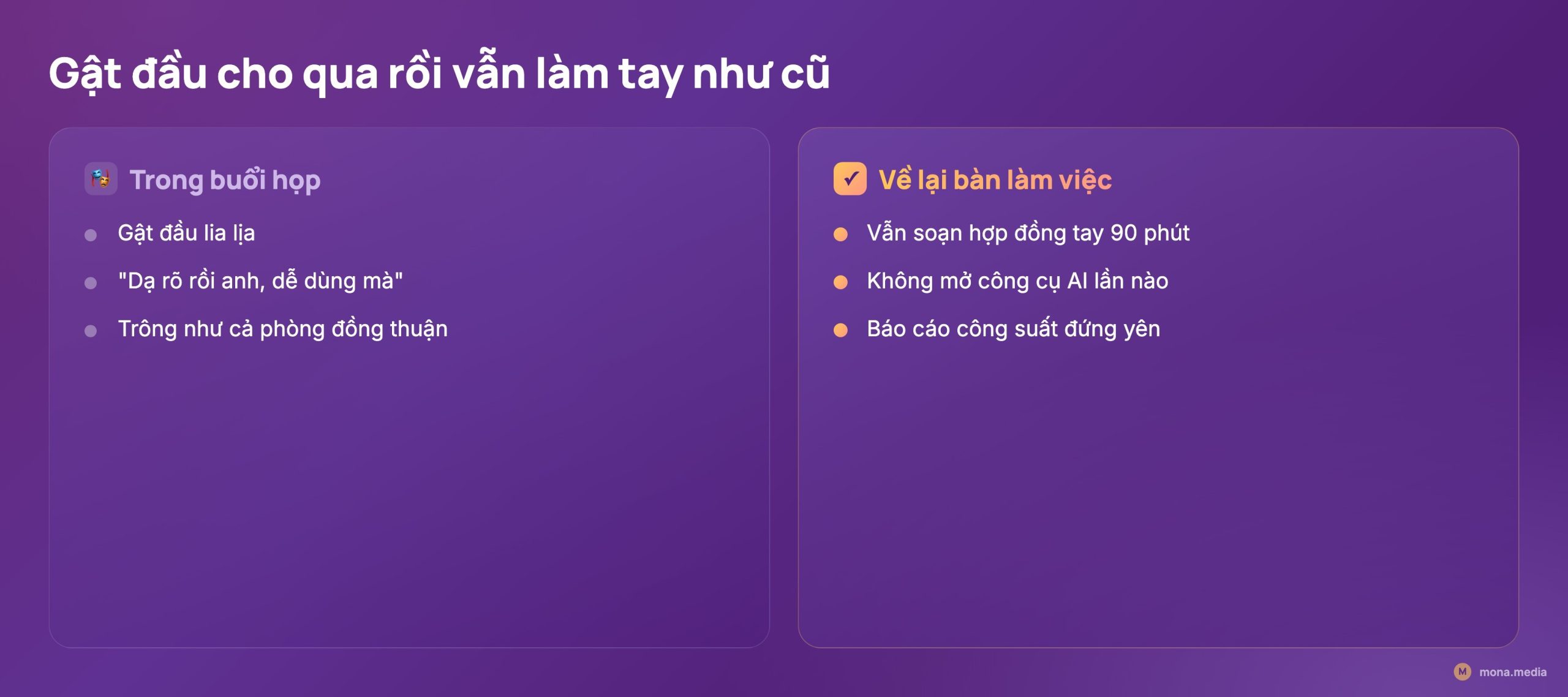
Friday, 9 a.m. You hold a training session for the whole sales department, 35 people, on a new AI tool that helps draft proposals and contracts. The tool promises to cut the time from 90 minutes to 7 minutes per file. You present with heart. Everyone watches the screen closely and nods away. At Q&A, you ask: “Is anything unclear?” The room is silent. Then a team lead speaks up: “Got it, boss. It’s easy to use.” A few others chime in: “Yes, I understand.” The meeting ends on a positive note. You believe 90% of the staff are ready.
The following Tuesday, 2 p.m. A salesperson named An gets an urgent request to send a quote to a big customer. Instead of opening the AI tool, An opens her familiar folder on her computer. She finds the file “BaoGia_Mau_Chuan_2023.docx.” She carefully copies it, pastes in the new customer’s details, and edits a few numbers. It takes 48 minutes. Just then you walk by and ask: “An, have you tried using AI to draft quotes yet?” An startles, and answers quickly without a moment’s hesitation: “Yes, I’ve been using it. It’s really fast and much more convenient.” A smooth, flawless lie.
Behind An’s lie is no bad intent. The first and deepest motive is the fear of losing face. In Friday’s meeting, An did not really understand everything. The tool’s interface has a lot of unfamiliar terms. The workflow had a few steps she missed. But looking around, she saw younger colleagues, new hires, all nodding as if they got it. She did not dare raise her hand. She feared being the only one who did not understand. She feared everyone would think she was “dumb,” slow with technology, and getting old.
The fear of being judged incompetent is even bigger than the wish to learn. It is a form of invisible peer pressure. She would rather lie and say she already knows and figure it out later than admit weakness in front of 34 other people. But that “figuring it out later” never happens. Work carries her away, and the fear of trying something she is unsure about comes back. Going back to the old way is much safer. It guarantees she gets results, even if slowly. Trying the new thing, and it going nowhere, and then being asked by the boss, would be even more embarrassing. So the first lie leads to a chain of avoidance.
Another very practical motive is target pressure. Your sales department has clear KPIs. Each employee must send at least 15 proposals a week. Missing the target at month-end costs performance points, which directly affect pay and bonuses. Employees like An face a hard choice. Learning the new AI tool can take a few hours, and even the whole first day of fumbling. At first, using AI can take longer than doing it by hand. A hand-made proposal takes 48 minutes, but fumbling with AI can take 2 hours with no guarantee of a good result.
In their heads it is a simple calculation. “The boss is pushing KPIs at the end of the week, and if I fall short I’m done. No time to fiddle with something new.” The pressure to finish work right now beats the vision of long-term efficiency. They choose the surest path to avoid penalties, which is the old way. The words “yes, I’ve used it” are just a shield so they can work in peace, so the boss does not check on them and push them to change in the middle of a crunch. The company’s own evaluation system is, unintentionally, encouraging employees to resist the very innovation you are trying to drive.
Do not underestimate the power of habit. An employee who has done a job one way for 5 or 10 years has formed a “rut” in the brain. Every copy, paste, and edit has become an unconditioned reflex. They can do it without much thought, like driving along a familiar road home.
Now you hand them an AI tool. It makes them think. They have to learn how to write prompts. Read a new interface. Check the results the machine produces. This process demands intense focus and burns mental energy. The first feeling is always “slower” and “harder.” After one or two tries with results they do not like, or that take longer than expected, they quickly conclude: “Doing it by hand is faster.” They give up and go back to their comfort zone. The comfort of the old habit has won. They do not hate AI. They simply do not want to step out of the convenience of what is already very familiar.
Because this type of employee is very good at covering up, you cannot trust what they say. Look at the data and the unusual signs instead. We have seen many companies realize this too late. Here are 5 signals you can check this very week:
A lie like “yes, I’ve been using it” sounds small. But when 30 people tell the same lie, the consequences for the business are enormous. In the early stage, you trust verbal reports. You think 80% of the sales department has adopted it successfully. Based on this distorted data, you confidently make a strategic decision: invest another 2 billion VND to buy licenses and roll out AI for the marketing and customer care departments. You may even report these positive numbers to the board.
Four months went by. Then it all fell apart when the new quarter's results showed none of the growth you expected. A big client complained about a contract that still carried last year's terms. You started digging. The truth came out. Not 80% adoption, only 5%. The whole rollout plan was put on hold. The new 2 billion VND investment became a sunk cost. But the biggest damage wasn't the money. It was 6 precious months wasted. Competitors pulled ahead. Your trust in your team was shaken. The digital transformation plan for the whole company slipped by at least half a year. All of it started with nods and harmless lies.
You find this problem to fix it, not to punish anyone. Blame only makes staff more afraid and better at hiding things. You need to remove the psychological barriers that pushed them to lie. MONA usually advises clients to take 3 simple but effective steps:
1. Measure with a system, don't trust what people say: Move from managing by asking around to managing by data. Set up dashboards that automatically record how often the new tool is used and what comes out of it. Share these numbers openly, but don't use them to punish anyone in the early phase.
2. Create a “safe period”: Make a clear announcement: “For the next 2 weeks, the company will not score KPIs against old results. If you're struggling or don't understand the AI tool, tell us honestly. Someone will coach you 1 on 1. People who speak up will get extra attitude points. People who hide problems will own them when the safe period ends.” This creates a safe space where people can admit their weak spots without fear of punishment.
3. Find and recognize your early adopters: Among 35 people, there are surely 2 or 3 who really use it and see results. Find them. Recognize them in a company meeting. Give them a small reward. Most important, let them share their experience and coach their colleagues. Learning from a peer is far less stressful and easier to follow than learning from the boss.
This is one of the subtlest kinds of resistance you will meet. These people don't object loudly. They use the company's own high quality standards as a shield, putting every effort to adopt automation in a tough spot. They are skilled professionals, sometimes core staff.
But in this new context, that same perfectionism becomes the biggest drag on the whole department. And if you don't spot it early, the company pays in speed and opportunity cost.
Tuesday afternoon, in the marketing meeting. You just proposed using an AI tool to quickly produce 50 ad variations for the upcoming sale week. The goal is to have many versions to test and see which performs best on Facebook.
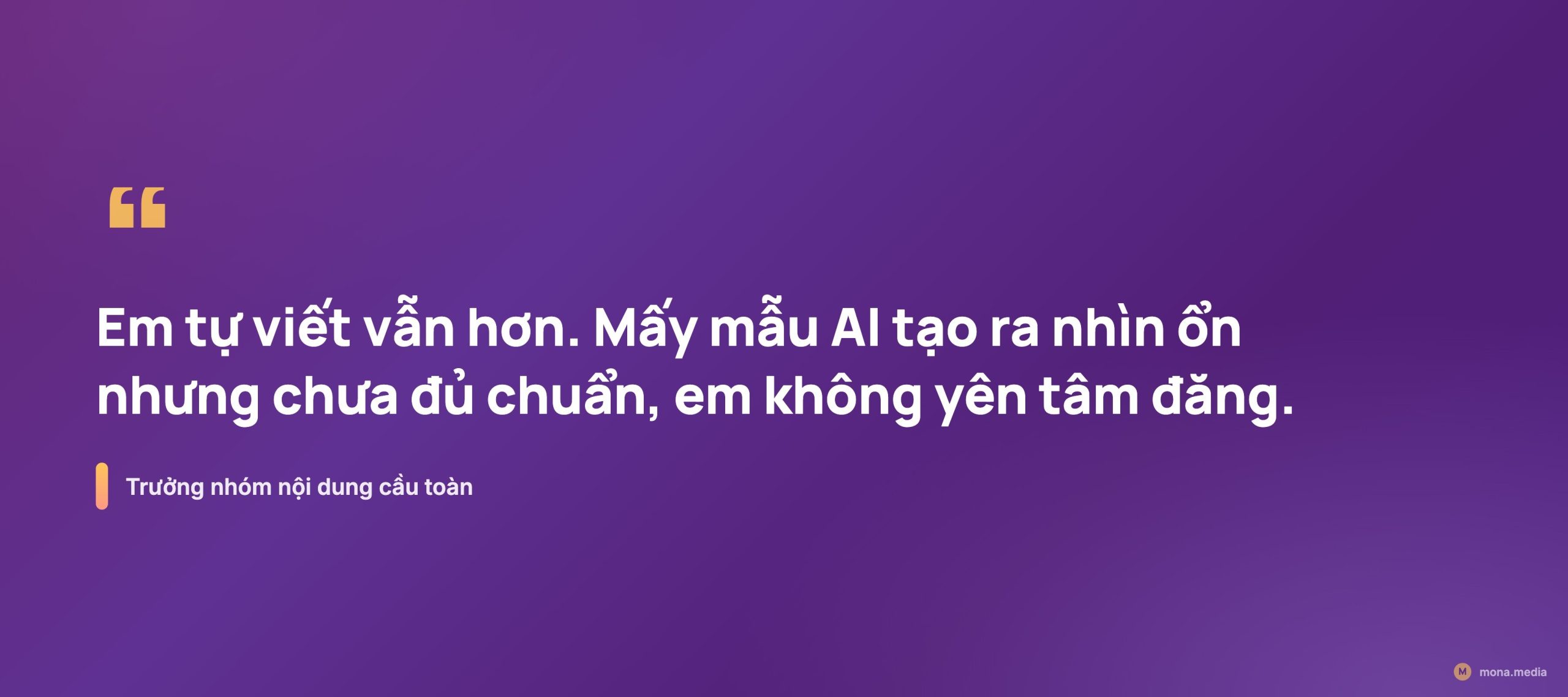
The content lead, a talented veteran, listens in silence. After looking at a few AI results, she shakes her head. “I read 5 ad lines the AI wrote. They don't match our brand voice. The wording is hollow and has no feeling. I'd rather write them myself to be safe.”
A very reasonable statement. Nobody can argue with it. But behind it, a whole test plan of 50 ad variations has shrunk to 5 handwritten ones. And you, the person in charge, feel stuck in a way that's hard to describe.
The first and most visible motive is perfectionism. This employee truly believes the AI output isn't up to standard. And they're not wrong. Today's AI rarely produces a 10/10 piece on the first try, especially when the brief calls for brand voice and subtle emotion.
They set a very high, almost impossible bar as the yardstick. They compare an 80% AI draft made in 30 seconds with a 95% piece that took them 5 hours. That comparison is unfair by nature. They are judging a high speed “line worker” by the standard of a “craftsman”. The goal of AI is to produce rough drafts and volume so people can refine them, not to replace the final creative step entirely.
And because the excuse “not perfect enough” sounds so valid, it becomes a solid shield against every change. They shift the discussion from “how do we use AI well” to “is AI as good as me”. On the second question, they always win.
It goes deeper than work standards. It's about their personal identity. A good copywriter builds self-worth on the ability to “work magic” with words. A designer builds a reputation on taste and a unique skill set. They are “craftsmen” in their field.
AI threatens this identity directly. Admitting a machine can produce a “pretty decent” draft makes them feel their unique value is shrinking. It's as if saying that most of what they did for years, the steps that took the most effort, can now be partly automated. That causes deep insecurity about their standing and recognition in the organization.
To protect the “craftsman” identity, they have to prove they're better than the machine at every turn. The easiest way is to say AI output has no “soul” and no “personal touch”. This is a fight to protect self-worth, not just a technology decision.
This is the strongest and most hidden motive. The perfectionist may not say it out loud, but they know AI can take over most of the rough work. That is the part that eats time but doesn't need top creativity: writing basic product descriptions, drafting routine email templates, designing banners from ready-made layouts.
If they admit AI can do 80% of this well, a logical question will cross leadership's mind: “So do we need a full-time person just for the remaining 20%?” The fear of being replaced, cut, or at least made less important is completely real. They fear their value on the job market will drop if their exclusive skill can now be replaced by a monthly software subscription.
So they have to insist that 100% of the work must be done by hand. By rejecting AI, they are protecting their turf and their own safety, even if it slows down the whole team.
The perfectionist's resistance is subtle, but it leaves traces. You can spot them through these repeated behaviors:
Say your marketing team has 5 content staff. A competitor of the same size also has 5. But they use AI to produce drafts. While your team writes 20 social posts and 5 blog posts by hand each week, the competitor's team produces 60 posts and 15 blog posts at 8/10 quality, then has people refine them. They cover more ground, test more messages, and quickly find the formula that works.
The productivity wasted on 3 content staff who refuse the tools can reach 180 million VND a month. But that's not the most expensive part. After a year, the competitor is present on every channel and knows what customers want to hear. Your business is still fiddling with a few “perfect” articles that barely reach anyone. You've lost a precious year of building your brand online. That opportunity cost can never be recovered.
With a perfectionist employee, firing is not the answer, since they are often capable people. What you need to do is reshape the game. When we deploy automation systems for clients at MONA, we usually give CEOs two specific pieces of advice.
First, define the roles clearly. AI handles volume, speed and first drafts. It is a diligent assistant that never gets tired. The perfectionist moves up a level: they become the final quality controller, the proofreader, the person who adds the brand “seasoning” to turn an 8/10 draft into a 9.5/10 piece. Their value is no longer in typing every word, but in editing and strategic direction.
Second, change how you measure performance. Instead of judging quality by feel, introduce a new metric: Total quality score = Number of outputs x Average quality score. A department that produces 100 articles at 8/10 (800 points total) rates higher than one that produces 10 articles at 9.5/10 (95 points total). This forces the whole team to think about overall output instead of getting lost in individual perfection.
This is the most common type of employee in a Vietnamese business. They don't object. They don't complain. They even nod in approval when you announce the AI rollout plan. But then nothing happens. Their silence and waiting are more dangerous than open resistance, because it quietly wears down motivation and slows the whole machine.
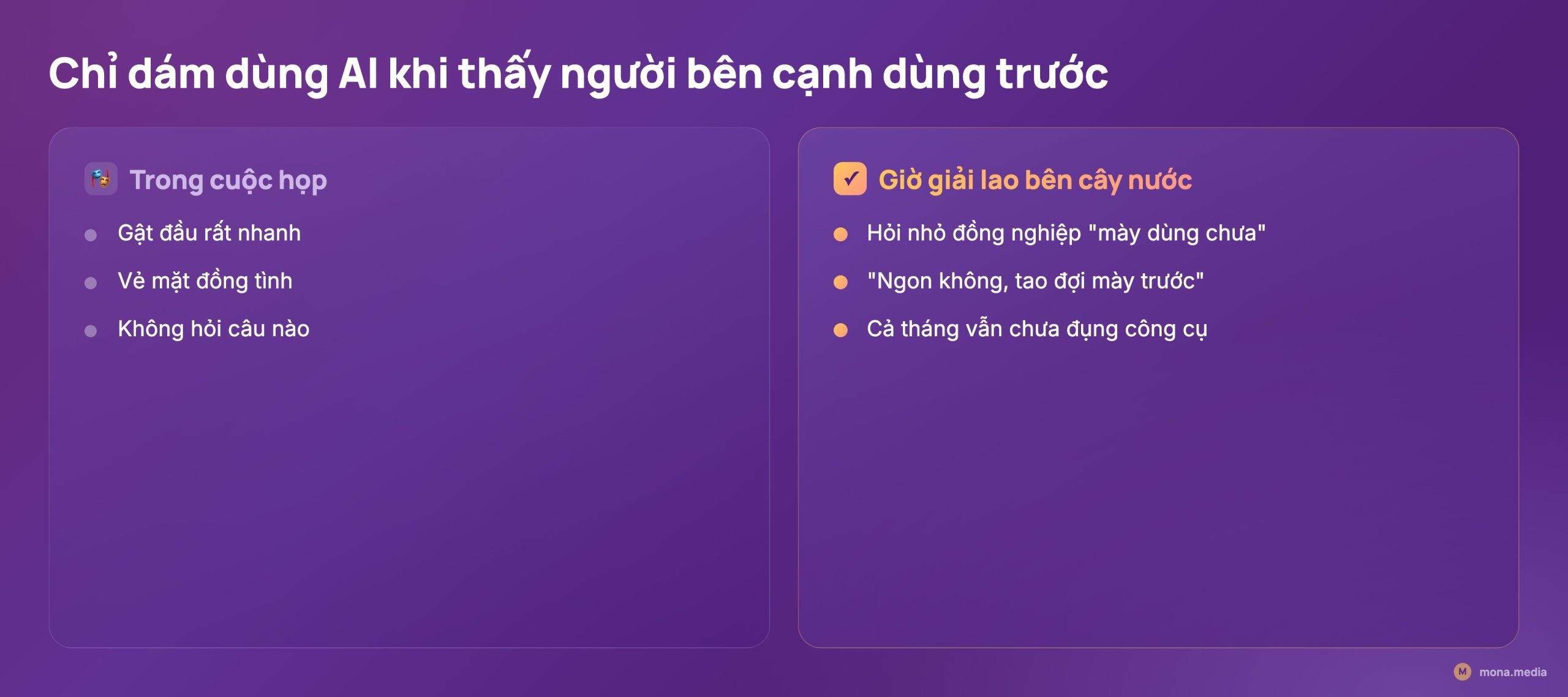
9 a.m. Monday, in the all-hands sales meeting. You just presented a new AI tool that drafts sales emails and tracks customers automatically. The whole room listens in silence. You ask: “What do you think, any questions?” An employee named Hung, sitting in the middle of the room, nods quickly. He looks fully on board.
11 a.m. the same day, by the water cooler. Hung stops by the desk of Lan, the team lead. He doesn't ask you, the person who just introduced the tool. He asks Lan: “Hey, that AI the boss talked about this morning, are you going to try it?” Lan shrugs: “Not sure yet, let's see.” Hung goes on: “Yeah, me too. I'll wait for others to use it first and see if it's okay, then I'll follow.”
A tiny conversation, just 15 seconds. But it is the start of a delay that will last 6 months. The agreement in the meeting room is fake. The waiting in the hallway is real.
The first motive behind this hesitation isn't technology. It's department culture. In many Vietnamese workplaces, the first person to try something the boss pushes down is often looked at with suspicion. They fear the whispers behind their back: “Showing off again?”, “Probably sucking up to the boss for a promotion.”
This kind of employee doesn't want to become the center of that negative attention. To them, standing out for being too eager is a social risk. They would rather be ordinary and safe in the crowd than a lonely star at risk of being shunned by colleagues. This invisible fear is even bigger than the pressure of performance metrics. They choose to please the 20 people in the room over pleasing you alone.
Their logic is simple: if you walk alone and trip, it's your own fault. If you walk with a crowd and trip, it's a group problem. Adopting AI is the same. If they are the only one using it and the AI tool causes an error, such as sending a wrong quote to a major client, all the responsibility lands on them. You might not punish them hard, but they would have to explain, fix the mistake, and carry the pressure alone.
But if the whole team uses it and the AI tool has a problem, the story changes. It becomes “the tool's problem”, “the vendor's problem”, or “a problem with the company's rollout process”. Responsibility is shared. Nobody points a finger at one person. The mindset of “wait for someone else to scout ahead” is a self-protection mechanism. They aren't working against you, they're just protecting themselves.
This is a silent question, but it is the biggest barrier. This employee is very practical. They think about specific risks. What if the AI writes an email in the wrong brand voice? What if it analyzes customer data wrongly? What if the system crashes right when a report is due?
Until you set up a “safe zone” for trial and error, they won't step in. What is a safe zone here? A clear message from leadership: “We are in a pilot phase. Any mistake from the AI tool in the first 3 months will not count against personal KPIs. Instead, it will be treated as a lesson for the whole team.”
Without that commitment, employees assume they carry every risk themselves. And when the choice is “keep the old way, safe, hit 100% of target” or “try the new way, risky, maybe hit only 80% and get reprimanded”, they will always pick the first. They work for a salary and stability, not to be guinea pigs for your initiatives.
This type of employee is easy to spot if you watch behavior rather than just listening to words. Instead of waiting until the end of the quarter to review reports, you can catch them in the second week after rollout through these signs:
Do a simple calculation for your 28-branch spa chain. The goal is for 80 consultants to automate 30% of basic customer replies and appointment booking with AI. The plan is expected to finish in 2 months.
But because 70 of the 80 staff are the “wait for someone else to go first” type, the process drags on to 8 months. 6 months are wasted. What does this delay cost? First, the salary cost for the work a machine could have done: 80 staff x 15 million VND/month (salary and allowances) x 30% (automation rate) x 6 months = 2.16 billion VND. Second, opportunity cost. A competitor adopts successfully first, responds to customers faster, and may have taken 5% of your new customers in those 6 months.
The total damage is not just sluggishness. These are numbers that speak. The hesitation of a few dozen employees can cost your business billions of VND without you ever knowing.
To solve this, slogans and pressure won't work. You need to change the “rules of the game” in the office. Instead of leaving each employee to decide, actively create a new “crowd”.
First, pick a pioneer group of about 15-20% of the department's headcount. For example, in a team of 80, choose the 12-15 people with the most open mindset. Work with this group separately, give them the best support, and set clear goals for 2 weeks. When this group succeeds, they become the safe “crowd” that everyone else is looking for.
Next, publicly recognize and reward this pioneer group in front of the whole company. This sends a strong message: “Using AI is not sucking up to the boss, it's smart and effective. Early AI users are the ones who get recognized.” You turn adopting AI from a personal risk into a chance to shine. Then the people who like to wait no longer have a reason to stand on the sidelines.
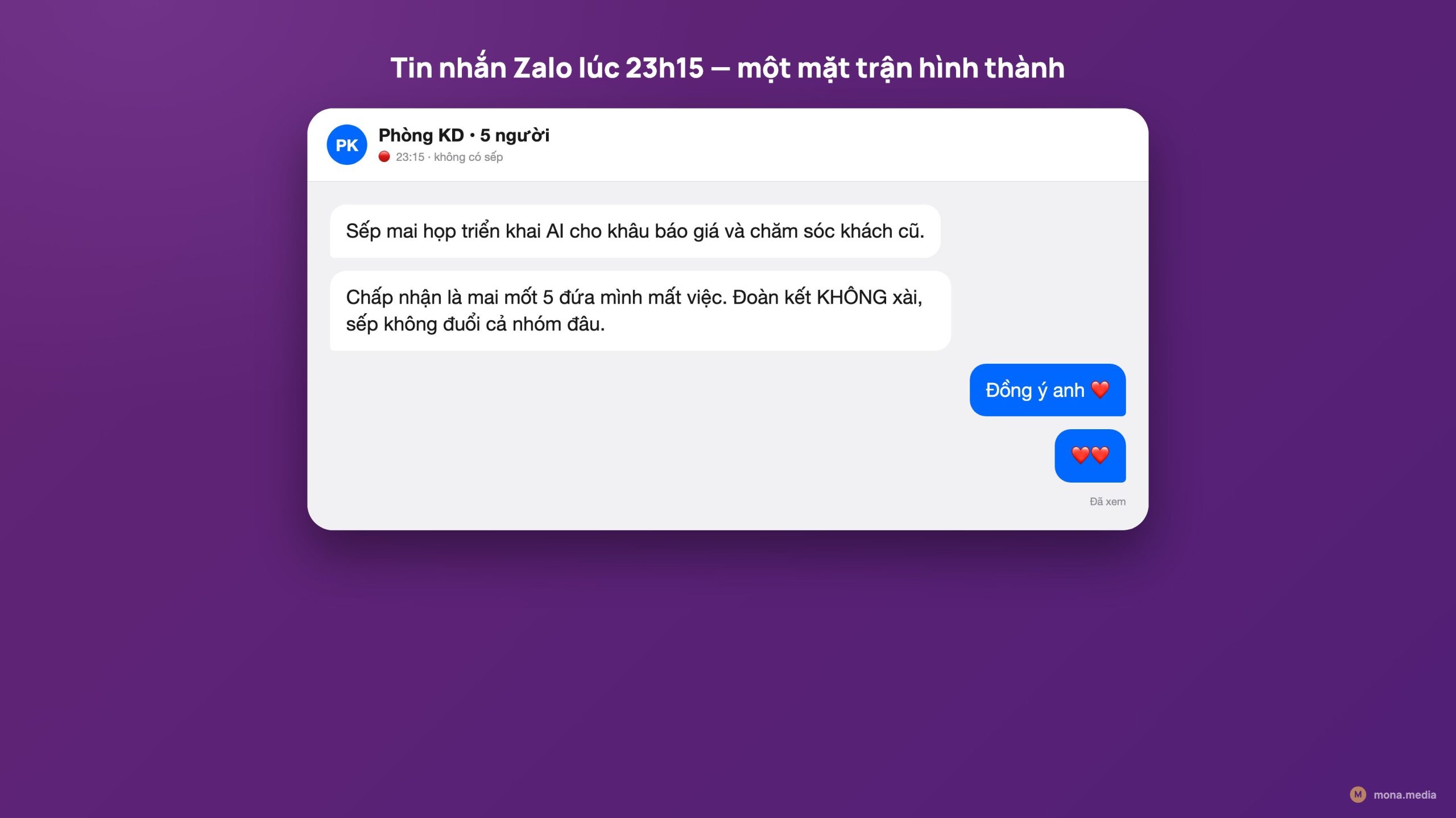
11:15 p.m., Wednesday. Five sales staff receive a Zalo message from their team lead. It isn't about metrics or customers. It's a call to arms. “The boss is holding a meeting tomorrow morning about rolling out AI for quoting and for looking after old customers. If we accept this, soon the 5 of us will lose our jobs. If we stick together and refuse to use it, the boss can't fire the whole team.”
The message gets hearted by everyone at once. A bloc of opposition has just formed in silence, right on the Zalo platform you gave them for work. They are not resisting one by one. They are building a front, turning personal fear into group strength. The core of the tactic is simple: a boss can fire one person, but will hesitate to deal with a whole group of key staff.
This is one of the most dangerous types of resistance. It isn't noisy and it doesn't argue head on. It is covert, organized, and hits the owner's weak spot: the reluctance to clash with the majority and the fear of disrupting business operations.
The deepest motive of the ringleader is to create bargaining power. Alone, saying “no” would label them stubborn and resistant, and they could be replaced in no time. But when the whole group says “no”, the story changes. It is no longer one person's opinion. It becomes “the voice of the whole sales team”.
This scene repeats in many companies. It is a spontaneous union mindset, where members believe solidarity will protect them. The team lead understands this well. They calculate that losing the entire sales team at once would be a huge shock to revenue and operations. You would have to weigh keeping people against adopting technology. And they bet that you will choose to keep people.
They turn themselves from individuals afraid of losing their jobs into a force with weight. Each member no longer feels alone. They have allies, people who stand shoulder to shoulder. The fear is shared, and courage multiplies.
Once a bloc has formed, another invisible pressure appears. It is the fear of being isolated and seen as a traitor. Suppose the team has a young staff member who sees the benefits of AI and wants to try it. But once the team lead has sent the message “stick together, don't use it”, this person immediately faces a hard choice.
If they break away and use AI, what will they get? Maybe recognition from the boss, but certainly a boycott from the other four. They'd eat lunch alone. Every work conversation would feel awkward. They'd be tagged as “betraying the team” and “breaking other people's livelihood for their own sake”. This peer pressure is extremely heavy, especially in a team environment.
So even the most open minded person backs off. They would rather take the safe route of following the majority and keeping the peace with colleagues than become a target of resentment. The ringleader has cleverly turned the fight against AI into a loyalty test.
To make the resistance look reasonable, the ringleader never admits to doing it out of fear of losing their position or reluctance to change. Instead, they wear the cloak of a righteous cause: “I'm doing this to protect jobs for the whole team.” They turn themselves into a hero, the one who dares to stand up for their colleagues.
They will say things like: “I know it's hard for you, but I can't watch everyone lose their job,” or “Our company was built over all these years on human warmth, not machines.” This argument goes straight to people's hearts, especially long-serving staff. It appeals to emotion and bonds, and cleverly paints the CEO as a “heartless” force that only cares about efficiency and forgets people.
This way, they not only strengthen the bloc's internal unity, but also build a moral barrier that puts you in an awkward spot. If you still push ahead with the rollout, you may be seen as a boss with no mercy. It is a very subtle psychological move.
You can recognize this type of employee early through very specific signs. Don't ignore them, because when they appear together, a hidden storm is very close.
In a scenario we witnessed at a 35-branch retail chain, the CEO ignored the early signs. He assumed they were just passing worries. Six months later, when an AI system for customer reporting and analysis was piloted, the entire 8-person marketing team handed in their resignations at once. The reason they gave was “not aligned with the company's new direction”.
The truth only came out when HR reviewed the company's Slack history. A private chat group called “Anh Em Sinh Tồn” (“Survival Brothers”) had been created six months earlier. The department head was the one who started it, planned it, and agreed on the collective action. The shock stalled all of that quarter's ad campaigns. Revenue dropped 18% over 4 months in a row. The cost of recruiting and retraining a completely new team came to nearly 900 million VND.
You lose more than money. You lose staff who understood the market and the stability of a pillar department. And more painfully, you realize you were systematically outmaneuvered. The feeling of being lost and out of control is real.
To defuse this, you must act before the bloc has time to harden. The key is transparency and separating the story from the fear. One, separate the tool from the people. Stress that AI does not replace employees who keep learning, it only replaces repetitive, boring tasks.
Two, announce a clear and public roadmap. Whoever adopts AI successfully first gets rewarded and trained for new management roles. Turn AI into a path to promotion, not a threat of layoffs. When MONA helped a 40-branch restaurant chain automate table booking and replies, the first thing we advised leadership to do was hold an all-hands meeting. They committed to keeping 100% of current staff, and those who mastered the new tools would earn 15% more after 3 months.
It immediately removes the motive to form an opposition bloc. It strips the ringleader of the “righteous cause” cloak and gives forward-looking people a way out. You turn individuals into your allies instead of letting them be pulled into an unnecessary fight.
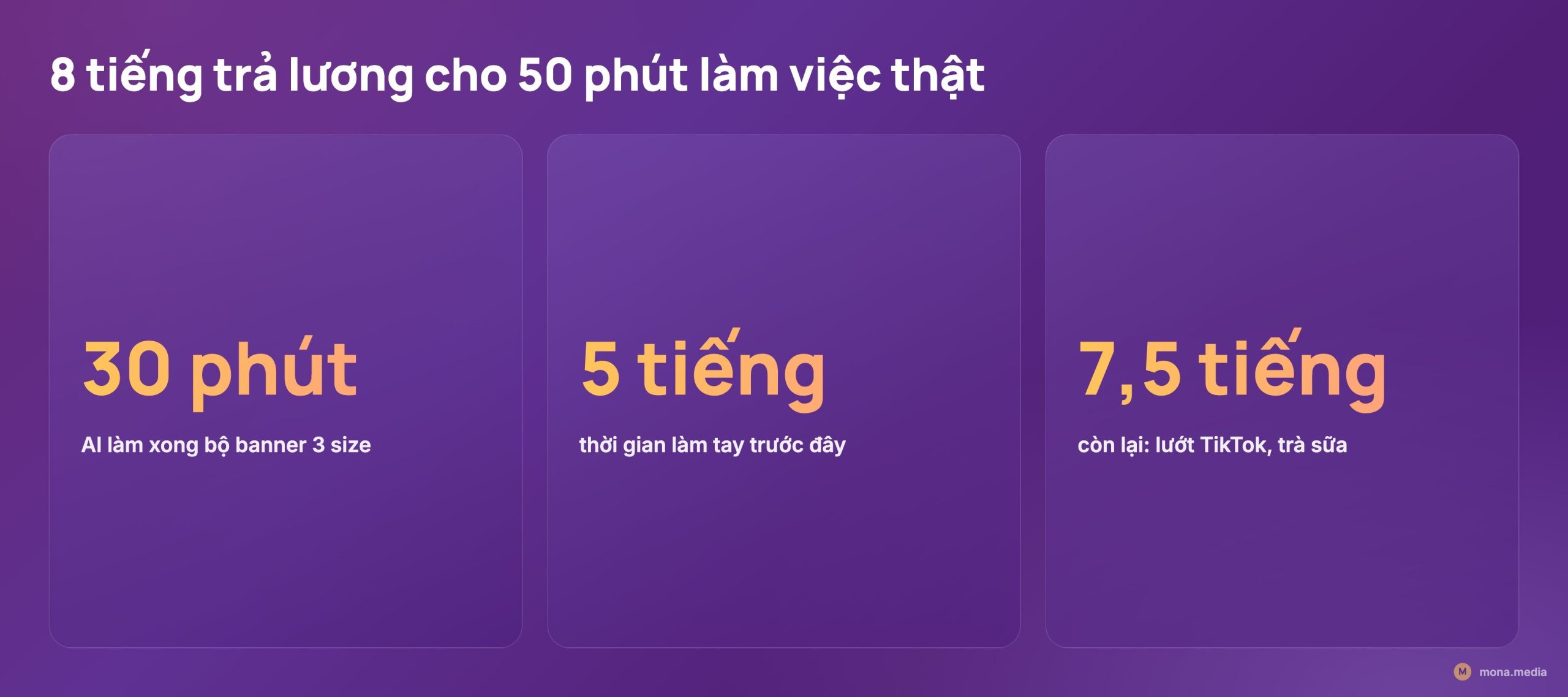
10 a.m. Tuesday. You ask a designer for a set of banners for the weekend promotion. The brief calls for 3 different sizes for Facebook, Zalo and the website. You figure it will take half a day, maybe not done until late afternoon.
30 minutes later, a Zalo message pops up. The design file is already there, all 3 sizes, fresh colors, solid copy. You're surprised by the speed. Before, another employee doing the same job needed at least 5 hours. What does this person do with the other 7.5 hours of the workday? Scroll TikTok, go for bubble tea with colleagues, read the news, shop online. Now and then they open the design file and tweak a small detail to look busy when you walk by.
In another corner of the office, a marketing staff member is asked to write 5 product descriptions for the website. This job used to take research, finding ideas, drafting and editing. 2-3 hours was normal. Now, with ChatGPT and a few ready-made templates, she finishes all 5 in 40 minutes. For the remaining 7+ hours, she plans a personal trip. The real working time of these two employees in an 8 hour day adds up to less than 90 minutes.
The strangest part is here. These same employees, when you hold a meeting to roll out AI in the company's shared process, are the ones who object or stay suspiciously quiet. The designer will say “AI takes the soul out of creativity, I want to keep my own style.” The writer will say “Machine wording is so lifeless, customers will notice right away.”
They publicly oppose rolling out AI across the system. But at night at home, or whenever no one is watching at the office, they secretly use those very AI tools on their personal computers to finish their assigned work. These two seemingly contradictory actions serve the same deeper purpose: hiding a truth. The truth that most of their work can already be automated, and their role no longer takes as much time or effort as before.
You have no idea. You still pay full salary for 8 hours a day, and still believe the reports about “hard work” and “effort”. In reality, you are paying for 50 minutes of labor and 7 hours of sitting around. You can read more about variants of the “craftsman” who secretly uses AI in the AI First handbook for businesses that we have put together.
The first and simplest motive is comfort. Slogging for 8 hours on something that takes under 1 hour makes no sense to them. Those 7 extra hours a day are too good a deal. They can use them for personal errands, entertainment, and rest while still getting full pay.
They see it as a “privilege” they discovered on their own. Declaring that they use AI would strip that privilege at once. Instead of enjoying free time, they would get more work piled on to fill 8 hours. The pressure would rise. The comfort would be gone. For them, staying silent is a rational way to protect the safe zone and the idle time they have.
Beneath the comfort is a very real fear. They are smart enough to see the inevitable consequence if the truth comes out. If one designer can handle the workload of 3 people with AI, what happens? If one writer can produce content 5 times faster, does the company need to keep a team of 10?
The answer they imagine is layoffs. Admitting they use AI is no different from writing their own name on a “replaceable” list. They fear the boss will do a simple calculation: a team of 10, each paid 20 million VND, a total payroll of 200 million VND a month. If 3 people using AI are enough, the company can save 140 million VND a month. The fear of losing a stable income is a huge psychological barrier, and it makes them determined to hide their secret at all costs.
Beyond money and time, there is another motive tied to self-worth. For years, an employee's value was measured by diligence, dedication and the time they put in. A product made “by hand” and “carefully over many hours” is usually rated higher than one produced quickly.
These employees still want that recognition. They want to hear things like “You worked so hard” and “You must have put a lot of heart into this design.” Admitting they use AI would shatter that image of the “silent hero”. Their effort would be reduced to a few clicks and a few lines of prompts. They fear being seen as lazy or cheating. So they keep playing the hard worker, accepting praise for effort that isn't real to protect their ego and their worth in the eyes of bosses and colleagues.
They are hard to detect without close observation, but there are unusual signs. You can check whether your team shows these:
The harm here is not only dishonesty, but a huge financial waste. Let's do a simple calculation. An employee like this earns an average of 20 million VND a month. You pay for about 176 working hours, but they actually work only 20-25 hours. That means nearly 18 million VND a month is wasted on one person.
Now multiply that across a department. In a marketing team of 10, if 7 behave this way, your business is “burning” 126 million VND a month in salary on idle time. Over a year, that comes to more than 1.5 billion VND. This is real money flowing out of the business every day for productivity that doesn't exist. And that's before counting the missed opportunity cost, when those employees could use their time and talent to create much more value.
When you discover this, many people's first reaction is anger and a wish to punish. But banning is not a lasting solution. The more you ban, the more cleverly they hide.
The right approach MONA usually recommends is to change the rules of the game. Instead of punishing, encourage transparency. You can make AI use official. Set a clear policy: the company encourages every employee to use AI to boost productivity. Whoever finishes work early thanks to AI will not be “stuffed” with more boring tasks, but will be given higher value, more strategic assignments.
Tie performance to rewards. For example, if a designer uses AI to do the work of 3 people, pay them the salary of 1.5 people and use the remaining 1.5 to invest in something else. Turn hidden productivity into declared, rewarded productivity. Then employees will see that the benefits of transparency far outweigh hiding. They will go from a 50 minute worker to a high performing employee who truly contributes to the company's growth.
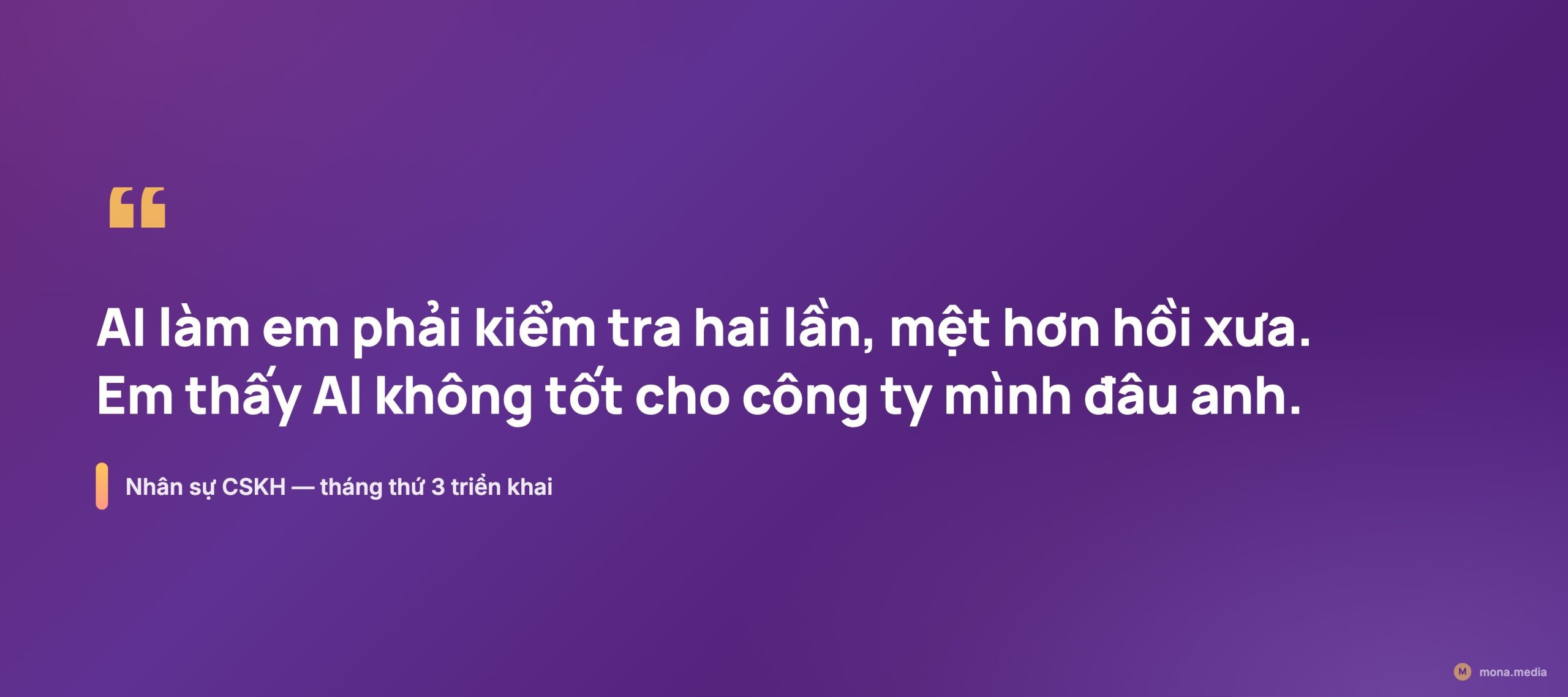
Most business owners have seen exactly this scene.
One afternoon in March, after almost three months of rolling out a new automation system. A customer service (CS) staff member complains.
“AI makes me check everything twice, it's more tiring than before. I don't think AI is good for our company, boss.”
The complaint is real, but it hides many angles. This is the kind of employee who most easily makes a CEO back off.
In the early phase of rolling out automation software, many staff feel “overwhelmed”. Everything is new. They have to learn again. Checking the system's results is necessary. But not everyone is ready to adapt.
We once observed a 35-branch retail chain in Hanoi and Ho Chi Minh City, with average revenue of 45 billion VND a month. Two months after adopting software that automates the purchasing process, a key warehouse staff member started complaining. “I'm used to entering stock by hand. Now the machine finishes and I still have to scan again. It's more work, not less.”
At first the complaint sounds reasonable. But if you don't look deeper, the whole project can stall. The employee is turning themselves into a “machine checker” instead of using the machine as an assistant.
The tiredness is real. But the root cause is not the technology itself. It comes from that employee's approach and mindset. They haven't fully accepted the change.
One main motive of this type of employee is avoiding responsibility. When a mistake happens, instead of reviewing their own steps, they easily blame AI. “The machine ran it wrong”, “The AI didn't understand me.”
This mindset is more common than you think, especially in complex processes. Finance and accounting automation software ERP developed by MONA helped a building materials group with 180 staff cut data entry errors by 80%. But when a small discrepancy occurred, one employee immediately blamed the system. In fact, the error came from a user entering the wrong warehouse code in the first step. The AI only processes the input data. It cannot fix human logic errors on its own.
Blaming AI makes staff feel safer. They don't have to face their own shortcomings. They keep their “face” in front of colleagues and bosses. If this goes on, it creates a culture of blame. Every problem is blamed on “technology”. Nobody takes the initiative to learn to use the system properly. The return on investment (ROI) of the software drops. You spend the money and still miss the goal.
AI or automation software is often an easy target for staff to vent negative feelings. Technology can't fight back. It has no feelings to hurt. It is a lifeless thing. When work pressure rises, or when staff feel stressed by personal issues, they turn to AI as a “punching bag”.
Do you remember a time when a staff member complained that the “machine is slow” even though everyone else used it normally? Or when the line “AI is so dumb, it can't do anything” spread around the room? That is often a sign. Work pressure can burn a person out.
MONA once supported an F&B chain of 22 restaurants. Our system restaurant management software streamlined table booking and ingredient inventory management. A shift manager at the District 1 branch in Ho Chi Minh City complained constantly. “This software is so troublesome. I keep seeing errors. I'd rather do it by hand, it's faster.” Clearly the system was running stably at the other branches. The problem was that this manager was struggling with managing staff. When staff have personal issues or work stress, they need a reason to let it out. AI is the perfect target. This doesn't just affect work performance. It also creates a negative atmosphere across the whole team. Other staff are easily influenced by the constant complaining. In the end, the energy of the whole department goes down.
More seriously, this type of employee may use “AI wears me out” as an excuse. An excuse to dodge new work. An excuse to skip the skills they need. They may even use it to demand the whole automation system be removed. Or worse, to ask to quit.
At a 28-branch spa chain in Ho Chi Minh City and Hanoi, a veteran front desk lead was the first to complain. “Our spa software is too complicated. I'm not used to it. Maybe I'm just not suited to this new technology.” The complaint gradually turned into a suggestion to “remove some of those AI features” and finally peaked at “I'll resign if the company still makes me use this.”
The deeper motive is fear of change. They fear losing their old comfort zone. They want everything to go back to how it was. Blaming AI is how they put pressure on you. They want you to back down. If you aren't firm, stopping the rollout halfway is entirely possible. This is covert resistance. It can wreck the company's whole digital transformation strategy.
This is a very real motive that is rarely spoken. Automation software helps standardize processes. It also measures performance objectively. When AI handles the repetitive work, a person's real ability is exposed. Those who used to rely on unclear processes to “do little and earn a lot” get found out.
For example, a marketing employee uses ChatGPT to write ad drafts in 10 minutes, instead of two hours as before. They spend the rest of the time on things unrelated to work. When the system business automation workflows integrates AI, every process is digitized. The time for each task is recorded. Then the staff member's real productivity becomes clear. They can no longer hide the seven hours of “sitting around”.
The fear of having targets raised is also a factor. When AI helps finish work faster, managers may increase the workload. Or they may ask staff to focus on more strategic tasks. This pushes staff out of their comfort zone. They fear that if AI works well, they'll be seen as surplus. This fear is a natural defensive reaction. But it makes them resist technology. They want to keep up the “illusion” of their own ability.
To spot this type of employee early, watch for these signs:
These signs don't appear on their own. They usually come together. You need to be sharp to see the pattern. Don't ignore small complaints. They can be the start of larger resistance that affects the whole project.
If not handled in time, this type of employee will cause serious consequences. At first it's just 1-2 burned out people. But that negative mood spreads fast. It pulls along 4-6 peers in the room, even the whole department. Mid-level staff trust their peers more than the CEO. They start doubting the system. The department's overall productivity drops sharply.
For you, the CEO, the consequences are bigger. You have invested hundreds of millions, even billions of VND, in automation software. For example, an education chain of 20 centers invested 1.2 billion VND in a system MONA's LMS. If complaints make you hesitate and stop the rollout halfway, all that money could be “burned” with no return. The drive for change in the company is gone completely. Starting over doesn't just cost another 4-6 months. It also requires you to rebuild trust with your staff. That costs far more than solving the problem at its root.
Stopping the project could even cost you credibility with the board. Or with investors. They will question your ability to lead and your decisiveness. One wrong decision can seriously affect the future of the business.
Solving this takes patience and the right method. We suggest three main approaches.
First, clearly separate process problems from tool problems. Sit down with that staff member. Analyze the specific errors. Is it a user's wrong action? Or is it an old process that doesn't fit the new system? In many cases, the problem isn't the AI. It's the business's own outdated operating process. MONA can send an expert enterprise AI audit to help you review it.
Second, retrain on correct use. Many staff complain because they don't truly understand how AI works. Hold deeper training sessions. Focus on the specific use cases of their department. Don't just teach general features. Show them how AI solves their exact problem. MONA EduCenter and our in-depth training programs are a solution we often deploy for clients.
Third, have someone support people through the mindset shift for the first 30-60 days as the work rhythm changes. An “internal pioneer” can be the answer. This person has both work experience and a drive to learn technology. They act as the bridge between leadership and staff. They listen to difficulties and answer questions. They also inspire and motivate. They help staff gradually adapt to the new working rhythm. A companion makes staff feel supported. They no longer feel alone facing the change.
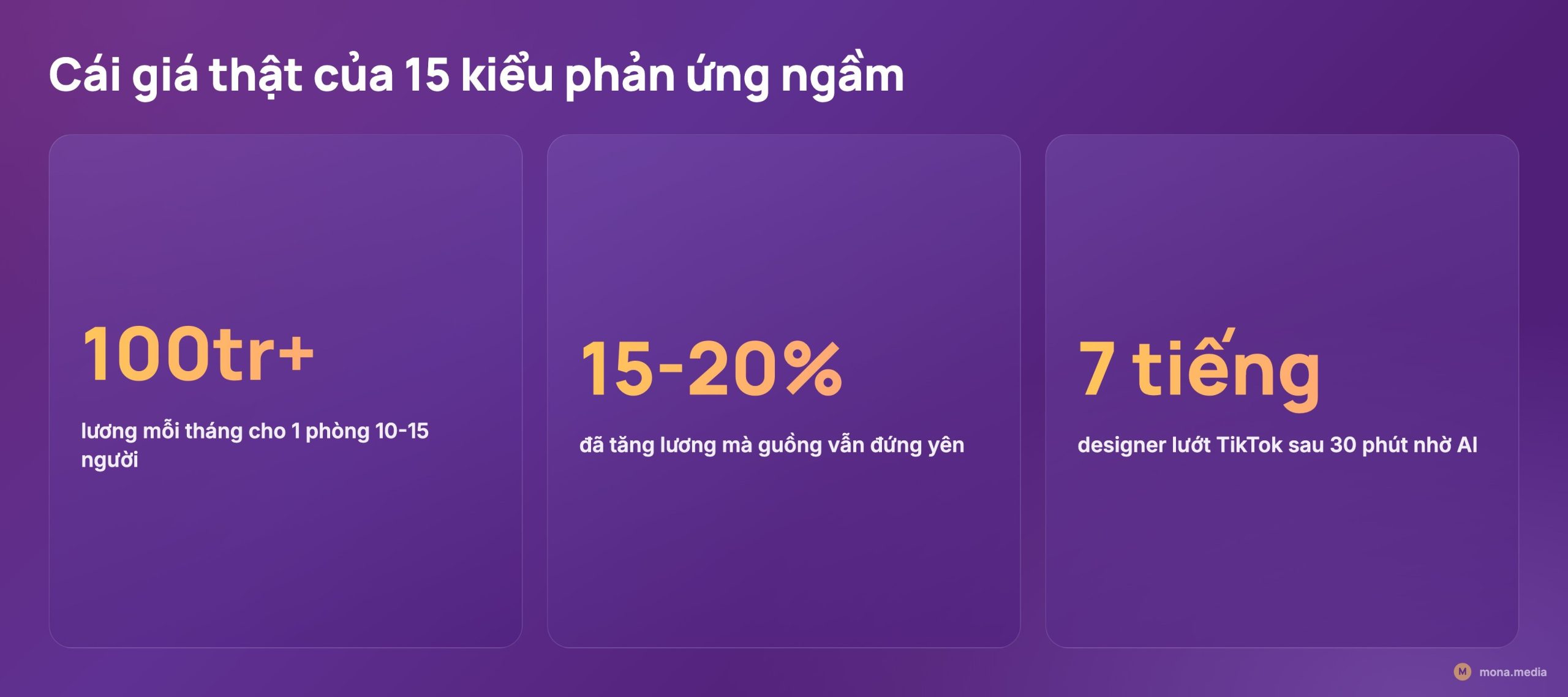
You are paying hundreds of millions of VND a month for a team of 10 to 15 people, regular hours and overtime, and it's not only money. MONA knows you have tried a great many things (15 to 20% raises, bonuses tied to targets, bringing in trainers for the new tools, weekly one-on-ones, a team-building trip, innovation slogans on every office wall, begging everyone to just go ahead and use AI, it's okay). You hoped they would treat the company like home and the transformation like their own business. But no. Most of that effort changes nothing.
A designer still finishes the banner in 30 minutes with AI and scrolls TikTok for the other 7 hours. An accountant still hides files so nobody touches them. A department head still sits on the numbers for 3 days before showing you. One person can't spot all 15 types at the same time. Out there, hundreds more posts appear every day teaching staff how to keep their seat, how to do little and gain much, how to outsmart the boss. You can't argue against that whole stream alone.
Trying to change the goodwill of the 15 people you have, or hiring a fresh, more driven batch for the future, is not the way. What you need is software that measures each person, plus a MONA person embedded next to you for the first 30 to 60 days, so who really works and who sits idle shows up in numbers, no longer depending on whether employees choose to tell the truth. Keep the few dedicated people to run with the system, instead of carrying a whole team where more than half are quietly dragging you back.
Send us a single line at info@themona.global, and we will review your team against these 15 types and point out who fits which one. The first 45 minutes, we sell nothing.
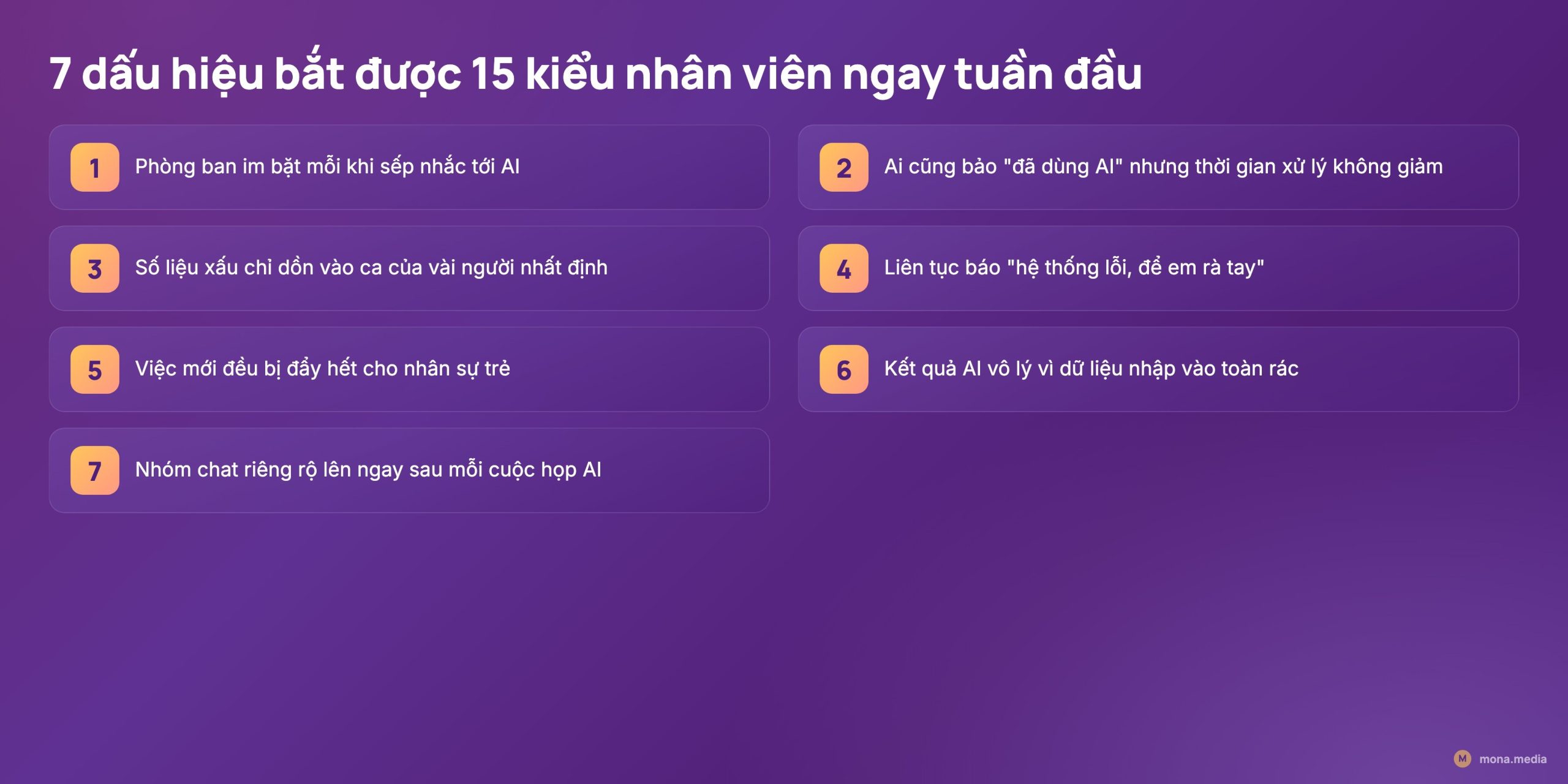
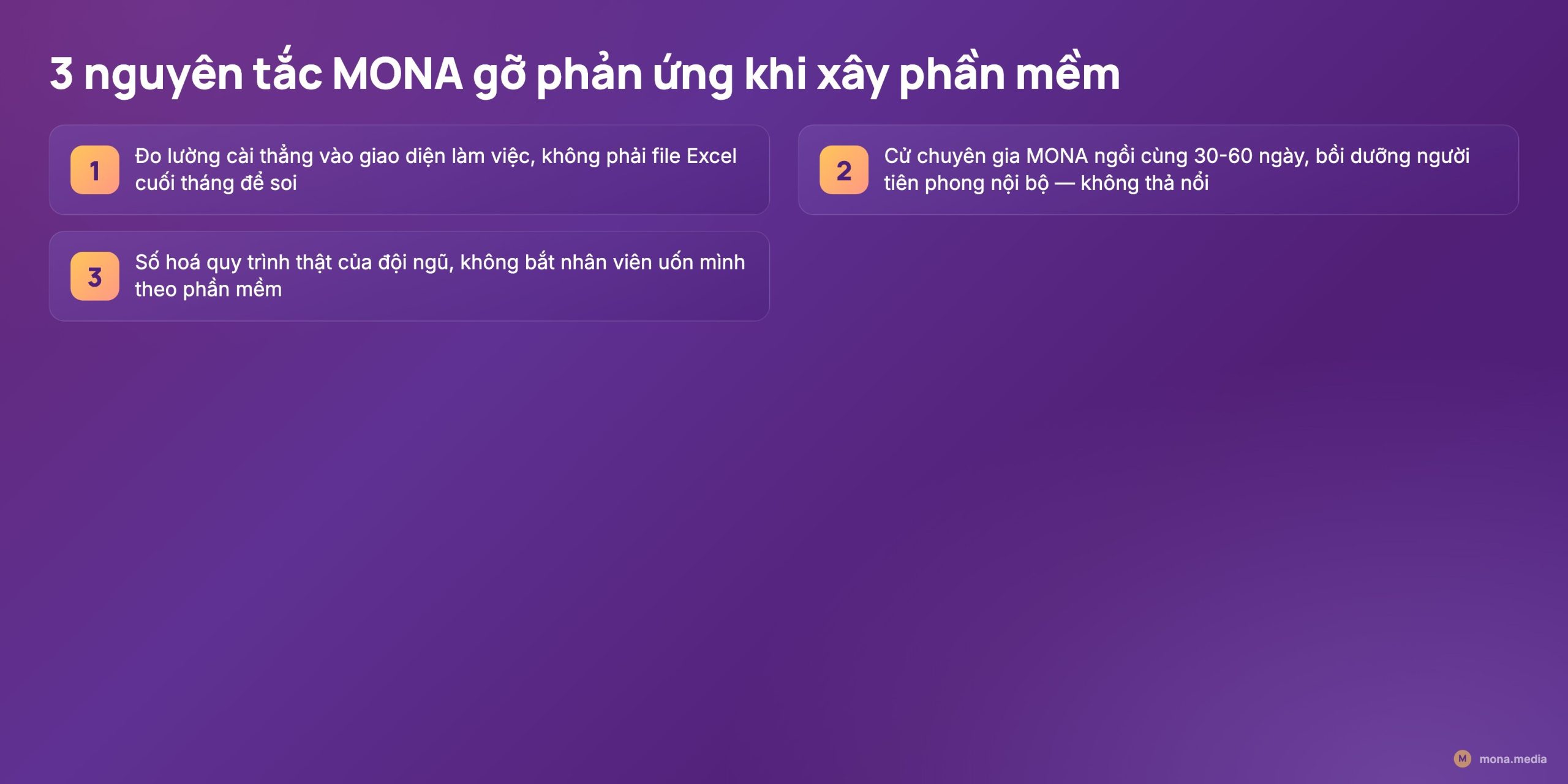
Spotting the reaction types is one thing. Defusing them without breaking up the team is another. At MONA, when we build custom automation systems for clients, we don't just hand over a block of code. We run a change process, and these are the 3 core principles that make it work.
“Nod and go along” and “perfectionist” employees survive because of vagueness. They can say “I'm working on it” all week without results, because nobody can measure what “working on it” really means. The “data sabotage” type is the same: they blame the system when the numbers are off.
We solve this by building the metrics right into each person's working screen. A customer service staff member sees on their own screen: messages answered this shift, average response time, appointments booked. These numbers are real time, and they see them before their manager does. It is not an Excel file compiled at month end to “inspect” them. It is part of the work, like a clock on the wall. When everything is transparent, good performers have data to back them up. Slow performers know for themselves where to improve. You no longer have to guess.
Mocking, waiting for others to go first, or banding together to boycott usually come from fear and unfamiliarity. New software feels like an “invader” in their daily work habits. If you only announce it and order people to use it, resistance is certain.
That is why we never hand over the software and walk away. A MONA deployment specialist will be in your office for the first 30 to 60 days. They sit and work with your 5-7 core staff. They find the youngest, fastest learner on the team and groom that person into an internal champion. Every question and snag gets answered on the spot. This presence turns MONA from a “vendor” into a “colleague”. This is part of the the AI First handbook for businesses that we use. You don't have to convince everyone on your own.
Some people hide Excel files, some call themselves “craftsmen”. Same psychological root. They feel the new tool is forcing them into pointless work that is less efficient than the old way. They resist not because they are stubborn, but because the software doesn't really understand their work.
MONA's principle is that software must follow the business process, not the other way around. Before writing a single line of code, we spend weeks watching how your team actually works. How a spa staff member advises a customer, how a restaurant manager builds the shift schedule, how the warehouse checks goods… all of it is digitized in the most natural way. Staff will see a familiar process on the software, just more automated and more accurate. They won't fight something that makes their work lighter. That is the core philosophy behind the solutions above MONA Software: technology serves people, not people serving technology.
You don't face these 15 types of reactions alone.
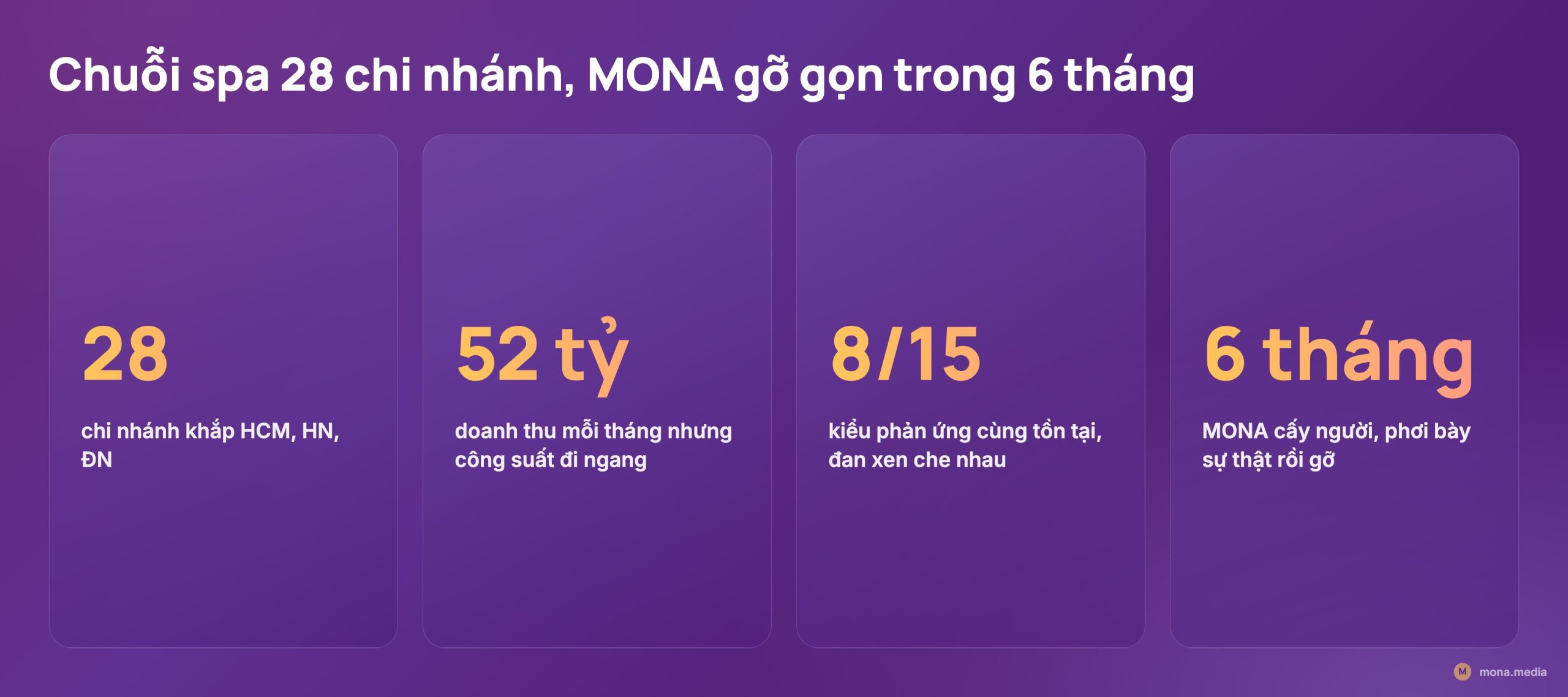
The theory is easy to picture, but in a real business these types of employees don't exist in isolation. You will see them combine and cover for each other, creating a fog inside operations that the CEO can't see through. We watched this at a large spa chain with 28 branches across HCMC, Hanoi and Da Nang, with revenue of around 52 billion VND per month.
They came to MONA not because of one specific incident. They came because of a vague feeling that the machine was slowing down. Even with 38 customer care staff, 30 receptionists and 12 marketers, the closing rate and renewal rate stayed flat. Money kept flowing in, but capacity didn't grow.
Our first step is not installing software. We embed people to watch the real process. In just four weeks, 8 of the 15 resistance types showed up clearly. The customer care team used “security” as an excuse to hide lead files on personal computers. The three most senior designers insisted on sticking with Photoshop CS6 and refused every new tool, saying “a craftsman has to work by hand for the work to have soul”.
Three customer care staff with 10 years of tenure kept saying “the old way is still fine”. The marketing head blocked all ad performance data and only reported vague totals. Five staff in other departments just “nodded along” in every meeting. A group of four quietly “banded together to boycott” even the smallest change. Strangest of all, two young designers secretly used Canva AI to finish work in 30 minutes, yet they were the loudest public opponents of the rollout.
Once we had a map of the people, we turned on real-time measurement. Every interaction with a customer, from receiving the message to booking the appointment, was recorded. The numbers exposed the truth. The manual processes of the “craftsmen” and “seniority” groups took 5-7 times longer. The hidden customer files caused hundreds of missed opportunities every month.
We didn't confront anyone head-on. We identified a group of 12 progressive staff who were ready to try something new. MONA built a small automated workflow just for this group. Their results were published openly every week. When the others saw the pioneer group handle three times the workload with less effort, the resistance started to wobble.
Once most staff had seen the benefits, it was the right time for MONA to roll out in full. A spa and salon management software tailored for the chain was installed, automating everything from receiving multichannel messages, sorting customers and booking appointments to follow-up care after treatments.
The system also detects bottlenecks automatically. When three customer care staff fell into “blaming others when overloaded” in month three, the data showed they had skipped steps in the new process. The problem was solved with retraining, not with emotional arguments.
After six months, the results were clear. The time to handle one customer request dropped 78%. The chain kept 12 senior customer care staff who truly had the skills, and let those who weren't a fit leave on their own. Monthly operating costs fell by 180 to 220 million VND. Most important, the rate of closing customers from messages rose from 23% to 41%, because no message was missed or answered late.
Readers who get this far usually split into two groups. Group one is very used to staff who nod and then ignore, has bought software that gathered dust, tried a rollout once and failed, and now accepts “that's just how my staff are”, treating a whole department quietly resisting change as a matter of fate. Group two are owners who, whether they have one branch or thirty, keep listening for new technology, still believe there is a way to handle those 15 types of employees, and once they find it, roll it out decisively and are willing to play the tough boss for the first few months so the whole chain gets through.
MONA (we are business people like you, with departments and staff, and we have also had headaches over these 15 types) is in group two. And we are confident we can bring the way out for group-two owners, which is just one 45-minute call away. It's free. A MONA person can review your situation no matter where you stand (one branch or fifty, a team full of young people or people who have been there for ten years, a team that is clueless about tech or already fluent, whether you are good at management or new to it), and we have an approach for every case.
Because this is already our tenth year bringing automation software to business owners in Vietnam, across more than 30 mid-market chains with all 15 of these employee types. Send a line to info@themona.global to book a review session.

Although these 15 employee types can show up anywhere, MONA's experience shows each industry has its own typical “combination” of resistance. You can use this to predict which groups will speak up first when an AI project starts. It helps you prepare talking points instead of reacting on the back foot.
Nearly 70% of the reactions we observed in F&B fall into the craftsman, seniority and secret AI user and secret AI user. Head chefs are often the “craftsmen”, believing that family recipes and a feel for seasoning are things AI can't copy. Long-serving branch managers “lean on seniority”, arguing that their experience in staffing and crisis handling can't be replaced. Meanwhile, young office staff quietly use AI to write promotional content or reports, just to finish early and get more free time.
In retail chains, about 65% of cases are a mix of hiding files, nodding along and waiting for others to go first. Heads of purchasing tend to “hide files”, the Excel sheets holding supplier data, because they fear an AI system will analyze and optimize them, costing them relationships or personal benefits. Store managers often “nod along” to every tech directive from headquarters, then go back to the store and tell staff to keep working the old way. Most other staff take a “wait for others to go first” attitude, wanting to see whether the pilot stores run into problems before they reluctantly follow.
Education has a slightly different resistance pattern, with about 60% being the mockers and perfectionists and seniority. Many experienced teachers will “mock” the idea of using AI to prepare lesson plans or grade automatically, because they believe a cold machine can't convey knowledge with “soul”. Subject leads easily fall into the “perfectionist” trap, demanding that an AI tool be 100% accurate and handle every teaching situation before they will adopt it. Finally, older center directors “lean on seniority”, insisting that their experience dealing with parents can't be automated.
The tech industry is the most distinctive, where we recorded as many as 75% of reactions falling into the Vim/Notepad craftsman and holding it back as a bargaining chip and secret AI user. Some veteran developers see themselves as “craftsmen”, used only to minimalist tools like Vim or Notepad, and they look down on AI coding assistants. Mid-level staff know how to use AI to boost productivity but “hold it back as a bargaining chip”, not sharing it with colleagues so they have it in reserve when they need to make an impression. Almost every junior developer is a “secret AI user” who fixes bugs or writes simple code with it, but never reports it for fear of having their KPI targets raised.
Overall, although each industry has its own flavor, you will see four reaction types that are the most common and cut across every field. They are hiding files, the craftsman, nodding along, and secret AI user. These are the four core groups that any rollout plan needs to have an answer for in advance.
You need to watch behavior closely. Watch attitudes in meetings about automation. Read the daily and weekly reports. Note the feedback you get, whether direct or indirect. Senior staff often have a clearer view. We also have an initial assessment tool.
Based on our work with businesses, about 80% of staff will have at least one type of reaction. It's a natural psychological reaction. Everyone worries when a big change comes. What matters is that you spot it early.
It's very hard, but not impossible. It depends on personal motivation. People who want to learn still have a chance. People who are stubborn and set in their ways are very hard to change. You need a clear training and adaptation path.
The type that poisons the data with junk is dangerous. It throws the automation system off. The department head who blocks data is also worrying. It obstructs the entire process. Last is the group that bands together to boycott. This is the most open form of resistance. It causes big losses in money and time.
Growing pioneers from inside is always better. They understand the company culture and processes. They also have credibility with their colleagues. People hired from outside are easily isolated. MONA always supports training your internal staff and turning them into AI experts.
It works very strongly. It sends a clear signal. It shows the leadership's determination. However, it is only one part of the solution. You need a strategy to go with it. It is usually the last resort.
Monitoring work chat groups is legal, especially when there is a clear policy from the start. You need to be transparent about this policy. The company chat group is company property. However, you must be careful in how you use the information.
Yes, younger staff are usually quicker. They grew up with technology. Adapting to AI is much easier for them. However, older staff have industry experience. They understand business processes deeply. Both groups have their own value.
You should slim down the department head layer. It is usually the biggest blocker. AI can replace a lot of purely managerial work. Department heads need to focus on strategy, or be retrained for new roles. This helps the company run more efficiently.
It usually takes about 4-6 months if you do it right. Staff gradually get used to the new system. They will see the benefits of AI. Decisive leadership matters a lot. Everyone will accept it and adapt.
You now have the list of 15 employee types and 7 warning signs. This week, print the table out. Stick it up in your own office. Then make a list of 5-10 staff you want to watch closely. Write their names and mark which type each one seems to be. You don't need to decide anything yet. Just name it clearly.
If you want to start right away, we invite you to a 45-minute review session. Send your request to info@themona.global. MONA will send an expert to analyze your chain. This person will help you identify the types of employees you have. After 45 minutes, you will have a list of staff to keep an eye on. In the first session, we commit to no selling.
Will you burn another 6 months lost and fumbling on your own? Let the 15 types of employees quietly drag the whole chain back? Or spend 45 minutes on a call this week to stop being lost and understand staff reactions to an AI rollout? You can also read more the AI First handbook for businesses from us. Are you willing to play the tough boss for the first 3-6 months so the whole chain gets through these 15 types?

CEO & Founder · The MONA
The founder of The MONA built a service company of 60+ staff with 14,000+ projects delivered. Khánh Hùng shares his thinking on building self-running systems, automating a business, and the real lessons behind MONA's projects.
 293




Professional website
design services
Own a website with a beautiful, 100% exclusive design and a lifetime warranty, with the ability
to expand features flexibly as your business grows, starting today!






 MONA will never sell your information or send you spam


 MONA will never sell your information or send you spam
