
 MONA OS 2.0
 Partner with MONA


 Tự động hoá doanh nghiệp
 Cẩm nang SEO
 Digital Marketing
 Kinh nghiệm thiết kế website
 Hạ Tầng Server
 Giáo dục


 VI
 EN













Message us on
Zalo Official


 ProductsNew

 ProductsProducts
 Mới ra mắtKHA AI 2027App tự edit video, tự đăng mọi mạng xã hội, 2 phút mỗi ngày










 Website designLooks good and wins customers over.
SEO servicesBrings in customers searching for exactly what you sell.
 Tư vấn digital marketingKéo khách từ nhiều kênh, đo bằng số thật.
Corporate video productionVideos introducing your company, factory and team.
 NewAI video productionCompany story films made with AI.
 Custom software developmentCRM, ERP and HRM built for your business.
 Viết AI Agent theo yêu cầuĐặt riêng một trợ lý AI cho đúng việc của mình.
 Tư vấn chuyển đổi AIĐưa AI vào vận hành của cả công ty.
NewMONA LMSManagement for centers and schools.
MONA SkillHubInternal training for company staff.
 NHTQ systemEnd-to-end China–Vietnam shipping operations.
MONA JMSManagement for gold, diamond and pawn shops.
 MONA E-LearningA website with every feature you need to sell courses.
 How to sell online courses (course)More than 30 free lessons on selling courses on autopilot.
 MONA Cloudmonacloud.vnServers to get your apps and websites running.
 MONA Basemonabase.vnPostgres database, sign-in and file storage.
 MONA Mailmonamail.vnSend OTP, order and invoice emails from your software.
 MONA Paymonapay.vnAccept bank transfers via VietQR and notify your software when the money arrives.
 MONA eInvoiceComing soonIssue e-invoices that meet tax standards.
Gấu CườiTrả lời khách 24/7 trên web, Fanpage, Zalo và thu lead cho sale.
 Gấu TeleSalesGọi điện tư vấn, chăm khách như tổng đài viên thật.
Dê CườiTư vấn và chốt đơn cho shop ngay trong khung chat.
Gấu WebmasterNhắn nhóm Zalo là website được sửa xong.
 Gấu Pháp ChếSoạn hợp đồng, rà điều khoản trong vài phút.
 Gấu Báo GiáLên báo giá đúng mẫu và gửi khách ngay.
 AI chăm sóc khách hàngTheo dõi và giữ chân khách hàng cũ.
 Gấu Tuyển DụngLọc hồ sơ, hẹn lịch, phỏng vấn ứng viên.
 Mới ra mắt
KHA AI 2027
Xây kênh chuyên gia 2 phút mỗi ngày
Quay bằng điện thoại, AI tự edit video, tự đăng lên 16 nền tảng và tự trả lời bình luận, tin nhắn.
853.366lượt xem trên kênh CEO MONA sau 29 ngày
 Anh Khánh HùngCEO MONA đang dùng mỗi ngày
Xem app làm được gì
 AI
Gấu Cười MONA ĐANG TỰ XÀITrả lời khách 24/7 trên website, Zalo OA, Messenger và thu lead về cho sale.
Dê CườiChốt đơn bán lẻ và sàn: Shopee, TikTok Shop, web. Chăm cả khách sỉ, đại lý.
Gấu WebmasterCập nhật nội dung, tối ưu SEO website mỗi ngày.
Gấu TeleSalesGọi điện tư vấn, chăm khách như tổng đài viên thật.
Gấu Tuyển DụngLọc hồ sơ, hẹn lịch, phỏng vấn ứng viên tự động.
AI chăm sóc khách hàngGiữ khách cũ, cứu lead đã rớt cho phòng kinh doanh.
Gấu Pháp ChếSoạn hợp đồng, rà điều khoản trong vài phút.
Gấu Báo GiáLên báo giá đúng mẫu, gửi khách ngay khi có yêu cầu.
 Chuyển đổi AI toàn phầnGiải pháp tổng cho doanh nghiệp, 3 lớp triển khai.
 Viết AI Agent theo yêu cầuĐặt riêng một con AI gánh đúng nghiệp vụ của bạn.
 Custom softwareCRM, ERP and HRM with built-in AI automation.
 SEO & AEO thời đại AIĐược Google lẫn AI trích dẫn, không chỉ xếp hạng.
 Kiến thức AI cho doanh nghiệpBài phân tích, hướng dẫn ứng dụng AI vào vận hành.
 Free AI courses
 AI tools at work
App mới · KHA AI 2027
Xây kênh 2 phút mỗi ngày
AI tự edit video, tự đăng mọi mạng xã hội
Free consultation, 8am–10pm every day

18 March, 2023
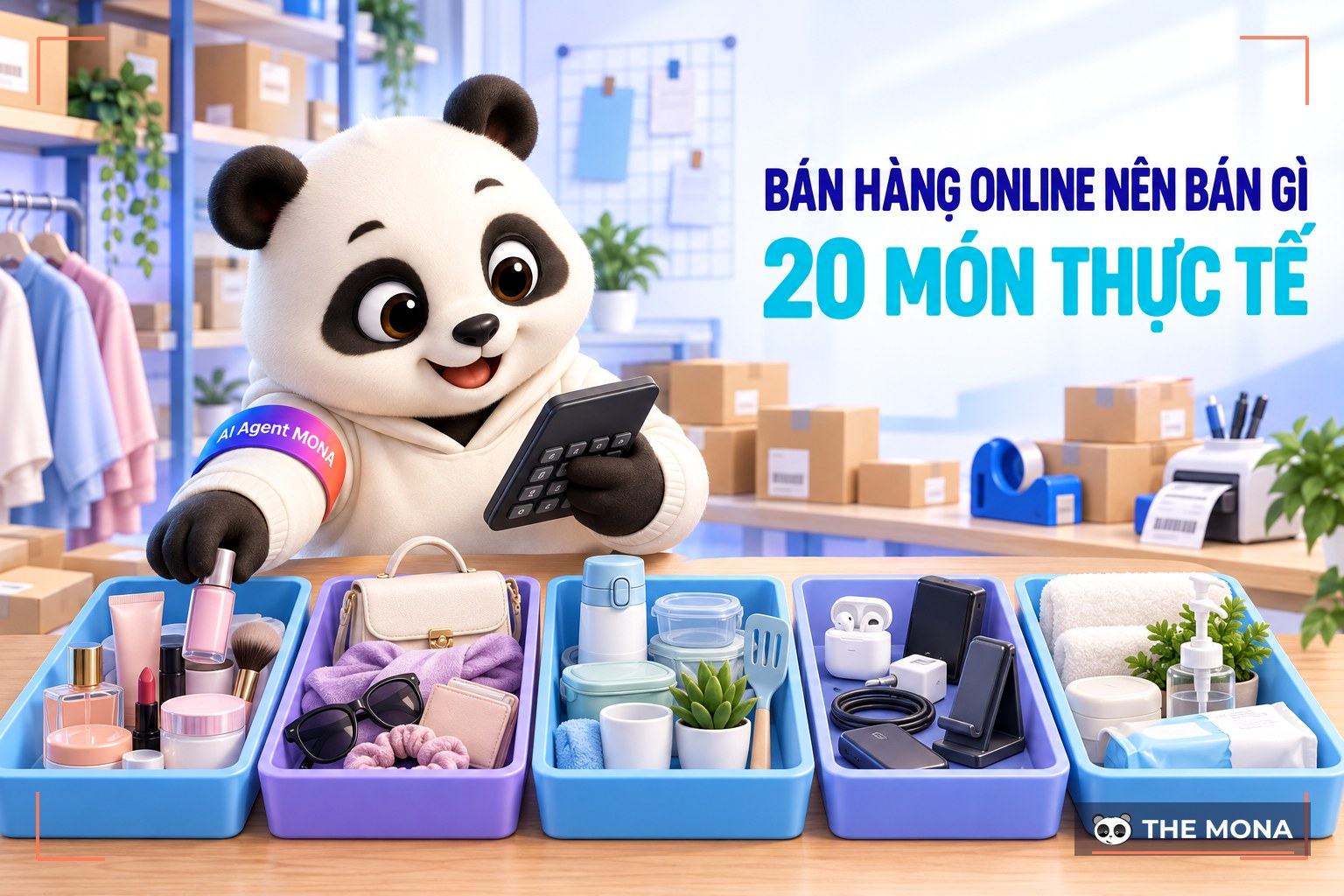
What should you sell online in 2026? Choose a product that solves a small problem people have again and again, can be sourced in small batches, has enough margin to cover marketplace fees and returns, and is easy to prove on video. Use a budget under 5 million VND to test 20 to 50 orders, not to stock a warehouse on a hunch.
This article gives 20 ideas in four groups: low capital, low overlap with other sellers, products riding the AI and e-commerce infrastructure wave, and local specialties taken to marketplaces. Every margin here is an estimated gross margin as of 07/08/2026, calculated as selling price minus cost of goods, before ads, marketplace fees, shipping, returns and your own labor. Keep that in mind.

A product with lots of views does not necessarily make a profit. Mass-market clothing looks like big demand, but size, color, returns and ads eat the margin. An unusual product with few sellers does not necessarily have buyers either. The second round of scoring only starts after 20 orders of testing.
We use five filters to cut quickly:
Score each filter from 1 to 5. A product scoring under 16 out of 25 gets dropped, 16 to 20 goes to testing, and above 20 is worth ordering in bulk. The score does not replace real customers; it only helps you avoid ordering wrong.
Decide with numbers. Limit each scoring round to 30 minutes, then spend the time buying samples and talking to people who have used something similar. A nice score sheet cannot save a supply source with no invoices or a product whose video still does not show what it does.
One example: a balcony plant-care kit scores 4 for demand, 5 for video, 4 for margin, 4 for sourcing and 4 for operations, for a total of 21/25. A lipstick with no origin could score 5 on video but 1 on sourcing and 1 on risk, so the total does not pass. Drop it right away.
The margins below are a budgeting range, not a profit promise. Before ordering, get at least 3 quotes in the same specification, and buy samples from 2 sources and run 20 test orders. Marketplace fees change by category, program and time, so read the updated Shopee fee schedule on the day you start selling.
Note the date you checked. Each quote must separate the factory price, the cost of delivering goods to your warehouse, the minimum order and the defective-exchange rate, because a cheap number that misses the last three will throw off your budgeted margin from the first batch. Set a test ceiling of 5,000,000 VND for samples, packaging and returns.
| Group | Product | Estimated gross margin | Main risk |
|---|---|---|---|
| Under 5 million VND capital | Consumable pet supplies | 25–45% | Thin product, shipping eats the margin |
| Under 5 million VND capital | Packaging kit for small shops | 30–50% | Easy to compare on price |
| Under 5 million VND capital | Balcony plant-care kit | 30–50% | Uneven material quality |
| Under 5 million VND capital | Operations template files for household businesses | 80–95% | Copying and wrong content |
| Under 5 million VND capital | Personalized desk accessories | 35–55% | Spelling mistakes, late delivery |
| Low overlap with other sellers | Engraved gifts by profession | 35–60% | Hard to return |
| Low overlap with other sellers | Craft village experience kit | 30–50% | Multi-item packaging |
| Low overlap with other sellers | Hard-to-find replacement parts | 25–45% | Wrong size, wrong model year |
| Low overlap with other sellers | Organizers sized for Vietnamese homes | 30–50% | Bulky |
| Low overlap with other sellers | Supply kits for niche hobbies | 30–55% | Small demand, needs deep content |
| AI and e-commerce trends | AI product photo pack with templates | 70–90% | Image rights and wrong expectations |
| AI and e-commerce trends | Livestream accessory kits by industry | 20–40% | Electronics with warranty |
| AI and e-commerce trends | Thermal labels and order-packing supplies | 20–40% | Price competition |
| AI and e-commerce trends | Personalized QR and NFC boards | 40–65% | Dead links, misprints |
| AI and e-commerce trends | Phone video kit for product shots | 25–45% | Combos that are not compatible |
| Local products | Regional spices and sauces | 20–40% | Food safety, shelf life |
| Local products | Herbal tea with a known growing area | 25–45% | Moisture, paperwork, declarations |
| Local products | Woven household goods | 30–55% | Bulky, easily dented |
| Local products | Local dried-food gift boxes | 20–35% | Shelf lives differ between items |
| Local products | Recycled fabric accessories | 35–60% | Uneven color and size |
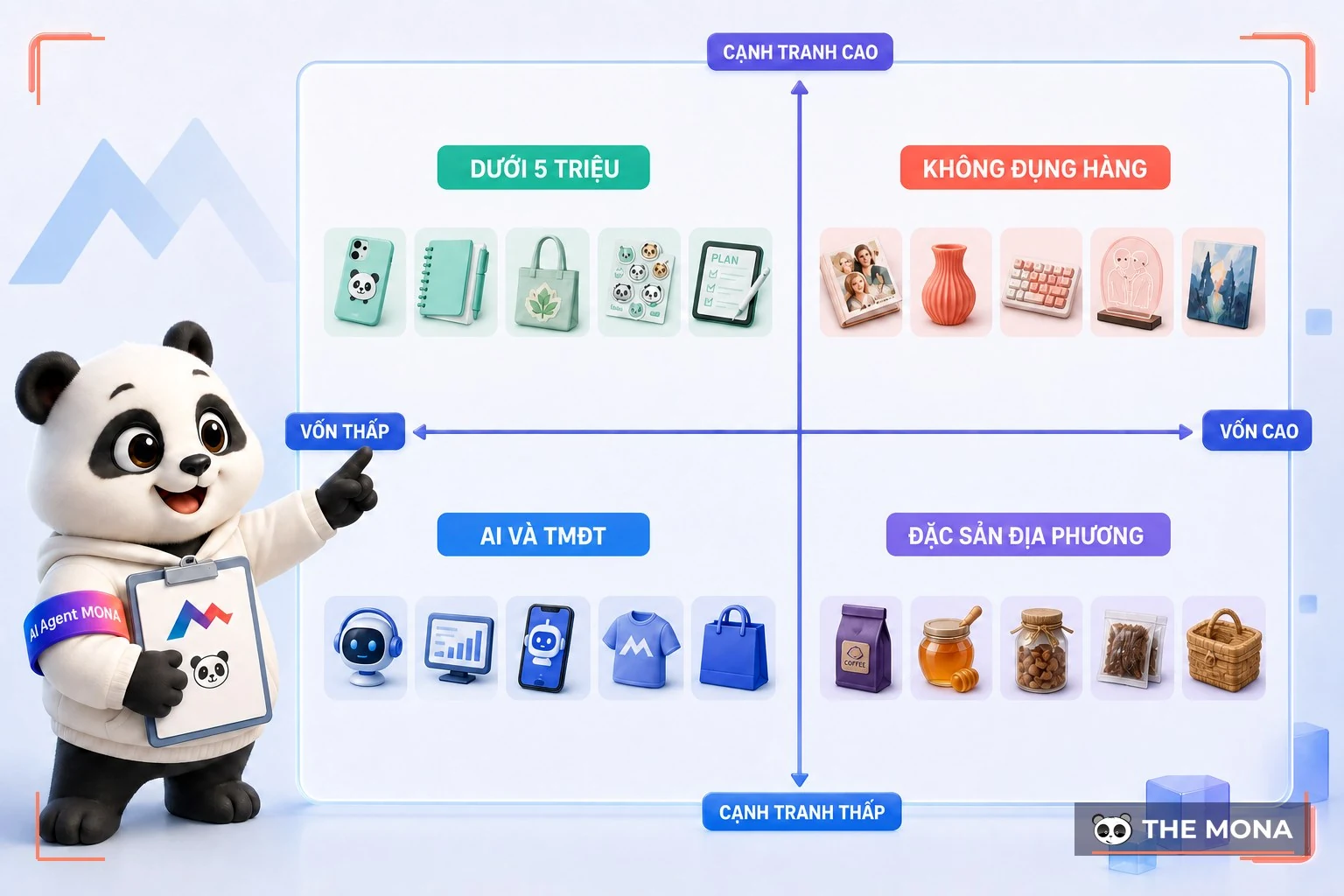
This group favors small purchase batches, products that are easy to film, and no need to rent a warehouse. The goal is to learn first after 20 orders, not to make big money in the first month. If a supplier forces a 500-piece minimum, skip it. A small batch buys you data.
Waste bags, paw wipes, lint rollers, bowl mats and small hygiene items have repeat demand. Source from pet distributors, plastic workshops or packaging suppliers that offer samples and invoices; start with 20 to 50 sets in combos. Estimated gross margin is 25–45% when sold as sets instead of single cheap items. Only repeat orders are worth it.
The risk is that shipping takes a large share and customers compare prices fast. Do not sell a single roll of bags; bundle a 30-day set for small dogs, large dogs or cats. The content must show the thickness, odor sealing and real size.
Your customers are new online sellers who need tape, thank-you stickers, instruction cards, shockproof bags and sorting labels in one style. Source from low-volume print shops and packaging suppliers, then sell in sets of 30, 50 or 100 orders. Gross margin is 30–50% if you design the templates yourself and match them to real needs.
This product is easy to price-compare when you only sell plain bags or tape. The value is in a set matched on size, color and wording for a specific field such as bakery, handmade cosmetics, accessories or books. The big risks are misprints and leftover samples that go out of fashion. Only a set built for a specific field has a chance.
One set includes small scissors, ties, plant labels, a fine-spout watering can, gloves and a guide by plant type, solving the problem of beginners not knowing what to buy piece by piece. Source from agricultural supply stores, plastic workshops and local nurseries; buy samples to check smell, durability and sharp edges. Gross margin is usually 30–50%. The workshop must record batch codes.
Before-and-after content is easy to film and easy to understand. The risks are uneven material quality between batches and wrong guidance. Start with one niche such as balcony vegetables, succulents or indoor plants, and do not put every kind of plant in the same box.
Files for tracking orders, stock, content calendars, quotes, opening checklists or a simple cash book cost almost nothing to copy. The source is your own know-how, reviewed by an accountant or expert, then sold through a website with a video guide. Gross margin before ads is about 80–95%.
This product is easy to copy. The value must lie in the guide, updates and Vietnam-specific examples, not just an empty Excel file. Never sell legal or tax templates that a qualified person has not reviewed, because one wrong cell sends customers off the rails for a month. One wrong cell is enough to ruin the work.
Cable clips, name plates, bookmarks, pen boxes, study schedule cards and mouse pads printed with names suit back-to-school season or group gifts. Source from laser, UV print and small sewing workshops that accept batches of 10 to 30 items. Gross margin is 35–55% when the design is made for a specific class, subject or profession. Small batches are good for learning.
The risks are misspelled names, color shifts in printing, and personalized orders that cannot be returned. The order form needs a step where the customer approves the name and sample before production. Set clear timing, and do not promise 24-hour delivery if the workshop needs three days.
"Not overlapping" does not mean inventing something nobody knows. The easier way is to take a familiar product and pair it with a profession, size, region or interest narrow enough that mass sellers do not serve it well. The niche is small but the message lands harder. Customers recognize themselves right away.
Luggage tags for flight attendants, desk name plates for teachers, pen boxes for architects or key rings with project codes are familiar gifts made for a trade. Source from laser, wood, leather or acrylic workshops; start with 5 to 10 designs for professions you understand. Gross margin is 35–60% thanks to the design and personalization.
The risks are using the wrong professional symbol, engraving the wrong name, and being unable to resell defective items. Every order needs an approved proof. Avoid printing organization logos or copyrighted characters without permission. Keep the approved proof on file.
A small box with materials, tools, a story and a video guide for making pottery, weaving, print art or folk dyes creates an experience instead of just selling a souvenir. Work directly with craft households, cooperatives or local workshops, and pay for their labor clearly. Gross margin is 30–50% depending on the packing labor. The craftspeople must get their share.
The hardest parts are making the guide easy enough and packing materials so they do not spill or break. A test kit should be finished by 5 people who have never done it before in 30 to 60 minutes. If all five have to call for help, do not sell it yet.
Bottle caps, coffee machine gaskets, fridge trays, adapters, stove knobs or stands for a specific model have clear demand because the customer is missing one small part. Source from parts distributors, 3D print shops using suitable materials, or dismantled-device stock; the model and dimensions must be recorded. Gross margin is 25–45%.
The risks are wrong model year, electrical parts, or materials that cannot take heat. Photograph a ruler, the model code and where it fits. Do not sell parts that affect safety without checking standards. One wrong code means one returned order.
Narrow shelves beside the fridge, drawer dividers, under-bed storage boxes and baskets for small bathrooms sell when the dimensions are stated very clearly. Source from plastic, rattan, metal or wood workshops that accept low volumes; survey 20 apartments before settling on sizes. Gross margin is 30–50%. The ruler must be in the photo.
Bulky goods raise shipping fees and dent easily at the edges. Do not film a video that is only pretty; show the ruler, the load capacity and the installation in a real space. Being one centimeter off is enough for a customer to return it.
Mini terrariums, stamp carving, crochet, bookbinding, model painting or doll restoration all need small supplies that beginners find hard to buy in full. Source from tool distributors, craft workshops and hobby communities; ask long-time hobbyists to check the list. Gross margin is 30–55%.
Demand is not large, but customers come back when they run out of supplies. The content must be deep enough on the craft and must not copy a list from the internet. The risk is chemicals, knives, glue or sharp objects that need warnings and proper packaging. Warnings must be readable.
AI does not turn a weak product into a bestseller. The opportunity is in the group that serves people already selling online: they need photos, video, order packing, QR codes, labels and kits for making content. Selling "shovels" to the gold diggers is sometimes more durable than chasing a hot product. The tool must solve a real job. Shops pay for results.
You take the shop's original photos, clean the background, build scenes with AI, and hand over the photo set together with a template so they can change prices themselves. The input is design skill, licensed tools and a set of standards you build yourself. Gross margin is 70–90% before tool fees and editing time. The original photo remains the reference.
The risk is that AI gets the product, logo, material or color wrong. Keep the original photos, mark the edited ones, and have the customer approve them. Do not use faces or brand assets that you have not been given rights to.
Instead of selling lights and mics separately, bundle kits for nail salons, clothing shops, food sellers or teachers: tripod, clamp, light, mic, cables and a diagram for where to place them. Source from electronics distributors with warranty, bag-sewing workshops and standard components. Gross margin is 20–40%.
Mass-market electronics face heavy price competition. The advantage is in a combo that fits the setting, a 10-minute setup video, and after-sales support. Check ports, power, compatible phones and the exchange policy. The warranty must be written on the order.
100×150 mm labels, barcode label rolls, ribbons, moisture-proof paper and label peelers are consumables for shops. Source from label manufacturers, printer distributors and paper workshops; take samples on the most common printer models. Gross margin is 20–40%. Keep the print samples.
This product gets price-compared very fast. Sell on compatibility, adhesion, the real label count and a 30-day pack. A wrong core size or adhesive layer makes customers return the whole box.
Small cafes, homestays, salons and service providers need boards for menus, reviews, payments or contact profiles. Source from acrylic and wood workshops, UV printing and NFC chip suppliers; the link should go through a page the customer controls. Gross margin is 40–65%.
The risks are misprinted QR codes, dead links, or NFC that some devices cannot read. Scan-test every board with at least 3 phones, include a backup QR and instructions for changing the link. Do not keep the customer's link under the seller's personal account. The link belongs to the customer.
A folding backdrop, reflector, phone clamp, small turntable and angle cards help shops make their own clips. Source from acrylic workshops, photo accessory distributors and backdrop sewing shops; bundle by product type such as small items, cosmetics, food or fashion. Gross margin is 25–45%. Film with the sample kit yourself first.
The risks are a generic combo and poor reflective material. Film with the same kit under ordinary room light to prove it. If it only looks good in a studio, customers will be disappointed when they buy it.
No product guarantees you will not be stuck with stock. Local goods have a chance because of the story of origin, the flavor and craftsmanship that are hard to copy, but paperwork, packaging and shelf life must be handled seriously. Test-sell within a short radius first. A short delivery distance exposes problems early.
Dipping salt, marinades, fish sauce, dry spices and cooking powders for local dishes have repeat demand when the taste is right. Source from facilities with paperwork, production date, expiry date, ingredients and compliant packaging; do not buy unlabeled repackaged goods. Gross margin is 20–40%.
The risks are bottle leaks, color change, taste differences between batches and food safety rules. Test shipping on 3 routes, keep reference samples to watch expiry, and record the batch code. The content tells the origin story but must also explain how to use the product. The batch code must be traceable.
Tea from leaves, flowers, fruit peel or blends sells when the growing area, drying method and brewing guide are clear. Source from cooperatives, growing households or processing facilities with testing and packaging; take samples through both the humid and dry seasons. Gross margin is 25–45%. Each season needs a reference sample.
Moisture and odd smells can ruin the value of a whole batch. Avoid health-cure claims. State the ingredients, weight, packing date and storage method; focus the content on flavor and drinking habits.
Trays, baskets, towel boxes, pot stands and lamp shades made of rattan, bamboo and sedge stand out through craftsmanship. Source directly from craft villages or groups of artisans, agreeing on dimensions and acceptable tolerance. Gross margin is 30–55% if sold as sets with the maker's story.
These goods dent, get moldy and take up space easily. Test-pack 10 shipments, weigh the volume as well, and photograph the handmade differences clearly so customers understand that no two pieces are exactly alike. Very large items should be sold nearby or by pre-order. A nice box is not enough to protect the goods.
Combining 3 to 5 dried items from one region into a gift box raises order value and gives people a reason to buy at holidays. Source from facilities with paperwork for each item; choose long shelf lives and state the nearest expiry date for the whole box. Gross margin is 20–35% after the box, filler paper and packing labor. Shelf life decides the selling calendar.
The risk is that one spoiled item affects the whole box. Do not stock holiday boxes too early; open pre-orders, fix the quantity, then pack close to the delivery date. Check temperature and smell when the items sit together.
Small bags, laptop sleeves, wallets, camera straps and covers made from leftover fabric or old clothes have a clear material story. Source from small sewing workshops, leftover fabric stock and recycling groups; sort materials before cutting. Gross margin is 35–60% because each batch is small and the designs are unique.
Uneven color, thickness and size are the risks. Code each real sample instead of using one photo to represent every piece. Test-wash, measure shrinkage, and state the traces of old material clearly so customers do not mistake them for defects. Each photo is tied to exactly one code.
Women's clothing from the same Guangzhou catalogs, generic phone cases, cosmetics with no sourcing advantage, household goods riding viral videos and cheap accessories all have demand. The problem is that thousands of shops use the same photos, prices and sources. A newcomer has to buy ads just to step into a price war.
We are not saying never sell these five groups. Only enter when you have a narrow angle: clothing for a specific body type, cosmetics with an official distributor, custom-designed cases, household goods with warranty, or accessories bundled by profession. With no narrow angle, skip it. If you still want to try, limit the first batch to 10 orders.
Dropshipping from a shared catalog is already hard. Customers see the same photos across many shops, delivery takes long, and the seller cannot check quality. Test-selling without holding stock can still help, but you must buy samples, film them yourself and take responsibility for returns.
One easy sign of saturation is when the top 20 results all use the same photo. The second sign is a gross margin below 25% before ads. The third sign is customers who only ask "how much can you take off." When all three show up together, look for another niche.
Take 5 buying keywords and record the first 20 results for each, the number of shops using duplicate photos, and the price range where listings cluster. We treat this as a screening test, not full market research, but it is enough to show when a newcomer is about to jump into a catalog everyone already sells identically. Check by hand first.
Gross margin is not net profit. A product sold for 250,000 VND with a cost of 120,000 VND looks like a 130,000 VND gain. Only after subtracting marketplace fees, vouchers the shop pays for, packaging, ads, returns and labor do you see what is left.
A formula you can use right away:
Contribution profit per order = Actual revenue received – Cost of goods – Marketplace fees – Shop-funded discounts – Packaging – Allocated ad cost – Expected return cost.
Example: a product with a list price of 250,000 VND, the customer pays 225,000 after a voucher; cost 120,000, fees and payment 28,000, packaging 8,000, ads 35,000, return reserve 12,000. Contribution profit is 22,000 VND per order, or 9.8% of actual revenue. Selling 100 orders yields only 2.2 million VND before labor and fixed costs.
| Variable | Question to ask before ordering |
|---|---|
| Real cost of goods | Does it include delivery to your warehouse, shrinkage and tax? |
| Actual selling price received | How much does the customer usually pay after vouchers? |
| Channel fees | Which service plan, category and program apply? |
| Ads | How much does it cost to get one delivered order? |
| Returns | How many orders come back, and what do you lose each time? |
| Labor | How many minutes per order go to advising, packing and reconciliation? |
We only order large batches when the sample has passed 20 successfully delivered orders, the return rate is within the budgeted level and contribution profit is still positive after ads. Selling fast while losing 10,000 VND on every order only empties the shelf faster. Do not confuse revenue with profit. This is a learning threshold, not a promise.
Days 1 to 2, pick three niches, then read 50 one-star reviews of similar products. Day 3, get three quotes and buy samples. Days 4 to 5, take photos, film videos and write the sales page.
Days 6 to 10, post 10 short pieces of content and open pre-orders or order a batch of 10 to 20 items. Track questions, message rate, orders, reasons people drop off, and the price customers accept. Do not cut prices while the clips have no viewers yet.
Days 11 to 14, deliver orders, call 5 customers back, calculate contribution profit and record the errors. Only order a second round when three things are true: at least 10 orders delivered, positive contribution margin and no repeated sourcing errors. If not, fix it or drop it. A test round must end in a conclusion.
You only need one table with 7 columnseach day: views, messages, orders created, orders delivered, ad spend, refunds and contribution profit. Record them in the same time window so the days can be compared. After 14 days, you should be able to say whether customers bought for the function, the price, the story, or because a random video got recommended. That is the data for a second round.
A reference split of a 5 million VND budget:
If you can handle it yourself, do so; there is no need yet to hire MONA or build a big system. Only after 50 to 100 orders will you know which processes are worth automating. Your first money buys data.
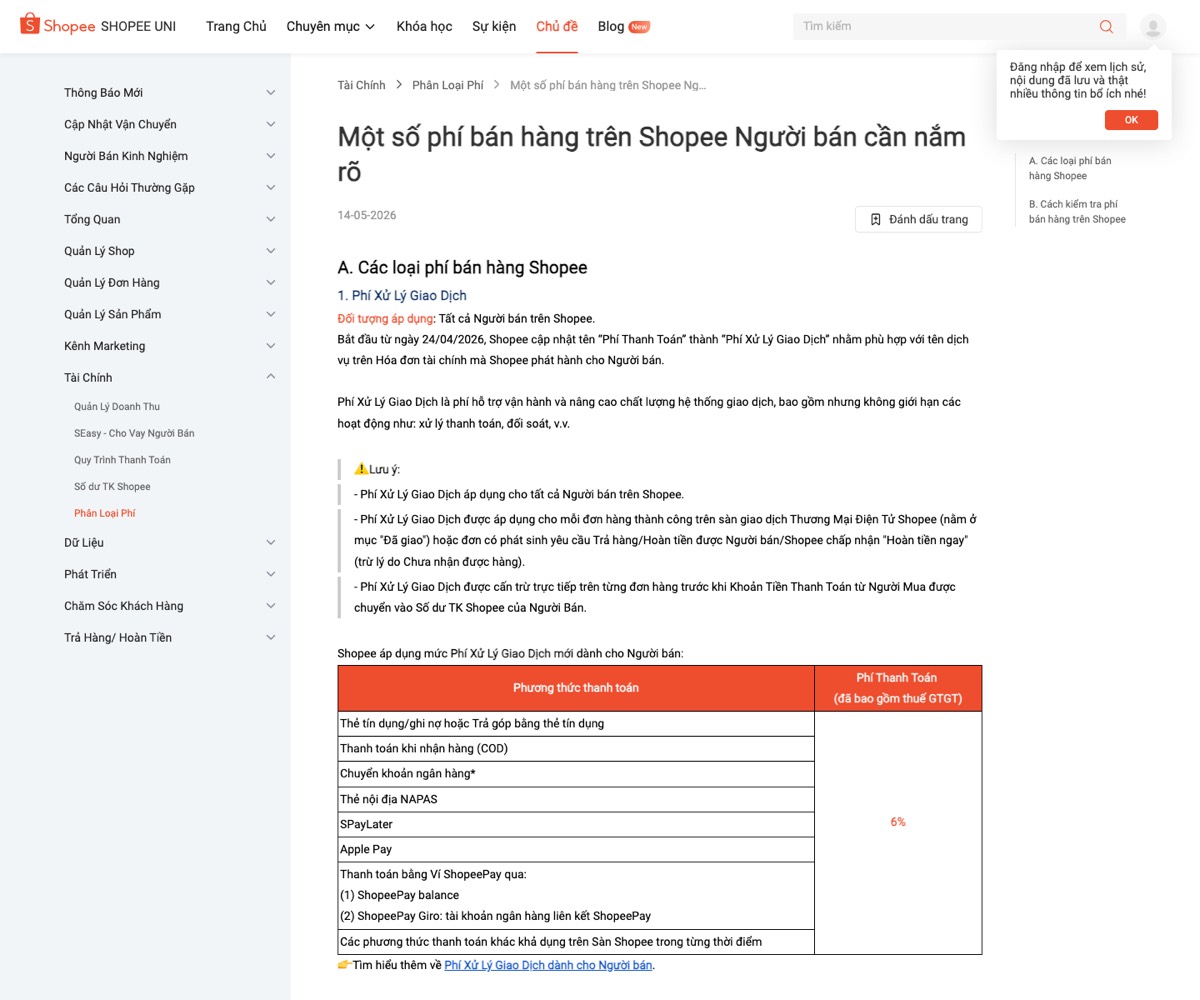
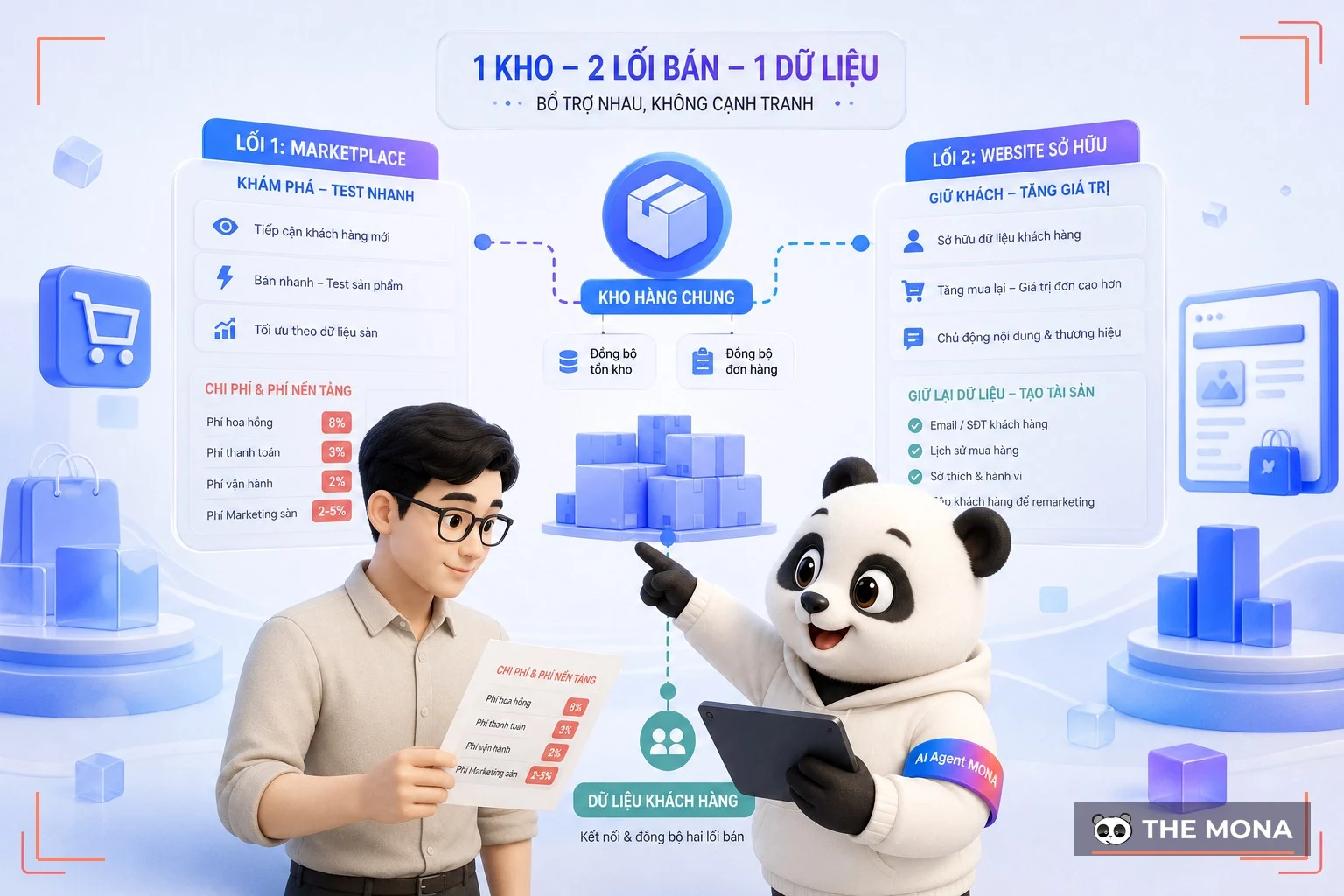
Marketplaces suit demand testing because people are already searching, promotion tools exist and the transaction process is set. In return you accept fees, display rules, price wars and limits on customer data. Before calculating profit, review the Shopee marketplace fees for the exact category and program you join. Fees must be calculated on real orders.
Hữu Hùng says in the video:
Without a website, you miss a very wide market and a very large amount of traffic. People still search on Google a lot. The cost of building a website is now very low, it has hit the floor. Not having a website is a big gap that hits your wallet directly.
Your own website fits when the product needs a story, customers come back, you have combos, SEO content, or you want to keep your purchase data. A website does not bring traffic by itself. Do not forget that. We have seen many shops spend tens of millions of VND on a site, leave it empty for six months with no posts and no ad spend, then conclude that websites do not work, when what was missing was whoever sends visitors there. You still need content, ads, social, or a customer base brought over properly from marketplaces.
| Phase | Priority channel | Goals |
|---|---|---|
| 0 to 20 orders | Social, marketplace or pre-order | Test demand and real questions |
| 20 to 100 orders | Marketplace plus a compact landing page | Measure fees, returns and closing content |
| Customers coming back | Your own website and marketplace | Keep data, sell combos, follow up |
| Many channels, many SKUs | Website plus management software | Sync stock, orders and customers |
We usually advise using both rather than choosing one. Marketplaces find new customers; a website keeps content, data and the next purchase. Keep one stock source in the middle so you do not oversell. Different channels, shared stock.
MONA has operated since 2016 and has completed 14,000+ projects and keeps a rate of 85% returning clients. Once a product has passed 20 to 100 test orders, we look at the website the way a buyer does, along with the stock source, payment, shipping and follow-up, instead of building a pretty template and leaving the shop to keep copying into Excel. See our e-commerce website design service or call 1900 636 648 when you need to connect marketplaces, your website and the order process.
Choosing the right product is still your job. The 14-day test, 20 orders and the contribution profit calculation give the question what should you sell online an answer based on data, instead of a list of "hot products" that goes stale before the goods arrive.

CEO & Founder · The MONA
The founder of The MONA built a service company of 60+ staff with 14,000+ projects delivered. Khánh Hùng shares his thinking on building self-running systems, automating a business, and the real lessons behind MONA's projects.
 1,6K




Professional website
design services
Own a website with a beautiful, 100% exclusive design and a lifetime warranty, with the ability
to expand features flexibly as your business grows, starting today!






 MONA will never sell your information or send you spam


 MONA will never sell your information or send you spam
