
 MONA OS 2.0
 Partner with MONA


 Tự động hoá doanh nghiệp
 Cẩm nang SEO
 Digital Marketing
 Kinh nghiệm thiết kế website
 Hạ Tầng Server
 Giáo dục


 VI
 EN














Message us on
Zalo Official


 ProductsNew

 ProductsProducts
 Mới ra mắtKHA AI 2027App tự edit video, tự đăng mọi mạng xã hội, 2 phút mỗi ngày










 Website designLooks good and wins customers over.
SEO servicesBrings in customers searching for exactly what you sell.
 Tư vấn digital marketingKéo khách từ nhiều kênh, đo bằng số thật.
Corporate video productionVideos introducing your company, factory and team.
 NewAI video productionCompany story films made with AI.
 Custom software developmentCRM, ERP and HRM built for your business.
 Viết AI Agent theo yêu cầuĐặt riêng một trợ lý AI cho đúng việc của mình.
 Tư vấn chuyển đổi AIĐưa AI vào vận hành của cả công ty.
NewMONA LMSManagement for centers and schools.
MONA SkillHubInternal training for company staff.
 NHTQ systemEnd-to-end China–Vietnam shipping operations.
MONA JMSManagement for gold, diamond and pawn shops.
 MONA E-LearningA website with every feature you need to sell courses.
 How to sell online courses (course)More than 30 free lessons on selling courses on autopilot.
 MONA Cloudmonacloud.vnServers to get your apps and websites running.
 MONA Basemonabase.vnPostgres database, sign-in and file storage.
 MONA Mailmonamail.vnSend OTP, order and invoice emails from your software.
 MONA Paymonapay.vnAccept bank transfers via VietQR and notify your software when the money arrives.
 MONA eInvoiceComing soonIssue e-invoices that meet tax standards.
Gấu CườiTrả lời khách 24/7 trên web, Fanpage, Zalo và thu lead cho sale.
 Gấu TeleSalesGọi điện tư vấn, chăm khách như tổng đài viên thật.
Dê CườiTư vấn và chốt đơn cho shop ngay trong khung chat.
Gấu WebmasterNhắn nhóm Zalo là website được sửa xong.
 Gấu Pháp ChếSoạn hợp đồng, rà điều khoản trong vài phút.
 Gấu Báo GiáLên báo giá đúng mẫu và gửi khách ngay.
 AI chăm sóc khách hàngTheo dõi và giữ chân khách hàng cũ.
 Gấu Tuyển DụngLọc hồ sơ, hẹn lịch, phỏng vấn ứng viên.
 Mới ra mắt
KHA AI 2027
Xây kênh chuyên gia 2 phút mỗi ngày
Quay bằng điện thoại, AI tự edit video, tự đăng lên 16 nền tảng và tự trả lời bình luận, tin nhắn.
909.718lượt xem trên kênh CEO MONA sau 38 ngày
 Anh Khánh HùngCEO MONA đang dùng mỗi ngày
Xem app làm được gì
 AI
Gấu Cười MONA ĐANG TỰ XÀITrả lời khách 24/7 trên website, Zalo OA, Messenger và thu lead về cho sale.
Dê CườiChốt đơn bán lẻ và sàn: Shopee, TikTok Shop, web. Chăm cả khách sỉ, đại lý.
Gấu WebmasterCập nhật nội dung, tối ưu SEO website mỗi ngày.
Gấu TeleSalesGọi điện tư vấn, chăm khách như tổng đài viên thật.
Gấu Tuyển DụngLọc hồ sơ, hẹn lịch, phỏng vấn ứng viên tự động.
AI chăm sóc khách hàngGiữ khách cũ, cứu lead đã rớt cho phòng kinh doanh.
Gấu Pháp ChếSoạn hợp đồng, rà điều khoản trong vài phút.
Gấu Báo GiáLên báo giá đúng mẫu, gửi khách ngay khi có yêu cầu.
 Chuyển đổi AI toàn phầnGiải pháp tổng cho doanh nghiệp, 3 lớp triển khai.
 Viết AI Agent theo yêu cầuĐặt riêng một con AI gánh đúng nghiệp vụ của bạn.
 Custom softwareCRM, ERP and HRM with built-in AI automation.
 SEO & AEO thời đại AIĐược Google lẫn AI trích dẫn, không chỉ xếp hạng.
 Kiến thức AI cho doanh nghiệpBài phân tích, hướng dẫn ứng dụng AI vào vận hành.
 Free AI courses
 AI tools at work
App mới · KHA AI 2027
Xây kênh 2 phút mỗi ngày
AI tự edit video, tự đăng mọi mạng xã hội
Free consultation, 8am–10pm every day

08 June, 2026

The question you ask us most is where to start. The short answer is to start from last month's expense statement, not from a meeting with a software vendor. Manufacturing digitization fails at the first step more often than at the technical step, because until you know where the money is leaking, whatever you buy is the wrong purchase.
This article is the 6-step roadmap we distilled from projects for a packaging factory, a furniture workshop and a logistics warehouse chain. Each step has a timeframe, the work to be done and a metric to tell whether the step is finished. After reading, you can take it and run it, even if you don't work with MONA.
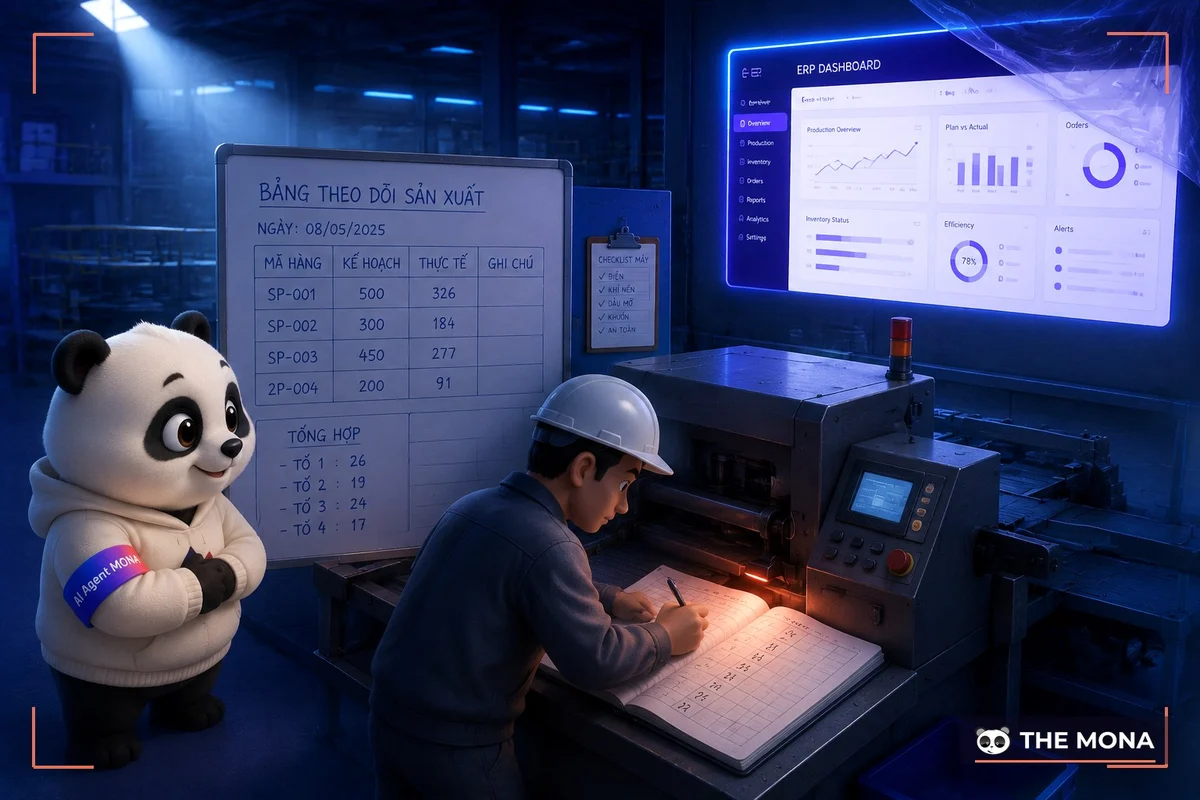
We see this scene in almost every factory before we start: an ERP screen hangs on the wall of the control room, with good numbers and full charts. Walk down to the workshop thirty meters away and the foreman is still writing output in a ruled notebook, team leaders still pin paper boards to the wall, and at the end of the shift someone sits down to retype it all into the system.
The system isn't broken. It is just describing a factory half a day behind reality, and that is the factory leadership is making decisions from.
On the shop floor, long-serving people are an asset. They know which machine tends to jam on the third shift, which batch of raw material tends to run short, and who to call when a supplier delivers short. When the new process is finalized and only then handed down, they don't argue. They just keep working the old way and let the system run in parallel for show.
We wrote that part up as its own article on three reasons employees resist automation and how to keep your best people, because it is too long to squeeze in here. What to remember for this roadmap: if step 2 is done halfheartedly, the four steps after it can't save you.
When insiders won't change, the common reflex is to hire someone from outside, with an impressive title and a salary on par with a senior department head. That person brings a beautiful plan on slides, full of big data and forecasting models.
The problem shows in the third week, when they have to describe the process for discharging a defective batch or changing the night-shift quota. Slide knowledge doesn't reach those places. The project stalls at the survey stage, and the salary has already been paid.
Not every outsider is like this, and some do excellent work. But the selection criterion should be "has stood inside a factory like this one," not the thickness of the plan.
The most common outcome is a big, expensive system where only about a fifth of the features are touched. Accounting still builds its own spreadsheets, the warehouse still keeps its own files, and at month end someone sits down to piece it all together.
MONA once took over a furniture company with 4 workshops and about 320 workers, which had spent a large sum on a foreign system and, after a year, had nearly abandoned it. We didn't suggest throwing that system out, because the money was already spent and scrapping it would be another shock for the team. Instead we built a few small modules that sit in the middle: staff keep entering data into the forms they know, and the modules read it and push it to the main system. After half a year, the share of data entering the system on time rose above 85% without anyone relearning from scratch.

The six steps below go in order. Skip one and you usually have to come back and make up for it, at a higher cost.
Most consultants open with a company-wide process survey. That takes months, costs money, and usually concludes with exactly what you already know.
We start from the money. Open the expense ledger for the last three months and find three items that have swollen abnormally: scrap, dead stock, labor hours on repeat work, and penalties for late deliveries. For a 3-workshop packaging manufacturer in Bình Dương, the biggest leak was manual stock counting and inventory reporting, enough to push the gap between the books and reality to double-digit percentages every month.
This step is done when: you can pin down exactly one step and say how much it costs you each month.
Three to five people, chosen for their standing inside the company rather than for being free: the workshop foreman, the warehouse accountant, the sales manager, plus one quick young hand. This group uses it first, criticizes it first and sees the software change in response to their criticism.
At an 18-workshop packaging factory chain, we spent the first three months just sitting with and interviewing about 80 core workers before writing the first line of code. It sounds slow, but it meant the data entry screen was built close to the paper forms they had filled in for ten years, and later training time dropped to two weeks.
This step is done when: there is a list of named people, a fixed weekly meeting and someone in the group who dares to say plainly what's wrong.
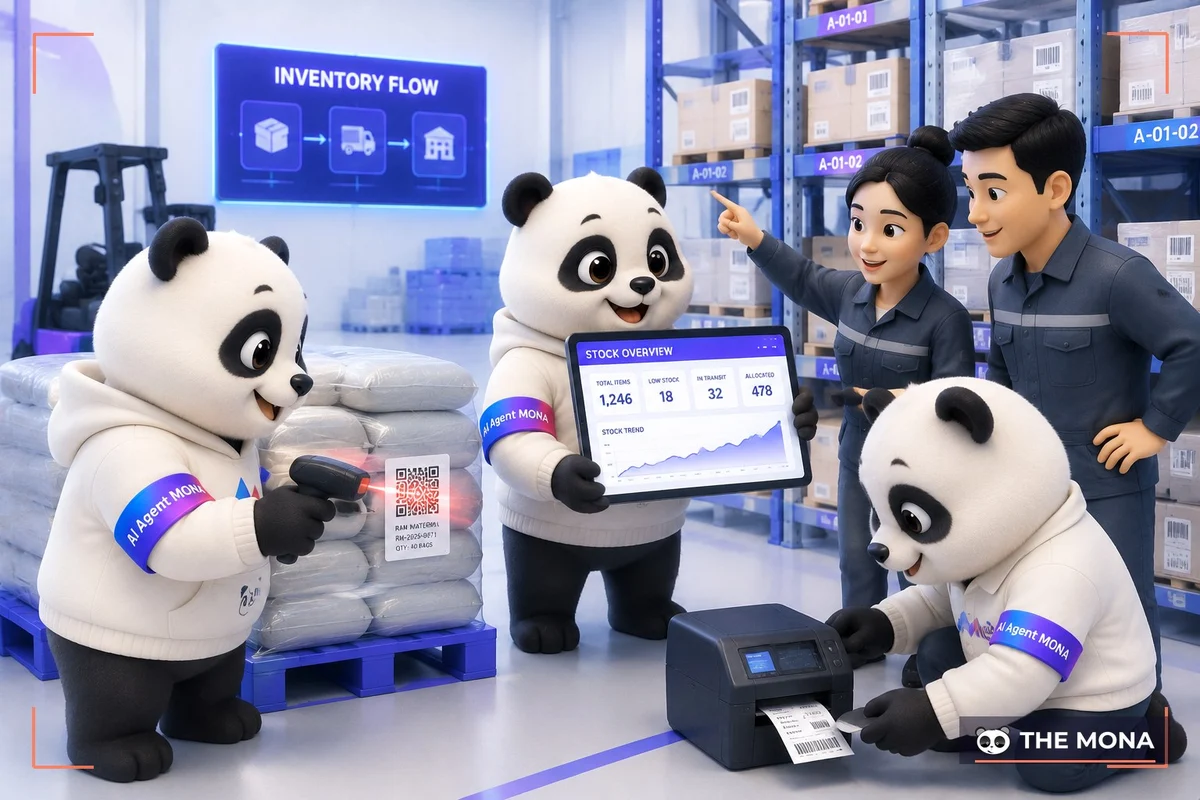
A factory doesn't need an all-encompassing system right away. Pick one small battle you are sure to win: the module that hits the leak you found in step 1.
For the packaging chain above, the first module was warehouse and materials management with QR codes. It is compact, quick to build, and directly addresses the step that costs the most. A visible win in the first quarter changes the whole company's attitude toward the project, which is worth far more than building five more modules at once.
This step is done when: the module scope is written down, with clear boundaries and a line saying "this one we'll do next time."
The pioneer team uses the module in a single workshop or on a single line for 90 days. The metrics must be set before the start date, such as: how many percent the counting time per shift drops, how far inventory discrepancy goes down and from what level, and how many minutes it takes for reports to export automatically.
If 90 days pass and the metrics haven't moved, sit down to find the cause and adjust. Don't scale up just to keep to the schedule. Scaling something that doesn't work yet only breaks three more workshops.
This step is done when: there is a before-and-after metrics comparison table, signed by that workshop's own foreman.
By now the trial group has become the people who know the work best. They are the ones who train the remaining workshops, using examples from their own jobs. Words from an insider carry more weight than words from a vendor, something we have verified on every project.
MONA handles the documentation, training videos and on-call support for the first two weeks of each new workshop. If a business wants to keep this training long term instead of letting documents drift away in group chats, we build it on an internal learning platform.
This step is done when: a new workshop can come on board without anyone from MONA being there in person.
Go back to step 1 with the new expense ledger. Where is the biggest leak now? It has usually shifted to another step, for example from inventory to production planning or quality management.
The modules are designed to connect to each other from the start, so when the second module goes live the data flows straight through and nobody enters it twice. After three or four rounds like this, what you hold is a system tailored to your own factory, built up layer by layer rather than in one multi-billion-dong leap.
This step is done when: you have a module schedule for the next two quarters, with the expected savings for each module.
Where step 1 snags most often
Many people open the expense ledger and then freeze, because costs in the ledger are grouped by department rather than by step, so no matter how long they look they can't see where the money is leaking. We have a checklist of 28 common leak points in factories, split across warehouse, production, quality and delivery, each with a way to check it quickly within a single session. Message us and we'll send it, no strings attached. You can use it to self-audit first, with no need to call us in.

This is a manufacturing partner that operates 18 factories nationwide. Their production lines run well. The problem was in the reporting department.
Before. Four experienced staff, not low-paid, whose main daily job was opening 18 Excel files sent in from 18 factories and retyping them into one master sheet. The figures were always at least a day late, mistakes were routine, and leadership never had an accurate view of inventory at the moment a decision was needed.
What MONA did. We didn't add yet another packaged software on top of the pile they already had. Instead we built a dedicated reporting module, plugged directly into their existing production management system, pulling data straight from the production machines and the warehouse scan points. Every movement of raw materials, semi-finished goods and finished goods is recorded the moment it happens, without waiting for anyone to send an email.
After two weeks of running live. Factory directors can see real-time inventory on their phones. Errors from manual data entry dropped by about 80%. Report delay is close to zero. And the part we find most valuable: about 210 working hours a week were handed back to those four staff, who moved on to analyzing data to optimize the supply chain instead of retyping numbers.
This story illustrates steps 3 and 4 above exactly: pick one step, do it through, measure it in numbers, then scale.
According to McKinsey, about 70% of large-scale transformation programs fail to reach their stated goals (source: McKinsey & Company). In the factories we've worked with, most failures fall into the three places below, and all three are avoidable.
Digitization is often assumed to be a technology matter and handed entirely to IT. The IT department does very well on infrastructure, servers and connectivity. But they aren't the ones accountable for scrap targets or injection machine capacity, so the software comes out technically right and wrong for the business.
At MONA, the first session is always with leadership, not IT. We fix the business goal in numbers first, such as bringing scrap down to a set level or raising the capacity of one line, and only then design software to hit that number. For a plastic packaging chain with 4 workshop clusters, setting the goal first like this helped them cut scrap by 9% after one quarter.
An ambitious plan sounds great in the meeting room: digitize HR, accounting, production and logistics at once. On the shop floor it becomes chaos. Staff get hit by four changes at the same time, the budget balloons, and the project has no end point where anyone can declare it done.
A garment company with 3 factories in Long An did the opposite: they touched only the materials management module and nothing else. After three months inventory costs dropped 12%, and that very number is what opened the way for the next phase.
This is the quietest way to break. The project runs, everyone is busy, and three months later when you ask "is it better?" the answer is a vague "seems a bit better." No one can prove it, so no one dares ask for budget for the next phase.
The cure sits in step 4: write the metrics down before the day you press go, and measure again the same way after 90 days. Just three metrics is enough, as long as they can be measured and nobody can change them with words.
If you want a broader view beyond the factory, we have written about digital transformation consulting in the AI era, and about automated workflows that can replace entire departments. And if your business is torn by cheap software pitches, also read 5 mistakes of cheap automation before you sign.
Three things you can do this week, with no budget needed.
Task 1: Pick the department that is bleeding the most money. Open last month's expense report. Warehouse, purchasing or the production floor: wherever there are abnormal costs, a high defect rate or inventory that has swollen for no reason. You don't need to be certain, just have a well-founded suspicion. A workshop with 80 workers that MONA once worked with started from exactly one line: auxiliary material costs up 18% in three months.
Task 2: Sit down with that department head and two people who do the work directly. No slides, no reports. Ask three questions: which repeated task takes the most time, which step most often goes wrong and has to be redone, and if a machine could take over one task, which would you pick. Write down the answers verbatim; don't polish them.
Task 3: Convert those answers into money. How many labor hours per week, multiplied by the hourly labor cost, plus the loss caused by errors. This number is what you bring to your next meeting, and also what you compare against any vendor's quote.
Audit the 28 leak points in your factory before spending a single dong
You have just read through six steps and three common break points, and you have probably realized that the most expensive part of a factory digitization project is the time spent going in the wrong direction, many times larger than the software cost: months of surveys producing a document nobody reads, a huge system where only a fifth of the features get used, and a company afterward reluctant to say the word digitization again. The workshop still logging by notebook every shift while the ERP screen glows on the wall is the invoice for that time.
We propose doing exactly step 1 with you, in a single session. Bring your last three months of expense ledgers and let us walk through your workshop; we'll audit against the 28-point leak checklist and point out the three steps costing you the most, with an estimate of how much you lose each month. You take that record home and use it to carry on yourself, or take it to ask any vendor for a price.
Book through the hotline 1900 636 648 or message us at mona.media. Tell us how many workshops your factory has and which step you suspect, so the meeting can get straight to work.

CEO & Founder · The MONA
The founder of The MONA built a service company of 60+ staff with 14,000+ projects delivered. Khánh Hùng shares his thinking on building self-running systems, automating a business, and the real lessons behind MONA's projects.
 361




Professional website
design services
Own a website with a beautiful, 100% exclusive design and a lifetime warranty, with the ability
to expand features flexibly as your business grows, starting today!






 MONA will never sell your information or send you spam


 MONA will never sell your information or send you spam
