
 MONA OS 2.0
 Partner with MONA


 Tự động hoá doanh nghiệp
 Cẩm nang SEO
 Digital Marketing
 Kinh nghiệm thiết kế website
 Hạ Tầng Server
 Giáo dục


 VI
 EN










Message us on
Zalo Official


 ProductsNew

 ProductsProducts
 Mới ra mắtKHA AI 2027App tự edit video, tự đăng mọi mạng xã hội, 2 phút mỗi ngày










 Website designLooks good and wins customers over.
SEO servicesBrings in customers searching for exactly what you sell.
 Tư vấn digital marketingKéo khách từ nhiều kênh, đo bằng số thật.
Corporate video productionVideos introducing your company, factory and team.
 NewAI video productionCompany story films made with AI.
 Custom software developmentCRM, ERP and HRM built for your business.
 Viết AI Agent theo yêu cầuĐặt riêng một trợ lý AI cho đúng việc của mình.
 Tư vấn chuyển đổi AIĐưa AI vào vận hành của cả công ty.
NewMONA LMSManagement for centers and schools.
MONA SkillHubInternal training for company staff.
 NHTQ systemEnd-to-end China–Vietnam shipping operations.
MONA JMSManagement for gold, diamond and pawn shops.
 MONA E-LearningA website with every feature you need to sell courses.
 How to sell online courses (course)More than 30 free lessons on selling courses on autopilot.
 MONA Cloudmonacloud.vnServers to get your apps and websites running.
 MONA Basemonabase.vnPostgres database, sign-in and file storage.
 MONA Mailmonamail.vnSend OTP, order and invoice emails from your software.
 MONA Paymonapay.vnAccept bank transfers via VietQR and notify your software when the money arrives.
 MONA eInvoiceComing soonIssue e-invoices that meet tax standards.
Gấu CườiTrả lời khách 24/7 trên web, Fanpage, Zalo và thu lead cho sale.
 Gấu TeleSalesGọi điện tư vấn, chăm khách như tổng đài viên thật.
Dê CườiTư vấn và chốt đơn cho shop ngay trong khung chat.
Gấu WebmasterNhắn nhóm Zalo là website được sửa xong.
 Gấu Pháp ChếSoạn hợp đồng, rà điều khoản trong vài phút.
 Gấu Báo GiáLên báo giá đúng mẫu và gửi khách ngay.
 AI chăm sóc khách hàngTheo dõi và giữ chân khách hàng cũ.
 Gấu Tuyển DụngLọc hồ sơ, hẹn lịch, phỏng vấn ứng viên.
 Mới ra mắt
KHA AI 2027
Xây kênh chuyên gia 2 phút mỗi ngày
Quay bằng điện thoại, AI tự edit video, tự đăng lên 16 nền tảng và tự trả lời bình luận, tin nhắn.
886.120lượt xem trên kênh CEO MONA sau 36 ngày
 Anh Khánh HùngCEO MONA đang dùng mỗi ngày
Xem app làm được gì
 AI
Gấu Cười MONA ĐANG TỰ XÀITrả lời khách 24/7 trên website, Zalo OA, Messenger và thu lead về cho sale.
Dê CườiChốt đơn bán lẻ và sàn: Shopee, TikTok Shop, web. Chăm cả khách sỉ, đại lý.
Gấu WebmasterCập nhật nội dung, tối ưu SEO website mỗi ngày.
Gấu TeleSalesGọi điện tư vấn, chăm khách như tổng đài viên thật.
Gấu Tuyển DụngLọc hồ sơ, hẹn lịch, phỏng vấn ứng viên tự động.
AI chăm sóc khách hàngGiữ khách cũ, cứu lead đã rớt cho phòng kinh doanh.
Gấu Pháp ChếSoạn hợp đồng, rà điều khoản trong vài phút.
Gấu Báo GiáLên báo giá đúng mẫu, gửi khách ngay khi có yêu cầu.
 Chuyển đổi AI toàn phầnGiải pháp tổng cho doanh nghiệp, 3 lớp triển khai.
 Viết AI Agent theo yêu cầuĐặt riêng một con AI gánh đúng nghiệp vụ của bạn.
 Custom softwareCRM, ERP and HRM with built-in AI automation.
 SEO & AEO thời đại AIĐược Google lẫn AI trích dẫn, không chỉ xếp hạng.
 Kiến thức AI cho doanh nghiệpBài phân tích, hướng dẫn ứng dụng AI vào vận hành.
 Free AI courses
 AI tools at work
App mới · KHA AI 2027
Xây kênh 2 phút mỗi ngày
AI tự edit video, tự đăng mọi mạng xã hội
Free consultation, 8am–10pm every day

25 July, 2026
🎓 Free course: Claude Code basics, lesson 9/10. The whole course is in the category Free AI courses package from MONA?
After this lesson, you'll know how to split work among Claude Code's “sub-employees” running in parallel, know the three sub-agents worth building for every user, understand how the agent teams feature works, and, just as important, know when not to use these flashy things, so you don't waste money.
A sub-agent is a small Claude session spawned by the main session (the parent agent) to hand off a sub-task. It is born with a clean, separate memory: it only knows the task it was given, returns the result to the parent and disappears. Sounds simple, but that structure addresses exactly the two weaknesses you learned about in lesson 6:
One, no clutter. Any job that means “reading a mountain to pull out a handful” (50 pages of documents, 1,000 rows of data) clutters the desk of your main session if you do it there. Hand it to a sub-agent: it holds that whole mountain in its own memory and sends back only a summary of a few hundred tokens. The parent's desk stays clean.
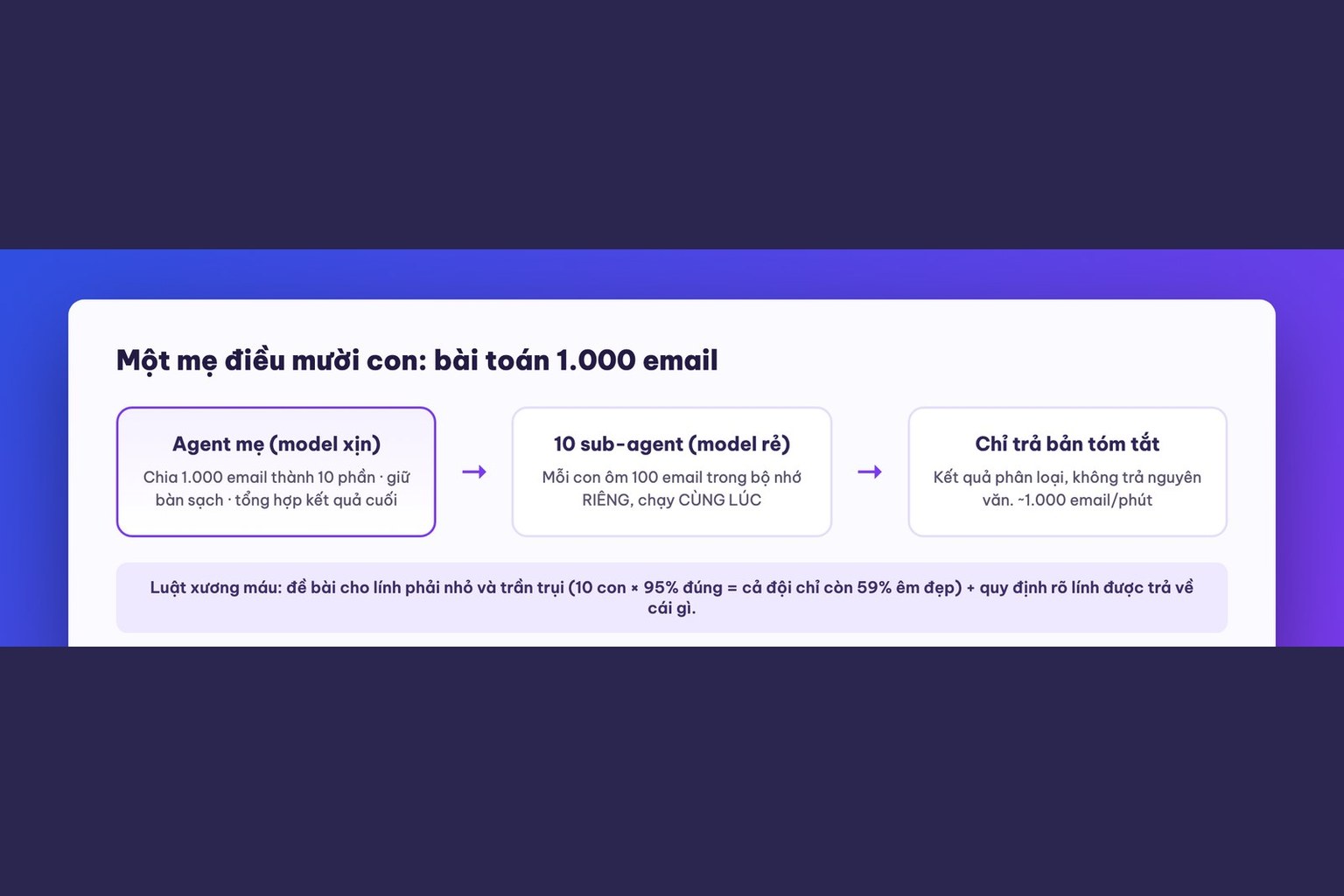
Two, much cheaper. Sub-agents can run on cheaper models (Sonnet, Haiku) while the parent keeps the premium model. The heavy lifting runs on low-cost soldiers, and only synthesis and decisions use the general. That is the task-splitting principle from lesson 6, now built into a proper structure.
And the biggest payoff: that runs. The email labeling task from lesson 8 took 36 seconds for 100 emails when run sequentially. Split across 10 sub-agents running at once, the original course measured: nearly 1,000 emails done in about a minute. A three-hour sequential job shrinks to about ten minutes, like a team of ten doing the work of one, except this team shows up at the press of a button.

There's nothing to memorize about setting this up: sub-agents are definition files that live in .claude/agents/ (the same family as skills), and you can simply ask Claude Code to build them: “turn the Gmail labeling skill into a sub-agent, I want 10 running in parallel, use the Sonnet model, test it and time it for me.” One small note: after building an agent you must open a new session before that session can see the agent, like hiring someone today who only shows up to work tomorrow.
Rule 1: the brief you give a sub-agent must be small and bare. Sub-agents run on cheaper models, so they're less smart than the parent, and this is where 11th-grade probability comes back to collect: if each one is 95% right, 3 in a row are all right only 85% of the time, 10 drop to 59%, and 50 drop to 7%. The more troops, the lower the odds that “the whole team runs smoothly.” The fix: give each one a single, tightly scoped job (“classify these 100 emails using label set X”) and don't make it carry a whole chain.
Rule 2: spell out what the troops are allowed to send back. The original course hit exactly this bug: 10 agents returned the full text of a thousand emails to the parent, the parent ran out of memory, and the whole run failed. The fix is one instruction: “sub-agents must not return the full text, only the classification result.” Soldiers report numbers; they do not read the whole ledger aloud to the boss.
Chain these three into the standard workflow recorded in CLAUDE.md: the parent builds, the reviewer inspects, the tester runs the tests, the parent fixes based on both reports, and only then does it ship. For a personal toy it's a bit much; for anything meant for other people, this rhythm is your safety line.
Sub-agents are troops that only report to the parent. Agent teams add another layer of management: a team-lead agent splits work among team members on its own; each member is a full Claude session, reads its own CLAUDE.md, runs its own skills, and talks to the others through a shared task board (like the internal assignment board in project management software). You stand outside like a company owner: give the team lead the goal, and occasionally poke in to message one member directly. This feature is experimental and must be enabled manually in settings.json (ask the machine to switch it on and you're done).
It sounds great, and social media is hyping it to the skies. Time for a necessary splash of cold water, with figures from Anthropic itself: an agent team uses about 7x the tokens of a single session, because each member carries its own full memory plus the “meeting” overhead between agents. Left unwatched, it can literally burn tens of millions of VND in a day. The official recommendation: use cheap models for members, keep the team very small, give very tight briefs, and disband the team as soon as the work is done.
We'll close with the principle we want you to carve into memory: how impressive a tool is should never be the goal. If a single session does the job well, use a single session. If the work splits into many independent, identical pieces, use sub-agents. Only when the work truly needs several roles coordinating and debating do you reach for an agent team, with an eye on the bill. Most of the business value sits in the first two rungs.

.claude/agents/, and record the “build, review, test, fix” workflow in CLAUDE.md.Lesson 10, the last lesson of the course: git worktree how to run several sessions on the same project without stepping on each other, and how to put your product live on the internet. When you finish, you'll have gone the full loop: from installation to a product alive in the real world.

CEO & Founder · The MONA
The founder of The MONA built a service company of 60+ staff with 14,000+ projects delivered. Khánh Hùng shares his thinking on building self-running systems, automating a business, and the real lessons behind MONA's projects.
 248




Professional website
design services
Own a website with a beautiful, 100% exclusive design and a lifetime warranty, with the ability
to expand features flexibly as your business grows, starting today!






 MONA will never sell your information or send you spam


 MONA will never sell your information or send you spam
