
 MONA OS 2.0
 Partner with MONA


 Tự động hoá doanh nghiệp
 Cẩm nang SEO
 Digital Marketing
 Kinh nghiệm thiết kế website
 Hạ Tầng Server
 Giáo dục


 VI
 EN








Message us on
Zalo Official


 ProductsNew

 ProductsProducts
 Mới ra mắtKHA AI 2027App tự edit video, tự đăng mọi mạng xã hội, 2 phút mỗi ngày










 Website designLooks good and wins customers over.
SEO servicesBrings in customers searching for exactly what you sell.
 Tư vấn digital marketingKéo khách từ nhiều kênh, đo bằng số thật.
Corporate video productionVideos introducing your company, factory and team.
 NewAI video productionCompany story films made with AI.
 Custom software developmentCRM, ERP and HRM built for your business.
 Viết AI Agent theo yêu cầuĐặt riêng một trợ lý AI cho đúng việc của mình.
 Tư vấn chuyển đổi AIĐưa AI vào vận hành của cả công ty.
NewMONA LMSManagement for centers and schools.
MONA SkillHubInternal training for company staff.
 NHTQ systemEnd-to-end China–Vietnam shipping operations.
MONA JMSManagement for gold, diamond and pawn shops.
 MONA E-LearningA website with every feature you need to sell courses.
 How to sell online courses (course)More than 30 free lessons on selling courses on autopilot.
 MONA Cloudmonacloud.vnServers to get your apps and websites running.
 MONA Basemonabase.vnPostgres database, sign-in and file storage.
 MONA Mailmonamail.vnSend OTP, order and invoice emails from your software.
 MONA Paymonapay.vnAccept bank transfers via VietQR and notify your software when the money arrives.
 MONA eInvoiceComing soonIssue e-invoices that meet tax standards.
Gấu CườiTrả lời khách 24/7 trên web, Fanpage, Zalo và thu lead cho sale.
 Gấu TeleSalesGọi điện tư vấn, chăm khách như tổng đài viên thật.
Dê CườiTư vấn và chốt đơn cho shop ngay trong khung chat.
Gấu WebmasterNhắn nhóm Zalo là website được sửa xong.
 Gấu Pháp ChếSoạn hợp đồng, rà điều khoản trong vài phút.
 Gấu Báo GiáLên báo giá đúng mẫu và gửi khách ngay.
 AI chăm sóc khách hàngTheo dõi và giữ chân khách hàng cũ.
 Gấu Tuyển DụngLọc hồ sơ, hẹn lịch, phỏng vấn ứng viên.
 Mới ra mắt
KHA AI 2027
Xây kênh chuyên gia 2 phút mỗi ngày
Quay bằng điện thoại, AI tự edit video, tự đăng lên 16 nền tảng và tự trả lời bình luận, tin nhắn.
884.102lượt xem trên kênh CEO MONA sau 36 ngày
 Anh Khánh HùngCEO MONA đang dùng mỗi ngày
Xem app làm được gì
 AI
Gấu Cười MONA ĐANG TỰ XÀITrả lời khách 24/7 trên website, Zalo OA, Messenger và thu lead về cho sale.
Dê CườiChốt đơn bán lẻ và sàn: Shopee, TikTok Shop, web. Chăm cả khách sỉ, đại lý.
Gấu WebmasterCập nhật nội dung, tối ưu SEO website mỗi ngày.
Gấu TeleSalesGọi điện tư vấn, chăm khách như tổng đài viên thật.
Gấu Tuyển DụngLọc hồ sơ, hẹn lịch, phỏng vấn ứng viên tự động.
AI chăm sóc khách hàngGiữ khách cũ, cứu lead đã rớt cho phòng kinh doanh.
Gấu Pháp ChếSoạn hợp đồng, rà điều khoản trong vài phút.
Gấu Báo GiáLên báo giá đúng mẫu, gửi khách ngay khi có yêu cầu.
 Chuyển đổi AI toàn phầnGiải pháp tổng cho doanh nghiệp, 3 lớp triển khai.
 Viết AI Agent theo yêu cầuĐặt riêng một con AI gánh đúng nghiệp vụ của bạn.
 Custom softwareCRM, ERP and HRM with built-in AI automation.
 SEO & AEO thời đại AIĐược Google lẫn AI trích dẫn, không chỉ xếp hạng.
 Kiến thức AI cho doanh nghiệpBài phân tích, hướng dẫn ứng dụng AI vào vận hành.
 Free AI courses
 AI tools at work
App mới · KHA AI 2027
Xây kênh 2 phút mỗi ngày
AI tự edit video, tự đăng mọi mạng xã hội
Free consultation, 8am–10pm every day

01 June, 2026
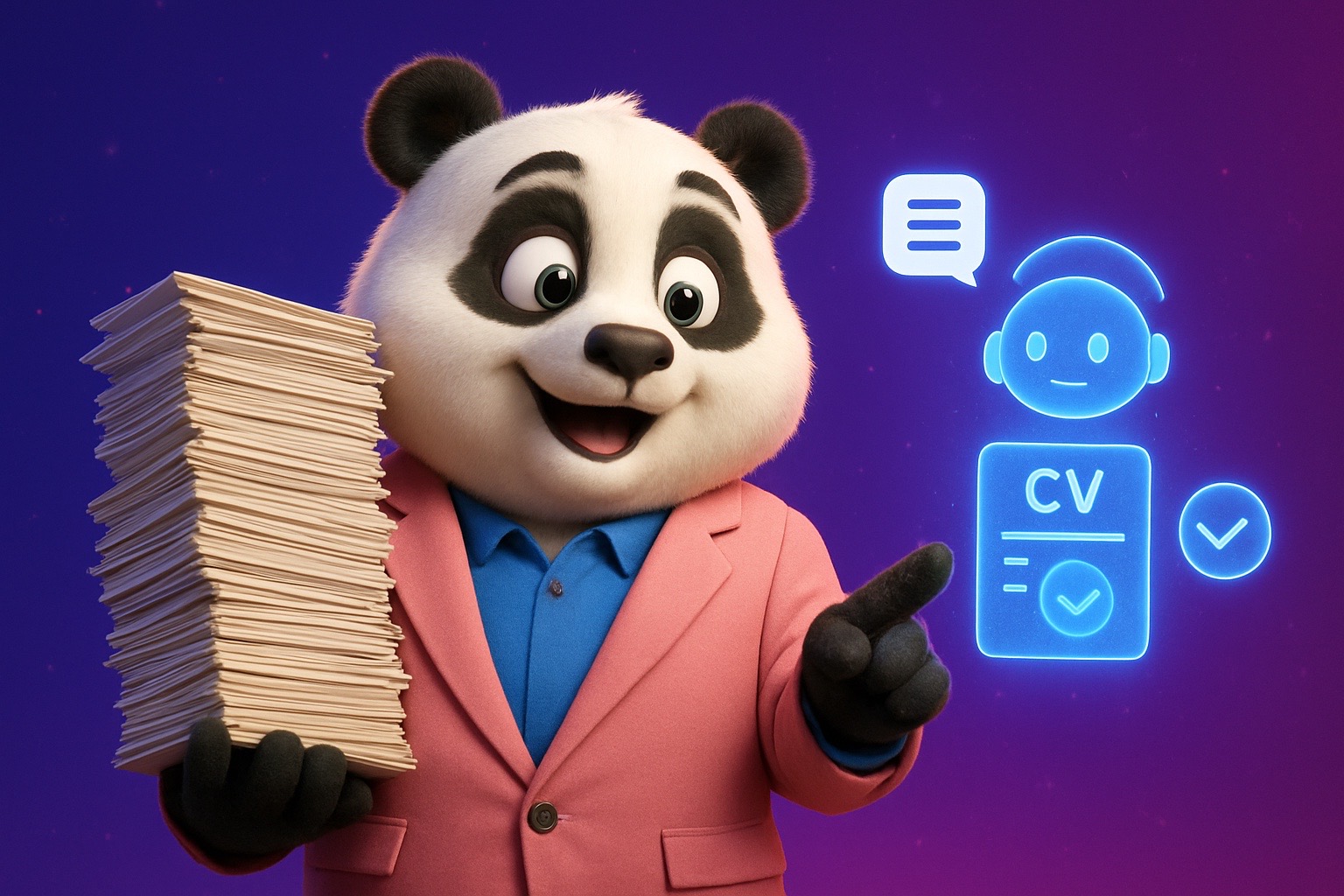
Why does your HR department still spend a hundred hours a month on repetitive work? See also how employees react when AI is rolled out. Screening CVs, calling to schedule interviews, sending payroll back and forth. Reconciling attendance, writing handbooks for new hires. In 2026, MONA sees that applying AI in the HR department is already running for real in many of our client businesses. No longer at the trial stage. AI for HR can now carry 12 specific tasks, from reading CVs and automating recruitment. Face-recognition attendance with AI attendance software, all the way to compiling 360-degree reviews. In this article we gather the AI uses for HR worth rolling out, with real figures from the chains MONA has worked with, so you have a clear picture before deciding to invest.
A bloated HR department is a familiar pain. A company of 300-800 staff usually has 6-10 HR people on an average salary of 18-25 million VND. The HR payroll comes to 150-250 million VND a month. Have you ever sat down and asked, out of that 150 million, how much is really spent on HR strategy. And how much is just manual data entry.
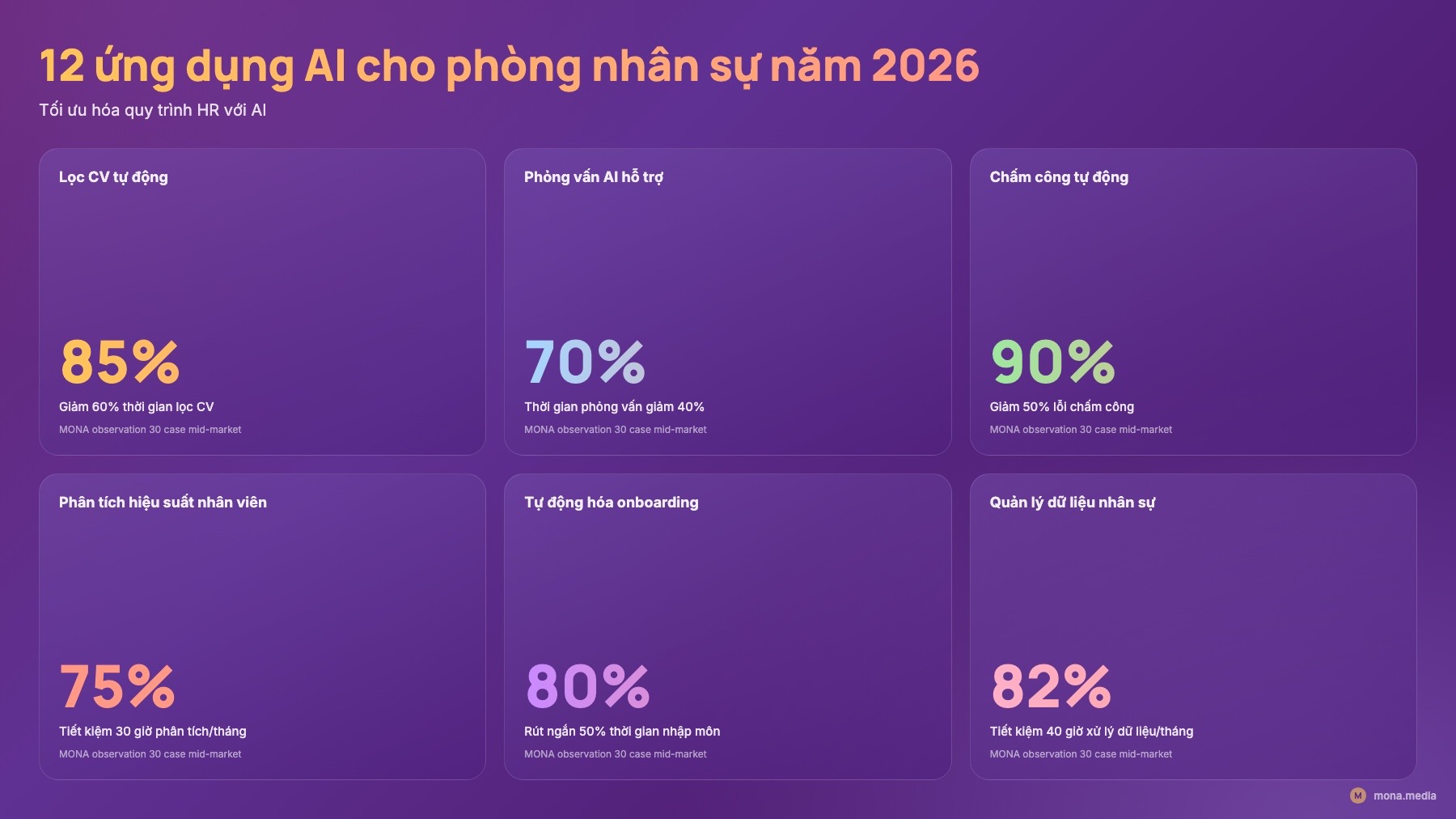
We compiled the 12 HR tasks that software already handles cleanly in 2026. Take a look to see where your department stands on this scale.
Ten years ago, each of these tasks needed a person. In 2026, AI applications for the HR department run steadily at the chains MONA has automated. We have seen the first ten run smoothly. The last two, drafting contracts and reporting, still need a person to review, but the software carries 80%. Read the foundational concept at What is AI automation to get the shared way of thinking.
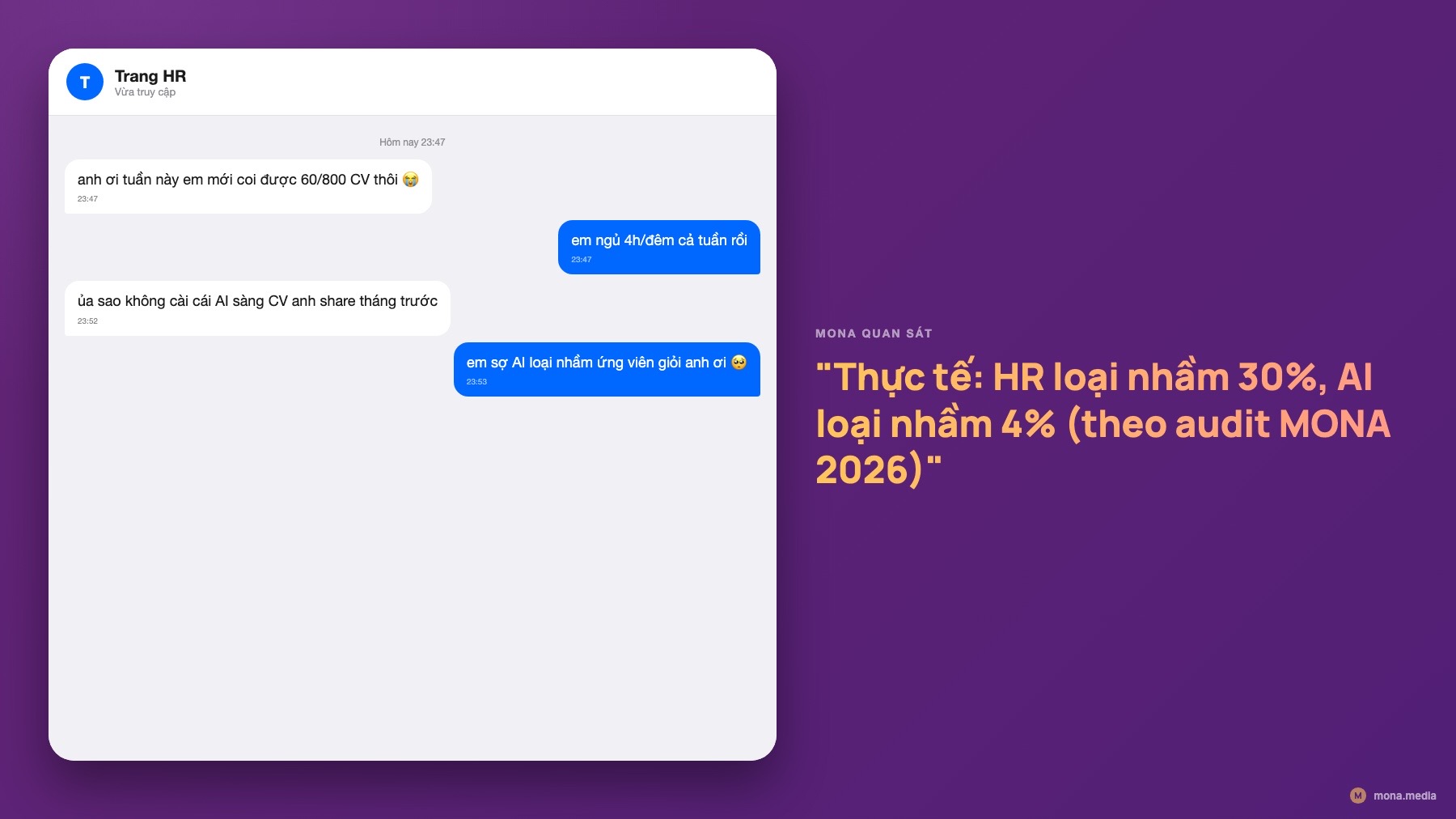
In a peak hiring season, a chain MONA automated, with about 22 branches, once received over 800 CVs for shift manager within 10 days. Their HR department has 4 people. That works out to 200 CVs each, at an average of 4 minutes per CV for first screening. About 13 hours of pure work. Add compiling, ranking and sending interview invitations, and the screening round alone swallowed over 60 hours for the department.
Do we really want HR to spend 60 hours just reading CVs? We do not think so. This is work machines do better than people, because a machine reads in parallel, never tires, and is not swayed by faces.
MONA wrote CV screening software and attached it to the client's HR department. The software reads PDF CVs and tags skill fields against a standardized job description. It scores the fit, then ranks. HR only looks at the top 30 high-scoring candidates, reads them carefully and decides who to invite to interview. Screening time dropped from 13 hours per person to 4 hours per person. Most of that is time re-verifying fields the machine was not sure about.
In the first 3 months, this chain's HR department cut 2 outsourced CV screening roles, saving 36 million VND a month. The share of top-30 candidates reaching interview round 2 hit 67%, 41% higher than with manual screening before.
A new HR person often reads CVs by gut feeling: the name of the university, years of experience, expected salary. A machine looks at how well each skill the job description requires matches each line of experience in the CV. It does not skip a good candidate because the CV is not nicely written. See details in the AI First handbook for businesses.
We also observed that the machine detects CVs copied from Topcv templates, CVs that exaggerate figures, and CVs that overlap heavily between candidates. HR avoids this work because it takes time, and wrong hires rise as a result. Machine screening cut the wrong-hire rate by 30% in the first 6 months for the 22-branch chain mentioned above.
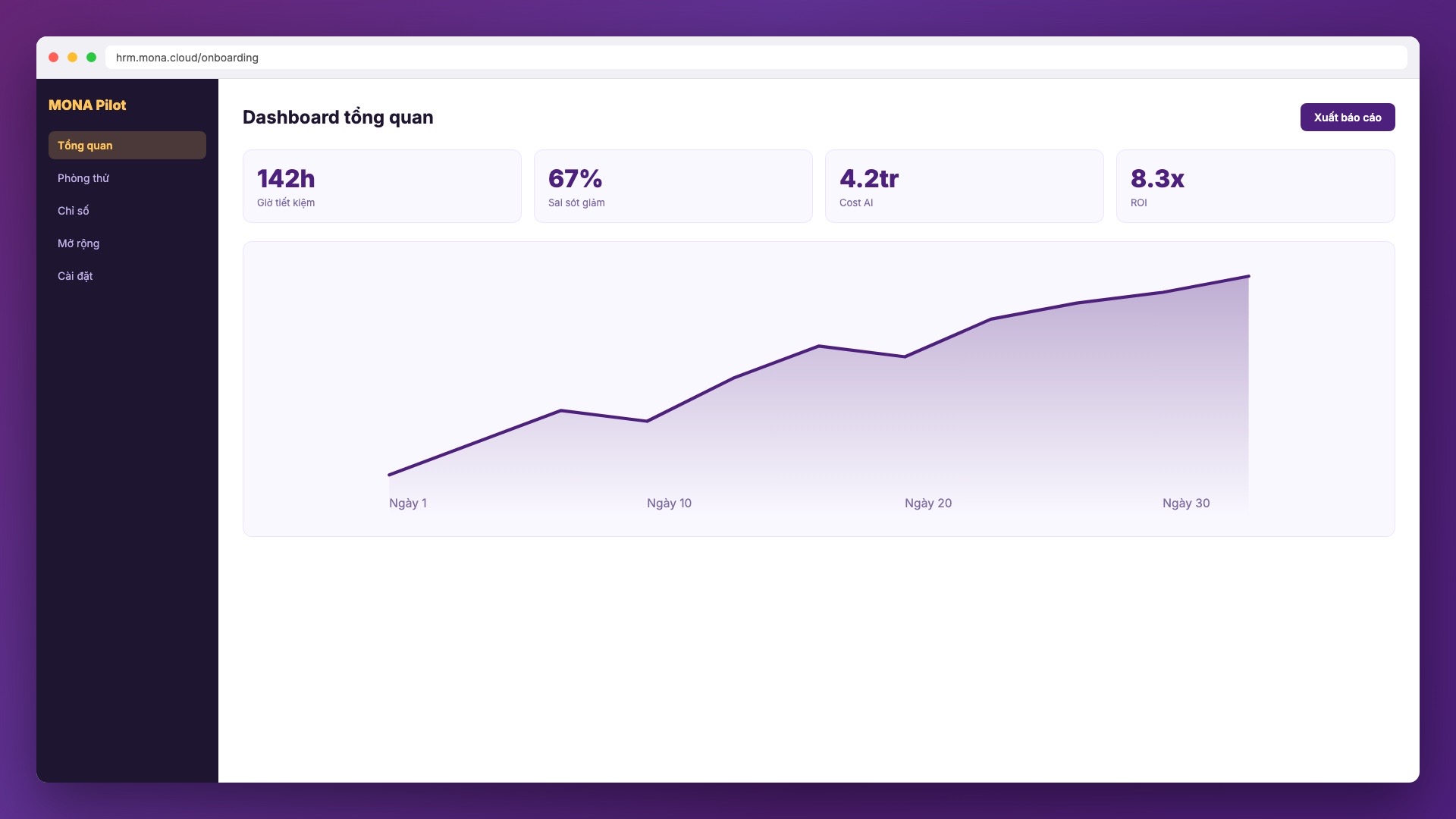
A new hire usually gets 10 documents to fill in. HR has to email them and explain each section. Each new hire takes 3 hours of complicated paperwork. The HR department loses 2 working days in the first week. The Zalo virtual assistant automatically sends 8 digitized documents. New hires get a link and fill in online forms easily. The system sends reminders 3 times a day. It makes sure the
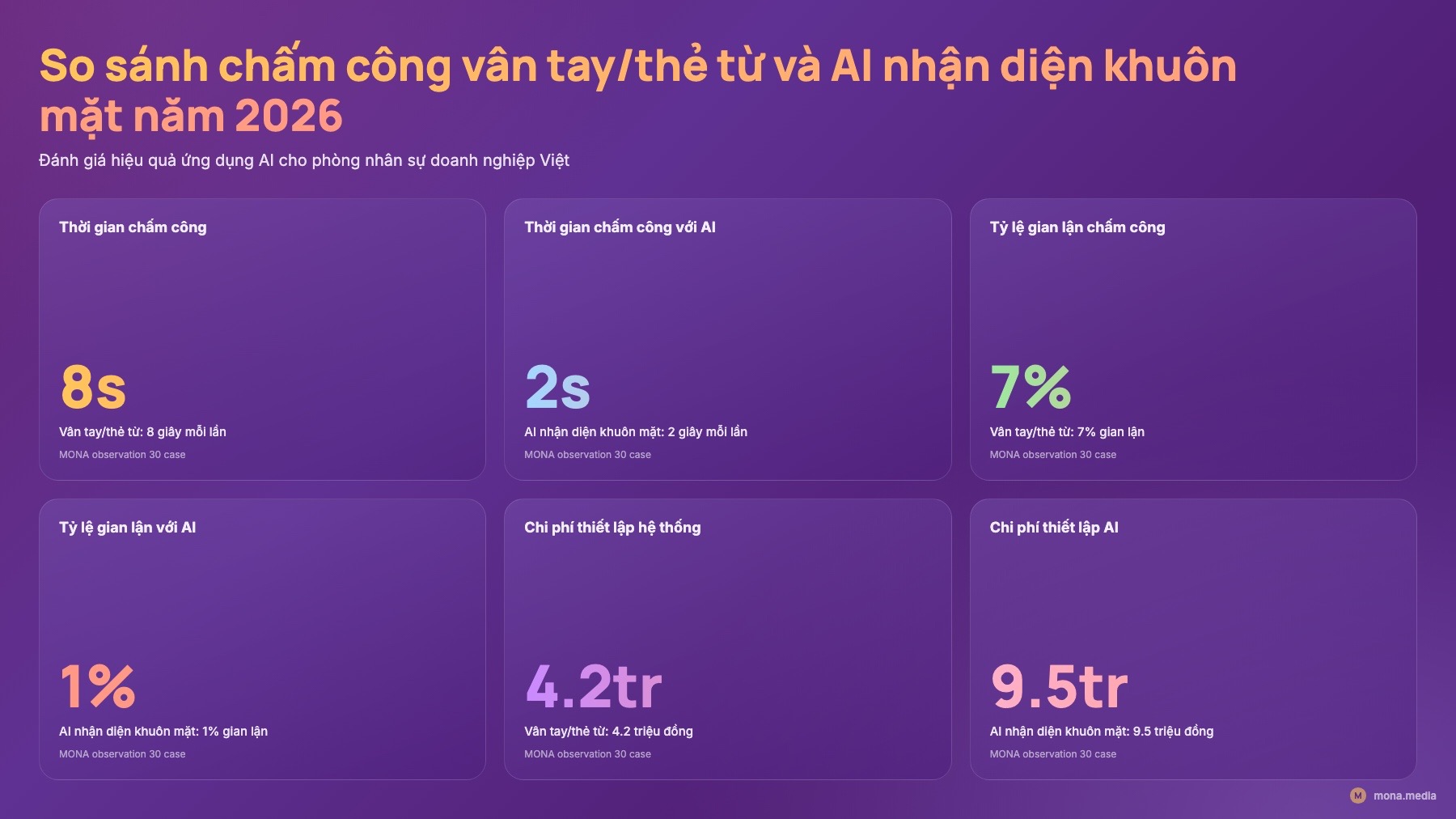
A familiar pain for chains with many branches is buddy punching. Staff arrive late and ask a colleague to swipe their card, then forget to check out at the end of the shift. Some branches even round hours together. Each month HR has to cross-check cameras against attendance, taking 2-3 days to close a clean timesheet.
AI face-recognition attendance software. MONA rolled it out for a 28-branch spa chain and solved this cleanly. A camera sits at the reception desk, staff look at it to clock in, and the software matches them against their profile. If two clock-ins are too close together, the system raises a fraud alert. If staff leave mid-shift, the system records when they left the desk. At month end the timesheet comes out automatically, with no manual closing by HR.
Real figures: the HR department of the 28-branch chain cut timesheet closing from 3 days to 4 hours. The rate of detected wrong clock-ins rose from 4% to 18%. That means overpayment from fraud fell by about 27 million VND a month. This alone is enough to pay back the software in 11 months.
Closing payroll at month end is HR's familiar nightmare. Attendance gives hours, then add overtime, add allowances, subtract absences, subtract penalties, add project bonuses. Subtract salary advances, add meal allowances, subtract social insurance, subtract personal income tax. About 12-15 calculation lines per employee. For a chain of 800 staff that is 12,000 lines. HR sits in Excel for 3-5 days, exhausted, with errors at 2-3%.
MONA wrote payroll software connected directly to the face-recognition attendance above. It plugs into the social insurance system to the Tax Department's standard. At the start of each month HR only looks at the dashboard, approves exceptions, and digitally signs the insurance submission. The whole flow went from 3 days to 2 hours.
The 28-branch spa chain above saved another 18 million VND a month by cutting 1 HR person who handled payroll. Payroll errors found after sending to staff dropped from an average of 14 cases a month to 2. Staff complained less and labor relations became calmer.
Performance review is something HR usually does every 6 months or once a year. Take the form, send it to 5-7 colleagues, wait for them to fill it in, collect by hand, summarize, send to the department head. HR at a mid-market chain often spends 3-4 weeks on each company-wide review round.
We all understand that an accurate 360-degree review is valuable people data for a company. So why do we still leave HR to do it by hand, once every 6 months? Because collecting the numbers is exhausting. The new answer for 2026 is that the machine collects.
The software we built for an 18-branch education chain reads internal Slack messages (with employee consent), reads comments in Notion, reads department Zalo groups, and groups them per person. It produces a summary of positive and negative feedback. HR only reviews it, making sure no bias slips in and no sensitive information leaks. A company-wide review round went from 4 weeks to 5 days.
The education chain above also uses the software to catch early signs of resignation. When the frequency of staff logging into the system drops, when positive comments in chat groups drop. When leave requests rise, the system alerts the department head. The head proactively talks to the employee before they submit a resignation.
The chain's retention of skilled staff rose from 71% to 86% in 9 months. Not having to hire for 4 key positions alone saved about 180 million VND in recruitment and retraining costs.
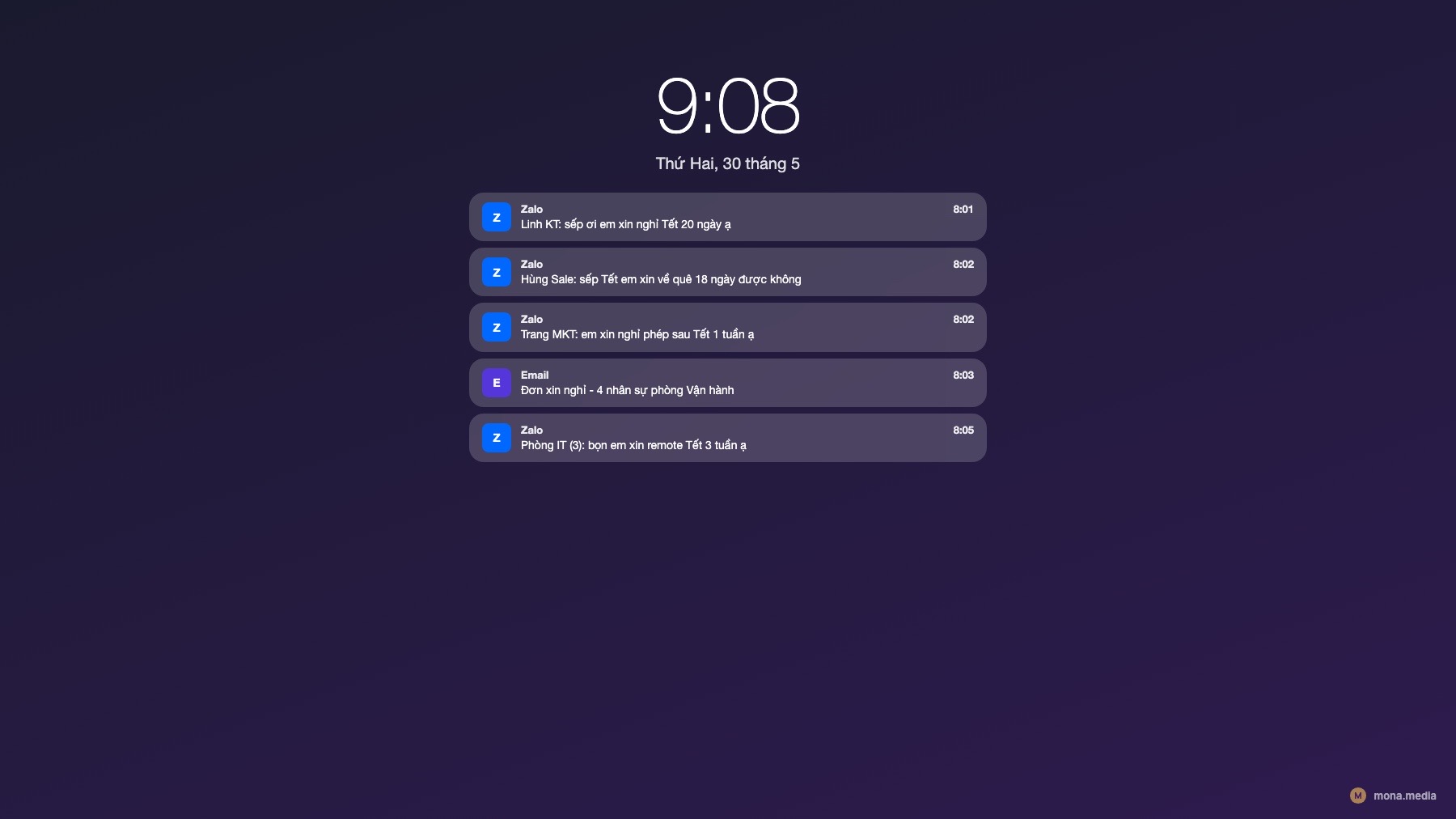
Take another look at your HR department. What percentage of HR's time goes to work that truly needs a human brain? Meeting manager-level candidates, reading employee psychology, handling labor disputes, building company culture. And how much goes to data entry, reconciling, collecting numbers and sending repetitive emails. See details in the AI First handbook for businesses.
We invest in HR at 18-25 million VND a salary hoping to get HR strategic thinking. If HR spends 70% of its time on manual work, you are paying a consultant's salary for a secretary's job. It is a kind of drawing a salary without producing that we often have to say plainly to client leadership.
The second consequence is wrong hires. When HR is worn out by manual work, CV screening is rushed and interviews are shallow. The average wrong-hire rate at Vietnamese mid-market chains is 28-32% by MONA's observation across 30+ automated clients. Each wrong hire costs at least 45 million VND in direct cost. Not counting indirect costs like team morale and lost customers due to weak staff.
MONA believes that software automating the HR department is not there to cut people. It is there so the remaining HR people do the work worth the salary they are paid. You can read more of this view in the article on CEOs getting AI wrong.
You are paying 60-90 million VND a month for 8-12 HR staff, including recruiters, compensation and benefits specialists, onboarding trainers and attendance specialists. And it is not only about money, MONA knows you have tried many things (raising the headhunting budget to 8-15 million VND per mid-level CV, bringing in an HR business partner expert for 2 months of training, offering a 5 million VND referral bonus, upgrading the benefits package with a gym and health insurance for the whole family, hoping staff would treat the company as a second home and carry heavier loads themselves). But no. All that effort did not work. One HR head is a drop in the ocean when out there every day 100 other job posts push pay 15-20% higher and pull your solid staff away. One HR head cannot do it all, cannot screen CVs, receive new hires, run payroll, track attendance, run reviews and resolve internal conflicts all at the same time.
Trying to hire 2-3 more fresh-graduate HR staff, trying to swap in a new HR head, trying to hire a bigger headhunting firm, none of these is the root fix. What you need is a technology solution, an automated, closed-loop HRM software suite that reduces dependence on people as much as possible, leaving a few dedicated HR staff working alongside the machine, instead of hiring a whole market of HR people full of friction only to hire again 6 months later.
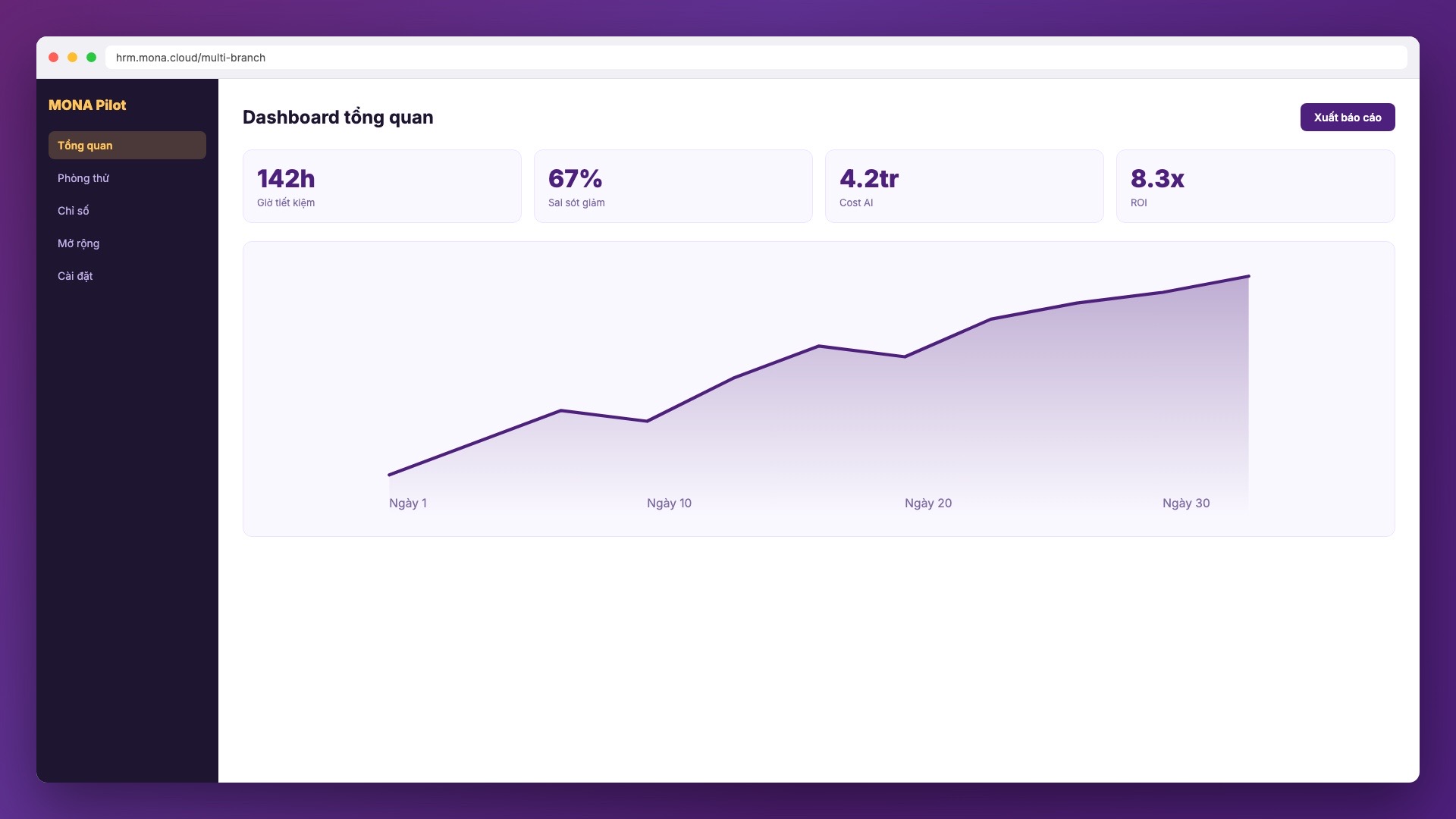
To give you a concrete picture, here is a case of a spa chain that is a MONA client. 28 branches across Ho Chi Minh City, Hanoi and Da Nang. Average revenue 52 billion VND a month, 612 staff in total. The HR department has 7 people with a total payroll of 165 million VND a month.
Before rolling out the HR automation software, their process ran like this. Card-app attendance, with fraud. Payroll in Excel, 3 days to close. Recruiting by posting on Topcv with HR reading by hand, 4-6 weeks per position. Onboarding with HR hand-holding each new hire, 2 new hires taking one HR person a whole week. Performance review every 6 months, done with Google Forms.
MONA rolled out 4 modules of AI for the HR department in 11 weeks. Face-recognition attendance across 28 branches. CV screening and interview scheduling. A Zalo virtual assistant guiding new hires through onboarding. Automatic payroll connected to social insurance. Total software cost 480 million VND all-in, running cost 12 million VND a month.
After 6 months of operation, this chain's HR department slimmed from 7 to 4 people (3 positions moved to internal training and talent development), saving 72 million VND a month in payroll. Attendance fraud fell, saving another 27 million VND. Outsourced CV screening cost fell 18 million VND. Total savings 117 million VND a month, minus 12 million VND software running cost, net 105 million VND. The 480 million VND investment paid back in 4.6 months.
More important than the numbers, the chain's leadership told MONA this. Before, the HR department never had time to sit with the board and discuss HR strategy. Now the remaining HR people really have time to think strategically. They propose a new pay structure and a talent retention program. This is a kind of value that is hard to measure in money but you feel it when it runs.
The business owners reading this article usually split into 2 groups. Group 1 is very used to HR drawing high pay with thin results, 30% wrong hires and 25% annual turnover, has fully given up looking for a fix, and accepts “people cost is just part of the game”, treating it as “that's how our industry is”. Group 2 is the newer owners, or those who, even after 10 or 20 years in business, never stop looking for solutions, keep an ear out for new HRM software, AI CV screening, virtual assistants for new hires, so that when a solution appears they bring it home and roll it out hard, shocking the HR head, the old department head and the new staff all at once. MONA (we are business people just like you, and MONA runs its own HR department with software we wrote ourselves) belongs to group 2, and we are completely confident we can bring a solution to group 2 owners. What you need is just a 45-minute call away. And it is free. A MONA specialist will bring it to you whatever your business model and whatever your current state (1 branch or 50 branches, a young workforce or many older staff, not tech-savvy or extremely tech-savvy, never used HRM or already switched HR software 3 times, running a spa chain or a factory of 800 workers), we have a solution for every case. Because this is already the 10th year MONA has brought automation and software to business owners in Vietnam. Email info@themona.global or book a 45-minute call through the mona.media website.
The AI applications we write for the HR department are not tied to the spa industry. The same software layers just change parameters and job description templates. They can run for 6 adjacent industries, all mid-market clients MONA has served or is serving.
Where does your industry sit in the list above? Chances are it is there. If not, message us. MONA will analyze the specific HR department of your industry to see how much the machine can carry.
We have to be straight. Not every HR department should automate right away. There are 3 cases where MONA usually advises clients to stop.
One is a company under 50 staff. At a small scale, the software cost per head is high and payback is slow. You should use existing SaaS software instead of a custom investment.
Two is an HR department in the middle of building a new culture. When the company has just changed its CEO and its business model. HR needs to be flexible and talk directly. Automating at this point easily creates a feeling of distance.
Three is when staff are not used to technology. A factory chain with workers mostly over 45 will push back on face-recognition attendance software. You need careful internal communication before rollout, or it will fail in the first week.
If this article makes sense to you, MONA suggests the 90-day roadmap below. In the first month, pick the 2 most painful HR tasks, usually CV screening and attendance, to roll out first. In the second month, extend to payroll and new hire onboarding. In the third month, re-measure the savings, assess staff attitudes and decide the next step.
The software MONA writes is designed in modules that fit together, and does not make you buy the full package up front. You can start small, measure results and expand gradually. This is how we have rolled it out for 30+ long-standing clients. No client has had to invest more than 600 million VND in HR without seeing payback in the first year.
For the big picture, read the article Applying AI in business. See how MONA fully automated 30 businesses. For technical terms see AI First and the AI enterprise glossary 2026.
Learn more about the platforms MONA uses to build the recognition modules. Vietnamese responses at What is Claude AI and What is a chatbot. When you want to build an internal HR management interface, see HR management website design. The solution set at CRM, HRM and ERP software. If you need a Vietnamese callbot for high-volume recruiting, see chatbot software.
Other foundational glossary pages: what AI is, What is AI First, What is AI Native, What is Generative AI. What is marketing automation, digital transformation, What is a prompt.
You can also look at an outside view in the report by McKinsey People & Organizational Performance and Stanford AI Index. We only quote the points that suit Vietnamese mid-market businesses, not word for word.
The MONA ecosystem for you to explore further: Mona Software for custom software. Mona Host for the server infrastructure that runs internal software. SkillHub MONA for internal staff training, Khánh Hùng Academy for upgrading the leadership team's thinking. If your chain needs its own staff training system, we have the MONA EduCenter and MONA LMS products, just get in touch.
The last question we want to leave you with. What do you hope your HR department looks like in 2027? The same 7 people spending 70% of their time on talent strategy. Or still 7 people spending 70% of their time on data entry and reconciling.
Applying AI in the HR department is not there to replace HR. It is there so the remaining HR people become the role leadership actually needs. MONA has rolled out AI applications for the HR department for 30+ long-standing clients. Each client cut HR department cost by 30-50% while staff quality rose. Are you ready for your HR department to turn to a new chapter? We are ready to sit down with you and see where your HR department actually stands. Message MONA any time for which AI application for the HR department to roll out first.
Keep reading in the same department cluster: applying AI in the sales department · applying AI in the marketing department.
We advise companies under 50 staff to use existing SaaS like MISA AMIS. Base, a custom build will not pay back within the year. Above 100 staff, start re-measuring the 12 tasks in this article. Pick the 2-3 most painful ones to roll out first. Above 300 staff, AI for HR already returns pre-tax profit within the first quarter.
Vietnamese law allows it if the company gives public notice and employees consent. MONA always advises you to issue a facial data protection policy first. Roll out, store data locally instead of sending it to the cloud, and delete it on a schedule. We have run this approach for 12 chains with no complaints.
It can, if you leave the AI to decide alone. MONA always has the AI rank the top 30% and a real HR person review before inviting anyone to interview. This combination reduces bias while keeping speed. After 6 months you have the data to fine-tune the model to your industry.
No. AI replaces 60-70% of repetitive manual work, and the remaining HR staff work on talent strategy, culture and negotiating to keep strong people. MONA observed 30 chains cut HR headcount by 30-50% after 12 months. The people who stayed earned 40% more because their roles changed.
The 90-day roadmap MONA runs: month 1 CV screening and attendance. Month 2 payroll and initial onboarding, month 3 360 reviews and training. Costs range from 250-600 million VND for chains of 300-800 staff, with payback in 6-9 months. We give specifics after a free 90-minute audit session.
Read more: What is AI recruiting · a recruitment AI Agent · recruiting chatbot.

CEO & Founder · The MONA
The founder of The MONA built a service company of 60+ staff with 14,000+ projects delivered. Khánh Hùng shares his thinking on building self-running systems, automating a business, and the real lessons behind MONA's projects.
 340




Professional website
design services
Own a website with a beautiful, 100% exclusive design and a lifetime warranty, with the ability
to expand features flexibly as your business grows, starting today!






 MONA will never sell your information or send you spam


 MONA will never sell your information or send you spam
