
 MONA OS 2.0
 Hợp tác với MONA


 Tự động hoá doanh nghiệp
 Cẩm nang SEO
 Digital Marketing
 Kinh nghiệm thiết kế website
 Hạ Tầng Server
 Giáo dục


 VI
 EN











Message us on
Zalo Official


 ProductsNew

 ProductsProducts
 Mới ra mắtKHA AI 2027App tự edit video, tự đăng mọi mạng xã hội, 2 phút mỗi ngày










 Thiết kế websiteVừa đẹp vừa thuyết phục được khách.
Dịch vụ SEOKéo về khách đang tìm đúng thứ anh chị bán.
 Tư vấn digital marketingKéo khách từ nhiều kênh, đo bằng số thật.
Quay video doanh nghiệpVideo giới thiệu công ty, nhà xưởng, đội ngũ.
 MớiDựng video AIDựng phim câu chuyện công ty bằng AI.
 Custom software developmentCRM, ERP and HRM built for your business.
 Viết AI Agent theo yêu cầuĐặt riêng một trợ lý AI cho đúng việc của mình.
 Tư vấn chuyển đổi AIĐưa AI vào vận hành của cả công ty.
NewMONA LMSManagement for centers and schools.
MONA SkillHubInternal training for company staff.
 NHTQ systemEnd-to-end China–Vietnam shipping operations.
MONA JMSManagement for gold, diamond and pawn shops.
 MONA E-LearningA website with every feature you need to sell courses.
 How to sell online courses (course)More than 30 free lessons on selling courses on autopilot.
 MONA Cloudmonacloud.vnServers to get your apps and websites running.
 MONA Basemonabase.vnPostgres database, sign-in and file storage.
 MONA Mailmonamail.vnSend OTP, order and invoice emails from your software.
 MONA Paymonapay.vnAccept bank transfers via VietQR and notify your software when the money arrives.
 MONA eInvoiceComing soonIssue e-invoices that meet tax standards.
Gấu CườiTrả lời khách 24/7 trên web, Fanpage, Zalo và thu lead cho sale.
 Gấu TeleSalesGọi điện tư vấn, chăm khách như tổng đài viên thật.
Dê CườiTư vấn và chốt đơn cho shop ngay trong khung chat.
Gấu WebmasterNhắn nhóm Zalo là website được sửa xong.
 Gấu Pháp ChếSoạn hợp đồng, rà điều khoản trong vài phút.
 Gấu Báo GiáLên báo giá đúng mẫu và gửi khách ngay.
 AI chăm sóc khách hàngTheo dõi và giữ chân khách hàng cũ.
 Gấu Tuyển DụngLọc hồ sơ, hẹn lịch, phỏng vấn ứng viên.
 Mới ra mắt
KHA AI 2027
Xây kênh chuyên gia 2 phút mỗi ngày
Quay bằng điện thoại, AI tự edit video, tự đăng lên 16 nền tảng và tự trả lời bình luận, tin nhắn.
866.399lượt xem trên kênh CEO MONA sau 33 ngày
 Anh Khánh HùngCEO MONA đang dùng mỗi ngày
Xem app làm được gì
 AI
Gấu Cười MONA ĐANG TỰ XÀITrả lời khách 24/7 trên website, Zalo OA, Messenger và thu lead về cho sale.
Dê CườiChốt đơn bán lẻ và sàn: Shopee, TikTok Shop, web. Chăm cả khách sỉ, đại lý.
Gấu WebmasterCập nhật nội dung, tối ưu SEO website mỗi ngày.
Gấu TeleSalesGọi điện tư vấn, chăm khách như tổng đài viên thật.
Gấu Tuyển DụngLọc hồ sơ, hẹn lịch, phỏng vấn ứng viên tự động.
AI chăm sóc khách hàngGiữ khách cũ, cứu lead đã rớt cho phòng kinh doanh.
Gấu Pháp ChếSoạn hợp đồng, rà điều khoản trong vài phút.
Gấu Báo GiáLên báo giá đúng mẫu, gửi khách ngay khi có yêu cầu.
 Chuyển đổi AI toàn phầnGiải pháp tổng cho doanh nghiệp, 3 lớp triển khai.
 Viết AI Agent theo yêu cầuĐặt riêng một con AI gánh đúng nghiệp vụ của bạn.
 Custom softwareCRM, ERP and HRM with built-in AI automation.
 SEO & AEO thời đại AIĐược Google lẫn AI trích dẫn, không chỉ xếp hạng.
 Kiến thức AI cho doanh nghiệpBài phân tích, hướng dẫn ứng dụng AI vào vận hành.
 Free AI courses
 AI tools at work
App mới · KHA AI 2027
Xây kênh 2 phút mỗi ngày
AI tự edit video, tự đăng mọi mạng xã hội
Free consultation, 8am–10pm every day

08 May, 2026

Have you ever wondered why Google AI Overview or ChatGPT can answer events that happened just a few days ago, often with a fairly complete list of sources? That doesn't come only from the data the AI was trained on. It also comes from an important mechanism behind the scenes called RAG (Retrieval-Augmented Generation). This technology lets AI look up fresh information in real time and then combine it into a complete answer for the user. With AI Search changing how people look for information so strongly, understanding RAG is no longer just for engineers. It is knowledge worth having for anyone working in SEO, content or web development. So what exactly is RAG? What are the pros and cons of RAG (Retrieval-Augmented Generation)? Let's MONA Media find out in this article!
RAG (Retrieval-Augmented Generation) is an AI mechanism that lets language models such as ChatGPT or Google AI rely not only on their pre-trained data but also pull in outside information before generating an answer. Put simply, instead of “answering from memory”, the AI looks up relevant data from websites, documents or databases and then combines it into a complete answer. As a result, answers are more current and more accurate, and the AI is less likely to “make up” information.
Today, RAG is an important foundation behind many AI Search systems such as Google AI Overview, ChatGPT hay Perplexity AI, helping change how users search for and reach information on the internet.

Here are the standout features of RAG:
See more: What is an AI chatbot: how it differs from a scripted chatbot and how to choose the right one
RAG works by combining data search with AI content generation. Instead of answering purely from “what it has learned”, the system actively looks for related information from outside and then combines it into a complete answer. As a result, AI can respond more accurately, more currently and in closer line with the context the user is searching in. RAG usually works through these steps:

Everything starts when a user asks a question or sends a request. The AI then analyzes the input to understand what information the user needs and what they are trying to find.
Once it understands the query, the system searches a database to pull out the most relevant documents or content. This step gives the AI extra “reference sources” instead of answering only from old training data.
The information it just found is placed into the prompt to give the large language model (LLM) extra context. With that, the AI has enough data to understand the issue more deeply before generating an answer.
Finally, the LLM combines and rephrases the information into a complete, coherent and easy-to-understand answer. In many cases, the AI can also attach sources so users can verify the information.
You can picture RAG as a smart assistant: it knows how to find the right document in a “data library” and can also explain the content in the most natural and easy-to-understand way for the user.
RAG (Retrieval-Augmented Generation) is becoming the core foundation behind modern AI Search systems such as ChatGPT Search, Google AI Overview and Perplexity AI. Unlike traditional search engines that only show a list of websites, AI Search actively searches, selects information and combines it into a complete answer for the user. This also shifts SEO from a race to “reach the top of Google” to a race to be chosen and cited by AI.

AI Search systems today usually work in the following process:
The key difference is that AI doesn't simply rank websites the way traditional Google does. It chooses data sources to use in its answer. This is also why:
RAG doesn't “make up” information. It works by retrieving data from many different sources before generating an answer. This is why AI Search systems such as ChatGPT, Google AI Overview or Perplexity can give current responses that match users' real queries. For SEO today, where your content appears, how it is structured and whether its meaning is clear enough directly affect whether AI can retrieve and use it.

A RAG system can pull data from many sources, such as:
RAG (Retrieval-Augmented Generation) is seen as one of the key technologies making AI Search smarter and more trustworthy. Instead of answering only from data it has already learned, RAG can pull in outside information to produce more current and accurate responses. However, alongside its many benefits, the technology has some limits that businesses need to understand before using it.

RAG helps AI answer more accurately and currently by retrieving real data before generating a response. It is also an important foundation of today's AI Search systems.
Alongside its many advantages, RAG still has some limits around data quality, processing cost and the complexity of deploying an AI system.
RAG isn't just the technology behind modern AI Search systems. It is also widely used in many real-world fields. By both retrieving data and generating smart responses, RAG helps AI provide information that is more accurate, faster and closer to the context than traditional models.

Some real-world uses of Retrieval-Augmented Generation:

As AI Search keeps growing, SEO is no longer just about optimizing keywords or racing for Google rankings. For your content to be chosen and cited by AI, SEO specialists needs to understand how AI systems “read”, analyze and retrieve data. That is also why RAG has become an important concept in SEO strategy today. Understanding RAG helps SEOs see:
User search behavior is changing very fast as AI Search becomes more common. Instead of clicking through many websites to find information, users now tend to ask ChatGPT, Google AI Overviews or Perplexity directly and get an answer immediately. This makes SEO more than a race to the top of Google. It is a race for your content to be chosen and cited by AI.
That is why businesses need to start SEO AI as early as possible. Besides improving visibility on Google, AI SEO makes your website a trusted data source in the eyes of AI systems, which keeps quality traffic, grows brand awareness and widens your reach across new search platforms.
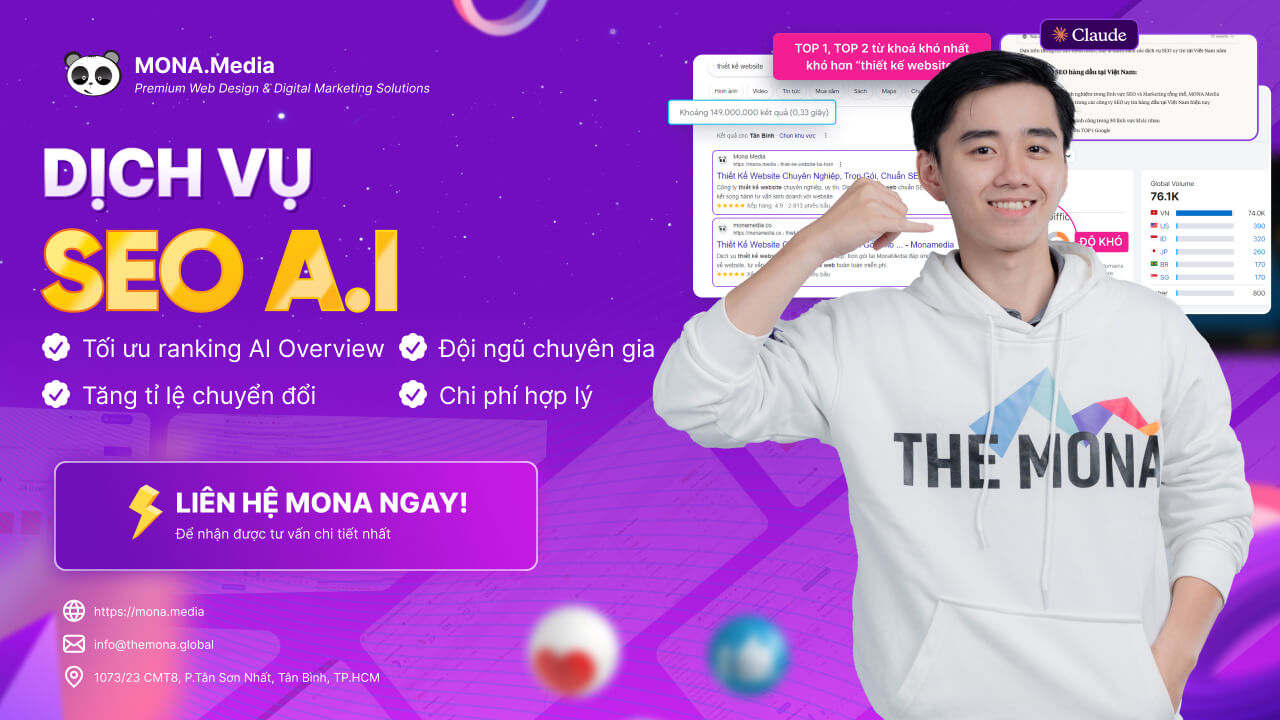
With over 10 years of experience delivering SEO website to TOP Google service for over 2,000 businesses across many fields, MONA doesn't only optimize on-page SEO, off-page SEO or technical SEO. It also adds an AI SEO strategy to help businesses adapt to the new search trend and grow sustainably in the AI Search era.
Highlights of AI SEO services at MONA:
If you want your website to appear not only on Google but also as the direct answer in the AI Search era, contact MONA for advice on a strategy and SEO services quote AI that fits your business!

RAG is developing very fast and is becoming an important foundation behind modern AI Search systems. Beyond retrieving and combining information, the technology opens new uses that make AI smarter, more personalized and able to handle complex tasks in the future.
Understanding what RAG is helps you see clearly how AI Search is changing the way we search for and process information. Instead of answering only from data it has already learned, AI can now retrieve, verify and then combine it into a complete response. This is also the foundation behind the strong growth of today's AI Search systems.
Whether you work in SEO, build products or simply want to know why user search behavior is changing, knowing what RAG (Retrieval-Augmented Generation) is and how retrieval-augmented generation works will help you adapt sooner and gain an edge in the AI era.
If you've read the concept and want to see how RAG runs in a real business, from the document store and how to cut chunks to the 5-step flow that produces a sourced answer, we took apart the full architecture of the bot on duty at mona.media in the article deploying RAG for businesses. That article also says plainly which 3 problems you should not use RAG for.

CEO & Founder · The MONA
Founder of The MONA, who built a services company of 200+ staff with 14,000+ projects delivered. Khánh Hùng shares how he thinks about building systems that run themselves, automating a business, and the real lessons from delivering projects at MONA.
 1,6K




Professional website
design services
Own a website with a beautiful, 100% exclusive design and a lifetime warranty, with the ability
to expand features flexibly as your business grows, starting today!






 MONA will never sell your information or send you spam


 MONA will never sell your information or send you spam
