
 MONA OS 2.0
 Partner with MONA


 Tự động hoá doanh nghiệp
 Cẩm nang SEO
 Digital Marketing
 Kinh nghiệm thiết kế website
 Hạ Tầng Server
 Giáo dục


 VI
 EN













Message us on
Zalo Official


 ProductsNew

 ProductsProducts
 Mới ra mắtKHA AI 2027App tự edit video, tự đăng mọi mạng xã hội, 2 phút mỗi ngày










 Website designLooks good and wins customers over.
SEO servicesBrings in customers searching for exactly what you sell.
 Tư vấn digital marketingKéo khách từ nhiều kênh, đo bằng số thật.
Corporate video productionVideos introducing your company, factory and team.
 NewAI video productionCompany story films made with AI.
 Custom software developmentCRM, ERP and HRM built for your business.
 Viết AI Agent theo yêu cầuĐặt riêng một trợ lý AI cho đúng việc của mình.
 Tư vấn chuyển đổi AIĐưa AI vào vận hành của cả công ty.
NewMONA LMSManagement for centers and schools.
MONA SkillHubInternal training for company staff.
 NHTQ systemEnd-to-end China–Vietnam shipping operations.
MONA JMSManagement for gold, diamond and pawn shops.
 MONA E-LearningA website with every feature you need to sell courses.
 How to sell online courses (course)More than 30 free lessons on selling courses on autopilot.
 MONA Cloudmonacloud.vnServers to get your apps and websites running.
 MONA Basemonabase.vnPostgres database, sign-in and file storage.
 MONA Mailmonamail.vnSend OTP, order and invoice emails from your software.
 MONA Paymonapay.vnAccept bank transfers via VietQR and notify your software when the money arrives.
 MONA eInvoiceComing soonIssue e-invoices that meet tax standards.
Gấu CườiTrả lời khách 24/7 trên web, Fanpage, Zalo và thu lead cho sale.
 Gấu TeleSalesGọi điện tư vấn, chăm khách như tổng đài viên thật.
Dê CườiTư vấn và chốt đơn cho shop ngay trong khung chat.
Gấu WebmasterNhắn nhóm Zalo là website được sửa xong.
 Gấu Pháp ChếSoạn hợp đồng, rà điều khoản trong vài phút.
 Gấu Báo GiáLên báo giá đúng mẫu và gửi khách ngay.
 AI chăm sóc khách hàngTheo dõi và giữ chân khách hàng cũ.
 Gấu Tuyển DụngLọc hồ sơ, hẹn lịch, phỏng vấn ứng viên.
 Mới ra mắt
KHA AI 2027
Xây kênh chuyên gia 2 phút mỗi ngày
Quay bằng điện thoại, AI tự edit video, tự đăng lên 16 nền tảng và tự trả lời bình luận, tin nhắn.
932.285lượt xem trên kênh CEO MONA sau 42 ngày
 Anh Khánh HùngCEO MONA đang dùng mỗi ngày
Xem app làm được gì
 AI
Gấu Cười MONA ĐANG TỰ XÀITrả lời khách 24/7 trên website, Zalo OA, Messenger và thu lead về cho sale.
Dê CườiChốt đơn bán lẻ và sàn: Shopee, TikTok Shop, web. Chăm cả khách sỉ, đại lý.
Gấu WebmasterCập nhật nội dung, tối ưu SEO website mỗi ngày.
Gấu TeleSalesGọi điện tư vấn, chăm khách như tổng đài viên thật.
Gấu Tuyển DụngLọc hồ sơ, hẹn lịch, phỏng vấn ứng viên tự động.
AI chăm sóc khách hàngGiữ khách cũ, cứu lead đã rớt cho phòng kinh doanh.
Gấu Pháp ChếSoạn hợp đồng, rà điều khoản trong vài phút.
Gấu Báo GiáLên báo giá đúng mẫu, gửi khách ngay khi có yêu cầu.
 Chuyển đổi AI toàn phầnGiải pháp tổng cho doanh nghiệp, 3 lớp triển khai.
 Viết AI Agent theo yêu cầuĐặt riêng một con AI gánh đúng nghiệp vụ của bạn.
 Custom softwareCRM, ERP and HRM with built-in AI automation.
 SEO & AEO thời đại AIĐược Google lẫn AI trích dẫn, không chỉ xếp hạng.
 Kiến thức AI cho doanh nghiệpBài phân tích, hướng dẫn ứng dụng AI vào vận hành.
 Free AI courses
 AI tools at work
App mới · KHA AI 2027
Xây kênh 2 phút mỗi ngày
AI tự edit video, tự đăng mọi mạng xã hội
Free consultation, 8am–10pm every day

11 June, 2026
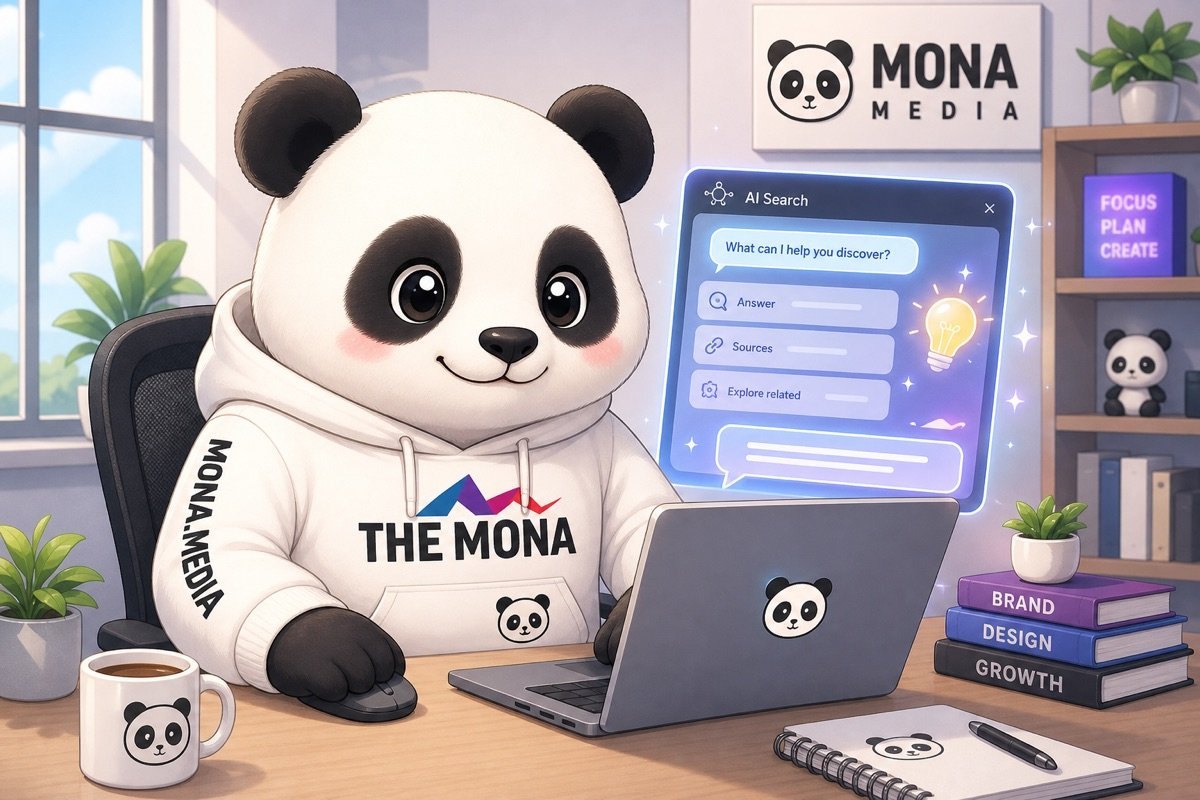
In an age of exploding data, finding accurate information quickly is key for every business. Perplexity AI has emerged as a capable helper, especially when you know how to get the most from a Perplexity prompt library. At MONA we see that Perplexity saves our team a lot of time researching markets, competitors and trends. This article shares practical tips so you and your team can use Perplexity effectively and make faster, more accurate business decisions.
Many of you are used to searching on Google. But Perplexity is more than plain search. It also synthesizes information and gives trustworthy sources. Professionals use Perplexity to get deep insight fast, without spending much time.
We'll show you how to make the most of Perplexity. It's a useful tool for business analysis and marketing. You'll see better value right away compared with traditional searching. The information is distilled and easy to verify. In just a few minutes, you have a fresh perspective.
Understanding the market is the foundation of every strategy. Perplexity helps you do this quickly. You can ask the tool to summarize industry trends and analyze key competitors.
With just a short prompt, you get an overview. The reference sources are fully cited. This saves you hours of manual filtering. Your business decisions will have a firmer basis.
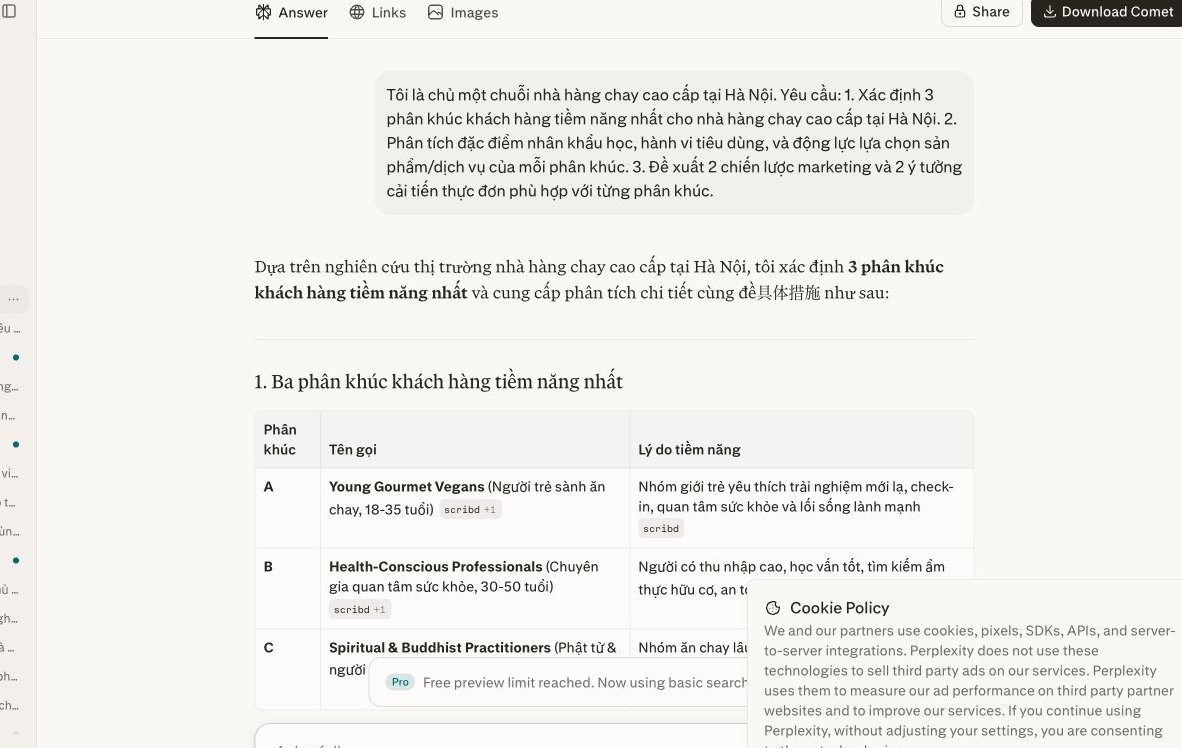
For example, you can type: "Analyze market trends in Vietnam's F&B industry 2024, notable restaurant chains and their marketing strategies."
Perplexity will synthesize reports and articles. It helps you quickly grasp the big picture. This is a way to cut research time. A very big a competitive advantage gain.
Marketers need information constantly. They need new ideas and to understand customers. Perplexity is a capable helper. You can use it to find hot topics. Or to see what competitors are doing.
The tool gives you marketing perspectives. These insights are synthesized from many reputable sources. From there, you plan content more effectively. Campaigns will stay close to current tastes.
Example prompt: "The most talked-about content marketing topics about luxury resort travel in Vietnam in Q3/2024 and effective distribution channels."
Perplexity provides a list. Along with links to the original articles. This lets you check the information. Decisions are based on data, not gut feeling.
Making sure information is accurate is extremely important. Perplexity stands out for citing sources. You can easily check reliability. This helps avoid misinformation.
Once you have the results, you can dig deeper. Perplexity suggests follow-up questions. It's a way to explore more angles. This process helps you build a well-rounded view.
Always review your sources. Cross-checking information is essential. Automation software from MONA is built on the same principle. We need clean, accurate data.
MONA EduCenter has also rolled out courses AI for business. We show you how to use AI effectively, including how to verify information. This is a core skill of the digital age.
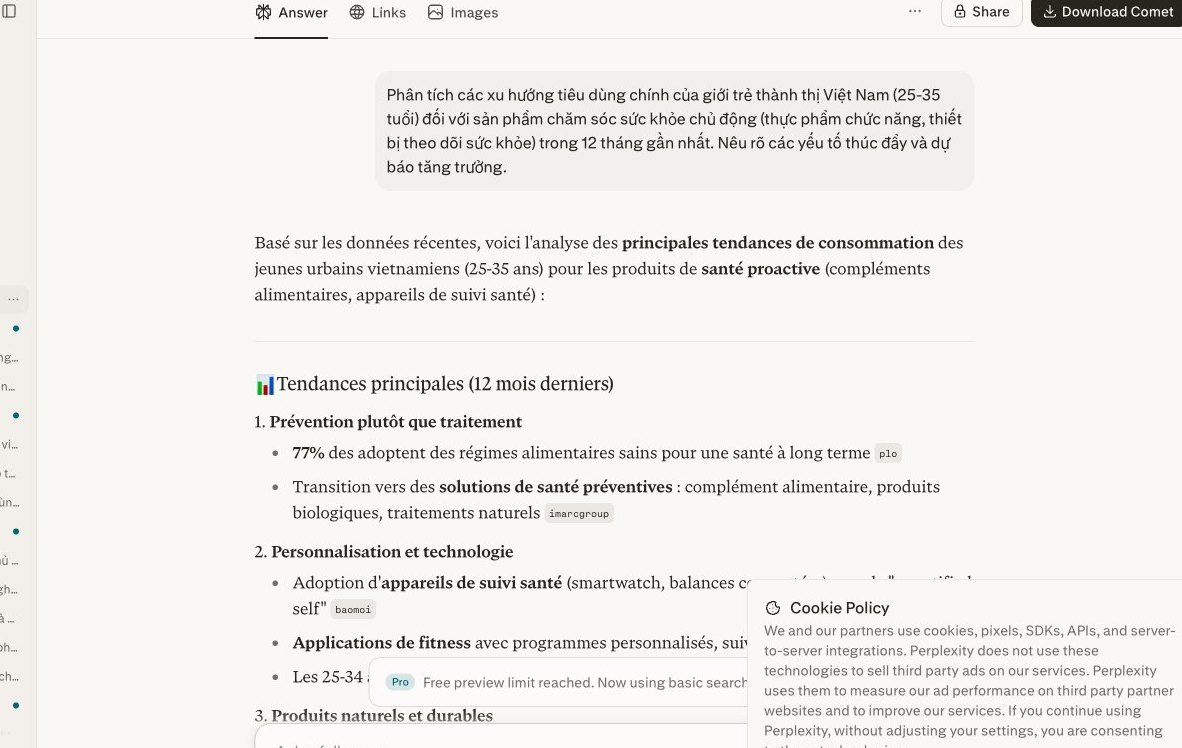
Perplexity is a great helper for market analysis. For it to gather information and also go deeper on insights, you need a clear process. The 3-step prompt formula below will help you build an in-depth report. It will spot industry trends in a structured way.
We have applied this approach successfully. The results are always reliable. The data is analyzed systematically.
The first step matters a lot. You need to know exactly what you want to find. Set a clear goal. For example, you want to learn about "organic cosmetics consumer trends in Hanoi over the next 6 months". Or maybe "analyze emerging competitors in the online education industry". The more specific the goal, the better Perplexity understands the request.
You also need to narrow the scope. Define the target market. Define the time frame. This is the foundation for every analysis that follows.
Once you have a goal, we build the prompt. Here is the formula that works:
A sample prompt might be: "Analyze E-learning market trends in Vietnam in 2024, summarize them into a report with 5 key points, prioritizing sources from the Ministry of Education and Training, FPT Education, and reputable market research firms." You will see a very different result.
The first result may not be polished. You need to review it. Evaluate the information Perplexity gives you. Then refine the question. Add specialized keywords. This helps the AI go deeper. You might want to "analyze the impact of TikTok Shop on Gen Z's household goods shopping behavior".
Choosing sources is also very important. Perplexity lets you focus on specific sources. You can ask it to use only reputable domains. Or research organizations. This keeps the results accurate and raises the quality of the report.
Perplexity saves you time. It gives you a complete view. Every business decision will rest on firmer ground.

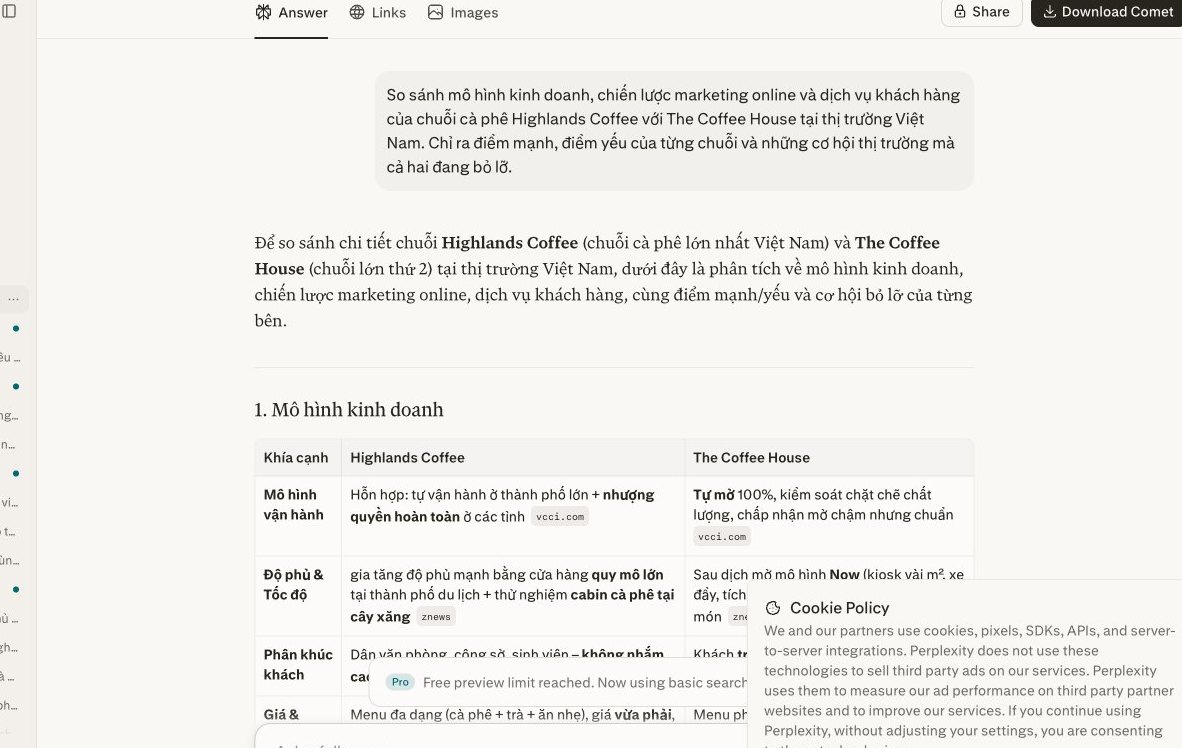
To keep your competitive edge, staying on top of competitor strategy is essential. We also need to re-assess our own position. Perplexity AI offers an especially effective "dual prompt trick". It helps you dissect a competitor's strategy and see your own gaps and untapped opportunities. It is the fastest way to get an objective view.
We at MONA use this method often. Let's walk through the specific steps. The tool is very useful. You will clearly see the strengths and weaknesses of both sides.
Perplexity has a very powerful Compare Mode. You can put any two entities side by side. It is a visual comparison. Enter your business name and a competitor's name. The system immediately pulls the information together. It gives you a first overview. Try it right away.
For example, say you own a fast-food restaurant chain. Your competitor is another brand that is growing fast. Enter both names in Compare Mode. Perplexity will search public data. It includes market share, business model, or standout points.
This feature saves research time. You get a fast overall picture. It is genuinely useful. It lays the groundwork for deeper analysis.
After the overview, the next step is to go deeper. Ask Perplexity to identify specific factors. Ask the AI to run a SWOT analysis of the competitor. Or simply list their strengths and weaknesses. Write a clear prompt. For example: "Run a SWOT analysis of [Competitor name] in the [Industry name] industry".
Perplexity will pull information from many sources, including financial reports, news, and customer reviews. The AI will produce a detailed analysis. It may cover their target market, pricing strategy, and distribution channels. It also highlights what they do well and what needs to improve. This is valuable information.
We use this method to understand competitors. It helps the marketing team see more clearly. From there, we build the right strategy. This brings strong results.
The competitor analysis is a valuable resource. Use it to look back at yourself. This is the most important step. Ask Perplexity a question. For example: "Based on the SWOT analysis of [Competitor name], what blind spots or opportunities might [My business name] be missing?"
The AI will give objective suggestions. It helps you see angles you might miss. It could be services you don't offer yet, or markets you haven't tapped. Or internal weaknesses where the competitor does better. These are views that are sometimes hard to see on our own. It opens up new directions.
For example, if the competitor is strong in digital customer experience, your business needs to review its systems CRM and online interaction processes. Perplexity helps us spot this. It makes clear what to prioritize. From there, you can adjust your strategy. We need to fill the gaps.
Competitor analysis is not only for learning. It is also for improving yourself. This dual prompt trick gives you a big advantage. It is a powerful tool.
The same features apply to these industries too:
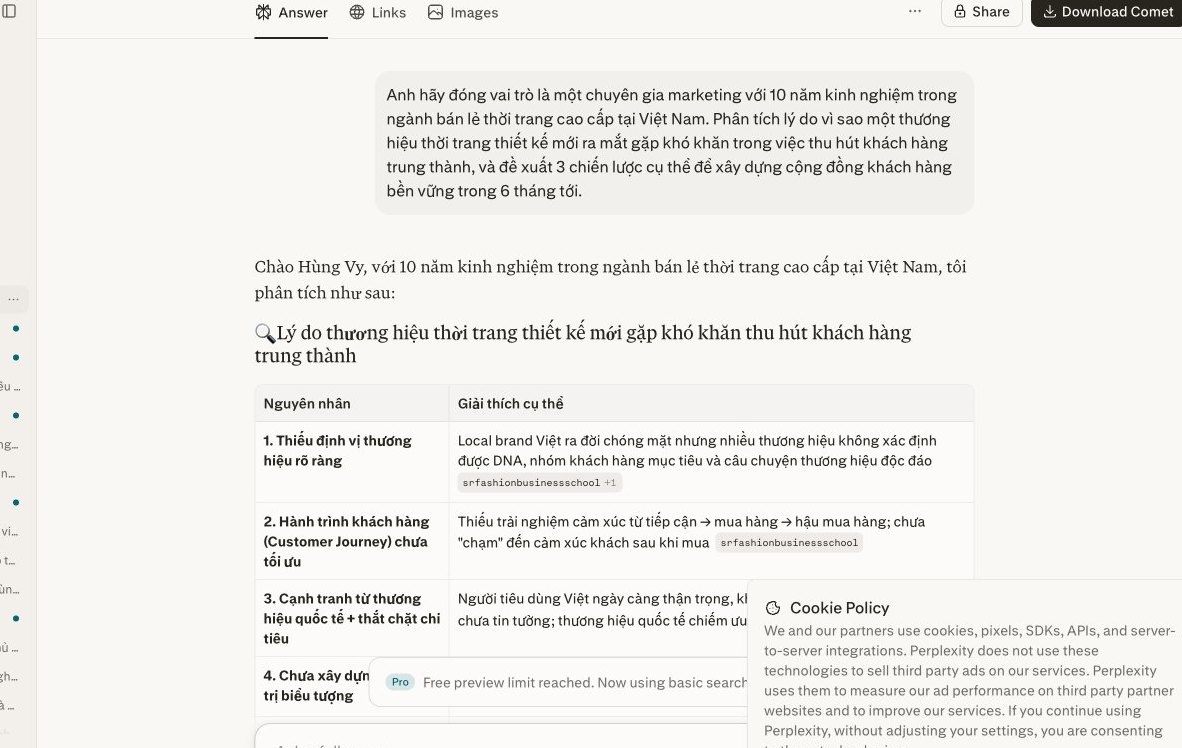
The `Role-play` technique helps Perplexity give deeper insights and suggestions. It feels like talking with a seasoned expert. You will get professional advice.
Perplexity will adjust its tone and reasoning. The result is much more valuable answers. Start using it today.
The first step is to assign Perplexity a clear role. Describe the position in detail. This helps the AI understand the context.
Ask Perplexity to play a "Marketing Director with 10 years of experience in F&B". Or a "B2B market data analyst". The more specific the information, the more accurate the result.
You can even add details about your goals or current challenges. Perplexity will focus better. It is a small tip, but an effective one.
Example prompt:
Act as a Marketing Director with 10 years of experience in the spa industry in major cities. You will advise on strategies to attract new customers.From now on, you are a supply chain analyst with 15 years of work experience in Vietnam. Give your view on optimizing import costs.After assigning the role, ask a specific question or make a specific request. Perplexity will use the knowledge that fits the role. The answer will be deeper.
Ask Perplexity for the "3 most effective marketing strategies". Or "How to build a sustainable supply chain". The goal is to draw on the experience of the assumed expert.
You can ask about industry challenges. Or the latest trends. The results will be well worth it.
Example prompt:
In this role, which 3 digital marketing strategies would you propose to grow revenue for the spa chain next quarter?Suppose I want to expand the market. Which customer segment would you advise me to focus on, and why?Perplexity can give good results. Still, reviewing them is essential. You need to make sure the information is accurate and fits.
Read the answer carefully. Look at the tone. Perplexity may need more editing. Don't hesitate to be specific.
If the answer falls short, ask Perplexity to "explain in more detail". Or "adjust to a more formal tone". This process is highly iterative.
Example prompt:
This analysis is very useful. Could you present it in a more confident, strategic tone?Please add projected figures or real case studies to illustrate this strategy more clearly.This is how Perplexity works best. Make the most of this tool. You will have a capable assistant.
Many business owners use Perplexity but haven't tapped its full potential. Perplexity has two powerful features: `Co-Pilot` and `Focus`. They help you filter out information noise quickly and concentrate on what matters most. The time we spend looking for insights drops considerably.

`Co-Pilot` is Perplexity's smart virtual assistant. It answers questions and also interacts proactively. `Co-Pilot` suggests related questions. It also clarifies your intent. This is very useful. You will get more accurate results.
To turn it on, just click the `Co-Pilot` icon (usually a paper plane) before asking your question. Or you can pick it after entering your first query. The AI will guide us. It helps pull out deeper information. For example, when you ask "SEO strategy for F&B", `Co-Pilot` might suggest "Do you want to learn about local SEO or content SEO for F&B?". This refines the query effectively.

The `Focus` feature lets you concentrate on the sources you want. Instead of searching the whole internet, we can be selective. You can pick `Academic`, `YouTube`, `Reddit`, `News`, or even `Wolfram|Alpha`. This removes a lot of unneeded information. The search results will be better quality. They also match your purpose more closely.
After entering your question, find the `Focus` icon (usually near the input box). Click it and a list of options appears. Pick the source you need. For example, if you want to learn about consumer trends from a scientific research angle, pick `Academic`. If you need tutorial videos, pick `YouTube`. `Focus` takes you straight to the point. It saves considerable effort.

The real power is in combining `Co-Pilot` and `Focus`. You will build an efficient search chain. It helps us stray less. This process cuts research time. You can start by turning on `Co-Pilot`.
For example, say you want to learn about the latest marketing strategies for Gen Z. Use `Co-Pilot` to clarify "which marketing strategy" and "which aspect of Gen Z". Then pick `Focus` on `News` or `YouTube` to see industry reports or expert opinions. This approach keeps results accurate. It also saves you considerable time.

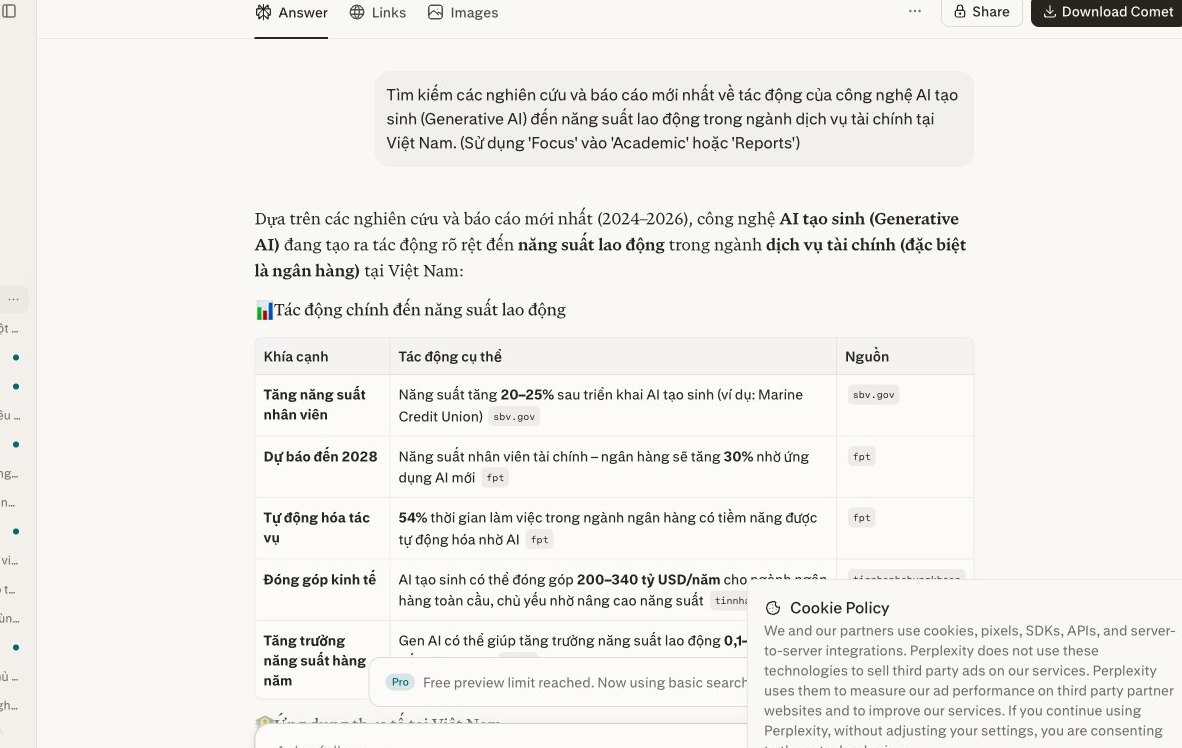
Perplexity is a powerful tool. It helps you search and analyze information quickly. It is very useful for standalone tasks. However, every tool has a "ceiling". We need to recognize that limit. Doing so helps your business go further.

Perplexity supports each employee very well. It provides information and suggests ideas. You can write marketing content more effectively. However, it remains a disconnected tool. Each user has to enter data and copy-paste by hand. Data cannot flow on its own across departments. This creates a lot of manual work. It slows down the whole business.
When you use Perplexity, you enter information into a public platform. Even with many security commitments, internal data still carries risk. This is especially true for sensitive business information. Moreover, Perplexity has no API for deep integration. It cannot connect to your existing CRM, ERP. This creates data silos. The business loses its overall view.

We at MONA understand the value of AI tools. We use them to streamline our internal processes. We also train customers to use Perplexity effectively. But we always say this is only the first step. For real automation, and to build a lasting competitive edge, businesses need a solution built from the ground up. Software designed specifically for them. It has to be based on their own data and processes.
MONA focuses on building automation software. These are self-contained modules with custom code. They are designed to fit seamlessly with your existing systems. Since 2016, we have worked alongside Vietnamese businesses. With . MONA has delivered over 14,000 projects successfully. Our customer retention rate is 85%. We use AI internally to raise the quality of our service. We also train customers to use new technology. The goal is to help businesses make the most of AI's potential. It does not stop at a single search tool.
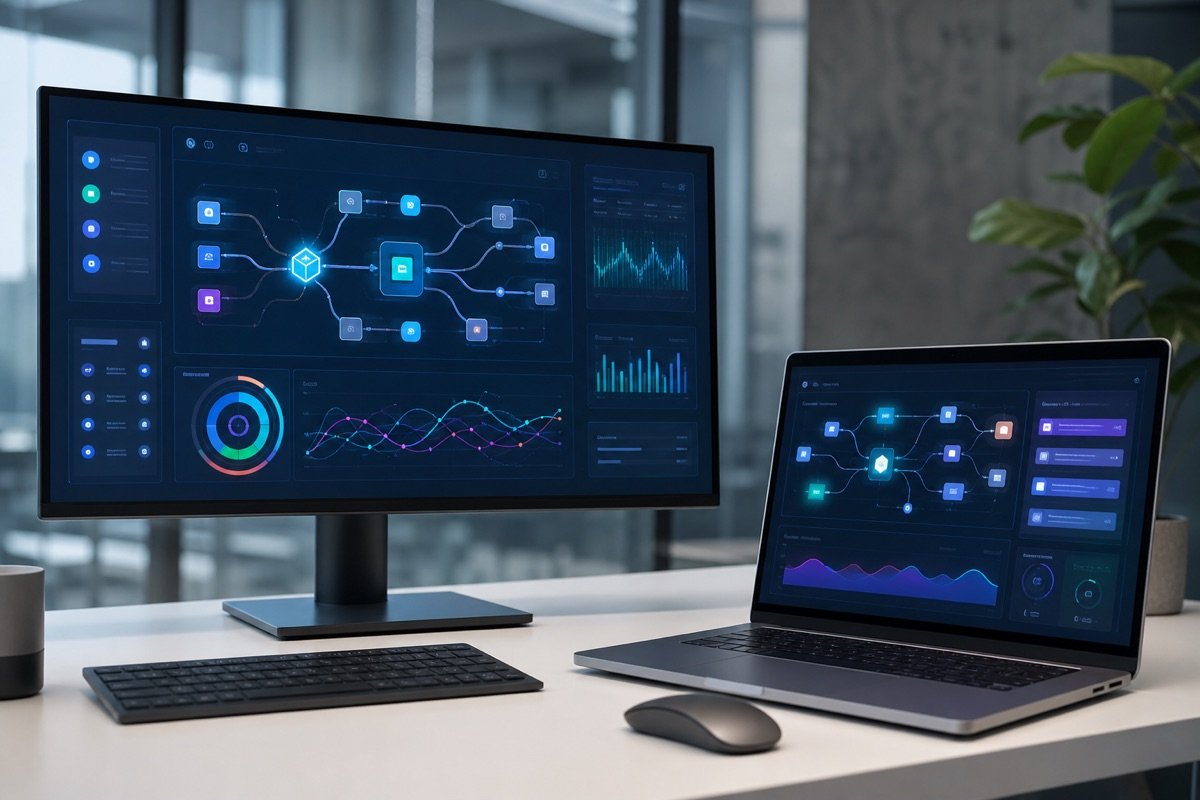
Feel free to keep your Perplexity prompts in a document while your team is small and you don't have many research topics. When each department writes in its own style, sources repeat, and results are hard to pull into one report, we can build a prompt library inside custom software, with forms, access rights, and a history of results.
Call 1900 636 648 so we can talk about bringing Perplexity prompts into your daily work. Clear commands, easy-to-check sources.
Further reading on the same topic:

CEO & Founder · The MONA
Founder of The MONA, who built a services company of 60+ staff with 14,000+ projects delivered. Khánh Hùng shares how he thinks about building systems that run themselves, automating a business, and the real lessons from delivering projects at MONA.
 254




Professional website
design services
Own a website with a beautiful, 100% exclusive design and a lifetime warranty, with the ability
to expand features flexibly as your business grows, starting today!






 MONA will never sell your information or send you spam


 MONA will never sell your information or send you spam
