
 MONA OS 2.0
 Partner with MONA


 Tự động hoá doanh nghiệp
 Cẩm nang SEO
 Digital Marketing
 Kinh nghiệm thiết kế website
 Hạ Tầng Server
 Giáo dục


 VI
 EN













Message us on
Zalo Official


 ProductsNew

 ProductsProducts
 Mới ra mắtKHA AI 2027App tự edit video, tự đăng mọi mạng xã hội, 2 phút mỗi ngày










 Website designLooks good and wins customers over.
SEO servicesBrings in customers searching for exactly what you sell.
 Tư vấn digital marketingKéo khách từ nhiều kênh, đo bằng số thật.
Corporate video productionVideos introducing your company, factory and team.
 NewAI video productionCompany story films made with AI.
 Custom software developmentCRM, ERP and HRM built for your business.
 Viết AI Agent theo yêu cầuĐặt riêng một trợ lý AI cho đúng việc của mình.
 Tư vấn chuyển đổi AIĐưa AI vào vận hành của cả công ty.
NewMONA LMSManagement for centers and schools.
MONA SkillHubInternal training for company staff.
 NHTQ systemEnd-to-end China–Vietnam shipping operations.
MONA JMSManagement for gold, diamond and pawn shops.
 MONA E-LearningA website with every feature you need to sell courses.
 How to sell online courses (course)More than 30 free lessons on selling courses on autopilot.
 MONA Cloudmonacloud.vnServers to get your apps and websites running.
 MONA Basemonabase.vnPostgres database, sign-in and file storage.
 MONA Mailmonamail.vnSend OTP, order and invoice emails from your software.
 MONA Paymonapay.vnAccept bank transfers via VietQR and notify your software when the money arrives.
 MONA eInvoiceComing soonIssue e-invoices that meet tax standards.
Gấu CườiTrả lời khách 24/7 trên web, Fanpage, Zalo và thu lead cho sale.
 Gấu TeleSalesGọi điện tư vấn, chăm khách như tổng đài viên thật.
Dê CườiTư vấn và chốt đơn cho shop ngay trong khung chat.
Gấu WebmasterNhắn nhóm Zalo là website được sửa xong.
 Gấu Pháp ChếSoạn hợp đồng, rà điều khoản trong vài phút.
 Gấu Báo GiáLên báo giá đúng mẫu và gửi khách ngay.
 AI chăm sóc khách hàngTheo dõi và giữ chân khách hàng cũ.
 Gấu Tuyển DụngLọc hồ sơ, hẹn lịch, phỏng vấn ứng viên.
 Mới ra mắt
KHA AI 2027
Xây kênh chuyên gia 2 phút mỗi ngày
Quay bằng điện thoại, AI tự edit video, tự đăng lên 16 nền tảng và tự trả lời bình luận, tin nhắn.
891.360lượt xem trên kênh CEO MONA sau 37 ngày
 Anh Khánh HùngCEO MONA đang dùng mỗi ngày
Xem app làm được gì
 AI
Gấu Cười MONA ĐANG TỰ XÀITrả lời khách 24/7 trên website, Zalo OA, Messenger và thu lead về cho sale.
Dê CườiChốt đơn bán lẻ và sàn: Shopee, TikTok Shop, web. Chăm cả khách sỉ, đại lý.
Gấu WebmasterCập nhật nội dung, tối ưu SEO website mỗi ngày.
Gấu TeleSalesGọi điện tư vấn, chăm khách như tổng đài viên thật.
Gấu Tuyển DụngLọc hồ sơ, hẹn lịch, phỏng vấn ứng viên tự động.
AI chăm sóc khách hàngGiữ khách cũ, cứu lead đã rớt cho phòng kinh doanh.
Gấu Pháp ChếSoạn hợp đồng, rà điều khoản trong vài phút.
Gấu Báo GiáLên báo giá đúng mẫu, gửi khách ngay khi có yêu cầu.
 Chuyển đổi AI toàn phầnGiải pháp tổng cho doanh nghiệp, 3 lớp triển khai.
 Viết AI Agent theo yêu cầuĐặt riêng một con AI gánh đúng nghiệp vụ của bạn.
 Custom softwareCRM, ERP and HRM with built-in AI automation.
 SEO & AEO thời đại AIĐược Google lẫn AI trích dẫn, không chỉ xếp hạng.
 Kiến thức AI cho doanh nghiệpBài phân tích, hướng dẫn ứng dụng AI vào vận hành.
 Free AI courses
 AI tools at work
App mới · KHA AI 2027
Xây kênh 2 phút mỗi ngày
AI tự edit video, tự đăng mọi mạng xã hội
Free consultation, 8am–10pm every day

04 August, 2026
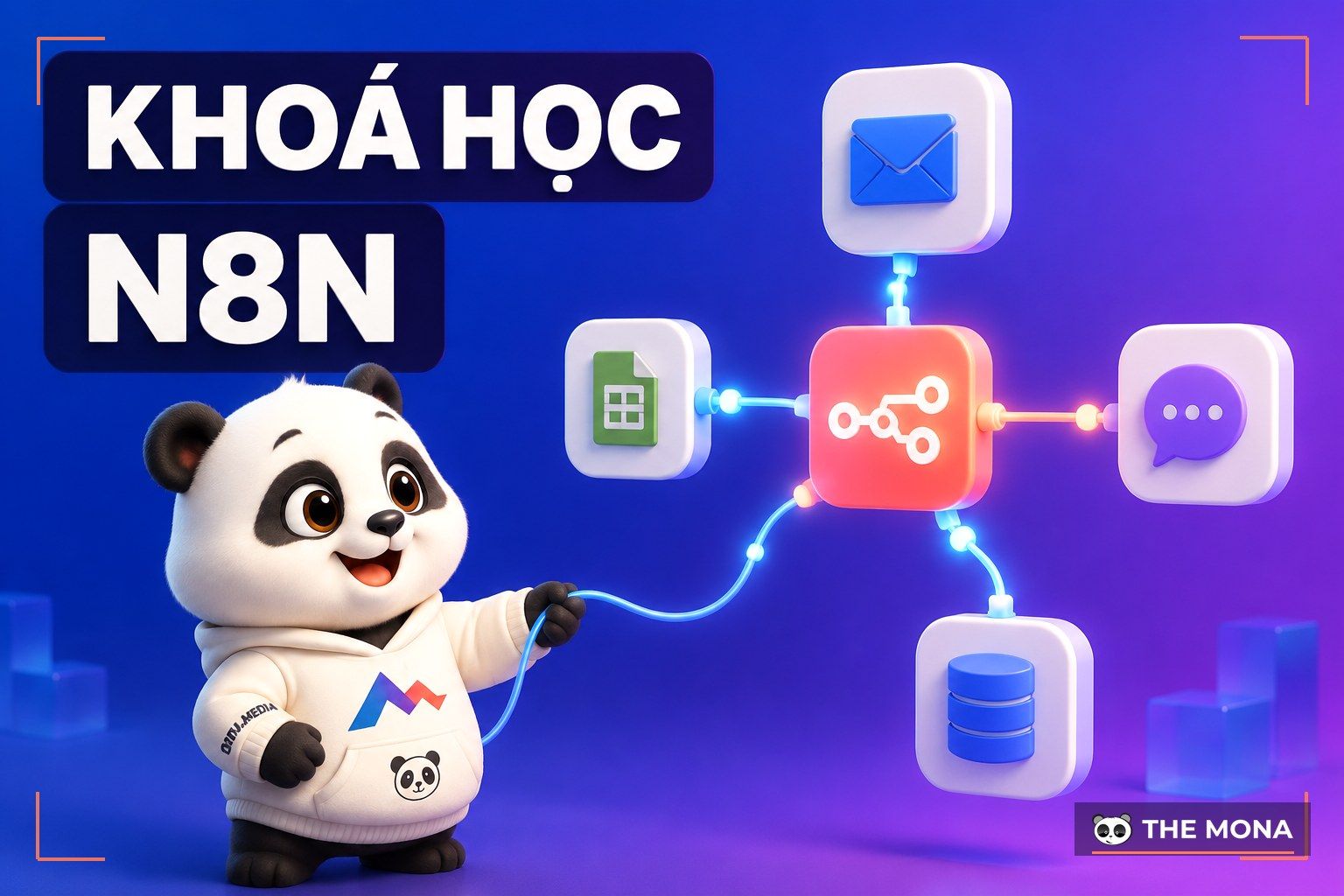
The ninth course in MONA's free AI course series: n8n from A to Z, built on a syllabus of over 8 hours that teaches how to build 8 real automation systems, from a personalized sales email writer to a machine that recycles content for social media posting. Before we start, we state our view plainly, as we promised you at the beginning of the series: n8n suits small scale or testing software ideas; for large scale, the live operations of a business, you should look into writing complete software. Drag-and-drop tools build fast and look intuitive, but a long chain of nodes is a chain of breaking points: one node failing in the middle of the night stops the entire pipeline, and in this course you'll see both the strength and the breakdowns with your own eyes (we've kept the stumbles in the middle instead of cutting them for polish, because that's where you learn the most). Learning n8n is still very worthwhile: it's the cheapest way to understand automation thinking, test which processes are worth automating, and serve your own light needs; its place relative to agentic workflows and custom software is mapped out in full at the end of the article.
Course contents
n8n is a drag-and-drop automation platform: you connect node (each node does one job: read a Google Sheet, call AI, send Gmail) into a pipeline, with a trigger at the head (a form is filled, an email arrives, an appointment time hits, a webhook is called) and the whole chain runs. Its strengths over similar tools (Make, Zapier): open source, self-hostable, and strong built-in AI nodes, with over 500 integrations.
Money first, to make things easy: the official cloud entry plan is 20 euros a month (billed annually, 2,500 executions), the Pro plan is 50 euros (10,000 executions), and business plans go higher; or self-host for free with the open-source version, in exchange for handling operations yourself and a much fiddlier Google account connection (you have to create OAuth yourself in Google Cloud Console instead of clicking one button). For beginners: stick with the cloud version for peace of mind and do the math later.
As for its place: after two courses vibe coding and agentic workflow, you already know the world of “AI plus code.” n8n is the third world: workflows drawn by eye. Its biggest gain isn't really technical, but communication: a node diagram shows at a glance how the process runs, and you can bring it into a room where everyone can weigh in: something a pile of code can't do for non-specialists. Its biggest loss, you'll see gradually across the eight pipelines: everything has to be clicked by hand, tested by hand, and fixed by hand when it breaks.


The first two hours of the syllabus go entirely to foundations, and here is the bare bones of it:
{{ $json.tenTruong }}; to pull data from a node more than one step back, use {{ $('Node Name').item.json.fieldName }}: this is the syntax that stumps you for a whole session if you don't know it.
$fromAI() letting the AI fill in parameters itself. The syllabus's experience matches our view: agents in business should be simple, more than 6-7 tools on one agent is a signal to split, and those pretty “agent calling five layers of agents” demos online are unstable and hard to sell to real customers.Six flow-control nodes carry the whole n8n world: If (split into two branches), Filter (keep or drop), Merge (merge branches), Split Out (unpack an array into separate packets), Loop Over Items (run packets one at a time, paired with the Wait node for a few seconds per round to dodge rate limits: n8n has no built-in mechanism to absorb that), and Limit (cap the quantity while testing). Plus four working habits the syllabus repeats again and again, which we'd like to put in a frame:

Once the foundations are taught, the syllabus gets to real building, and the first two pipelines are chosen very cleverly because they are short yet touch every technique:
Each of these two pipelines has under a dozen nodes, yet together they cover everything: triggers, reading and writing spreadsheets, AI returning JSON in a set template, filtering, and creating drafts for human review. After building both, you can confidently read and understand any n8n workflow online: the rest of the course is just stacking these bricks higher.
The business idea behind it is well worth learning: instead of a cold sales email, give a custom-made gift first to each prospect (a newsletter-style analysis written just for their company), and response rates jump well above a dry pitch letter. The pipeline: scrape a list of prospects from a business database (through the Apify intermediary scraping service to keep it cheap) → filter for those with both a website and an email (from 500 down to 247 qualified prospects) → scrape each prospect's website and compress it into Markdown → AI pass one reads it and extracts “company context + person context + 3 unique angles” → AI pass two writes the personalized newsletter from a ready template → pour it into Google Docs as a nicely formatted document (technical tip: the native Google Docs node can't insert formatting, so you have to add an HTTP Request that writes HTML into the document) → loop through each prospect with a 5-second pause per round. For Vietnamese businesses, this turns into swapping the “newsletter” for a preliminary quote, a website analysis, or a sample content plan: same frame.
A few numbers and small details from this pipeline are worth keeping intact. Scraping cost: going around through an intermediary scraping service is far cheaper than buying the raw data package directly (the syllabus spent about $120 on a dataset that would have cost many times more bought directly): the lesson is “the same data has several doors, compare prices before reaching for your wallet.” Input quality decides the usable rate: scraping returned 500 prospects, but filtering for “has both website and email” left only 247: don't promise yourself a number before filtering. And the AI step that writes the newsletter uses exactly the technique from the Claude course: give it a real sample written by a person as the tone standard, and the AI follows that template instead of flying free: much more stable quality.
The quote machine has an upgraded version in the syllabus for anyone who wants to go all the way: replace Google Slides with a dedicated quoting service that integrates e-signature and a payment button (50% deposit on signing, 50% on handover) by calling their API directly through HTTP Request: the customer views the quote, signs and pays the deposit in the same document, cutting out the back-and-forth emails entirely. For Vietnamese businesses, this thinking applies even with a different tool: a quote isn't a document to be read, it's a closing machine: the fewer the steps from “view” to “sign,” the faster the money arrives.

But the most valuable part of these two pipelines is the real breakdowns the syllabus hit along the way, which we've kept intact so you see the downside of drag-and-drop: the image generation node sometimes dies from trouble on the service's side, not your mistake; the AI-generated image links expire on their own after a while, so you have to download them right away; the Merge node accepts only two inputs, so a third means a workaround; the YouTube API doesn't distinguish short videos from long ones, so you infer it from the duration string with an ugly regex; the Code node says “no output data” even though the logic is right, and you end up switching to a Filter node; and the heaviest of all: a bug in n8n itself that makes variables from the previous loop bleed into the next, pouring one channel's data into another channel's table: you have to rig up an extra loop just to force it to forget the old variable. Read this chain and ask yourself: what if this were the invoicing pipeline at your company? That is exactly why there is a boundary in section 10.
The technical chain of the “read every page” machine is worth describing in detail because it is the most complex pipeline in the course: scrape the homepage → HTML Extract node pulls out all links → filter to keep only internal linking (those starting with a slash) → deduplicate → join the domain onto each link to scrape every subpage → compress to Markdown → AI summarizes each page into two paragraphs (with a rule to truncate input over 5,000 characters so one long page doesn't clog the whole pipeline) → Aggregate node collects all summaries for the same prospect into one array → AI reads the whole array and writes a multi-line opener. The prompt for the final step uses a 5-layer structure: role, rules, a sample input, a model output, and only then the real data. This is the “industrial-grade” prompt level you should copy for every important AI step, whatever the platform.
We close the hands-on part with the five mistakes beginners make most, gathered from the stumbles in the course itself: one, forgetting to switch the Test URL to the Production URL when turning on a live pipeline (the pipeline “dies” mysteriously); two, forgetting the Limit node while testing, so AI runs a hundred rounds and burns money for nothing; three, writing to a spreadsheet with a missing column, which wipes old data blank; four, trusting AI-generated code for expressions without knowing n8n doesn't support another library's loop syntax (you have to concatenate strings by hand); five, building one overly long workflow instead of splitting it into small pipelines that call each other: hard to debug, hard to test, hard to hand over. Pin these five lines next to your screen and you'll dodge quite a few sleepless nights.
After the eight pipelines, you have enough to draw your own map. We'll draw it for you, using over 10 years of building software and everything this very course exposes:

On money: the original course positions the systems in it at the international market rate of $1,500 to $15,000 per client deployment, and that number says something more worth thinking about than “go sell n8n door to door”: businesses are ready to pay real money for a properly automated process, whatever tool it's built with. If you're a business owner, the right view is the buyer's: which of the eight pipelines above is worth paying for at your company, and which version to buy: the drag-and-drop version that lives on one employee who knows n8n, or a version built as a system with a warranty and someone accountable.
And that's our invitation, familiar but with one more clause this time: if you want to test first, build it with n8n following this course, and when you see which process delivers real value, bring it to MONA and we will industrialize exactly that process: keep the logic you've already verified and rebuild it in production code with permissions, logs, load capacity and an operating commitment. If you'd rather go straight in: call 1900 636 648 or send it to info@themona.global, tell us the process eating the most people, and MONA will review it for free and tell you straight: this part n8n can do on its own at no cost, this part is worth building properly, at this price, paying back in this long. Over 10 years, 14,000+ projects, and the quote you sign is the price we deliver at.
What is n8n, and is it free? An open-source drag-and-drop automation platform: you connect nodes into a self-running pipeline. The cloud version starts at 20 euros a month; the self-hosted version is free, but you handle operations yourself and the account-linking is fiddlier.
Do you need to know code to use n8n? Not for the basics: drag, drop and fill in the boxes. But used to its full extent you'll run into expressions, JSON and regex as in the course: a bit of coding background makes you twice as fast.
How does n8n compare to Make and Zapier? Same drag-and-drop genre; n8n scores with open source, self-hosting, strong AI nodes and friendly per-run pricing at high volume. The thinking you learn in this course carries over to all three.
Should a large business run its core operations on n8n? Our straight view: no. n8n suits small scale and experiments; live business operations need complete software with tests, permissions, load capacity and someone accountable. In the course itself you've seen the breakages: a platform bug that bleeds loop variables, image links that expire on their own, nodes that die when an outside service hiccups.
n8n or agentic workflows, which should you learn first? Either works, but the smoothest path is to learn the agentic workflow course first to grasp the “AI judges, code executes” mindset, then learn n8n to add a tool for seeing the process visually. Both are free in MONA's series.
How long does it take to build an n8n pipeline? The pipelines in the course range from a few dozen minutes (the draft email machine) to a session (the content repurposing machine). Add the time to connect your service accounts for the first time: that often takes longer than the drag-and-drop part.
The next course in the series: intro to AI agents: the core theory fits into 2 hours, so you can talk about agents without getting bluffed. See you there.

CEO & Founder · The MONA
The founder of The MONA built a service company of 60+ staff with 14,000+ projects delivered. Khánh Hùng shares his thinking on building self-running systems, automating a business, and the real lessons behind MONA's projects.
 333




Professional website
design services
Own a website with a beautiful, 100% exclusive design and a lifetime warranty, with the ability
to expand features flexibly as your business grows, starting today!






 MONA will never sell your information or send you spam


 MONA will never sell your information or send you spam
