
 MONA OS 2.0
 Partner with MONA


 Tự động hoá doanh nghiệp
 Cẩm nang SEO
 Digital Marketing
 Kinh nghiệm thiết kế website
 Hạ Tầng Server
 Giáo dục


 VI
 EN










Message us on
Zalo Official


 ProductsNew

 ProductsProducts
 Mới ra mắtKHA AI 2027App tự edit video, tự đăng mọi mạng xã hội, 2 phút mỗi ngày










 Website designLooks good and wins customers over.
SEO servicesBrings in customers searching for exactly what you sell.
 Tư vấn digital marketingKéo khách từ nhiều kênh, đo bằng số thật.
Corporate video productionVideos introducing your company, factory and team.
 NewAI video productionCompany story films made with AI.
 Custom software developmentCRM, ERP and HRM built for your business.
 Viết AI Agent theo yêu cầuĐặt riêng một trợ lý AI cho đúng việc của mình.
 Tư vấn chuyển đổi AIĐưa AI vào vận hành của cả công ty.
NewMONA LMSManagement for centers and schools.
MONA SkillHubInternal training for company staff.
 NHTQ systemEnd-to-end China–Vietnam shipping operations.
MONA JMSManagement for gold, diamond and pawn shops.
 MONA E-LearningA website with every feature you need to sell courses.
 How to sell online courses (course)More than 30 free lessons on selling courses on autopilot.
 MONA Cloudmonacloud.vnServers to get your apps and websites running.
 MONA Basemonabase.vnPostgres database, sign-in and file storage.
 MONA Mailmonamail.vnSend OTP, order and invoice emails from your software.
 MONA Paymonapay.vnAccept bank transfers via VietQR and notify your software when the money arrives.
 MONA eInvoiceComing soonIssue e-invoices that meet tax standards.
Gấu CườiTrả lời khách 24/7 trên web, Fanpage, Zalo và thu lead cho sale.
 Gấu TeleSalesGọi điện tư vấn, chăm khách như tổng đài viên thật.
Dê CườiTư vấn và chốt đơn cho shop ngay trong khung chat.
Gấu WebmasterNhắn nhóm Zalo là website được sửa xong.
 Gấu Pháp ChếSoạn hợp đồng, rà điều khoản trong vài phút.
 Gấu Báo GiáLên báo giá đúng mẫu và gửi khách ngay.
 AI chăm sóc khách hàngTheo dõi và giữ chân khách hàng cũ.
 Gấu Tuyển DụngLọc hồ sơ, hẹn lịch, phỏng vấn ứng viên.
 Mới ra mắt
KHA AI 2027
Xây kênh chuyên gia 2 phút mỗi ngày
Quay bằng điện thoại, AI tự edit video, tự đăng lên 16 nền tảng và tự trả lời bình luận, tin nhắn.
884.102lượt xem trên kênh CEO MONA sau 36 ngày
 Anh Khánh HùngCEO MONA đang dùng mỗi ngày
Xem app làm được gì
 AI
Gấu Cười MONA ĐANG TỰ XÀITrả lời khách 24/7 trên website, Zalo OA, Messenger và thu lead về cho sale.
Dê CườiChốt đơn bán lẻ và sàn: Shopee, TikTok Shop, web. Chăm cả khách sỉ, đại lý.
Gấu WebmasterCập nhật nội dung, tối ưu SEO website mỗi ngày.
Gấu TeleSalesGọi điện tư vấn, chăm khách như tổng đài viên thật.
Gấu Tuyển DụngLọc hồ sơ, hẹn lịch, phỏng vấn ứng viên tự động.
AI chăm sóc khách hàngGiữ khách cũ, cứu lead đã rớt cho phòng kinh doanh.
Gấu Pháp ChếSoạn hợp đồng, rà điều khoản trong vài phút.
Gấu Báo GiáLên báo giá đúng mẫu, gửi khách ngay khi có yêu cầu.
 Chuyển đổi AI toàn phầnGiải pháp tổng cho doanh nghiệp, 3 lớp triển khai.
 Viết AI Agent theo yêu cầuĐặt riêng một con AI gánh đúng nghiệp vụ của bạn.
 Custom softwareCRM, ERP and HRM with built-in AI automation.
 SEO & AEO thời đại AIĐược Google lẫn AI trích dẫn, không chỉ xếp hạng.
 Kiến thức AI cho doanh nghiệpBài phân tích, hướng dẫn ứng dụng AI vào vận hành.
 Free AI courses
 AI tools at work
App mới · KHA AI 2027
Xây kênh 2 phút mỗi ngày
AI tự edit video, tự đăng mọi mạng xã hội
Free consultation, 8am–10pm every day

11 July, 2026

Importing goods from China through official channels means importing through an international border gate, with a foreign trade contract, customs declaration and full tax payment. The goods arrive at your warehouse with legal invoices and documents, and you can issue VAT invoices when you sell. In 2026 this is no longer an option but the required path. Orders under 1 million VND have been charged VAT since February 18, 2025, and Taobao and 1688 stopped shipping directly to Vietnam from May 21, 2025. Decree 122/2024/ND-CP even sets the deadline: from January 1, 2030, 100% of border import and export goods must go through official channels. In this article, the MONA team, who have built sourcing systems for 90+ order-sourcing businesses, explain the full process, taxes and documents from A to Z.
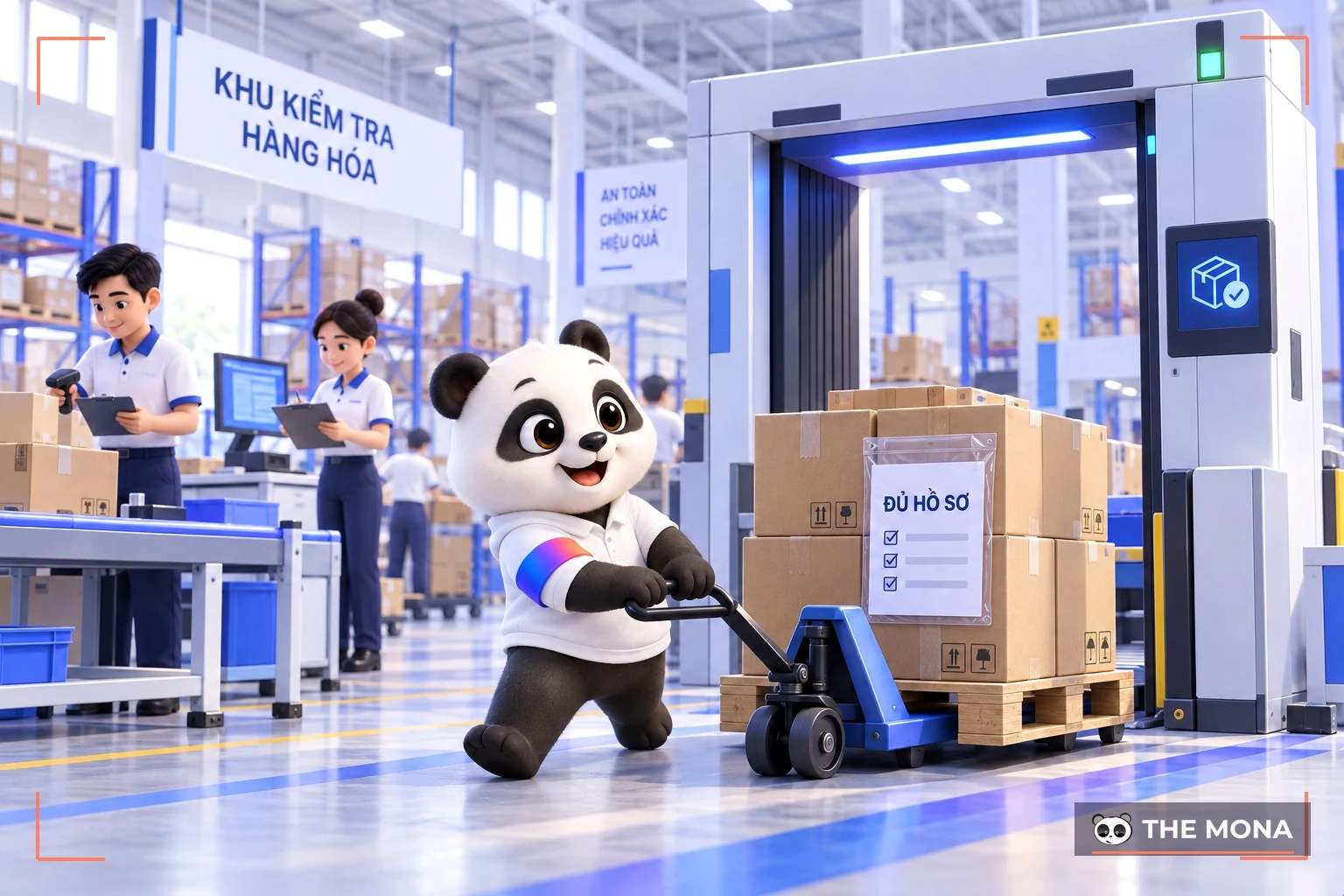
Official-channel importing from China is international trade done by the book: both sides sign a foreign trade contract, the goods cross an international border gate, are declared to customs, and import duty and VAT are paid as required. In return, the shipment carries full documents proving its origin and is fully protected by law.
Informal border trade is the opposite. It is a form of exchange for border residents: small value, simple procedures, low taxes and fees. For years, traders exploited this loophole to gather large volumes, split them into individual resident orders and move them across the border. The goods arrive fast and cheap, but with no invoices, no documents and nobody to protect you when something goes wrong.
To picture it, informal border trade is like hiring a motorbike courier to slip goods down village lanes. Fast and cheap while the road is open, but the moment there is a checkpoint, your goods stay where they are. Official channels are a container truck on the highway, paying all tolls, a little more expensive but sure to arrive with papers in hand.
The table below sums up the difference between the two:
| Criterion | Informal border trade | Official channels |
|---|---|---|
| Legal basis | Based on border resident policy, being tightened and abolished entirely from 2030 | Foreign trade contract, full customs declaration, protected by law |
| Tax | Avoided or paid at a very low rate, with a risk of back taxes at any time | Full import duty and VAT paid, with a C/O for preferential rates |
| Invoices and documents | None, so you cannot issue VAT invoices when you sell | Full set: contract, invoice, declaration, input VAT invoice |
| Risk | Seizure, confiscation, administrative fines, back taxes, capital tied up | Very low, and a contract serves as the basis for resolving disputes |
| Speed | Fast when the border is open; if the border jams, goods sit in storage with no return date | Stable, predictable schedules, independent of border trade policy |
| Cost | Cheap on paper, but add the risk of losing goods and it may not be cheap | Higher at first, offset by input VAT deductions and an accurate cost of goods |
Looking at this table, many of you may still find informal trade attractive because of the near-term cost. The problem is that the rules have changed. The next section shows the informal border door closing on a very clear roadmap.
From 2025 to 2030, the State has issued five consecutive documents tightening rules on low-value goods and border trade goods. Each milestone hits the wallet of anyone trading goods from China. We explain each one in plain language so you can follow even if you do not know the law.
February 18, 2025, Decision 01/2025/QD-TTg: orders under 1 million VND lose the VAT exemption. Previously, imported orders under 1 million VND sent by express delivery were exempt from both import duty and VAT. That is why cheap Chinese goods flooded in, at times 4 to 5 million small parcels a day, with total low-value imports in 2023 reaching 27.7 trillion VND. From February 18, 2025, the VAT exemption was abolished, leaving only the import duty exemption. That means every 200,000 VND item you order now carries VAT, and the cheap-price advantage from avoiding tax is gone. You can look up the document on the Government's Policy-Making Portal.
May 21, 2025: Taobao and 1688 stop shipping directly to Vietnam. This was a shock for order-sourcing businesses. Two of China's biggest wholesale and retail platforms stopped direct shipping to Vietnam, so goods can only arrive through intermediaries with an import legal entity. At the same time, many Taobao shops opened cross-border storefronts selling directly on Shopee Vietnam, meaning Chinese sellers themselves are moving to the official route. Vietnamese order-sourcing services lost their monopoly as “the people who know how to order on your behalf” and have to step up to the role of real importers.
August 1, 2025, Circular 29/2025/TT-BTC (issued May 26, 2025): customs collects VAT automatically. Before, collecting tax on small orders was held up by manual declaration, and many orders slipped through. From August 1, 2025, the customs system automatically calculates and collects VAT on low-value goods sent by express delivery. In plain terms: a machine collects it, not a person, and there is no more “dodge it if you can”.
July 1, 2025, Decree 117/2025/ND-CP: e-commerce platforms pay tax on behalf of sellers. Platforms withhold and pay tax on behalf of individual sellers at each transaction. Anyone selling Chinese goods on a platform now has revenue that is transparent to the tax authority. With transparent output and input with no invoices, that gap will sooner or later be questioned.
July 1, 2026, E-commerce Law 122/2025/QH15: foreign platforms must have a legal entity in Vietnam. Foreign platforms that want to operate must set up a legal entity, appoint a representative in Vietnam or post a deposit. Cross-border marketplaces are brought fully into the framework, and goods come with clear tax obligations.
January 1, 2029 and January 1, 2030, Decree 122/2024/ND-CP: the end of informal border trade. From 2029, border residents must handle procedures directly, ending the practice of lending their names to traders. From January 1, 2030, 100% of import and export goods across the border must go through official channels. You can look up the full decree on Thu Vien Phap Luat (Legal Library), and the tightening of tax on low-value goods was followed closely through 2025 by outlets such as VnExpress throughout 2025.
Put the five milestones together and the message is one: the State does not ban you from trading goods from China. It is closing, step by step, every route with no tax and no documents. Those who move early to official-channel importing have time to build a foundation; those who wait until 2030 will have to switch on the back foot.
The official-channel import process from China has 7 steps: find a factory, negotiate, sign a contract, prepare the C/O and documents, declare to customs, pay tax, receive the goods. It sounds long, but each step is quite logical. We go through each one with examples so even a first-timer can picture it.
Sourcing still starts from familiar places: 1688 for wholesale direct from factories, Taobao for retail with many designs. What differs for official-channel importers is how they choose partners. Prioritize factories with a clear business license, export capability, and willingness to sign a contract and issue documents.
For example, if you plan to import jackets, instead of choosing a shop with nice photos and a low price, ask directly: can the factory issue an invoice, and can it help with a Form E C/O? A factory that answers both smoothly is usually a well-run one.
Negotiating for official channels is more than haggling over price. You need to lock down 4 things: unit price, minimum order quantity (MOQ), delivery terms and each side's responsibilities. Delivery terms decide who pays freight and who bears risk in transit, for example whether the factory delivers at its own warehouse or all the way to the port or border gate.
From the systems we have built: ask for a quote that separates the cost of goods from shipping. A bundled quote sounds neat, but when declaring to customs it is hard to break out the taxable value, and customs may easily challenge the price.
The foreign trade contract is the backbone of the whole official-channel shipment. It states the goods, quantity, unit price, total value, delivery terms and payment method. Attached are the commercial invoice and the packing list (a detailed list of each package).
Think of this set of papers as the birth certificate of the shipment. Later, when customs asks, the tax authority asks, or you have a dispute with the factory, everything is checked against the contract. This is exactly where informal goods lose out: lose the goods and you lose everything, because there is no evidence.
A C/O (Certificate of Origin) is a certificate of the goods' origin, issued by the Chinese side for the shipment. It is one of the most valuable papers in the file. Goods with a C/O from China or ASEAN get preferential rates under trade agreements, and for many HS codes the import duty drops sharply compared with no C/O.
A standard document set for a shipment usually includes:
Miss one paper from this set and the shipment may sit at the border gate waiting for it. Every day of waiting means storage and yard fees.
When the goods reach the border gate, you (or a hired customs agent) file an electronic declaration on the customs system. The declaration covers the goods' HS code, value, origin and quantity. The HS code is an international goods classification number that determines the tax rate for that item.
The system routes declarations into lanes: green clears immediately, yellow checks the documents, red checks both the documents and the actual goods. Declared correctly with matching documents, most go through the green or yellow lane. Declaring an abnormally low value to dodge tax is a quick way to be flagged, face a price challenge and a post-clearance audit.
After the declaration is accepted, the system calculates the tax due, covering import duty and VAT. You pay through a bank, and once the money reaches the state budget the goods are cleared. We cover the exact calculation in a separate section below, with a numeric example.
Something many of you overlook: the VAT paid at import is deductible input VAT. When a business sells goods on, it charges output VAT; subtract the input from the output and the VAT you actually pay is far lower than the original figure. Go through informal channels with no customs declaration and there is nothing to deduct.
Once cleared, the goods are trucked to your warehouse. You count them against the packing list and note any shortages or defects so you can claim against the factory under the contract. The whole shipment goes into your accounting books at a proper cost of goods, covering the goods, shipping, taxes and fees.
From here on your goods are fully "clean": you can sell wholesale to agents with a VAT invoice, list on e-commerce platforms without worrying about being asked where they came from, and expand into supermarkets and retail chains, all of which now qualify.
The total cost of an official-channel shipment has 4 parts: the goods, international shipping, import duty and VAT, plus a service fee if you hire someone to handle the paperwork. The tax formula is not hard. The hard part is getting it right for each HS code. We worked through a sample order so you can see how the money moves.
The standard customs formula currently in use:
Illustrative example (assumed figures; real tax rates must be looked up by HS code for each product): you import 1,000 jackets at a purchase price of 200,000 VND each, so 200 million VND in goods. Freight and insurance to the border gate come to 20 million VND. The shipment's taxable value is 220 million VND.
Without a C/O (certificate of origin), assuming a 20% import duty rate: import duty is 220 million x 20% = 44 million VND. VAT at 10% on (220 + 44) million = 26.4 million VND. Total tax is 70.4 million VND, and the landed cost is about 290,400 VND per jacket.
With a Form E C/O claiming the preferential rate, assuming import duty drops to 0%: import duty is zero. VAT at 10% on 220 million = 22 million VND. Total tax is just 22 million VND, and the landed cost is about 242,000 VND per jacket.
The gap between the two scenarios is 48.4 million VND on a shipment with 200 million VND of goods. That is why we say the C/O is worth the money: for the same shipment, complete paperwork and incomplete paperwork give two very different cost bases. And that 22 million VND of VAT can still be offset against your output VAT when you sell.
This calculation repeats with every shipment, every HS code has its own rate, and having a C/O or not changes the result again. Doing it by hand in Excel works for a few orders, but at a few hundred orders a month errors creep in, and a wrong cost basis means a wrong selling price and wrong profit.

Yes. You can absolutely source from 1688 and Taobao through official channels, using an import trustee (ủy thác nhập khẩu) or a service provider with a legal entity. 1688 and Taobao are only places to find suppliers. What decides whether it is official-channel is how the goods reach Vietnam and whether they are declared.
In practice: you pick products on 1688 and Taobao as usual. The service provider consolidates orders, works with the factory to get the documents, files the import declaration in its own name (this is called an import trustee arrangement), pays the tax and delivers the goods to your warehouse with an invoice. Small buyers can get officially imported goods without setting up an import-export company.
Since May 21, 2025, when Taobao and 1688 stopped shipping directly to Vietnam, this trustee route has become the only official one. It is also a major turning point for the order-service industry. The "buy on behalf, consolidate, go informal" model is dying out along the legal timeline. The replacement is the full-service importer: take the order, handle the paperwork, handle the tax, deliver with a VAT invoice.
The market already has proof that this model works at scale. Ninja Direct, a full-service official-channel import system whose technology MONA Software built, serves about 1,500 businesses. It focuses on customers importing 100 million VND or more per month, and even advances 70-80% of the order value. That means a customer puts up only 20-30% of the capital and still imports a fully documented official-channel shipment.
Moving from informal ordering to official-channel imports, what you lack is not a license but an operating system. MONA was founded in 2016 and has over 10 years of experience, 60+ staff and 14,000+ projects. In this segment alone we have built import systems for 90+ order businesses. From inside all those systems, we see clearly that every business that comes through the transition in good shape shares the same 4 functional blocks.
Block 1: a landed-cost quote with tax, returned the moment a customer asks. In the informal era, an order customer only needed the exchange rate and shipping fee. In the official-channel era they ask a much harder question: what does this item cost me after tax? To answer it, the system has to look up the tax rate by product group, add import duty, VAT, freight and fees, and return one final number. Staff calculating by hand in Excel are slow and wrong, and a customer who waits 2 hours for a quote is a customer who leaves.
Block 2: document management for each shipment. The contract, invoice, packing list, C/O and declaration of each shipment must be tied to that shipment and traceable when customs runs a post-clearance audit. Documents scattered across Zalo and email are a ticking time bomb: when you need to cross-check, no one can find them.
Block 3: VAT invoices linked directly to orders. Business customers buy through official channels to get input invoices. The system must issue invoices that match each order and each product code, not hand-made one by one.
Block 4: an ordering portal connected directly to 1688 and Taobao. Customers search for products themselves and paste a link, and the system pulls the product information, converts the price and creates the order. They can follow the whole order lifecycle, from deposit to warehouse delivery, instead of messaging staff at every stage.
These four blocks are the core of the solution China import website design we deploy for order businesses. MONA NHTQ 7.0 adds an AI landed-cost quote: the customer sends a product link, and the AI extracts the price, estimates the tax and returns a landed figure with tax, plus an official-channel module for document management and customs declarations. Small order businesses can use it right away, and larger ones can customize it to their own workflow.
Not mandatory across the board in 2026, but the timeline is set in stone. Decree 122/2024/NĐ-CP provides that from January 1, 2029 border residents must complete procedures directly, and from January 1, 2030 100% of border import-export goods must go through official channels. The 2025 tax policies have already tightened a step ahead, so switching in 2026 is a proactive move, while waiting until 2030 means being forced.
The upfront cost is higher because you pay full tax, but the real total cost is not necessarily higher. Goods with a C/O from China or ASEAN get preferential import duty, and input VAT is deductible when you sell. Meanwhile, hand-carried and informal goods without a declaration carry the risk of fines, back taxes and losing the goods entirely if they are seized.
Yes, through an import trustee. You do not need to set up an import-export company. You only need to order through a service provider with a legal entity, who files the declaration in its own name, pays the tax and delivers the goods with the documents. Models like Ninja Direct even advance 70-80% to customers importing from 100 million VND per month.
The core document set includes a foreign trade contract, commercial invoice, packing list, bill of lading, Form E C/O and customs declaration. Goods under specialized management, such as cosmetics and food, need additional licenses and product registration. If you go through a trustee, they handle this whole set for you.
If you have been in the order business for years, you already feel the pressure: small orders no longer get the VAT exemption, Taobao and 1688 have closed direct shipping, and platforms now withhold tax on every transaction on the seller's behalf. Every quarter, the old model's margin gets another layer thinner, while competitors who already moved to official channels are steadily collecting the business customers who need your invoices.
Many of you keep telling yourselves to wait and see, in case the policy loosens. Looking at the 5 documents from Decision 01/2025 to Decree 122/2024, we will say it straight: there is no loosening ahead. The 2025 milestones are already in force, 2030 is the deadline and not the start date, and each new document only tightens the one before.
What really matters: your real problem is not tax. Everyone who imports officially pays the same tax, so the playing field is being leveled. The problem is that your system cannot yet handle tax: it cannot quote a landed price in minutes, cannot manage documents by shipment, and cannot issue VAT invoices that match each order. Whoever solves the system problem first will be standing at the front door when the whole market has to play by one set of rules.
MONA has built systems for official-channel imports from China for 90+ order businesses, from the ordering portal connected to 1688 to the AI landed-cost quote in MONA NHTQ 7.0. If you want to know which blocks your model needs and what the transition roadmap looks like, just book a consultation on import systems with MONA or call the hotline 1900 636 648. We will sit down with you and sketch out the system before you have to decide anything.

CEO & Founder · The MONA
The founder of The MONA built a service company of 60+ staff with 14,000+ projects delivered. Khánh Hùng shares his thinking on building self-running systems, automating a business, and the real lessons behind MONA's projects.
 240




Professional website
design services
Own a website with a beautiful, 100% exclusive design and a lifetime warranty, with the ability
to expand features flexibly as your business grows, starting today!






 MONA will never sell your information or send you spam


 MONA will never sell your information or send you spam
