
 MONA OS 2.0
 Partner with MONA


 Tự động hoá doanh nghiệp
 Cẩm nang SEO
 Digital Marketing
 Kinh nghiệm thiết kế website
 Hạ Tầng Server
 Giáo dục


 VI
 EN















Message us on
Zalo Official


 ProductsNew

 ProductsProducts
 Mới ra mắtKHA AI 2027App tự edit video, tự đăng mọi mạng xã hội, 2 phút mỗi ngày










 Website designLooks good and wins customers over.
SEO servicesBrings in customers searching for exactly what you sell.
 Tư vấn digital marketingKéo khách từ nhiều kênh, đo bằng số thật.
Corporate video productionVideos introducing your company, factory and team.
 NewAI video productionCompany story films made with AI.
 Custom software developmentCRM, ERP and HRM built for your business.
 Viết AI Agent theo yêu cầuĐặt riêng một trợ lý AI cho đúng việc của mình.
 Tư vấn chuyển đổi AIĐưa AI vào vận hành của cả công ty.
NewMONA LMSManagement for centers and schools.
MONA SkillHubInternal training for company staff.
 NHTQ systemEnd-to-end China–Vietnam shipping operations.
MONA JMSManagement for gold, diamond and pawn shops.
 MONA E-LearningA website with every feature you need to sell courses.
 How to sell online courses (course)More than 30 free lessons on selling courses on autopilot.
 MONA Cloudmonacloud.vnServers to get your apps and websites running.
 MONA Basemonabase.vnPostgres database, sign-in and file storage.
 MONA Mailmonamail.vnSend OTP, order and invoice emails from your software.
 MONA Paymonapay.vnAccept bank transfers via VietQR and notify your software when the money arrives.
 MONA eInvoiceComing soonIssue e-invoices that meet tax standards.
Gấu CườiTrả lời khách 24/7 trên web, Fanpage, Zalo và thu lead cho sale.
 Gấu TeleSalesGọi điện tư vấn, chăm khách như tổng đài viên thật.
Dê CườiTư vấn và chốt đơn cho shop ngay trong khung chat.
Gấu WebmasterNhắn nhóm Zalo là website được sửa xong.
 Gấu Pháp ChếSoạn hợp đồng, rà điều khoản trong vài phút.
 Gấu Báo GiáLên báo giá đúng mẫu và gửi khách ngay.
 AI chăm sóc khách hàngTheo dõi và giữ chân khách hàng cũ.
 Gấu Tuyển DụngLọc hồ sơ, hẹn lịch, phỏng vấn ứng viên.
 Mới ra mắt
KHA AI 2027
Xây kênh chuyên gia 2 phút mỗi ngày
Quay bằng điện thoại, AI tự edit video, tự đăng lên 16 nền tảng và tự trả lời bình luận, tin nhắn.
892.132lượt xem trên kênh CEO MONA sau 37 ngày
 Anh Khánh HùngCEO MONA đang dùng mỗi ngày
Xem app làm được gì
 AI
Gấu Cười MONA ĐANG TỰ XÀITrả lời khách 24/7 trên website, Zalo OA, Messenger và thu lead về cho sale.
Dê CườiChốt đơn bán lẻ và sàn: Shopee, TikTok Shop, web. Chăm cả khách sỉ, đại lý.
Gấu WebmasterCập nhật nội dung, tối ưu SEO website mỗi ngày.
Gấu TeleSalesGọi điện tư vấn, chăm khách như tổng đài viên thật.
Gấu Tuyển DụngLọc hồ sơ, hẹn lịch, phỏng vấn ứng viên tự động.
AI chăm sóc khách hàngGiữ khách cũ, cứu lead đã rớt cho phòng kinh doanh.
Gấu Pháp ChếSoạn hợp đồng, rà điều khoản trong vài phút.
Gấu Báo GiáLên báo giá đúng mẫu, gửi khách ngay khi có yêu cầu.
 Chuyển đổi AI toàn phầnGiải pháp tổng cho doanh nghiệp, 3 lớp triển khai.
 Viết AI Agent theo yêu cầuĐặt riêng một con AI gánh đúng nghiệp vụ của bạn.
 Custom softwareCRM, ERP and HRM with built-in AI automation.
 SEO & AEO thời đại AIĐược Google lẫn AI trích dẫn, không chỉ xếp hạng.
 Kiến thức AI cho doanh nghiệpBài phân tích, hướng dẫn ứng dụng AI vào vận hành.
 Free AI courses
 AI tools at work
App mới · KHA AI 2027
Xây kênh 2 phút mỗi ngày
AI tự edit video, tự đăng mọi mạng xã hội
Free consultation, 8am–10pm every day

18 March, 2023

Blockchain is still a controversial topic. Some say it's a scam, others say it's the breakthrough technology of the future. But what is blockchain really? How can it be applied to improve everyday life?
The article below will answer that for you.
Blockchain is a special form of database storage. This database cannot be tampered with by anyone, including the owner, the person hosting the server, the technician on staff, or hackers around the world.
Without blockchain, when you make a bank transfer, the details of your transaction are recorded in a database we'll call a "ledger". This "ledger" then does calculations, such as adding, subtracting, multiplying and dividing, to produce the final result, your balance.
Here is a concrete example:
Today I go to the bank and deposit 10 million VND. The bank writes in the ledger: "Mr. Hung just deposited 10 million into account 123456".
The next day I transfer 1 million to Mr. B, so the bank adds another line: "Mr. Hung transferred 1 million to Mr. B".
From those 2 lines, the bank knows my account balance. The bank's "ledger" does the math: take the original 10 million, subtract the 1 million sent to Mr. B, and the result is 9 million.
That is how a bank "ledger" works. In other words, it is how the bank stores data.
The bank's way of storing data described above made a "Japanese guy" suspicious.
He was afraid bank staff could edit his money whenever they wanted. He also worried that a hacker might attack the system and change his transaction to: "the Japanese guy transfers 10 million to the hacker's account".
So he designed a new way of storing data called blockchain, to stop anyone from editing that database.
Say 4 people take part in a blockchain system: A, B, C and D. Two transactions happen in the system:
1. A sends B 15 BTC.
2. C sends B 25 BTC.
When transactions happen, each of the 4 people has to write the 2 transactions on their own "sheet of paper", including D, who isn't part of either transaction. So the 4 "sheets" have identical content.
At the end of the session, the 4 "sheets" are gathered and compared to produce the "final page". The content of the "final page" is naturally no different from the content of the 4 "sheets".

The content of the "final page" is no different from the content of the 4 "sheets"
But what if one "sheet" is written differently from the other 3? In that case, the different "sheet" will be rejected. The final result is still the content written on the other 3 sheets.
Going back to the example above, we can see this:
If B writes that A sent him 55 BTC instead of 15, B's "sheet" is not accepted by the system. B's final balance is still just 15 + 25 BTC = 40 BTC. The "final page" will still show as follows:
Continuing the example, when the session ends, the "final page" is sealed to prevent it from being hacked. When sealing it, the blockchain system assigns it a code. This code uses an algorithm called a verification algorithm, which I won't go deep into in this article.
To find the seal code for this "final page", people use a lot of computers to run that verification algorithm. A lot of people take part in this verification work , and whoever finds it first gets paid.
Example: Someone sets up a very powerful rig. Every 10 minutes they jump into some blockchain system to find the seal codes of the "final pages". Under the rules, whoever finds it first gets paid. That means the more powerful and faster your machines, the easier it is to find seal codes and the more reward you earn than others.
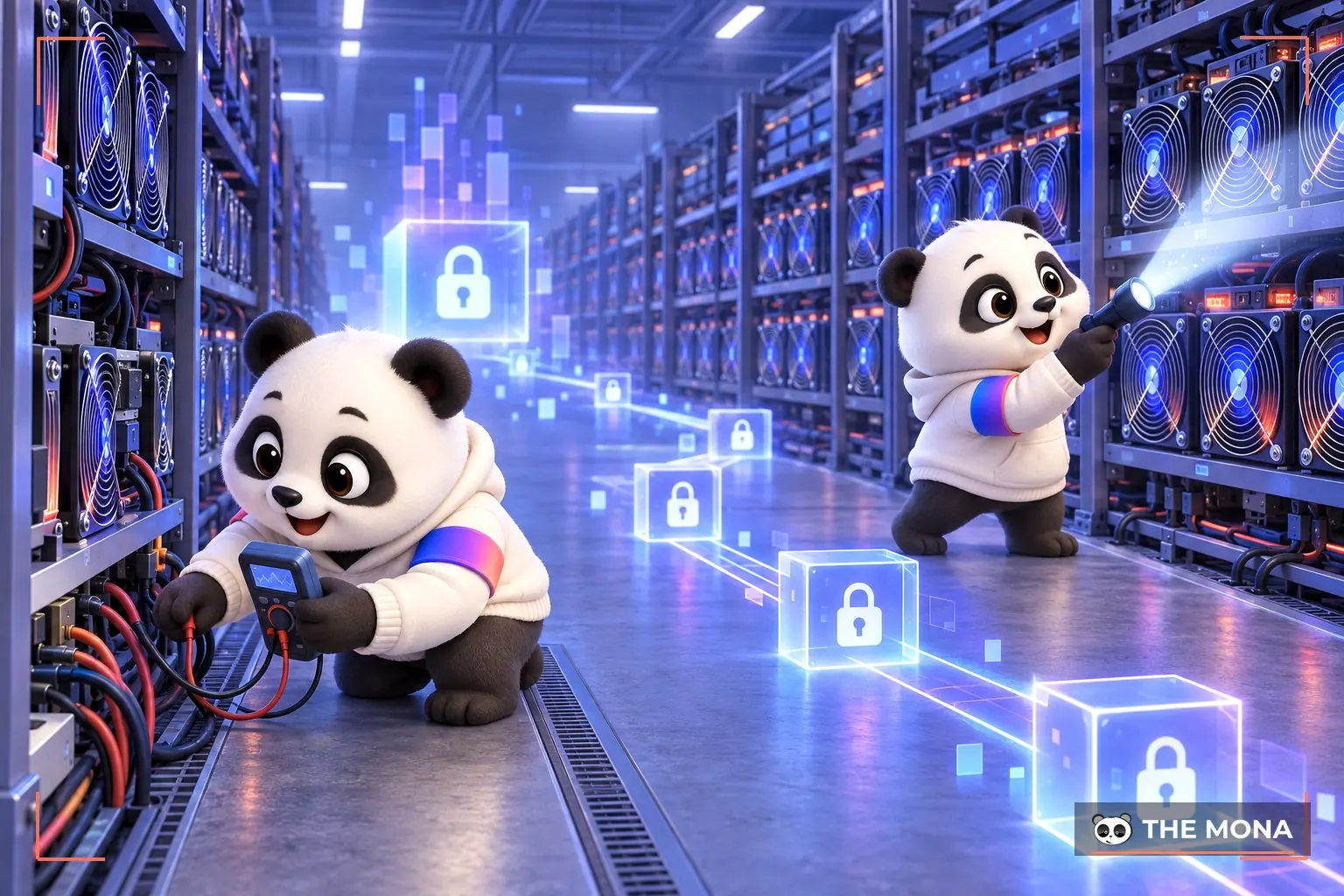
Each participant sets up a powerful system to "mine bitcoin".
That is the activity of "mining Bitcoin“.
But "mining Bitcoin" is not like mining minerals, which eventually run out. The reward for each seal code found drops after every 210,000 codes. Beyond 210,000 codes, the Bitcoin a person owns will not grow much more. In other words, the pace at which one person gains Bitcoin slows down, keeping the total Bitcoin in the world within a controlled limit, so it cannot inflate.
In addition, people have calculated that the electricity cost of "mining Bitcoin" is about $4500/BTC/person (including the risk of mining but not winning because someone else "mined" first). As the "mining Bitcoin" reward drops, Bitcoin's value drops too, until it falls below this $4500 figure and miners stop. Because even if they keep going:
So at that point people will stop mining, which means it's also hard to say "Bitcoin has run out", the way minerals can be exhausted.
As analyzed above, many people set up extremely powerful computer systems to find the seal codes. Each seal code uses data from the transaction before it as the basis for the algorithm. This is why blockchain has the word "chain", meaning a link in a chain.
For example: if the "sheet" above has a total of 40, the ledger has an algorithm, say, that takes the transaction total and adds 1, which gives a new number, "41". Then I use this number 41 in the algorithm to produce the seal code of "sheet" number 2.
If someone edits the transaction data to 55 BTC, the ledger's algorithm will not produce the number 41. That "sheet" will not be accepted.
To edit a blockchain you would need to change and rearrange the order and details of transactions so that the total comes out to 41. But each "sheet" holds hundreds of millions of transactions, so editing one is completely unthinkable.
From the information above, in theory "Bitcoin will collapse when a 51% attack happens".
As in the first example, 4 people take part in the blockchain system and write on 4 different sheets. If 3 of the 4, more than 50%, cheat, the information in the blockchain will be changed.
That is: instead of only B, C and D also change their sheets to "A sent B 55 BTC", and the blockchain system will accept this "new" value. It is no longer accurate. And a database that is no longer accurate is no longer a trustworthy database.

B, C and D all change it to "A sent B 55 BTC"
However, millions of people use blockchain systems around the world. For a 51% attack to happen, you would need to get a huge number of people to edit transactions at the same time, all with the same content.
That is also unthinkable, so the fear of a 51% attack is a needless worry.
Blockchain has been around for 10 years. In those 10 years, it has had 3 standout applications:
Blockchain's first and most prominent application is creating its own currency system. But this accidentally made blockchain a stepping stone for speculation and currency hoarding. "Hoarding currency" or "trading Bitcoin" and so on are many fancy names for this activity, but in reality it is no different from "gambling".
Blockchain: gambling in disguise
Because how Bitcoin goes up and down in price is beyond any individual's knowledge. A currency's value is affected by many factors, most of them state secrets, and only heads of state have enough information to judge the trend of a currency's price.
When Bitcoin first appeared, many speculators rushed to buy and hoard it. This is called "money laundering" and "speculative hoarding". Thanks to this, Bitcoin's value rose in a short time. But once people stop speculating on Bitcoin, nobody knows if its price will keep rising. An ordinary person mining Bitcoin, even reading news about Bitcoin, cannot know this either.
People are just betting their luck. So "mining Bitcoin" is purely gambling!
This second application comes from the very "anonymous transaction" feature that people praise.
However, not many people truly need "anonymous transactions" . Only a few people use this feature, and usually for unhealthy purposes such as: illegal transactions and funding terrorist activities.
Example: when I want to fund an organization or a terrorist activity, I certainly won't use my Vietcombank account or any other account tied to my identity. Instead, I'd use an anonymous form of transaction like blockchain and Bitcoin to avoid being tracked by police and authorities.
Other illicit activities such as terrorism and extortion also use blockchain's "anonymous transaction" feature. If a hacker or kidnapper demands that the victim's family transfer money through a Bitcoin or Ethereum wallet, the police are helpless in tracing the culprit.
As you can see, I'm not exaggerating: if you're an ordinary person, have you ever needed this anonymous way of transferring money? If anything, I want the bank to monitor my transactions so that if something goes wrong, they can help me get back the money I lost.
Blockchain's last standout application is also the reason it appears so often in the media: a front for ICO scams.
And this is how an ICO scam works:
They launch a new ICO crypto coin, then spread the word that its price will rise quickly in the coming days. They advise you to buy and hoard these ICO coins while the price is low, because by the time the price rises it will be too late.
But as I said about blockchain's application number 1: no ordinary person has enough macro market information to be sure whether Bitcoin will rise tomorrow. You will have to hold those coins and wait for the price to rise, day after day, with no certainty at all.

Nobody can be sure whether the Bitcoin price will go up or down tomorrow
When they launch those ICO coins, they intend to scam you. They "bait" you and wait for the fish to get caught in the net.
"Baiting" the price of an ICO coin is easy. One of the basic rules affecting a currency's value is its supply and demand. Crypto coins such as Bitcoin and Ethereum go up and down in price with the volume of buying and selling in an ICO. To "bait" you, they only need to place buy orders for the ICO coin on the market, and its value rises automatically. That gives you the illusion that "the coin is really rising in value", and you rush to buy.
All the information you receive about the ICO coin "going up and down in price" is just information created by big players and scammers. You are just one fish in the tank. Or maybe you know that and decide to trick other fish into the net. You may accidentally catch a few smaller fish, but if you don't swim away in time, bigger fish will swallow you too.
It is simply a tiered scam.
That said, to be fair, blockchain is just a plain kind of database; it isn't bad, but people have made it bad. But personally, I don't see blockchain as a great, superior technology. That is why in 10 years there has been no decent, proper application of blockchain. In 10 years, not a single bank in the world has accepted payments or transfers in Bitcoin or any other crypto coin.
Many experts expect blockchain to be used to create an advanced, secure currency exchange. This trading system would serve payments, money transfers and so on, much like a bank.
Blockchain does have a few minor advantages for building its own currency exchange, such as:
However, these advantages are not better than traditional methods. Its benefits are not big enough for people to replace the banking system with blockchain.
On the contrary, blockchain has fatal flaws when used as a currency exchange.
A currency exchange needs money to carry out transactions. But a blockchain exchange doesn't use any currency managed by the governments of the world, such as the US dollar, British pound or Japanese yen. It uses its own currencies, the most common being Bitcoin and Ethereum. However, those 2 currencies, like others created with blockchain technology, are not considered legal tender because they don't "hold value".

Ethereum, like Bitcoin, is not considered a currency.
Here is an example:
I'm a seller who wants to sell a laptop for $4000. I will sell that laptop to anyone who pays $4000 in cash, then use that money to buy a new laptop and keep doing business. However, if someone wants to buy my laptop for 1 Bitcoin (say 1 BTC = $4000 at that time), I won't sell. Because Bitcoin doesn't "hold value". If I accept 1 BTC for the laptop, but the next day 1 BTC is no longer worth $4000, I can't restock to keep selling.
Being unable to "hold value" makes the value of Bitcoin and other blockchain currencies keep fluctuating, which hinders transactions. So those coins are not considered legal tender. And since a blockchain exchange has no legal currency, it can't be considered a legal exchange. No major bank in the world accepts transactions in Bitcoin or Ethereum.
In addition, blockchain is designed to work without any third-party intermediary. As I said in the section on illegal transactions enabled by anonymity: having no third party in charge isn't necessarily a good thing.
Example: if you lose your bank card or someone steals it, you can call the hotline for help, such as locking the card urgently or changing the PIN. Without a third party like a bank stepping in, you might lose everything.
On the other hand, blockchain's performance is extremely poor, because its way of recording and encrypting data is too complex and consumes too much electricity.
Today, VISA handles 56,000 transactions per second, but the Bitcoin system handles only 7 transactions per second. That number is far too low to meet the needs of millions of people around the world.
In short, because of these huge drawbacks, blockchain cannot become an effective form of payment or money transfer.
Currently, to send money across borders, banks use the SWIFT code system, while ordinary people can use online e-wallets such as PayPal, Skrill, Stripe and Western Union.
Blockchain systems allow free, anonymous cross-border transfers that no bank or government agency controls. That sounds nice, but if something goes wrong, nobody will help you sort it out.
Example: I have a Canadian friend whose bank account was hacked. The hacker used control of the account to ask the bank to transfer money to his own account all the way in Zimbabwe. However, the bank locked my friend's account right after, because it noticed something suspicious in the transaction.
Cross-border transfer is a macro-level activity: once money leaves your pocket and goes to a faraway country, it is very hard to get back. Without banks and regulators to monitor and protect them, customers can easily fall victim to sophisticated attacks that seize their assets.
So blockchain's advantage of "cross-border transfers with no intermediary" is not really necessary, and sometimes it is a double-edged sword.
What is a smart contract? A smart contract is a contract first drafted by lawyers and legal experts, then handed to programmers to rewrite in programming language and methods. Once the parties complete the written terms, the money or the terms in the contract are carried out and transferred. Smart contracts are said to be highly accurate, save time and minimize legal disputes.
However, this application is not very groundbreaking. A similar application already exists, Amazon Contract, but that technology has nothing to do with blockchain.
Not to mention, one of the supposed advantages of smart contracts, no legal disputes, is completely impossible.
Basically, the content of a smart contract is still drafted by legal experts, and programmers only convert it to programming language. If ordinary contracts can lead to legal disputes, smart contracts can too.
Example: the contract states that party A must deliver 1 ton of construction steel to party B. However, when the steel is delivered, party B refuses to pay because "the steel is not up to quality". And of course, only a court can decide who is right.
In short, using blockchain for smart contracts doesn't bring much benefit either.
Blockchain's most praised application is often said to be creating financial management software, medical records, citizen records and more that are extremely effective and secure. In reality, there are already many effective record management systems that don't need blockchain.
Example: in the US, everyone is issued a Social ID number. When government agencies look it up on a computer, they can see all the necessary information about someone, such as their elementary school, criminal record, outstanding college tuition, or even how many times they've had a tooth pulled.
Applying blockchain does little to improve such management software. As for "data integrity", that depends entirely on how well government agencies secure their systems. In reality, break-ins that steal user data from government record systems rarely happen. They mostly happen in movies, by the hands of genius hackers.
As mentioned, the electricity cost of "mining Bitcoin" is about $4500/BTC/person. With an electricity bill that large, we can imagine how much power it takes to mine 1 Bitcoin. According to research, mining $1 worth of Bitcoin uses 3 times as much electricity as mining $1 worth of gold.

Blockchain technology is consuming the world's electricity.
Multiply that figure by the millions of Bitcoin in existence and we get a terrifying amount of electricity. Denmark, the first country in Europe to go cashless and use only cards, is a leader in developing and using advanced technology. Yet the total electricity all Danish people use in a whole year is less than the energy used to mine Bitcoin in just a few months.
As you can see, the modest advantages of Bitcoin in particular and blockchain in general are not enough to cover its flaws, especially the huge global energy waste.
Above, I've introduced how blockchain works, its negative applications today, and how feasible other applications might be in the future. In reality, blockchain is not a huge technological breakthrough that can change how the world runs, as many people think. So far, people still haven't found effective ways to use it.
I'll say it plainly: at its core, blockchain isn't bad. But right now it is only used to lure and scam people who know little about technology and are keen to get rich from crypto. Using blockchain for other, more decent purposes is still not feasible and has no real prospects. The best advice is to stay away from concepts like blockchain, Bitcoin and crypto, so bad actors can't take advantage of you and leave you with nothing.

CEO & Founder · The MONA
The founder of The MONA built a service company of 60+ staff with 14,000+ projects delivered. Khánh Hùng shares his thinking on building self-running systems, automating a business, and the real lessons behind MONA's projects.
 1,5K




Professional website
design services
Own a website with a beautiful, 100% exclusive design and a lifetime warranty, with the ability
to expand features flexibly as your business grows, starting today!






 MONA will never sell your information or send you spam


 MONA will never sell your information or send you spam
