
 MONA OS 2.0
 Partner with MONA


 Tự động hoá doanh nghiệp
 Cẩm nang SEO
 Digital Marketing
 Kinh nghiệm thiết kế website
 Hạ Tầng Server
 Giáo dục


 VI
 EN










Message us on
Zalo Official


 ProductsNew

 ProductsProducts
 Mới ra mắtKHA AI 2027App tự edit video, tự đăng mọi mạng xã hội, 2 phút mỗi ngày










 Website designLooks good and wins customers over.
SEO servicesBrings in customers searching for exactly what you sell.
 Tư vấn digital marketingKéo khách từ nhiều kênh, đo bằng số thật.
Corporate video productionVideos introducing your company, factory and team.
 NewAI video productionCompany story films made with AI.
 Custom software developmentCRM, ERP and HRM built for your business.
 Viết AI Agent theo yêu cầuĐặt riêng một trợ lý AI cho đúng việc của mình.
 Tư vấn chuyển đổi AIĐưa AI vào vận hành của cả công ty.
NewMONA LMSManagement for centers and schools.
MONA SkillHubInternal training for company staff.
 NHTQ systemEnd-to-end China–Vietnam shipping operations.
MONA JMSManagement for gold, diamond and pawn shops.
 MONA E-LearningA website with every feature you need to sell courses.
 How to sell online courses (course)More than 30 free lessons on selling courses on autopilot.
 MONA Cloudmonacloud.vnServers to get your apps and websites running.
 MONA Basemonabase.vnPostgres database, sign-in and file storage.
 MONA Mailmonamail.vnSend OTP, order and invoice emails from your software.
 MONA Paymonapay.vnAccept bank transfers via VietQR and notify your software when the money arrives.
 MONA eInvoiceComing soonIssue e-invoices that meet tax standards.
Gấu CườiTrả lời khách 24/7 trên web, Fanpage, Zalo và thu lead cho sale.
 Gấu TeleSalesGọi điện tư vấn, chăm khách như tổng đài viên thật.
Dê CườiTư vấn và chốt đơn cho shop ngay trong khung chat.
Gấu WebmasterNhắn nhóm Zalo là website được sửa xong.
 Gấu Pháp ChếSoạn hợp đồng, rà điều khoản trong vài phút.
 Gấu Báo GiáLên báo giá đúng mẫu và gửi khách ngay.
 AI chăm sóc khách hàngTheo dõi và giữ chân khách hàng cũ.
 Gấu Tuyển DụngLọc hồ sơ, hẹn lịch, phỏng vấn ứng viên.
 Mới ra mắt
KHA AI 2027
Xây kênh chuyên gia 2 phút mỗi ngày
Quay bằng điện thoại, AI tự edit video, tự đăng lên 16 nền tảng và tự trả lời bình luận, tin nhắn.
886.668lượt xem trên kênh CEO MONA sau 36 ngày
 Anh Khánh HùngCEO MONA đang dùng mỗi ngày
Xem app làm được gì
 AI
Gấu Cười MONA ĐANG TỰ XÀITrả lời khách 24/7 trên website, Zalo OA, Messenger và thu lead về cho sale.
Dê CườiChốt đơn bán lẻ và sàn: Shopee, TikTok Shop, web. Chăm cả khách sỉ, đại lý.
Gấu WebmasterCập nhật nội dung, tối ưu SEO website mỗi ngày.
Gấu TeleSalesGọi điện tư vấn, chăm khách như tổng đài viên thật.
Gấu Tuyển DụngLọc hồ sơ, hẹn lịch, phỏng vấn ứng viên tự động.
AI chăm sóc khách hàngGiữ khách cũ, cứu lead đã rớt cho phòng kinh doanh.
Gấu Pháp ChếSoạn hợp đồng, rà điều khoản trong vài phút.
Gấu Báo GiáLên báo giá đúng mẫu, gửi khách ngay khi có yêu cầu.
 Chuyển đổi AI toàn phầnGiải pháp tổng cho doanh nghiệp, 3 lớp triển khai.
 Viết AI Agent theo yêu cầuĐặt riêng một con AI gánh đúng nghiệp vụ của bạn.
 Custom softwareCRM, ERP and HRM with built-in AI automation.
 SEO & AEO thời đại AIĐược Google lẫn AI trích dẫn, không chỉ xếp hạng.
 Kiến thức AI cho doanh nghiệpBài phân tích, hướng dẫn ứng dụng AI vào vận hành.
 Free AI courses
 AI tools at work
App mới · KHA AI 2027
Xây kênh 2 phút mỗi ngày
AI tự edit video, tự đăng mọi mạng xã hội
Free consultation, 8am–10pm every day

01 June, 2026

AI replaces average employees but can't replace the top 10%. Read more how employees react when you roll out AI. This is the view we settled on after 18 months of observing nearly 30 Vietnamese mid-market businesses. MONA has fully applied it to itself for 6 months. We're writing this article today not to scare Vietnamese business owners, but to share a reality many CEOs have quietly felt and nobody has said out loud. When you finish reading, you'll have a framework to assess your own team: who to keep, who to train, and who to let leave on their own. More importantly, you'll see that AI is not a threat to your company. It's a chance to free the top 10% of strong people who are stuck doing repetitive work.
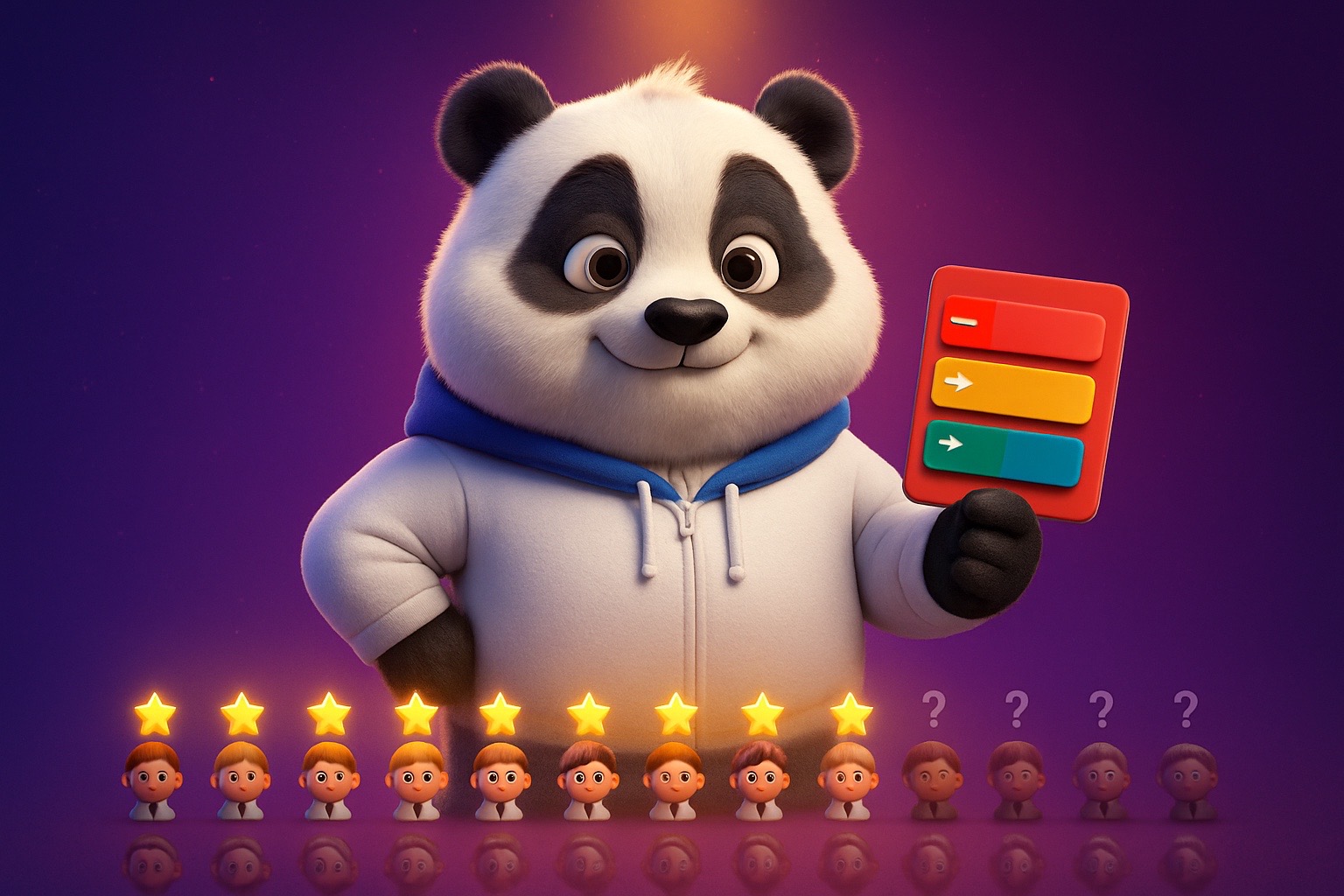
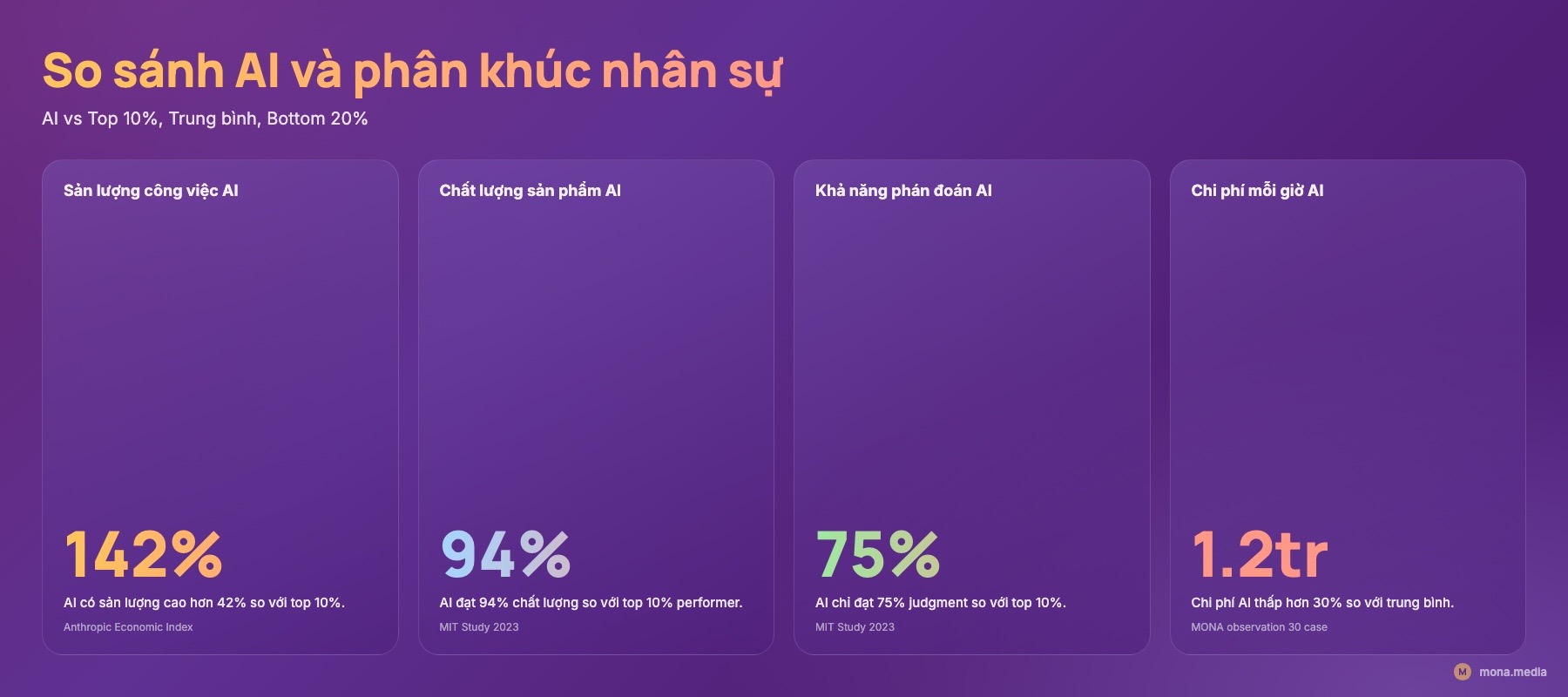
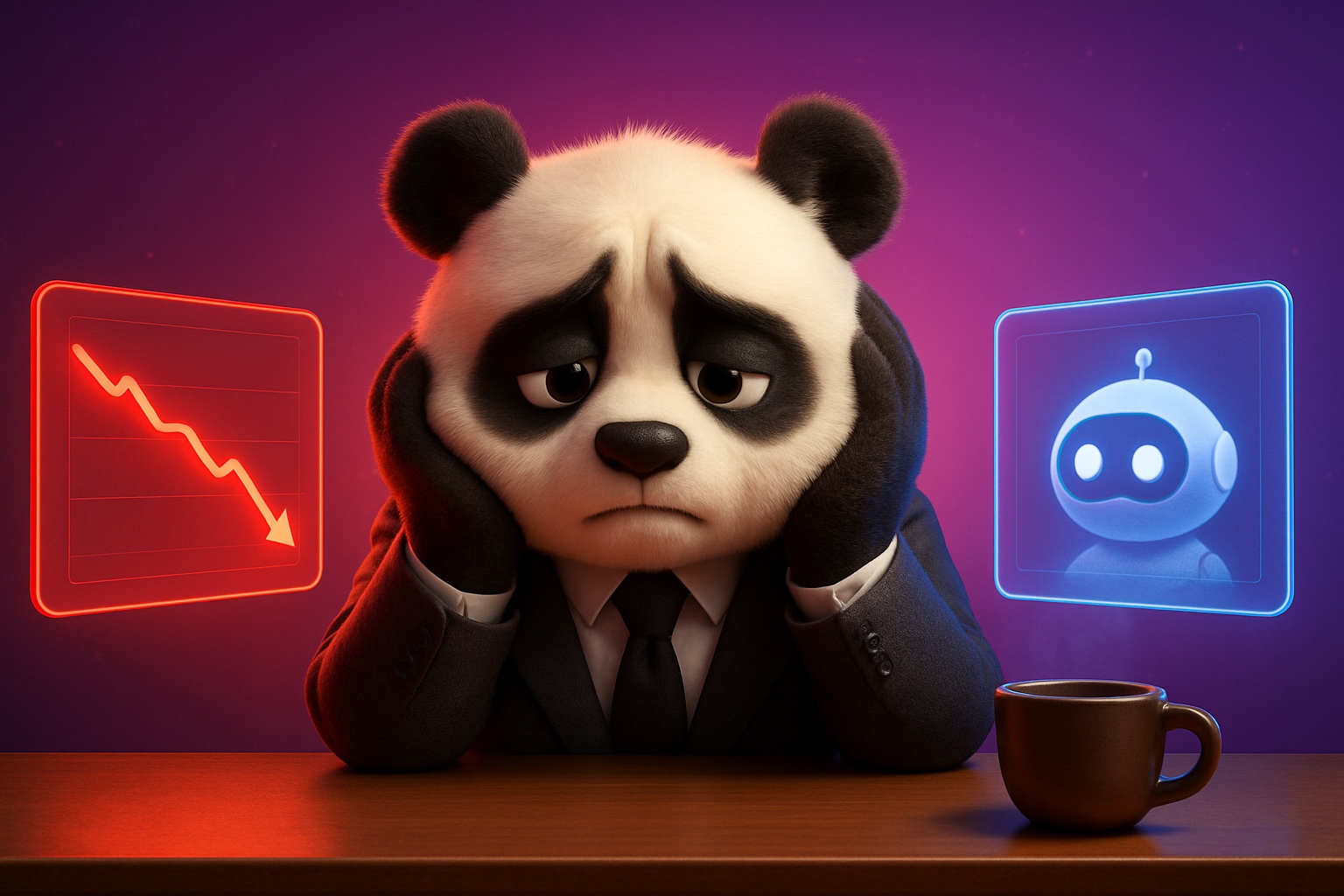
We'll say it straight. AI loses to the top 10-20% of strong people but beats 60-80% of average staff. This is the ratio we've observed across 30 Vietnamese mid-market businesses, especially those with 100-500 employees. A report from MIT Initiative on Digital Economy points to a similar pattern: second-generation AI has already passed the average knowledge worker on classification tasks, summarizing, translating, and writing template-based content. Strong people still beat AI on complex judgment, leading big clients, and creating new content.
You can check this yourself. In your 10-person content marketing team, 1-2 people write pieces with a voice of their own that readers remember. The other 6-8 write from templates, and you can't tell their work from AI output. In a 20-person sales team, 2-3 reps close big clients by reading subtle situations. The other 15-17 follow scripts, and AI could make those calls too. In a 15-person customer support team, 1-2 managers handle VIP complaints that need a cool head. The other 13 answer repeated questions. The 10-20% strong and 60-80% average split repeats in every department of a large company.
MONA calls this "the average layer that drains the company". It has 3 traits. One, a salary of 12-25 million VND, neither high nor low. Two, measurable results that aren't outstanding. Three, the company doesn't fire them for fear of being short-handed, but doesn't promote them either because they don't stand out. This is the layer AI can replace most clearly in the next 12-24 months. We wrote a related view in What is AI-First so you can understand it better.
There are 3 reasons. One, AI in 2026 is already good at repetitive patterns. AI reads 1,000 sample customer emails and writes the 1,001st with 92% accuracy. An average person doing the same job reaches 85%, and is 10 times slower. Two, the top 10% have 3 things AI doesn't have yet: intuition built on company history, personal relationships with long-time clients, and ethical judgment in new situations. Three, strong people do big, rarely repeated work, so AI can't see enough examples to imitate them.
The bigger the company, the higher the share of average staff. The organizational structure creates this. Work is split into many repeated steps, and one person handles only 1-2 of them. With so much repetition, AI learns easily. Companies under 30 people are different. Each person does 5-7 different jobs, and each job carries a personal mark. AI struggles to replace that cleanly. This is the root cause, and it explains the trend MONA has seen. See the details in the AI First handbook for businesses.
The share of average staff rises sharply. A 50-person company keeps 40-55%. A 500-person company can reach 75-85%. MONA has observed 30 mid-market cases. AI replaces 6 roles most clearly. Tier-1 customer support is the clearest target. So are accounting data entry staff. Bulk product description writing gets replaced. First-round CV screening by keyword. Cold calling with Vietnamese callbots. Standard technical translation. These roles will be fully replaced within 12-24 months.
Owners of large companies think differently. They put operational stability first. They hire fast to fill positions. "Good enough" is the practical standard. There's no time to pick excellent people, and the risk of being short-staffed is higher. They rarely look for exceptional people, who are often hard to manage and need a special environment. Large companies focus on process. Personalizing the job is limited. The goal is even performance.
The consequences of this trend are huge. Thousands of staff will be affected. Large companies will have to restructure. Payroll budget will be freed up. Invest in the top 10% of strongest people. They will create breakthrough value. Average staff need to upgrade their skills, or they'll be left behind. AI is not a threat. It's a chance to optimize. This future is unavoidable.
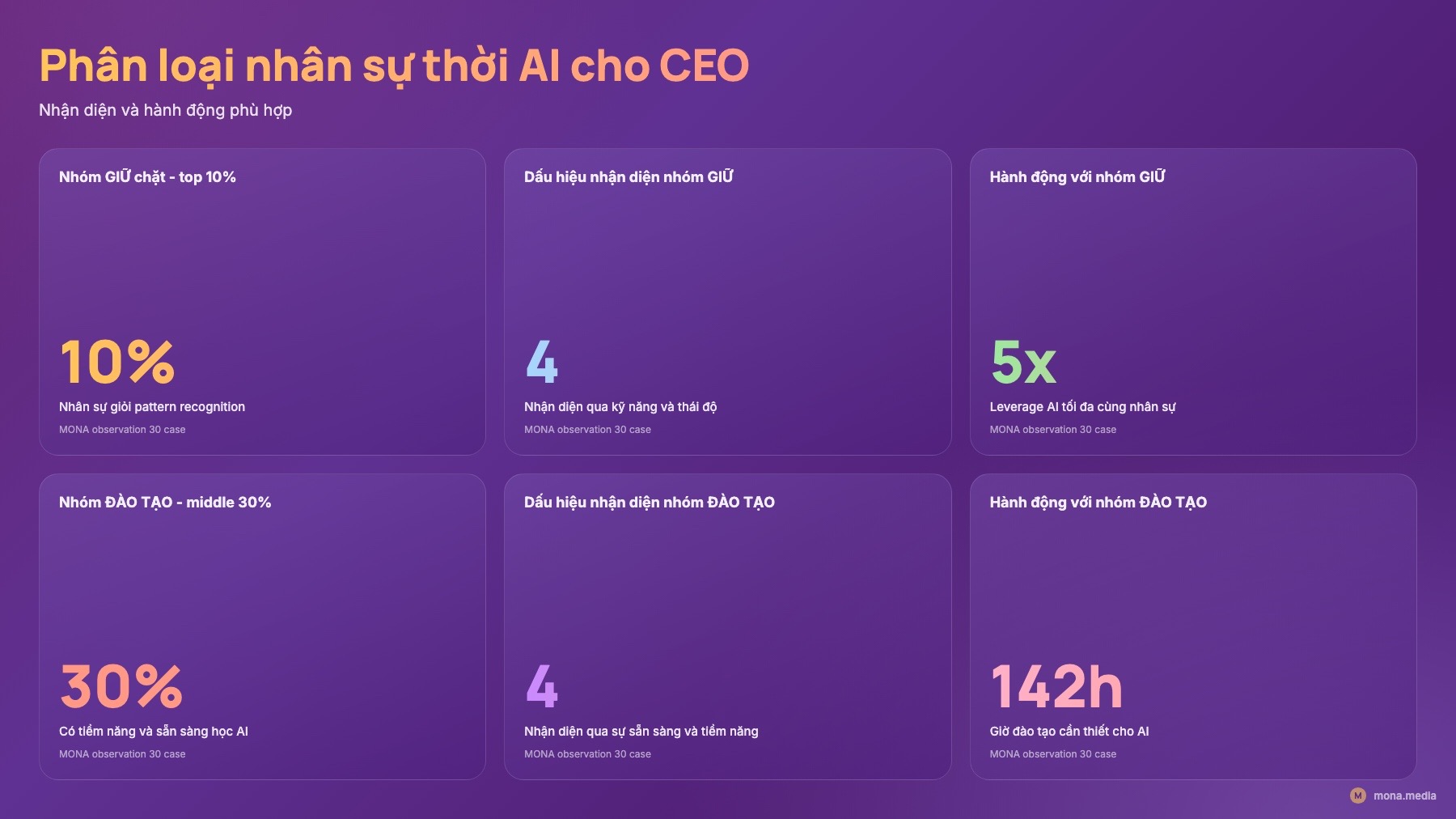
This is the practical part you came for. We're sharing the 3-group framework MONA has applied to itself since April 20, 2026. It isn't theory. It's the process we live by every day.
Group 1: keep and invest heavily in the top 10% of strong people. Give this group a 30-50% raise. Hand them big work tied to the 3-year strategy. The top 10% usually know their own value and are ready to switch jobs if the company doesn't recognize it. You keep this group with: pay 30-50% above market, authority to make big decisions, plus 1-2 direct reports to increase their leverage. A top 10% person with AI does the work of 5 average employees put together.
Group 2: train the "upper-half potential" group to become AI operators. This is 20-30% of average employees. They want to learn and are curious about technology. Invest in training them to become "AI operators". They take charge of running one specific AI area (managing prompt templates, reviewing output, connecting AI to the CRM). This is an important middle layer. AI doesn't run itself, it needs someone to operate it. MONA is training this layer internally through Khánh Hùng Academy.
Group 3: let the rest leave on their own through a natural process. This is 60-70% of average employees. Their repetitive work is being replaced by AI. You don't fire anyone and you don't make announcements, you let it happen naturally. Specifically: don't hire more for these positions, and don't raise pay above inflation. Move processes to AI gradually, and people who don't adapt will switch companies on their own within 12-18 months. This reduces headcount without shock and keeps the company's reputation as a good place to work.
You can apply this framework with a simple table. Column 1: employee name. Column 2: assessment (top 10%, upper-half potential, lower average). Column 3: action (keep and increase leverage, train as AI operator, let leave on their own). Column 4: decision deadline. Meet with 2-3 department heads you trust, stick the table on the meeting room wall, and update it every month. This is the HR discipline for the AI era that MONA is applying.
You're paying 60-180 million VND a month for the top 10% of strong people (1-2 department heads, 1-2 solid sales reps, 1 head chef, 1 senior engineer), and it's not just money. We know you've tried many ways to keep them (pay 30-40% above market, ESOP, a quarterly retreat in Phu Quoc, calls to check in at Tet, covering their work when they're sick, staying silent when they miss a deadline 2-3 times, gifting a MacBook to keep the vibe). It doesn't work. The top 10% know exactly what they're worth. They hold the company in their hands, and if they're away for a month the company collapses. Big clients only talk to them. You can't clone them. Hiring 2 equivalent seniors isn't realistic, because in the Vietnamese mid-market you can count people at that level on one hand. The problem isn't doubling the top 10%'s pay. What you need is software that automates the average layer and frees the top 10% from the 60% of repetitive work they carry for others, so they can do 3 times more big work instead of being drained every day by average staff.
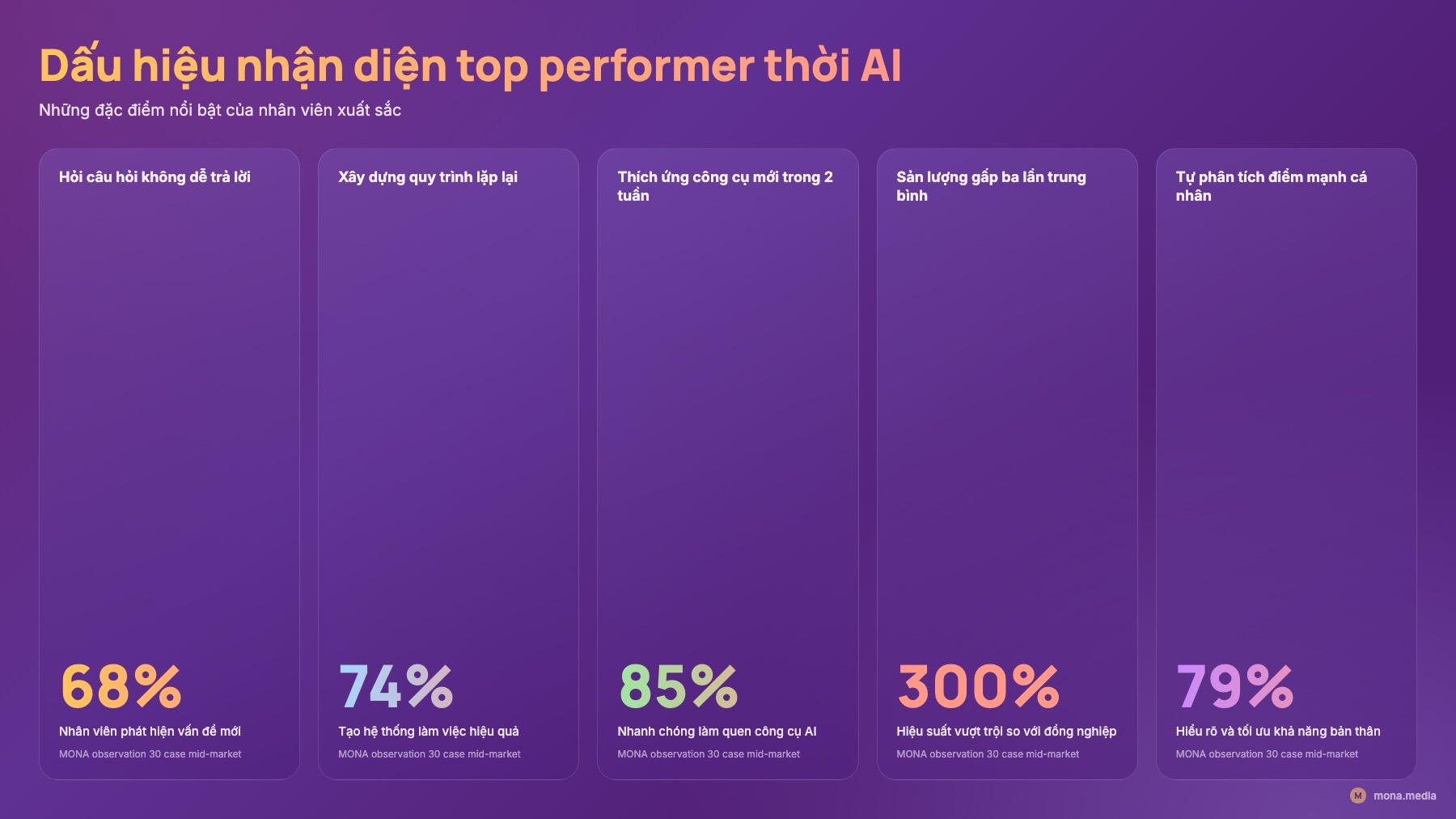
This is the hardest part. You can't rely on revenue alone, because 20% of strong people are still early. They're laying the foundation for the next 12 months and have no numbers yet. Here are the 5 signs MONA uses to spot the top 10%.
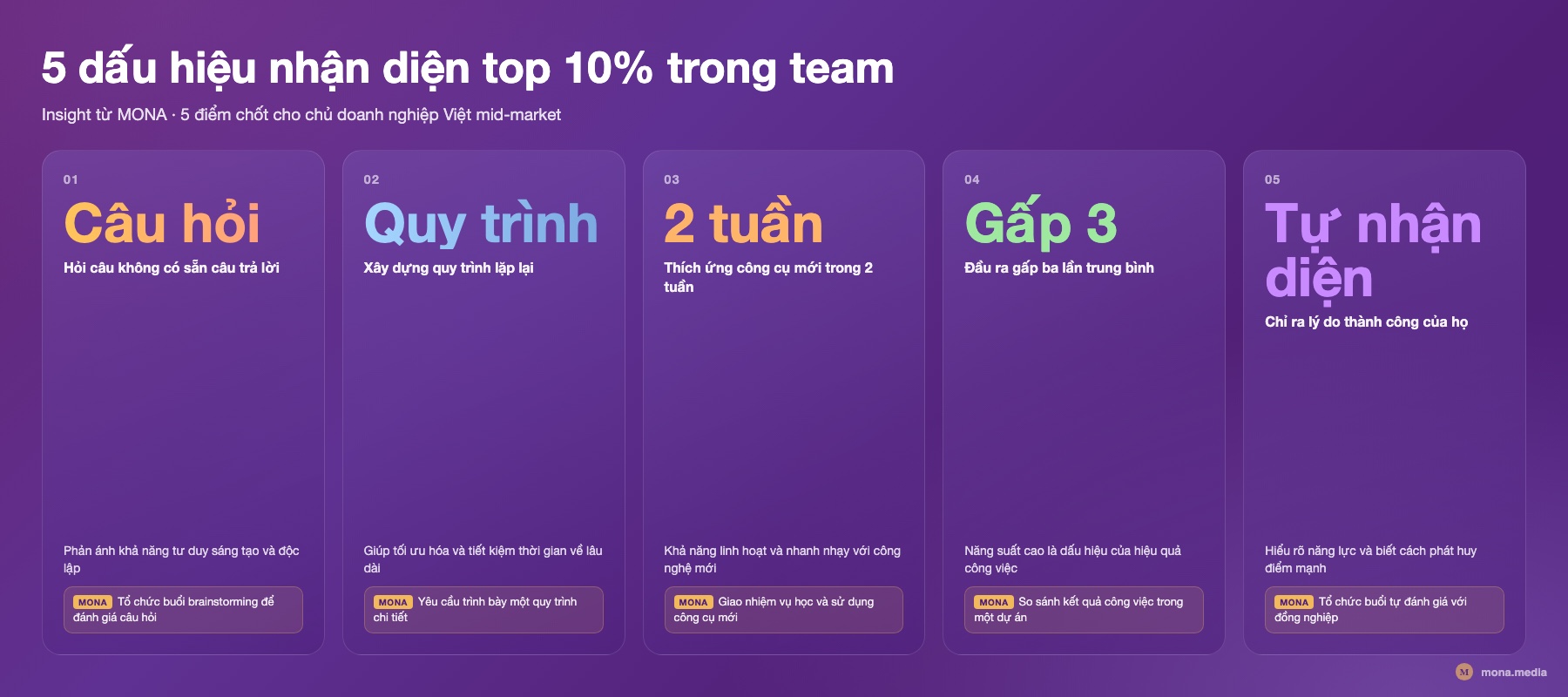
Sign 1: they use AI naturally, long before the boss orders it. Strong people sign up for Claude and ChatGPT on their own and use them without being told. Check your internal Slack and Zalo. See who shares good prompts and who brags about using AI to summarize a report. That's an early signal.
Sign 2: they accept mistakes and correct themselves fast. Strong people admit a mistake within 2 days, fix the process, and don't blame anyone. Average people take 2 weeks to admit it, and tend to blame the tool, the client, or a coworker. Look at the last 3-5 times someone responded to a mistake and the sign shows clearly.
Sign 3: they ask themselves "do I still need to do this work?". Strong people ask themselves every quarter, "Could AI replace what I do now within 6-12 months?". If yes, they move on to bigger work by choice. What we've seen: employees who often suggest automating their own work are the top 10%, because they're confident they'll have other work to do. See the details in the AI First handbook for businesses.
Sign 4: they teach coworkers without being asked. Strong people share what they know naturally. In the department chat group, see who often answers coworkers' questions. Whoever writes a short guide and sends it to the whole department is in the top 10%. This is the strongest sign because it measures a sense of ownership toward the company.
Sign 5: they still do well when the boss is away for 2 weeks. Try it during a long business trip. The top 10%'s work keeps running, sometimes better. Average staff slow down by 30%. Lower-average staff stop completely and wait for the boss to return. It's a harsh test but an accurate one.
There is one layer within the top 10% that AI will almost never replace in the next 5-10 years: the people who take final responsibility when something goes wrong. AI can't bear legal consequences for a wrong decision. AI doesn't get sued by clients. AI can't sit with a big client and explain when a contract falls apart. This layer will always need people. Hold on tight to whoever sits in the "final signer" seat, "the one who calls the most important client last", and "the one who makes the hard call at the end of the day". They are your most valuable asset as AI spreads to every other role.
On April 20, 2026, MONA made its internal decision. Every day feels like a new company. We automated all 6 departments thoroughly. No campaigns, no workshops that drag on for months. The boss sat down and wrote out 12 specific processes that were burning people. Each process went to 1 department head plus 1 MONA Software engineer, with a 60-day deadline to have a working automation v1. No "pilots", it either works or it doesn't.
Inside MONA, 7 of the 30 average employees left naturally within 4 months. No layoffs, no pressure. When processes moved to AI, their old positions no longer matched. People who didn't adapt found other places. People who stayed received a 15-25% allowance for taking on an AI operator role. The top 10% had their project budgets doubled and were given bigger work.
What this means for you comes down to a specific date. Not a long-term philosophy of 3-5 years. Set a Day X. Before Day X, meet with 3 department heads you trust. After Day X, every new hiring decision has to answer one question: can AI do this job? If the answer is "yes", stop hiring and have MONA or your in-house engineers build it. Only if the answer is "no" do you open the job.
The deeper lesson is that speed separates survival from failure. Vietnamese mid-market companies of the same size have stood still for 12-18 months. Younger competitors, 2-3 years old, carry no legacy staffing burden. They ship AI-native products from day one. If you don't commit to a specific date, in 24 months your company will cost 30-40% more than competitors for the same revenue. By then no price will save you.
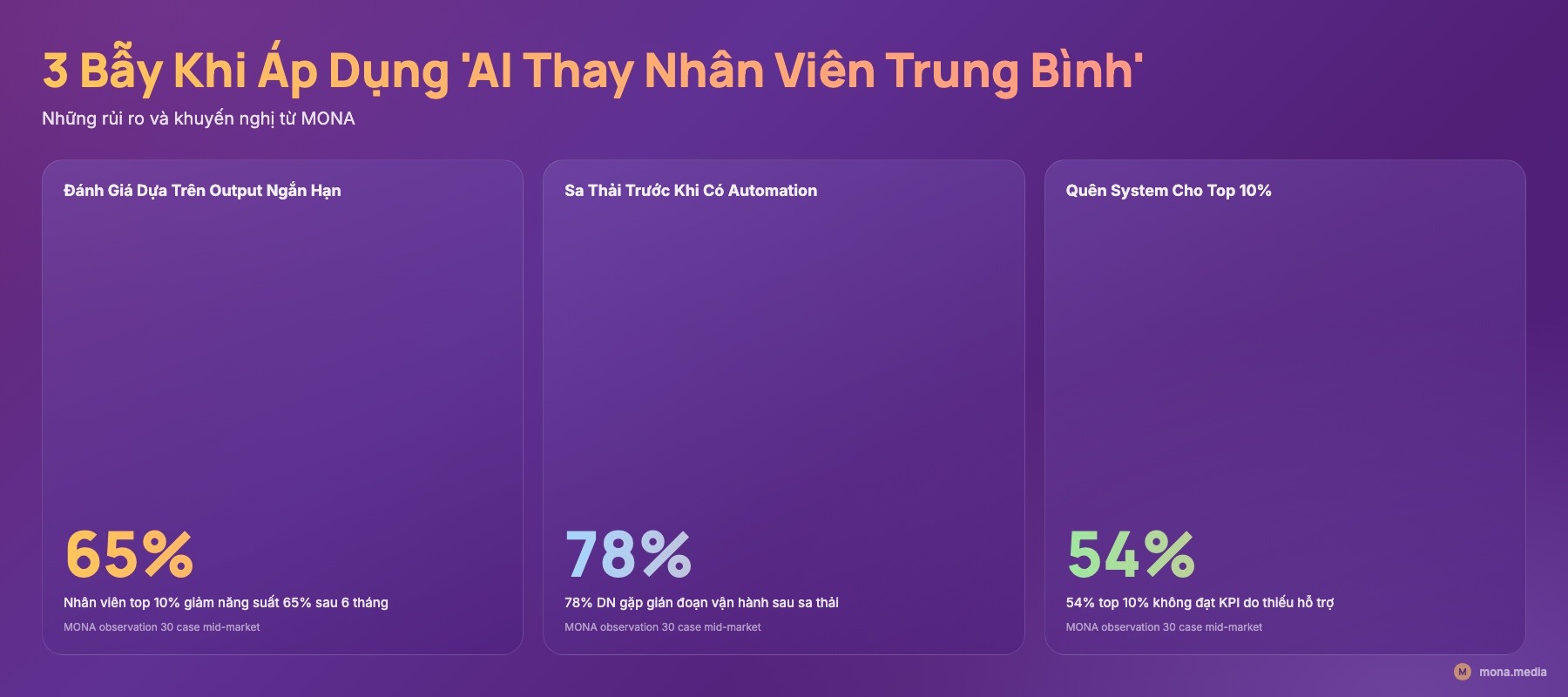
We've seen 3 traps Vietnamese business owners often fall into after hearing the view that AI replaces average employees.
Trap 1: mass layoffs in the first 90 days. You hear this, walk out of the meeting, and lay off 30% of your customer support staff because "AI can already do it". After 60 days, AI isn't mature enough for your specific industry, customers complain, and revenue drops. When you rehire, market pay has risen 30%. You lose 6 months and 2 billion VND in salary and bonuses to recover. MONA always advises: test AI in the role for at least 6 months before cutting headcount.
Trap 2: judging the top 10% by the boss's gut feeling. You say, "I know who's good in my company". In reality that judgment is biased. People who sit in front of the boss and speak up in meetings get remembered as "good". People who sit far away, rarely attend meetings and work quietly get forgotten. Use the 5 objective signs we shared above instead of relying on impressions.
Trap 3: not telling your staff about this approach. You keep the "AI replaces the average" view to yourself. You hide it from staff and quietly shift things behind the scenes. After 6 months staff sense it, start to worry, lose morale, and productivity falls. The right way is to share the view openly at a company meeting, with a commitment: "MONA won't lay anyone off, we'll move to bigger work together". Staff trust you, the top 10% stay committed, and the average layer chooses to leave or adapt.
The view that AI replaces average employees is one we settled on after 18 months of observation. MONA has applied it to itself for 5 weeks. You don't have to agree 100%. We just hope you'll spend one afternoon this week on 3 specific tasks.
First, sit down and draw up your company's staff list. Split it into 3 columns: top 10%, upper-half potential, lower average. Use the 5 objective signs we shared. Don't go by gut feeling. By the end of this week you'll have a real map of your people.
Second, pick 1-2 of your top 10% who are stuck in repetitive work. Meet them privately for 30 minutes and ask: "What work makes you bored? What work do you want to do but haven't had the chance to?". Then gradually move their repetitive work to AI or to junior staff. Strong people will rise on their own.
Third, announce the view at a company meeting. You can quote it directly: "Our company believes AI will replace average employees in repetitive work within the next 12-24 months. But it can't replace the top 10% of strong people. We won't lay anyone off, we'll move to bigger work together. Whoever proactively learns AI will be supported. Whoever doesn't, the company won't force". Staff will understand the rules, the top 10% will stay more committed, and the average layer will make its own choice.
MONA is sharing more related articles for your reference: CEO sài AI. What is AI-First, automating 30 businesses. 30-day roadmap for CEOs to use AI, why Vietnamese businesses fail at AI. business automation category. AI for sales teams, MONA homepage, corporate website design, and complete SEO services. business management software, HR management software. digital transformation solutions, spa management software, contact MONA.
If you need deeper support, MONA is always ready. We write custom automation software for each client, not drag-and-drop tools. For your own private AI hosting, see mona.host, and for in-house training, see Khánh Hùng Academy. For digital transformation materials, see mona.academy.
The last question we want you to ask yourself every morning this week. If 60-80% of your staff are in the average layer and AI can replace them, do you still have another 12 months to hesitate? Your top 10% of strong people are waiting to be freed. Will they do bigger work, or are they getting ready to leave because they see no future? AI replacing average employees is not a danger. It's a door for you to rebuild your company to the scale it deserves. Are you ready to walk through it?
Readers of this article usually fall into 2 groups. Group 1 is already used to it and has completely given up on finding a solution, accepting "money lost to average staff" as part of life, as in "that's just how our industry is". Group 2 is the owners, new or with 10 or 20 years in business, who never stop looking for solutions, keep an ear on technology, AI progress and automation, so that when a solution appears they bring it in right away, and once they deploy it they do it decisively, shocking old and new staff alike. MONA (we're business people just like you, and our team of 60+ has automated 100% of its repetitive departments since April 20, 2026) belongs to group 2, and we're fully confident we can bring a solution to the group 2 owners among you. What you need is just a 45-minute call away. And it's free: a MONA specialist will always deliver it, whatever your business model or current state (1 branch or 50 branches, mostly young staff or mostly older staff, no tech knowledge or very tech-savvy, no CRM yet or already on ERP, revenue of 5 billion VND a month or 80 billion VND a month). We have a solution for every case. This is already our 10th year bringing automation solutions and software to mid-market business owners in Vietnam.
How to contact MONA
Email: info@themona.global
Website: mona.media · mona.software
Someone who shows at least 3 of 5 signs: asks the right questions first, writes documents others can reuse, beats KPIs by 30%+ for 6 months in a row, is sought out by coworkers for advice, and dares to push back on the boss when the boss is wrong. It isn't the top by seniority, and it isn't the top by current level.
Big companies tend to have many middle layers doing repetitive work, control, reporting and compiling. AI can replace 60-80% of these layers. Small companies have only 1-2 layers, and each person does many mixed jobs that are hard to automate. This is why MONA focuses on mid-market clients, not small SMEs.
Keep the top 10% by raising pay 40-60% and giving them more responsibility for designing AI. Train the 60% average group in the middle. Keep those who move into AI-augmented roles, and let those who refuse to learn leave on their own. For the 30% below average, automate their work outright with no replacement needed. MONA has used this framework with 30 mid-market chains.
Right now the top 10% typically lose 60-70% of their hours to repetitive admin such as reports, summary meetings and follow-up emails. Once AI carries that load, they have 60-70% of their hours for high-value work such as industry strategy, training successors, and negotiating with big partners. Their pay rises with the new role.
On April 20, 2026, MONA began rolling out automation decisively for itself, with every day feeling like a new company. MONA shares this openly to give Vietnamese business owners an anchor: if MONA can do it for itself, your business can too. There's no need to wait another 12 months to start.
See the overall solution: Full AI transformation and automation for businesses.

CEO & Founder · The MONA
The founder of The MONA built a service company of 60+ staff with 14,000+ projects delivered. Khánh Hùng shares his thinking on building self-running systems, automating a business, and the real lessons behind MONA's projects.
 493




Professional website
design services
Own a website with a beautiful, 100% exclusive design and a lifetime warranty, with the ability
to expand features flexibly as your business grows, starting today!






 MONA will never sell your information or send you spam


 MONA will never sell your information or send you spam
