
 MONA OS 2.0
 Partner with MONA


 Tự động hoá doanh nghiệp
 Cẩm nang SEO
 Digital Marketing
 Kinh nghiệm thiết kế website
 Hạ Tầng Server
 Giáo dục


 VI
 EN












Message us on
Zalo Official


 ProductsNew

 ProductsProducts
 Mới ra mắtKHA AI 2027App tự edit video, tự đăng mọi mạng xã hội, 2 phút mỗi ngày










 Website designLooks good and wins customers over.
SEO servicesBrings in customers searching for exactly what you sell.
 Tư vấn digital marketingKéo khách từ nhiều kênh, đo bằng số thật.
Corporate video productionVideos introducing your company, factory and team.
 NewAI video productionCompany story films made with AI.
 Custom software developmentCRM, ERP and HRM built for your business.
 Viết AI Agent theo yêu cầuĐặt riêng một trợ lý AI cho đúng việc của mình.
 Tư vấn chuyển đổi AIĐưa AI vào vận hành của cả công ty.
NewMONA LMSManagement for centers and schools.
MONA SkillHubInternal training for company staff.
 NHTQ systemEnd-to-end China–Vietnam shipping operations.
MONA JMSManagement for gold, diamond and pawn shops.
 MONA E-LearningA website with every feature you need to sell courses.
 How to sell online courses (course)More than 30 free lessons on selling courses on autopilot.
 MONA Cloudmonacloud.vnServers to get your apps and websites running.
 MONA Basemonabase.vnPostgres database, sign-in and file storage.
 MONA Mailmonamail.vnSend OTP, order and invoice emails from your software.
 MONA Paymonapay.vnAccept bank transfers via VietQR and notify your software when the money arrives.
 MONA eInvoiceComing soonIssue e-invoices that meet tax standards.
Gấu CườiTrả lời khách 24/7 trên web, Fanpage, Zalo và thu lead cho sale.
 Gấu TeleSalesGọi điện tư vấn, chăm khách như tổng đài viên thật.
Dê CườiTư vấn và chốt đơn cho shop ngay trong khung chat.
Gấu WebmasterNhắn nhóm Zalo là website được sửa xong.
 Gấu Pháp ChếSoạn hợp đồng, rà điều khoản trong vài phút.
 Gấu Báo GiáLên báo giá đúng mẫu và gửi khách ngay.
 AI chăm sóc khách hàngTheo dõi và giữ chân khách hàng cũ.
 Gấu Tuyển DụngLọc hồ sơ, hẹn lịch, phỏng vấn ứng viên.
 Mới ra mắt
KHA AI 2027
Xây kênh chuyên gia 2 phút mỗi ngày
Quay bằng điện thoại, AI tự edit video, tự đăng lên 16 nền tảng và tự trả lời bình luận, tin nhắn.
943.354lượt xem trên kênh CEO MONA sau 45 ngày
 Anh Khánh HùngCEO MONA đang dùng mỗi ngày
Xem app làm được gì
 AI
Gấu Cười MONA ĐANG TỰ XÀITrả lời khách 24/7 trên website, Zalo OA, Messenger và thu lead về cho sale.
Dê CườiChốt đơn bán lẻ và sàn: Shopee, TikTok Shop, web. Chăm cả khách sỉ, đại lý.
Gấu WebmasterCập nhật nội dung, tối ưu SEO website mỗi ngày.
Gấu TeleSalesGọi điện tư vấn, chăm khách như tổng đài viên thật.
Gấu Tuyển DụngLọc hồ sơ, hẹn lịch, phỏng vấn ứng viên tự động.
AI chăm sóc khách hàngGiữ khách cũ, cứu lead đã rớt cho phòng kinh doanh.
Gấu Pháp ChếSoạn hợp đồng, rà điều khoản trong vài phút.
Gấu Báo GiáLên báo giá đúng mẫu, gửi khách ngay khi có yêu cầu.
 Chuyển đổi AI toàn phầnGiải pháp tổng cho doanh nghiệp, 3 lớp triển khai.
 Viết AI Agent theo yêu cầuĐặt riêng một con AI gánh đúng nghiệp vụ của bạn.
 Custom softwareCRM, ERP and HRM with built-in AI automation.
 SEO & AEO thời đại AIĐược Google lẫn AI trích dẫn, không chỉ xếp hạng.
 Kiến thức AI cho doanh nghiệpBài phân tích, hướng dẫn ứng dụng AI vào vận hành.
 Free AI courses
 AI tools at work
App mới · KHA AI 2027
Xây kênh 2 phút mỗi ngày
AI tự edit video, tự đăng mọi mạng xã hội
Free consultation, 8am–10pm every day

17 June, 2026

Many sales directors like you still let marketing and sales teams run on gut feeling, especially when quoting prices. This loses an average of 27% of potential revenue every year. Deploying a smart AI pricing system is no longer a story about the future. It is the only way to accurately analyze market data, customer profiles and competitors in real time. From there, AI suggests the best price for each segment and each moment, helping a business maximize profit and expand its market in a methodical way. At MONA Media, we have applied AI deeply to SEO campaigns and website design, turning them into automatic sales machines that optimize value for every visit.


Tuấn once stood exactly where many sales directors stand today. When the team was small, coaching each person was not too hard. But as the team grew, quality gradually thinned out, and Tuấn realized he could not clone himself to be everywhere at once.
This pain of losing control hurts performance, and it also quietly leaks marketing revenue. This is when we need to take another look at how we operate, especially in pricing and reaching customers.
Tuấn remembers the early days when the sales team was just 10 people. Every morning, Tuấn sat down with each person and went through every call and every email. You can picture Tuấn with one team member reviewing a sales pitch, editing every line to make it as persuasive as possible.
Everyone was taught to price MONA’s products and services consistently, from website design to SEO services. Output quality was assured, and customers felt confident because of the professionalism and consistency.
This is a stage with strong bonds and high efficiency. Every member felt supported and was growing. However, this model only works while the team stays at a certain size.
When the team grew to 30-50 people, Tuấn started to notice a difference. There were still standout people, the “stars” who could close big contracts on their own and bring in better revenue. They seemed to have a good “feel” for pricing and persuading customers without Tuấn coaching them closely.
For example, a veteran at MONA can confidently and flexibly price a management software project for a 28-branch spa chain, based on experience and the ability to read the customer. They know how to adjust each module to fit the partner’s budget and expectations.
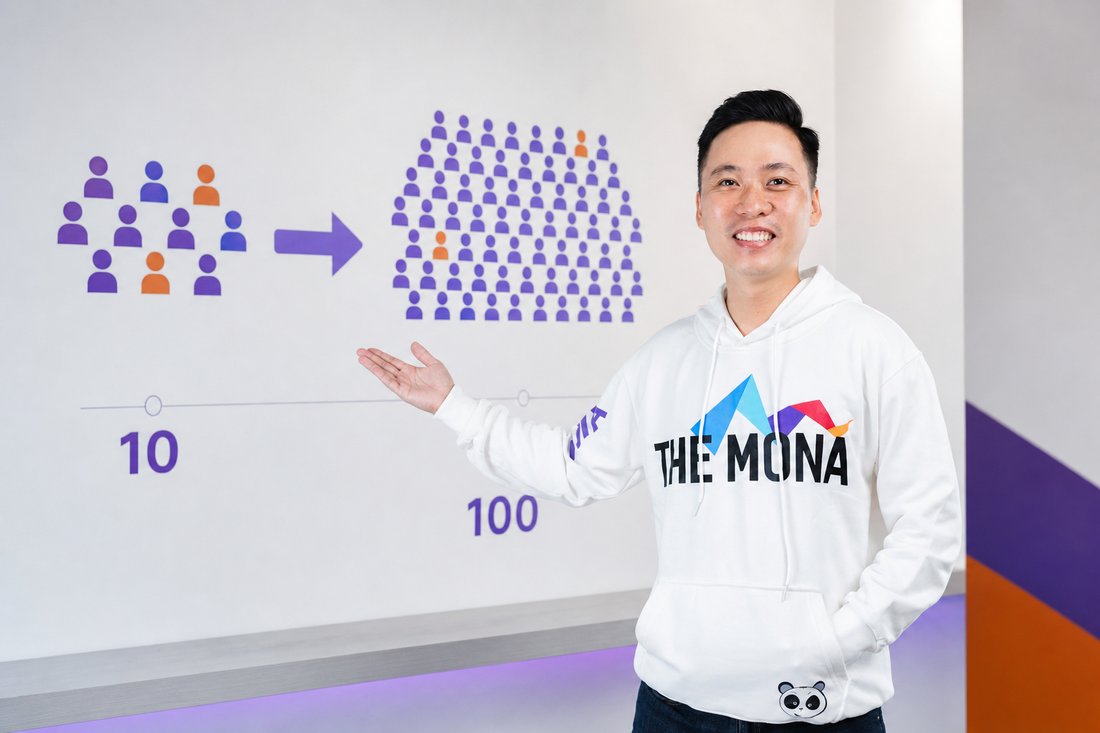
But these stars also open a big gap between themselves and the rest of the team. New or less experienced staff struggle to repeat their success, which leads to large differences in performance.
When the team hit 100 people, Tuấn had to accept a reality: managing each person’s quality and performance the old way was impossible. Tuấn could not listen to every call, read every email or sit in every pricing meeting.
Every day, Tuấn received dozens of price approval requests and hundreds of questions about how to handle customer situations. The real pain was realizing that, despite doing his best, opportunities were still being missed, and prospects felt poorly served just because pricing and advice were inconsistent.
A large pharmacy chain in Hanoi once told us they received two different prices for the same package restaurant management software from two different MONA staff. This destroys trust, and it also leaks a significant amount of revenue.
Tuấn understood that this was the time we needed a systematic solution, a “brain” that could clone the stars’ experience and keep the whole team consistent, in pricing and in every step of reaching customers.
Tuấn understands that you have invested heavily in marketing. From running ads and optimizing SEO to building the brand, the end goal is to bring in quality leads. But a reality Tuấn sees many businesses facing is that marketing money pours in out of proportion to the revenue actually closed. This pain usually sits in quoting and consulting.
Every time Tuấn sees prospects drawn in by ads leave for unclear reasons, he knows you are just as troubled. Marketing money is like water poured into a leaking bucket, and the biggest leak comes from inside, from how staff interact and price products and services.
Picture a phone retail chain with 18 branches in Hanoi and Ho Chi Minh City, with monthly revenue of about 40 billion VND. Its sales advisors number nearly 50, and each approaches customers differently. Some cut the price right away with enthusiasm, some try to hold the original price, and some even forget about the promotion that is running.

Tuấn saw this happen in his own company in the early years. A customer called and got two different prices for the same service from two different employees. As a result, they lost trust and moved to a competitor. This inconsistency loses customers, and it also seriously damages the brand’s reputation.
Unsynchronized consulting scripts, without up-to-date information on products or the latest pricing policy, leave customers confused and feeling they are not served professionally. This is when we need a standardized system, a shared “brain” that makes sure every interaction meets the standard.
Marketing money has helped you attract a large number of prospects. But if the quote is not timely, accurate and delivered when the customer needs it, all the earlier effort becomes meaningless. Tuấn has seen many cases, such as a 28-branch spa chain across Ho Chi Minh City, Hanoi and Da Nang with about 52 billion VND in monthly revenue, losing customers just because staff replied slowly.
Modern customers are very sensitive about time. They expect fast, accurate information. If a staff member spends 15-20 minutes checking stock, asking a manager or finding the price list again, the customer may already have gone to a competitor. Especially in industries with quick buying cycles like F&B and fashion retail, every passing moment is a lost opportunity.
Even when staff reply quickly, if the information does not fit the customer’s specific needs (for example, quoting a service package that is not what they wanted, or failing to offer an alternative), the customer will still leave. This is when we need a system that can analyze and make the best suggestion in real time.
According to McKinsey research, businesses often waste up to 27% of their marketing spend by failing to convert prospects into revenue. The main cause is inconsistent customer experience, especially in quoting and consulting. Tuấn believes the figure could be even higher in Vietnam without tight management.
This is not a problem of a few individuals or one department. It is a systemic hole that calls for a solution. Letting marketing money drain out day after day through these holes cuts profit, and it also wears down the motivation of the whole team.

MONA recognized this and focused on developing automation software modules to solve it at the root. We cannot expect staff to be robots, but we can equip them with a powerful AI assistant. MONA’s AI Agent system, such as Gấu Cười and Dê Cười, is designed to make sure every customer interaction is standardized, fast and accurate.
Where does marketing money go when the quoting team goes by gut feeling and wastes every prospect.
Tuấn understands your worries. He once stood exactly where you are standing, with a team of only 10 where coaching still worked, a team of 50 where he struggled, and a team of 100 where he let go. Tuấn spent a lot of time and resources testing traditional solutions. But then he realized they were only temporary patches that did not solve the problem of cloning core capability.
Tuấn remembers vividly the long strategy meetings and the constant skills training. MONA’s marketing team back then, though it had some very good people, did not have everyone able to price products or services consistently and effectively. Especially for website design or SEO services, each project has its own traits and needs deep experience to come up with a reasonable number.
Tuấn ran in-depth training on competitor analysis, on customers’ perceived value and on the factors that make up cost. However, when new staff joined or when sales pressure rose, that knowledge was easily set aside. As a result, some projects were quoted too high and customers left, or too low and MONA lost profit. This is proof of high pay with output that does not match, a pain Tuấn believes many of you are also facing.
To control pricing quality, Tuấn thought about hiring more mid-level managers, experienced people who could review and approve proposals. He brought in a few department heads, hoping they would be an extended arm to keep everything on track.
But then the structure became more bloated. Management salary costs went up noticeably while decisions got slower. Managers could only control part of it, and they could not “clone” their experience and instinct for the whole team. In the end, inconsistent pricing was still there, just better hidden.
After many rounds of trial and error, Tuấn realized something at the core: the problem is not that staff lack ability or training. The problem is the system itself. Smart pricing, especially in creative services like website design or SEO, needs a mix of data, experience and instinct. That is very hard to standardize and clone with traditional methods.
MONA has faced cases where one staff member could quote 100 million VND for a website design project, while another quoted only 70 million VND for the same requirements. This gap loses revenue, and it also lowers the company’s reputation. Tuấn realized that we needed a tool, a system smart enough to learn from thousands of delivered projects and then give accurate, consistent pricing, taking human gut feeling out of it.

This is also why Tuấn and the MONA team committed to building an AI pricing automation solution. Tuấn believes that only with a system powerful enough can we solve the root of the high-pay, low-output problem, especially in steps that demand high expertise and experience.
Many business owners and sales directors Tuấn has met share the same worry. We see AI everywhere, from free tools to expensive software. You wonder whether you can apply AI to your sales team, but you get lost in the forest of information and promises.
Tuấn understands that finding a truly effective solution, not just inflated advertising, is extremely hard. You need a field-tested AI system that clones a great manager’s ability across the whole team, not a tool that only handles a few scattered tasks.
MONA does not sell “AI” as a standalone product. We deliver a comprehensive automation software system, in which AI agents are smart pieces that help your sales team work more effectively. This is how MONA has helped many mid-market businesses solve pricing and team management.
To price smartly, we need to understand the customer well. Tuấn has seen many sales teams miss opportunities because customer data is scattered. Zalo messages in one place, emails in another, purchase history in different software.
MONA’s DataFly system is the central brain, collecting every customer interaction from multiple channels. From Facebook and Zalo messages to emails, calls and transaction history. All of it is combined into a single profile, giving Gấu Cười (MONA’s customer care AI) and Gấu Thợ Bào (an AI assistant for sales staff) a complete view.
For example, a pharmacy chain with 35 branches in Hanoi and Da Nang, with average revenue of 40 billion VND a month, used to struggle because it did not know what customers were saying about new products. DataFly helped them gather all the comments from the fanpage, Google Maps and ordering apps. As a result, the marketing and sales teams could respond quickly, adjust strategy and set suitable promotional prices.

Pricing a product or service has never been easy. Tuấn knows many sales directors still rely on personal experience or gut feeling to set prices, which leads to missed revenue or lost customers because the price is too high or too low.
MONA’s smart pricing AI agent, part of Gấu Thợ Bào, analyzes data from DataFly. It looks at purchase history, interaction behavior, level of interest and even market factors to give the best price for each specific customer. It is a flexible assistant that keeps learning.
For a spa chain with 28 branches in Ho Chi Minh City, Hanoi and Da Nang, with about 52 billion VND in monthly revenue, pricing new treatment packages is always a challenge. The AI agent helped them suggest a personalized price for each customer based on visit frequency, favorite service type and ability to pay. As a result, the package conversion rate went up noticeably, and customers hesitating over price became rarer.
A large sales team often struggles with consistency in its sales scripts. Tuấn used to get a headache seeing each employee consult in their own way, which led to uneven service quality and performance that was hard to control.
MONA’s AI agent system makes sure every salesperson has a standard set of procedures and scripts. Gấu Thợ Bào suggests product information, and it also suggests how to approach customers, answers to common questions and even upsell/cross-sell strategies that fit each customer.
On top of that, the AI agent monitors how well each script works and keeps suggesting improvements. It analyzes customer feedback, close rates and response times to make timely adjustments. Tuấn often tells you that this is exactly how we clone the experience of the best people, and keep making it better.
Many business owners wonder whether automation technology fits their industry. Tuấn understands that worry. He has seen many businesses miss big opportunities because they assumed AI solutions are only for a few sectors.
In reality, MONA’s smart pricing model, together with its AI Agent system, has proven to be more flexible. We have deployed it successfully for retail chains, beauty and education. Each industry has its own traits, but the principle of automation still delivers a high return on investment.
In retail, pricing products is a constant battle. A price that is too high loses customers. A price that is too low eats into profit. Tuấn sees many retail chains still adjusting prices based on personal experience or competitors. This easily leads to significant revenue leakage.
MONA’s pricing system helps you solve this problem. It analyzes a large range of data: sales history, inventory, competitor prices and market trends. From there, the system automatically suggests the best price for each item, even each branch.
Tuấn remembers a convenience store chain with 35 branches in Hanoi. Their revenue was about 40 billion VND a month. After deploying the smart pricing system, they saw average revenue growth of 8% in the first 3 months. The system helped detect and promptly correct mispriced products, especially items with a short shelf life. This noticeably reduced the rate of expired inventory.
The beauty and spa industry has peak and off-peak hours. Fixed service pricing sometimes misses potential revenue. You may see empty rooms in the morning but overloaded ones in the evening. This is a constant pain for owners of large spas.
MONA’s system helps beauty chains price flexibly. It analyzes booking data, occupancy rates, peak hours and even customer behavior. From there, the system automatically adjusts service prices in real time. For example, a small discount in off-peak hours to stimulate demand, or a higher price for special services in golden hours.
A 28-branch spa chain across Ho Chi Minh City, Hanoi and Da Nang, with about 52 billion VND in monthly revenue, applied this solution. They saw occupancy during off-peak hours rise by 15%. At the same time, revenue from premium services at peak hours also rose thanks to more accurate pricing. This optimizes capacity, and it also improves the customer experience.
In education, pricing courses and training programs is not simple either. Market demand keeps changing. If you keep tuition fixed, you may lose your competitive edge or miss the chance to attract new students. Tuấn knows many large education centers are always worried about how to balance quality and tuition.

MONA has deployed a smart pricing system for education chains. The system analyzes course search trends, student ages, competitors’ tuition and even conversion rates from marketing campaigns. From there, it suggests the best tuition for each course and each moment.
MONA EduCenter and UniMaster are typical examples. With over 40,000 students and 760 professional teachers on SkillHub, we keep optimizing course pricing. The system automatically analyzes enrollment data and student feedback to adjust tuition. As a result, we keep a stable student rate and maximize revenue from each course.
Tuấn sees AI agents as the answer, cloning experience to get pricing right for teams of any size.
To truly control marketing cash flow and stop revenue loss, you need a comprehensive, seamless automation system. Tuấn understands that only custom-written software can fully meet this requirement, building AI into every corner of your sales process.
Many sales directors Tuấn meets have tried every kind of SaaS on the market. They use one tool for CRM, another for email marketing, and a separate platform for ads. The result is fragmented, scattered data and no way to see the whole picture of marketing return on investment.
Tuấn once watched a fashion retail chain with 20 stores in Hanoi and about 45 billion VND in yearly revenue struggle because it could not accurately match Facebook ad spend against the actual sales of each campaign. Each department used a different system, so auditing marketing return became a nightmare. Reports had to be compiled by hand, taking dozens of staff hours every week.
MONA believes that AI only shows its power when it is built into a single software system, where it can access and process all the data. Buying AI piece by piece is not automation, it is just adding another scattered tool to an already bulky toolbox.
With custom software, all customer data, interaction history, marketing campaign performance, inventory and orders sit on a single platform. This completely removes the risk of information leaks or inconsistent data.
Tuấn supported a study-abroad services company with 15 branches nationwide. Before, they used many Excel files and small tools, which meant losing track of leads and being unable to personalize the customer experience. MONA developed a system CRM with built-in AI, where every customer interaction from the website, Facebook and Zalo is recorded and analyzed. AI Agents such as Gấu Cười (customer care) and Gấu Thợ Bào (sales assistant) work seamlessly, helping the sales team grasp customer needs quickly and accurately.

Custom software lets you design workflows exactly the way your business operates, instead of forcing yourself into the mold of off-the-shelf solutions. This matters most when you want to integrate specialized AI modules for pricing, ad personalization or automated customer replies.
MONA understands that investing in custom software is an important strategic decision. We are not just building a tool, but an automation brain for your entire sales and marketing process.
With experience since 2016 and thousands of projects delivered, MONA confidently delivers production-grade automation software, tailored to each business. From website optimization and SEO to running the sales chain, MONA works alongside you so AI is not just a trend but a real engine of growth.
Tuấn and the MONA team are always ready to listen to your challenges. Let's build a system together that gives you full control of your marketing revenue and turns leaks into profit.
The same automation features and applications of the AI Agent system have also been deployed effectively by MONA for these industries: pharmacy chains, F&B chains, spa/salon/nail chains, fashion retail, pharmaceutical distribution, education services, and transport logistics.
Reference data from: Gartner, Harvard Business Review.
More related articles from MONA: Contact MONA today for detailed advice and to understand more about the topic of smart pricing with AI.


CEO & Founder · The MONA
Founder of The MONA, who built a services company of 60+ staff with 14,000+ projects delivered. Khánh Hùng shares how he thinks about building systems that run themselves, automating a business, and the real lessons from delivering projects at MONA.
 262




Professional website
design services
Own a website with a beautiful, 100% exclusive design and a lifetime warranty, with the ability
to expand features flexibly as your business grows, starting today!






 MONA will never sell your information or send you spam


 MONA will never sell your information or send you spam
