
 MONA OS 2.0
 Partner with MONA


 Tự động hoá doanh nghiệp
 Cẩm nang SEO
 Digital Marketing
 Kinh nghiệm thiết kế website
 Hạ Tầng Server
 Giáo dục


 VI
 EN









Message us on
Zalo Official


 ProductsNew

 ProductsProducts
 Mới ra mắtKHA AI 2027App tự edit video, tự đăng mọi mạng xã hội, 2 phút mỗi ngày










 Website designLooks good and wins customers over.
SEO servicesBrings in customers searching for exactly what you sell.
 Tư vấn digital marketingKéo khách từ nhiều kênh, đo bằng số thật.
Corporate video productionVideos introducing your company, factory and team.
 NewAI video productionCompany story films made with AI.
 Custom software developmentCRM, ERP and HRM built for your business.
 Viết AI Agent theo yêu cầuĐặt riêng một trợ lý AI cho đúng việc của mình.
 Tư vấn chuyển đổi AIĐưa AI vào vận hành của cả công ty.
NewMONA LMSManagement for centers and schools.
MONA SkillHubInternal training for company staff.
 NHTQ systemEnd-to-end China–Vietnam shipping operations.
MONA JMSManagement for gold, diamond and pawn shops.
 MONA E-LearningA website with every feature you need to sell courses.
 How to sell online courses (course)More than 30 free lessons on selling courses on autopilot.
 MONA Cloudmonacloud.vnServers to get your apps and websites running.
 MONA Basemonabase.vnPostgres database, sign-in and file storage.
 MONA Mailmonamail.vnSend OTP, order and invoice emails from your software.
 MONA Paymonapay.vnAccept bank transfers via VietQR and notify your software when the money arrives.
 MONA eInvoiceComing soonIssue e-invoices that meet tax standards.
Gấu CườiTrả lời khách 24/7 trên web, Fanpage, Zalo và thu lead cho sale.
 Gấu TeleSalesGọi điện tư vấn, chăm khách như tổng đài viên thật.
Dê CườiTư vấn và chốt đơn cho shop ngay trong khung chat.
Gấu WebmasterNhắn nhóm Zalo là website được sửa xong.
 Gấu Pháp ChếSoạn hợp đồng, rà điều khoản trong vài phút.
 Gấu Báo GiáLên báo giá đúng mẫu và gửi khách ngay.
 AI chăm sóc khách hàngTheo dõi và giữ chân khách hàng cũ.
 Gấu Tuyển DụngLọc hồ sơ, hẹn lịch, phỏng vấn ứng viên.
 Mới ra mắt
KHA AI 2027
Xây kênh chuyên gia 2 phút mỗi ngày
Quay bằng điện thoại, AI tự edit video, tự đăng lên 16 nền tảng và tự trả lời bình luận, tin nhắn.
887.729lượt xem trên kênh CEO MONA sau 36 ngày
 Anh Khánh HùngCEO MONA đang dùng mỗi ngày
Xem app làm được gì
 AI
Gấu Cười MONA ĐANG TỰ XÀITrả lời khách 24/7 trên website, Zalo OA, Messenger và thu lead về cho sale.
Dê CườiChốt đơn bán lẻ và sàn: Shopee, TikTok Shop, web. Chăm cả khách sỉ, đại lý.
Gấu WebmasterCập nhật nội dung, tối ưu SEO website mỗi ngày.
Gấu TeleSalesGọi điện tư vấn, chăm khách như tổng đài viên thật.
Gấu Tuyển DụngLọc hồ sơ, hẹn lịch, phỏng vấn ứng viên tự động.
AI chăm sóc khách hàngGiữ khách cũ, cứu lead đã rớt cho phòng kinh doanh.
Gấu Pháp ChếSoạn hợp đồng, rà điều khoản trong vài phút.
Gấu Báo GiáLên báo giá đúng mẫu, gửi khách ngay khi có yêu cầu.
 Chuyển đổi AI toàn phầnGiải pháp tổng cho doanh nghiệp, 3 lớp triển khai.
 Viết AI Agent theo yêu cầuĐặt riêng một con AI gánh đúng nghiệp vụ của bạn.
 Custom softwareCRM, ERP and HRM with built-in AI automation.
 SEO & AEO thời đại AIĐược Google lẫn AI trích dẫn, không chỉ xếp hạng.
 Kiến thức AI cho doanh nghiệpBài phân tích, hướng dẫn ứng dụng AI vào vận hành.
 Free AI courses
 AI tools at work
App mới · KHA AI 2027
Xây kênh 2 phút mỗi ngày
AI tự edit video, tự đăng mọi mạng xã hội
Free consultation, 8am–10pm every day

10 August, 2026
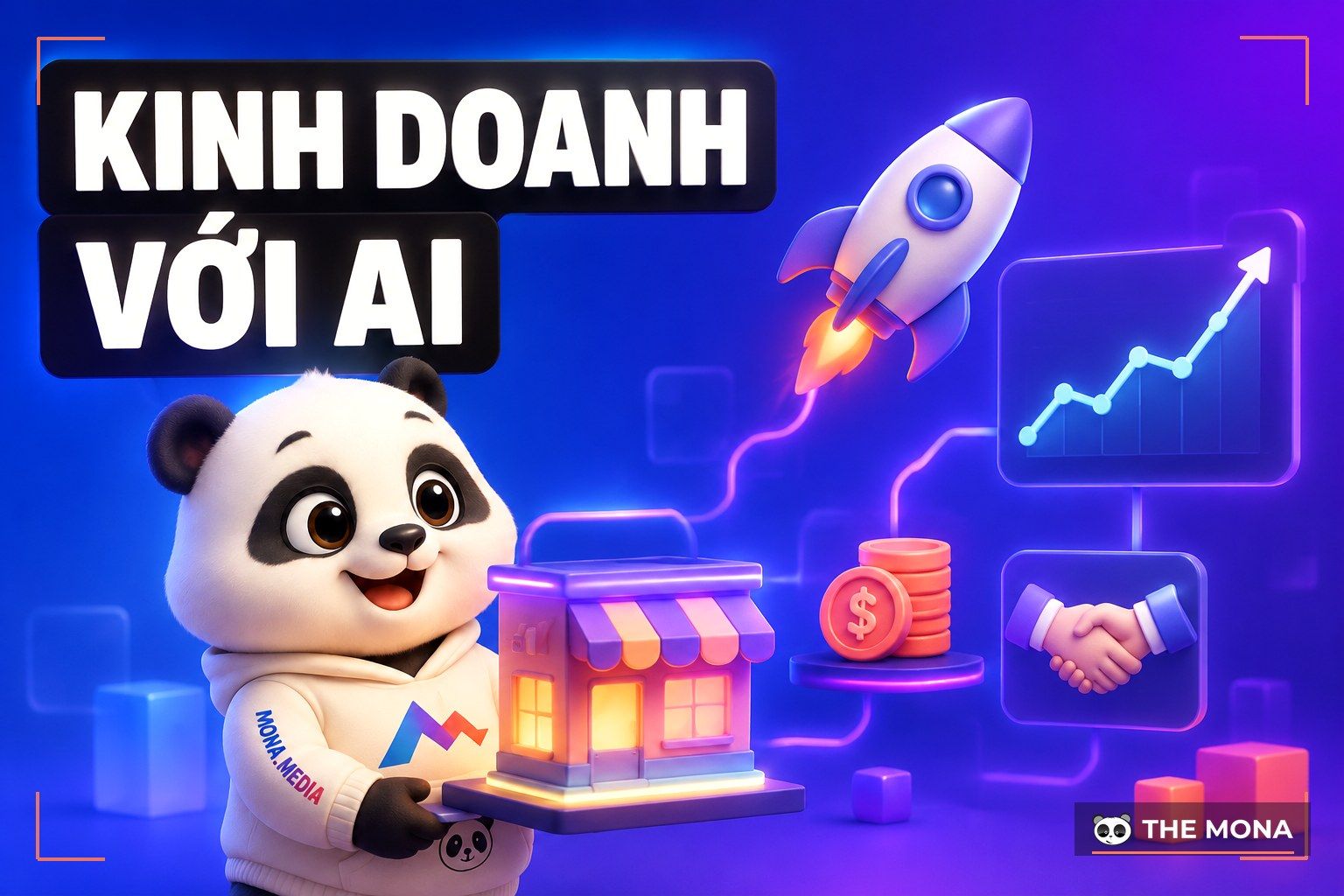
The eleventh course in MONA's free AI course series: build your first AI business, based on a 6-hour curriculum that we rate as one of the most honest on this topic. It does not paint a dream of “quitting your job and becoming a millionaire with AI”. It teaches exactly what decides life and death: finding clients, selling, delivering, retaining them: through a live business launch from zero, running real campaigns, getting real replies, and even wasting real money. The course is for two kinds of readers: those who want to open an AI services line (part-time or full-time), and business owners who want to understand how an AI service seller operates so they buy wisely. All the techniques learned in earlier courses (agentic workflows, n8n, vibe coding) are put in their proper place here: one small box in the larger business picture.
Course contents
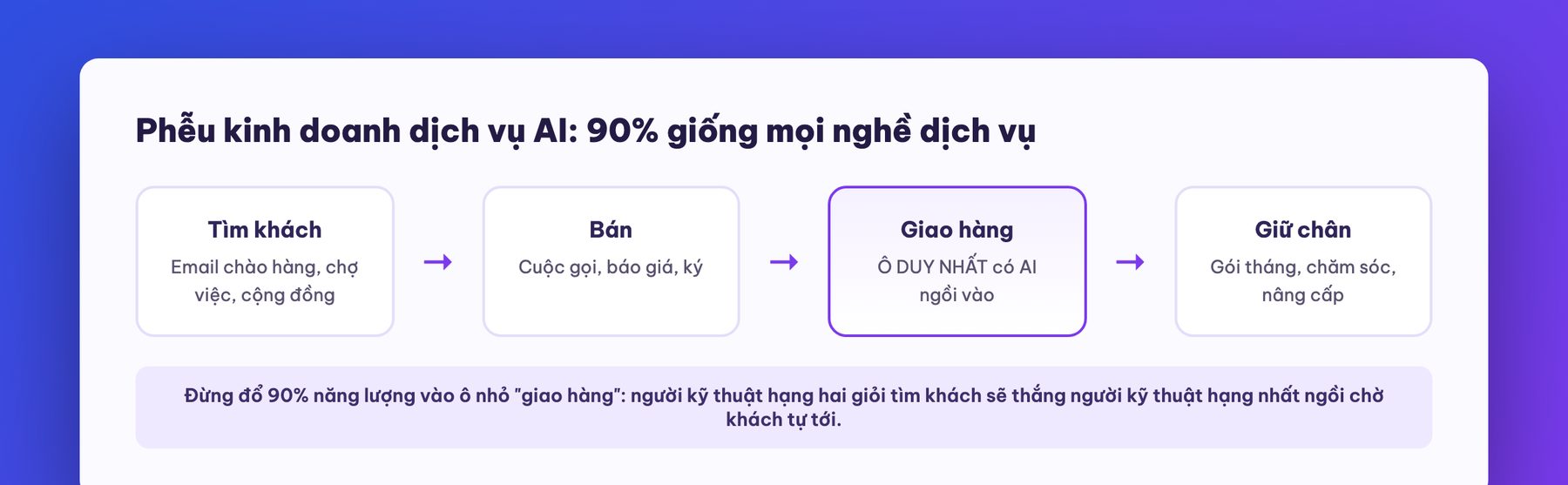
We wholeheartedly agree with the curriculum's opening view: an AI services business is not a magic model, it is a B2B services business like any other trade. The standard funnel: find prospects → sales call → quote → sign → deliver → retain. Nine tenths of that funnel is identical to a recruiting firm, an ad agency, even a team of plumbers. The only different box is delivery: where AI automation sits. And here is the course's most valuable advice: do not pour 90% of your energy into that small box. A second-rate technician who is good at finding clients, selling and retaining them will beat a first-rate technician waiting for clients to show up. This rule holds in the US and holds exactly the same in Vietnam, and we see it every day in our own industry.
The technical part of the course is wrapped in three pieces familiar to anyone who has followed the series: API (the path that sends data out: read the docs, find the authentication section, copy the cURL sample, build a minimal call, and only then add extras), webhook (the path that receives data), and prompt ba vai (system sets the role, user assigns the task, force a JSON reply). More valuable are the two build principles:
The backbone of the course: build a “minimum viable business” in the right order, to cure perfectionism:
Plus one cheap but powerful psychological weapon: a daily minimum sheet: a Google Sheet logging the date, emails sent, applications submitted and posts published, shared with an acquaintance to hold yourself accountable. The curriculum states the gap between learners and people who earn money plainly, and we sign off on it: it is not in knowledge, it is in whether you do the full count every day.
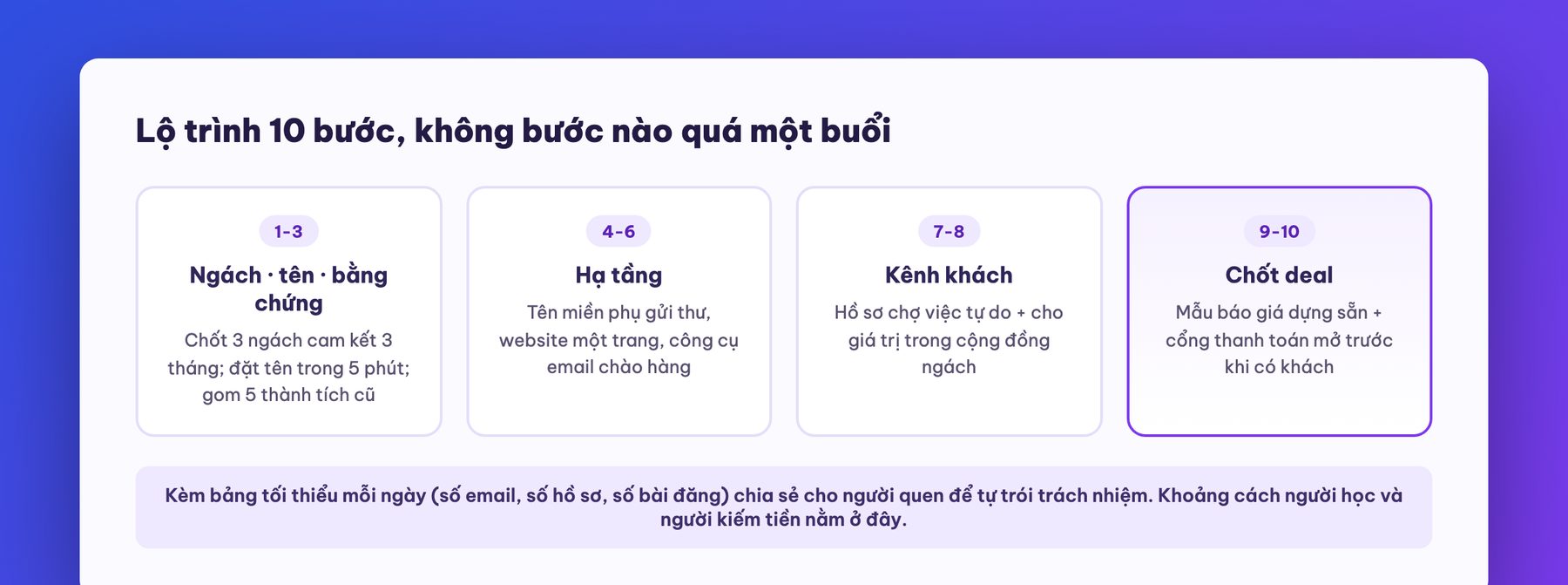
The most watchable part of the course: building for real from scratch, real numbers, real stumbles:
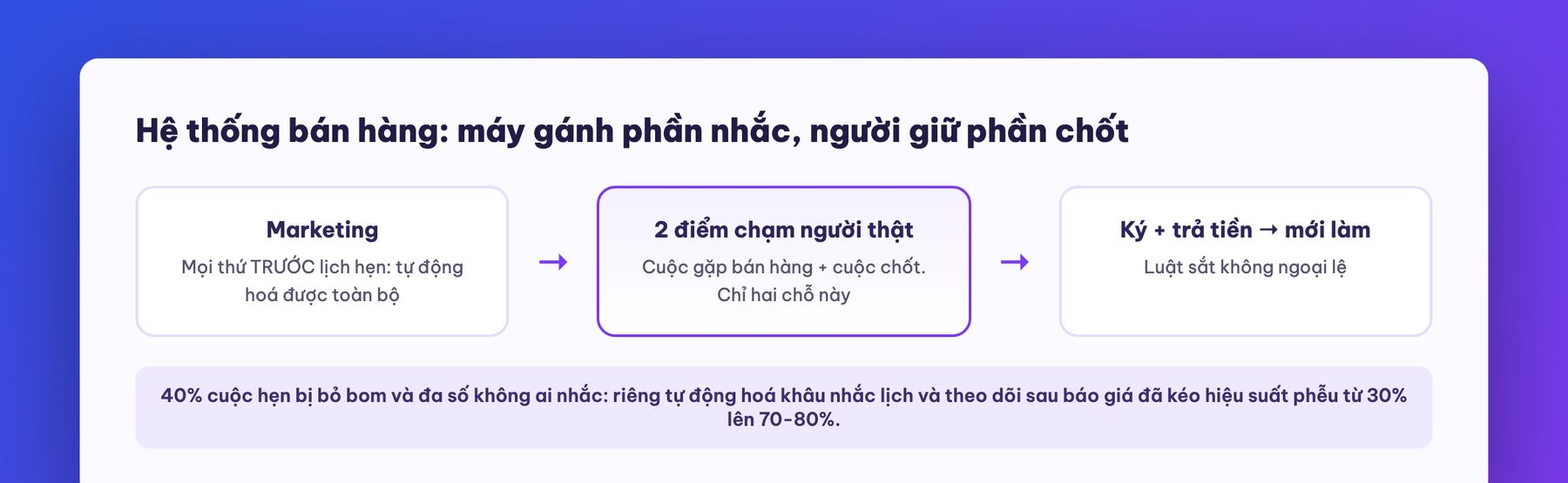
The course's tightest definition: marketing is everything before the appointment; sales is everything after. A service company's standard sales system goes through these stages: appointment booked → (if the client forgets to show, a reminder loop) → meeting → three outcomes (not right for now / never right / move forward) → quote → (if unsigned after 7 days, a nudge) → signed and paid → only then start work. The iron rule is repeated twice: no payment, no kickoff: every exception turns into a sad story one day.
Three numbers from this part worth hanging on the wall: first, a client's value rises along the funnel: the same person is worth one when they just booked, and five once they have heard the quote. The closer to the end of the funnel, the more carefully you must tend them, so do not pour all your effort into newcomers while neglecting people about to sign. Second, about 40% of appointments are no-shows and most companies never follow up: automating just the reminders and the post-quote follow-up (work machines do better than people because they do not feel awkward and do not forget) lifts funnel performance from about 30% to 70-80%. Third, in the whole system there are only two points that require a real person: the sales meeting and the closing. Everything else: machines.
The part worth money for both sellers and buyers: eight ways to price an automation service: hourly billing (easy to start, but it punishes fast workers); a percentage of the money saved for the client (a practical ceiling of about half the savings); a percentage of added revenue (usually 10-30%); pay per results result (a set amount per booked appointment: high risk, for the seasoned); prepaid hour packages; a monthly package by task (with weekly meetings, support, a new system each month: steady income but you must keep proving value); pricing per product unit (per article, per design: easy to package); and a percentage of gross revenue (only when trust is extreme). The smart path: start hourly → move early to value-based pricing with a monthly package → only play results-based once you are seasoned. Note that this is the detailed version of the “price at 10-20% of the value created” principle from the vibe coding course: two different curricula, one truth.
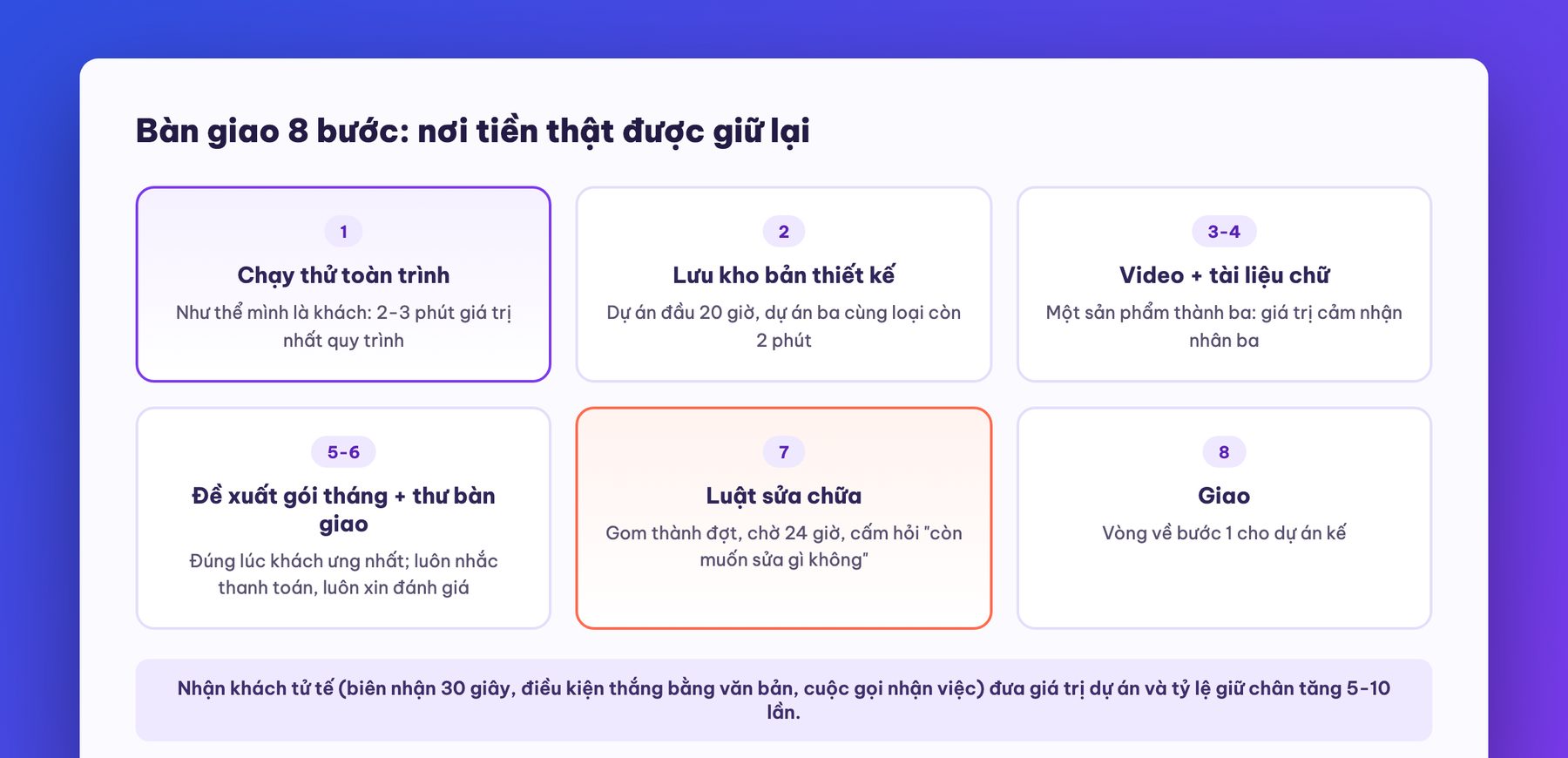
In this part the curriculum says one sentence we want in bold: the money is not in building the system, it is in how you hand it over. Three areas:
The closing section is the framework we urge every business owner to read slowly, because it runs against instinct: the right yardstick is revenue per person involved in operations, not total revenue. Hiring more people usually drags this number down reducing costs (communication overhead, training, mistakes), so before you hire, go through four steps: one, package it (break the service into a standard product: each step, each checklist, each input and output); two, automate 80% of what you've packaged: don't chase 100%. A ready-made template library takes each order from 80% to the finish line instead of from zero, a fivefold multiplier; three, automate distribution: proactive outreach at scale, or content (one video or article serving ten people or ten thousand for the same effort); four, and only then consider changing the model (from service to product or platform) if you want to go further. The course estimates these milestones for the international market: pure manual work tops out at $15-20 thousand per person per month; packaging gets you to 20-30; automation to 50-100; automated distribution to 100-250. Vietnam's numbers differ, but the multipliers don't.
As we wrap up nearly the whole series, here is our take from both sides. If you plan to start an selling AI service business: this course is the most honest map in the series, and its step one (pick a niche, put in the daily reps) has no shortcut. If you are a business owner planning to mua: you now know what a good vendor looks like. They have a written win condition, a client onboarding process, a handover video and documents, and revision rules. Without those, even a cheap price becomes expensive. And if you want to work directly with a team that has run to that standard for over 10 years across 14,000+ projects: call 1900 636 648 or send it to info@themona.global, MONA will listen to your problem and quote transparently. We do the work at the price we sign, and hand over the full system, documentation and training, just as this article described.
Can I start an AI service business knowing nothing about AI? You can learn the technique through this very free course series. What decides success is business skill: picking a niche, pitching, selling, delivering. The course advises putting your energy there, and we agree.
How much capital do I need to start? Very little: a domain, a few tools at a few dozen dollars a month, and about a hundred dollars per batch for scraping client data. The most expensive thing is the discipline to put in the daily reps, and you can't buy that.
How do I pick the right niche? Pick 3 niches that live online, with high-ticket projects and few legal barriers. Commit for 3 months, test all three, and let the data decide. Drop any niche that shows no opportunity without regret, like the live demo in the course.
How should I price an AI service? Start with hourly pricing because it is easy to close, then move to value-based pricing early (a percentage of savings or added revenue, usually 10-30%) plus a monthly plan. All eight methods are covered in part 6.
How do I keep clients paying consistently? Onboard them properly (instant receipt, a written win condition, a kickoff call with screen sharing) and hand over all three deliverables: the system, the video, the document. Perceived value decides the monthly plan, and it lives in how you deliver, not just in the machine.
The final course in the series: writing cold outreach emails: the top-of-funnel skill that everything in this article is waiting behind. See you there.

CEO & Founder · The MONA
The founder of The MONA built a service company of 60+ staff with 14,000+ projects delivered. Khánh Hùng shares his thinking on building self-running systems, automating a business, and the real lessons behind MONA's projects.
 422




Professional website
design services
Own a website with a beautiful, 100% exclusive design and a lifetime warranty, with the ability
to expand features flexibly as your business grows, starting today!






 MONA will never sell your information or send you spam


 MONA will never sell your information or send you spam
