
 MONA OS 2.0
 Partner with MONA


 Tự động hoá doanh nghiệp
 Cẩm nang SEO
 Digital Marketing
 Kinh nghiệm thiết kế website
 Hạ Tầng Server
 Giáo dục


 VI
 EN














Message us on
Zalo Official


 ProductsNew

 ProductsProducts
 Mới ra mắtKHA AI 2027App tự edit video, tự đăng mọi mạng xã hội, 2 phút mỗi ngày










 Website designLooks good and wins customers over.
SEO servicesBrings in customers searching for exactly what you sell.
 Tư vấn digital marketingKéo khách từ nhiều kênh, đo bằng số thật.
Corporate video productionVideos introducing your company, factory and team.
 NewAI video productionCompany story films made with AI.
 Custom software developmentCRM, ERP and HRM built for your business.
 Viết AI Agent theo yêu cầuĐặt riêng một trợ lý AI cho đúng việc của mình.
 Tư vấn chuyển đổi AIĐưa AI vào vận hành của cả công ty.
NewMONA LMSManagement for centers and schools.
MONA SkillHubInternal training for company staff.
 NHTQ systemEnd-to-end China–Vietnam shipping operations.
MONA JMSManagement for gold, diamond and pawn shops.
 MONA E-LearningA website with every feature you need to sell courses.
 How to sell online courses (course)More than 30 free lessons on selling courses on autopilot.
 MONA Cloudmonacloud.vnServers to get your apps and websites running.
 MONA Basemonabase.vnPostgres database, sign-in and file storage.
 MONA Mailmonamail.vnSend OTP, order and invoice emails from your software.
 MONA Paymonapay.vnAccept bank transfers via VietQR and notify your software when the money arrives.
 MONA eInvoiceComing soonIssue e-invoices that meet tax standards.
Gấu CườiTrả lời khách 24/7 trên web, Fanpage, Zalo và thu lead cho sale.
 Gấu TeleSalesGọi điện tư vấn, chăm khách như tổng đài viên thật.
Dê CườiTư vấn và chốt đơn cho shop ngay trong khung chat.
Gấu WebmasterNhắn nhóm Zalo là website được sửa xong.
 Gấu Pháp ChếSoạn hợp đồng, rà điều khoản trong vài phút.
 Gấu Báo GiáLên báo giá đúng mẫu và gửi khách ngay.
 AI chăm sóc khách hàngTheo dõi và giữ chân khách hàng cũ.
 Gấu Tuyển DụngLọc hồ sơ, hẹn lịch, phỏng vấn ứng viên.
 Mới ra mắt
KHA AI 2027
Xây kênh chuyên gia 2 phút mỗi ngày
Quay bằng điện thoại, AI tự edit video, tự đăng lên 16 nền tảng và tự trả lời bình luận, tin nhắn.
847.400lượt xem trên kênh CEO MONA sau 28 ngày
 Anh Khánh HùngCEO MONA đang dùng mỗi ngày
Xem app làm được gì
 AI
Gấu Cười MONA ĐANG TỰ XÀITrả lời khách 24/7 trên website, Zalo OA, Messenger và thu lead về cho sale.
Dê CườiChốt đơn bán lẻ và sàn: Shopee, TikTok Shop, web. Chăm cả khách sỉ, đại lý.
Gấu WebmasterCập nhật nội dung, tối ưu SEO website mỗi ngày.
Gấu TeleSalesGọi điện tư vấn, chăm khách như tổng đài viên thật.
Gấu Tuyển DụngLọc hồ sơ, hẹn lịch, phỏng vấn ứng viên tự động.
AI chăm sóc khách hàngGiữ khách cũ, cứu lead đã rớt cho phòng kinh doanh.
Gấu Pháp ChếSoạn hợp đồng, rà điều khoản trong vài phút.
Gấu Báo GiáLên báo giá đúng mẫu, gửi khách ngay khi có yêu cầu.
 Chuyển đổi AI toàn phầnGiải pháp tổng cho doanh nghiệp, 3 lớp triển khai.
 Viết AI Agent theo yêu cầuĐặt riêng một con AI gánh đúng nghiệp vụ của bạn.
 Custom softwareCRM, ERP and HRM with built-in AI automation.
 SEO & AEO thời đại AIĐược Google lẫn AI trích dẫn, không chỉ xếp hạng.
 Kiến thức AI cho doanh nghiệpBài phân tích, hướng dẫn ứng dụng AI vào vận hành.
 Free AI courses
 AI tools at work
App mới · KHA AI 2027
Xây kênh 2 phút mỗi ngày
AI tự edit video, tự đăng mọi mạng xã hội
Free consultation, 8am–10pm every day

18 June, 2023
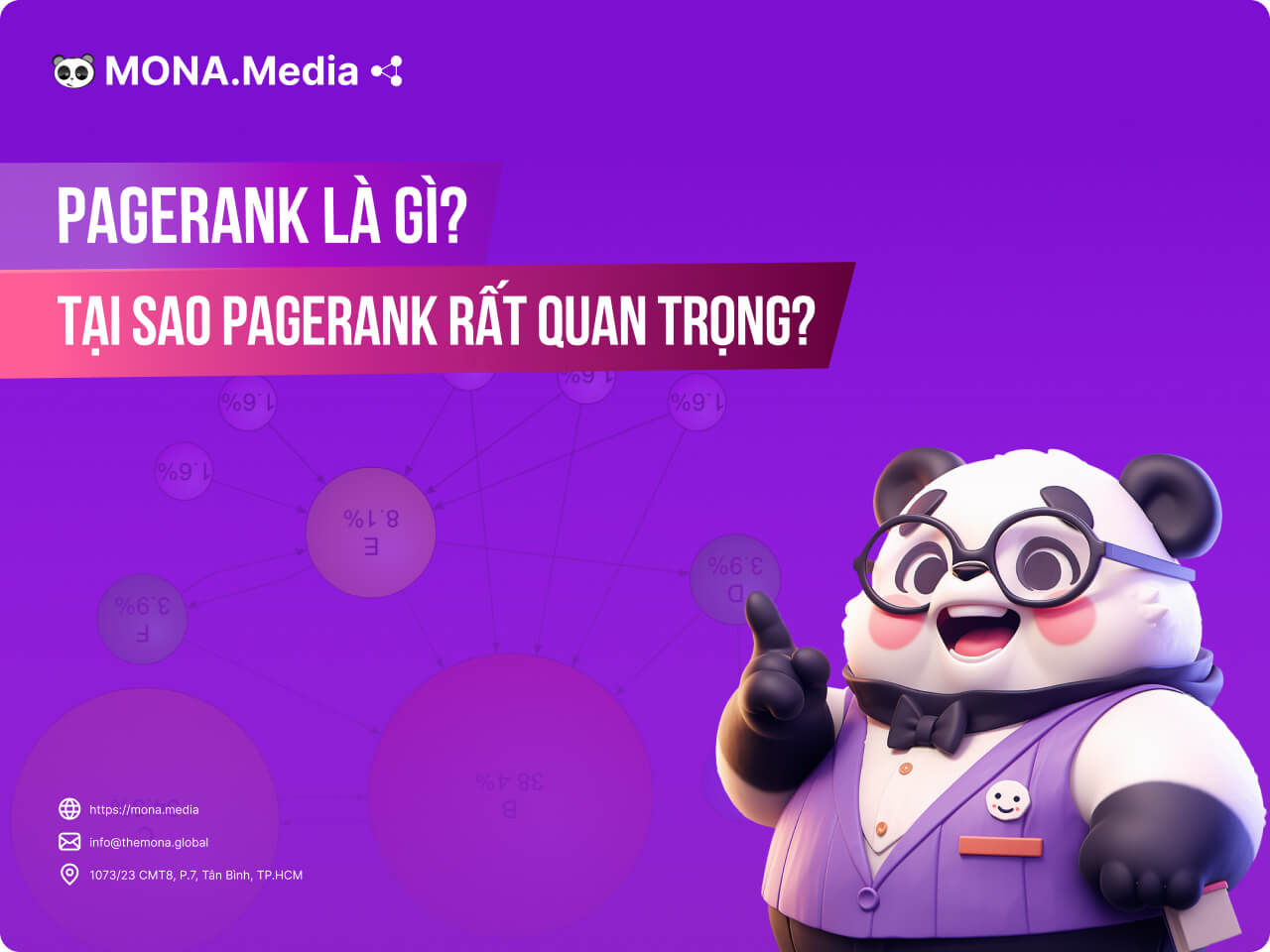
PageRank was once one of the most important algorithms Google used to evaluate and rank web pages on the internet. It is mentioned less publicly today, but that does not mean PageRank has lost its value. In fact, PageRank is still a foundation of how Google judges the authority of websites. It is simply no longer published as widely as before. Let's MONA Media take a closer look at Pwhat PageRank is and why it matters for SEO.
PageRank is an algorithm developed by Google's two founders, Larry Page and Sergey Brin. It helps Google judge how important a web page is based on the links that point to it from other sites. Think of each link as a vote of confidence: the more votes a site gets from reputable sites, the more highly Google rates it.

The PR score is the score a page receives based on the number and quality of the links pointing to it. If a page gets many links from sites with a high PageRank, its own PR score rises too, which signals authority and trustworthiness. If the links come from low-authority sites, the score stays low.
PageRank is not the only factor that decides Google rankings, but it is an important part of Google's overall evaluation system. For SEO specialists, the PageRank score works as a measure of whether their link building strategy is paying off. When PageRank rises, it shows that more reputable sites are "voting" for the page, which helps improve its position in search results.
PageRank is what Google uses to judge the importance of a web page based on the links pointing to it. The algorithm treats each link as a referral, but not every vote carries the same weight.
The formula for a site's PageRank is as follows.

Where:
T1,T2,…,Tn are the pages that link to page A.
PR(Ti) is the PageRank score of page Ti.
C(Ti) is the number of outbound links from page Ti.
d is the damping factor, usually set to 0.85. It models the chance that a user randomly jumps to another page instead of only following links.
A note on how PageRank is distributed:
PageRank is really a probability distribution. It shows the likelihood that a user who randomly clicks through a chain of links ends up on a given page. For that reason, PageRank scores are divided among all pages on the web as percentages, and the total PageRank of all pages always equals 1.
Here is an illustration:
PageRank plays a very important role for a website. SEO specialists should keep a few points in mind:

Site PageRank is an algorithm that measures how authoritative a website is. Google no longer publishes it, but it still influences search rankings today. These are the factors that affect the score:
Anchor text is a piece of text containing a link that takes the user to another web page when clicked. Anchor text matters for PageRank because it helps Google understand the content and topic of the linked page.

Key points about anchor text in site PageRank:
Not all links on a page carry the same value in Google's eyes. How likely a user is to click a link also affects how PageRank is distributed.
Google described this principle in a patent called Reasonable Surfer, which holds that users do not click every link at random. They lean toward links they find relevant, prominent and trustworthy. Position, size, color, display style and anchor text all affect that likelihood.
So when calculating PageRank, Google assigns different weights to different links:
Internal links are links within the same website that help users and Google navigate to other pages on the site. Internal links matter for PageRank because they distribute PageRank to other pages on the site and add authority to the important ones. Internal links also improve the site's structure, content and user experience.

Key points about internal links in PageRank:
Nofollow links are links with the attribute rel=“nofollow”, which tells search engines to ignore the link and not pass PageRank to the linked site. Nofollow links are used to prevent ranking manipulation through buying and selling links, placing links in unrelated comments or forums, or using paid or advertising links.
Nofollow links affect PageRank in these ways:
Google officially removed the public PageRank score from its toolbar in 2016, after years of not updating it for the public. The main reasons Google publicly removed site PageRank are:

That does not mean Google dropped PageRank entirely, though. Google still uses PageRank in its ranking algorithm. It just keeps it on the server side and no longer shows it to users.
Link spam violates Google's guidelines on link quality. It means creating links that are unnatural, have no value or have nothing to do with the content of the site. The aim is to manipulate the site's ranking in search results, or to profit from paid or advertising links.
Some causes of link spam:
CASE STUDY: MONA x VÕ MINH THIÊN LOGISTICS
Võ Minh Thiên Logistics is a pioneer in importing goods from China, working in a fiercely competitive logistics market with many large rivals. Before working with MONA, Võ Minh Thiên struggled to set a clear marketing strategy. It chased many ad channels without results, so revenue grew slowly and the website had little traffic. After partnering with MONA, the team redesigned the website, optimized it fully in both technical and content terms, and carried out a proper white-hat SEO strategy with a quality backlink system and a content plan covering every area. The strategy full-scope SEO helped Võ Minh Thiên overcome the challenges, grow strongly and build a solid brand in a highly competitive market.
Nofollow is an attribute HTML used to mark links that the webmaster does not want to share PageRank with, or does not trust or endorse. When you add the nofollow attribute to a link, you tell search engines to ignore that link when indexing or ranking the site.
Nofollow was introduced in 2005 by Google, Yahoo and Microsoft to fight link spam such as buying and selling links, placing links in unrelated comments or forums, or using software that creates links automatically. These practices lower the quality of search results and the user experience.

PageRank sculpting is an SEO technique webmasters use to control how much PageRank passes from one page to others through links. The aim is to optimize the strength of a site's link profile by boosting valuable links and cutting back unnecessary or unrelated ones.
One common way to do PageRank sculpting is to add the attribute rel="nofollow" to outbound or internal links the webmaster does not want to pass PageRank through.

However, PageRank sculpting has its limits:
So if you use PageRank sculpting, weigh its benefits and risks carefully, and do not overuse it or depend on it too much.
Some alternatives to PageRank:
There are also other metrics used to judge how important a site is, such as Domain Authority (DA), Trust Flow (TF), Citation Flow and more. Keep in mind that no metric can fully replace PageRank, because they are all estimates based on different algorithms and data.
URL Rating (UR) and PageRank (PR) are two different metrics used to judge the strength of a site's link profile. Both are based on the number and quality of incoming and outgoing links.
PageRank is the metric Google developed and uses to rank pages in search results, but Google does not publish PageRank values to the public. URL Rating is the metric developed by Ahrefs for users to track and improve their website SEO.

PageRank only counts "dofollow" links, meaning links with the attribute rel="dofollow" or with no rel attribute. URL Rating also counts only "dofollow" links, but it also takes the site's internal links into account.
PageRank can also be affected by the damping factor, the probability that a user will stop clicking links on a site. The damping factor is usually set at 0.85, which means there is a 85% chance that a user keeps clicking links on the site. URL Rating has no damping factor. It depends only on the number and quality of links.
The damping factor in SEO is an important factor for judging the probability that users keep clicking links on your site and stay longer. It affects how PageRank is calculated, and PageRank is one of the factors that decide a site's rankings on Google.
The damping factor is usually set between 0 and 1, and should be adjusted to fit SEO strategy your site. If the damping factor is too high, you are assuming users click many links on your site, and PageRank will depend heavily on the number and quality of links coming into the site.
If the damping factor is too low, you are assuming users click few or no links on your site, and PageRank will depend heavily on the number and quality of links going out from the site. So you need to find a balance between the damping factor and other SEO factors to get keywords to the top of your website.
PageRank plays a very important role in SEO because it helps Google judge a site's authority and importance based on the number and quality of the links pointing to it. When your PageRank is high, your site is more likely to appear high in search results, which makes it easier for potential customers to find you.
To reach a high PageRank, build a quality website with SEO-standard content useful content, and optimize your SEO with keywords, meta tags and a sensible page structure. You should also prepare an effective link building strategy to build your site's credibility.

Some effective link building strategies for a higher Google PageRank:
To increase PageRank, focus on building quality links to your website and on optimizing the internal and external links on your site. Here are some effective ways to improve PageRank:
While building your website, you can create countless backlinks from your own satellite sites. It is an effective SEO technique that many SEOers use. Still, keep the number of links you create reasonable and don't overdo it, because Google will notice, and you risk a penalty.
|
Choosing a reputable SEO provider is a key step in the success of a company's SEO strategy. The wrong partner can cost you keywords, or even a domain you have built over many years. On the other hand, working with a professional team that delivers SEO services will shorten the time it takes to reach ONTOP, grow revenue and build a lasting brand on Google. 
MONA Media is confident working with businesses on a full-scope SEO strategy that is transparent and clearly measured, helping you grow your brand steadily and effectively.
Contact with MONA Media for a full-scope SEO strategy consultation and a website SEO quote plan that fits your goals and budget. |
PageRank does affect search engine rankings, but it is not the only factor. Search engines use many other algorithms to judge a site's content, structure, speed, security and user-friendliness.

So a website with a high PageRank will not necessarily appear in the top position in search results, since other factors matter too. In short, PageRank has a considerable effect on how a site ranks in search engines, but whether a keyword reaches the top also depends on many other factors.
To quickly check a competitor's PageRank, you can use these tools for checking Google PageRank from A to Z:
SEO is more than writing articles. You also need to read the metrics and analyze user behavior. Watch the video to see how Huy tracks results.
How are PageRank and SEO related?
PageRank and SEO influence each other. A site with a high PageRank is more likely to appear higher in search results and attract more visitors. In turn, a site with good SEO earns more quality links, which raises its PageRank.
What is Google PageRank?
Google PageRank is a score from 0 to 10 that estimates how trustworthy and authoritative a website is, based on the number and quality of links pointing to it. The score directly affects where a page ranks in Google's results, and 10 is the highest.
By now you should have a clear idea of what PageRank is and why it matters for SEO. We hope this explanation of PageRank helps those of you working in SEO apply it effectively to your own websites.

CEO & Founder · The MONA
Founder of The MONA, who built a services company of 200+ staff with 14,000+ projects delivered. Khánh Hùng shares how he thinks about building systems that run themselves, automating a business, and the real lessons from delivering projects at MONA.
 1,5K




Professional website
design services
Own a website with a beautiful, 100% exclusive design and a lifetime warranty, with the ability
to expand features flexibly as your business grows, starting today!



NHẬN TƯ VẤN SEO MIỄN PHÍ !






 MONA will never sell your information or send you spam


 MONA will never sell your information or send you spam
