
 MONA OS 2.0


 Tự động hoá doanh nghiệp
 Cẩm nang SEO
 Digital Marketing
 Kinh nghiệm thiết kế website
 Hạ Tầng Server
 Giáo dục



 VI
 EN


















Message us on
Zalo Official


 ProductsNew

 ProductsProducts
 Mới ra mắtKHA AI 2027App tự edit video, tự đăng mọi mạng xã hội, 2 phút mỗi ngày










 Website designLooks good and wins customers over.
SEO servicesBrings in customers searching for exactly what you sell.
 Tư vấn digital marketingKéo khách từ nhiều kênh, đo bằng số thật.
Corporate video productionVideos introducing your company, factory and team.
 NewAI video productionCompany story films made with AI.
 Custom software developmentCRM, ERP and HRM built for your business.
 Viết AI Agent theo yêu cầuĐặt riêng một trợ lý AI cho đúng việc của mình.
 Tư vấn chuyển đổi AIĐưa AI vào vận hành của cả công ty.
NewMONA LMSManagement for centers and schools.
MONA SkillHubInternal training for company staff.
 NHTQ systemEnd-to-end China–Vietnam shipping operations.
MONA JMSManagement for gold, diamond and pawn shops.
 MONA E-LearningA website with every feature you need to sell courses.
 How to sell online courses (course)More than 30 free lessons on selling courses on autopilot.
 MONA Cloudmonacloud.vnServers to get your apps and websites running.
 MONA Basemonabase.vnPostgres database, sign-in and file storage.
 MONA Mailmonamail.vnSend OTP, order and invoice emails from your software.
 MONA Paymonapay.vnAccept bank transfers via VietQR and notify your software when the money arrives.
 MONA eInvoiceComing soonIssue e-invoices that meet tax standards.
Gấu CườiTrả lời khách 24/7 trên web, Fanpage, Zalo và thu lead cho sale.
 Gấu TeleSalesGọi điện tư vấn, chăm khách như tổng đài viên thật.
Dê CườiTư vấn và chốt đơn cho shop ngay trong khung chat.
Gấu WebmasterNhắn nhóm Zalo là website được sửa xong.
 Gấu Pháp ChếSoạn hợp đồng, rà điều khoản trong vài phút.
 Gấu Báo GiáLên báo giá đúng mẫu và gửi khách ngay.
 AI chăm sóc khách hàngTheo dõi và giữ chân khách hàng cũ.
 Gấu Tuyển DụngLọc hồ sơ, hẹn lịch, phỏng vấn ứng viên.
 Mới ra mắt
KHA AI 2027
Xây kênh chuyên gia 2 phút mỗi ngày
Quay bằng điện thoại, AI tự edit video, tự đăng lên 16 nền tảng và tự trả lời bình luận, tin nhắn.
310.136lượt xem trên kênh CEO MONA sau 17 ngày
 Anh Khánh HùngCEO MONA đang dùng mỗi ngày
Xem app làm được gì
 AI
Gấu Cười MONA ĐANG TỰ XÀITrả lời khách 24/7 trên website, Zalo OA, Messenger và thu lead về cho sale.
Dê CườiChốt đơn bán lẻ và sàn: Shopee, TikTok Shop, web. Chăm cả khách sỉ, đại lý.
Gấu WebmasterCập nhật nội dung, tối ưu SEO website mỗi ngày.
Gấu TeleSalesGọi điện tư vấn, chăm khách như tổng đài viên thật.
Gấu Tuyển DụngLọc hồ sơ, hẹn lịch, phỏng vấn ứng viên tự động.
AI chăm sóc khách hàngGiữ khách cũ, cứu lead đã rớt cho phòng kinh doanh.
Gấu Pháp ChếSoạn hợp đồng, rà điều khoản trong vài phút.
Gấu Báo GiáLên báo giá đúng mẫu, gửi khách ngay khi có yêu cầu.
 Chuyển đổi AI toàn phầnGiải pháp tổng cho doanh nghiệp, 3 lớp triển khai.
 Viết AI Agent theo yêu cầuĐặt riêng một con AI gánh đúng nghiệp vụ của bạn.
 Custom softwareCRM, ERP and HRM with built-in AI automation.
 SEO & AEO thời đại AIĐược Google lẫn AI trích dẫn, không chỉ xếp hạng.
 Kiến thức AI cho doanh nghiệpBài phân tích, hướng dẫn ứng dụng AI vào vận hành.
 Free AI courses
 AI tools at work
App mới · KHA AI 2027
Xây kênh 2 phút mỗi ngày
AI tự edit video, tự đăng mọi mạng xã hội
Free consultation, 8am–10pm every day

24 April, 2023

Before we built funnels for clients, we lived on one ourselves, and we still do. For more than 10 years MONA has had no team cold-calling strangers: people type a keyword into Google, land on our articles, read one that fits, ask our chatbot a few questions, and by the time a consultant calls back, the person on the other end already knows what they want. That routine has run for 10 years. This mapped-out path is exactly what people in the trade call a marketing funnel, hay funnel marketing In this article we explain what a funnel is in a salesperson's language, point out where money leaks most, and show how to build a funnel that runs on its own for your business.
A marketing funnel is a model that describes a customer's path, from the moment they know nothing about your business to the point where they pay and come back, split into layers from wide to narrow: awareness, consideration, conversion, retention. It is called a funnel because people drop out layer by layer: 1,000 people see an ad, 100 visit the website, 10 leave their number, 3 buy. It sounds harsh but it is accurate. That shape is a rule of the game, not anyone's fault.

Once you understand the funnel, the way you spend changes. The question is no longer “do ads bring in orders” but “which layer is leaking”. With the same budget, someone with a funnel knows to fix the spot where 100 people visit the site but only 3 leave their number, while someone without one just pours more money into the top and hopes. In digital marketingalmost every technique you have heard of exists to serve one layer of this funnel.
We will start with our own funnel, since it is what we have run every day since 2016. The top of the funnel is thousands of well-built SEO articles that cover exactly the questions business owners type into Google, such as “how much does an e-commerce website cost” or this very article, “what is a marketing funnel”. By the end of an article, the reader has already filtered themselves into the consideration layer.
The middle layer is staffed by our AI chatbot. It does not unload a speech about the company; it asks just a few questions: what business are you in, do you need a website or software, do you have a timeline. Someone who answers all 3 is almost certainly a real customer, and their file goes straight to the consulting team along with the full conversation. A person steps in only at the last layer, where a call is worth the most, instead of spending 8 hours a day answering “can I get a price list” from people who are only curious.

What is worth copying here is how the work is split: machines handle the wide layers, people handle the narrow ones. Articles and the chatbot can talk to thousands of people without getting tired, while the salesperson's precious 30 minutes go only to people ready to hear a quote. Whether you are a business of 2 or 200, the principle stays the same. Machines filter, people close.
A case we see so often it has become tiresome: the owner of a furniture shop spends 30 million VND a month on ads, and every click lands on the home page. The home page talks about everything, not about the one sofa in the ad, has no button to leave a phone number, and has nothing that follows up with the people who left. Every month there are “a few orders”, but ask which orders came from which ads and nobody knows. That is a pipe leaking at both ends, not a funnel. What goes in runs straight out.
Industry numbers show how big this leak is: according to Statista, 70.19% of online shopping carts are abandoned, meaning that out of every 10 people who have picked their items, 7 leave before paying. A 2025 survey of US shoppers shows that nearly 40% abandon because of extra fees at checkout: shipping, tax and surcharges that only appear at the last step. These are all people who made it to the bottom of the funnel before dropping out. Pouring more money into the top without fixing these spots is like pouring water into a sieve.
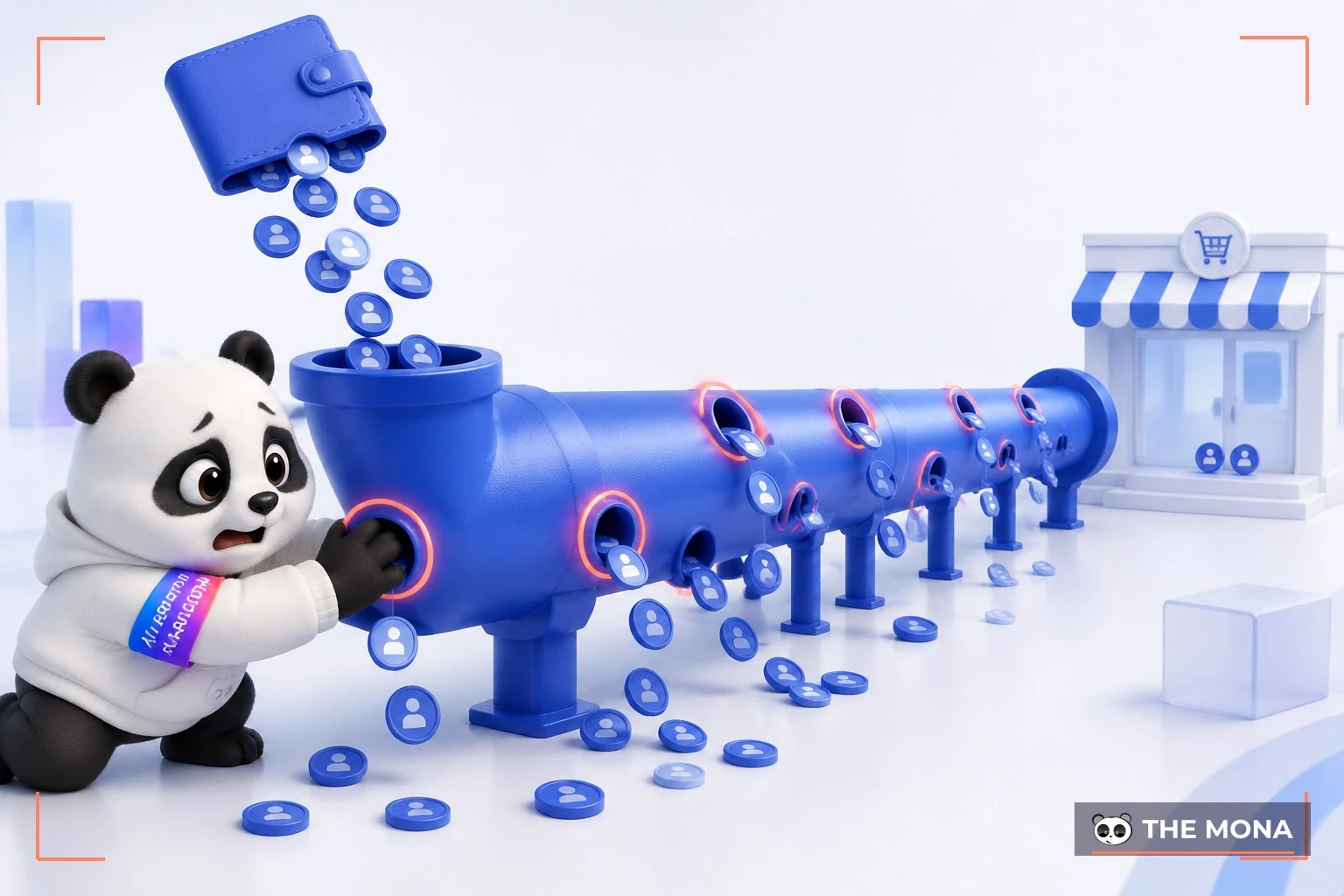

The frustrating part is that fixing the bottom of the funnel costs far less than widening the top. One landing page about one product, one call-to-action button in the right place, and one campaign to follow up with people who have visited, and those three together usually cost less than one month of ad budget burning for nothing.
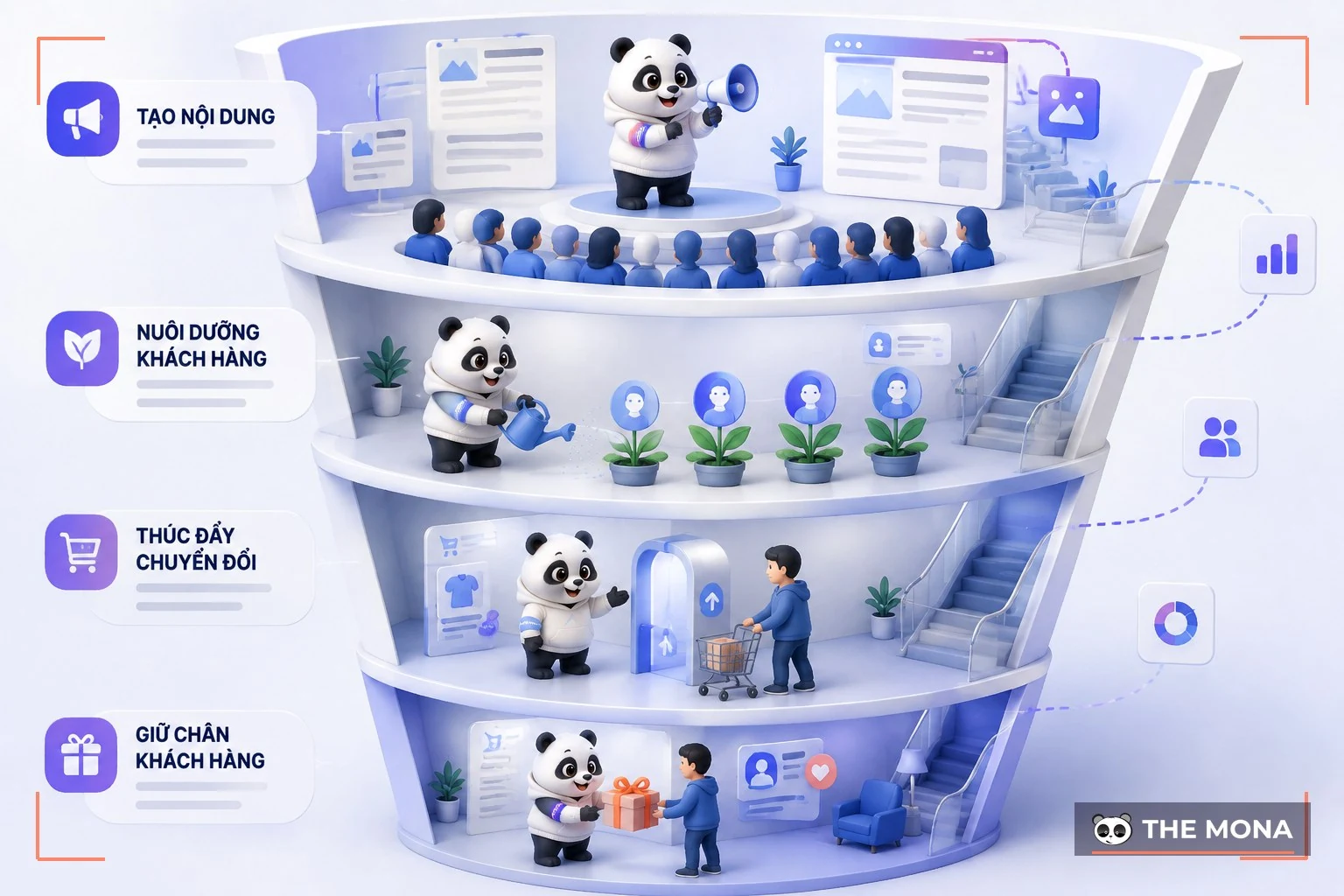
Each funnel layer answers a different question in the customer's mind, so the work differs too. Mixing up the layers, such as quoting a price to someone who has just heard your name for the first time, is the fastest way to be ignored. The right work at the right layer is what pays off.
Awareness layer, where customers are asking “what is my problem”. Your job is to show up when they search: articles that answer exactly what they type, video, display ads. Content marketing and SEO belong to this layer, and the content has to give real knowledge rather than a flyer praising yourself. Give first, receive later.
Consideration layer, where customers ask “who can solve this for me”. This is the home of comparison tables, real cases we have done for clients, reviews from past customers and nurturing emails. A person who leaves their details at this layer is called a lead, and one potential customers that is nurtured properly is worth many times more than an ad view.
Conversion layer, where customers ask “is it worth buying here”. A clear landing page, transparent pricing, no hidden fee popping up at the last minute, few steps to pay, and someone who answers right when the customer hesitates. Conversion rate is the number that rules this layer, and cutting one clumsy step from checkout means more orders within the week.
Retention layer, the most neglected one: turning a one-time buyer into someone who buys 4 or 5 times. Follow-up emails, offers for past customers, and messages sent on the right occasion. Selling to someone who has bought before is always cheaper than finding a stranger, yet the budget all goes to strangers.

The funnel model is drawn as a straight line to keep it simple, while real customers wander. McKinsey calls the modern buying path the consumer decision journey: a loop of consideration, evaluation, purchase, and then the after-purchase experience feeding back into the next round of consideration, not a one-way street. A customer sees an ad today, remembers it a week later and goes searching, reads reviews in three places, asks people they know, then comes back to buy through a completely different channel. Nobody goes in a straight line. We measure the same on our own funnel: customers usually touch us 3 or 4 times through articles, ads and messages before picking up the phone.
The practical consequence for you: the funnel has to cover many touchpoints instead of betting on one channel. Redraw customer journey for your own business and see where customers meet you: Google, social media, marketplaces, shops. Then take care of two things: your sales channels tell the same story, and whichever channel a customer asks on, someone replies within minutes. If a customer messages at 11 at night and gets an answer the next morning, even the prettiest funnel breaks at exactly that point.

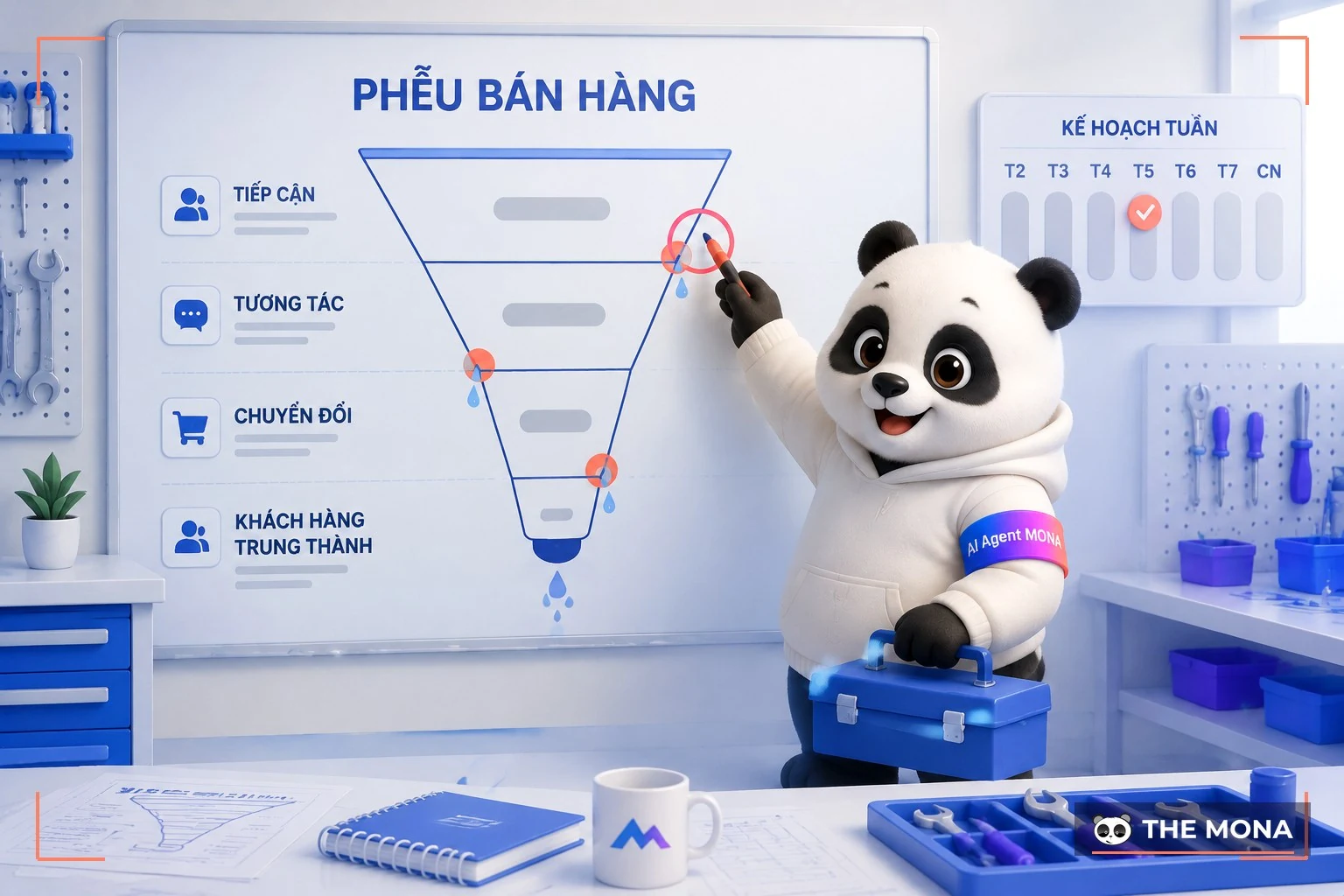
A funnel does not need a dashboard of a hundred metrics. We advise small clients to start with exactly three numbers, checked once a week, which is enough to tell whether the funnel is healthy or sick.
One: the pass-through rate. How many website visitors it takes to get 1 person to leave their details, and how many leads it takes to get 1 buyer. Two: cost per lead. Divide total marketing spend by the number of leads in the month; if this number jumps, you know the top of the funnel has a problem. Three: response time. How many minutes pass between a customer asking and getting an answer. The longer you leave it, the more money you lose, because online customers ask 3 or 4 businesses at once and do not wait for anyone. Three numbers, one simple spreadsheet, and no more meetings run on gut feeling.

You can do the theory above yourself. The part where most small businesses give up is somewhere else: a funnel is a machine that has to run continuously, and people have to sleep. Articles have to be published steadily, the website has to be fast and SEO-ready, messages have to be answered within minutes even at midnight, and customer data has to be recorded instead of getting lost in a message inbox. Machines do not sleep.
That is the part MONA can take off your hands, using the same toolkit we use ourselves: e-commerce websites built around a landing-page mindset for each funnel layer rather than a site that is there for show, chatbot AI covering the middle layer around the clock and passing you only customers who are ready, an SEO team feeding the top of the funnel with articles customers find on their own, and when the funnel needs deeper management, then Mona.Software tailor-made for your own processes. Since 2016 we have built this kind of machine across 14,000+ projects, and 85% of clients come back to work with us again, mostly because they can see where every dong they spend goes.

Two names for two sections of the same path. The marketing funnel takes care of the journey from stranger to prospect, and the sales funnel picks up from there until the order is signed. It is normal for a small business to run them as one funnel, as long as the two sections do not blame each other.
The smaller you are, the more you need one, because there is no money to burn on experiments. A small shop's funnel needs only 3 pieces: a content channel that publishes steadily, a landing page with a place to leave a number, and a process for answering messages quickly. Three pieces are enough. Build it once, then adjust as the numbers come in.
AIDA (attention, interest, desire, action) is the grandfather of funnel thinking, created more than 100 years ago for one-way advertising. A modern funnel adds a retention layer after purchase and accepts that customers wander between layers, which is closer to how people buy online today.
The skeleton, made up of a landing page, a content channel and measurement tools, can be built in 2 to 4 weeks. The time-consuming part is nurturing: content needs a few months to earn rankings, and the data needs a few cycles to show which layer is leaking. A funnel is an asset that builds up over time, not a campaign you run for a month and switch off.
You can, for the strategy part: you understand your customers better than anyone, so you should be the one to decide what the funnel says. For the technical parts (website, chatbot, measurement), outsourcing is the cheaper option compared with figuring it out alone, and MONA can take that whole part on at 1900 636 648.
Do not rebuild the whole funnel in one week. Pick the single biggest leak and fix it. After counting the three numbers in the section above, you will see it right away: if many people visit the website but nobody leaves a number, fix the landing page first; if many people ask but replies are slow, install the chatbot first; if nobody visits the website, work on the top of the funnel first. One leak a week, and in about a month the funnel is sealed. Fix one spot only.
And if you look at it and see leaks in all three places, the same picture as the 30 million VND of monthly ad spend flowing into a leaky pipe at the start of this article, call us via 1900 636 648. Tell us what you sell and where customers are slipping away, and we will draw the funnel diagram for your industry, give transparent pricing for each item (website, chatbot, SEO), and stay with the price we quote. Now that you know what a marketing funnel is, do not let it stay a nice picture in a slide deck.

CEO & Founder · The MONA
Founder of The MONA, who built a services company of 200+ staff with 14,000+ projects delivered. Khánh Hùng shares how he thinks about building systems that run themselves, automating a business, and the real lessons from delivering projects at MONA.
 1,6K




Professional website
design services
Own a website with a beautiful, 100% exclusive design and a lifetime warranty, with the ability
to expand features flexibly as your business grows, starting today!






 MONA will never sell your information or send you spam


 MONA will never sell your information or send you spam
