
 MONA OS 2.0
 Partner with MONA


 Tự động hoá doanh nghiệp
 Cẩm nang SEO
 Digital Marketing
 Kinh nghiệm thiết kế website
 Hạ Tầng Server
 Giáo dục


 VI
 EN















Message us on
Zalo Official


 ProductsNew

 ProductsProducts
 Mới ra mắtKHA AI 2027App tự edit video, tự đăng mọi mạng xã hội, 2 phút mỗi ngày










 Website designLooks good and wins customers over.
SEO servicesBrings in customers searching for exactly what you sell.
 Tư vấn digital marketingKéo khách từ nhiều kênh, đo bằng số thật.
Corporate video productionVideos introducing your company, factory and team.
 NewAI video productionCompany story films made with AI.
 Custom software developmentCRM, ERP and HRM built for your business.
 Viết AI Agent theo yêu cầuĐặt riêng một trợ lý AI cho đúng việc của mình.
 Tư vấn chuyển đổi AIĐưa AI vào vận hành của cả công ty.
NewMONA LMSManagement for centers and schools.
MONA SkillHubInternal training for company staff.
 NHTQ systemEnd-to-end China–Vietnam shipping operations.
MONA JMSManagement for gold, diamond and pawn shops.
 MONA E-LearningA website with every feature you need to sell courses.
 How to sell online courses (course)More than 30 free lessons on selling courses on autopilot.
 MONA Cloudmonacloud.vnServers to get your apps and websites running.
 MONA Basemonabase.vnPostgres database, sign-in and file storage.
 MONA Mailmonamail.vnSend OTP, order and invoice emails from your software.
 MONA Paymonapay.vnAccept bank transfers via VietQR and notify your software when the money arrives.
 MONA eInvoiceComing soonIssue e-invoices that meet tax standards.
Gấu CườiTrả lời khách 24/7 trên web, Fanpage, Zalo và thu lead cho sale.
 Gấu TeleSalesGọi điện tư vấn, chăm khách như tổng đài viên thật.
Dê CườiTư vấn và chốt đơn cho shop ngay trong khung chat.
Gấu WebmasterNhắn nhóm Zalo là website được sửa xong.
 Gấu Pháp ChếSoạn hợp đồng, rà điều khoản trong vài phút.
 Gấu Báo GiáLên báo giá đúng mẫu và gửi khách ngay.
 AI chăm sóc khách hàngTheo dõi và giữ chân khách hàng cũ.
 Gấu Tuyển DụngLọc hồ sơ, hẹn lịch, phỏng vấn ứng viên.
 Mới ra mắt
KHA AI 2027
Xây kênh chuyên gia 2 phút mỗi ngày
Quay bằng điện thoại, AI tự edit video, tự đăng lên 16 nền tảng và tự trả lời bình luận, tin nhắn.
896.993lượt xem trên kênh CEO MONA sau 37 ngày
 Anh Khánh HùngCEO MONA đang dùng mỗi ngày
Xem app làm được gì
 AI
Gấu Cười MONA ĐANG TỰ XÀITrả lời khách 24/7 trên website, Zalo OA, Messenger và thu lead về cho sale.
Dê CườiChốt đơn bán lẻ và sàn: Shopee, TikTok Shop, web. Chăm cả khách sỉ, đại lý.
Gấu WebmasterCập nhật nội dung, tối ưu SEO website mỗi ngày.
Gấu TeleSalesGọi điện tư vấn, chăm khách như tổng đài viên thật.
Gấu Tuyển DụngLọc hồ sơ, hẹn lịch, phỏng vấn ứng viên tự động.
AI chăm sóc khách hàngGiữ khách cũ, cứu lead đã rớt cho phòng kinh doanh.
Gấu Pháp ChếSoạn hợp đồng, rà điều khoản trong vài phút.
Gấu Báo GiáLên báo giá đúng mẫu, gửi khách ngay khi có yêu cầu.
 Chuyển đổi AI toàn phầnGiải pháp tổng cho doanh nghiệp, 3 lớp triển khai.
 Viết AI Agent theo yêu cầuĐặt riêng một con AI gánh đúng nghiệp vụ của bạn.
 Custom softwareCRM, ERP and HRM with built-in AI automation.
 SEO & AEO thời đại AIĐược Google lẫn AI trích dẫn, không chỉ xếp hạng.
 Kiến thức AI cho doanh nghiệpBài phân tích, hướng dẫn ứng dụng AI vào vận hành.
 Free AI courses
 AI tools at work
App mới · KHA AI 2027
Xây kênh 2 phút mỗi ngày
AI tự edit video, tự đăng mọi mạng xã hội
Free consultation, 8am–10pm every day

15 July, 2026

Callbot is already calling in place of people at many large chains in Vietnam, and most customers do not realize the other end is a machine. Meanwhile, a 30-person telesales room still dials 900 calls a day by hand, and 28 out of 30 calls get hung up in the first 5 seconds.
If you are just starting to learn about this area, read this article first: virtual call center where MONA explains the three generations of call center solutions from the ground up. With that foundation, this article will click into place.
In this article we break down what an AI callbot is, the cascade architecture behind it and the deployment cost. We also include the case of a 28-branch real estate chain that reaches 1000 cold leads a day. After reading, you will be able to work out the numbers for your own business.
Summary: A callbot is software that calls and listens to customers in natural speech. It specializes in repetitive calls such as cold-lead outreach, appointment reminders and surveys. Thanks to the cascade architecture, the machine listens, understands and replies in under 800 milliseconds, so one system can run 1000 calls a day without adding people.
A callbot is software that automatically makes and receives calls in natural speech. The machine hears what the customer just said, understands the intent and replies in the right context, with nobody sitting on duty. This is what separates it from two things people often confuse it with.
The first comparison is the old recorded call center. That kind only reads one way, makes customers press 1 or 2, and neither hears nor understands anything. The second is the chatbot, which works with typed text on the web or Zalo. A callbot works by voice over the phone line, where Vietnamese customers are still used to making decisions.
The question we often ask business owners is simple. Can the job of calling 500 numbers a day with the same script be given to a machine? In 2020 the answer was no. In 2026 the answer is yes, and that is why callbots became a hot topic in sales departments.
An AI callbot listens and branches the conversation based on what the customer says. Older callbots just play a recording and wait for a key press. The gap between the two generations is in how well they listen. A 2022 bot misheard about 30% of words, while a 2026 bot hears about 96% correctly, including voices from all three regions.
So when you hear someone say callbots are useless, they are almost certainly talking about the rigid-script generation. The technology behind it has changed completely in just a few years, and how we judge it has to change too.
Mid-market businesses that run ads steadily often end up in the same scene: leads pour in faster than the sales team can call. More than half get forgotten. This is a silent loss that the end-of-month report rarely names correctly.
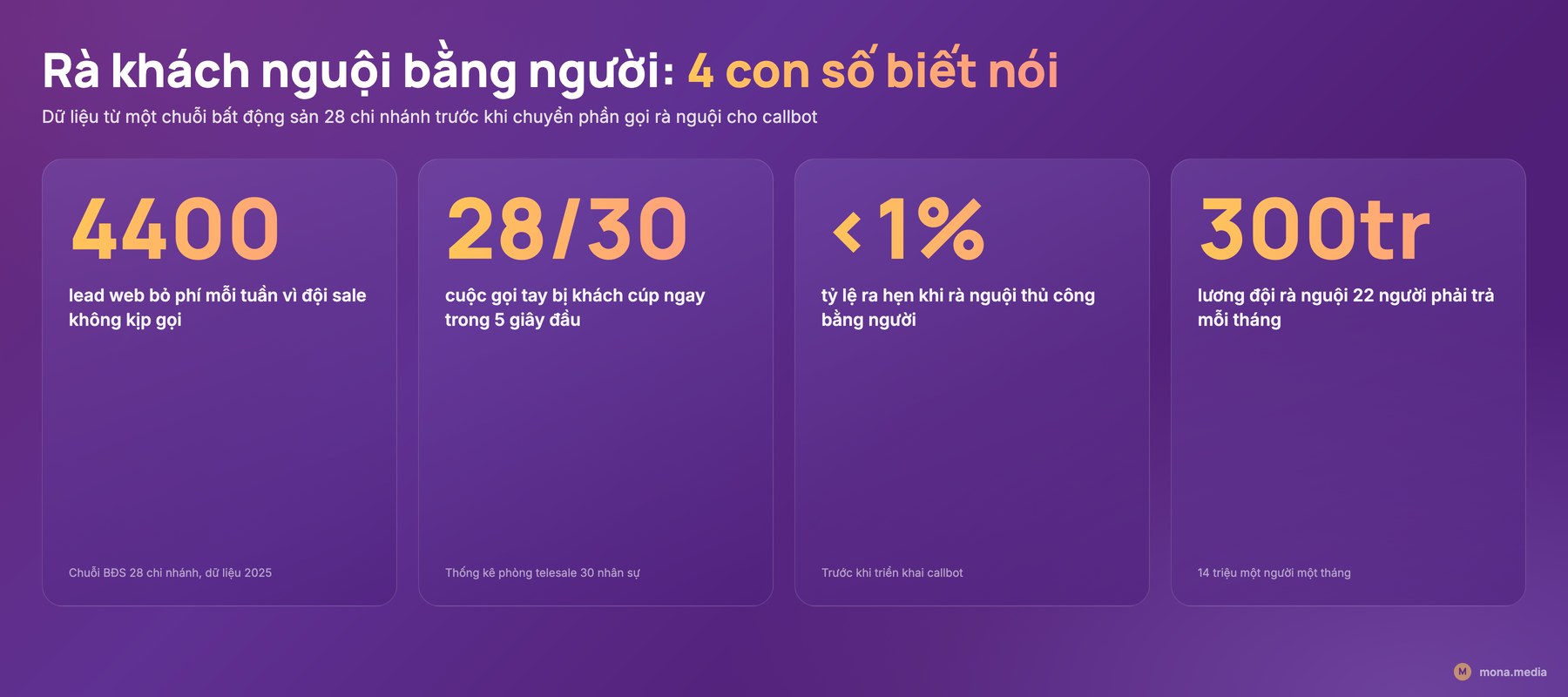
A real estate chain came to MONA in mid-2025 with a number that made everyone wince. 5000 web leads a week, the sales team could manually reach only 600, and 4400 leads went to waste. The ad money had already been paid for every phone number in that pile.
We all wince at the same thing: once a lead goes cold for 48 hours, there is almost no chance left, because the customer has already talked to two or three competitors. The global call center and phone customer care market keeps growing, according to Statista's figures. That means outbound calls have never been less important, only the way of making them is changing.
The more leads a sales department has, the more it needs a filtering layer like a callbot running steadily in front. You can see the wider picture of this layer in AI for sales teams that we wrote earlier.
Reaching cold leads with people is a clearly inefficient spending line in a sales department. The work is essentially repeating one script a few hundred times a day. The real estate chain above kept a 22-person cold-outreach team at 14 million VND each, over 300 million VND a month in total. In return, the booking rate was under 1%.
Money is only half the pain. Good salespeople avoid cold calling because it wears out the mouth and pays little commission. New hires last 3 or 4 months and then leave, taking with them the goodwill of a few customers who had just warmed up. Vietnamese sales turns over about 60% of staff each year, so by the time one batch is trained, the previous batch is gone.
There is another pain few people say out loud: you cannot hear what your team is saying to customers. Someone may overpromise, skip the standard greeting, or even badmouth your own product. The business owner has no idea until a customer complains.
Run the numbers with us. Over 300 million VND in cold-outreach salaries every month, plus several hundred million in ads that produced exactly the leads now lying dead in the CRM. That is nearly half a billion VND a month poured into a machine that books under 1%. And it is not only money. MONA knows you have put enormous effort into saving that number (raising commission per appointment, constantly switching data sources, adjusting the script every Monday morning, hiring part-time callers for the evenings, even sitting down to make sample calls for the team to hear). But no. The effort of a few hard workers facing a list of thousands of numbers every week is a drop in the ocean, because 28 out of 30 calls are hung up before the second sentence. The problem is not hiring better callers. What needs to change is this repetitive work itself, which is the machine's job to begin with.
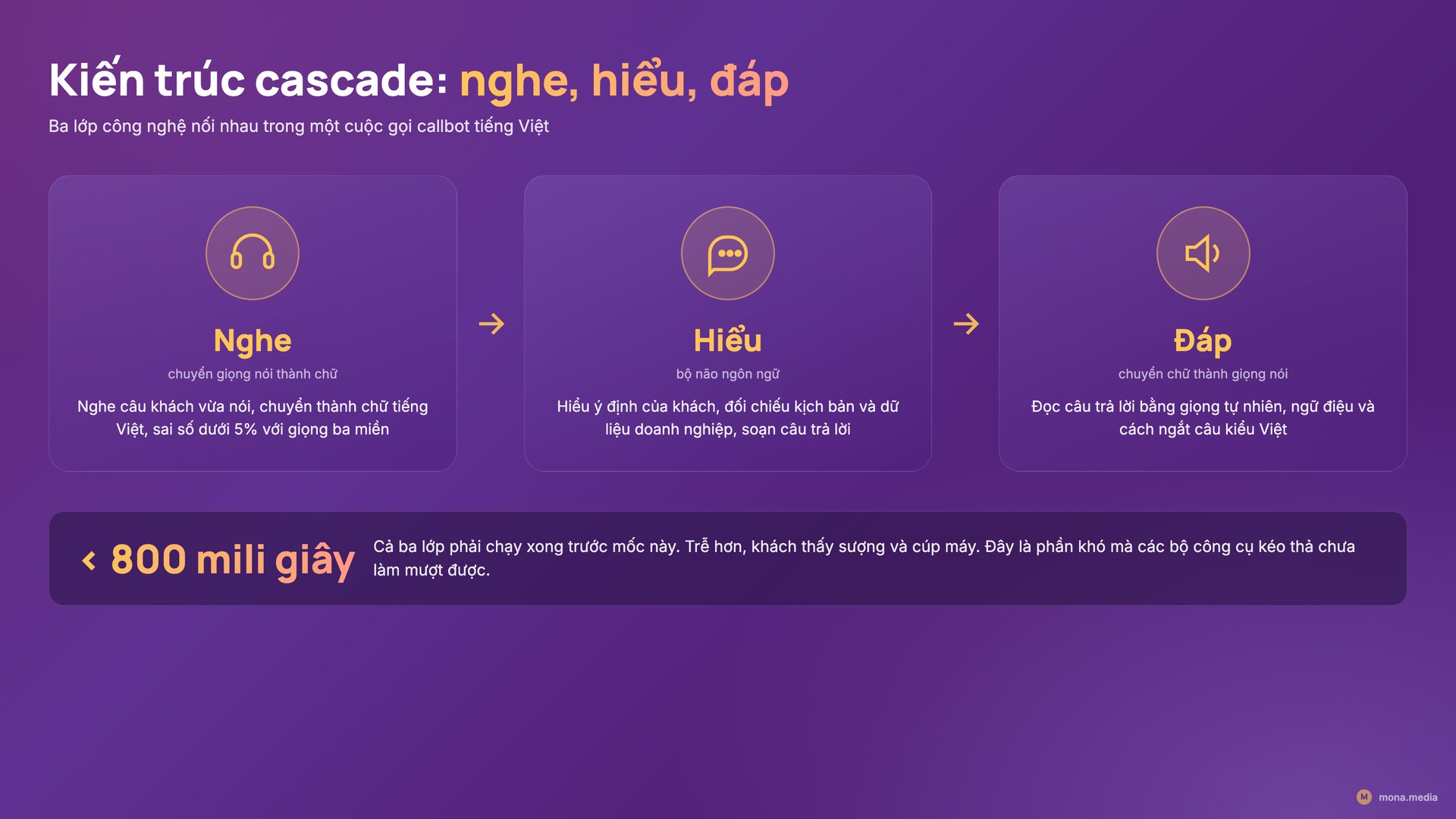
Cascade is the three-layer listen, understand, reply architecture of an AI callbot. The machine turns the customer's voice into text, a language brain reads that text to understand the intent and draft a reply. A natural voice layer then reads the reply aloud to the customer. All three layers must fit within 800 milliseconds, and any slower makes the customer feel awkward and hang up.
Each layer is now mature for Vietnamese in 2026. The listening layer reaches an error rate under 5% across the three regional accents, even with noise. The understanding layer matches what the customer says against the script and the business's own data. The speaking layer has Vietnamese intonation and phrasing, so only about 10% of customers realize they are talking to a machine.
The market has two other architectures. The if-else keypad kind is cheap but rigid, and if a customer goes slightly off script it breaks. The speech-to-speech kind sounds smoother but is hard to control and expensive, not yet suited to high-volume calling. Cascade sits in the middle: natural enough for customers to talk, controlled enough for the business to know every sentence the bot says. We broke down these three architectures in our AI call center article, so read it to pick the right type for each job.
This direction is not a short-lived trend. Gartner forecasts by 2029, AI will handle 80% of common customer service requests on its own without human intervention. Businesses that get used to running callbots early will hold a cost advantage for many years.
A serious cold-lead callbot campaign always goes through four steps. The first has nothing to do with technology. We analyze 200 to 500 real calls from your own telesales team. From that we draw a script of 12 to 18 conversation branches true to your industry, instead of inventing one from an air-conditioned server room.
Step two is choosing the voice. A bot calling Hanoi leads should not speak with a heavy Southern accent, because customers hang up early when it sounds off. Step three is connecting the callbot to the CRM: every call automatically logs its result, and hot leads are pushed straight into a queue for real people. This part fits with AI auto-reply chatbot that MONA has already packaged. Step four is measuring every week: answer rate, hot-lead transfer rate, complaint rate, to keep refining the script.
The cold-outreach call itself runs only 50 to 90 seconds. The callbot greets, states why it is calling, asks 2 or 3 questions to classify the need, then books a slot with a real advisor if the customer is interested. The script decides half the outcome, so see how to write one in phone call scripts for customers package from MONA?
A point often missed is the learning loop. An AI callbot records and transcribes 100% of calls, so each week the business knows exactly which sentence made customers hang up and which kept them listening. A team calling by hand never has data this dense to fix its script.
Back to the 28-branch real estate chain in Ho Chi Minh City, Hanoi and Da Nang that we mentioned at the start. It has 320 sales staff, revenue of about 58 billion VND a month, and has worked with MONA since mid-2025. The callbot system was deployed in 8 weeks, with a 14-branch script and male and female voices matched to the two regions.
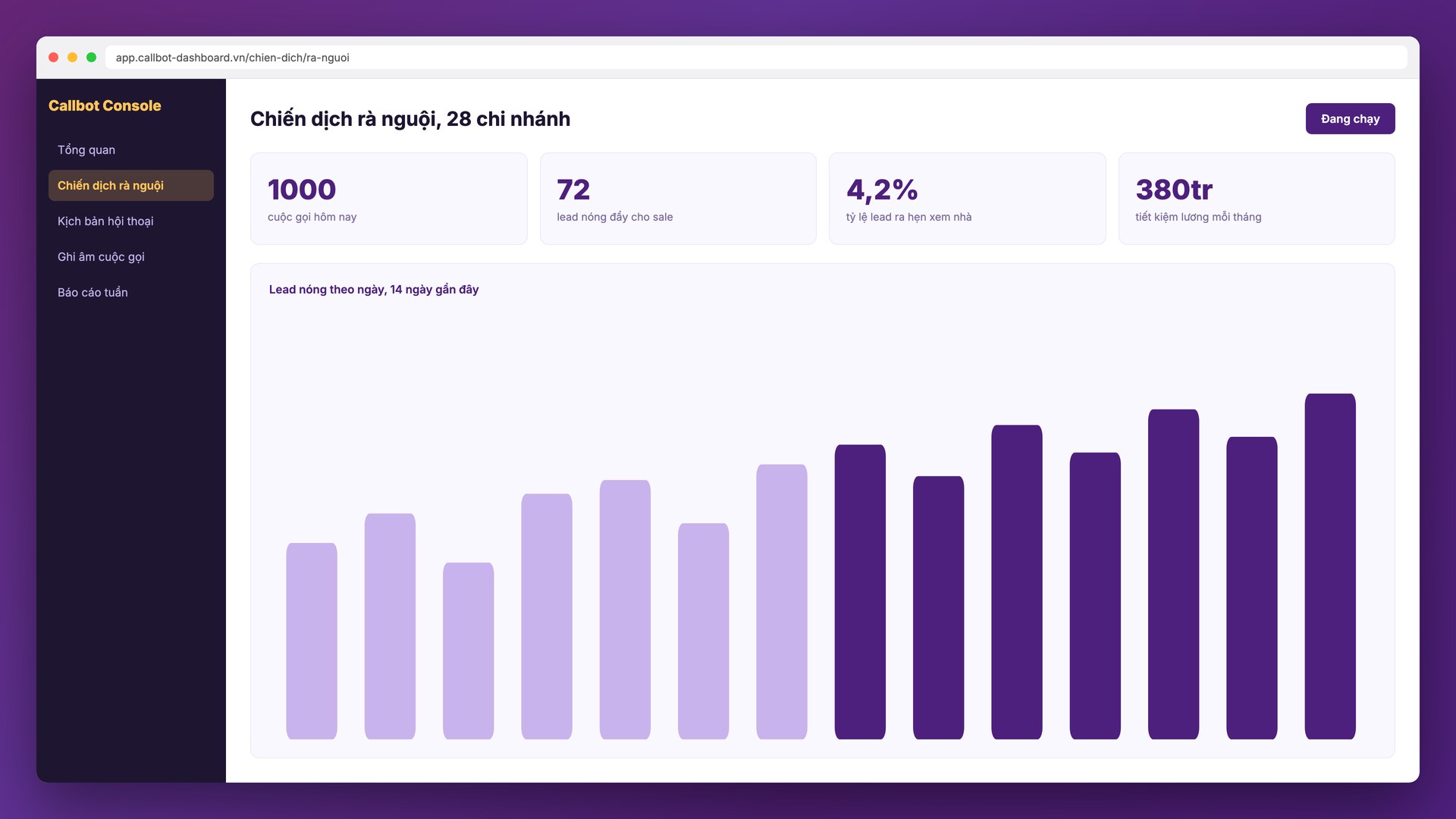
The results after 6 months of operation speak louder than any advertising. The callbot makes 1000 calls a day, handles 95% of web leads without people, and delivers 60 to 80 hot leads a day to the sales team. The conversion from web lead to house-viewing appointment rose from 0.8% to 4.2%. The chain cut 15 level-1 cold-outreach staff, saving about 380 million VND in salary each month.
What we want you to notice is not the headcount cut, but how roles shifted. MONA worked with this chain's team for 4 weeks. The 7 remaining cold-outreach staff were moved up to closing roles, with pay raised to 22 million VND. The new metric counts successful appointments instead of calls made. The machine takes the repetitive calling, and people keep the work that needs emotion and finesse.
We wrote up the whole technology layer behind this case in our Vietnamese voice AI article. As for the scale of the value, McKinsey estimates that generative AI could add 2.6 to 4.4 trillion USD of value a year to the global economy. Sales and customer care are two of the first groups to benefit.
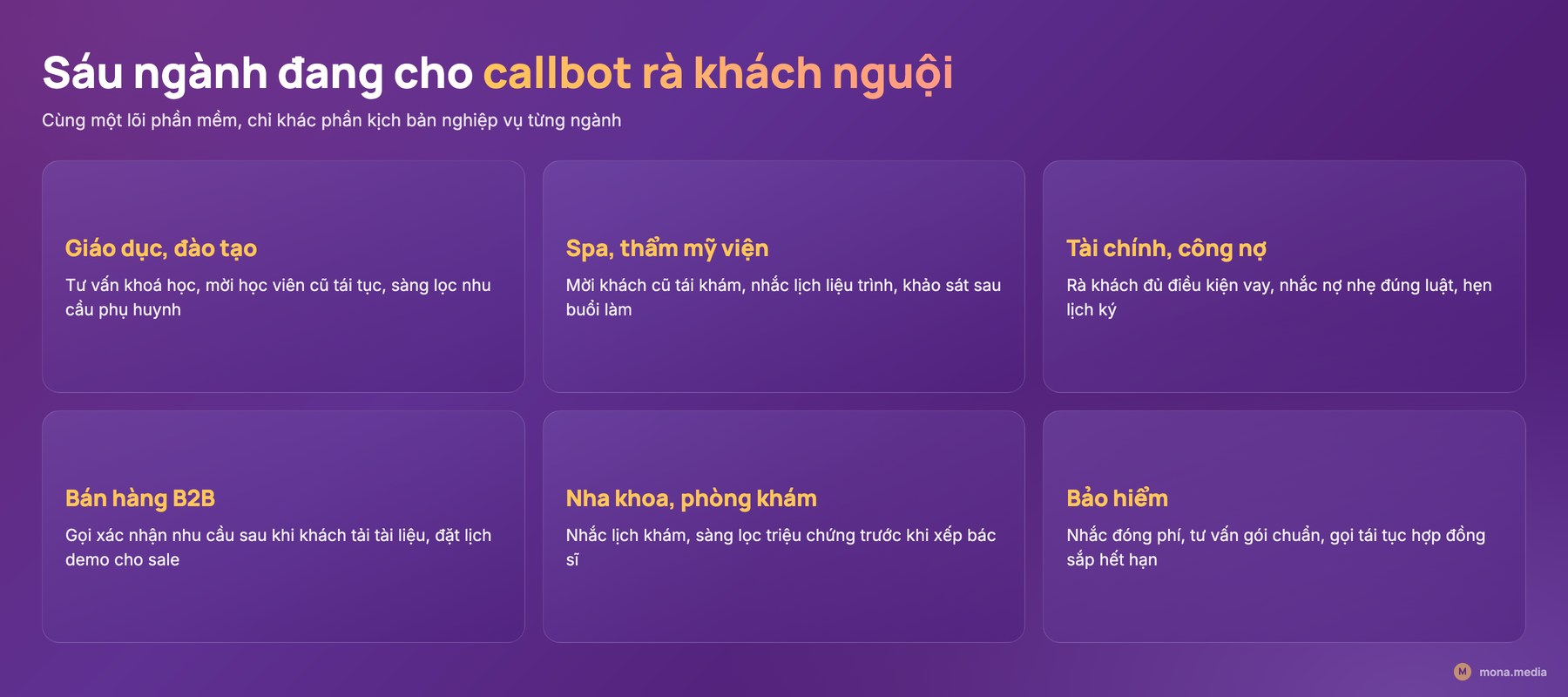
Any industry with a large phone list and a repetitive calling script can run a callbot. Only the business script differs. On the same software core, MONA has built and is building for closely related industries:
These six industries share about 75% of the callbot core, so setting up a new industry is much faster than building from scratch. For inbound calls outside working hours, the same system covers for people, as we describe in our 24/7 AI customer care article.
A production-grade callbot system usually costs less than 6 months of salary for the cold-outreach team it replaces. In the 28-branch chain case above, savings of 380 million VND a month pay back the deployment in just the first few months. Every month after that is money the business keeps.
That does not mean handing everything to the machine. We always draw a clear line with business owners: the machine does cold outreach, appointment reminders, surveys, screening and night duty. Closing big contracts, handling serious complaints and caring for VIP customers must be done by people. The closing team may even need more investment, as we describe in our AI sales coach article.
One more honest warning: do not assemble a callbot yourself from drag-and-drop toolkits. Those suit personal experiments, but a business making thousands of calls a day will see it stutter because it depends on third-party services. One wrong setting stops the whole flow, and your customers' call data sits on foreign servers. This is also a common mistake we analyze in our article on why Vietnamese businesses fail at AI deployment. Read it together with our article on 3 mistakes when choosing an AI company.
MONA's approach is to write our own software, run production-grade on the infrastructure MONA Host, developed and maintained long term by the MONA Software team. Call data is stored in Vietnam, with a team accountable when something fails, instead of you holding a pile of stitched-together tools that nobody backs.
Readers at this point usually split into two groups. The first nods, shrugs, and accepts that a telesales rep dialing 30 calls and getting hung up on 28 times is the fate of the trade, keeps hiring and losing people every quarter, and treats 4400 wasted leads a week as the hidden cost of the job. The second group, whether running a 10-person or a 300-person sales team, wants to hear a machine-made call with their own ears, see the hot-lead list land every morning with their own eyes, and work out how much their scale would save. If you are in the second group, call 1900 636 648 during office hours, or email info@themona.global. Within 24 working hours we will reply and book a 30-minute demo where you hear a bot make a real call using a script from your own industry, with a savings estimate based on your exact number of branches and leads. If it is not a fit, you still keep that estimate as a baseline when working with any other provider.
Deploying an AI call center does not mean laying off your on-duty team tomorrow. MONA's system has three modes: the machine speaks fully; a person speaks while the machine records and automatically logs the call into your management software; and a "machine stalls for the person" mode, where on the first ring the machine jumps in to greet and keep the conversation going, and a staff member can take over at any moment. If your business wants its telesales team to make outbound calls, see more at AI Agent telesales.
About 10% of customers notice, and the other 90% talk as normal, as if with a new call center agent. This figure applies to the 2026 Vietnamese cascade system, while with a rigid-script callbot nearly every customer notices from the first sentence.
A full cold-outreach system for a multi-branch chain takes about 8 weeks. The steps are analyzing real calls, building the script, connecting the CRM and a supervised trial run. Simpler problems, like appointment reminders, can go live sooner than that.
No, and it should not. The machine takes over repetitive calls like cold-lead outreach, appointment reminders and surveys; people keep contract closing and important customer care. Every real MONA case comes with a role shift, moving former staff up to closing roles with higher income.
With systems MONA builds, all recordings and customer data are stored on infrastructure in Vietnam, not passed through foreign intermediary services. You own your data, even if you switch providers later.
The cost has two parts: the initial system build and the operation, charged by call minutes per month. The exact investment depends on the number of script branches and the level of CRM integration, so we always quote after a survey. We include a savings estimate so you can compare directly against your current payroll.
Three small checks tell you whether your business needs a callbot. One, open your CRM and count the leads nobody has called in the past 30 days. Two, listen again to 10 recent cold-outreach calls from your sales team and count how many got past the second sentence. Three, read our AI First handbook for businesses to place automatic calling in the right spot of the bigger picture.
If the first two numbers make you wince, that is a sign this work should go to a machine. We are ready to run a demo callbot call using a script from your own industry through hotline 1900 636 648. Are you ready to have the first machine-made cold-outreach call run this month?
About MONA Media: MONA Media is the web design and marketing brand of The MONA Group, founded in 2016, with a team of professionals. The team has completed more than 14,000 projects with an 85% returning-customer rate. MONA builds callbots, AI call centers and custom business automation software for mid-market Vietnamese businesses. Hotline: 1900 636 648. Email: info@themona.global.

CEO & Founder · The MONA
The founder of The MONA built a service company of 60+ staff with 14,000+ projects delivered. Khánh Hùng shares his thinking on building self-running systems, automating a business, and the real lessons behind MONA's projects.
 474




Professional website
design services
Own a website with a beautiful, 100% exclusive design and a lifetime warranty, with the ability
to expand features flexibly as your business grows, starting today!






 MONA will never sell your information or send you spam


 MONA will never sell your information or send you spam
