
 MONA OS 2.0
 Partner with MONA


 Tự động hoá doanh nghiệp
 Cẩm nang SEO
 Digital Marketing
 Kinh nghiệm thiết kế website
 Hạ Tầng Server
 Giáo dục


 VI
 EN











Message us on
Zalo Official


 ProductsNew

 ProductsProducts
 Mới ra mắtKHA AI 2027App tự edit video, tự đăng mọi mạng xã hội, 2 phút mỗi ngày










 Website designLooks good and wins customers over.
SEO servicesBrings in customers searching for exactly what you sell.
 Tư vấn digital marketingKéo khách từ nhiều kênh, đo bằng số thật.
Corporate video productionVideos introducing your company, factory and team.
 NewAI video productionCompany story films made with AI.
 Custom software developmentCRM, ERP and HRM built for your business.
 Viết AI Agent theo yêu cầuĐặt riêng một trợ lý AI cho đúng việc của mình.
 Tư vấn chuyển đổi AIĐưa AI vào vận hành của cả công ty.
NewMONA LMSManagement for centers and schools.
MONA SkillHubInternal training for company staff.
 NHTQ systemEnd-to-end China–Vietnam shipping operations.
MONA JMSManagement for gold, diamond and pawn shops.
 MONA E-LearningA website with every feature you need to sell courses.
 How to sell online courses (course)More than 30 free lessons on selling courses on autopilot.
 MONA Cloudmonacloud.vnServers to get your apps and websites running.
 MONA Basemonabase.vnPostgres database, sign-in and file storage.
 MONA Mailmonamail.vnSend OTP, order and invoice emails from your software.
 MONA Paymonapay.vnAccept bank transfers via VietQR and notify your software when the money arrives.
 MONA eInvoiceComing soonIssue e-invoices that meet tax standards.
Gấu CườiTrả lời khách 24/7 trên web, Fanpage, Zalo và thu lead cho sale.
 Gấu TeleSalesGọi điện tư vấn, chăm khách như tổng đài viên thật.
Dê CườiTư vấn và chốt đơn cho shop ngay trong khung chat.
Gấu WebmasterNhắn nhóm Zalo là website được sửa xong.
 Gấu Pháp ChếSoạn hợp đồng, rà điều khoản trong vài phút.
 Gấu Báo GiáLên báo giá đúng mẫu và gửi khách ngay.
 AI chăm sóc khách hàngTheo dõi và giữ chân khách hàng cũ.
 Gấu Tuyển DụngLọc hồ sơ, hẹn lịch, phỏng vấn ứng viên.
 Mới ra mắt
KHA AI 2027
Xây kênh chuyên gia 2 phút mỗi ngày
Quay bằng điện thoại, AI tự edit video, tự đăng lên 16 nền tảng và tự trả lời bình luận, tin nhắn.
882.681lượt xem trên kênh CEO MONA sau 36 ngày
 Anh Khánh HùngCEO MONA đang dùng mỗi ngày
Xem app làm được gì
 AI
Gấu Cười MONA ĐANG TỰ XÀITrả lời khách 24/7 trên website, Zalo OA, Messenger và thu lead về cho sale.
Dê CườiChốt đơn bán lẻ và sàn: Shopee, TikTok Shop, web. Chăm cả khách sỉ, đại lý.
Gấu WebmasterCập nhật nội dung, tối ưu SEO website mỗi ngày.
Gấu TeleSalesGọi điện tư vấn, chăm khách như tổng đài viên thật.
Gấu Tuyển DụngLọc hồ sơ, hẹn lịch, phỏng vấn ứng viên tự động.
AI chăm sóc khách hàngGiữ khách cũ, cứu lead đã rớt cho phòng kinh doanh.
Gấu Pháp ChếSoạn hợp đồng, rà điều khoản trong vài phút.
Gấu Báo GiáLên báo giá đúng mẫu, gửi khách ngay khi có yêu cầu.
 Chuyển đổi AI toàn phầnGiải pháp tổng cho doanh nghiệp, 3 lớp triển khai.
 Viết AI Agent theo yêu cầuĐặt riêng một con AI gánh đúng nghiệp vụ của bạn.
 Custom softwareCRM, ERP and HRM with built-in AI automation.
 SEO & AEO thời đại AIĐược Google lẫn AI trích dẫn, không chỉ xếp hạng.
 Kiến thức AI cho doanh nghiệpBài phân tích, hướng dẫn ứng dụng AI vào vận hành.
 Free AI courses
 AI tools at work
App mới · KHA AI 2027
Xây kênh 2 phút mỗi ngày
AI tự edit video, tự đăng mọi mạng xã hội
Free consultation, 8am–10pm every day

01 June, 2026

Vietnamese voice AI in 2026 is very different from the “stiff machine answering” feeling you heard three or four years ago. A lead-screening call can now run 2 minutes 40 seconds with two-way Q&A, and customers often do not realize the other end is a machine. We have all seen it: a telesales room of 30 staff, each making 30 calls a day, 28 calls hung up within the first 5 seconds, and a closing rate of a few percent. Vietnamese voice AI in 2026 does not replace a good sales team, but it can replace the cold-lead screening and the night call center so the human team can focus on hot leads. We wrote this article to explain clearly the 3 technology layers behind Vietnamese voice AI, voice analytics for sales teams, and how MONA deployed it for a mid-market chain of 28 branches across HCM, Hanoi and Da Nang, with revenue of about 58 billion VND a month.

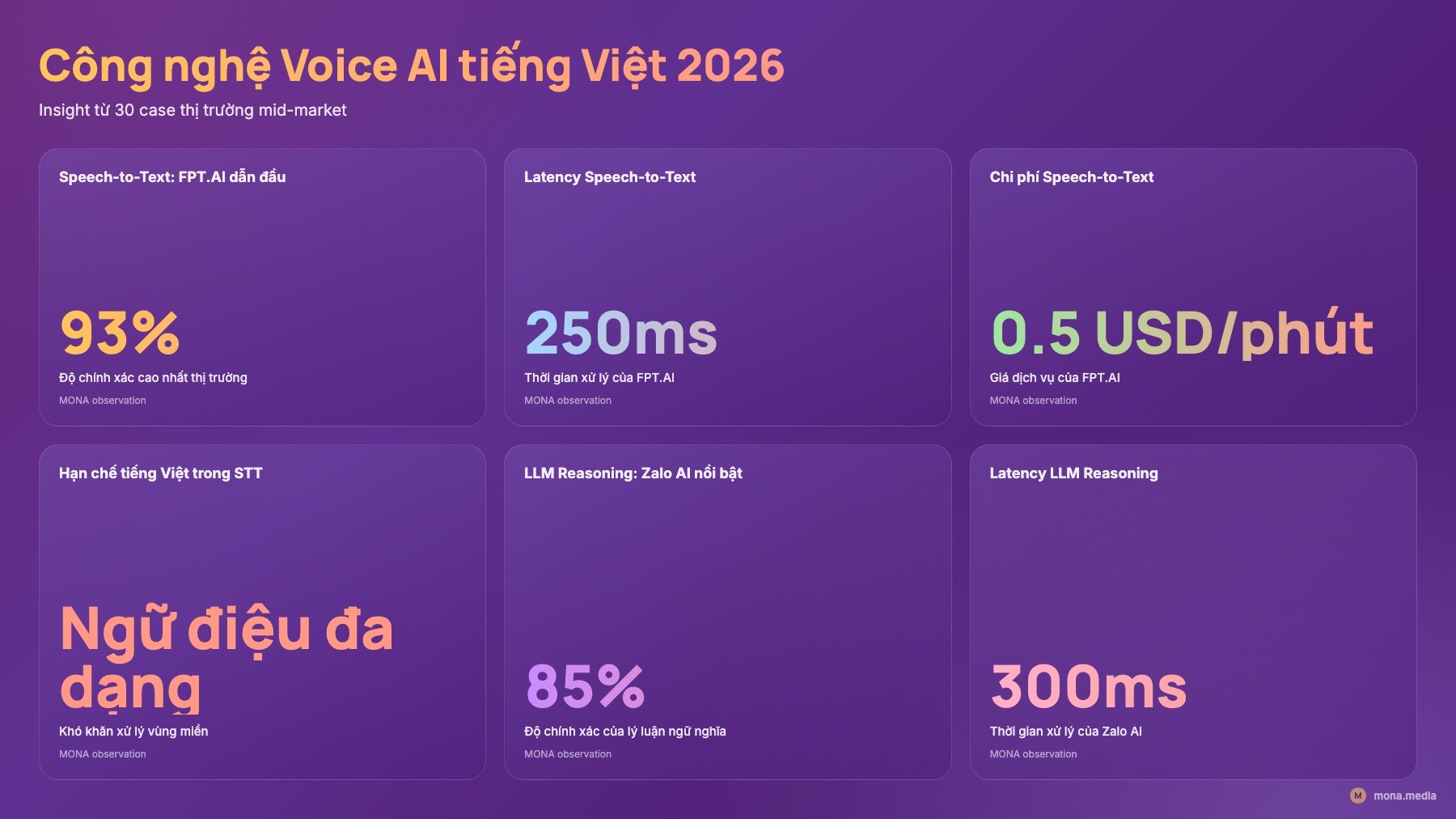
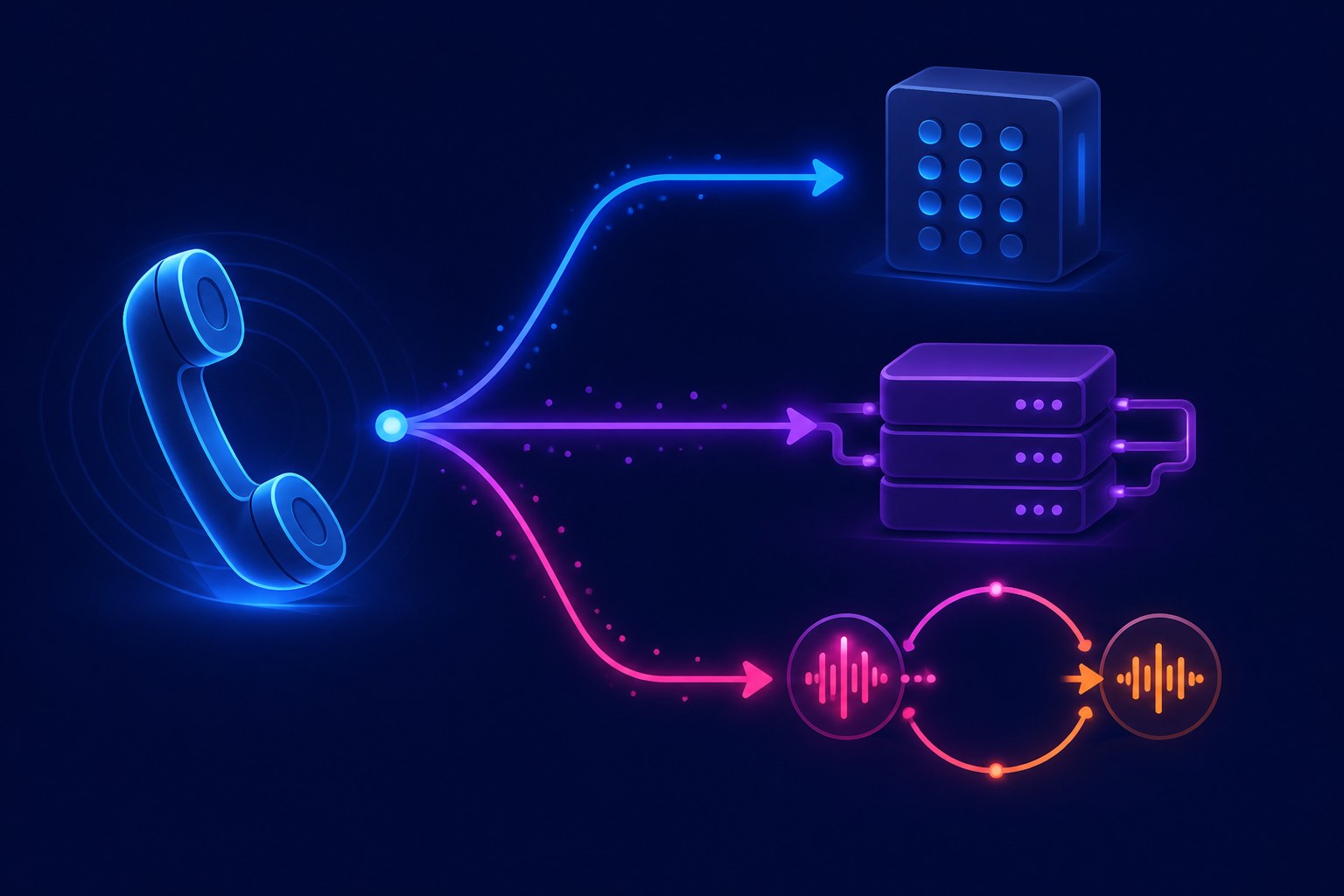
Have you noticed: for the same sentence “excuse me, how much is a room this weekend”, a 2022 bot misheard 30% of the words, while a 2026 bot hears 96% correctly? The difference is in the 3 technology layers. Vietnamese voice AI is a chain of 3 parts joined together: turning sound into text (STT), a brain that understands meaning and generates a reply (LLM), then turning text into speech (TTS). A call is smooth only when all 3 parts sound natural in Vietnamese.
We often tell business owners: Vietnamese voice AI in 2026 is mature enough for about 70% of the call scripts of a mid-market business. In 2022 that figure was only about 20%. That is why MONA puts voice AI in the “machines can do it now” group in its business automation framework.
All 3 parts must fit together in under 800 milliseconds, or the customer hangs up. That is the hard technical part that no-code toolkits out there cannot yet do smoothly. MONA builds the whole Vietnamese voice AI chain as production-grade business automation software, custom code running on its own infrastructure. See the overall framework at what is conversational AI and what is an AI agent. To compare all 3 call center architectures and pick the right one for the job, we broke them down in detail in AI call center.
Does a telesales room of 30 staff calling cold leads all day, then getting 12 million VND at month end for closing 2-3 contracts, sound familiar? MONA meets this pain in 100% of mid-market owners in financial services, real estate, education and aesthetics. Vietnamese voice AI in 2026 can replace exactly the cold screening call, not the closing call.
A typical cold screening call lasts 50-90 seconds. A 2026 Vietnamese bot handles this rhythm fairly naturally: greet, state the reason for the call, ask 2-3 questions to classify the need, and book a callback with a real consultant if the customer is interested. About 10% of customers will realize it is a machine, and the other 90% talk normally as if with a new call center agent.
A real estate chain that MONA works with runs a callbot screening 1,000 calls a day across 28 branches, filtering out 60-80 hot leads a day and saving 15 telesales staff who did tier-1 screening. The real sales team only works with hot leads, and the closing rate rose from 2.1% to 7.8% per the chain's data. For more on how MONA writes scripts, see phone call scripts for customers.
Do you remember calling a bank call center and hearing “press 1 for… press 2 for…”, pressing 3 times before reaching a real person? That is the old IVR call center, the middle generation of 3 generations virtual call center that we compared in detail. Vietnamese voice AI in 2026 lets customers state their need directly, and the bot classifies it and routes to the right department. A mid-market business with 200-500 staff usually has a call center with 4-8 lines, and at peak hours about 30% of calls are abandoned because customers do not want to wait. See details in the article on AI first for businesses.
We build AI call centers for mid-market businesses on the principle that “the bot does 80% of a tier-1 agent's work and the other 20% goes to people”. The 80% covers: order lookup, booking, rescheduling, opening hours, standard service prices, booking consultation appointments. When a customer needs personalized advice or has a serious complaint, the bot transfers to a real agent with a summary of why they called.
A mid-market chain MONA works with cut its peak-hour call abandonment rate from 31% to 7%, and trimmed 18 tier-1 call center staff within 8 months. It saved about 320 million VND in monthly salaries, redirected into training the tier-2 team to handle serious complaints. See the overall framework at business automation.
Do you know: a mid-market business owner replays on average only 2% of sales calls in a month. For the other 98% of calls, no one knows what telesales said, whether it went off script, or whether leads were nurtured properly. That is the biggest black box business owners are carrying. Vietnamese voice AI in 2026 opens this black box.
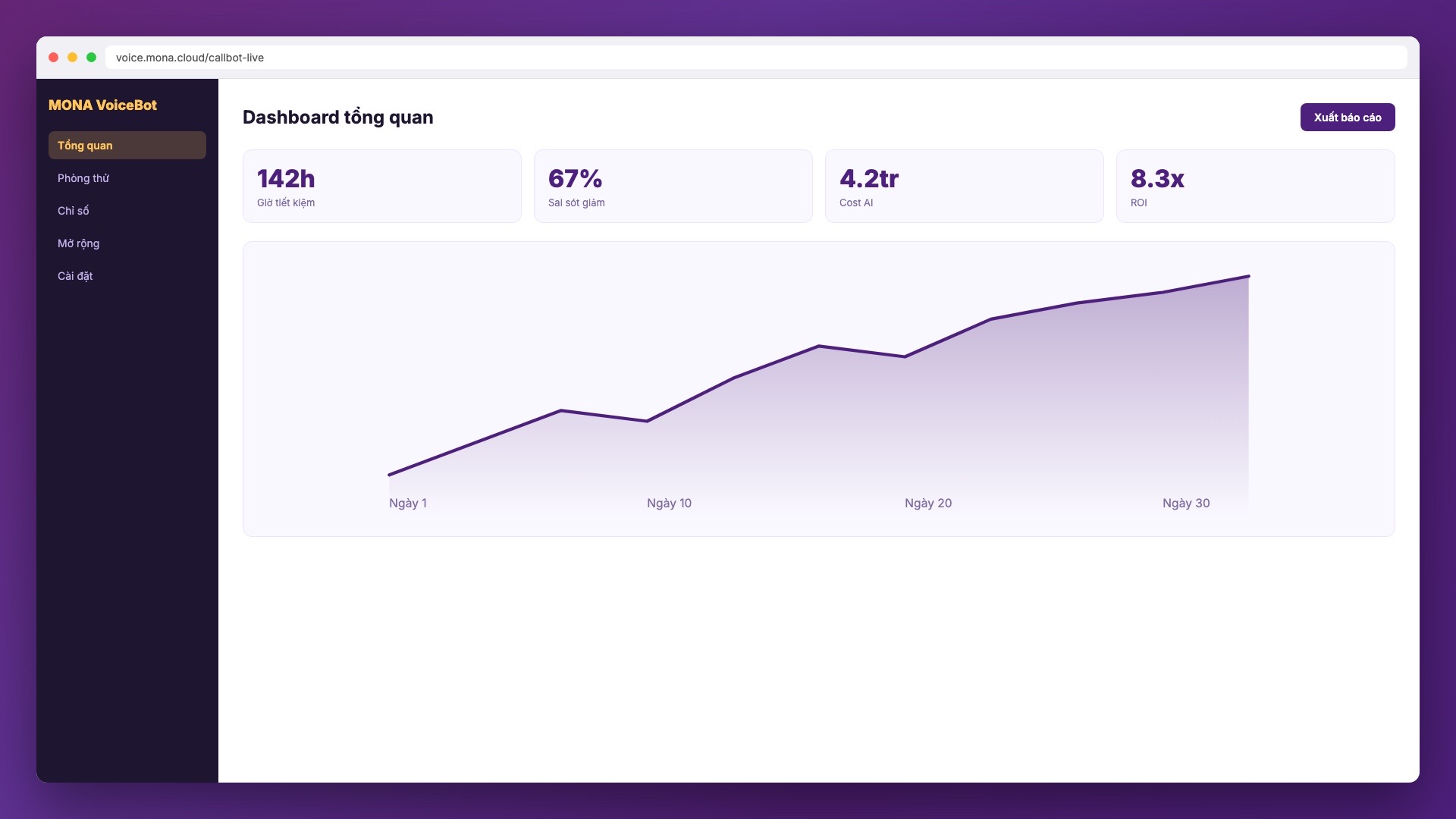
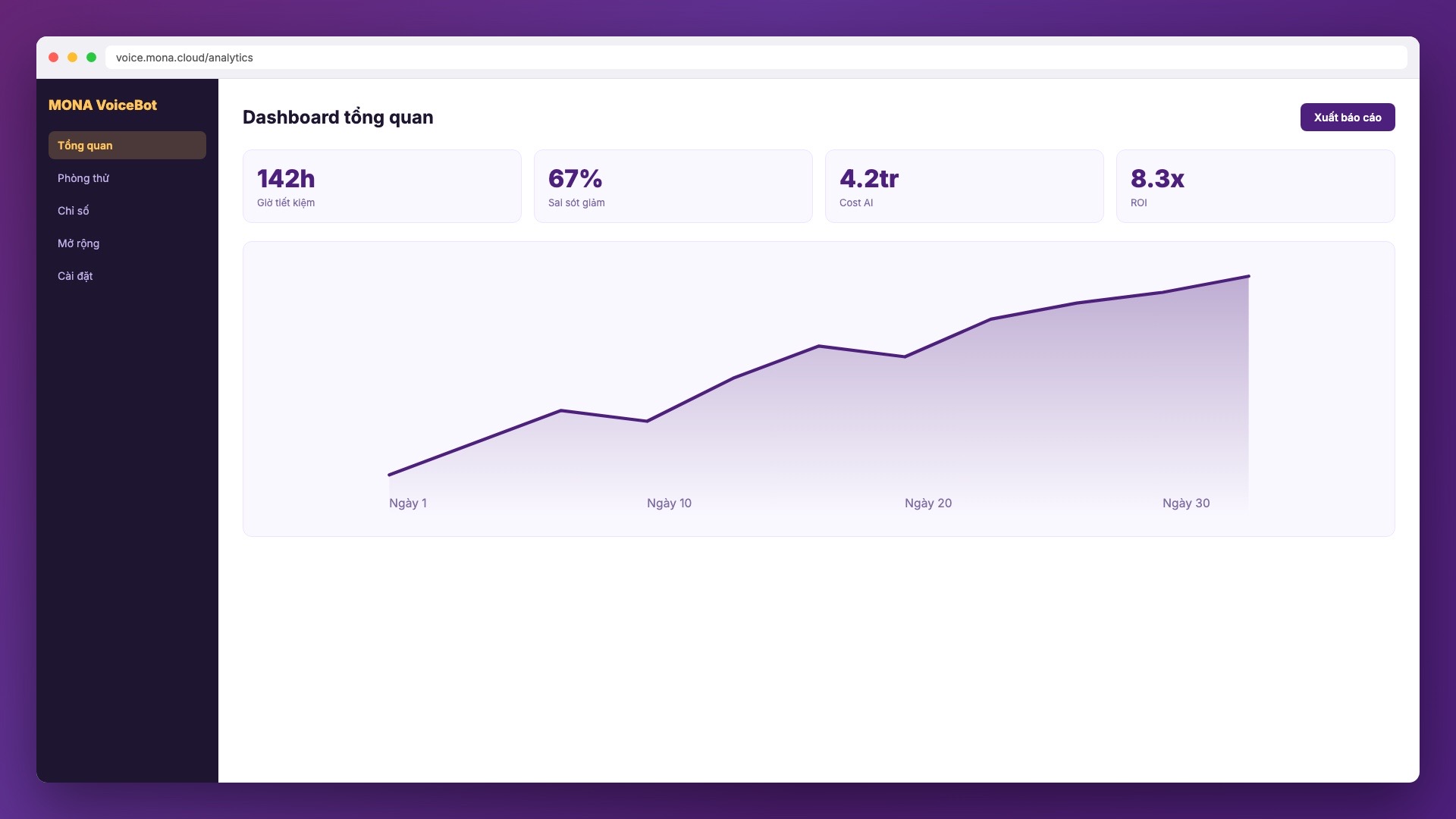
Voice analytics is another Vietnamese voice AI module. Every sales call is turned into text by STT, then analyzed by an LLM on many dimensions: did telesales greet according to script, ask all 5 qualifying questions, close an appointment, and how did the customer react emotionally. On the dashboard the owner sees 100% of calls already scored, with no manual replaying.
A mid-market chain of 28 branches that MONA works with found 12 telesales staff skipping the correct greeting, and 8 cases of not asking all the qualifying questions, causing the loss of about 18% of leads that could have closed. After 6 weeks of retraining guided by voice analytics, the closing rate rose from 4.8% to 9.2%, bringing in about 2.1 billion VND more revenue a month. For more on how MONA builds voice software for businesses, see what AI automation is and what is marketing automation.
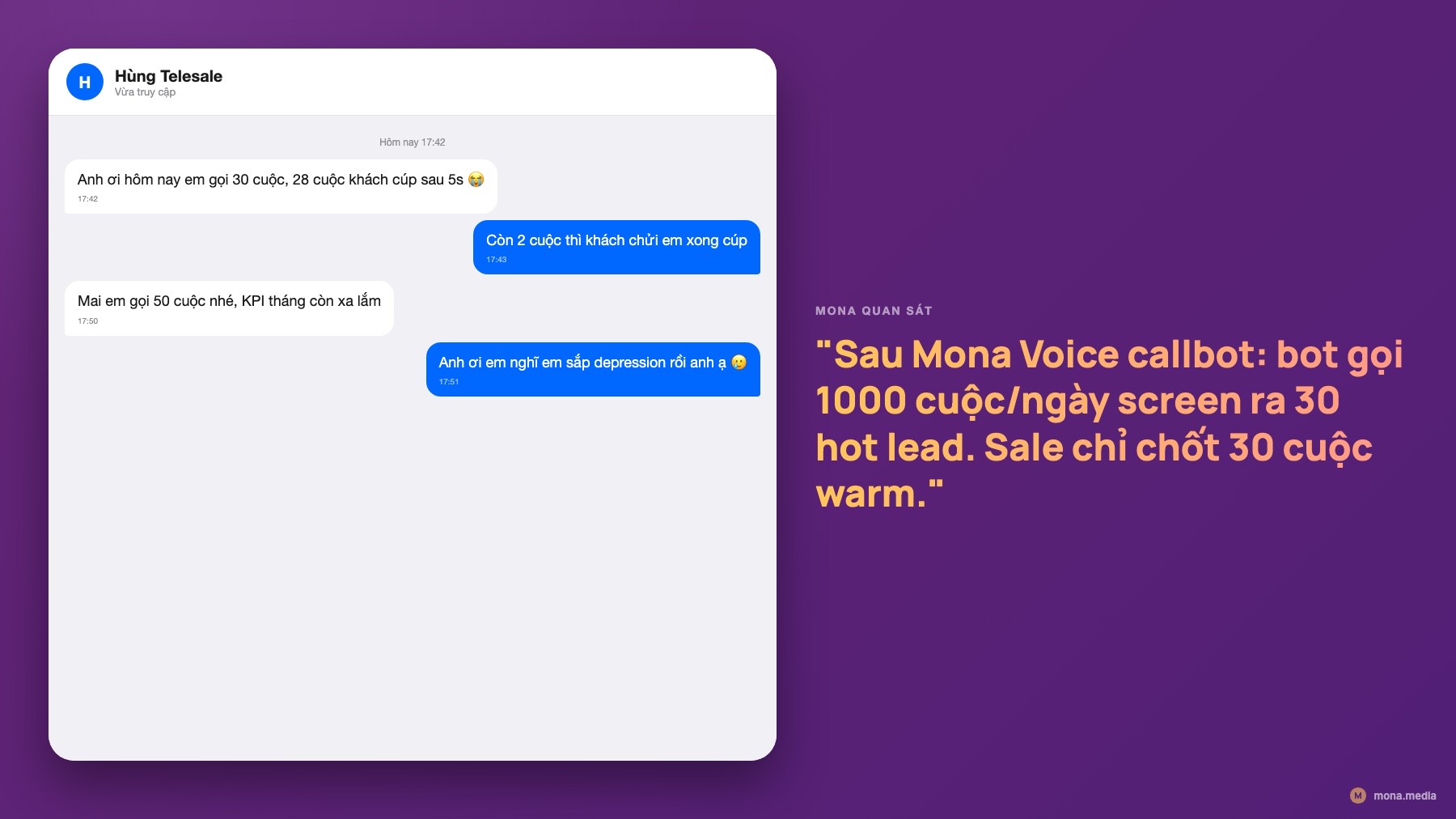
We recently sat down with the owner of a mid-market chain. He looked at his dashboard and sighed: a telesales room of 30 people, each making 30 calls, 900 calls a day. Of those, 840 were hung up within the first 5 seconds, 50 lasted 30 seconds, 10 ran over 1 minute, and 1-2 contracts closed. The telesales payroll is 420 million VND a month, and the ROI is negative. Do you see yourself in this story?
This pain isn't the telesales team's fault. Vietnamese customers now hang up by reflex when an unknown number calls. Telesales has to make a huge number of calls to get a handful of real conversations. Vietnamese voice AI can replace exactly this cold-calling step, so your human team only works with warm leads. Your telesales people aren't replaced. They move to closing instead of screening, with higher pay and a higher close rate.
There's another pain business owners rarely talk about: you don't have full visibility into the sales calls happening. Staff can over-promise to customers, badmouth the company, or steer customers to a competitor. Without voice analytics, the owner is blind. This is the “loss of control” pain that MONA often digs into when advising chain owners.
We understand that business owners sometimes worry about staff pushing back when Vietnamese voice AI is rolled out. We worked with the staff council at a 28-branch chain for 4 weeks to change roles: telesales weren't replaced but promoted to “closers”, with pay up 35% and a new KPI based on closing instead of call volume. After this step, the team supported MONA even more than the chain's owner did.
You're paying 280 to 420 million a month for 30 to 50 telesales reps closing deals across morning and afternoon shifts, plus 8 to 12 customer service agents on duty 24/7, including Tet and holiday weekends. And it isn't only about money. MONA knows you've already tried many other ways to keep your telesales team (base pay 25% above the industry, 8 to 15% commission per closed deal, weekly sales training, quarterly team-building retreats, month-end KPI bonuses, one-on-one coaching with the sales team lead, “the customer comes first” posters all over the office, treating every telesales rep like family, and treating every dong of Google Ads spend per lead like your own blood). But it hasn't worked. A sales director alone can't hold a telesales team together in an industry with 60% yearly turnover. It's a drop in the ocean. A telesales rep makes 30 calls a day and 28 customers hang up within the first 5 seconds. Out there, 100 million junk sales calls a day across the country have trained Vietnamese people to “hang up on any unknown number”, and one person alone can't change that. Replacing the current telesales team, hiring more energetic customer service agents, or outsourcing to a Philippine BPO is not the answer. What you need is closed-loop Vietnamese voice AI software, a callbot and AI call center that reduces dependence on people, leaving 1 to 2 dedicated senior sales closers working alongside a callbot that screens cold leads 24/7. It's not about hiring a whole crowd of toxic telesales reps who quit 4 months later and walk away with your lead list.
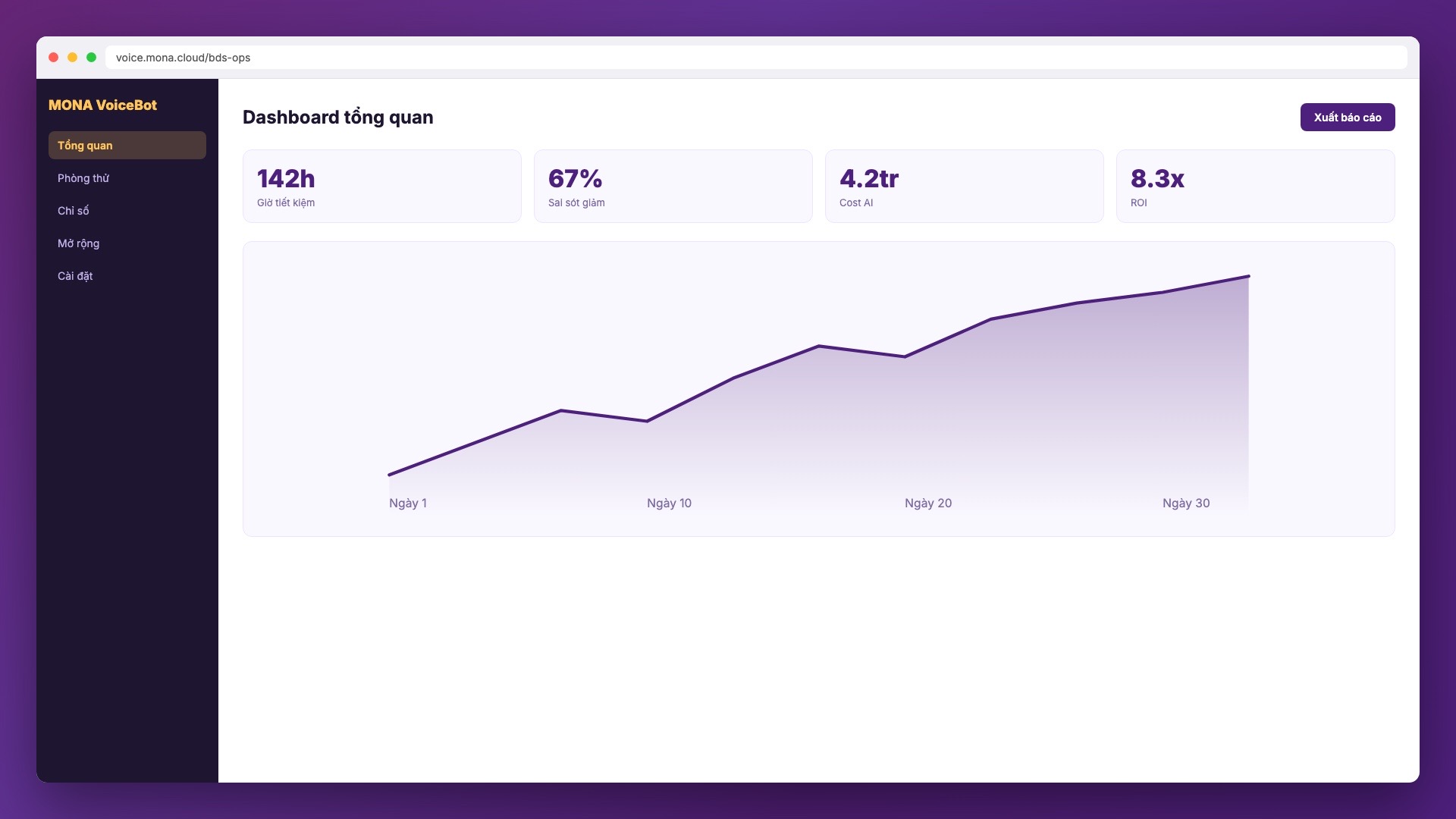
We'd like to share a case from a real estate chain MONA has worked with since mid-2025. It has 28 branches across Ho Chi Minh City, Hanoi and Da Nang, 320 sales staff, and revenue of about 58 billion VND a month. The starting pain: 5,000 web leads a week, and manual follow-up only reached 600 of them, so 4,400 leads were wasted. The cold-calling team had 22 people paid 14 million a month, with an appointment rate under 1%.
MONA deployed a Vietnamese voice AI callbot in 8 weeks. The bot makes 1,000 calls a day, with a script of 14 conversation branches and matched male and female voices for 2 regional accents. Results after 6 months:
The Vietnamese voice AI software suite MONA built for this chain runs production-grade on infrastructure MONA Host and MONA Cloud that doesn't depend on outside no-code tools. All call data is stored in Vietnam and never leaks to third-party services. The core software is developed and maintained long-term by MONA Software developed and maintained over the long term.
With the same Vietnamese voice AI, you can apply it to:
These six adjacent industries share 75% of the Vietnamese voice AI core and differ only in the business script. MONA's modular way of writing software allows fast reuse across industries, saving 60-70% of build time compared with starting from scratch.
We usually see the mid-market business owners reading this article fall into 2 clear groups. Group 1 is all too used to telesales making 30 calls a day with 28 hung up within the first 5 seconds, a customer service call center with a 7-button phone menu where customers press a key and then hang up and run, and voice analytics that only checks the quality of 5% of calls. They've given up looking for a solution, accepted that “that's just how sales is”, and treat a 2% close rate as fate. Group 2 is the business owners who, whether they run a 10-person sales team or 200 telesales nationwide, never stop looking for a solution. They read about Vietnamese voice AI callbots and AI call centers, look into TTS voices so natural that Vietnamese customers can't tell them from real people, ask peers about voice analytics that reviews 100% of calls, try a demo of a callbot that screens 1,000 cold calls a day, and once they see the right solution, they roll it out decisively and shock both the old telesales team and the customer service call center in the very first week of the switch. MONA (we're business people just like you, and MONA Software has automated 100% of our internal call center and run a customer service callbot for Mona.Host handling 800 calls a day since 2026) belongs to group 2, and we bring Vietnamese voice AI to you in group 2. What you need is now just a 45-minute call on the hotline or an email away info@themona.global. And it's free. A MONA specialist brings you a solution whatever your business model (a 10-person telesales team closing insurance deals, 50 customer service agents in real estate, 100 telesales in education, 200 sales staff nationwide in consumer finance, a bank with 30 branches, a hospital chain with 12 sites, an owner who knows AI technology inside out, or an owner who only cares about the month-end close rate, and so on). In every case we have a Vietnamese voice AI solution that fits. This is because it's already the 10th year MONA has been bringing automation solutions and production-grade voice AI callback software to business owners doing business in Vietnam.
We always propose an 8-12 week roadmap built on one principle: “measurable results every 4 weeks, not a gamble at the end of the term”.
After 12 weeks of rolling out Vietnamese voice AI, a mid-market business typically automates about 65-75% of level-1 calls. The human team is freed from cold calls and focuses on closing and caring for important customers. If you'd like a reference framework, see the 2026 enterprise AI glossary, What is AI first, and SEO voice search.
The Stanford AI Index 2025 report notes that Vietnamese speech-to-text error rates dropped from 12% in 2022 to under 5% at the end of 2025 (aiindex.stanford.edu). McKinsey Customer Care 2025 also reports that businesses deploying voice AI in their call centers cut operating costs by 25-40% without a drop in customer satisfaction (mckinsey.com/operations). This is the reference framework we often share with business owners when advising on Vietnamese voice AI. See the details in our article on AI first for businesses.
You run a mid-market business with 200-500 staff and a telesales room that calls all day with negative ROI. Would you like to sit down with MONA for 90 minutes so we can sketch a concrete Vietnamese voice AI roadmap for your sales room?
This isn't theory: call 1900 636 648 any time of day and Gấu (our bear assistant) picks up, one brain on duty across phone, website chat, Messenger, Zalo and email at once. The running cost of the AI call center at MONA is about 3-4 million VND a month, while a call center operator is a profession of its own, hard to hire and hard to keep, paying 6-7 million VND while expecting 8-9 out of 10 in quality. See how it calls and books appointments at AI Agent telesales, and for on-duty coverage and lead collection, see Gấu Cười multichannel desk.
70-80% of customers do not notice within the first 30 seconds if the bot is fine-tuned on enough industry data. MONA sets a rule for the bot to introduce itself as a virtual assistant in the very first sentence to avoid legal complaints later, and to hand over to a real person when the customer shows real interest.
Yes. Voice AI in 2026 is trained on the 3 main regions. Accuracy is 92-95% for Northern accents, 88-92% for Southern and 80-88% for Central. MONA always tests 200 sample calls before go-live to decide which regions need extra fine-tuning for your customers.
IVR makes customers press numbers. An AI call center understands a customer saying naturally 'I want to check my order' and routes to the right branch. Customer experience improves clearly, and the drop-off rate mid-call falls 40-60%. That is the core difference between an AI call center and old-style IVR.
Yes. AI listens to and scores 100% of calls against the criteria you set. Each call gets a score, 3 highlighted key segments and improvement suggestions. MONA helps mid-market chains use it to coach junior sales staff, raising the closing rate by 18-25% after 3 months.
Callbot setup costs 180-350 million VND, a voicebot AI call center 250-450 million VND, and voice analytics call scoring 150-280 million VND. Combining the 3 modules averages 700 million VND for a mid-market chain. Payback is 8-12 months thanks to a 60-70% cut in telesales and call center costs.

CEO & Founder · The MONA
The founder of The MONA built a service company of 60+ staff with 14,000+ projects delivered. Khánh Hùng shares his thinking on building self-running systems, automating a business, and the real lessons behind MONA's projects.
 291




Professional website
design services
Own a website with a beautiful, 100% exclusive design and a lifetime warranty, with the ability
to expand features flexibly as your business grows, starting today!






 MONA will never sell your information or send you spam


 MONA will never sell your information or send you spam
