
 MONA OS 2.0


 Tự động hoá doanh nghiệp
 Cẩm nang SEO
 Digital Marketing
 Kinh nghiệm thiết kế website
 Hạ Tầng Server
 Giáo dục



 VI
 EN


















Message us on
Zalo Official


 Products

 ProductsProducts










 Website designLooks good and wins customers over.
SEO servicesBrings in customers searching for exactly what you sell.
 Tư vấn digital marketingKéo khách từ nhiều kênh, đo bằng số thật.
Corporate video productionVideos introducing your company, factory and team.
 NewAI video productionCompany story films made with AI.
 Custom software developmentCRM, ERP and HRM built for your business.
 Viết AI Agent theo yêu cầuĐặt riêng một trợ lý AI cho đúng việc của mình.
 Tư vấn chuyển đổi AIĐưa AI vào vận hành của cả công ty.
NewMONA LMSManagement for centers and schools.
MONA SkillHubInternal training for company staff.
 NHTQ systemEnd-to-end China–Vietnam shipping operations.
MONA JMSManagement for gold, diamond and pawn shops.
 MONA E-LearningA website with every feature you need to sell courses.
 How to sell online courses (course)More than 30 free lessons on selling courses on autopilot.
 MONA Cloudmonacloud.vnServers to get your apps and websites running.
 MONA Basemonabase.vnPostgres database, sign-in and file storage.
 MONA Mailmonamail.vnSend OTP, order and invoice emails from your software.
 MONA Paymonapay.vnAccept bank transfers via VietQR and notify your software when the money arrives.
 MONA eInvoiceComing soonIssue e-invoices that meet tax standards.
Gấu CườiTrả lời khách 24/7 trên web, Fanpage, Zalo và thu lead cho sale.
 Gấu TeleSalesGọi điện tư vấn, chăm khách như tổng đài viên thật.
Dê CườiTư vấn và chốt đơn cho shop ngay trong khung chat.
Gấu WebmasterNhắn nhóm Zalo là website được sửa xong.
 Gấu Pháp ChếSoạn hợp đồng, rà điều khoản trong vài phút.
 Gấu Báo GiáLên báo giá đúng mẫu và gửi khách ngay.
 AI chăm sóc khách hàngTheo dõi và giữ chân khách hàng cũ.
 Gấu Tuyển DụngLọc hồ sơ, hẹn lịch, phỏng vấn ứng viên.
 KHA AI 2027
Xây kênh chuyên gia 2 phút mỗi ngày
Quay bằng điện thoại, AI tự edit video, tự đăng lên 16 nền tảng và tự trả lời bình luận, tin nhắn.
288.048lượt xem trên kênh CEO MONA sau 17 ngày
 Anh Khánh HùngCEO MONA đang dùng mỗi ngày
Xem app làm được gì
 AI
Gấu Cười MONA ĐANG TỰ XÀITrả lời khách 24/7 trên website, Zalo OA, Messenger và thu lead về cho sale.
Dê CườiChốt đơn bán lẻ và sàn: Shopee, TikTok Shop, web. Chăm cả khách sỉ, đại lý.
Gấu WebmasterCập nhật nội dung, tối ưu SEO website mỗi ngày.
Gấu TeleSalesGọi điện tư vấn, chăm khách như tổng đài viên thật.
Gấu Tuyển DụngLọc hồ sơ, hẹn lịch, phỏng vấn ứng viên tự động.
AI chăm sóc khách hàngGiữ khách cũ, cứu lead đã rớt cho phòng kinh doanh.
Gấu Pháp ChếSoạn hợp đồng, rà điều khoản trong vài phút.
Gấu Báo GiáLên báo giá đúng mẫu, gửi khách ngay khi có yêu cầu.
 Chuyển đổi AI toàn phầnGiải pháp tổng cho doanh nghiệp, 3 lớp triển khai.
 Viết AI Agent theo yêu cầuĐặt riêng một con AI gánh đúng nghiệp vụ của bạn.
 Custom softwareCRM, ERP and HRM with built-in AI automation.
 SEO & AEO thời đại AIĐược Google lẫn AI trích dẫn, không chỉ xếp hạng.
 Kiến thức AI cho doanh nghiệpBài phân tích, hướng dẫn ứng dụng AI vào vận hành.
 Free AI courses
 AI tools at work
 App mới · KHA AI 2027
Xây kênh 2 phút mỗi ngày
AI tự edit video, tự đăng mọi mạng xã hội
Free consultation, 8am–10pm every day

18 March, 2023

In SEO, keywords decide whether your content gets found. To attract the right audience, you need to know what they are searching for, what problems they have and which phrases they use to describe their needs. That is why keyword research is always the first and most important step of any SEO strategy.
But not everyone knows how to research keywords properly. Beginners often pick keywords by feel, going with whatever “sounds good”, so the content does not match what people actually search. The result is a lot of time spent with no real results.
In this article, MONA Media will walk you through the whole SEO keyword research process from A to Z in a simple, practical way. Read on.
What is a keyword? Keywords are the words or phrases users type into the search bar when they look for a topic. They are also the key phrases that describe a website's content, so search engines understand what the site is about.
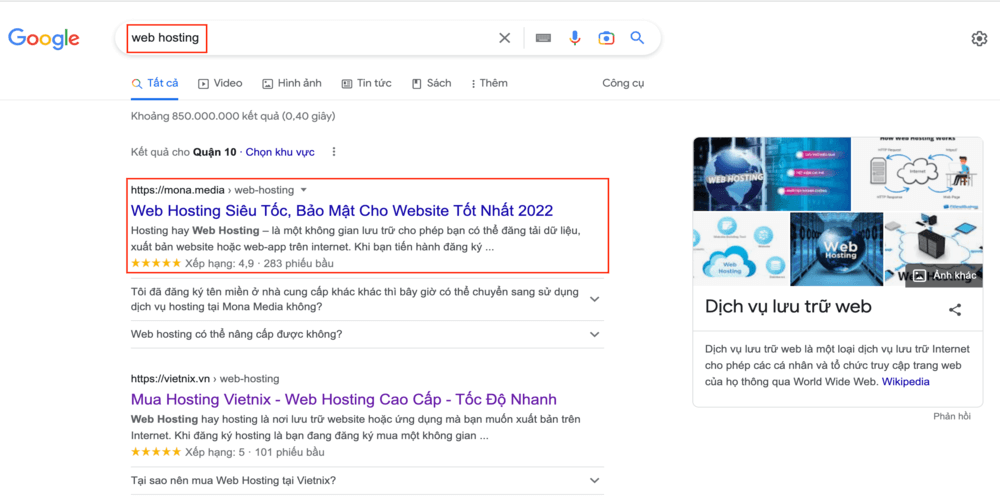
Main keywords for web hosting services at MONA Media
Accordingly, search engines (Search Engine) such as Google and Bing use their own algorithms to rank the websites that best match what users search for. Each search engine ranks differently. Having keywords that exactly or closely match the search is only one of the ranking criteria.
What is keyword research? In Vietnamese, this phrase means “tìm kiếm từ khóa” (searching for keywords) or researching keywords. It is the process of finding the words and phrases related to a business's products and services that users often search for.
Keyword research plays an important role in getting your products and services in front of the right customers. The results directly affect content quality, how well it matches search needs, and the practical value users get.
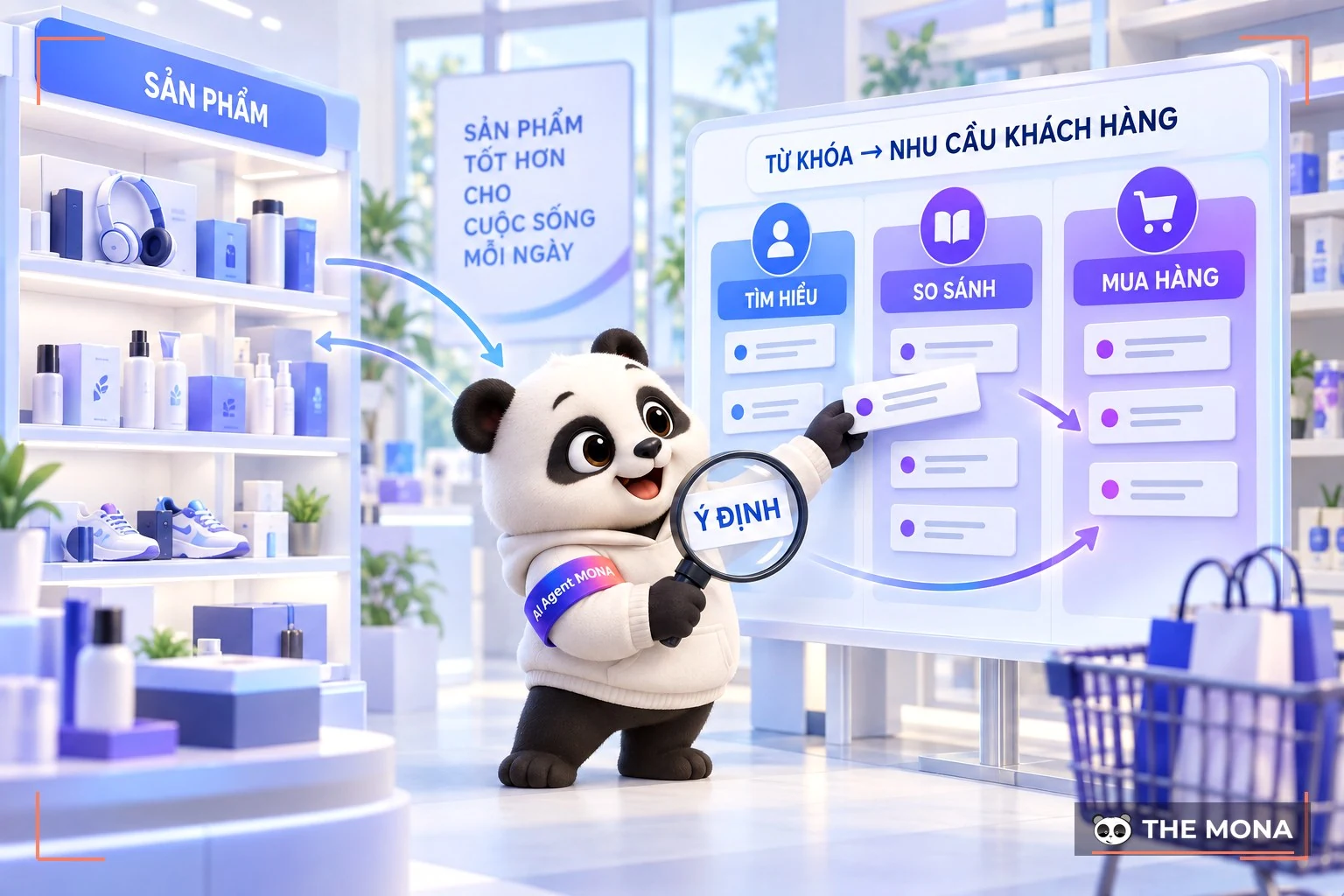
What is keyword research?
In online marketing terms, keyword research is what opens the opportunity to SEO cho website and improve your site's ranking on search engines, which brings in more users.
When you research Google keywords, you will see they fall into 3 types, each with its own traits. Here is each type in detail:
Short keywords usually have no more than 3 words and are usually very general and broad.
Example: artists, Honda motorbikes, t-shirts, website design,…
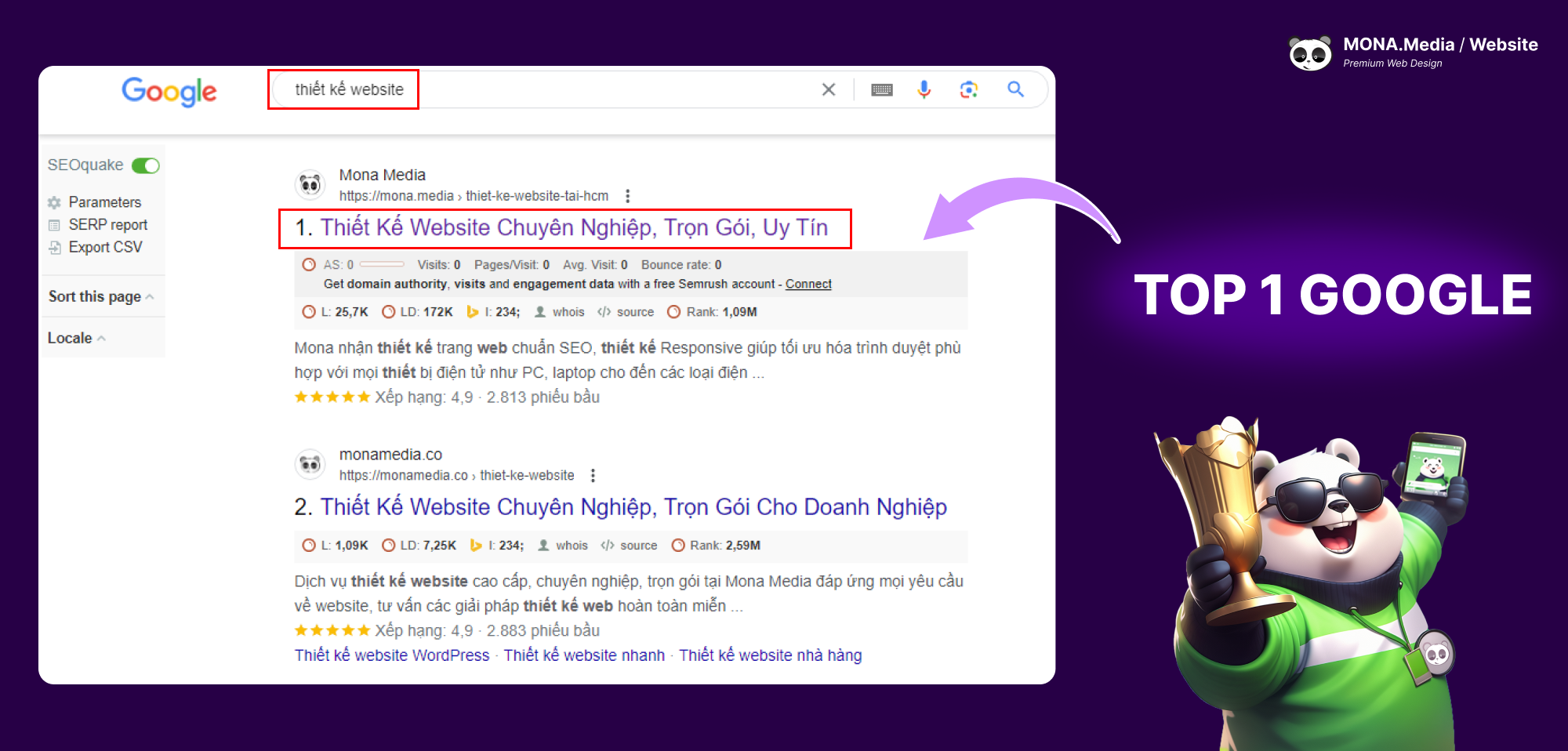
SEO for the short keyword “Website design“
Short keywords usually have very high search volume because they are generic and anyone can type them when looking for information. But because they are so broad, competition is fierce, with many websites having targeted and optimised for them for a long time.
Also, people searching short keywords are usually just “curious” or doing “early research”, with no intent to buy or act yet, so the conversion rate is usually quite low.
In contrast, long-tail keywords usually have at least 3 words and form a long phrase, almost a full sentence.
Example: how to peel a boiled egg, yoga classes for seniors, cheap flights from Ho Chi Minh City to Hanoi, Ricoh photocopier for sale,…
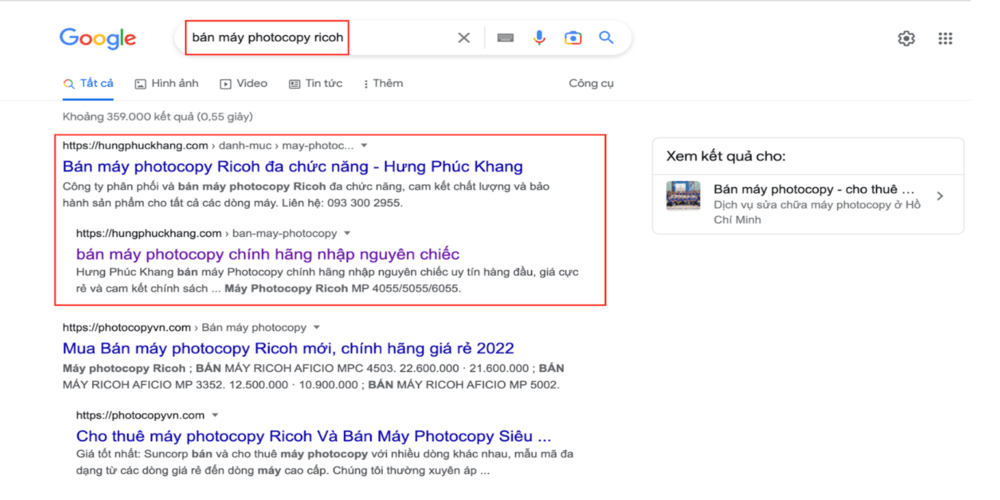
Long-tail keyword SEO for the Hưng Phúc Khang project
Long-tail keywords usually have lower search volume because they are very specific and go into one small need. But that detail means less competition and a high conversion rate. People typing such phrases usually have clear intent. They may be at the last stage of research, ready to sign up, ask for advice or buy.
Short keywords reach large search volume, while long keywords rank more easily and follow users' specific needs closely. So instead of choosing one, combine both sensibly in your SEO campaign, giving each keyword group its own role at each stage to optimise both traffic and conversion. This is a sustainable approach that makes SEO more effective in the long run.
In the SEO process, keyword research is extremely important because it is the foundation of your whole website optimisation strategy. Do it well at the start and you will know what to write, who to write for and what to optimise toward.
You should put keyword research first for these reasons:

Keyword research greatly affects your website traffic
According to many studies, 95% of clicks go to the first page (Search Result Page – SERP). Of those, nearly 50% of users visit the top 3 positions in the results and ignore the rest.
By traffic source, more than 50% of website traffic comes from organic search (SEO Google), while paid ads and social media make up only about 15%. And Google is clearly the biggest search channel, with over 90% of global market share.
These figures show keywords strongly affect a website's ranking and traffic. Researching keywords and choosing the right ones makes your website more competitive against others in the market.
You may also be interested in:
- How to increase website traffic sustainably and effectively
- How to increase traffic through SEO Social
When you analyse groups of related keywords, you can picture your target customer clearly: their age, job, income and search habits.
In other words, keyword research shows you the phrases that truly match what potential users need and intend. You can then build more accurate content and advertising strategies instead of guessing and hoping SEO delivers.

Keyword research helps you find the right keyword set
With keyword research tools, you will know the search volume and level of competition as well as and how well each keyword fits your field. You can then pick the most accurate, relevant keywords to attract the right target customers, raise traffic and improve your website's conversion rate.
Google keyword research also helps you spot keyword “gaps” that competitors use but you have not yet taken advantage of (Keyword Gap). This is a valuable chance to quickly take high positions in search rankings and build a lasting competitive edge.
Keyword research does not just identify the phrases users search. It also surfaces keywords closely related to your field. You can then build a full keyword set with a clear direction, the base for developing content topic by topic, from broad to narrow. It works as a long-term “map” for content, helping you work methodically and stay close to what users really need.
In short, Investing in keyword research is the best way to save time and and cut SEO costs. Choosing the right keywords avoids investing in activities that do not work, saving time and cost. Thorough keyword research also builds a stronger, better optimised marketing strategy, raises visibility in search engines and attracts more potential customers.
Data from Google Analytics or other tools is just “raw numbers” until it is analysed. Huy will show you how to clean it, visualise it and find the gaps in the customer journey. Watch the video to learn how to turn numbers into revenue.
Keyword research is the first and most important step in any website SEO strategy. To make Google keyword research effective, follow the steps below with MONA:

Defining your business field is the first step of keyword research
To research keywords properly for SEO, first define your business field and keep up with industry trends, changes and information on competitors. Above all, gather information on your target customers, such as:
Example: MONA has a website about SEO services, whose purpose is to give information about website SEO services and SEO-related topics, and to “sell” strategies that push clients' websites to the top and raise their sales. MONA's target customers are businesses that need website SEO and higher Google rankings.
With these criteria clear, MONA runs Google AdSense and affiliate marketing aimed at business owners who need SEO services. From this simple way of defining your field, you can find keyword ideas more easily and quickly.
SEO keyword research means racking your brain for hours over which keywords to use? In practice it does not have to be. You can cut the time to find keyword ideas with the methods below:
Find seed keywords
You should find your seed keywords when researching keywords
Seed keywords (also called short-tail keywords) are your website's basic keywords, usually 1 to 2 words. They show your website's topic or niche and are used to develop other keyword sets (for example long-tail keywords).
Example: If your niche is cheap accessories, your seed keyword could be “cheap accessories”, not just “accessories”.
Use Universal Keywords
Once you have a seed keyword, put it into the Universal Keywords research tool and press “Enter”. You can also use SEMrush to find keyword ideas with these steps:
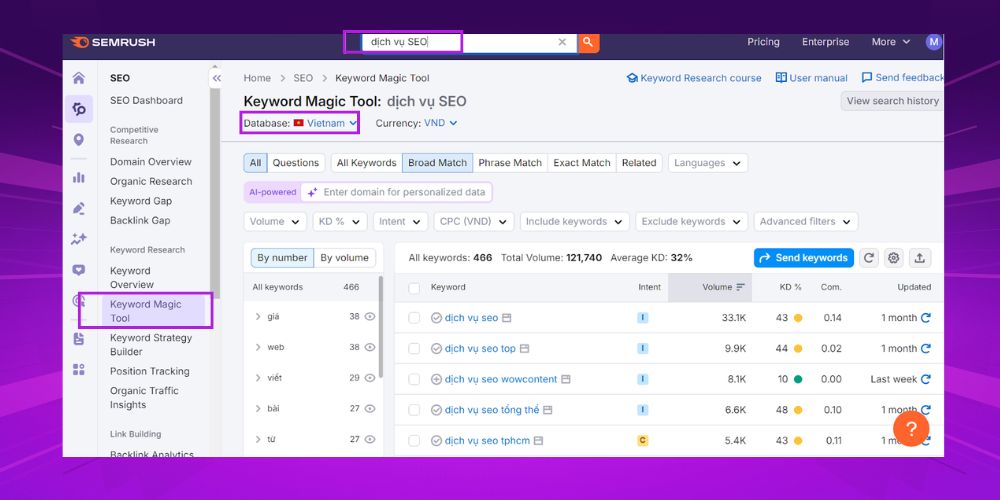
Guide to keyword research with SEMrush
Research the market for more information
Market research is important not only in SEO but in business generally. Trends and search needs change constantly, so relying only on tool data will not keep you up with the market.
So besides Google keyword research with tools, combine it with real-world observation, user research and new trends to get the most effective, complete SEO strategy.
Once you have a full keyword set, filter it to focus on the truly promising keywords using Opportunity, Volume, Keyword Difficulty and Potential. In detail:
Opportunity
Opportunity tells you whether your website can write complete content on that keyword. It lets you drop keywords that do not fit your content direction or your products and services.
For example, if you run a website that offers SEO services and SEO information, keywords naming another company, such as “dịch vụ seo ladigi” (Ladigi SEO services) may not be a fit.
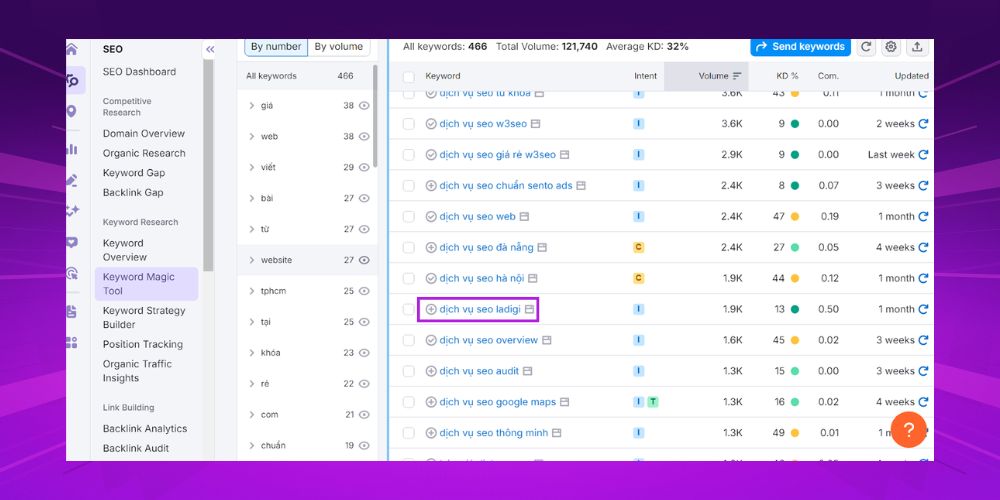
How to check Opportunity when researching SEO keywords with SEMrush
Volume
Search Volume reflects the average monthly searches for a keyword. It is the basis for judging user interest in a product or service, and you can use it to optimise and plan content better.
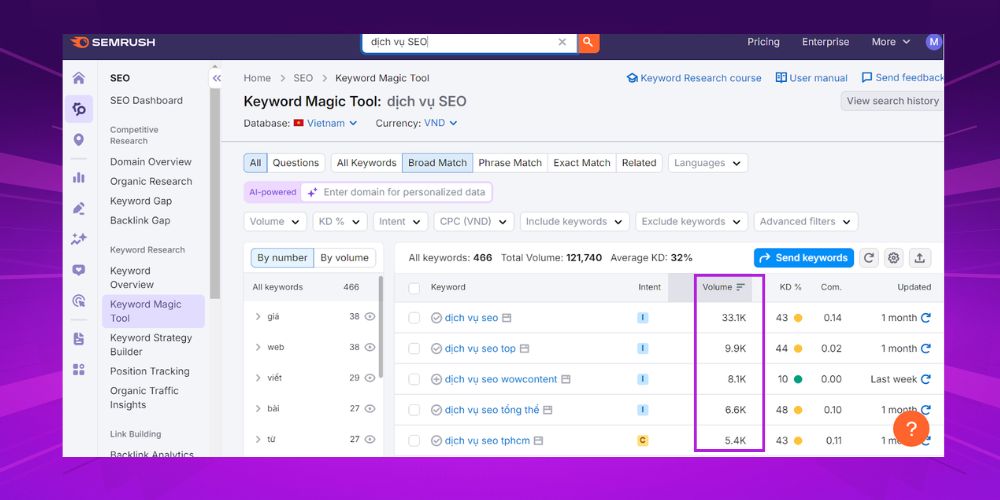
Search volume of the keyword “Dịch vụ SEO” (SEO services)
*Note: Do not rush into high-volume keywords without looking at the whole picture, because the more searches a keyword has, the fiercer the competition. This is when you check Keyword Difficulty in your Google keyword research.
Keyword Difficulty
Keyword Difficulty (KD) shows how hard it is for that keyword to reach the top of Google results. SEO tools such as Ahrefs and SEMrush may give different KD figures, but they usually do not differ much.
Based on 10 years of providing full-scope SEO services and our own measurements, the MONA team has found that the shorter the keywordand the broader it is, the higher the difficulty, with a KD that can exceed 30. By contrast, keywords of more than 3 words (long-tail keywords) are specific and easy to understand, so their search volume is lower => less competition.
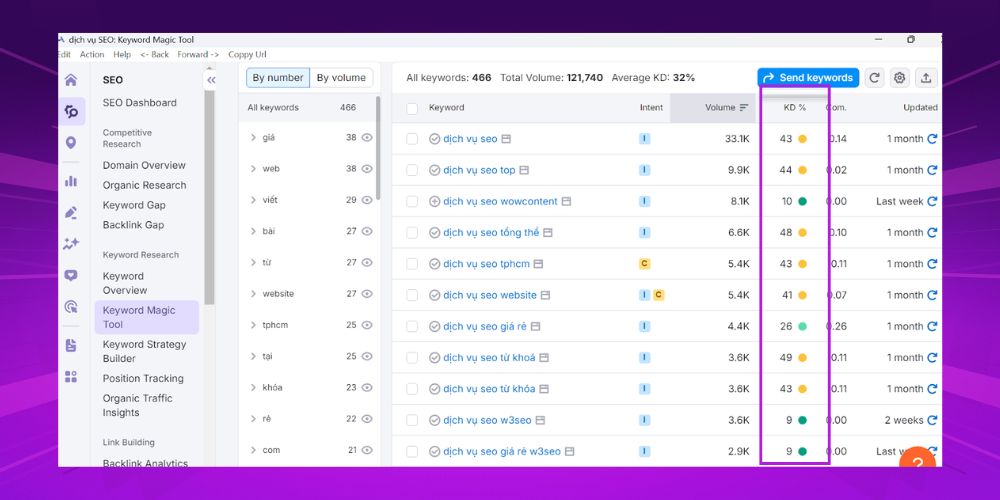
SEOers can find Keyword Difficulty in SEMrush's “Keyword Magic Tool”
Example: In SEMrush, the keyword “dịch vụ SEO” (SEO services) has a difficulty of 43, “dịch vụ SEO top” (top SEO services) is as high as 44 => high competition. Longer keywords such as “dịch vụ SEO giá rẻ” (cheap SEO services) are more specific, so their difficulty is lower and they are easier to take on for a new website.
Potential
Potential (potential traffic) is search volume plus users' clicks, from which you can judge how popular a keyword is. A keyword's potential comes not only from the keyword itself but from variants such as synonyms and related terms.
Informational Keywords
Informational keywords are what users search when they want to know something. In MONA's research, informational queries take the form of questions: How, What, When, Who, Where, usually starting with words like “how to”, “way to…”, “how much…”, “what is…”,…
Example: “What are SEO services?”, “How much do SEO services cost?”, “Where to order reliable SEO services?”,…
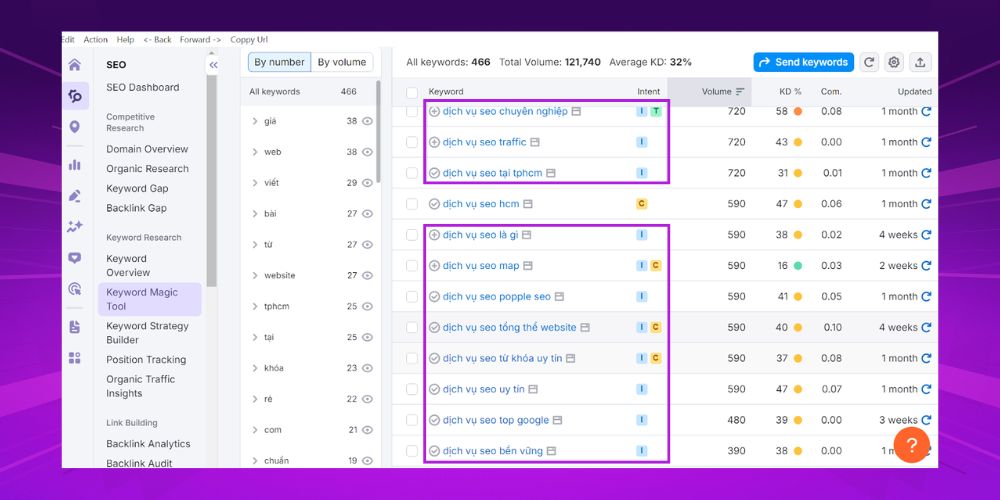
“What are SEO services” is an informational keyword businesses often search
Navigational Keywords
Navigational keywords are queries users enter into Google when they want to reach a specific website or page but do not remember the exact URL, or simply do not want to type the full address. In plain terms, they show the user already knows what they are looking for and just wants to reach that exact website or brand.
Example: If users search keywords such as “ahrefs”, ““MONA SEO services” means they want to find those websites. ahrefs.com or https://mona.media/dich-vu-seo/.
Commercial Investigation Keywords
These keywords show users weighing and assessing options before deciding to buy. They may look for product reviews, check features or compare products and services.
Example: If you research keywords for the keyword “SEO services”, the commercial investigation keywords would be “reliable full-scope SEO services”, “which SEO service is best now”, “reviews of top SEO companies in Ho Chi Minh City”,…
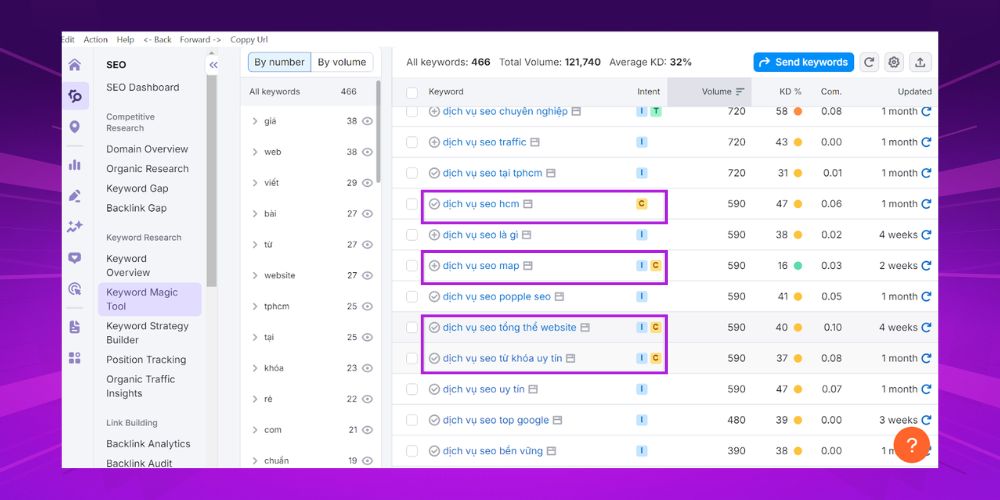
Some Commercial Investigation Keywords related to the SEO services keyword
Transactional Keywords
Transactional keywords show strong intent to act, usually when users are ready to complete a transaction such as buying, signing up, booking or hiring a service. Common transactional terms on Google include: buy, price, order…
Say your website offers SEO services. To attract customers and “sell” the service, you can use good keywords such as: “professional SEO services”, “cheap all-in-one SEO services”…
*Note: Because this group has the highest conversion potential, competition is fierce. So research Google keywords carefully and use long-tail keywords.
With a list of promising keywords, next group those with the same meaning and the same search intent. A concept called Parent Keyword (main keyword) represents a broad field or topic that covers a shared search intent. For example, users may search with many different phrases, but all point to the same problem.
To choose a suitable parent keyword, base it on your product, field and target customers. The simplest check is to search the keyword on Google. If most results (SERP) return content about the same parent keyword, the keyword you searched is a child keyword.
Example: Say you are researching keywords in “SEO services”. You hesitate between 2 keywords: “dịch vụ SEO trọn gói” (all-in-one SEO services) andi” and “dịch vụ SEO tổng thể” (full-scope SEO services). Open 2 Google browser tabs and search one keyword in each. If both return the same type of articles, such as “dịch vụ SEO website trọn gói (all-in-one website SEO services)”, “dịch vụ SEO tổng thể website uy tín (reliable full-scope website SEO services)”,… then you can group them under one parent keyword: “dịch vụ SEO” (SEO services).
With too many keywords to check, the method above does not work. So what is the right keyword research strategy here? The answer is to use SEO tools such as Ahrefs. It is simple: enter the head keyword (for example: SEO services) in the search bar and press enter, and Ahrefs's algorithm automatically groups keywords with the same intent into one topic.
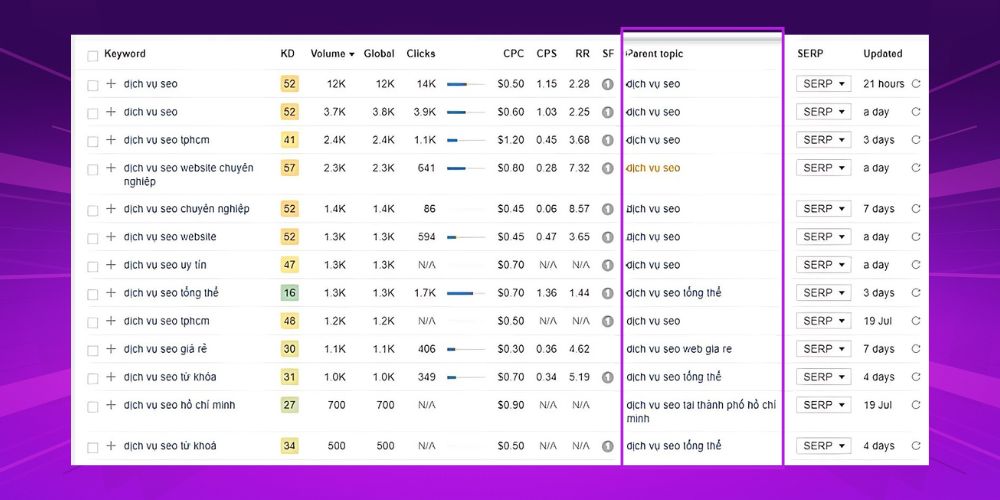
You can group keywords easily with Ahrefs
Once keywords are grouped, the next step in SEO keyword research is expanding your keyword ideas with these useful tools:
Use YouTube and the Google suggestion box
Type a keyword into the Google or YouTube search box and the system suggests a range of related phrases based on popular user queries. These suggestions are real “insight” that reflect how users actually search. But do not take them all. Only take note keep the most relevant suggestions to add to your expansion list.

You can expand keywords with the Google or YouTube suggestion box
Find related keywords
Scroll to the bottom of Google's results page and you will see “Searches related to”. This is where Google collects the phrases people often search together with your keyword. These suggestions help you expand ideas and open up promising keyword niches not yet explored.
Do not overlook the Google Images box either. On the Images tab, the keyword boxes at the top are another great source of secondary keywords.
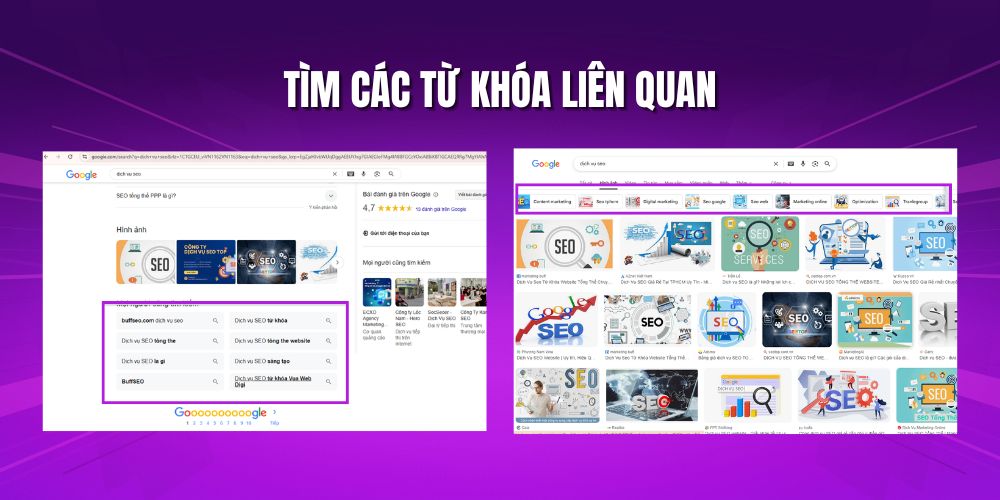
Finding related keywords with Google keyword and image suggestions
Find popular keywords on forums
In keyword research you can also join relevant forums such as Reddit, Quora and Facebook groups. Why? Because users ask about what they care about on these forums. It is a chance to see the community's view of the product or service and collect the keywords they actually use, not only what tools suggest.
Wikipedia Table of Contents
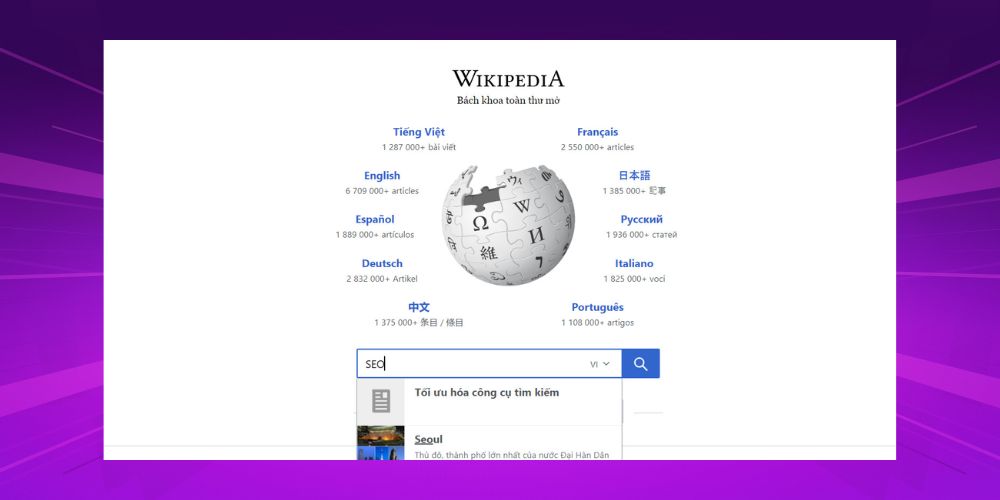
Wikipedia can also help you find keywords that work for SEO
Wikipedia can be a handy trick for finding suitable keywords in SEO. When you look up a topic, check the Table of Contents. The subheadings there are the important aspects of the topic and also potential secondary keywords you can turn into articles.
Ắc Quy Việt Nhật is a trusted battery distributor in Vietnam with a wide product range for most popular vehicle types. Based on the industry and how users search, MONA Media built a full SEO strategy combining traditional methods with AI-assisted SEO.
From deep analysis of keywords by need to building an in-depth blog content system, the campaign clearly improved the company's search rankings, increased its chance to appear in AI Overview, in AI tool answers, and brought steady traffic. After 10 months, Ắc Quy Việt Nhật reached 100% of its SEO goals and built a base for sustainable growth in the next phase. See the case study in detail below.

When researching SEO keywords on Google, high search volume alone is not enough. To choose truly effective keywords, you need metrics that judge reach potential, competition and conversion potential.
In this part, MONA shares the metrics every SEOer must know: Volume, Keyword Difficulty, CPC and fit with search intent. They are the basis for choosing “golden” keywords for your website.

Search Volume is a key metric to watch when researching keywords on Google
Search Volume is one of the most important keyword research metrics in SEO. It shows how often users search that keyword in a given period, helping SEOers pick promising keywords that fit their SEO strategy.
Knowing user search trends is necessary to choose keywords and plan articles sensibly. You can set up Google Trends to follow viral keywords and currently trending keywords that many users care about and that fit your product or campaign, then build SEO content from them.

This is the level of keyword competition among competitors in the same field who build similar SEO content. The higher the keyword difficulty, the harder it is for the keyword to climb the rankings quickly. But once you get the traffic, your website becomes more durable.
Keyword difficulty is usually judged by these factors:
To choose the right SEO keywords, researching Google keyword difficulty is very important. If you have a professional, long-established website with stable keywords, moving on to harder keywords is necessary. With a new website, start with low-difficulty keywords before high-difficulty ones.
To make your keyword research simpler and more effective, MONA has listed the 9 best SEO keyword research tools today for you to use:
Google Trends is a tool built for keyword and search trend research. It is completely free and gives a full view of whether a specific keyword is rising or falling. It also lists keywords related to the main keyword in the same field, so you can choose suitable secondary keywords.
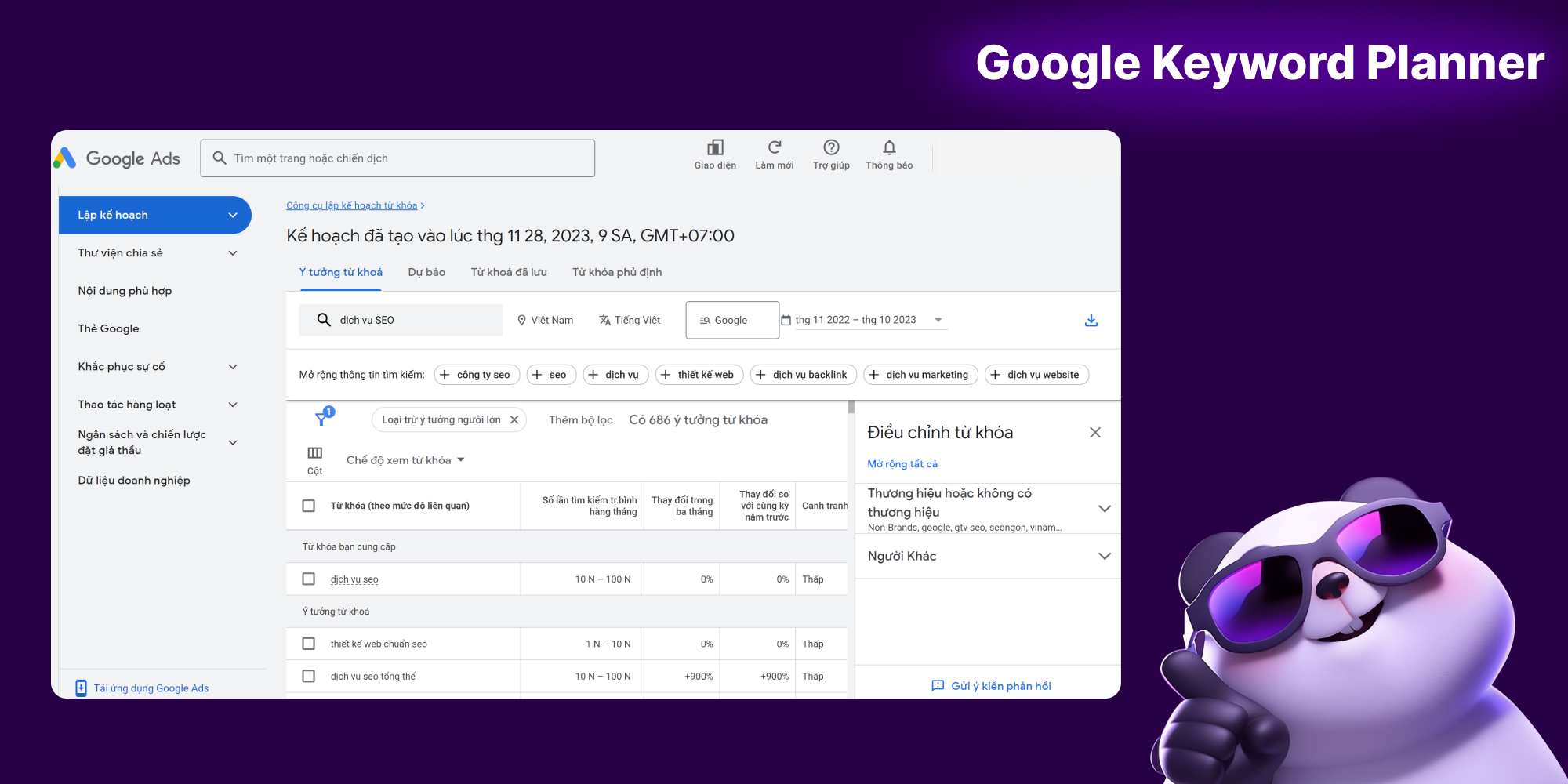
Google Keyword Planner interface
This is a keyword research tool for running Google Ads. Google Keyword Planner lists keywords related to the phrase you enter. It also gives detailed figures for each keyword, including: monthly search volume, level of competition, ad impression share, and ad bid prices,… giving you detailed data to choose the best keywords for your campaign.
You may also be interested in: How to use Google Keyword Planner for keyword research
Google Search Console is one way to research keywords, and Google provides it completely free. It is highly accurate, costs nothing and is quick and easy to set up.
Installing Google Search Console brings benefits such as: Crawling your website's content, indexing it, and showing linked pages and how often your site appears on Google Search through keywords,… This helps you build more professional, better optimised keyword and content strategies for your website.
With its huge database, Ahrefs SEO is probably one of the most powerful keyword research tools right now. Ahrefs results usually include many related keywords and specific measurements with very high accuracy.
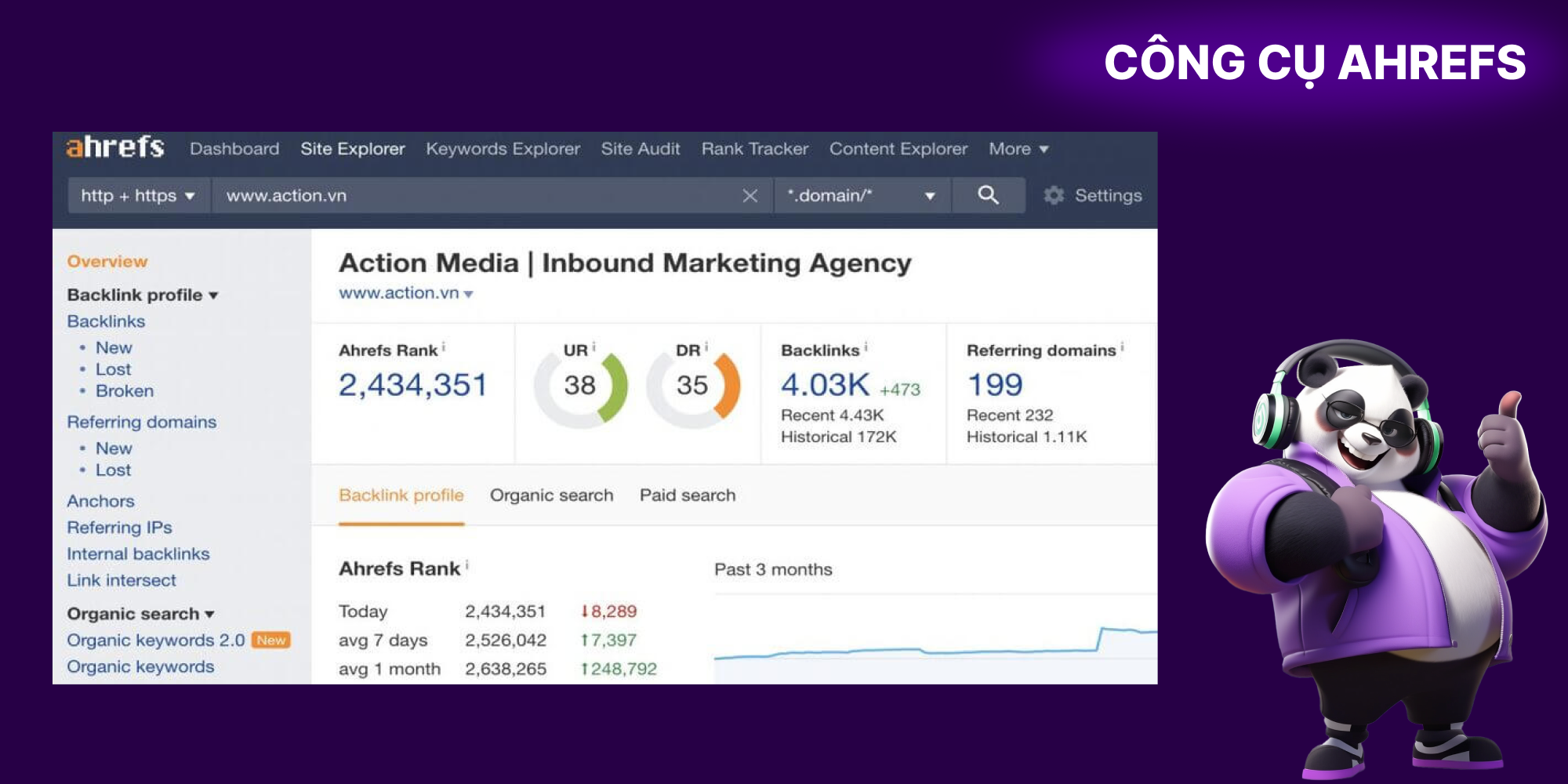
Ahrefs SEO tool interface
This keyword research tool has a free plan, but it has many limits. You need a paid version for the best features. For new websites and SEOers without much budget, that can be a big barrier.
Another popular and trusted SEO keyword research tool you can look at is SEMRush. It offers many advanced keyword research features and presents them visually with figures, charts and colours.
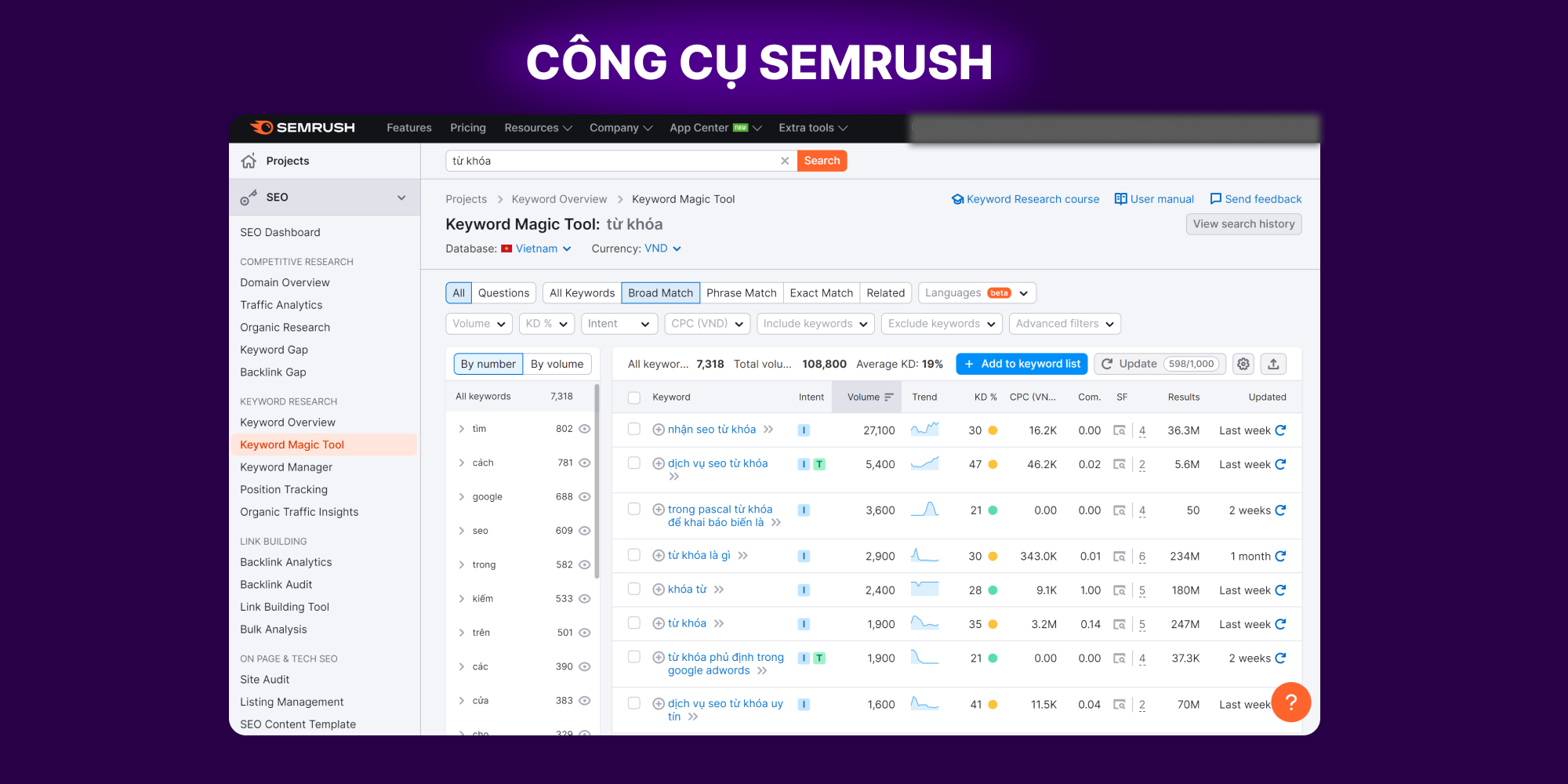
SEMrush interface
SEMrush is a real help in finding “valuable” keywords to make SEO easier. But the power comes at a price: you need SEMrush Premium to use its in-depth features.
Google Suggestion not only reflects what users are interested in but also suggests options close to real search needs. Because it updates continuously with user behaviour, it is very useful for spotting trends, identifying search intent and expanding your keyword set.
So if you want to understand customer insight better, do detailed SEO keyword research and find extended keywords, do not skip Google Suggestion. It now even has smart auto-suggest, so you can pull data faster and more systematically.
Keywordtool.io is one of the leading keyword research apps today. This keyword analysis tool is highly secure, analyses keywords professionally and returns accurate results with good keyword priority reports. That makes selecting and measuring keyword metrics, and finding related and extended keywords, simpler and more effective with Keyword Tool.
Keyword Tool also handles search volume, competitor keyword analysis, and filtering keywords by country, cost, trend or search volume.
Today, SEO keyword research is much faster and more effective thanks to artificial intelligence (AI). Besides specialist tools like Google Keyword Planner, SEMrush or Ahrefs, you can use AI assistants like ChatGPT or Gemini to explore keyword ideas smartly.
For example, you can use ChatGPT to brainstorm topics and keywords from the start. Just ask a simple question like:
“List long-tail keywords related to ‘yoga at home for beginners’, suited to people learning about and starting to practise yoga.”
And the AI may return a list like:
These long-tail keywords are specific, face less competition and answer the problem or question users are searching, which makes your content fit real needs better and raises your chances of ranking and converting. With AI you no longer search for a needle in a haystack. You can reach what users need in a few clicks.
For effective keyword research strategies, pay attention to the following:
To speed up Google keyword research and optimise SEO, you need an experienced team that brainstorms keywords, understands the market and knows how to pick keywords that convert. At MONA Media, we do not only help with keyword research but also build a content strategy that fits your industry, user behaviour and specific business goals. Whatever your field or difficulty, the team SEO specialists at MONA can always find the best plan. Choose our hard-keyword SEO service and you get:
99.9% of clients who used SEO services at MONA gave positive feedback, because they clearly see changes in ranking, traffic and above all real conversions. You can get similar results when you contact us today.

If you think you must start over to do SEO for a website that is already running, not necessarily. Google already has data on how your site ranks for each keyword. Use it to grow content and optimise SEO more effectively. So how do you find keyword ideas for an existing site during keyword research?
Before looking for new keywords on other platforms and forums, check the keywords your site already ranks for in Google Search Console (GSC). To find keywords closer to users on URLs that have ranked, follow these steps:
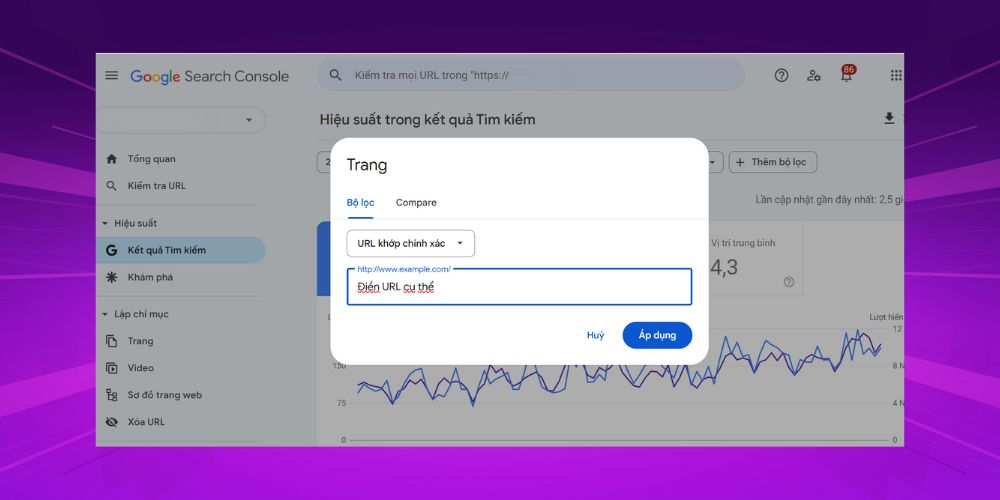
How to check keyword rankings with Google Search Console
*Note: Google Search Console shows the average position of each ranked keyword, but it gives no monthly search volume data and shows at most 1,000 keywords.
One ready-made source of keywords that few people use is the list of keywords your competitors rank for, the sites competing with you directly on Google. They have already done keyword research before you, and an SEO tool can show you all of it so you can pick out the best keywords. That saves a good deal of research time. You can use SEMrush to check a competitor's keywords with these steps:
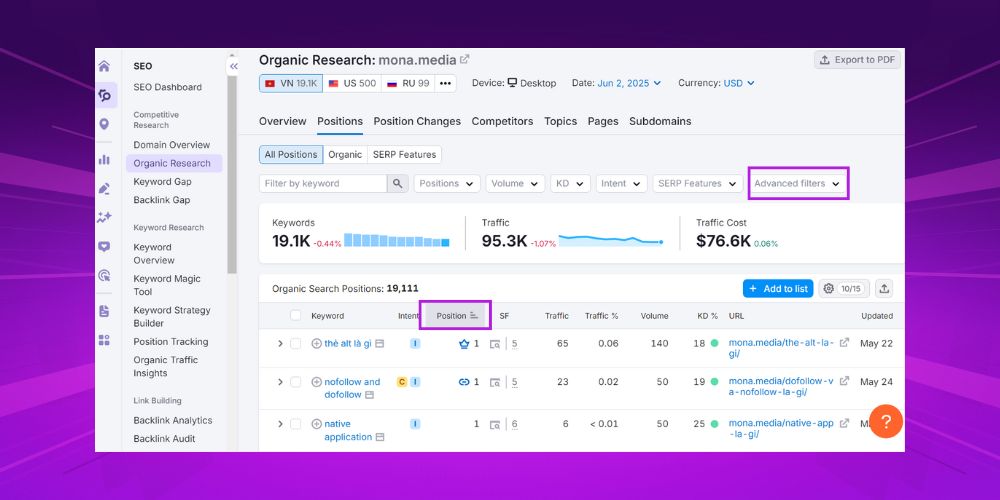
Competitor keyword rankings help you filter out the best keywords
*Note: If you don't know who your competitors are, type a seed keyword into Google and search. The sites that rank at the top and cover the same topic as yours are your competitors.
For professional SEOs, Google Search Console and competitor checks alone are not enough. You need a fuller picture of keywords, covering potential, competition and search trends, so you can find strong keywords that nobody is targeting yet. That is where SEO keyword research tools such as SEMrush, Ahrefs, Keywordtool.io, Ubersuggest come into their own.
Whichever tool you choose, the basic routine is the same: enter a seed keyword (for example, website design or SEO services) and within seconds the tool returns hundreds or thousands of related keyword ideas. The keyword data these tools suggest usually comes from:
*Note: Paid keyword research tools like SEMrush usually give better and more varied keyword data, but the list can easily overwhelm you (for example, the keyword "dịch vụ SEO" (SEO services) has 466 related ideas with a combined volume of 121.7k). So you can filter by these categories:
Finally, to stand out and get ahead of your competitors, do what many SEOs skip: research your own niche market. How do you find these out-of-the-box keywords? Start here:
Example: If you offer website SEO services, the niche keywords you could use include:
AIDA is a marketing funnel model widely used in keyword strategy. Once you have done detailed keyword research, you can use the AIDA model to build persuasive, engaging content that pushes users toward buying.
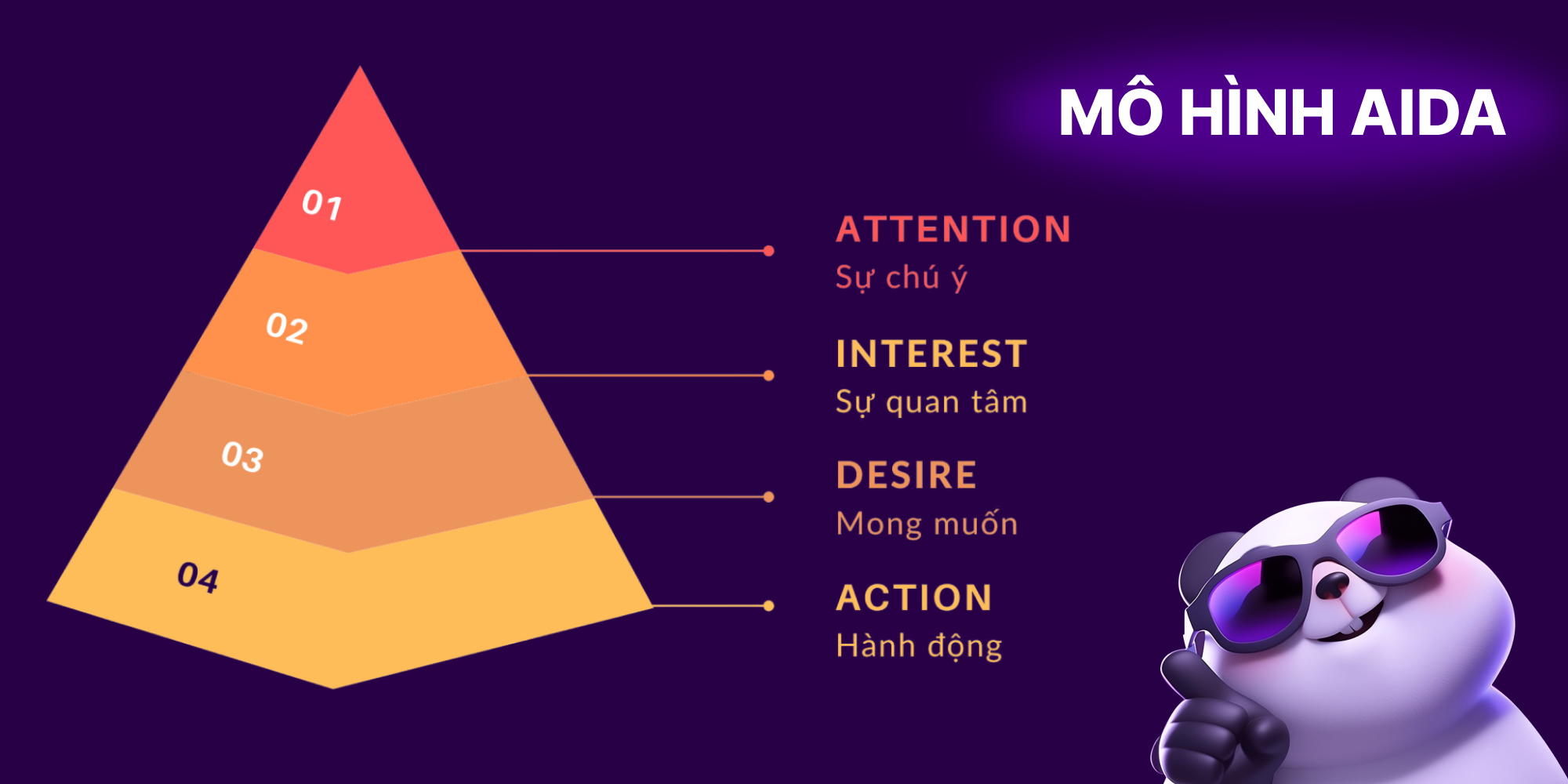
Applying the AIDA model to Google keyword research helps raise your website's conversion rate
AIDA stands for the letters Attention (capture attention), Interest (spark interest) and Desire (build desire), and finally Action (drive action). If you cover these four elements, your chances of a higher conversion rate go up.
Throughout this process, include your priority keywords and other important keyword types in the article to widen the information you cover, so customers become interested in and want the products or services you offer.
Many people confuse SEO keywords with Google Ads keywords and assume one keyword set works for both. In practice they serve completely different goals.
SEO keywords aim for free, steady, long-term traffic. Google Ads keywords, on the other hand, focus on fast conversions and depend on your budget and ad performance. So the way you choose and evaluate the two types is very different. What exactly sets them apart? Let's find out with MONA.

Google Ads keywords usually sit in the top positions and carry an "Ad" label
Google Ads keywords are keywords a business has to pay for in order to appear on the first page of search results. Appearing at the top takes a high spend: you choose higher keyword bids to get priority placement.
Search results for Google Ads keywords usually sit in very high positions, at Top 1, 2, 3 and 4. At the top, these results always appear with the word "Ads". Google Ads keyword research services give results straight away.
SEO keywords take more time and people for research. From these keywords you need to build a content strategy, build links and more before you can properly optimize for what customers search.
SEO keyword research brings in organic searches and takes time to reach the top. The ranking you earn on Google is more durable, valued more highly by users, and you don't pay per click the way you do with Google Ads.

Common questions about keyword research on Google
1 – Why does a professional SEO keyword research process matter?
When you do SEO keyword research well and build valuable content strategies, your website can climb the rankings steadily without spending money on Google Ads. A website that does professional keyword research will beat its competitors, reach a large number of customers, and enjoy a high conversion rate and good revenue.
2 – How do you do Google keyword research effectively?
To research effectively, make sure you do the following:
3 – Should you use keywords with low search volume?
The answer is YES if it matches what users are looking for and fits your content strategy. Although search volume is low, these keywords are usually specific (niche) and convert well, because the people searching already have a very particular need.
In short, researching keywords is a key step in SEO. It helps you filter out the most "valuable" keywords to bring your website to the top of Google and support its long-term, sustainable growth. That said, proper SEO keyword research takes market knowledge, analytical skill and hands-on experience. If you want to save time, avoid mistakes and start with a clear strategy, the SEO team at MONA Media is ready to work with you. Contact us to get SEO services quote free advice and an SEO strategy that is effective, realistic and matched to your business goals, starting today.

CEO & Founder · The MONA
Founder of The MONA, who built a services company of 200+ staff with 14,000+ projects delivered. Khánh Hùng shares how he thinks about building systems that run themselves, automating a business, and the real lessons from delivering projects at MONA.
 1,9K




Professional website
design services
Own a website with a beautiful, 100% exclusive design and a lifetime warranty, with the ability
to expand features flexibly as your business grows, starting today!






 MONA will never sell your information or send you spam


 MONA will never sell your information or send you spam
