
 MONA OS 2.0
 Partner with MONA


 Tự động hoá doanh nghiệp
 Cẩm nang SEO
 Digital Marketing
 Kinh nghiệm thiết kế website
 Hạ Tầng Server
 Giáo dục


 VI
 EN











Message us on
Zalo Official


 ProductsNew

 ProductsProducts
 Mới ra mắtKHA AI 2027App tự edit video, tự đăng mọi mạng xã hội, 2 phút mỗi ngày










 Website designLooks good and wins customers over.
SEO servicesBrings in customers searching for exactly what you sell.
 Tư vấn digital marketingKéo khách từ nhiều kênh, đo bằng số thật.
Corporate video productionVideos introducing your company, factory and team.
 NewAI video productionCompany story films made with AI.
 Custom software developmentCRM, ERP and HRM built for your business.
 Viết AI Agent theo yêu cầuĐặt riêng một trợ lý AI cho đúng việc của mình.
 Tư vấn chuyển đổi AIĐưa AI vào vận hành của cả công ty.
NewMONA LMSManagement for centers and schools.
MONA SkillHubInternal training for company staff.
 NHTQ systemEnd-to-end China–Vietnam shipping operations.
MONA JMSManagement for gold, diamond and pawn shops.
 MONA E-LearningA website with every feature you need to sell courses.
 How to sell online courses (course)More than 30 free lessons on selling courses on autopilot.
 MONA Cloudmonacloud.vnServers to get your apps and websites running.
 MONA Basemonabase.vnPostgres database, sign-in and file storage.
 MONA Mailmonamail.vnSend OTP, order and invoice emails from your software.
 MONA Paymonapay.vnAccept bank transfers via VietQR and notify your software when the money arrives.
 MONA eInvoiceComing soonIssue e-invoices that meet tax standards.
Gấu CườiTrả lời khách 24/7 trên web, Fanpage, Zalo và thu lead cho sale.
 Gấu TeleSalesGọi điện tư vấn, chăm khách như tổng đài viên thật.
Dê CườiTư vấn và chốt đơn cho shop ngay trong khung chat.
Gấu WebmasterNhắn nhóm Zalo là website được sửa xong.
 Gấu Pháp ChếSoạn hợp đồng, rà điều khoản trong vài phút.
 Gấu Báo GiáLên báo giá đúng mẫu và gửi khách ngay.
 AI chăm sóc khách hàngTheo dõi và giữ chân khách hàng cũ.
 Gấu Tuyển DụngLọc hồ sơ, hẹn lịch, phỏng vấn ứng viên.
 Mới ra mắt
KHA AI 2027
Xây kênh chuyên gia 2 phút mỗi ngày
Quay bằng điện thoại, AI tự edit video, tự đăng lên 16 nền tảng và tự trả lời bình luận, tin nhắn.
834.956lượt xem trên kênh CEO MONA sau 27 ngày
 Anh Khánh HùngCEO MONA đang dùng mỗi ngày
Xem app làm được gì
 AI
Gấu Cười MONA ĐANG TỰ XÀITrả lời khách 24/7 trên website, Zalo OA, Messenger và thu lead về cho sale.
Dê CườiChốt đơn bán lẻ và sàn: Shopee, TikTok Shop, web. Chăm cả khách sỉ, đại lý.
Gấu WebmasterCập nhật nội dung, tối ưu SEO website mỗi ngày.
Gấu TeleSalesGọi điện tư vấn, chăm khách như tổng đài viên thật.
Gấu Tuyển DụngLọc hồ sơ, hẹn lịch, phỏng vấn ứng viên tự động.
AI chăm sóc khách hàngGiữ khách cũ, cứu lead đã rớt cho phòng kinh doanh.
Gấu Pháp ChếSoạn hợp đồng, rà điều khoản trong vài phút.
Gấu Báo GiáLên báo giá đúng mẫu, gửi khách ngay khi có yêu cầu.
 Chuyển đổi AI toàn phầnGiải pháp tổng cho doanh nghiệp, 3 lớp triển khai.
 Viết AI Agent theo yêu cầuĐặt riêng một con AI gánh đúng nghiệp vụ của bạn.
 Custom softwareCRM, ERP and HRM with built-in AI automation.
 SEO & AEO thời đại AIĐược Google lẫn AI trích dẫn, không chỉ xếp hạng.
 Kiến thức AI cho doanh nghiệpBài phân tích, hướng dẫn ứng dụng AI vào vận hành.
 Free AI courses
 AI tools at work
App mới · KHA AI 2027
Xây kênh 2 phút mỗi ngày
AI tự edit video, tự đăng mọi mạng xã hội
Free consultation, 8am–10pm every day

09 January, 2026
Now that AI has changed how content is ranked, an SEO Content Brief is what makes sure an article is optimized for the algorithm while still holding real value for the reader. A well-built Brief is not only a compass for the writer but also a tool for competing for the top spots in 2026 search results. This article MONA Media explains what a Content Brief is and how to build a detailed content plan that improves marketing performance for your business. Read on!
A Content Brief (or content summary) is a detailed guide document that gives writers all the information they need to understand the requirements before they start writing. A Content Brief works like a "map" that keeps the whole team heading in the right direction, toward the right goal, and at the right readers.

Example: Say you are preparing a campaign to promote a new product. Instead of giving vague requirements, a clear content brief would include:

A Content Brief plays an important role in SEO strategy because it makes sure content is optimized for search engines from the moment it is created. Here are the core benefits a content brief delivers:
Both are guidance documents prepared before production, but a Content Brief and a Creative Brief cannot replace each other. One focuses on how to build specific content and SEO performance, while the other sets the creative direction at a strategic level.
Here is a detailed comparison to help you understand the difference between a Content Brief and a Creative Brief:
|
Criterion |
Content Brief |
Creative Brief |
|
The concept of |
A Content Brief is a detailed content summary used to guide the production of one specific piece of content (a blog post, landing page, SEO article and so on). |
A Creative Brief is a document that sets the overall creative direction for a campaign or communications project. |
|
Main goal |
Makes sure content is written in the right direction, with the right keywords and structure, and meets SEO and marketing goals. |
Sets the idea, message and creative style for the whole project. |
|
Scope of use |
Narrow: focused on one specific piece of content. |
Broad: applies to a whole campaign or to several creative deliverables. |
|
Level of detail |
Very detailed: main keyword, secondary keywords, H2-H3 outline, length, tone, CTA, internal links and more. |
Directional: objectives, customer insight, main message, tone and mood. |
|
SEO factors |
Yes. Especially important in an SEO Content Brief, which covers keywords, search intent and an SEO-standard structure. |
Not required, and usually not focused on SEO. |
|
Users |
Content writers, SEO specialists, editors and content production teams. |
Planner, creative team, designer, copywriter, account. |
|
When it is used |
Before writing a piece of content or producing SEO content. |
Before starting a creative campaign or project. |
|
Flexibility |
Low: the writer needs to follow the brief closely to keep content and SEO performance on track. |
High: allows flexible creativity within the general direction. |
|
Application |
A sample SEO Content Brief for the blog post "What is a Content Brief", and a sample Content Brief for a landing page. |
A Creative Brief for an ad campaign, TV commercial or social campaign. |
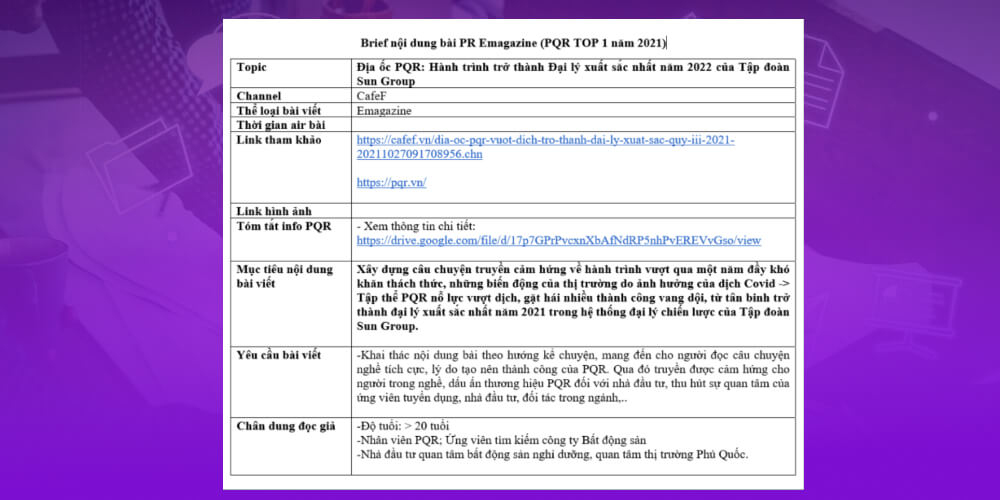
In marketing, the SEO Content Brief is the most common and most practical type of content summary. To make sure the writer has enough information to produce a quality article, a sample SEO Content Brief needs these core components:
An SEO-optimized content brief is the foundation that helps writers, editors and even AI produce focused content that meets search and conversion goals. Here is the standard 5-step process for building an effective brief:
This stage focuses on researching your keyword set to pick out the main keywords and a secondary keyword set with good Search Volume. At the same time, define your reader profile, including interests, age, needs and the problems they face, so you understand their pain points and expectations and can tailor the content to them.
Example: When making a brief for the keyword "Full-scope SEO services", the target audience is CEOs or managers.

Each article needs a specific strategic goal, such as attracting traffic, pushing a hard keyword to the top, or raising brand awareness. A clear goal lets you direct the writer to focus on the core factors that deliver the business result you want.
Example: For an article about "SEO pricing", the goal is to convert potential customers. So the brief asks the writer to stress cost transparency and the direct benefits the business gets.
A detailed outline organizes ideas and messages logically. Define each part clearly, from the introduction and the main arguments to the conclusion, and make sure every piece serves the article's overall goal. To optimize for readers and search engines, keep the structure coherent, use suitable Heading tags, break text into short paragraphs and keep the parts closely connected.
Example: For the topic "Full-scope SEO services", the outline needs a clear hierarchy:

In this step, build in the technical standards that improve visibility in search engines. Specify where to place the keyword in key spots such as the title, meta tags and URL, and spread it at a natural density through the text.
Also require Alt text optimization for images, a system of Internal Links to guide users, and External Links to reputable sources to increase the content's credibility.
Before publishing, check carefully for spelling and grammar errors and cross-check against the SEO standards you set. The article has to meet the technical requirements and also deliver real value to the reader. Finally, check user experience factors such as page load speed and mobile compatibility to improve ranking performance.

To see how the steps above are applied, take a look at the sample SEO Content Brief below for the "SEO-friendly website design" service.
* Target audience: Individuals, shop owners and new businesses that want to build a professional online presence through a website.
* Main keyword: SEO-friendly website design
* Article length: Under 2,000 words
* Article outline:
* Call To Action: Contact us today to get a professional website and an offer that streamlines your operations.
* Internal links: Links to the home page, the website management service page and the Hosting/Domain service page.
* SEO techniques: Meta tag of 120-160 characters containing the keyword "SEO-friendly website design".
* Brand style: Creative, trustworthy and professional.
* Measurement goals: Organic traffic, keyword rankings, click-through rate (CTR), SERP impressions.
Here are the common mistakes to avoid so your SEO Content Brief helps content perform well after publishing:

In today's digital age, artificial intelligence (AI) makes the briefing process faster and richer in data. AI tools not only help analyze keywords but also suggest creative content structures, saving content teams a significant amount of time.
Sample prompt for creating an SEO Content Brief with AI
Prompt: You are an SEO content expert. Create an SEO Content Brief for an article with the main keyword "Full-service marketing" based on the requirements below:
A well-built SEO Content Brief is the "bridge" between the power of AI and the reader's experience. It saves the business resources and makes sure the article holds value and ranks well after publishing. We hope this article gives you a solid grasp of the process for building an effective SEO Content Brief, so you can create real differentiation and lead the search rankings.

CEO & Founder · The MONA
Founder of The MONA, who built a services company of 200+ staff with 14,000+ projects delivered. Khánh Hùng shares how he thinks about building systems that run themselves, automating a business, and the real lessons from delivering projects at MONA.
 1,6K




Professional website
design services
Own a website with a beautiful, 100% exclusive design and a lifetime warranty, with the ability
to expand features flexibly as your business grows, starting today!






 MONA will never sell your information or send you spam


 MONA will never sell your information or send you spam
