
 MONA OS 2.0


 Tự động hoá doanh nghiệp
 Cẩm nang SEO
 Digital Marketing
 Kinh nghiệm thiết kế website
 Hạ Tầng Server
 Giáo dục



 VI
 EN




















Message us on
Zalo Official


 ProductsNew

 ProductsProducts
 Mới ra mắtKHA AI 2027App tự edit video, tự đăng mọi mạng xã hội, 2 phút mỗi ngày










 Website designLooks good and wins customers over.
SEO servicesBrings in customers searching for exactly what you sell.
 Tư vấn digital marketingKéo khách từ nhiều kênh, đo bằng số thật.
Corporate video productionVideos introducing your company, factory and team.
 NewAI video productionCompany story films made with AI.
 Custom software developmentCRM, ERP and HRM built for your business.
 Viết AI Agent theo yêu cầuĐặt riêng một trợ lý AI cho đúng việc của mình.
 Tư vấn chuyển đổi AIĐưa AI vào vận hành của cả công ty.
NewMONA LMSManagement for centers and schools.
MONA SkillHubInternal training for company staff.
 NHTQ systemEnd-to-end China–Vietnam shipping operations.
MONA JMSManagement for gold, diamond and pawn shops.
 MONA E-LearningA website with every feature you need to sell courses.
 How to sell online courses (course)More than 30 free lessons on selling courses on autopilot.
 MONA Cloudmonacloud.vnServers to get your apps and websites running.
 MONA Basemonabase.vnPostgres database, sign-in and file storage.
 MONA Mailmonamail.vnSend OTP, order and invoice emails from your software.
 MONA Paymonapay.vnAccept bank transfers via VietQR and notify your software when the money arrives.
 MONA eInvoiceComing soonIssue e-invoices that meet tax standards.
Gấu CườiTrả lời khách 24/7 trên web, Fanpage, Zalo và thu lead cho sale.
 Gấu TeleSalesGọi điện tư vấn, chăm khách như tổng đài viên thật.
Dê CườiTư vấn và chốt đơn cho shop ngay trong khung chat.
Gấu WebmasterNhắn nhóm Zalo là website được sửa xong.
 Gấu Pháp ChếSoạn hợp đồng, rà điều khoản trong vài phút.
 Gấu Báo GiáLên báo giá đúng mẫu và gửi khách ngay.
 AI chăm sóc khách hàngTheo dõi và giữ chân khách hàng cũ.
 Gấu Tuyển DụngLọc hồ sơ, hẹn lịch, phỏng vấn ứng viên.
 Mới ra mắt
KHA AI 2027
Xây kênh chuyên gia 2 phút mỗi ngày
Quay bằng điện thoại, AI tự edit video, tự đăng lên 16 nền tảng và tự trả lời bình luận, tin nhắn.
310.136lượt xem trên kênh CEO MONA sau 17 ngày
 Anh Khánh HùngCEO MONA đang dùng mỗi ngày
Xem app làm được gì
 AI
Gấu Cười MONA ĐANG TỰ XÀITrả lời khách 24/7 trên website, Zalo OA, Messenger và thu lead về cho sale.
Dê CườiChốt đơn bán lẻ và sàn: Shopee, TikTok Shop, web. Chăm cả khách sỉ, đại lý.
Gấu WebmasterCập nhật nội dung, tối ưu SEO website mỗi ngày.
Gấu TeleSalesGọi điện tư vấn, chăm khách như tổng đài viên thật.
Gấu Tuyển DụngLọc hồ sơ, hẹn lịch, phỏng vấn ứng viên tự động.
AI chăm sóc khách hàngGiữ khách cũ, cứu lead đã rớt cho phòng kinh doanh.
Gấu Pháp ChếSoạn hợp đồng, rà điều khoản trong vài phút.
Gấu Báo GiáLên báo giá đúng mẫu, gửi khách ngay khi có yêu cầu.
 Chuyển đổi AI toàn phầnGiải pháp tổng cho doanh nghiệp, 3 lớp triển khai.
 Viết AI Agent theo yêu cầuĐặt riêng một con AI gánh đúng nghiệp vụ của bạn.
 Custom softwareCRM, ERP and HRM with built-in AI automation.
 SEO & AEO thời đại AIĐược Google lẫn AI trích dẫn, không chỉ xếp hạng.
 Kiến thức AI cho doanh nghiệpBài phân tích, hướng dẫn ứng dụng AI vào vận hành.
 Free AI courses
 AI tools at work
App mới · KHA AI 2027
Xây kênh 2 phút mỗi ngày
AI tự edit video, tự đăng mọi mạng xã hội
Free consultation, 8am–10pm every day

18 March, 2023

Google's algorithms are a complex system of rules and processes Google uses to analyze, assess and rank billions of web pages. Thanks to them, search results are sorted and shown quickly and match what users need.
Understanding how Google's algorithms work not only helps you “decode” why a site appears at the top of Google, it is also the key to improving your search rankings and reaching the right target customers. Let's MONA Media look at it in more detail in the article below.
The Google algorithm is the system of rules and processes Google uses to find and rank content on the internet based on a user's query. It is the core of how Google shows the most relevant results, and is also called the Google core algorithm, which includes other smaller Google algorithms.
Google updates its search algorithm almost every day, but most changes are small and hard to notice. A few times a year, Google releases major updates called core updates, which usually affect rankings clearly and are officially announced.
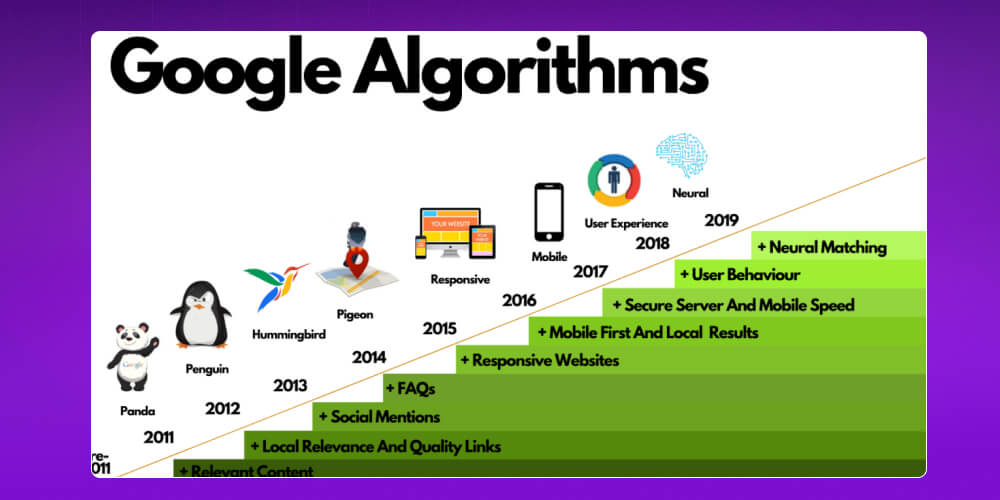
Each update aims to improve search quality and address the following issues:
I know a lot of you in SEO tense up when you hear “Google algorithm”, afraid of updates and of dropping from the top without knowing why. So in this video I'll sit down and walk you through each Google algorithm in the simplest way, so you know what Google dislikes and what to do right. Watch it now.
Khi SEO, it is important to know Google's algorithms in order to optimize a site and improve its rankings. Because Google keeps updating its algorithms to improve user experience, SEOs need to understand them so they can adjust their strategy effectively.
Launch date: First released on February 24, 2011
Update frequency: Updated monthly to keep improving search result quality.
Purpose of the Google Panda algorithm:
Improve user experience.
Boost the rankings of sites with high-quality content.
Lower the rankings of, or penalize, sites with low-quality, spammy content that adds no value.

Specifically, the types of content Google Panda penalizes include:
Thin content: Lacking information, unclear and of no value.
Plagiarism or duplicate content: Copying content from other sources or repeating content within the same site.
Low-quality content: Wrong information, lots of spelling mistakes, no depth.
Content farming: Mass-producing content that has no real value for users.
Keyword stuffing: Using too many keywords unnaturally, hurting the reading experience.
High ad ratio: Ads take up most of the page, with little or no useful main content.
Spam comments or low-quality content created by users.
Pages rated low by users or blocked directly in search results.
How do you avoid a Panda penalty?
Update and review content regularly to keep quality up.
Remove all duplicate or plagiarized content.
Avoid keyword stuffing, and use keyword density keywords naturally and in context.
Focus on in-depth, quality content that gives readers real value.
Improve user experience: content that is easy to read and understand, with accurate and trustworthy information.
Launch date: was first introduced on October 26, 2015.
Main goal of the algorithm:
As part of Google's ranking system, RankBrain uses machine learning to better understand user search intent.
It helps return the most relevant and accurate results for search queries, especially new keywords or ones never seen before.

Sites at risk from RankBrain
Pages whose content is unrelated to the query or does not meet what the user needs.
Sites with low-quality content, little credibility or no real value.
Sites with poor user experience, such as slow loading, hard-to-use design or no mobile compatibility.
How do you keep good rankings with Google RankBrain?
For academic or specialist keywords, produce in-depth content with reliable sources and high accuracy.
For keywords tied to current events such as natural disasters or epidemics, information must be updated quickly and verified clearly.
Build in-depth content on a given topic to earn natural authority and raise your site's credibility.
Use a range of related keywords instead of repeating a single one, which makes content more natural and easier to follow.
Launch date: was officially launched on April 24, 2012.
Update frequency: Updated in real time, reflecting a site's link quality continuously and accurately.
Goal of the algorithm
Focuses on assessing backlink quality and dealing with deliberate link manipulation to raise rankings.
Lowers the rankings of sites that use backlink spam or build unnatural links.

Behaviors that can get a site penalized by Google Penguin include:
Taking part in link schemes meant to deliberately raise rankings.
Creating or buying backlinks from disreputable, low-quality sources.
Using tools to create backlinks in bulk or unnaturally.
Excessive or illogical link exchanges between websites.
Repeating the same keyword many times in anchor text or using anchor text that does not fit the context.
Linking to unrelated pages or pages whose content does not match the description.
How do you avoid a Google Penguin penalty?
Monitor your backlink profile regularly, at least once a week, to catch unusual links.
Remove or disavow toxic backlinks that could hurt your site's ranking.
Use the Google Disavow Links to ask Google to ignore unwanted links, especially backlinks that competitors may have sent to damage your site's reputation.
Launch date: Mobile Friendly was introduced by Google on April 21, 2015.
Update frequency: has been updated continuously over the years to match the growing use of mobile devices.
Goal of the algorithm
Assesses how a website displays and performs on mobile devices.
A mobile-friendly site has a big advantage in search rankings.
This is one of the important factors Google uses to rank sites in search

Criteria Mobile Friendly emphasizes
A layout that displays well on small screens, with no need to zoom or scroll sideways.
Fast page loading, suited to mobile connections.
Buttons and links that are easy to tap and not awkward to use.
Content displays fully, with no font errors.
How to check mobile friendliness
Manual check: Visit the site on a phone or tablet to experience it like a regular user.
Use a tool: Google PageSpeed Insights is a popular option for analyzing a site's performance and mobile optimization.
Launch date: was announced on July 24, 2014.
Update dates: Google continued to update and adjust it on December 22, 2014
Goal of the algorithm
To give users more accurate, relevant search results based on location and related factors.
Helps improve the local search experience, for example “coffee shop near me” or “reliable car repair center”.

Google Pigeon makes it easier for local businesses to appear in search results and on Google Maps. The three main factors affecting local rankings are:
Relevance: SEO-optimized website contentthat reflects what the user is searching for.
Distance: The algorithm considers the distance from the user's location to business locations.
Prominence: Businesses rank higher if they are well known, have many positive reviews and are active across online networks.
When a user runs a search, the keyword is analyzed and matched against relevant databases. Pigeon then evaluates how well each site fits. Each time a page meets the criteria well, it earns a Pigeon Rank score, which directly affects where it appears.
Pigeon also links local search results more closely with Google's overall ranking system. This gives small and local businesses a better chance to compete by clearly and professionally optimizing their website and business profile.
The range of results shown was also adjusted to focus on locations closest to the user. Google used to show 7 results on the map, but since Pigeon this has dropped to 3, making competition for a spot fiercer than ever.
Sites at risk of negative effects
Sites with poor-quality content or content that does not reflect their line of business.
Mistakes in setting up the Google My Business profile.
Missing clear contact information or absent from local directories.
How to optimize your site for Google Pigeon
Make sure your name, address and phone number (NAP) on the website are clear, accurate and consistent across all platforms.
Fully optimize your Google My Business profile with detail.
Build your online reputation through customer reviews and feedback.
Keep your business information updated on local platforms and reputable directories.
Launch date: was introduced on August 30, 2013.
Update dates: updated in October 2019
Goal of the algorithm
Hummingbird was designed to better understand what users really intend when they search, especially long keywords and questions.
Instead of relying on single keywords, Google can now analyze meaning, context, location and time of search to give more relevant and accurate results.

How to optimize your site for Google Hummingbird
Focus on users: Content should target the right audience, answer their questions and meet their real needs.
Use varied keywords: Don't just use the main keyword, include synonyms, related terms and semantic phrases to enrich the content.
Optimize user experience: An easy-to-use interface, optimized images, fast loading and clear, readable content help improve rankings.
Use keywords naturally: Avoid excessive keyword spam, and use keywords the way people actually speak or search.
Clear site structure: Build an SEO-friendly site that is easy to navigate and helps users find information quickly and conveniently.
Build quality backlinks: Build natural links from reputable sources to raise your site's credibility.
Launch date: August 2012
Update dates: October 2014.
Goal of the algorithm: To lower the rankings of sites that are repeatedly reported for copyright infringement, such as stealing articles, films, music or other intellectual property.
Sites affected
Sites that Google confirms have infringing content through reports in Google Search Console.
Mostly sites that share films, music, books or documents without the owner's permission.
What to do if Google Pirate affects you
If you are the legitimate owner and find your content used without permission, submit a takedown request under the DMCA (Digital Millennium Copyright Act) process to ask Google to remove the infringing results from search.
Launch date: was officially rolled out on March 8, 2017.
Goal of the algorithm: Google Fred targets black hat SEO tricks such as tips and tactics used to “fool” the search system. It removes low-quality sites, especially those that focus on profiting from ads or selling links without giving users real value.

Sites vulnerable to Fred
Sites with too many ads, even confusing or annoying ones.
Pages with many unnecessary outbound links that dilute the value of the main content.
Low-quality, shallow content, just enough to “fool” the search engine.
Poor mobile design and experience, not user-friendly.
Pages over-optimized for SEO that ignore the reader's experience and benefit.
How to keep your site safe from Google Fred
Use ads sensibly, without overwhelming the main content or annoying viewers.
Focus on quality content that gives readers real value.
Limit unnecessary outbound links.
Make sure the site works well on mobile and has a clear, easy-to-use structure.
Launch date: was introduced in March 2013.
Goal of the algorithm: To stop the abuse of social platforms like Facebook, Twitter and Instagram for spamming links to push a site up in SEO.

Behaviors Google Zebra penalizes:
Sharing one link too many times on social media just to raise rankings.
Posting links everywhere in comments, especially on unrelated posts.
Spamming links in off-topic groups, forums or communities.
Posting masses of links on a personal page with no useful content alongside.
Using social media unnaturally as a tool to “push” SEO rankings.
Impersonating other people's accounts or creating fake accounts to boost engagement.
Using non-transparent tricks to grow followers.
Spamming links on Google+ or creating many unclear, inauthentic Google+ accounts.
How do you avoid a Google Zebra penalty?
Build a reputable Google+ account with clear, trustworthy information.
Use secondary accounts sensibly, only for real, valuable interaction.
Share links in suitable, on-topic groups and communities.
Plan your article sharing clearly and avoid random, uncontrolled posting.
Name your Google+ account according to the rules, and don't use a brand or service name, to avoid a heavy penalty.
Avoid joining groups that trade likes, shares or dishonest follows.
Launch date: 1/9/2016.
Goal of the algorithm: To improve local search accuracy by using the user's actual location to show the most relevant results. Businesses close to where the user is searching have a better chance of appearing higher in results.

Google Possum's impact on local SEO
A business in a suburb of a city can now also appear in that city's search results, as long as it fits the query.
Businesses with a complete Google My Business profile and clear NAP (name, address, phone number) information are favored in results.
How to optimize your site for Google Possum
Provide a clear business address: This builds trust with both users and Google. A specific, accurate address helps a lot in improving local rankings.
Use keywords naturally and where they fit: Work keywords tied to your location and line of business into your content in a way that reads well, so Google can easily understand what your business does and rate it correctly.
Every time Google updates its search algorithm, your website can be affected. Spotting the signs early and knowing how to respond is what keeps your rankings steady. Below are the most common signs that a site has been hit, and what to do about it.
After each Google algorithm update, you need to track and assess the impact on your website. Two things to watch closely are organic traffic and keyword rankings. Metrics such as impression also show how well your pages are performing in search results.
You can use two SEO tools free and very effective tools, Google Analytics and Google Search Console, to check and analyze your data. Google also provides charts that make it easy to see changes in traffic that line up with algorithm updates.

When you track keyword rankings, you may run into different situations:
If A small drop in rankings, for example from position 2 to position 4, does not call for immediate action. Small shifts are often normal, and a rushed reaction can backfire.
On the other hand, if rankings fall sharply, for example from position 4 all the way to 29, that is a warning sign and you need to look more closely. Start with questions like these:
If your website has lost a lot of ground since a Google algorithm update, you can take these steps to improve the situation:

Recovery does not happen overnight, but if you go about it the right way and stay patient, your rankings can come back and may even end up better than before.
1. How many times a year does Google update its algorithm?
By most estimates, Google makes around 500 to 600 algorithm updates a year. Most of these changes are small and do not have a big effect on a website's rankings.
2. Is Google's algorithm complicated?
Google's ranking system is very complex and is updated all the time. Some ranking factors have been announced publicly, but how the system really works has never been disclosed. Experts estimate there may be more than 200 different ranking factors, which are adjusted continuously to deliver the best possible search results.
3. Which algorithms does Google use to rank websites?
One of the first and best-known is PageRank, developed by Larry Page and Sergey Brin. It ranks web pages by the number and quality of the links pointing to them. PageRank matters less than it used to, but it was the foundation that helped Google become the dominant search engine.
That wraps up the most common Google algorithms that anyone working in SEO should know. We hope this gives you a clearer and more accurate picture of how Google evaluates and ranks websites, so you can build a solid SEO plan, grow your site and reach lasting high rankings in search.
If you want to save time and effort and climb to the top of Google faster, let MONA help you with SEO services to reach lasting top rankings on Google.
Our experienced team will plan and deliver SEO strategy full-scope SEO, tailored to your business goals and your specific situation, aimed at steady growth online. Contact MONA for a consultation and a detailed full-scope SEO quote, as quickly as possible.


CEO & Founder · The MONA
Founder of The MONA, who built a services company of 200+ staff with 14,000+ projects delivered. Khánh Hùng shares how he thinks about building systems that run themselves, automating a business, and the real lessons from delivering projects at MONA.
 1,5K




Professional website
design services
Own a website with a beautiful, 100% exclusive design and a lifetime warranty, with the ability
to expand features flexibly as your business grows, starting today!






 MONA will never sell your information or send you spam


 MONA will never sell your information or send you spam
