
 MONA OS 2.0
 Partner with MONA


 Tự động hoá doanh nghiệp
 Cẩm nang SEO
 Digital Marketing
 Kinh nghiệm thiết kế website
 Hạ Tầng Server
 Giáo dục


 VI
 EN















Message us on
Zalo Official


 ProductsNew

 ProductsProducts
 Mới ra mắtKHA AI 2027App tự edit video, tự đăng mọi mạng xã hội, 2 phút mỗi ngày










 Website designLooks good and wins customers over.
SEO servicesBrings in customers searching for exactly what you sell.
 Tư vấn digital marketingKéo khách từ nhiều kênh, đo bằng số thật.
Corporate video productionVideos introducing your company, factory and team.
 NewAI video productionCompany story films made with AI.
 Custom software developmentCRM, ERP and HRM built for your business.
 Viết AI Agent theo yêu cầuĐặt riêng một trợ lý AI cho đúng việc của mình.
 Tư vấn chuyển đổi AIĐưa AI vào vận hành của cả công ty.
NewMONA LMSManagement for centers and schools.
MONA SkillHubInternal training for company staff.
 NHTQ systemEnd-to-end China–Vietnam shipping operations.
MONA JMSManagement for gold, diamond and pawn shops.
 MONA E-LearningA website with every feature you need to sell courses.
 How to sell online courses (course)More than 30 free lessons on selling courses on autopilot.
 MONA Cloudmonacloud.vnServers to get your apps and websites running.
 MONA Basemonabase.vnPostgres database, sign-in and file storage.
 MONA Mailmonamail.vnSend OTP, order and invoice emails from your software.
 MONA Paymonapay.vnAccept bank transfers via VietQR and notify your software when the money arrives.
 MONA eInvoiceComing soonIssue e-invoices that meet tax standards.
Gấu CườiTrả lời khách 24/7 trên web, Fanpage, Zalo và thu lead cho sale.
 Gấu TeleSalesGọi điện tư vấn, chăm khách như tổng đài viên thật.
Dê CườiTư vấn và chốt đơn cho shop ngay trong khung chat.
Gấu WebmasterNhắn nhóm Zalo là website được sửa xong.
 Gấu Pháp ChếSoạn hợp đồng, rà điều khoản trong vài phút.
 Gấu Báo GiáLên báo giá đúng mẫu và gửi khách ngay.
 AI chăm sóc khách hàngTheo dõi và giữ chân khách hàng cũ.
 Gấu Tuyển DụngLọc hồ sơ, hẹn lịch, phỏng vấn ứng viên.
 Mới ra mắt
KHA AI 2027
Xây kênh chuyên gia 2 phút mỗi ngày
Quay bằng điện thoại, AI tự edit video, tự đăng lên 16 nền tảng và tự trả lời bình luận, tin nhắn.
890.158lượt xem trên kênh CEO MONA sau 36 ngày
 Anh Khánh HùngCEO MONA đang dùng mỗi ngày
Xem app làm được gì
 AI
Gấu Cười MONA ĐANG TỰ XÀITrả lời khách 24/7 trên website, Zalo OA, Messenger và thu lead về cho sale.
Dê CườiChốt đơn bán lẻ và sàn: Shopee, TikTok Shop, web. Chăm cả khách sỉ, đại lý.
Gấu WebmasterCập nhật nội dung, tối ưu SEO website mỗi ngày.
Gấu TeleSalesGọi điện tư vấn, chăm khách như tổng đài viên thật.
Gấu Tuyển DụngLọc hồ sơ, hẹn lịch, phỏng vấn ứng viên tự động.
AI chăm sóc khách hàngGiữ khách cũ, cứu lead đã rớt cho phòng kinh doanh.
Gấu Pháp ChếSoạn hợp đồng, rà điều khoản trong vài phút.
Gấu Báo GiáLên báo giá đúng mẫu, gửi khách ngay khi có yêu cầu.
 Chuyển đổi AI toàn phầnGiải pháp tổng cho doanh nghiệp, 3 lớp triển khai.
 Viết AI Agent theo yêu cầuĐặt riêng một con AI gánh đúng nghiệp vụ của bạn.
 Custom softwareCRM, ERP and HRM with built-in AI automation.
 SEO & AEO thời đại AIĐược Google lẫn AI trích dẫn, không chỉ xếp hạng.
 Kiến thức AI cho doanh nghiệpBài phân tích, hướng dẫn ứng dụng AI vào vận hành.
 Free AI courses
 AI tools at work
App mới · KHA AI 2027
Xây kênh 2 phút mỗi ngày
AI tự edit video, tự đăng mọi mạng xã hội
Free consultation, 8am–10pm every day

14 June, 2026

A 2026 SEO budget should be split into three parts instead of putting everything in one place as before: about 55% for the website foundation and traditional SEO, 25% cho AEO (optimizing so content is picked as the direct answer), 20% cho GEO (optimizing so generative AI tools cite your source correctly). This ratio is the starting point we use for mid-market businesses in Vietnam, and it shifts by industry. A wrong split burns money. This article explains why we split it this way, what each part of the money goes into, and the three items you are most likely to waste money on without noticing.
First, one thing needs to be clear, because many places use these three abbreviations interchangeably. SEO is optimizing so your pages rank high on Google's results page. AEO (Answer Engine Optimization) is optimizing so content is picked as the direct answer: the featured snippet, the “People also ask” box, voice assistants and the AI summary at the top of the page. And GEO (Generative Engine Optimization) is optimizing so ChatGPT, Gemini, Perplexity and Claude name you and link back to you when users ask them.
GEO is not local SEO. Plenty of articles online get this wrong, including ones from service providers, so please note it down: optimizing Google Maps and your business profile is Local SEO, which belongs to traditional SEO, not GEO.
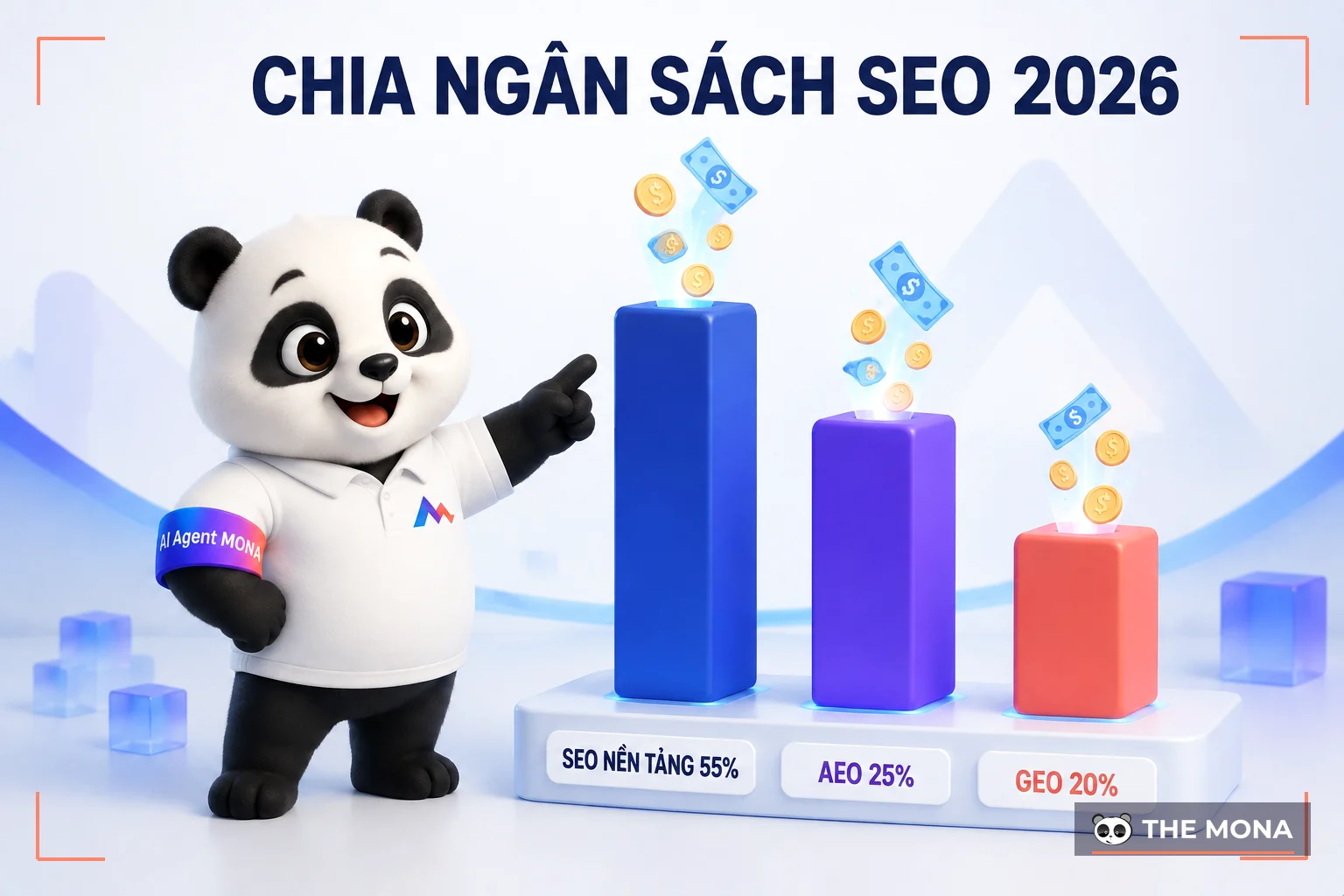
With the 55/25/20 ratio, money goes into three very different groups of work. The table below is how we split the tasks when planning for a business just getting started.
| Budget share | What the money goes into | How long until results | How to measure |
|---|---|---|---|
| Foundation + traditional SEO (55%) | Page load speed, URL structure, sitemap, content by topic cluster, Google Business profile, links | 3 to 6 months | Google Search Console: impressions, average position, number of indexed pages |
| AEO (25%) | Writing a direct answer at the start of each section, an FAQ block, FAQPage and HowTo schema, clear data tables | 4 to 10 weeks | Number of queries that show a featured snippet, display rate in the “People also ask” box |
| GEO (20%) | Content with figures and cited sources, brand entity declaration, consistent information everywhere AI can read | 6 to 12 weeks | Count how often the brand is named when asking ChatGPT, Gemini and Perplexity from a fixed question set |
The three numbers 55, 25 and 20 are not an even split for fun. They follow payback time: the foundation takes 3 to 6 months to move, AEO takes only 4 to 10 weeks, and GEO sits in between at 6 to 12 weeks. The slower part needs more money, because it feeds the other two.
The three parts don't replace each other. They stack: content written well for AEO is also easier for generative AI to cite, and to be cited the page still has to load fast and be properly indexed, which means you still do the foundation first.
The old split was very simple: almost all the money went into keywords, content and links, with one goal of reaching the Google top 10. That worked well for nearly ten years. It started to fall short when Google put the AI summary at the top of the results page.
There is one number worth a close look. The Pew Research Center (US) tracked real web browsing behavior and published in July 2025: when a results page has an AI summary, only 8% of searches led the user to click a link; when there is no AI summary, that figure is 15% (Pew Research Center source). Nearly half the clicks vanish, while your page stays in the same position.
Gartner forecasts that traditional search engine query volume will fall 25% by 2026 as users switch to asking chatbots and virtual assistants directly (Gartner press release, February 2024). A forecast is still a forecast, but these two numbers point the same way.
What happens next, anyone working in marketing has already seen. Rankings hold, sometimes even rise. Impressions keep growing. But website sessions go flat or drop, and calls and messages thin out. The monthly report still reads well, but the money doesn't come in.
We see this so often that it has become a default question when we take on a new account: pull up Search Console and compare the click-through rate of the last twelve months. If impressions go up while click-through rate goes down, it is almost certain customers are being blocked at the AI summary layer, and the content is not the problem. The two issues need very different fixes, and fixing the wrong one costs you another quarter.
Many of you hear “AI” and want to cut all the old SEO money to pour into the new thing. We advise against it. The reason is very practical: both AEO and GEO ride on SEO's infrastructure. OpenAI and Perplexity bots still have to load your pages, still have to read the HTML, and still skip pages that load slowly or block bots. Cutting the foundation cuts the entry path for the other two.
Within that 55%, the priority order we usually set is this. First is infrastructure: load speed, properly compressed images, a clear page hierarchy, a clean sitemap, no orphan pages. Next is content by topic cluster rather than isolated keywords. Last come links and the Google Business profile for each branch.
A multi-branch spa chain in Ho Chi Minh City once asked us to review their site. The website ran on an old platform, treatment photos were left as raw camera files several megabytes each, and a category page took more than six seconds to show everything on 4G. Their SEO team still turned out ten articles every month. After we fixed the images and caching, without writing a single new article, rankings for the service keyword group moved up because Google could crawl more pages in the same visit. Images went from 3 MB to under 200 KB, and full-content load time dropped from over 6 seconds to around 2 seconds. Not one more word written.
Don't cut this part. Here is a simple tip that few people use: open Search Console, go to Crawl stats, and check the server's average response time. Above 600 milliseconds, your infrastructure is eating its own crawl budget. This number isn't in any SEO report, but it decides how many of your pages get seen.
AEO is the cheapest part and pays back fastest, so we usually have clients do it before thinking about GEO. It needs no extra infrastructure. It needs a rewrite of how things are presented.
This part pays back fastest. The principle fits in one sentence: each section must finish answering its question within the first two to four sentences, and only then explain at length. It sounds simple, yet most Vietnamese content online does the opposite: three paragraphs of lead-in, and the real content starts in the fourth. A machine reading that has left by paragraph two.
Here is the task list we run for this 25% share, which you can hand straight to your content team:
FAQPage for that block, and declare HowTo for step-by-step guides.A standard AEO page at MONA has 4 to 6 FAQs, each answered in 2 to 4 sentences, and all figures sit in tables instead of being scattered through paragraphs. Fixing one key page takes about 40 minutes for someone who has done it before.
Measuring is simpler than you think. In Search Console, filter the question-type queries and compare average position before and after the fix. In parallel, each month retype the twenty questions customers often ask and note whether your page shows up in the direct answer. A Google Sheet is enough for that table, no need to buy any tool yet.
GEO is the newest part, and also the part where many people spend money blindly. Before you spend, you should know there is research measuring that it works. A team from Princeton, Georgia Tech and IIT Delhi published a set of optimization methods for generative engines at KDD 2024, measured on more than 10,000 real queries, and recorded a rise in source visibility inside AI answers of up to 40% when applied (GEO paper, arXiv 2311.09735).
What is interesting is which methods work. Keyword stuffing doesn't help. What lifts citation rates is adding source citations, adding quantitative figures, and adding statements from people with expertise. In other words, AI favors content that looks like it was written by someone who actually does the work.
So we don't pour the 20% GEO budget into tools, but into three jobs. One is adding sourced figures to the key pages that are still bare. Two is declaring the brand entity clearly: schema Organization, an about page with legal entity details, and keeping name, address and phone number identical everywhere AI can read. Three is building a fixed question set to measure every month.
You can only spend what you can measure. That question set has about 20 to 30 questions in three groups: industry questions, supplier comparison questions, and questions that name the brand directly. Each month, rerun them on ChatGPT, Gemini and Perplexity, and record whether you are named and which page is cited. After three months you will have a real trend line instead of a feeling.
We will say plainly what most service providers avoid saying: GEO has no standard measurement tool like Search Console, and AI answers have randomness, so the same question asked twice can come out differently. So don't sign any contract that guarantees GEO rankings. Whoever guarantees that is selling something they can't control.
Three places where the split often goes wrong
If you are splitting the budget yourself and aren't sure whether you are pouring money into something already broken, send us your website link. Our team will review three things from the table at the start of this article: server response time, the share of pages with a direct answer paragraph, and how often AI names you. Then we send back one page saying what to keep and what to cut. It's free, and you don't need to sign anything first.
The 55/25/20 ratio is a starting point. It is not a rigid formula. There are four situations where we adjust it from the very first session.
A website built less than six months ago: shift to 75/15/10. A page with no age, no links and incomplete indexing is too early for GEO. Put money into the foundation first, and open up the other two gradually from the second quarter.
Industries with many branches: spas, restaurants, clinics, training centers: keep 55/25/20, but within that 55%, set aside at least a third for the Google Business profile and location-based content. Customers in these industries search on their phones, nearby, and decide within minutes.
Industries that sell solutions to businesses: software, industrial equipment, consulting services: push it up to 45/25/30. Buyers in this group ask ChatGPT before they pick up the phone, and they ask very long, very specific questions. This is where GEO pays back fastest.
E-commerce with many SKUs: 60/30/10. AEO here sits entirely in the product page: a description with a spec table, schema Product with full price and stock status, and a Q&A block right under each SKU. Blog posts come later.
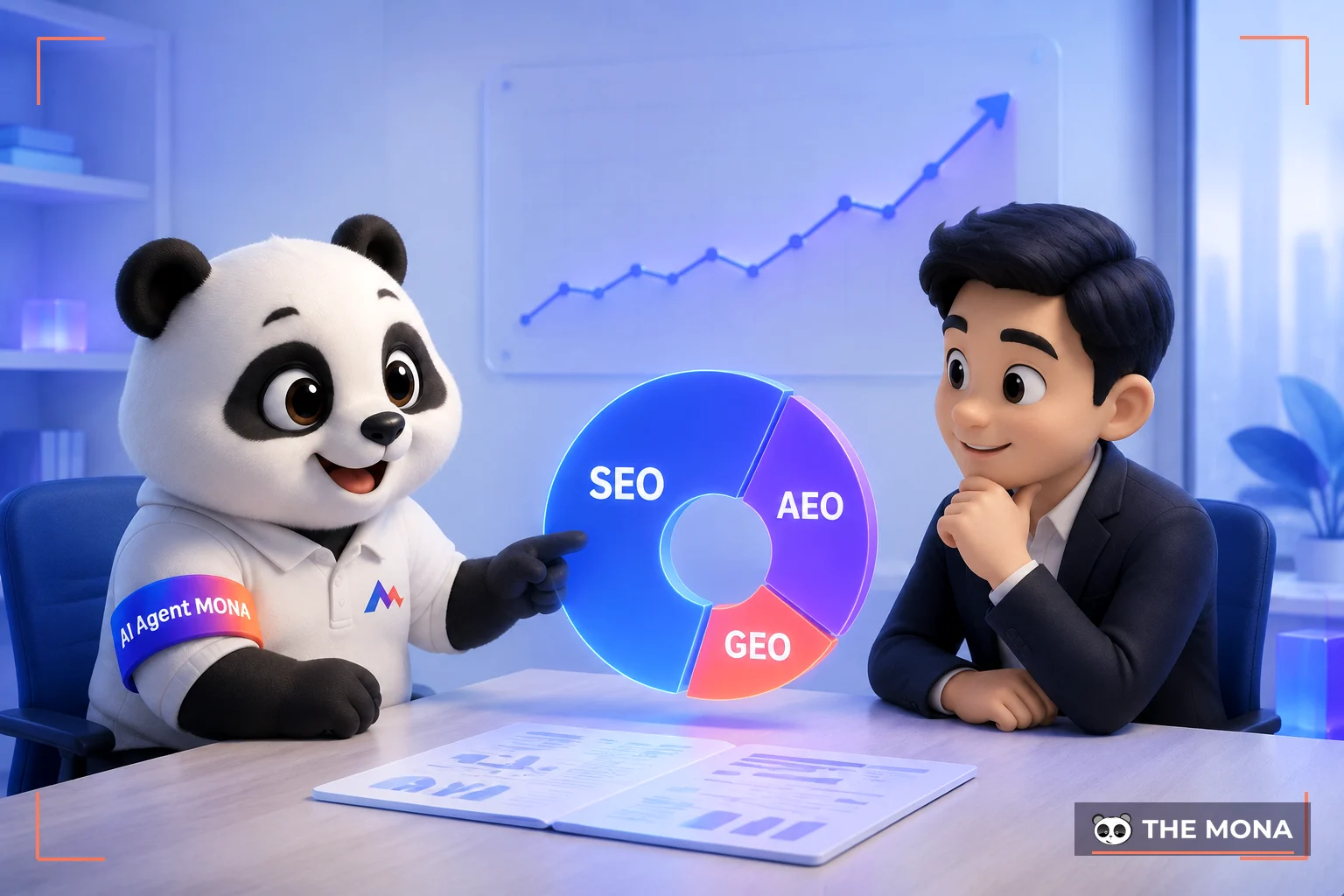
There is one more variable every table forgets: who you already have on your team. If you already have a strong content writer in-house, AEO costs almost nothing extra, just two weeks of retraining on how to present content. On the other hand, if you must outsource everything, that 25% is real money. A strong content writer in Ho Chi Minh City currently costs around 15 to 25 million VND a month, and fully outsourced content is usually priced per article. Splitting a budget without looking at the payroll is splitting on paper.
We wrote this part from having cleaned up for clients many times. The three items below together usually take a quarter to a third of the budget, and when you drop them, nobody notices anything missing.
First item: writing articles to hit a quantity target. The contract says 30 articles a month, the content team writes all 30, and more than twenty of them don't get a single query. We once filtered a website with more than 400 articles, and 310 of them got fewer than 5 impressions a month. The number of articles isn't the target. The number of topic clusters covered is.
Second item: buying links in bulk. Some places still sell cheap packs of 100 links, placed on pages nobody reads, on unrelated topics. Google ignored that kind of link long ago, and generative AI doesn't read them at all. Move that money into a small study with real data from your industry, which earns natural links and feeds the GEO part at the same time.
On link buying alone, we once dug into a contract of 12 million VND a month for 100 links, and on review, 87 of those links sat on pages that had not a single impression in Search Console over 6 months.
Third item: buying tools nobody opens. This one is delicate, because the tools are often proposed by the marketing team itself. Open the account management page of each tool and check when the last login was. If nobody has logged in for three months, cancel it and use that money to pay for a training session.
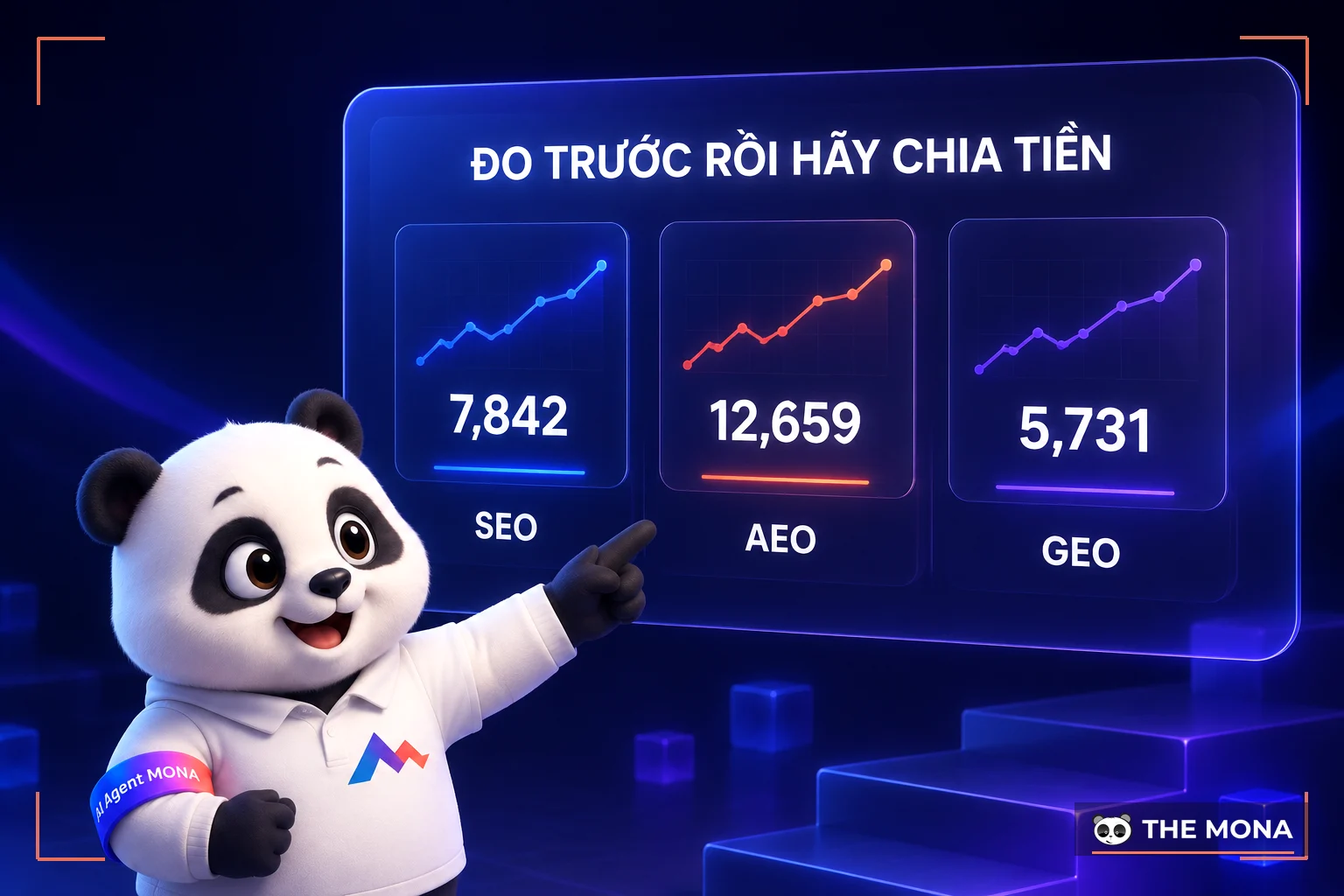
To cut these three items correctly, you need the measurement dashboard first. We usually build a single dashboard that pulls from three sources: Search Console for SEO, a manual sheet counting featured snippets for AEO, and a sheet running the fixed question set for GEO. Look at one dashboard each month and decide in fifteen minutes.
We don't sell “AI” as a separate product. MONA builds automation software written specifically for each business, and AI sits inside that software as one piece, so machines can read what only people used to be able to read: messages, reviews, photos and voice.
In content and search, MONA changed its own internal operations starting April 20, 2026. Content production, technical review and report compilation were handed to software, and the people who stayed handle direction and approval. Costs in the stages that moved fell by about 60%. We tell this story not to show off, but because it is why we dare advise you to cut quantity-chasing work: we cut it from ourselves first.
As for services, MONA has been working since 2016 and has gone through over 14,000 projects, with a returning-client rate of around 85%. The parts relevant to this article include full-scope SEO services, AEO service, and rebuilding the foundation when an old website can't carry the load, see also business website design. If you want to do it yourself first and decide later, read the GEO audit and the article on SEO costs when doing it yourself, and those two are enough to run your first quarter without hiring anyone.
There is one thing we won't take on: guaranteeing GEO rankings. The reason is explained above. If someone quotes you a price with a guarantee to “rank top on ChatGPT”, ask them directly which tool they measure with, and ask to see last month's measurement.
For service businesses in Vietnam, most cases we see fall in the range of 3% to 7% of revenue for all digital marketing, with SEO taking about a third of that. A new business without a brand usually has to accept a higher share in the first six months before bringing it down as organic traffic stabilizes.
No. Generative AI tools still go and fetch data from pages that are indexed and load fast. If you drop the foundation, bots can't get into your pages, and GEO loses its raw material to cite. This is why we still keep 55% for this group of work.
Measure with two things. First is the average position of question-type queries in Google Search Console, compared before and after you change how content is presented. Second is a manual sheet: each month, retype about 20 questions customers often ask and note whether your page appears in the direct answer.
AEO spends on how content is presented on your own page so machines can extract it. GEO spends on source credibility: figures with cited sources, consistent brand information and entity declaration. One article can serve both, but the two spends don't replace each other.
AEO usually starts to move in 4 to 10 weeks because it only needs a change in presentation. GEO needs 6 to 12 weeks for models to refresh their sources. The foundation and traditional SEO are the slowest at 3 to 6 months, but they are the part that lasts the longest.
If you only have time to do one thing next week, open Google Search Console and compare the click-through rate of the last twelve months. If impressions rise while click-through rate falls, that is a sign money is flowing into traditional SEO while customers are being held back at the AI summary layer. The next step is to move a quarter of your content budget straight into writing direct answer paragraphs for your key pages. This needs no extra people, no tools to buy, and can be done in 2 weeks. Start with your 10 strongest pages.
And if the numbers in Search Console feel heavy, or you have signed an SEO contract somewhere and don't know what the money is going into, just give us a call. The MONA team will sit with you and go through your current budget sheet, point out which item is feeding 310 articles nobody reads, which should move to direct answers, and how many monthly measurement questions GEO should start with. That session takes about 45 minutes, we sell nothing in it, and at the end you take home a written budget split you can use right away, whether or not you work with MONA.
Call 1900 636 648 to book a time, or leave your number on mona.media and we will call you back within a working day.

CEO & Founder · The MONA
Founder of The MONA, who built a services company of 60+ staff with 14,000+ projects delivered. Khánh Hùng shares how he thinks about building systems that run themselves, automating a business, and the real lessons from delivering projects at MONA.
 294




Professional website
design services
Own a website with a beautiful, 100% exclusive design and a lifetime warranty, with the ability
to expand features flexibly as your business grows, starting today!






 MONA will never sell your information or send you spam


 MONA will never sell your information or send you spam
