MONA OS 2.0
 Partner with MONA










































 Free AI courses
 AI tools at work

 Tự động hoá doanh nghiệp
 Cẩm nang SEO
 Digital Marketing
 Kinh nghiệm thiết kế website
 Hạ Tầng Server
 Giáo dục


 VI
 EN





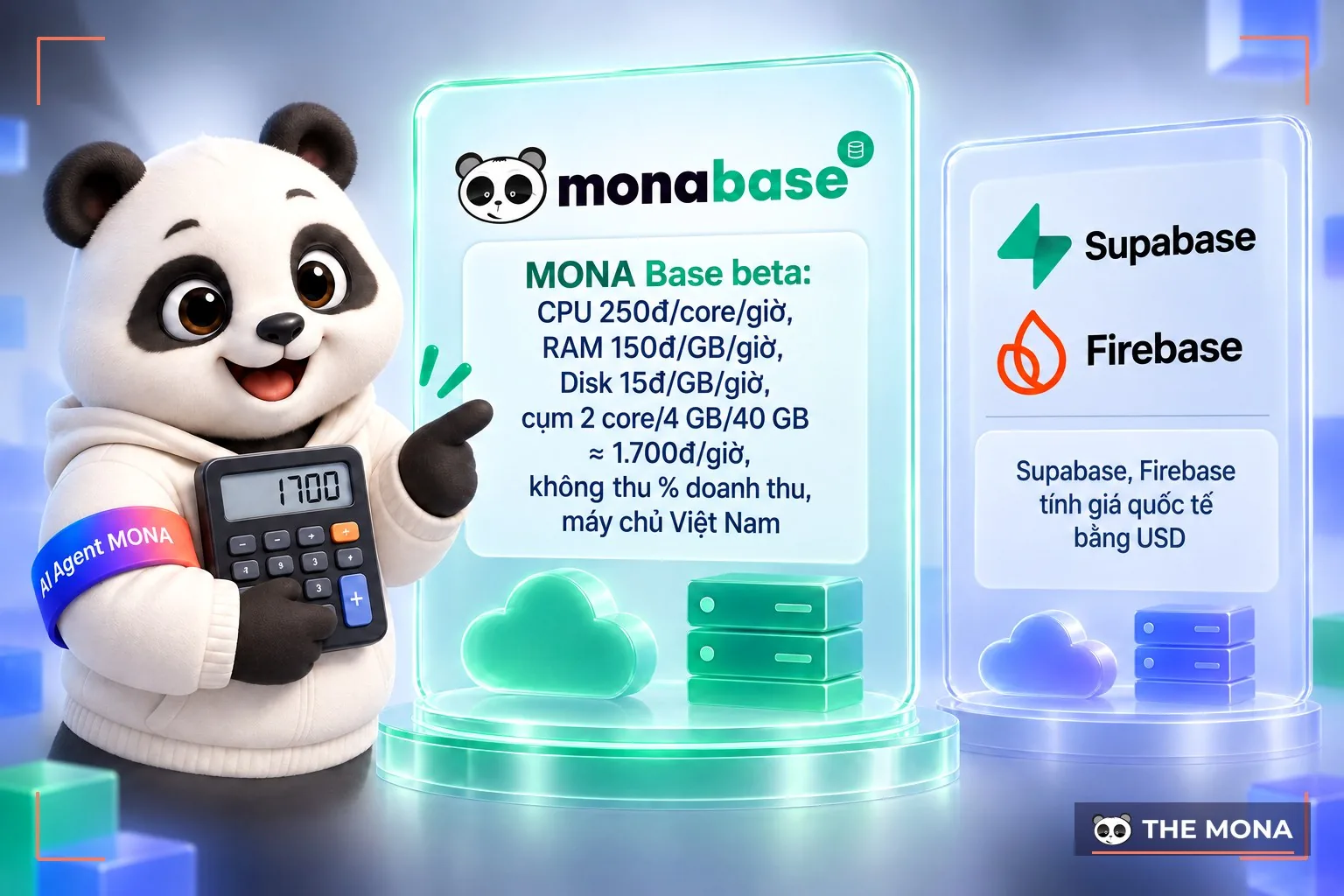
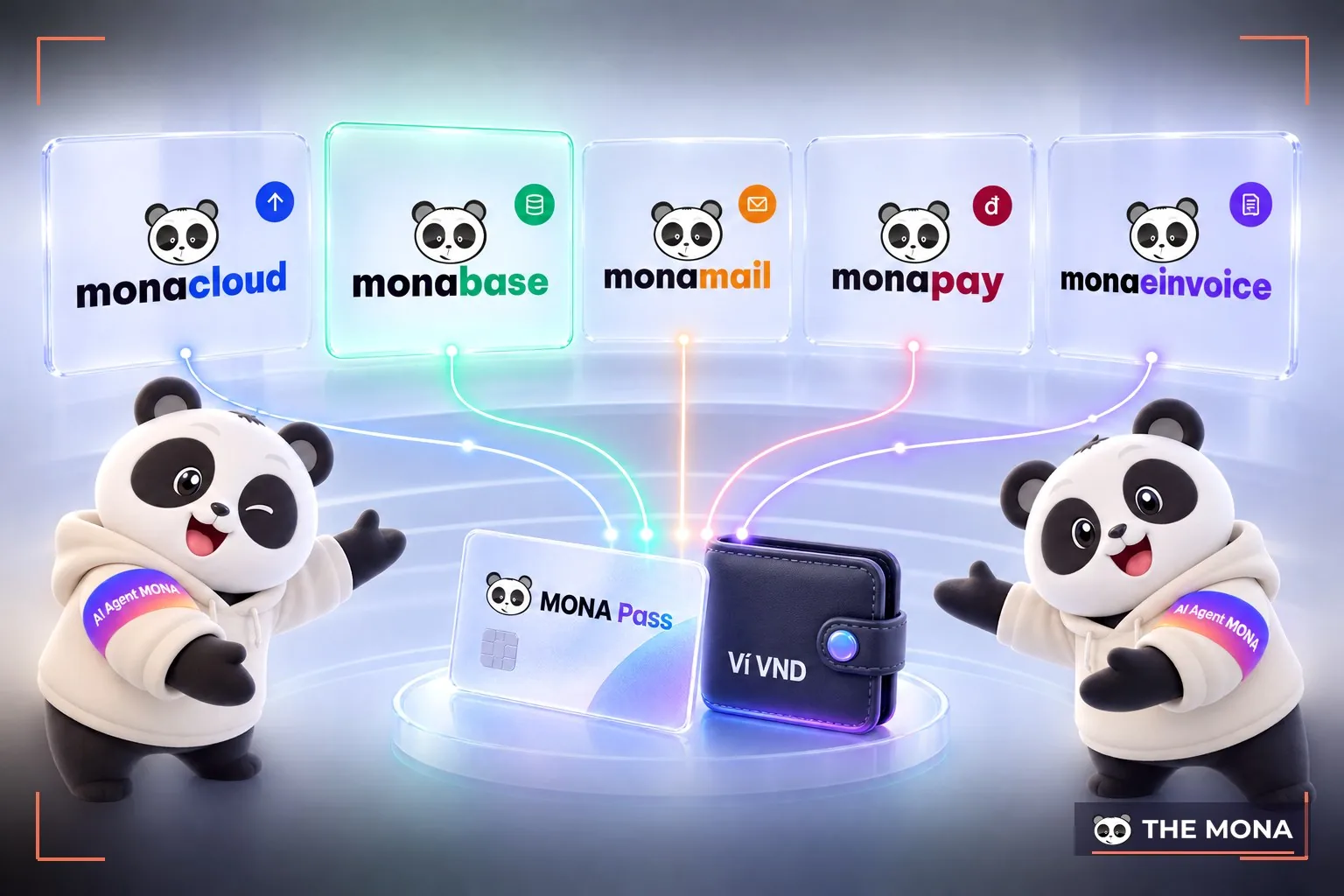
Clients who come to MONA in 2026 often bring a familiar problem: software already exists, but the data still sits on overseas servers, billing is in USD, and any month the exchange rate jumps, costs jump with it. After 14,000 projects, we see clearly that this trips up almost every dev team when they take a product into real operation. MONA Base is a Postgresservice, with login, file storage and realtime from The MONA Group. It uses the same calls as supabase-js, is hosted in Vietnam and is paid in VND. This product belongs to The MONA Group's MONA Cloud suite, sharing one MONA Pass account and one VND wallet.

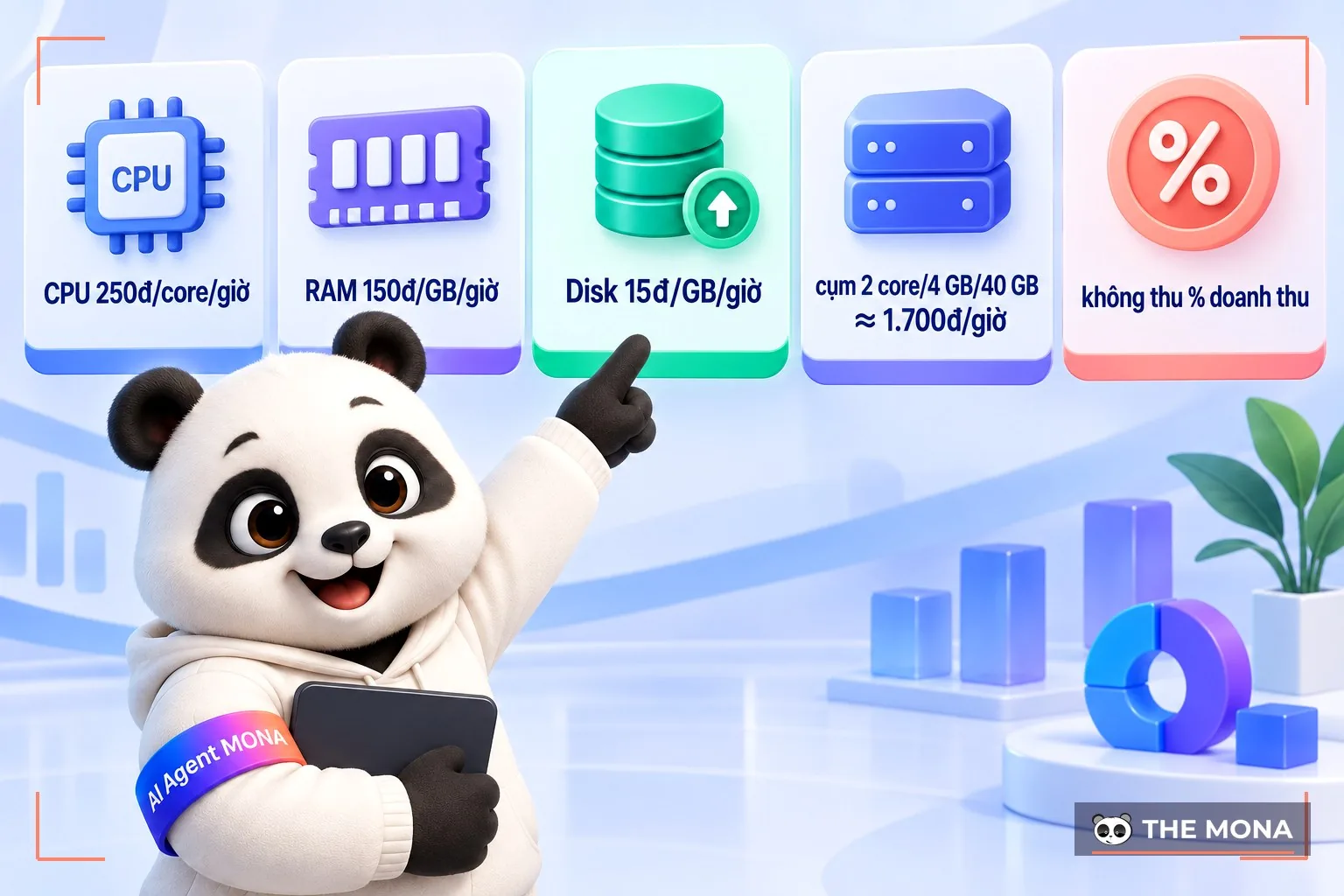
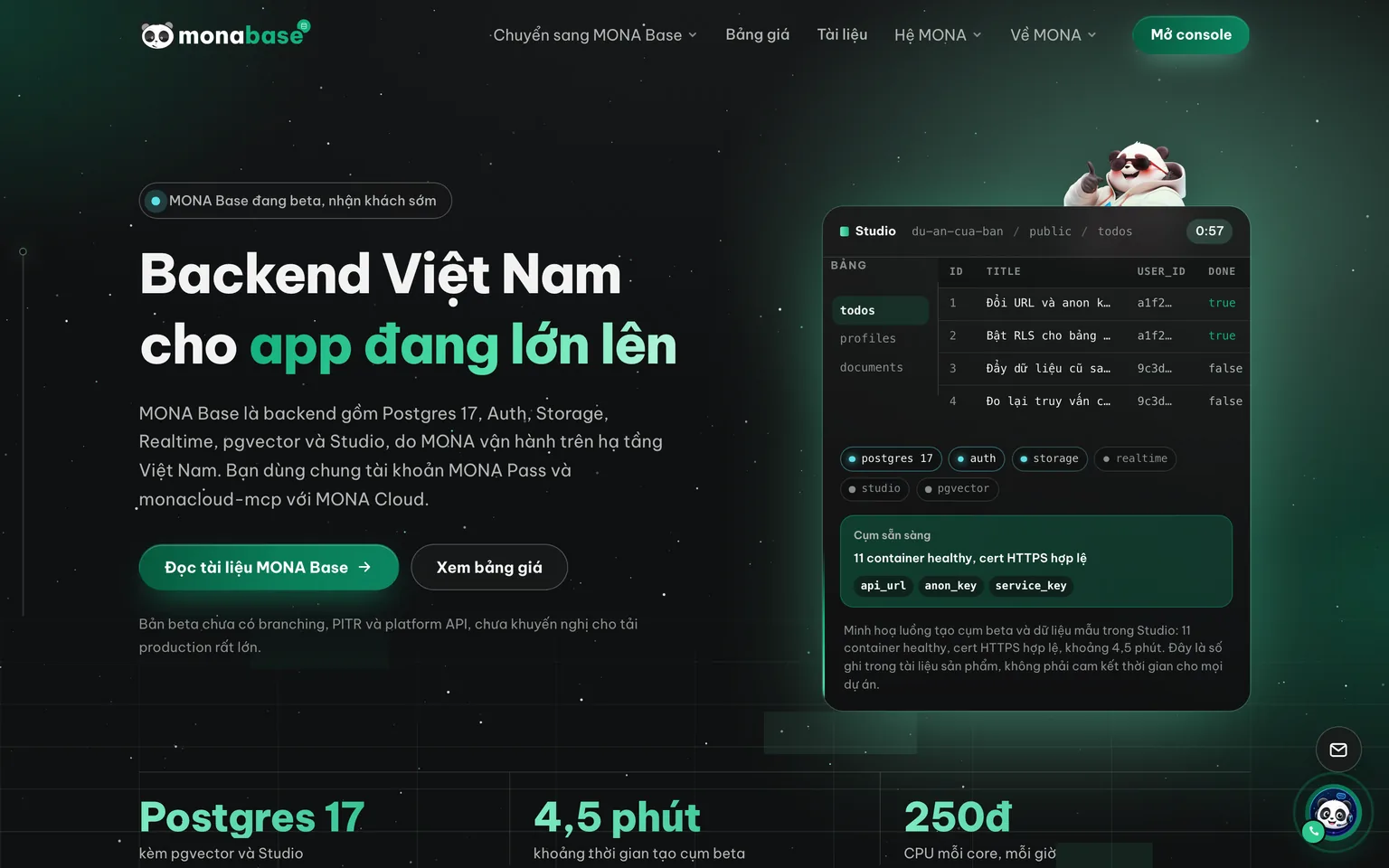
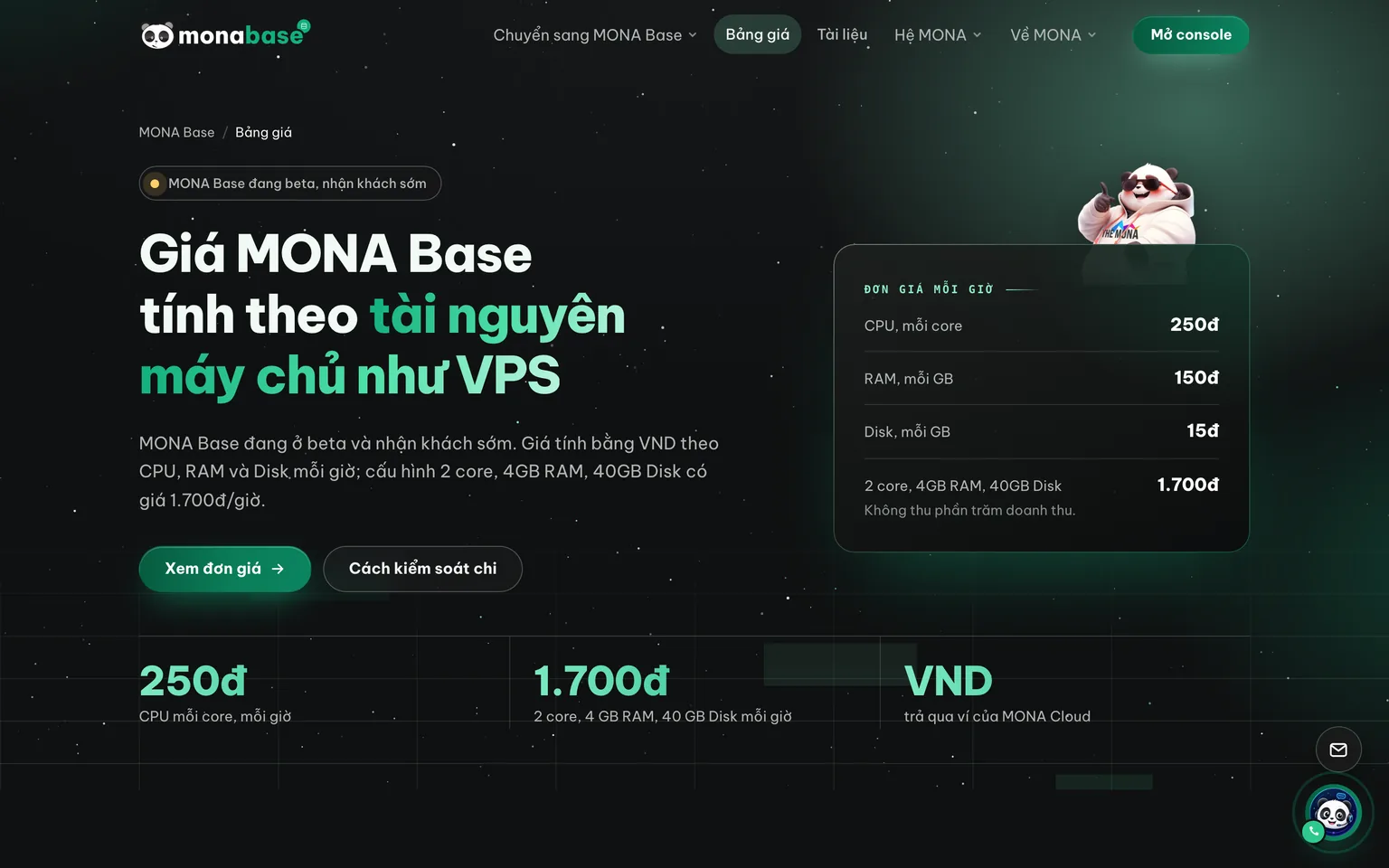
The beta opened in September 2026. AI creates a Postgres 17 cluster with login and file storage in about 4.5 minutes, priced by the hour: CPU 250 VND/core, RAM 150 VND/GB, Disk 15 VND/GB. Swap the keys and it runs, and a cluster with 2 cores, 4 GB RAM and 40 GB Disk costs about 1,700 VND per hour.

Why we built this database platform
MONA started building software in 2016. Over 10 years, 14,000+ projects delivered, and one problem keeps repeating: clients hire us to build web design or an app, the system runs fine in the dev stage, and then real operation exposes the USD billing problem. Writing code with AI in the Supabase style is fast, but at deployment you have to attach a foreign card, exchange rates swing unpredictably, and in some months server costs ran 1.5 times higher than when the contract was signed.

We started from our own needs. MONA Pay we have used ourselves to collect payments since 2022, MONA Mail sent its first real email on September 3, 2026, and MONA devs used Base internally on client projects for many months before the beta opened in September 2026. Nobody made us do it. 14,000 projects simply taught us one thing: software lives or dies on where the data sits and what you pay in.
Where customer data sits is a problem of its own. Many Vietnamese businesses, medical centers and government agencies require user data to be stored within Vietnam for legal compliance under current regulations. Each time we hit a project like this, we had to configure every server by hand, costing our developers many working days. So we built it ourselves. At first, Base was just an internal data layer for MONA Cloud, serving regular clients. In September 2026, after stable internal use, we opened the public beta for you to use too.
We know well where self-built, AI-written software tends to break. Login, sign-up and password recovery sound simple, but building them from scratch easily creates security holes. File and image uploads: building your own storage server is costly and hard to scale when users spike. Realtime instant updates require keeping connections alive, handling dropped networks and syncing state, which is genuinely exhausting. MONA Base was born so we could solve these problems for our own team, and once it ran well, we brought it out for you to try.
You no longer have to watch the USD rate every day, because every transaction is clearly in VND. And your data sits in Vietnam, in line with current security regulations.
What it does, in plain language
This beta provides a toolkit so your app works from day one. Say you are building a multi-branch dental clinic system, with thousands of patients a day, and records and appointments must be stored and retrieved constantly. The core runs on Postgres 17, a widely used open-source database management system. You store all medical records, prescriptions and personal details of thousands of customers safely and retrieve them fast. We also built in pgvector, so later you can build an chatbot AI-based advisory feature on top of that data: patients chat to ask about appointments, and the AI queries the database directly through pgvector and answers accurately with no human involved.

In short: Base has 6 parts: Postgres 17 (data store), Auth (login), Storage (file storage), Realtime (instant updates), pgvector (lets AI search by meaning) and Studio (a screen to view and edit data). An app already written in the supabase-js style only needs the URL and anon key changed, and creating a new cluster takes about 4.5 minutes. A cluster with 2 cores, 4 GB RAM and 40 GB Disk costs about 1,700 VND per hour. Swap the key and it runs.
User management is much easier because Auth is built into the core. Take an English center that needs a login portal for thousands of students. Instead of hiring someone to write code for account creation, confirmation emails and password resets, you use MONA Base's ready-made Auth. Students enter an email, receive a verification code and log in right away, with strong security. Alongside it is Storage, a place to keep PDF documents, tutorial videos and certificate images without worrying about running out of space midway.
Why does Realtime matter? Suppose you run a delivery system or a ride-booking app. Realtime lets drivers and customers see positions on the map update every second. Every change in order status, from the driver accepting the trip and moving to successful delivery, is pushed straight to the user's phone with no noticeable delay. We also have Studio, a browser interface where you view, edit and delete data like working in an Excel sheet, with no SQL commands to type.
Just read through the MONA Base introduction, and you will see each feature tied to a specific real situation, with nothing added just to fill out the set.
Your AI calls it directly and does everything itself
When you build software yourself with AI agent, the workflow changes. We have built the monacloud-mcp tool in. While you type code in Cursor or Claude Code, you just ask in natural language, for example: “create a backend for me using the cloud_base_* tools and tell me the cost in VND”. The AI reads the latest price list, matches it against the configuration needed, and reports the expected cost clearly, with no hidden fees.
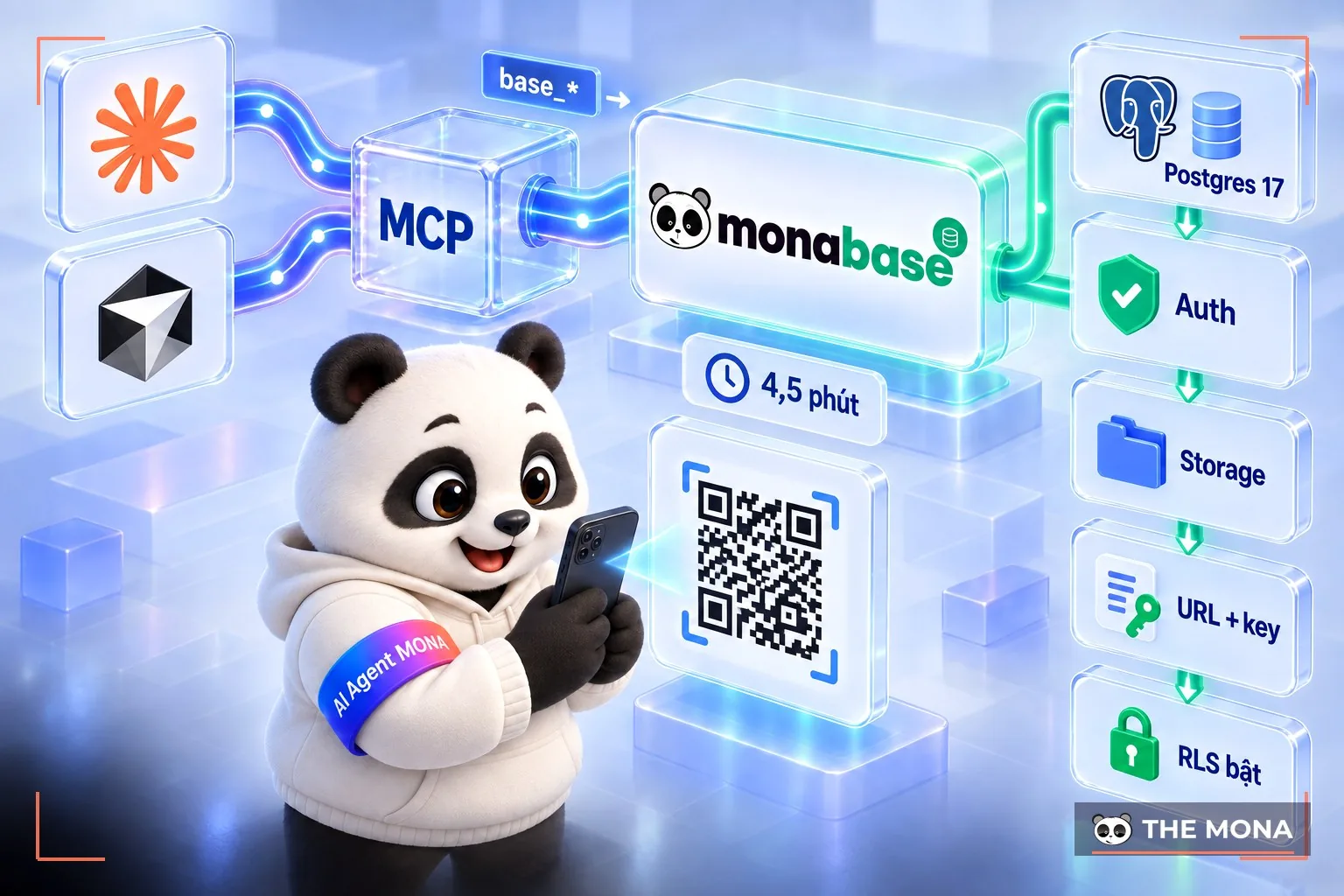
After you review the quote and agree, the AI creates a sandbox to test the configuration. Once that checks out, it creates the real database cluster. The whole process takes about 4.5 minutes. The result includes api_url, anon_key and service_key to drop straight into your app's source code. You look at the screen, approve the quote, scan the QR code to top up your VND wallet if the balance is short, and sign in to MONA Pass once to authenticate. We do not ask you to create any other account.

The accompanying tool is monacloud-mcp version 0.8.1 or later, with a ready-made cloud_topup command that prints a VietQR code right in the chat when your wallet is short, and every cluster-creation command quotes the price first and waits for your approval.
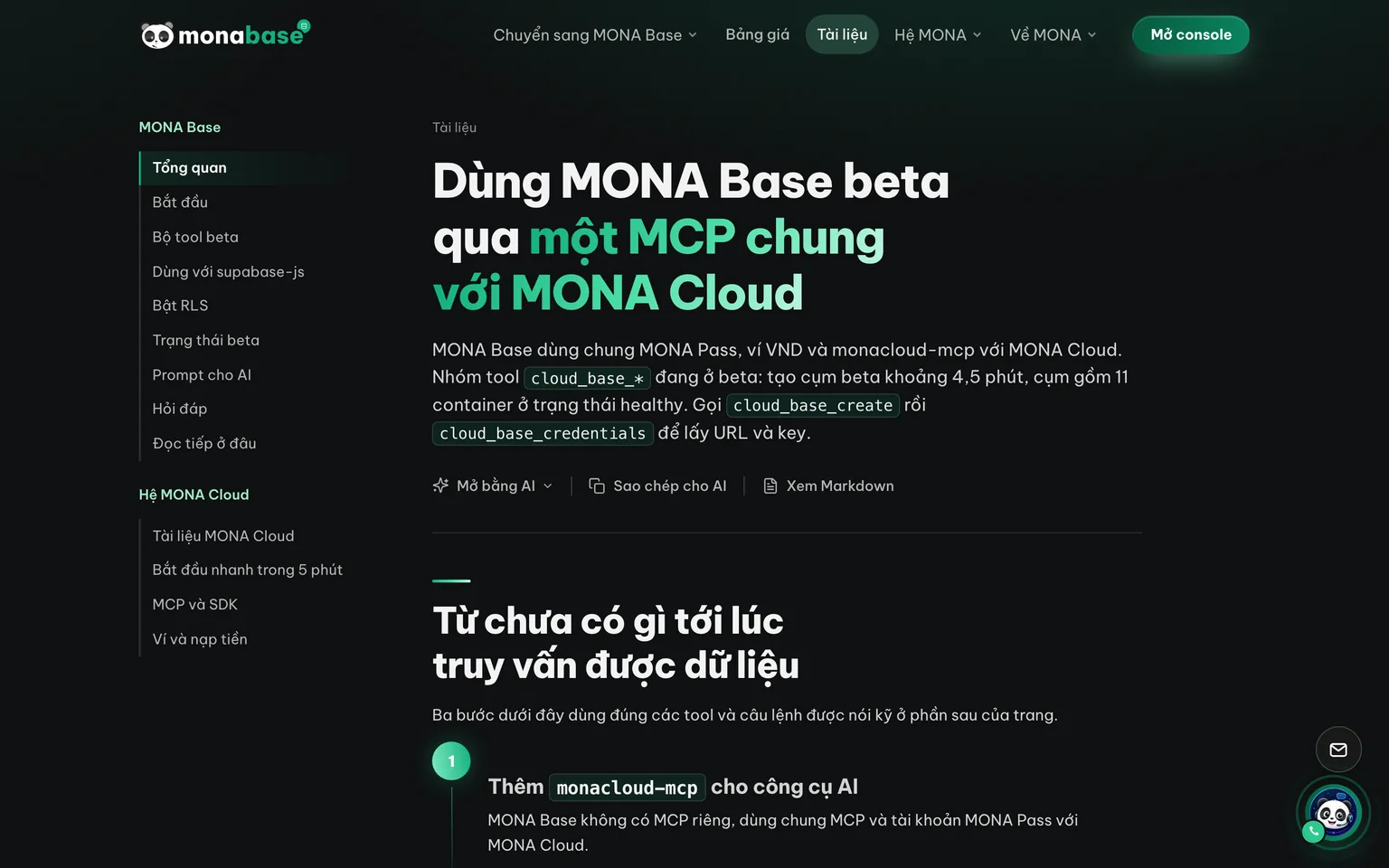
You still do the basic confirmation steps, and the system never acts on its own behalf. But the AI carries 99% of the manual workload. No need to open dozens of tabs to hunt for settings. No separate payment wallet. No separate MCP software to install for MONA Base. We designed the flow so every tool in vibe coding tools works together, and you only play the final decision maker.
This approach saves many days of infrastructure setup. Spending that time on your core features pays off far more.
Where does your app keep customer data, and how many dollars do you pay for it this month?
A MONA Base cluster with 2 cores, 4 GB RAM and 40 GB of disk costs about 1,700 VND per hour, takes 4.5 minutes to create, and supabase-js-style code keeps running once you swap the URL and anon key. Tell Gau Cuoi which platform you use now, and we will show what you can swap right away and what has to wait.
Create your first Postgres cluster Call 1900 636 648