
 MONA OS 2.0
 Partner with MONA


 Tự động hoá doanh nghiệp
 Cẩm nang SEO
 Digital Marketing
 Kinh nghiệm thiết kế website
 Hạ Tầng Server
 Giáo dục


 VI
 EN
















Message us on
Zalo Official


 ProductsNew

 ProductsProducts
 Mới ra mắtKHA AI 2027App tự edit video, tự đăng mọi mạng xã hội, 2 phút mỗi ngày










 Website designLooks good and wins customers over.
SEO servicesBrings in customers searching for exactly what you sell.
 Tư vấn digital marketingKéo khách từ nhiều kênh, đo bằng số thật.
Corporate video productionVideos introducing your company, factory and team.
 NewAI video productionCompany story films made with AI.
 Custom software developmentCRM, ERP and HRM built for your business.
 Viết AI Agent theo yêu cầuĐặt riêng một trợ lý AI cho đúng việc của mình.
 Tư vấn chuyển đổi AIĐưa AI vào vận hành của cả công ty.
NewMONA LMSManagement for centers and schools.
MONA SkillHubInternal training for company staff.
 NHTQ systemEnd-to-end China–Vietnam shipping operations.
MONA JMSManagement for gold, diamond and pawn shops.
 MONA E-LearningA website with every feature you need to sell courses.
 How to sell online courses (course)More than 30 free lessons on selling courses on autopilot.
 MONA Cloudmonacloud.vnServers to get your apps and websites running.
 MONA Basemonabase.vnPostgres database, sign-in and file storage.
 MONA Mailmonamail.vnSend OTP, order and invoice emails from your software.
 MONA Paymonapay.vnAccept bank transfers via VietQR and notify your software when the money arrives.
 MONA eInvoiceComing soonIssue e-invoices that meet tax standards.
Gấu CườiTrả lời khách 24/7 trên web, Fanpage, Zalo và thu lead cho sale.
 Gấu TeleSalesGọi điện tư vấn, chăm khách như tổng đài viên thật.
Dê CườiTư vấn và chốt đơn cho shop ngay trong khung chat.
Gấu WebmasterNhắn nhóm Zalo là website được sửa xong.
 Gấu Pháp ChếSoạn hợp đồng, rà điều khoản trong vài phút.
 Gấu Báo GiáLên báo giá đúng mẫu và gửi khách ngay.
 AI chăm sóc khách hàngTheo dõi và giữ chân khách hàng cũ.
 Gấu Tuyển DụngLọc hồ sơ, hẹn lịch, phỏng vấn ứng viên.
 Mới ra mắt
KHA AI 2027
Xây kênh chuyên gia 2 phút mỗi ngày
Quay bằng điện thoại, AI tự edit video, tự đăng lên 16 nền tảng và tự trả lời bình luận, tin nhắn.
937.359lượt xem trên kênh CEO MONA sau 42 ngày
 Anh Khánh HùngCEO MONA đang dùng mỗi ngày
Xem app làm được gì
 AI
Gấu Cười MONA ĐANG TỰ XÀITrả lời khách 24/7 trên website, Zalo OA, Messenger và thu lead về cho sale.
Dê CườiChốt đơn bán lẻ và sàn: Shopee, TikTok Shop, web. Chăm cả khách sỉ, đại lý.
Gấu WebmasterCập nhật nội dung, tối ưu SEO website mỗi ngày.
Gấu TeleSalesGọi điện tư vấn, chăm khách như tổng đài viên thật.
Gấu Tuyển DụngLọc hồ sơ, hẹn lịch, phỏng vấn ứng viên tự động.
AI chăm sóc khách hàngGiữ khách cũ, cứu lead đã rớt cho phòng kinh doanh.
Gấu Pháp ChếSoạn hợp đồng, rà điều khoản trong vài phút.
Gấu Báo GiáLên báo giá đúng mẫu, gửi khách ngay khi có yêu cầu.
 Chuyển đổi AI toàn phầnGiải pháp tổng cho doanh nghiệp, 3 lớp triển khai.
 Viết AI Agent theo yêu cầuĐặt riêng một con AI gánh đúng nghiệp vụ của bạn.
 Custom softwareCRM, ERP and HRM with built-in AI automation.
 SEO & AEO thời đại AIĐược Google lẫn AI trích dẫn, không chỉ xếp hạng.
 Kiến thức AI cho doanh nghiệpBài phân tích, hướng dẫn ứng dụng AI vào vận hành.
 Free AI courses
 AI tools at work
App mới · KHA AI 2027
Xây kênh 2 phút mỗi ngày
AI tự edit video, tự đăng mọi mạng xã hội
Free consultation, 8am–10pm every day

13 June, 2026

Many business owners and marketing teams are actively looking for ways to integrate Claude into their workflow, from creating content and analyzing data to supporting customer care. Claude really is a powerful tool that handles many individual and small-team tasks well. However, we see a clear limit: as a business grows, data gets more complex and the need for deep automation increases, standalone AI tools stop being enough. That's when it's worth taking custom software seriously, built to integrate Claude and other AI modules into a closed, seamless and fully secure process chain.
Many people starting with Claude type commands in a casual, natural way. That tends to produce generic replies. To get the best out of Claude, you need to brief it from the start, the way you'd brief a new hire.
How you start the conversation matters a lot. We've distilled 3 prompting techniques that help Claude understand what you want right away. They save you editing time and raise the quality of the output.
Claude needs to know who it is in the conversation. Assign a specific role. For example: "You are a marketing expert with 10 years of experience." Or "You are a financial advisor."
This shapes Claude's tone and background knowledge. It keeps Claude focused. Responses get deeper and avoid generic answers. It's the first step toward controlling the result.
After assigning a role, state a specific goal. The more detailed the goal, the closer the result. For example: "Write 5 ideas for a Facebook post about the summer promotion."
Next comes the output format you want. A bulleted list? A paragraph? A table? Say so clearly. Claude will follow it closely. That makes it easy to drop the content into your work and saves you reformatting.
For large projects, or when you need Claude to hold a consistent style, use the "System Prompt" feature. It's a set of core instructions that sits outside the normal conversation.
You can declare your brand voice, rules that must never be broken and key background information. Claude will remember and apply these "System Prompts" throughout. That keeps every response within the principles you set and helps the business stay consistent, especially when many people use Claude for different purposes.
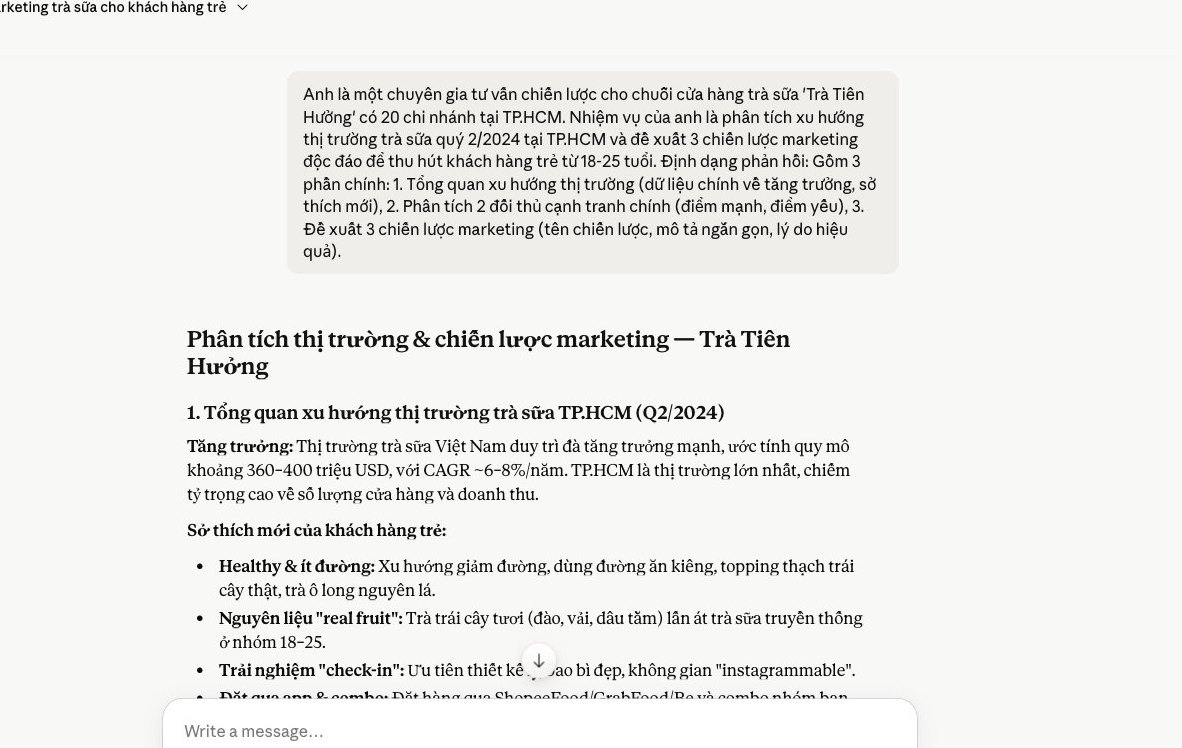
A major challenge when using AI is keeping the tone consistent. We want Claude to produce content that meets the standard and reflects the spirit of the business. This matters for every marketing or communications campaign. We developed a 4-layer prompt formula that keeps Claude strictly on brand voice, so you get high-quality output.
The first layer lays the foundation. Give Claude specific context. Start by defining who the business is, who the target audience is and what the content is for. For example, "You are the owner of an e-commerce site specializing in premium home appliances. Customers are young, with decent incomes. They care about convenience and minimalist design. This article introduces a new dishwasher." This helps Claude understand its role and know what to do.
After context, we go deeper into style. This is where you define your own tone. A brand voice can be friendly, professional, humorous or formal. List the words you use often, and also the words that should never appear. "Our voice should be approachable and energetic. Use words like 'enjoy', 'discover', 'unique'. Avoid complex jargon. Don't use archaic Sino-Vietnamese words." This creates a language filter, and Claude gets clear direction.
Real examples are a powerful tool. Give Claude pairs of examples: one with the right tone, one to avoid. "Do write: 'Enjoy a truly relaxing moment with product X.' Don't write: 'Product X brings maximum satisfaction to users.'" These examples illustrate the point visually. Claude learns faster and understands exactly what you expect.
Optimization doesn't stop. We need to evaluate Claude's output. If the result isn't right, give specific feedback. "This paragraph is too formal, use more everyday words." Claude will adjust based on that. Repeating these steps improves accuracy, and the brand voice takes shape over time. We've applied this formula across many projects SEO and content. The result is noticeably better consistency.
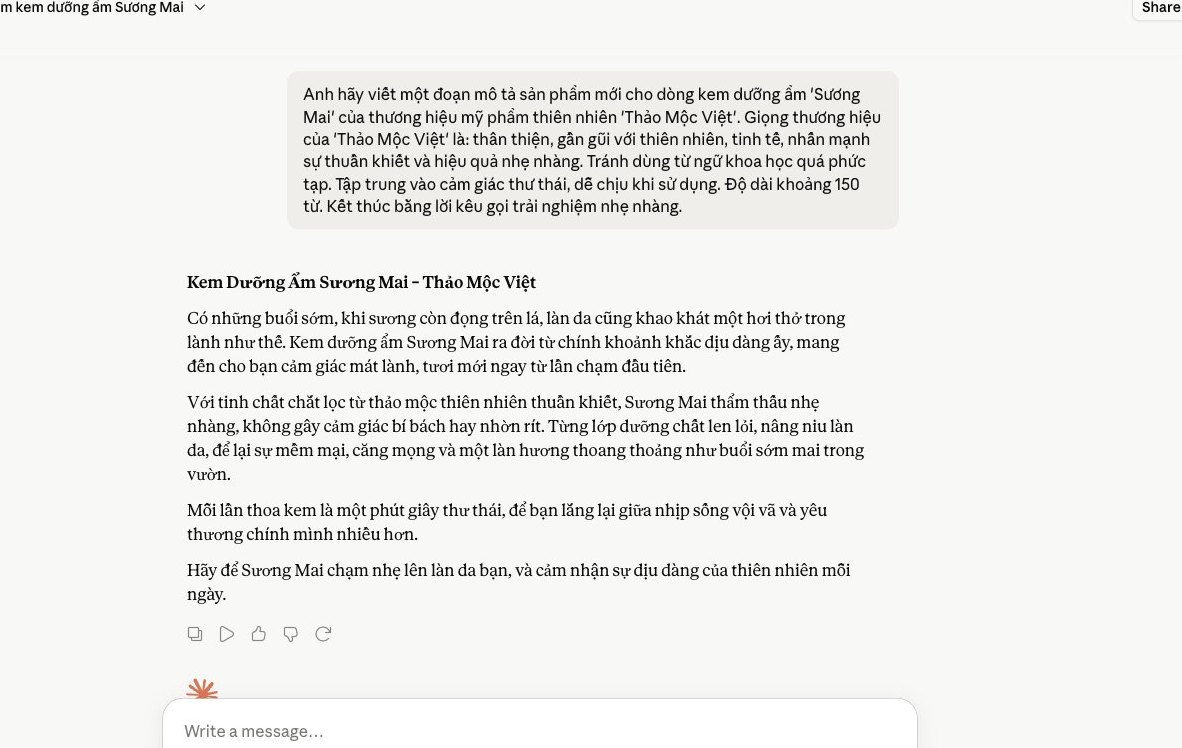
To keep a strong presence on social media, you need a large volume of content. We developed a workflow for using Claude effectively. In just one hour, you can produce 30 quality posts. Here's how MONA streamlines the content process with customers.
Start by identifying the big topics. Prepare a list of main keywords related to your business. Then use Claude to explore different angles. Ask Claude for several variations of each topic.
An effective prompt: "List 5 main topics about [your industry/product]. For each topic, suggest 3 different angles and 2 post formats (for example: tips, Q&A, personal story)." Claude will quickly suggest. Your topic list becomes more varied.
Once you have ideas, move on to drafting. Give Claude one specific topic at a time. Ask Claude to write a short post. We repeat this quickly.
Example prompt: "Write a Facebook post of about 100 words on 'The benefits of morning yoga'. Friendly tone, with the call to action 'Sign up for the course today'." Claude returns a result right away. Repeat for other topics. These drafts come together very fast.
Every social platform has its own character. Posts need adjusting to fit. Review Claude's drafts. Add details specific to your business. Adjust the tone.
For example, a LinkedIn post should be more professional. An Instagram post needs eye-catching visuals and less text. You can ask Claude to revise: "Rewrite this for LinkedIn. Formal tone, focused on business value." This step matters. It makes the post feel more natural.
Once the content is final, the next step is scheduling. You can use social media management tools. They automate posting and let you plan a schedule so posts go out at the right time.
Don't forget to track how each post performs. This data is valuable. It tells us which type of content works. From there, you can adjust your strategy and improve content results. MONA always stresses the importance of this analysis. We need concrete numbers. They drive continuous improvement.
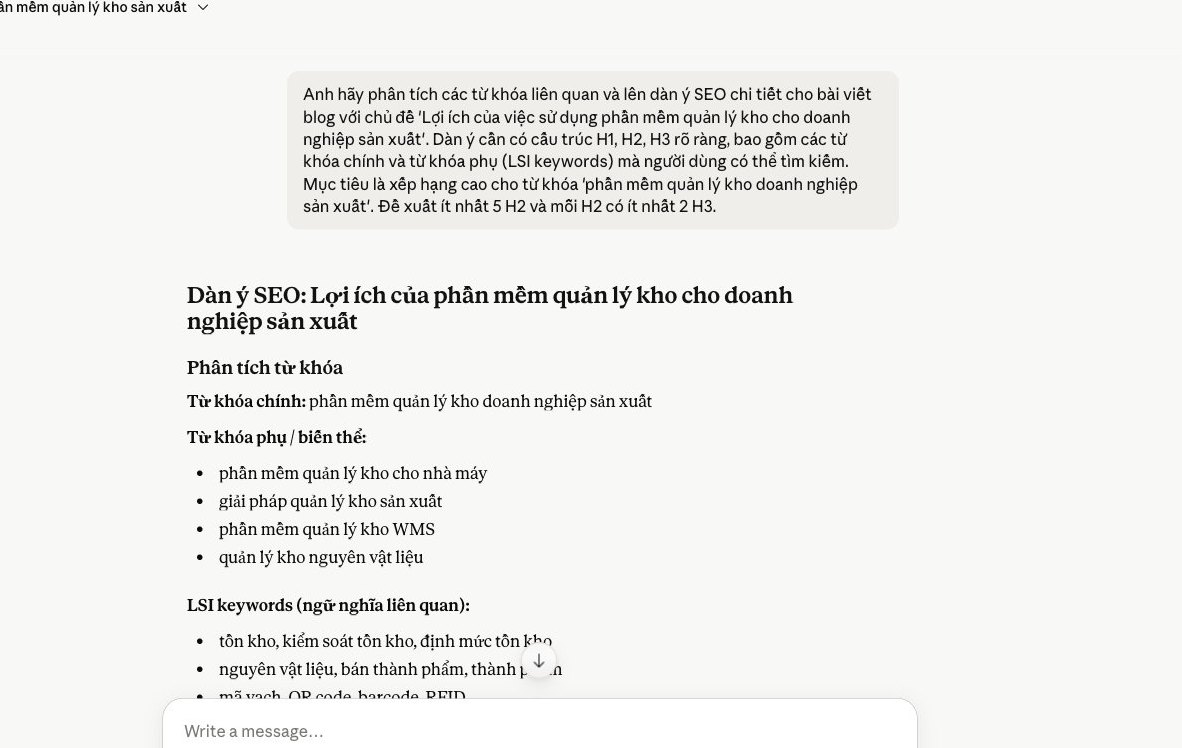
Claude is becoming an indispensable tool for marketing teams that want better SEO performance. We find you can use Claude to speed up research, analysis and outlining considerably. That frees your marketers to spend more time on strategy and creativity.
Understanding keywords isn't just about the numbers. We need to grasp the intent behind each search. Claude helps you analyze long-tail phrases, related keywords and the questions users commonly ask.
With one simple prompt, Claude suggests niche topics. These topics often have little competition but bring quality traffic. We applied this to an architecture project, and the team found dozens of new keywords.
A detailed article outline is the foundation of SEO-friendly content. Claude can build a logical H2/H3 structure so the article covers enough ground. It also suggests fresh angles that help your article stand out.
For complex topics, this saves hours of thinking. Claude's outlines are always tuned to be easy to read and search-engine friendly. That's a big advantage.
On-page SEO factors are the backbone of a high-ranking article. Claude helps you review and recommend improvements right away. It's a simple step, but an extremely effective one.
From titles, meta descriptions and keyword density to internal links, Claude gives an assessment. That makes sure every article meets the technical standard. We use this for a quick check before publishing.
Old content still holds a lot of value. Claude can help you review published articles. From there, it suggests improvements so they stay at the top of search results.
Updating old content often delivers a high return on investment. There's no need to create something new, just optimize what exists. Claude suggests adding information, updating figures or adding new keywords.
Claude is a real help to marketing teams. However, using standalone AI tools like Claude only solves one task at a time. It still requires people to work manually, step by step, switching between different platforms.
To optimize the entire SEO and marketing process, you need a software system with seamless automation. MONA integrates Claude and other AI modules into dedicated software solutions. We build custom software that automates everything from research and content production to distribution. MONA has over 10 years of experience since 2016, with 14,000+ projects and an 85% client retention rate. We have trained and transferred AI technology to many Vietnamese businesses. Contact us to explore a solution for your business.
Claude is a capable assistant for many creative and marketing analysis tasks. You've seen that for yourself. However, as a business scales, Claude's initial convenience sometimes hits its limits. Using scattered AI tools can create new challenges. We need a more unified solution.
At MONA, we've seen this across many projects. Claude helps individuals optimize their work. Still, it isn't enough to build a seamless automation system. Here are the points to consider.

A major challenge is fragmented SEO content data. Each person uses Claude to create articles, product descriptions or keyword ideas. That information usually ends up spread across personal accounts.
You'll see the marketing team spend a lot of time consolidating. They have to collect, cross-check and standardize the data. That blocks building a central content resource, a common problem that slows down the content production cycle.
MONA helped a 35-branch tech retail chain in Hanoi with revenue of around 60 billion VND a month. Previously, each person used Claude on their own. We built a custom content management module that integrates Claude to suggest ideas automatically. Data is now gathered in a single place. Consolidating is no longer a burden, and the team can retrieve everything easily.
Claude helps individuals create content faster. Yet the review and publishing process is often still slow. Even with Claude, the handoff from creator to reviewer to publisher is usually manual. That increases waiting time and affects how often you can publish.
An F&B chain with 18 restaurants in Ho Chi Minh City was struggling. They needed to refresh menus and promotional content every week. MONA deployed a restaurant chain management system that includes a content workflow module. Claude helps draft. Review and approval run automatically. Content is published to the website and social channels seamlessly. This saves a significant amount of time.
Information security comes first. When you use Claude or other general-purpose AI platforms, your data may be at risk. Customer information, marketing strategy and business data are valuable assets. Putting sensitive data on third-party tools calls for great care.
Control over your data is something you need to keep. A financial services company with over 50 staff came to MONA, worried about customer information leaking. We designed a CRM software custom one. This software has an in-house AI module and doesn't depend entirely on general-purpose AI APIs. Data is stored securely on the company's own servers. All activity is tightly controlled, and an encryption system protects the information. You can rest easy.
Claude has pricing plans by usage tier. Every person on the marketing, SEO or content team needs their own account. The total license cost per Claude account can add up, and it's not a small number. It lowers your return on investment if it isn't managed well.
When someone leaves, transferring their account is also complicated. You may end up paying for a new one. MONA has built automation software AI integrations. We optimize costs. The business invests once in a system that can serve the whole team. That cuts individual license costs and clearly improves return on investment.

CEO & Founder · The MONA
Founder of The MONA, who built a services company of 60+ staff with 14,000+ projects delivered. Khánh Hùng shares how he thinks about building systems that run themselves, automating a business, and the real lessons from delivering projects at MONA.
 351




Professional website
design services
Own a website with a beautiful, 100% exclusive design and a lifetime warranty, with the ability
to expand features flexibly as your business grows, starting today!






 MONA will never sell your information or send you spam


 MONA will never sell your information or send you spam
