
 MONA OS 2.0
 Hợp tác với MONA


 Tự động hoá doanh nghiệp
 Cẩm nang SEO
 Digital Marketing
 Kinh nghiệm thiết kế website
 Hạ Tầng Server
 Giáo dục


 VI
 EN















Message us on
Zalo Official


 ProductsNew

 ProductsProducts
 Mới ra mắtKHA AI 2027App tự edit video, tự đăng mọi mạng xã hội, 2 phút mỗi ngày










 Thiết kế websiteVừa đẹp vừa thuyết phục được khách.
Dịch vụ SEOKéo về khách đang tìm đúng thứ anh chị bán.
 Tư vấn digital marketingKéo khách từ nhiều kênh, đo bằng số thật.
Quay video doanh nghiệpVideo giới thiệu công ty, nhà xưởng, đội ngũ.
 MớiDựng video AIDựng phim câu chuyện công ty bằng AI.
 Custom software developmentCRM, ERP and HRM built for your business.
 Viết AI Agent theo yêu cầuĐặt riêng một trợ lý AI cho đúng việc của mình.
 Tư vấn chuyển đổi AIĐưa AI vào vận hành của cả công ty.
NewMONA LMSManagement for centers and schools.
MONA SkillHubInternal training for company staff.
 NHTQ systemEnd-to-end China–Vietnam shipping operations.
MONA JMSManagement for gold, diamond and pawn shops.
 MONA E-LearningA website with every feature you need to sell courses.
 How to sell online courses (course)More than 30 free lessons on selling courses on autopilot.
 MONA Cloudmonacloud.vnServers to get your apps and websites running.
 MONA Basemonabase.vnPostgres database, sign-in and file storage.
 MONA Mailmonamail.vnSend OTP, order and invoice emails from your software.
 MONA Paymonapay.vnAccept bank transfers via VietQR and notify your software when the money arrives.
 MONA eInvoiceComing soonIssue e-invoices that meet tax standards.
Gấu CườiTrả lời khách 24/7 trên web, Fanpage, Zalo và thu lead cho sale.
 Gấu TeleSalesGọi điện tư vấn, chăm khách như tổng đài viên thật.
Dê CườiTư vấn và chốt đơn cho shop ngay trong khung chat.
Gấu WebmasterNhắn nhóm Zalo là website được sửa xong.
 Gấu Pháp ChếSoạn hợp đồng, rà điều khoản trong vài phút.
 Gấu Báo GiáLên báo giá đúng mẫu và gửi khách ngay.
 AI chăm sóc khách hàngTheo dõi và giữ chân khách hàng cũ.
 Gấu Tuyển DụngLọc hồ sơ, hẹn lịch, phỏng vấn ứng viên.
 Mới ra mắt
KHA AI 2027
Xây kênh chuyên gia 2 phút mỗi ngày
Quay bằng điện thoại, AI tự edit video, tự đăng lên 16 nền tảng và tự trả lời bình luận, tin nhắn.
879.625lượt xem trên kênh CEO MONA sau 35 ngày
 Anh Khánh HùngCEO MONA đang dùng mỗi ngày
Xem app làm được gì
 AI
Gấu Cười MONA ĐANG TỰ XÀITrả lời khách 24/7 trên website, Zalo OA, Messenger và thu lead về cho sale.
Dê CườiChốt đơn bán lẻ và sàn: Shopee, TikTok Shop, web. Chăm cả khách sỉ, đại lý.
Gấu WebmasterCập nhật nội dung, tối ưu SEO website mỗi ngày.
Gấu TeleSalesGọi điện tư vấn, chăm khách như tổng đài viên thật.
Gấu Tuyển DụngLọc hồ sơ, hẹn lịch, phỏng vấn ứng viên tự động.
AI chăm sóc khách hàngGiữ khách cũ, cứu lead đã rớt cho phòng kinh doanh.
Gấu Pháp ChếSoạn hợp đồng, rà điều khoản trong vài phút.
Gấu Báo GiáLên báo giá đúng mẫu, gửi khách ngay khi có yêu cầu.
 Chuyển đổi AI toàn phầnGiải pháp tổng cho doanh nghiệp, 3 lớp triển khai.
 Viết AI Agent theo yêu cầuĐặt riêng một con AI gánh đúng nghiệp vụ của bạn.
 Custom softwareCRM, ERP and HRM with built-in AI automation.
 SEO & AEO thời đại AIĐược Google lẫn AI trích dẫn, không chỉ xếp hạng.
 Kiến thức AI cho doanh nghiệpBài phân tích, hướng dẫn ứng dụng AI vào vận hành.
 Free AI courses
 AI tools at work
App mới · KHA AI 2027
Xây kênh 2 phút mỗi ngày
AI tự edit video, tự đăng mọi mạng xã hội
Free consultation, 8am–10pm every day

01 June, 2026

Mistakes in rolling out enterprise AI are the reason nearly 70% of the mid-market Vietnamese business owners we met at MONA in the past 18 months had to scrap their first round before coming back to a professional technical partner. You are not wrong to suspect that AI is dumb. You just haven't had anyone tell you the truth about the 5 common stumbling points. In this article we lay out the 5 mistakes we have seen again and again across nearly 30 cases MONA has worked on. Each mistake comes with warning signs, the budget pain that goes with it, and how MONA fixed it for the customer. After reading, check for yourself which ones your business is making.

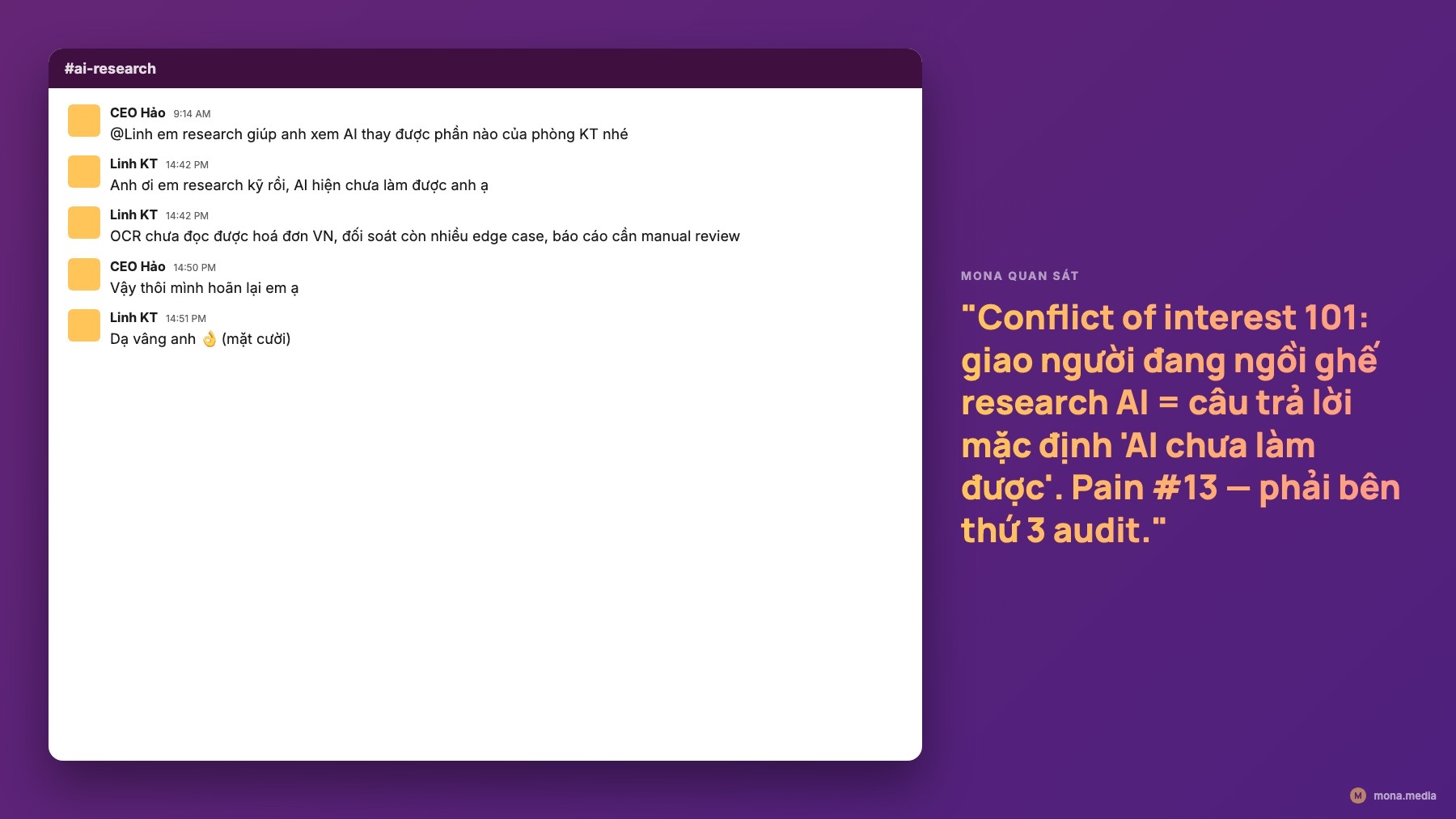
We have seen this pattern at least 18 times in nearly 30 cases. A business owner wants to try AI for the accounting department. They hand it to the chief accountant to research whether it's usable. After 3 weeks the chief accountant comes back and reports that AI simply can't do the job. The proposal is to keep the current team of 12 accountants as it is.
Do you see this as a structural conflict of interest? We are not telling you to doubt your staff. We are only pointing out that when people face the risk of losing their jobs, the default answer is always that AI can't do it yet. This pain ranks thirteenth on the list of 14 tier-1 pains we have gathered from Vietnamese business owners.
Here is how MONA did it differently. An education chain of 22 campuses across HCMC, Hanoi and Can Tho, with revenue of about 31 billion VND a month last September, had us run an independent audit of its accounting and admissions departments. We worked with the chain owner and an outside CTO. We did not meet the heads of accounting and admissions during the audit. Result: 8 of 14 accounting tasks and 6 of 9 admissions tasks could be taken over by machines right away. For how independent audits differ from internal ones, see What is AI-First. 2026 enterprise AI glossary.
Ask yourself 3 questions. Is the person reporting to you on whether AI can replace their job the same person whose job it is? Was anyone from outside in the room when the AI feasibility conclusion was reached? Does the final proposal include a specific number of tasks machines can take over? If all 3 answers are “yes, the reporter is the person affected”, “no outsider” and “no specific number”, you are right in the middle of mistake #1. For more on how to structure an independent audit, see the article CEO sai AI.
We have seen at least 22 mid-market Vietnamese business owners open the free version of ChatGPT. They ask 3-5 questions about their business, get generic answers and conclude that AI isn't good enough. That judgment is wrong at the root.
Plain ChatGPT is a conversation. It doesn't know what your business sells when you ask it. It doesn't know who your customers are or how your accounting books are coded. It's a toy for personal users. A real automation product is software with 3 parts: your business data loaded in privately, tools that connect the steps, and an automated chain that runs without anyone pressing a button. We write production-grade custom-code automation software for each customer, not plain ChatGPT.
Here is how MONA did it differently. A fashion retail chain with 24 branches across 9 provinces and revenue of about 32 billion VND a month had us build a Zalo chatbot that answers 24/7. The chatbot loads the full product catalog and warranty policy, each customer's purchase history and each store's inventory. This software layer alone closed 2,400 extra orders in the first month without going through sales staff. That added 380 million VND in revenue. Cross-check at using AI in business and MONA automation cases.
There are three basic differences. The first is data. Custom automation software loads all of your business data through a retrieval method (RAG). The second is tools. Automation software connects to your sales software, accounting, warehouse, Zalo OA and callbot, instead of only chatting. The third is the automated chain. One task finishes and leads to the next, with no one pressing keys between steps. See also the set of enterprise AI terms 2026 to understand these concepts.
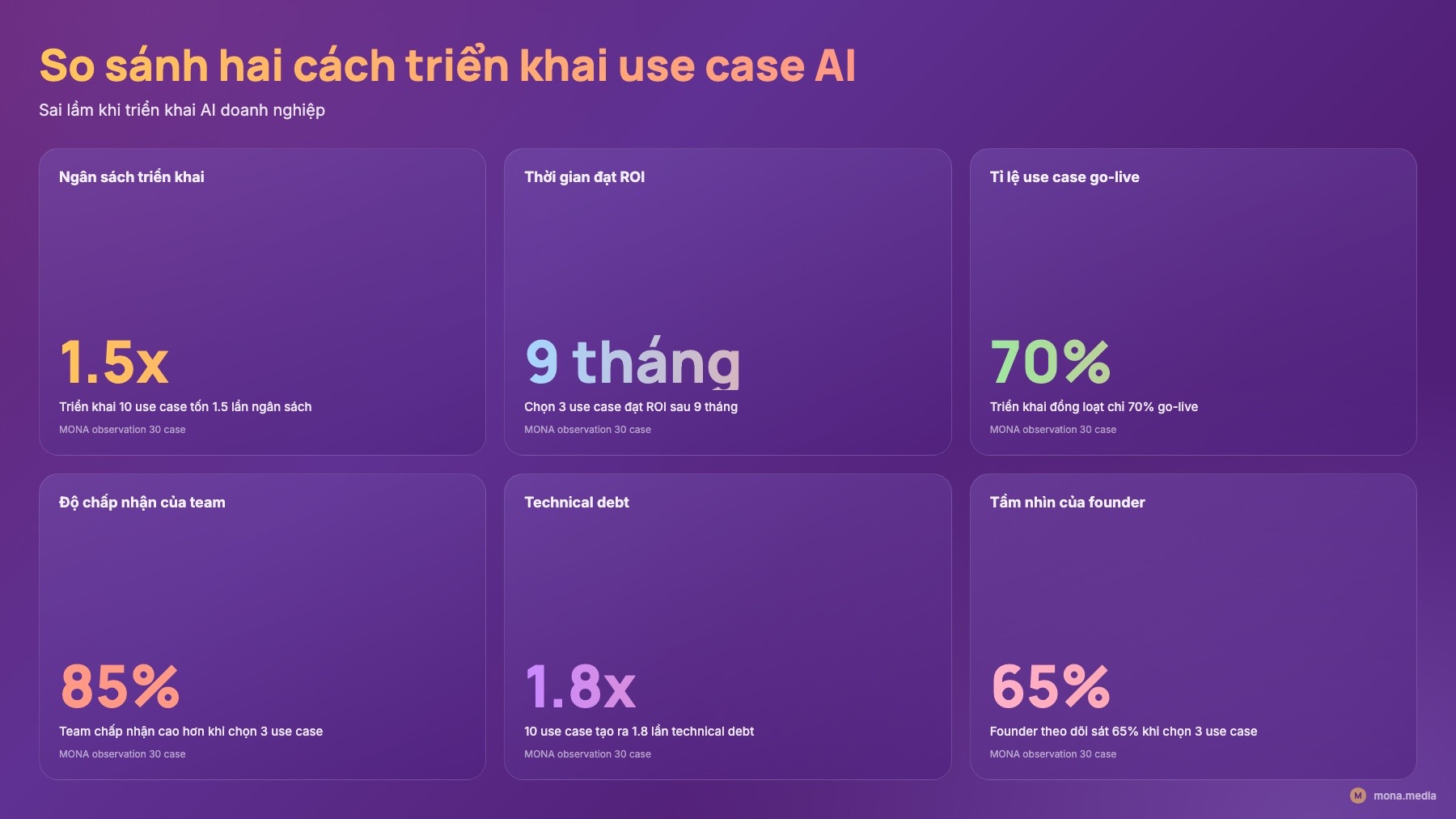
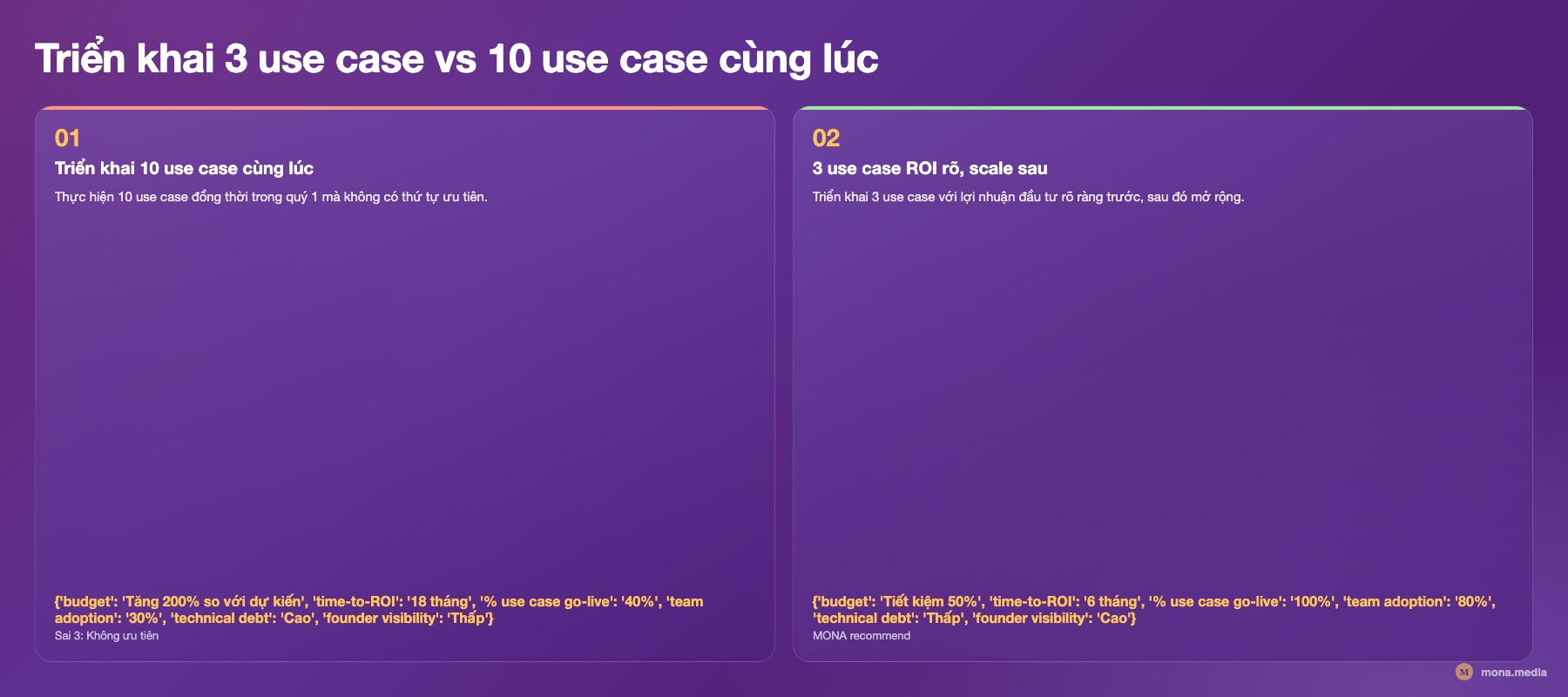
The budget pain here is clear. A chain owner comes back fired up from a conference and approves 6-8 AI projects at once in a board meeting. The tech team has to run 8 branches in parallel, operations has to absorb 8 changes at once, and departments have to deal with 8 points of contact. After 4 months, no branch has reached the finish line and everyone is complaining.
We met a restaurant chain with 26 branches in HCMC and Hanoi and revenue of about 41 billion VND a month. In early 2025 it approved 9 projects at once with 3 different vendors. Six months later the owner sat down and counted: project 1 was 35% done, project 2 was 18% done and project 9 hadn't been touched. Total paid was 1.2 billion VND, and no real return could be calculated. The chain then came to MONA, and we proposed going back to 3 priority projects and firmly closing the other 6. By the end of Q4 the chain was saving 540 million VND a month on back-office staff. It then added 5 new projects once the first 3 were running steadily.
This is how MONA ranks priorities. For each project, count 3 numbers: staff hours saved per month, one-time rollout cost and payback time. Projects that pay back in under 6 months and save more than 80 staff hours a month go in the top 3. The rest are pushed back. For details, see CEO sai AI and 30-day roadmap for a CEO who got AI wrong.
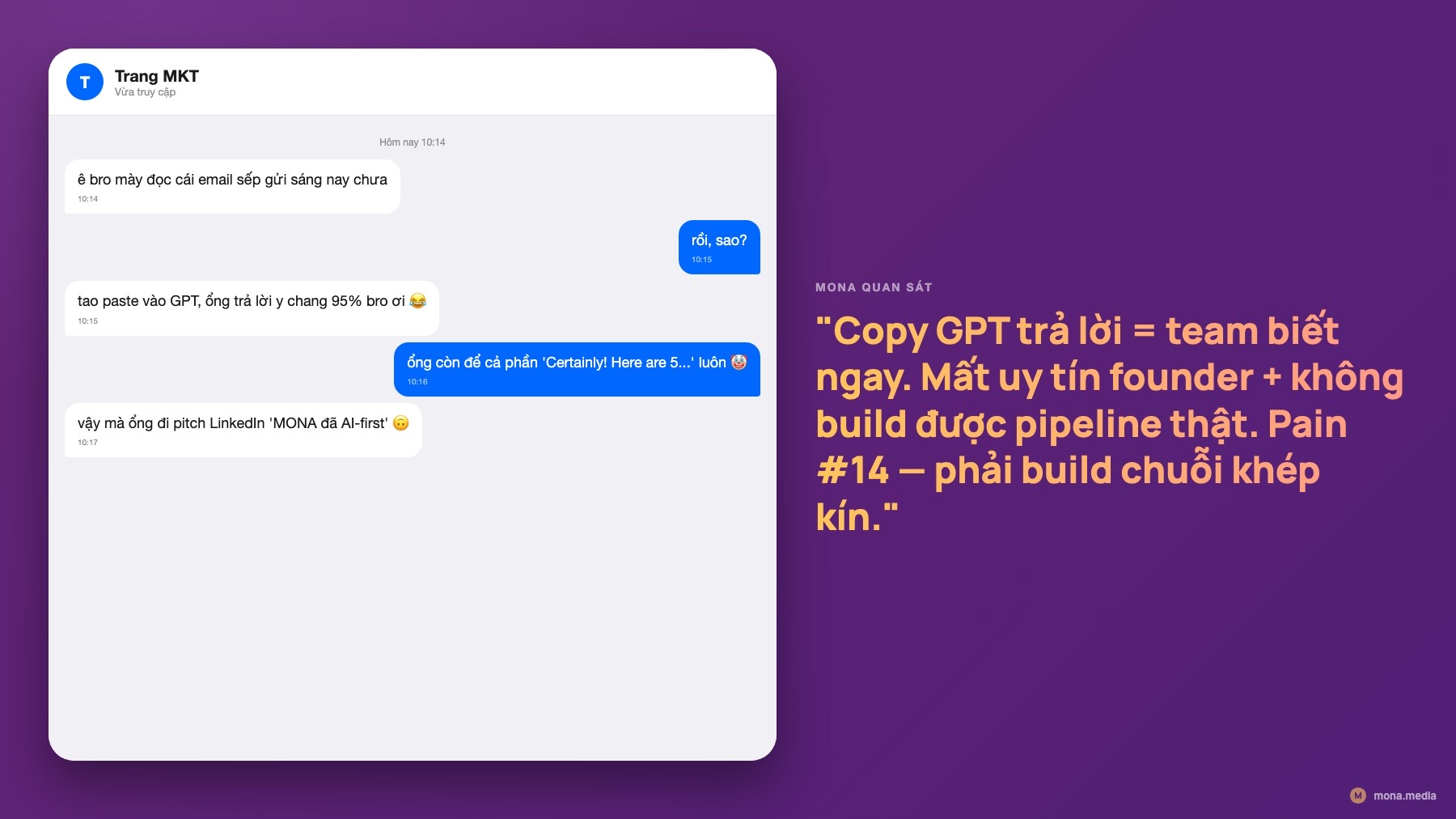
This is an internal culture pain. A business owner uses ChatGPT to write replies to customers, posts for the chain's Facebook page and reports for subordinates. After 2 months, younger staff notice the boss is using ChatGPT, and trust inside the company slips. The marketing team also starts copying chatbot replies into customer messages without loading any private customer data. No one checks the brand voice, and the results sometimes go against company policy.
This pain ranks fourteenth on the list of 14 tier-1 pains for Vietnamese business owners: losing face from half-hearted AI use. Do you feel this too? We have seen at least 7 chain owners lose their evening that week. A young employee opens the Zalo group and exposes the boss using ChatGPT to answer.
Here is how MONA did it differently. A spa chain with 28 branches across HCMC, Hanoi and Da Nang and revenue of about 52 billion VND a month had us build a closed automated chain instead of copying ChatGPT. We did it like this: the chain's customer data is loaded privately into a technical data store. Every message going out on Zalo to customers passes through a chain that checks brand voice and service policy. Staff can't copy and can't expose anything. Your business keeps its reputation and automates its messaging at the same time. For how to design a closed automated chain, see What is AI-First and using AI in business.
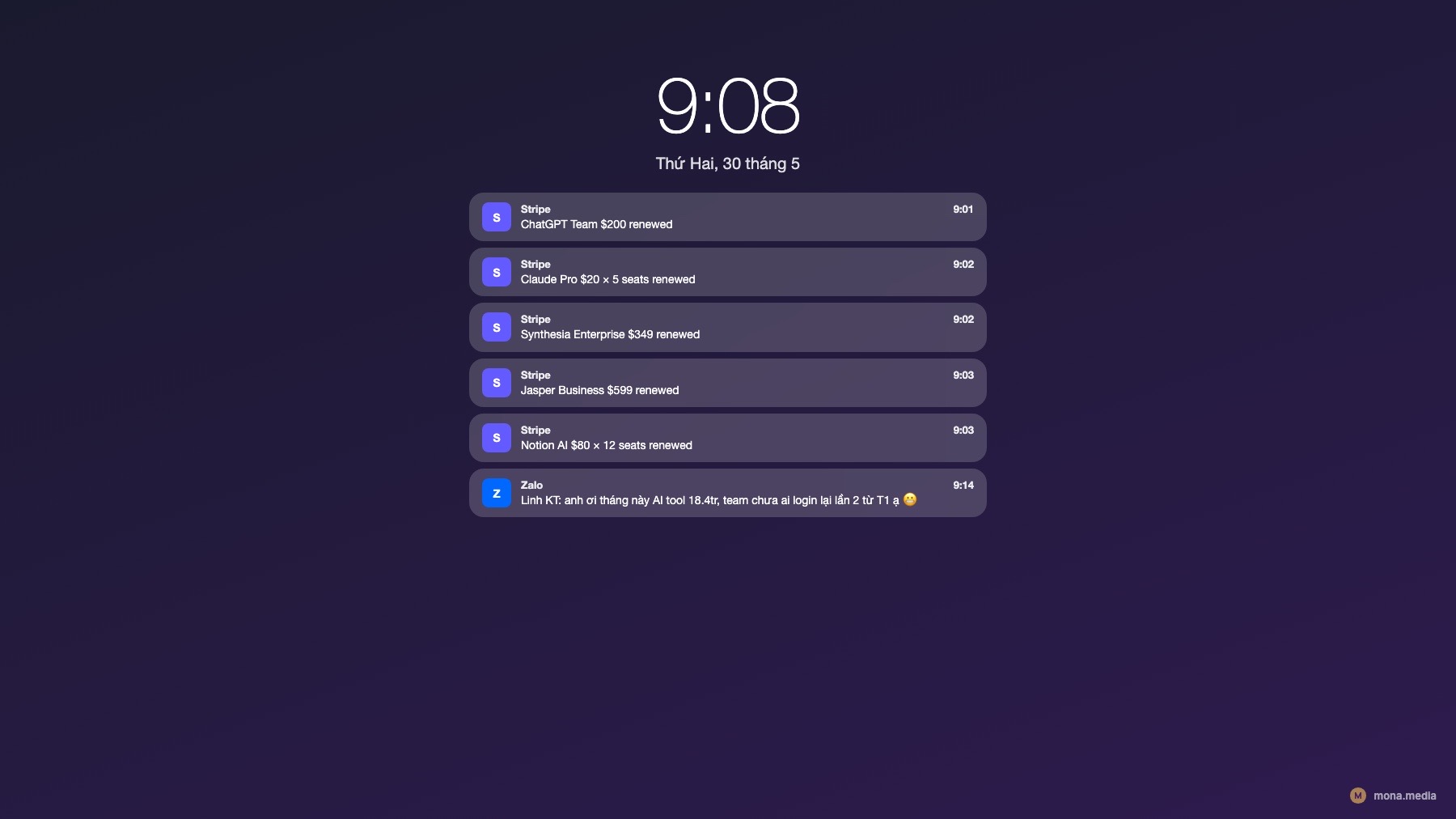
You open your credit card and sign up for 5-7 plans of well-known international AI tools. Each plan costs 49-199 USD a month. After 4-6 months you open the card statement: 47 million VND a month in total. Your team uses about 12% of the features because the interface is all in English. The support documents are all in English, and every small error means opening a ticket and waiting 48-72 hours on US time.
We have watched 11 mid-market Vietnamese business owners run into exactly this pain over the past 18 months. Do you get that feeling when you open Apple Pay each month and see a 6-line renewal notice? It's the pain of money flowing out without any change inside the company.
Here is how MONA did it differently. A supermarket chain with 19 branches in the North and revenue of about 45 billion VND a month moved in early 2025 from 6 international tools costing 38 million VND a month combined to MONA's custom automation software. We built a Vietnamese content management software layer, a Vietnamese dashboard, and Vietnamese support through Zalo and direct phone calls. After 5 months, the chain owner reported that feature usage exceeded 78%, nearly 7 times the earlier international plans. Fixed tool costs fell from 38 to 18 million VND a month. At the same time it replaced 7 back-office staff. See more at MONA automation cases and the product suite at Mona.Software.
There are three main reasons. The first is that most operations staff aren't comfortable with technical English. They lose 40-60% of their time reading documents. The second is that when a product breaks, it needs a fast fix. You need to talk to the person fixing it within 1-2 hours, not 48 hours. The third is that automation software must connect to Vietnamese accounting software, Vietnamese sales software and Vietnamese Zalo OA, not just Slack and Stripe. For details, see the article using AI in business and enterprise AI terms 2026.
We have seen that these 5 mistakes rarely appear alone. An owner who makes mistake 1 often makes mistake 3 next. A department head has just concluded “AI isn't ready” for their field. The owner then approves 8 scattered projects in the hope that one of them hits. An owner who makes mistake 2 often makes mistake 4 next, because after trying plain ChatGPT it doesn't seem like enough, so they have staff copy ChatGPT answers into customer messages. Mistake 5 often comes with mistake 3 because there is no Vietnamese support for the 6 international tools. The team splits up with one tool each and can't integrate them. This is a combination of pains MONA meets again and again. For more on this combination of signs, see 2026 enterprise AI glossary.
Do a quick sum of what it costs if these 5 mistakes hit your business. MONA will lay it out plainly. Mistake 1, handing the audit to a department head, pushes the AI budget back 6 months, which means 6 more months of burning 80-120 million VND in that department's salaries. Mistake 2, trying plain ChatGPT and concluding AI is dumb, means stopping investment for 12 months and losing 400-600 million VND in revenue from customers who would have closed through a chatbot. Mistake 3, running 9 projects at once and not finishing any in 6 months, costs 1.2 billion VND in hard costs plus 8 months of lost opportunity. Mistake 4, copying ChatGPT to answer customers, costs internal face, and some customers leave the chain after a single off-voice message. Mistake 5, buying 6 international tools at 47 million VND a month, is 564 million VND a year for 12% of features actually used. Add up 6-12 months of detours for these 5 mistakes and you get 500-800 million VND in hard money plus an AI budget frozen by the board for 1-2 years. And it's not only money. We know you have tried many things (inviting 3 individual AI experts to pitch a strategy, sending the tech team to a bootcamp at 30 million VND a head, subscribing to 4 international AI newsletters to read every morning, sitting down with 2 SaaS vendors to compare prices, building an 18-sheet AI roadmap spreadsheet yourself). But it doesn't work. If the root structure still has conflicts of interest, still has scattered point tools and still copies ChatGPT, no amount of effort will pay off. The problem is not finding a better individual AI expert. What you need is an automation software team that sits with you for 12 months, runs an independent audit, and writes closed production-grade chains for 3-5 core processes first, measured by 3 indicators (money, hours, errors). Leave your core staff to coordinate the automated system, instead of the whole company revolving around 12 months of scattered experiments.
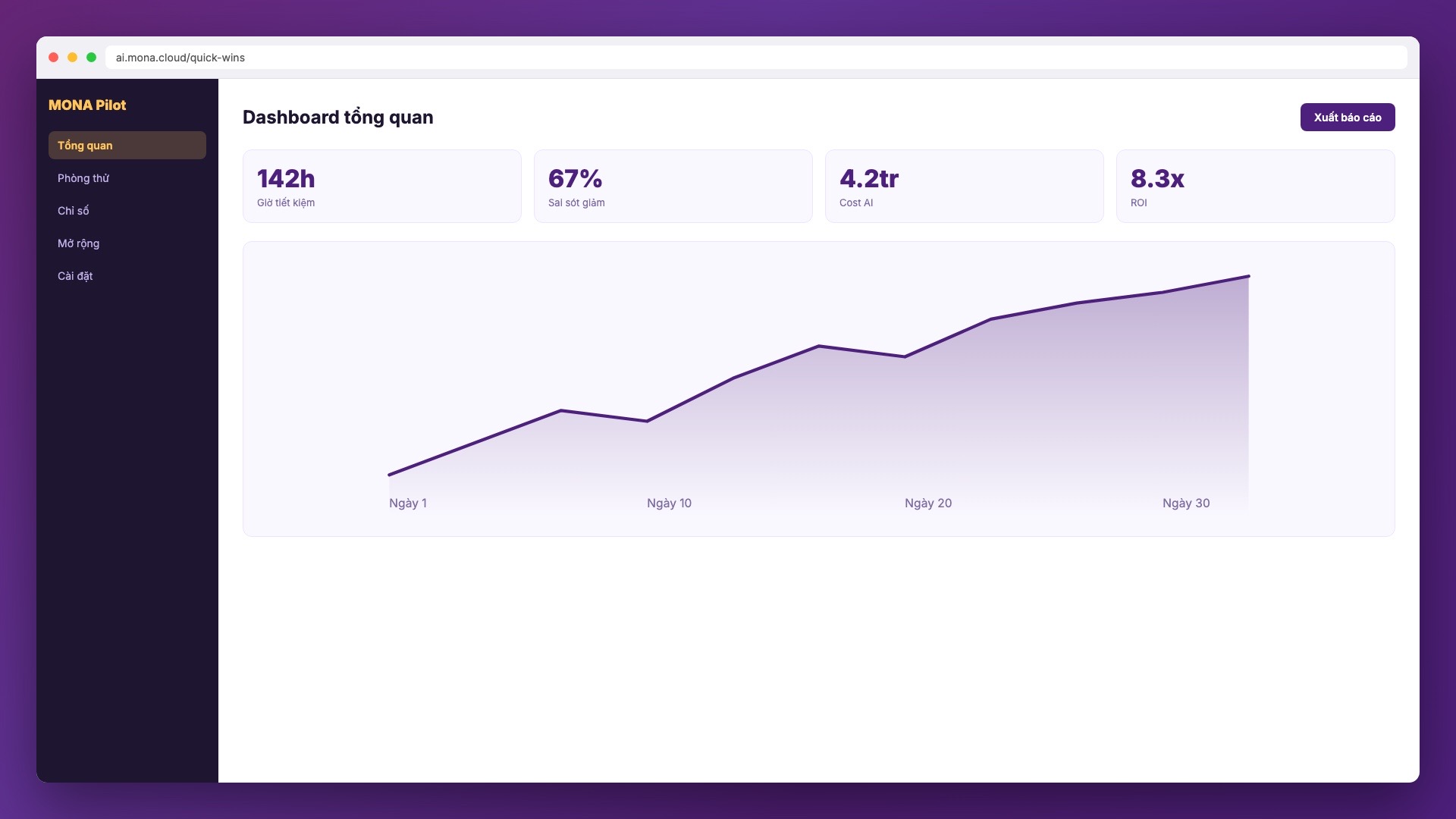
We don't suggest doing 9 things at once. We suggest picking 3 things for 3 different departments. Each one pays back in under 6 months and has its own dashboard. After 6 months, if the 3 are running steadily, open the next 5. This is the framework MONA has run successfully with nearly 30 mid-market chain owners.
These are the 3 things we usually propose first. The first is a Zalo OA or Messenger chatbot that answers 24/7 for customer care. The second is a callbot that re-engages cold customers or reminds people of appointments for operations. The third is automatic invoice reconciliation or receivables sheets for accounting. Three departments represent three groups of work, with three dashboards and three clear numbers.
A real estate chain with 9 offices and 130 agents in HCMC, with revenue of about 35 billion VND a month, ran exactly this framework. In June: locked in 3 priority use cases. July to September: rollout. October: full dashboard. November to December: expanded to the next 5 use cases. By year end it was saving 612 million VND a month on back-office staff and its opportunity funnel had grown 41%. For how to roll out this framework, see What is AI-First and CEO sai AI.
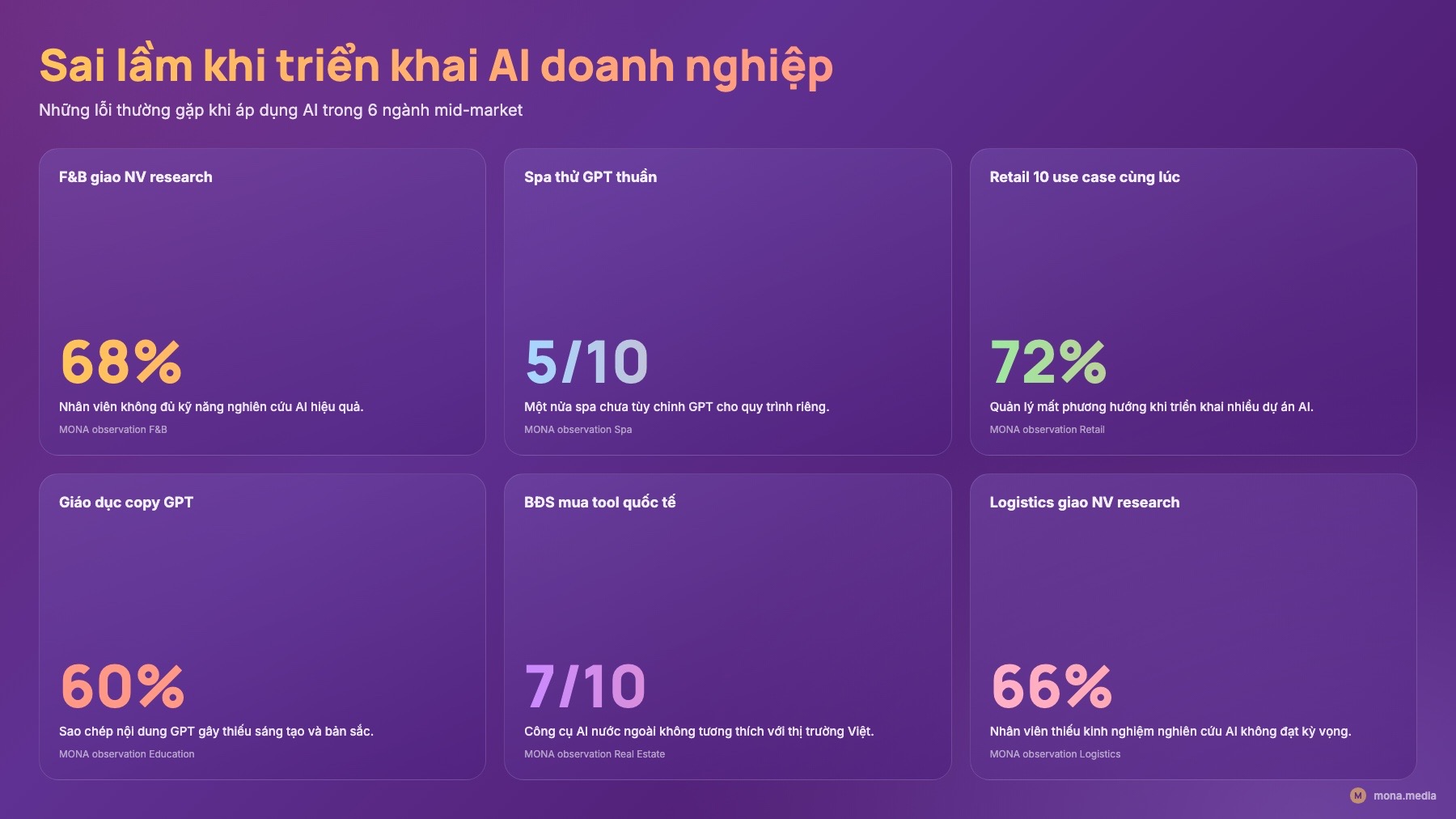
The 5-mistake framework you just read is not limited to one industry. We have seen similar patterns in the 6 industries below. Only the context changes, and so do the signs.
Retail chains with 20-50 branches usually make mistakes 1 and 3. The owner asks the head of operations to research whether AI can manage inventory by itself, and the result is “not yet”. Then the owner approves 7 projects at once for 7 key branches, and no department reaches the finish line.
Restaurant and food chains with 20-50 branches usually make mistakes 2 and 4. The owner tries ChatGPT on table-booking messages for a week, sees many errors and concludes AI can't do it yet. Then operations staff copy ChatGPT replies to customers on Zalo, get the combo policy wrong and lose credibility.
Education and training with 15-30 campuses usually make mistakes 1 and 5. The owner hands the research to the training director, who recommends no change. At the same time the owner buys 4 international tool plans for admissions, and the team uses 8% of them.
Healthcare clinic chains with 15-25 sites usually make mistakes 2 and 5. The owner tries ChatGPT for quick health advice, finds it unsafe and concludes AI isn't usable. At the same time they buy 3 expensive international appointment plans, and the front-desk staff aren't used to the interface.
Real estate with 5-12 offices and 80-150 agents usually makes mistakes 3 and 4. The owner approves 8 AI projects at once for 8 agent teams, and no team finishes. At the same time individual agents copy ChatGPT to answer customers on Zalo, getting the pricing policy and project information wrong. See details in the article the AI-First handbook for businesses.
Manufacturing with 200-600 workers usually makes mistakes 1 and 5. The owner has the head of engineering research AI for the production line. The head of engineering reports “not feasible” out of fear of losing their job. At the same time they import expensive international machines with no Vietnamese support for the operators. See more industry-specific products at Mona.Software and the set of mona.media enterprise automation blog.
Chain owners who read this article usually split into 2 groups. Group 1 nods along, thinks “right, I'll avoid that next time”, closes the tab and goes back to burning money on the old AI subscriptions, accepting that “our business isn't ready to do this properly” and treating the 5 mistakes as luck of the draw that everyone hits. Group 2 is the owners who, whether they run a chain of 10 branches or 50, immediately open Excel to check which of the 5 signs they have, ready to call a technical partner this weekend, ready to cancel 4 international tool subscriptions next month and ready to run a decisive independent audit that shocks even the heads of accounting and HR who hold those positions. MONA (we also run an operation with a sizeable team just like you, and we fixed these 5 mistakes for ourselves starting 20 April 2026) belongs to group 2, and we are fully confident sitting with group 2 owners to check these 5 mistakes against their own business. You are just a 45-minute call away. And it's free: a MONA specialist will review your business against these 5 signs (whatever stage you are at, whether a large long-tenured team or a young one, whether you already have an ERP or still use Excel, whether your data is clean or scattered, whether you haven't tried AI or have already burned 1 billion VND), and we have a way to break down every case. The free audit comes with a proposal for 3 priority use cases written specifically for your business. Book by email info@themona.global. Because this is already our 10th year bringing production-grade automation software to mid-market Vietnamese business owners.
We are not a point-tool vendor. We are an automation software team that writes custom software for each mid-market Vietnamese customer. Over the past 18 months we have sat with nearly 30 business owners. We write about 8-14 modules for each customer, and no customer shares modules with another.
If you'd like to try the first independent audit framework, see the article CEO sai AI. The article 30-day roadmap for a CEO who got AI wrong. If you'd like the 12-month roadmap framework, see the AI-First 12-month roadmap article in the same category. If you'd like the suite of industry automation software, see Mona.Software, for infrastructure see Mona.Host. Mona Cloud, for internal training see Khánh Hùng Academy and SkillHub Mona Academy. Cross-check global benchmarks at McKinsey QuantumBlack. Stanford AI Index, and the international chatbot risk case at Klarna AI rollback.
Which of the 5 mistakes above do you see yourself in? Have you measured your business last month on the 3 indicators (money, hours, errors), or are you still using the old reports? At MONA we believe Vietnamese business owners in 2026 are sharp enough to check these 5 mistakes, apply enterprise AI rollout to their own business and fix them before the year-end board meeting.
When you ask the head of HR to research ‘can AI replace my department’, a conflict of interest appears right away. The department head protects their own position and proposes AI only as a supporting assistant. They never propose that AI replace 50% of staff even when it's feasible. MONA always recommends hiring an independent audit.
Plain ChatGPT is just a generic LLM that doesn't understand your industry and has no access to your internal business data. You are right that it answered in generic terms, but concluding that AI is dumb is wrong. Real AI for business needs to be fine-tuned with industry data and integrated with internal systems. This is the level MONA builds at.
Resources get spread thin and no use case delivers a clear result. After 6 months the whole company is worn out and stops believing in AI. MONA always recommends picking 2-3 quick wins in the first quarter, measuring them with 3 indicators (money, hours, errors), and expanding only once the results are clear. Add at most 2-3 new use cases each quarter. See details in the article the AI-First handbook for businesses.
Copying means using a human hand as the bridge between AI and your systems. It costs people, causes errors and doesn't scale. An automated chain is an API that connects AI to your CRM, ERP and accounting and sends emails automatically, with no one in the middle. MONA always builds production-grade automated chains instead of letting staff copy back and forth.
International tools like Salesforce Einstein and Microsoft Copilot are powerful but weak in Vietnamese and don't understand Vietnamese law. You pay to learn, pay to translate and still can't use them deeply. MONA writes native Vietnamese software and integrates international tools where needed. We don't make you replace your whole stack.

CEO & Founder · The MONA
The founder of The MONA built a service company of 60+ staff with 14,000+ projects delivered. Khánh Hùng shares his thinking on building self-running systems, automating a business, and the real lessons behind MONA's projects.
 373




Professional website
design services
Own a website with a beautiful, 100% exclusive design and a lifetime warranty, with the ability
to expand features flexibly as your business grows, starting today!






 MONA will never sell your information or send you spam


 MONA will never sell your information or send you spam
