
 MONA OS 2.0
 Partner with MONA


 Tự động hoá doanh nghiệp
 Cẩm nang SEO
 Digital Marketing
 Kinh nghiệm thiết kế website
 Hạ Tầng Server
 Giáo dục


 VI
 EN














Message us on
Zalo Official


 ProductsNew

 ProductsProducts
 Mới ra mắtKHA AI 2027App tự edit video, tự đăng mọi mạng xã hội, 2 phút mỗi ngày










 Website designLooks good and wins customers over.
SEO servicesBrings in customers searching for exactly what you sell.
 Tư vấn digital marketingKéo khách từ nhiều kênh, đo bằng số thật.
Corporate video productionVideos introducing your company, factory and team.
 NewAI video productionCompany story films made with AI.
 Custom software developmentCRM, ERP and HRM built for your business.
 Viết AI Agent theo yêu cầuĐặt riêng một trợ lý AI cho đúng việc của mình.
 Tư vấn chuyển đổi AIĐưa AI vào vận hành của cả công ty.
NewMONA LMSManagement for centers and schools.
MONA SkillHubInternal training for company staff.
 NHTQ systemEnd-to-end China–Vietnam shipping operations.
MONA JMSManagement for gold, diamond and pawn shops.
 MONA E-LearningA website with every feature you need to sell courses.
 How to sell online courses (course)More than 30 free lessons on selling courses on autopilot.
 MONA Cloudmonacloud.vnServers to get your apps and websites running.
 MONA Basemonabase.vnPostgres database, sign-in and file storage.
 MONA Mailmonamail.vnSend OTP, order and invoice emails from your software.
 MONA Paymonapay.vnAccept bank transfers via VietQR and notify your software when the money arrives.
 MONA eInvoiceComing soonIssue e-invoices that meet tax standards.
Gấu CườiTrả lời khách 24/7 trên web, Fanpage, Zalo và thu lead cho sale.
 Gấu TeleSalesGọi điện tư vấn, chăm khách như tổng đài viên thật.
Dê CườiTư vấn và chốt đơn cho shop ngay trong khung chat.
Gấu WebmasterNhắn nhóm Zalo là website được sửa xong.
 Gấu Pháp ChếSoạn hợp đồng, rà điều khoản trong vài phút.
 Gấu Báo GiáLên báo giá đúng mẫu và gửi khách ngay.
 AI chăm sóc khách hàngTheo dõi và giữ chân khách hàng cũ.
 Gấu Tuyển DụngLọc hồ sơ, hẹn lịch, phỏng vấn ứng viên.
 Mới ra mắt
KHA AI 2027
Xây kênh chuyên gia 2 phút mỗi ngày
Quay bằng điện thoại, AI tự edit video, tự đăng lên 16 nền tảng và tự trả lời bình luận, tin nhắn.
889.183lượt xem trên kênh CEO MONA sau 36 ngày
 Anh Khánh HùngCEO MONA đang dùng mỗi ngày
Xem app làm được gì
 AI
Gấu Cười MONA ĐANG TỰ XÀITrả lời khách 24/7 trên website, Zalo OA, Messenger và thu lead về cho sale.
Dê CườiChốt đơn bán lẻ và sàn: Shopee, TikTok Shop, web. Chăm cả khách sỉ, đại lý.
Gấu WebmasterCập nhật nội dung, tối ưu SEO website mỗi ngày.
Gấu TeleSalesGọi điện tư vấn, chăm khách như tổng đài viên thật.
Gấu Tuyển DụngLọc hồ sơ, hẹn lịch, phỏng vấn ứng viên tự động.
AI chăm sóc khách hàngGiữ khách cũ, cứu lead đã rớt cho phòng kinh doanh.
Gấu Pháp ChếSoạn hợp đồng, rà điều khoản trong vài phút.
Gấu Báo GiáLên báo giá đúng mẫu, gửi khách ngay khi có yêu cầu.
 Chuyển đổi AI toàn phầnGiải pháp tổng cho doanh nghiệp, 3 lớp triển khai.
 Viết AI Agent theo yêu cầuĐặt riêng một con AI gánh đúng nghiệp vụ của bạn.
 Custom softwareCRM, ERP and HRM with built-in AI automation.
 SEO & AEO thời đại AIĐược Google lẫn AI trích dẫn, không chỉ xếp hạng.
 Kiến thức AI cho doanh nghiệpBài phân tích, hướng dẫn ứng dụng AI vào vận hành.
 Free AI courses
 AI tools at work
App mới · KHA AI 2027
Xây kênh 2 phút mỗi ngày
AI tự edit video, tự đăng mọi mạng xã hội
Free consultation, 8am–10pm every day

25 July, 2026

🎓 Free course: Claude Code basics, lesson 3/10. The whole course is in the category Free AI courses package from MONA?
After this lesson, you'll grasp the philosophy that separates great AI users from mediocre ones: when you hand off work, attach a way to verify it. Along with it come two practical skills: giving feedback so the machine fixes the result accurately, and running several Claude Code sessions in parallel without getting confused.
Let's state plainly a truth that people selling AI courses like to hide: AI almost never gives a perfect result on the very first try. The first version usually reaches about 80%. Beginners see that, get disappointed, conclude “AI is useless”, and quit.
But look at how people work: a skilled craftsman might get it 100% right the first time, at the cost of 5 hours. The machine gives an 80% version in 2 minutes, and what pays off is that it can retry hundreds of times faster than a human: fix, check, fix again, each round taking just a few dozen seconds. Let it loop four or five rounds, 5 minutes in total, and the quality reaches what the craftsman took 5 hours to make. AI's value lies in iteration speed, not in the first shot.
To get that, the way you hand off work needs all three beats: hand off the work, let the machine do it, then make the machine verify its own result. A mediocre user has only the first two beats: hand off, receive the result, hand off the next. Missing the verification beat throws away most of the tool's value.
What verification means depends on the type of work:
At MONA we have a catchphrase for this: “looks done” isn't done. When the machine says it's done, it has to come with evidence: screenshots, test run results, a comparison table. Demand proof the way you'd demand a numbers report from an employee, and don't accept a bare report.

Once you have the 80% version, your part is giving feedback. Hard-won experience: gather all your comments into one go, pointing at each exact spot, instead of dribbling out one sentence at a time. For example, a good round of feedback for the website you just built:
“The logo in the left corner is too big, shrink it. The main headline is too bold, try a serif font and see. The portrait photo is cropped across the forehead, move it down and shrink it so the whole face fits in the frame. The button in the middle of the photo does nothing, either make it open the video or remove it. The customer review block is shifted left, center it. Change the copyright year in the footer to 2026.”
Six points in one round, and the machine fixes them in one pass. A tip that makes it three times faster: speak instead of typing. People type 50-70 words a minute and speak almost 200. Using a speech-to-text tool, you “unload” the whole stream of comments as if you were standing next to the craftsman's desk, and the machine understands it all.
This is when the “practice using the terminal” advice from lesson 1 pays off. Claude Code is not limited to one session: you open two or three terminal windows, each running a session on a different job. Lesson 2 built a website in a few minutes, so opening three sessions means building three options at once, then putting them side by side to pick your favorite. This flips the traditional habit of buying design: instead of waiting for one version and then revising back and forth, you have the machine produce three versions and choose.
But running in parallel has its price, and we want you to know it upfront so you aren't disillusioned:

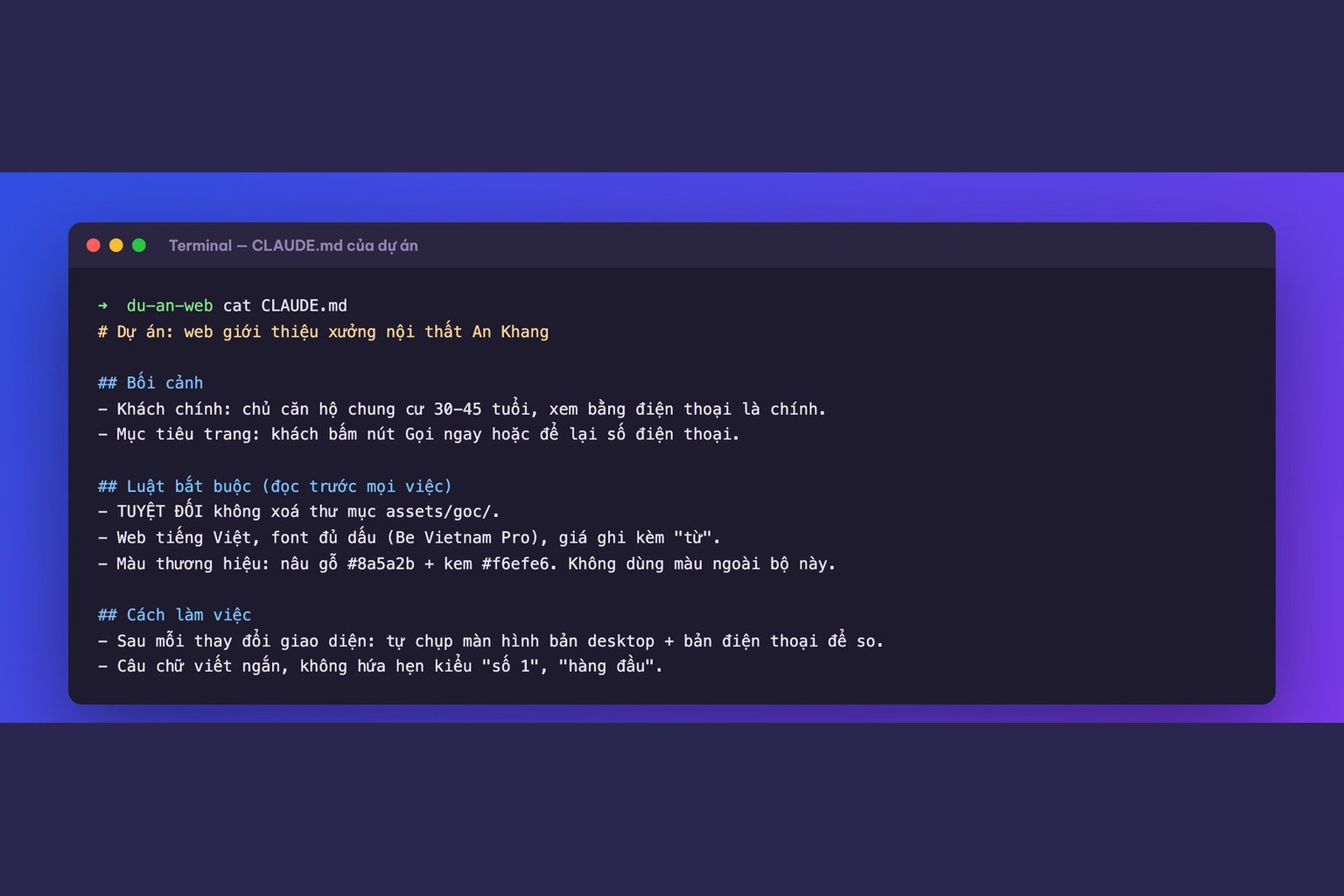
A mistake beginners building websites often make: only admiring the result on a computer screen. Yet in Vietnam, most of your customers open websites on their phones. Your command needs one more verification beat: “check the phone display, take a portrait screenshot for me to look at, and fix any text that overflows or any image that's distorted.” The machine can do all of it, as long as you remember to ask.
Lesson 4 opens a door that most Claude Code users have never opened: the .claude folder with settings, hooks, rules, plus the working modes (plan mode, the skip-permission-prompts mode) and the set of slash commands. Once you understand lesson 4, you belong to the 10% of users who grasp this tool's deeper toolkit.

CEO & Founder · The MONA
The founder of The MONA built a service company of 60+ staff with 14,000+ projects delivered. Khánh Hùng shares his thinking on building self-running systems, automating a business, and the real lessons behind MONA's projects.
 386




Professional website
design services
Own a website with a beautiful, 100% exclusive design and a lifetime warranty, with the ability
to expand features flexibly as your business grows, starting today!






 MONA will never sell your information or send you spam


 MONA will never sell your information or send you spam
