
 MONA OS 2.0
 Partner with MONA


 Tự động hoá doanh nghiệp
 Cẩm nang SEO
 Digital Marketing
 Kinh nghiệm thiết kế website
 Hạ Tầng Server
 Giáo dục


 VI
 EN












Message us on
Zalo Official


 ProductsNew

 ProductsProducts
 Mới ra mắtKHA AI 2027App tự edit video, tự đăng mọi mạng xã hội, 2 phút mỗi ngày










 Website designLooks good and wins customers over.
SEO servicesBrings in customers searching for exactly what you sell.
 Tư vấn digital marketingKéo khách từ nhiều kênh, đo bằng số thật.
Corporate video productionVideos introducing your company, factory and team.
 NewAI video productionCompany story films made with AI.
 Custom software developmentCRM, ERP and HRM built for your business.
 Viết AI Agent theo yêu cầuĐặt riêng một trợ lý AI cho đúng việc của mình.
 Tư vấn chuyển đổi AIĐưa AI vào vận hành của cả công ty.
NewMONA LMSManagement for centers and schools.
MONA SkillHubInternal training for company staff.
 NHTQ systemEnd-to-end China–Vietnam shipping operations.
MONA JMSManagement for gold, diamond and pawn shops.
 MONA E-LearningA website with every feature you need to sell courses.
 How to sell online courses (course)More than 30 free lessons on selling courses on autopilot.
 MONA Cloudmonacloud.vnServers to get your apps and websites running.
 MONA Basemonabase.vnPostgres database, sign-in and file storage.
 MONA Mailmonamail.vnSend OTP, order and invoice emails from your software.
 MONA Paymonapay.vnAccept bank transfers via VietQR and notify your software when the money arrives.
 MONA eInvoiceComing soonIssue e-invoices that meet tax standards.
Gấu CườiTrả lời khách 24/7 trên web, Fanpage, Zalo và thu lead cho sale.
 Gấu TeleSalesGọi điện tư vấn, chăm khách như tổng đài viên thật.
Dê CườiTư vấn và chốt đơn cho shop ngay trong khung chat.
Gấu WebmasterNhắn nhóm Zalo là website được sửa xong.
 Gấu Pháp ChếSoạn hợp đồng, rà điều khoản trong vài phút.
 Gấu Báo GiáLên báo giá đúng mẫu và gửi khách ngay.
 AI chăm sóc khách hàngTheo dõi và giữ chân khách hàng cũ.
 Gấu Tuyển DụngLọc hồ sơ, hẹn lịch, phỏng vấn ứng viên.
 Mới ra mắt
KHA AI 2027
Xây kênh chuyên gia 2 phút mỗi ngày
Quay bằng điện thoại, AI tự edit video, tự đăng lên 16 nền tảng và tự trả lời bình luận, tin nhắn.
892.224lượt xem trên kênh CEO MONA sau 37 ngày
 Anh Khánh HùngCEO MONA đang dùng mỗi ngày
Xem app làm được gì
 AI
Gấu Cười MONA ĐANG TỰ XÀITrả lời khách 24/7 trên website, Zalo OA, Messenger và thu lead về cho sale.
Dê CườiChốt đơn bán lẻ và sàn: Shopee, TikTok Shop, web. Chăm cả khách sỉ, đại lý.
Gấu WebmasterCập nhật nội dung, tối ưu SEO website mỗi ngày.
Gấu TeleSalesGọi điện tư vấn, chăm khách như tổng đài viên thật.
Gấu Tuyển DụngLọc hồ sơ, hẹn lịch, phỏng vấn ứng viên tự động.
AI chăm sóc khách hàngGiữ khách cũ, cứu lead đã rớt cho phòng kinh doanh.
Gấu Pháp ChếSoạn hợp đồng, rà điều khoản trong vài phút.
Gấu Báo GiáLên báo giá đúng mẫu, gửi khách ngay khi có yêu cầu.
 Chuyển đổi AI toàn phầnGiải pháp tổng cho doanh nghiệp, 3 lớp triển khai.
 Viết AI Agent theo yêu cầuĐặt riêng một con AI gánh đúng nghiệp vụ của bạn.
 Custom softwareCRM, ERP and HRM with built-in AI automation.
 SEO & AEO thời đại AIĐược Google lẫn AI trích dẫn, không chỉ xếp hạng.
 Kiến thức AI cho doanh nghiệpBài phân tích, hướng dẫn ứng dụng AI vào vận hành.
 Free AI courses
 AI tools at work
App mới · KHA AI 2027
Xây kênh 2 phút mỗi ngày
AI tự edit video, tự đăng mọi mạng xã hội
Free consultation, 8am–10pm every day

09 July, 2026
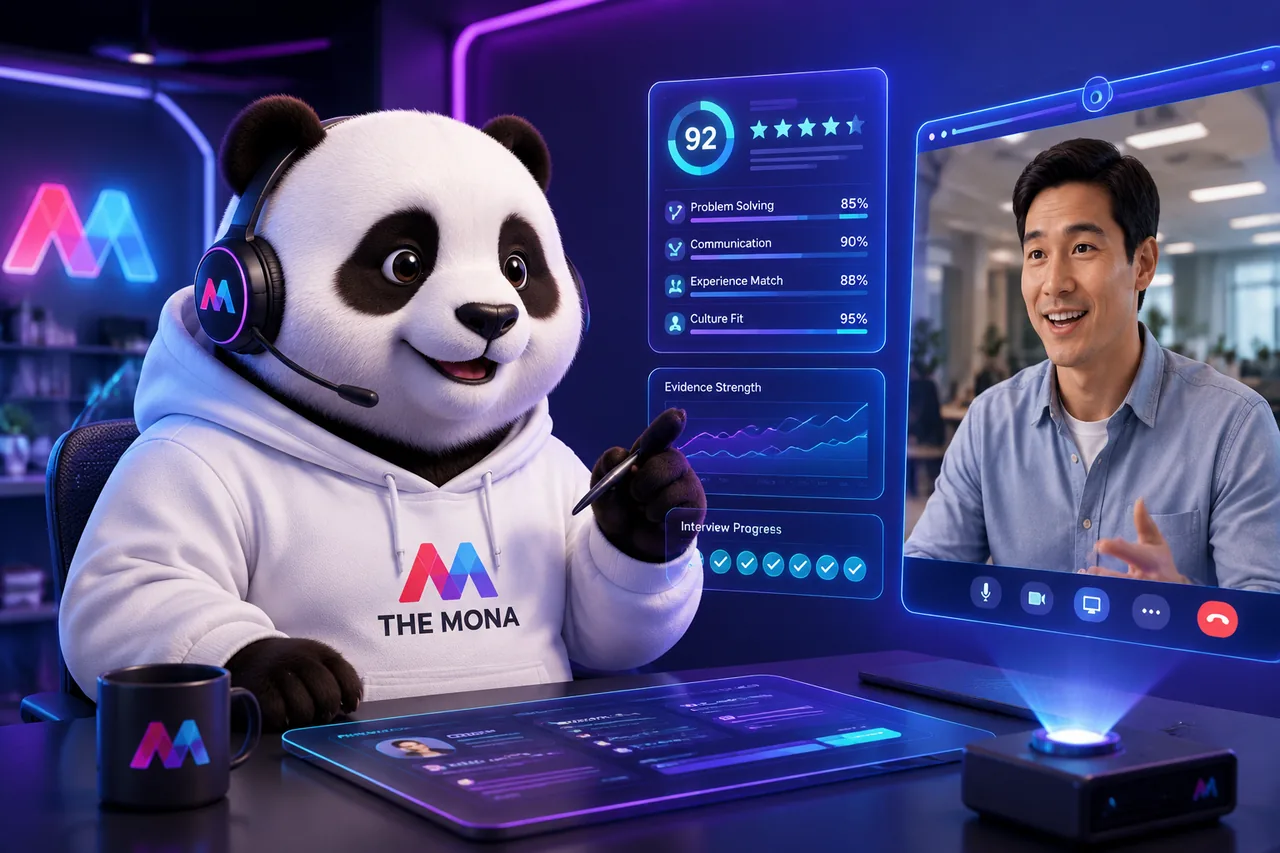
The most people-intensive step in recruitment isn't posting the job, it's the first-round interview. Your leader has to meet dozens of candidates, ask the same few questions over and over, and then most get rejected after five minutes. automated AI interviews was built to carry exactly this round: the machine talks with candidates through real work scenarios and scores objectively with evidence, so your people only meet those truly worth meeting. In this article we explain how it works and why MONA believes in this approach.
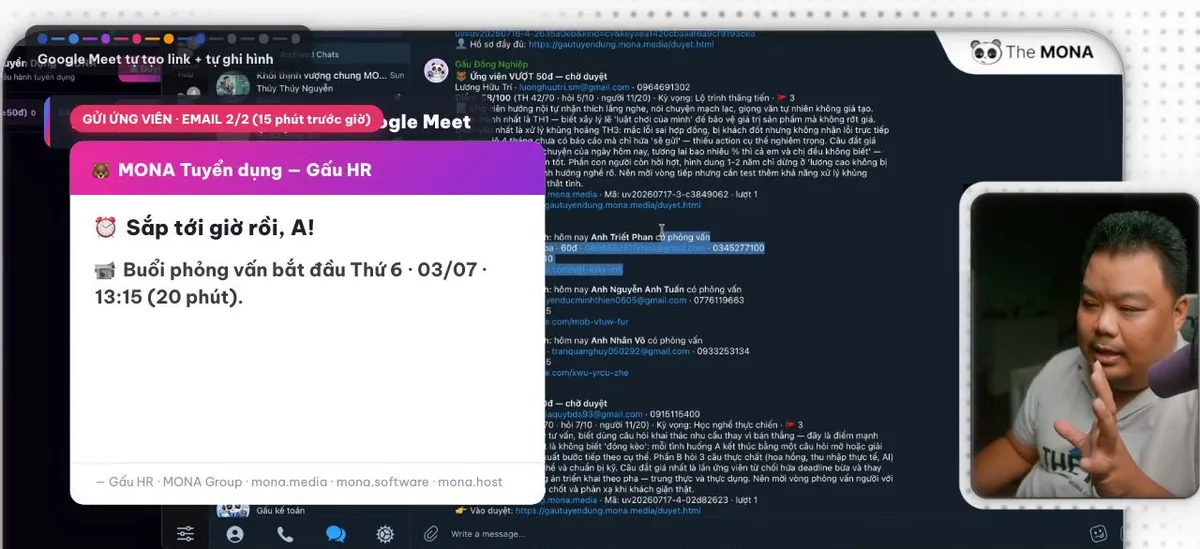
Many people picture a machine reading out fixed questions and making candidates answer multiple choice. That's not it. A properly built AI interview system plays the conversation partner: it sets up a scenario, listens to the answer, then asks a follow-up based on what it just heard.
For a customer care role, for example, the machine plays a customer annoyed about a late delivery. Depending on how the candidate handles it, the machine pushes a harder scenario, just like a real working session. This dynamic questioning gives a much closer picture than reading a polished CV. It is the natural next step after you have already AI CV screening at the application stage.
A big difference: the machine asks everyone the same way, with no bias for looks or accent, and it doesn't get tired after the twentieth person. Every candidate is judged against the same yardstick.
A question like “what do you think your strengths are” is nearly useless, because everyone memorizes a nice answer. Smooth talkers breeze through, while capable but quiet people get unfairly rejected.
Scenario interviews flip that. You don't ask candidates to praise themselves, you put them in the real work situation and watch what they do. A good salesperson shows up in how they handle a customer who is saying no, not in the line “I have a high sense of responsibility”. With the same thinking, we also use machines so that an AI Agent for business management measures the team's real performance instead of listening to pretty reports.
This way of judging through real work isn't something MONA invented. Harvard Business Review has long shown that scenario-based interviews predict job performance better than theory questions. Gartner notes that many HR departments are shifting to assessment based on real ability, and McKinsey shows that AI helps extend this approach to hundreds of candidates. To prevent rote preparation, a good system also shuffles questions across many variants and by industry, so two candidates applying for the same role won't get the same set. It is the same thinking we use when standardizing sales teams: measure by real performance, not by promises.
A legitimate worry: if a machine gives the scores, what guarantees it isn't scoring at random? The answer is that scoring must be transparent and backed by evidence.
Our interview system scores on a clear scale, split across several axes such as situation handling, problem-solving and attitude toward customers. Each score comes with a quote of exactly what the candidate said, plus a few-line summary the reviewer can read in half a minute. There is a pass/fail threshold set in advance, and borderline applications are always reviewed by a person rather than left to the machine alone.
Scoring with evidence matters because it gives you the right to overturn the machine's decision. You don't receive a bare score, you receive the reasons. That is the line between a trustworthy tool and a black box.
You may worry that candidates will find interviewing with a machine cold and lose goodwill toward the company. Done right, the opposite happens.
Candidates can interview any time they are free, without taking time off work to attend and without a week of back-and-forth scheduling emails. They are asked real scenarios, so they feel fairly evaluated instead of being rejected because of one meeting where the interviewer was tired. Many even say they like it because they get to show real ability.
The lighter chat that answers questions, sends reminders and keeps candidates from dropping out midway, we split into its own track, which you can read about in the recruitment chatbot article. The two complement each other: the chatbot keeps candidates engaged, and the AI interview evaluates ability.
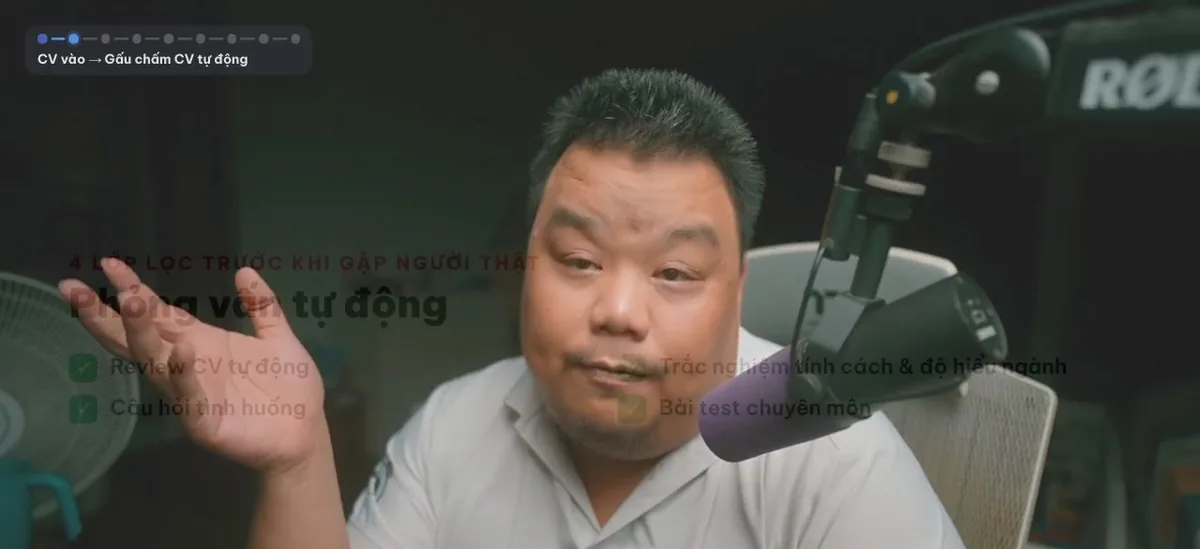
Any industry that has to interview many people for the same type of role benefits from this approach.
What they share is the problem of “many interviews, the same criteria, and standards that drift between recruiters”. This is also why AI interviews usually come with the whole applying AI in the HR departmentrather than standing alone. They typically connect to recruitment management software to store results, and to the broader direction of business automation.
We're not talking theory. Right now MONA is hiring Account staff with its own AI interview system, running on real ads at a real cost per candidate who passes the first round.
Candidates talk with an AI playing a difficult client, handle three real scenarios from the job, get scored on a threshold-based scale, then book a meeting with the leader for the final round. This whole outer round is about 80% automated, and people step in only at the deciding moment. For training candidates after they are hired, you can look at Khánh Hùng Academy. This is one piece of a recruitment AI Agent from MONA, sitting alongside the AI Agent suite that we built for ourselves and then opened up to businesses.
A frank word: we don't advise you to stitch together drag-and-drop tools to build an AI interview booth. They work when you test a few people, but in peak season, with hundreds of candidates arriving at once, they clog and fail easily, and nobody is accountable when they break. MONA builds custom software that carries load day and night, with a team behind it. If you want a more complete HR system, the Mona Software team also builds custom CRM, HRM and ERP management software, or a recruitment website as the gateway for receiving applications.
🐻 MONA uses its own AI Agent for recruitment
This isn't theory. Right now MONA is hiring Account staff with its own a recruitment AI Agent system: it runs on real ads, interviews and scores candidates automatically for about 80% of the outer-round process, at a real cost of about 12,000 VND per candidate who passes the first round. With the same method, MONA screened 1,000 worker applications in 3 hours. See the system running for real, then decide.
Book a demo of MONA's recruitment AI Agent →Organizing an interview has always been a pile of small chores: messaging back and forth to fix a time, creating a meeting room, reminding the interviewer so they don't forget, and after the session sitting down to recall what the candidate said so you can write notes for the boss. Each is tiny, but together they add up to half an HR workday per candidate. An automated interview system hands that whole chain to the machine.
The flow works like this. A candidate who passes screening is invited to pick a slot from the interviewer's open calendar, and once chosen, both calendars sync on their own. At the scheduled time, the system creates a Google Meet room automatically: the link goes to the candidate by email, and the interviewer gets a Telegram alert just before the start and only has to click in. The interview is recorded automatically and the recording becomes a transcript, a written record of everything both sides said, with no sentence missed. The AI reads the transcript and rescores against the role's own criteria sheet, producing an objective review for the boss to approve. Whether the interviewer that day was easygoing or in a bad mood, the machine's scoring still sticks to the criteria. Two views side by side make for a fairer decision for the candidate.
The system also has one small but firm rule: a candidate who books and then doesn't show up, without notice, has their phone number and email added to a permanent blacklist. The machine keeps the schedule seriously and asks for the same seriousness back from participants.
Not entirely. The machine handles the outer round to screen and do preliminary scoring, while the final meeting and the decision about who to hire stay with people. This way the leader only meets candidates who have already been screened.
The system guards against rote preparation by shuffling questions across many variants and asking dynamically based on the answers, so it is hard to prepare in advance. There is also still the final in-person round to cross-check.
The higher the role, the bigger the human part of the meeting. AI fits best in the outer round for volume-hiring roles, while for senior management it is better to let the machine do a preliminary screen and then have people interview in depth.
A serious system stores and processes data inside the business's own system, masks personal information as required by regulations, and doesn't send it outside. Ask any provider about this point in detail.
Pick the one position you interview for most, then count the hours your leader spends on the first round each month. Multiply that by their hourly pay and you'll immediately see the amount automated AI interviews can give back.
Once you have the number, we invite you to book a call with MONA. We'll show you an AI interview running for real and work out how to apply it to the exact position where you're short of people. If you want the big picture first, start with the article What is AI recruitment.
To see how this AI interview round fits into the complete package, visit the page the AI recruitment software Gấu Tuyển Dụng.

CEO & Founder · The MONA
The founder of The MONA built a service company of 60+ staff with 14,000+ projects delivered. Khánh Hùng shares his thinking on building self-running systems, automating a business, and the real lessons behind MONA's projects.
 411




Professional website
design services
Own a website with a beautiful, 100% exclusive design and a lifetime warranty, with the ability
to expand features flexibly as your business grows, starting today!






 MONA will never sell your information or send you spam


 MONA will never sell your information or send you spam
