
 MONA OS 2.0
 Hợp tác với MONA


 Tự động hoá doanh nghiệp
 Cẩm nang SEO
 Digital Marketing
 Kinh nghiệm thiết kế website
 Hạ Tầng Server
 Giáo dục


 VI
 EN














Message us on
Zalo Official


 ProductsNew

 ProductsProducts
 Mới ra mắtKHA AI 2027App tự edit video, tự đăng mọi mạng xã hội, 2 phút mỗi ngày










 Thiết kế websiteVừa đẹp vừa thuyết phục được khách.
Dịch vụ SEOKéo về khách đang tìm đúng thứ anh chị bán.
 Tư vấn digital marketingKéo khách từ nhiều kênh, đo bằng số thật.
Quay video doanh nghiệpVideo giới thiệu công ty, nhà xưởng, đội ngũ.
 MớiDựng video AIDựng phim câu chuyện công ty bằng AI.
 Custom software developmentCRM, ERP and HRM built for your business.
 Viết AI Agent theo yêu cầuĐặt riêng một trợ lý AI cho đúng việc của mình.
 Tư vấn chuyển đổi AIĐưa AI vào vận hành của cả công ty.
NewMONA LMSManagement for centers and schools.
MONA SkillHubInternal training for company staff.
 NHTQ systemEnd-to-end China–Vietnam shipping operations.
MONA JMSManagement for gold, diamond and pawn shops.
 MONA E-LearningA website with every feature you need to sell courses.
 How to sell online courses (course)More than 30 free lessons on selling courses on autopilot.
 MONA Cloudmonacloud.vnServers to get your apps and websites running.
 MONA Basemonabase.vnPostgres database, sign-in and file storage.
 MONA Mailmonamail.vnSend OTP, order and invoice emails from your software.
 MONA Paymonapay.vnAccept bank transfers via VietQR and notify your software when the money arrives.
 MONA eInvoiceComing soonIssue e-invoices that meet tax standards.
Gấu CườiTrả lời khách 24/7 trên web, Fanpage, Zalo và thu lead cho sale.
 Gấu TeleSalesGọi điện tư vấn, chăm khách như tổng đài viên thật.
Dê CườiTư vấn và chốt đơn cho shop ngay trong khung chat.
Gấu WebmasterNhắn nhóm Zalo là website được sửa xong.
 Gấu Pháp ChếSoạn hợp đồng, rà điều khoản trong vài phút.
 Gấu Báo GiáLên báo giá đúng mẫu và gửi khách ngay.
 AI chăm sóc khách hàngTheo dõi và giữ chân khách hàng cũ.
 Gấu Tuyển DụngLọc hồ sơ, hẹn lịch, phỏng vấn ứng viên.
 Mới ra mắt
KHA AI 2027
Xây kênh chuyên gia 2 phút mỗi ngày
Quay bằng điện thoại, AI tự edit video, tự đăng lên 16 nền tảng và tự trả lời bình luận, tin nhắn.
878.582lượt xem trên kênh CEO MONA sau 35 ngày
 Anh Khánh HùngCEO MONA đang dùng mỗi ngày
Xem app làm được gì
 AI
Gấu Cười MONA ĐANG TỰ XÀITrả lời khách 24/7 trên website, Zalo OA, Messenger và thu lead về cho sale.
Dê CườiChốt đơn bán lẻ và sàn: Shopee, TikTok Shop, web. Chăm cả khách sỉ, đại lý.
Gấu WebmasterCập nhật nội dung, tối ưu SEO website mỗi ngày.
Gấu TeleSalesGọi điện tư vấn, chăm khách như tổng đài viên thật.
Gấu Tuyển DụngLọc hồ sơ, hẹn lịch, phỏng vấn ứng viên tự động.
AI chăm sóc khách hàngGiữ khách cũ, cứu lead đã rớt cho phòng kinh doanh.
Gấu Pháp ChếSoạn hợp đồng, rà điều khoản trong vài phút.
Gấu Báo GiáLên báo giá đúng mẫu, gửi khách ngay khi có yêu cầu.
 Chuyển đổi AI toàn phầnGiải pháp tổng cho doanh nghiệp, 3 lớp triển khai.
 Viết AI Agent theo yêu cầuĐặt riêng một con AI gánh đúng nghiệp vụ của bạn.
 Custom softwareCRM, ERP and HRM with built-in AI automation.
 SEO & AEO thời đại AIĐược Google lẫn AI trích dẫn, không chỉ xếp hạng.
 Kiến thức AI cho doanh nghiệpBài phân tích, hướng dẫn ứng dụng AI vào vận hành.
 Free AI courses
 AI tools at work
App mới · KHA AI 2027
Xây kênh 2 phút mỗi ngày
AI tự edit video, tự đăng mọi mạng xã hội
Free consultation, 8am–10pm every day

09 September, 2026

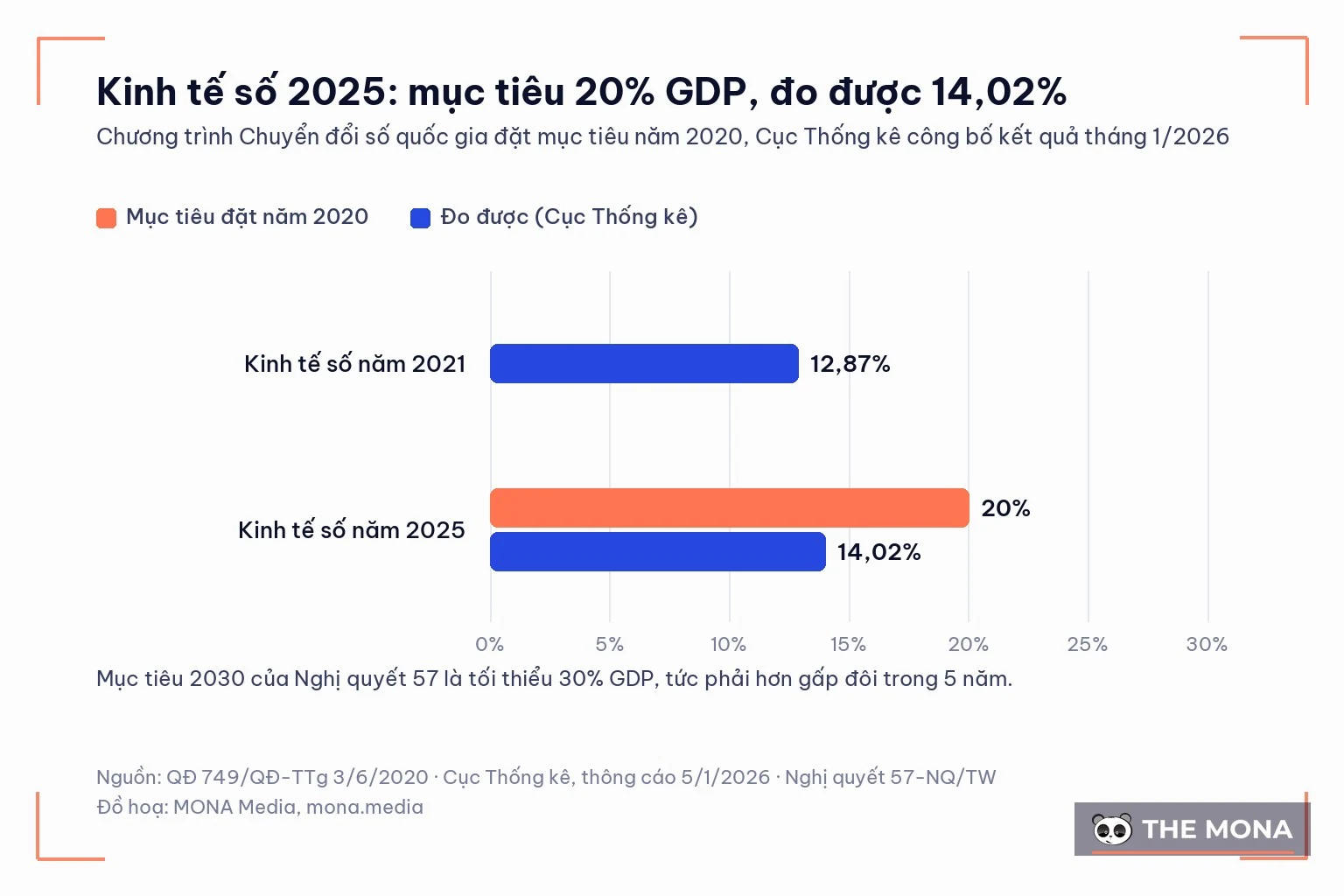
We guess you still remember 2020. The whole country talked about digital transformation, every conference shouted it, every paper wrote about it, and you sat down too and worked out building a proper website and buying some customer management software, then the pandemic passed, regulars came back, orders flowed in steadily, you saw that not doing it didn't kill you, and that was that. Now in 2026 you hear people say AI transformation is mandatory, and the first reflex is very natural: probably like last time, let's wait and see. We don't blame that reflex, because last time you really could miss it, and the numbers prove it: the National Digital Transformation Program signed in 2020 set a target of the digital economy reaching 20% of GDP by 2025, and the General Statistics Office measured 14.02%; the share of businesses with a website over the 8 years from 2018 to 2025 stayed around 42 to 46%. The whole country missed that train, and the whole country survived. But our view, after the previous two articles and many sessions sitting with clients, is that this train is different: AI transformation is mandatory, and the difference is that it can be measured, not that it is shouted louder.
In this article we answer 3 questions. Why you could miss the last train. Why you can't miss this one, with 3 reasons that sit with your customers, your competitors and your own people. And what “climb aboard fast” means in 30 days, because we see many people read “fast” as “buy a lot,” then get left behind precisely because they bought a lot.
Quick summary: The 2020 digital transformation train was optional: a digital economy target of 20% of GDP with 14.02% measured, business websites standing still for 8 years, and yet most companies survived on regulars and Zalo. The AI transformation train is mandatory because 3 things have already happened: customers ask AI before they ask anyone (94% of business buyers use AI when buying, Forrester 2026), competitors cut costs with AI, and 76% of Vietnamese leaders won't hire people without AI skills. Being left behind means a gap in data and processes that compounds every year, and money can't buy it back. Climbing aboard fast means that in 30 days one step is running with numbers, not 30 days of buying 10 subscriptions.

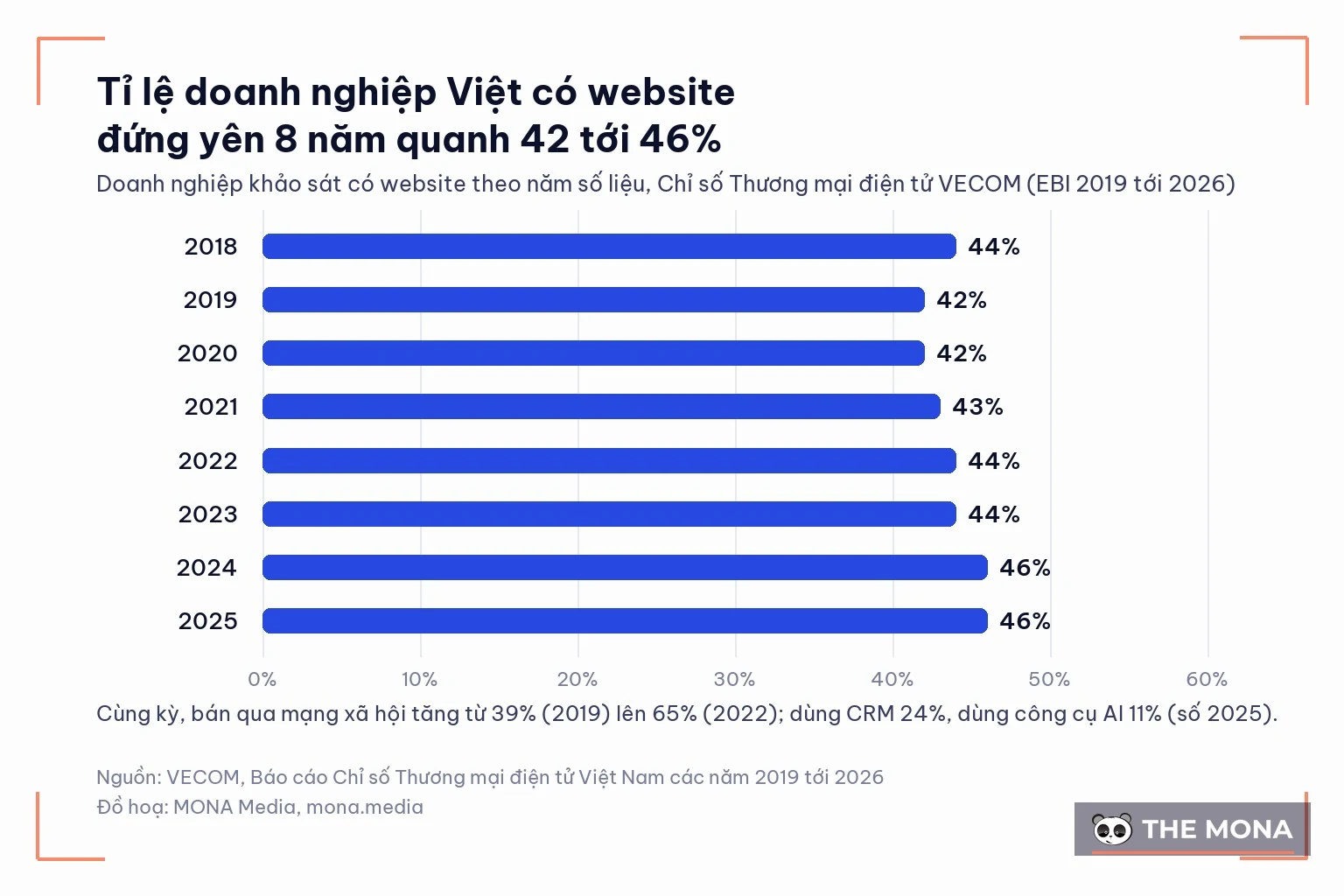
Numbers first, stories after. Decision 749 of June 3, 2020 set the target that by 2025 the digital economy would account for 20% of GDP and at least 10% in each sector. The General Statistics Office reported in January 2026: in 2025 the digital economy was 14.02% of GDP, up from 12.66% in 2020, meaning just under 1.4 percentage points of movement in 5 years and a miss of about 6 points against the target. The Ministry of Information and Communications previously calculated it differently and arrived at 18.3% for 2024, but since late 2025 the government uses the General Statistics Office figure, so we use that one. At the business level, VECOM's E-commerce Index tracks the share of businesses with a website year by year: 44% in 2018, 42% in 2019, 42% in 2020, 43% in 2021, 44% in 2022, 44% in 2023, and 46% in 2024 and 2025. Eight years, two percentage points. Over the same period, selling through social media jumped from 39% in 2019 to 65% in 2022, and by the 2025 data only 24% use a CRM and only 11% use AI tools.
The Enterprise Digital Transformation annual report from the Agency for Enterprise Development, 2022 edition, has a figure we still remember: 48.8% of businesses once used a digital transformation solution but no longer do, only 2.2% have mastered technology or management software, and 6.2% have finished defining their digital transformation goals. As of October 2025, the Ministry of Science and Technology still recorded 69% of businesses at the basic adoption level. The SMEdx program reported 407,712 small and medium businesses using digital platforms in 2024, over 43% of the total, but “using a platform” here means signing up and trying it, which is not the same as running it for real every day, and that is exactly why in March 2026 the Prime Minister had to sign another Digital Transformation Project for Small and Medium Enterprises 2026 to 2030, targeting 500,000 businesses. The 2020 train has gone. Most are still standing on the platform.
We see that platform very clearly, because MONA sells tickets right there. In 2020 and 2021, at the height of the pandemic, inquiries for e-commerce websites at MONA doubled, and everyone built a website because there was nowhere else to sell. By 2022 and 2023, most of those websites weren't being updated by anyone, and when we opened them we still saw a Tet banner hanging in the middle of June. In 2025 we met those same clients again with a new question: “let's do AI.” A mother-and-baby chain with 6 stores built a website with us in 2021, abandoned it from 2022, and came back in April 2025 asking about a chatbot. When we opened the numbers, the website had 40 visits a month, mostly staff visiting on their own. We told that story in the article on who benefits from AI and article on how far AI in Vietnamese businesses has come, so here we go straight to the harder question: you missed that train, so why did you survive?
We'll be honest, and say the opposite of most articles on digital transformation: a business with no website and no CRM can still survive in 2026, even do well. Regulars call, partners message on Zalo, orders close on Facebook, the accountant keeps Excel, and at year end there is still profit. Digital transformation digital transformation makes everything faster, with fewer errors and fewer people, but it doesn't change how customers find you in the short term, and it won't make you lose customers right away if you skip it. It is an optional train. Those who board go faster, those who don't walk, and walking still gets you to the market.
The numbers say the same if you read them closely. The World Bank surveyed Vietnamese businesses in December 2020, in the middle of the pandemic: 78% of businesses increased their use of digital platforms, and the group using digital platforms had a higher share of online sales and higher revenue growth. The advantage was real. But the other 22% increased nothing, and most are still around today, because that advantage is one of speed and margin, not of life and death. Google, Temasek and Bain measured in 2020 that 41% of digital service users in Vietnam were new, and 94% said they would keep using them; buyers had gone online, but they still messaged their regular shop on Zalo rather than demanding the shop have a website.
We have a client selling plumbing supplies in District 12 who built a website with MONA in 2020 and then ignored it for 3 years, yet revenue kept growing steadily thanks to 2 strong sales staff on Zalo and a list of 300 regular contractors. In 2024 he told us: “I don't need a website, my customers are already there.” That was true, at least until then, and we didn't argue. The last train was optional, so you could miss it. The question is whether this train is still optional, and we see 3 places that make it completely different, the first of which sits on your customers' side.

On the last train, the tool was in the business's hands: whether you built a website was up to you, and customers still asked on Zalo. On this train, the tool is in the customer's hands first. e-Conomy SEA 2025 measured 81% of Vietnamese users saying they use AI tools daily, the highest in Southeast Asia. ChatGPT had 800 million weekly users as of October 2025 according to Sam Altman himself, and by UBS estimates it took only 2 months to reach its first 100 million users. Gartner forecast in February 2024 that by 2026 traditional search engine volume would fall 25% because of AI chatbots. Bain measured in February 2025: about 80% of users rely on AI summaries for at least 40% of their searches, about 60% of searches end without a click, and organic traffic to websites fell 15 to 25%. Pew measured in July 2025: when Google shows an AI summary, only 8% of people click a result below it, versus 15% when there is none.
Business-to-business buying is moving even faster. Forrester, January 2026: 94% of business buyers use AI in their buying process. Gartner in May 2026 asked 645 B2B buyers: 45% have used generative AI, mostly to research suppliers, and Gartner forecasts that by 2028, 90% of B2B buying will go through AI agents. G2 measured in 2026: 51% of software buyers start their research with an AI chatbot more than with Google, up from 29% just a year earlier. BrightLocal 2026: the share of people using AI to ask for place and service recommendations jumped from 6% to 45% in 1 year. What does that mean for a factory owner in Binh Duong? It means his new customer, before calling anyone, asks AI “reliable mechanical machining workshop in Binh Duong” and AI answers with 5 names. If he isn't among those 5, he loses the customer, and he never knows he just lost one. On the last train, if you missed it, customers still messaged you on Zalo. On this train, customers ask AI before they ask anyone.
We saw this earlier than our clients because we wrote our own tool that checks whether AI can read a company's website , and the scan results at clients startled us: many websites block AI bots at the server level without the site owner knowing, because the old web agency blocked all bots “for safety.” An interior design company with 3 showrooms in Ho Chi Minh City had a beautiful website and still got customers from Google every month, but in the first 6 months of 2026 not a single customer said “I saw you on ChatGPT,” while competitors in the same segment were already being named by AI. After the scan we found the site had been blocking AI bots since 2023. The fix took one afternoon. Six months of lost customers can't be fixed. That is the first reason, and the second sits with your competitors.

On the last train, when a competitor built a website they gained one more sales channel, but their cost of goods didn't change, so market prices didn't change, and you could skip the website and still sell at your old price. On this train, AI hits cost directly. Stanford AI Index 2026 compiled productivity gains by type of work: 26% in software development, 50% in marketing, 14 to 15% in customer support. Y Combinator's W25 batch had 25% of startups with 95% of their code written by AI. At FPT, the CodeVista tool lifted coding productivity by 30%, even if the whole project only improved about 10% according to Do Cao Bao. The most modest figure there, 10%, is enough for a competitor to quote 10% lower than you and still keep the same profit.
The principle in plain words: when 3 out of 10 competitors in the same industry get 20 to 30% cheaper, the whole industry's price floor sinks with them, and the one still working by hand loses money not on the annual report but on every order, because customers compare prices order by order. Web design, graphic design, content, translation and accounting services are seeing this first. Our own design team now has AI produce 20 layout options in about 10 minutes, work that took 2 days two years ago, and we have had to cut our cost in design and content to hold our selling price, not because we wanted to but because customers compare prices every week against 3 other quotes, one of which always comes from someone already using AI. Market prices don't wait for anyone.
That is the difference between the two trains. Digital transformation was about whether you were more convenient. AI transformation is about whether your competitor is cheaper than you, and in many industries the answer is already yes. Customers don't need to know what AI is; they just see the other side quoting lower and delivering faster. By then, choosing or not choosing is no longer the question. The third reason sits right inside your own company.
Microsoft Work Trend Index 2024, Vietnam edition, has three numbers we put side by side: 88% of Vietnamese knowledge workers already use generative AI at work, 76% of Vietnamese leaders say they won't hire people without AI skills, and 78% of leaders prefer candidates with less experience but AI skills over candidates with lots of experience and none. Navigos surveyed in early 2026 and found 48.8% of businesses still haven't trained staff on AI. Put together, it says one thing: workers have already gone ahead of their companies, leaders have changed their hiring criteria, and yet nearly half of companies still haven't taught their people anything.
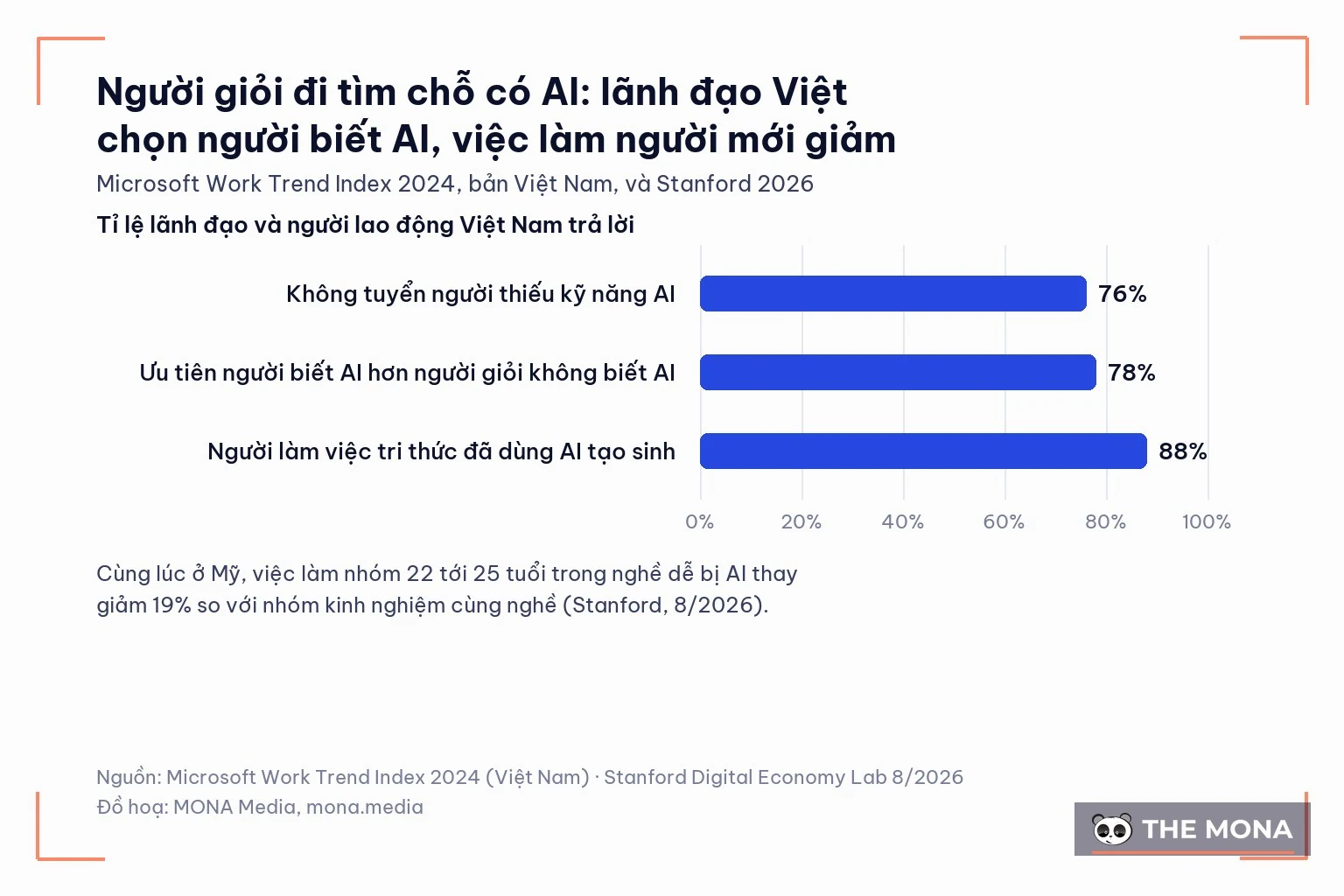
The consequence is very visible at our service clients: top talent goes looking for places with AI so they can work faster, learn faster and get paid more, and a company without AI loses people before it loses customers. A 25-person interior design firm in Ho Chi Minh City lost 2 senior designers to a competitor in the first 4 months of 2026, and both gave the same reason when they left: the other side had an AI toolset, one design option took 1 hour instead of 1 day, and the pay was 20% higher. Nobody betrayed anybody here. Good people simply move toward where they can do more. The ones who stay use personal AI with the company's customer data, as staff at over 90% of companies do according to the MIT NANDA 2025 survey, and data leaves through personal accounts every day without the boss knowing. The figures above come from the US: Stanford measured employment of 22 to 25 year olds in the most AI-exposed jobs falling 19% compared with experienced workers in the same jobs. Newcomers and top talent alike are moving toward places with AI, the only difference being that top talent can move right away.
Three reasons add up: customers ask AI first, competitors get cheaper thanks to AI, and good people leave because of AI. None of them waits for you to finish deciding. All three have already happened. That is the difference between a choice and an obligation. It is also where we owe you a proper explanation of the word “permanently” in “left behind permanently”, because saying it strongly without explaining it is just scaring people. A strong claim needs numbers.

In the previous article we wrote that AI multiplies what a company already has. Multiplication has a property that addition does not: it compounds. A spa chain owner with 12 branches and 40,000 customer records plugged AI into appointment reminders, saw results after 3 weeks, and those 3 weeks produced cleaner data for the next step. A machine shop owner with 40 workers in Binh Duong had no foundation yet, so he spent 8 months building a website and quoting software before plugging in AI. In those 8 months, his competitor, who already had a foundation, added 2 more steps. Next year, when he plugs in his first step, the competitor is on the fourth with 2 years of data. The gap does not wait for you to catch up. It widens every year, because the side with a foundation gets multiplied and the side without one gets multiplied by zero.
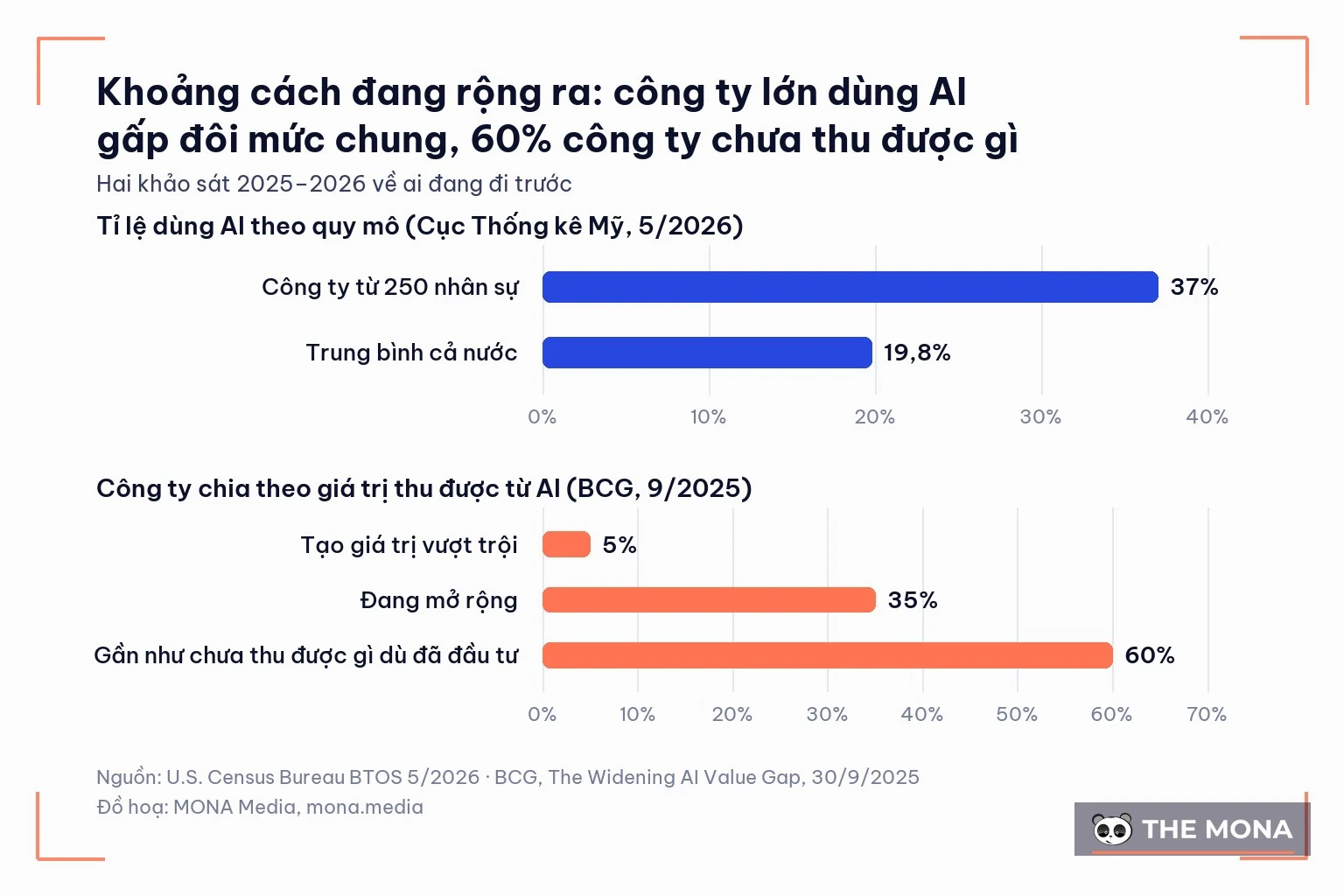
Large-scale numbers show the gap is really widening. The US Census Bureau measured in May 2026: companies with 250 or more employees use AI at 37%, companies with 1 to 4 people under 20%, and that is the US, where digital infrastructure is far more even than in Vietnam. BCG in September 2025 splits global companies into 5% leaders, 35% scaling up, and 60% that have gained almost nothing despite investing; that top 5% grows revenue 1.7 times faster, earns 1.6 times the profit margin, and delivers 3.6 times the shareholder returns over 3 years compared with the laggards. McKinsey 2026: only 6% of companies are high performers, and they have been at it for 3 to 4 years. The IMF warned in January 2024 that AI could widen the gap. History has seen it once before: Robert Allen measured the first 60 years of the steam engine in Britain, when output per worker rose 46% while workers’ wages rose only 12%, and the difference went to those who already owned the factories.
So what does “permanently” actually mean? It does not mean you can never catch up. It means the gap widens faster than you can close it for as long as the other side keeps running, and what they have, 3 years of data plus workflows polished over 3 years, cannot be bought back with money in 3 months. A water-supplies dealer in District 12 understood this in 2026, when 300 of his regular contractors started asking AI to compare prices, and he had no 3 years of data for his own AI to answer on his behalf. He had the money. He did not have the time. So what does climbing up fast really mean, and what do customers misunderstand most? We need to say that right away.
The reflex of someone who has just realized they are late is to rush out and buy a lot: a chatbot, an AI plan for the marketing team, “company-wide AI” software, 5 contracts signed in 3 months, and then call it AI first. The numbers show that is the fastest way to be left behind, because the money goes out and the foundation is not there. A mid-2025 MIT NANDA survey (small sample, so we cite it with caution) found that 95% of organizations could not yet measure anything from generative AI. BCG: 60% of companies have spent and gained almost nothing. IBM 2025: only 25% of AI projects hit their expected return on investment. PwC surveyed 4,454 CEOs in January 2026: 56% had seen no significant financial benefit. Gartner predicted in June 2025 that more than 40% of AI agent projects will be canceled before the end of 2027. Most of those four numbers come from companies that bought very fast and bought a lot, exactly the pattern of 80% of AI projects in Vietnam fail that we have dissected before.
Fast the way we do it means 30 days to get one step running with a number, not 30 days buying 10 packages. That one step should be the most repeated one with the most data on hand, bought from a partner who has already built it rather than built in-house, because the same MIT survey found that projects bought from partners reach production about 67% of the time while in-house builds reach it only about 33%, and exactly one person in the company is responsible for reviewing the AI’s output every day. For a make-or-break step that touches money and orders, we advise against assembling it yourself with drag-and-drop tools. It is not a knock on those tools. It is a maintenance issue: flows break when a third party changes its interface, one wrong configuration cell stops the whole flow without anyone noticing, and the more flows you have, the more people you need to watch them. That step needs custom-built software to handle load, with a team accountable when it fails.
We once had to pull the owner of a 15-branch electronics chain back to exactly this point. He arrived with a plan for “company-wide AI in 6 months” and had already asked 4 vendors for quotes. When we opened his data, the 15 branches were running 3 different sales systems that had not even been merged yet, so we advised him to do just 3 steps first, starting with quoting for project customers. He was a little annoyed. Three months later he called back to open the second step. That is what fast looks like. We have the schedule drawn out.
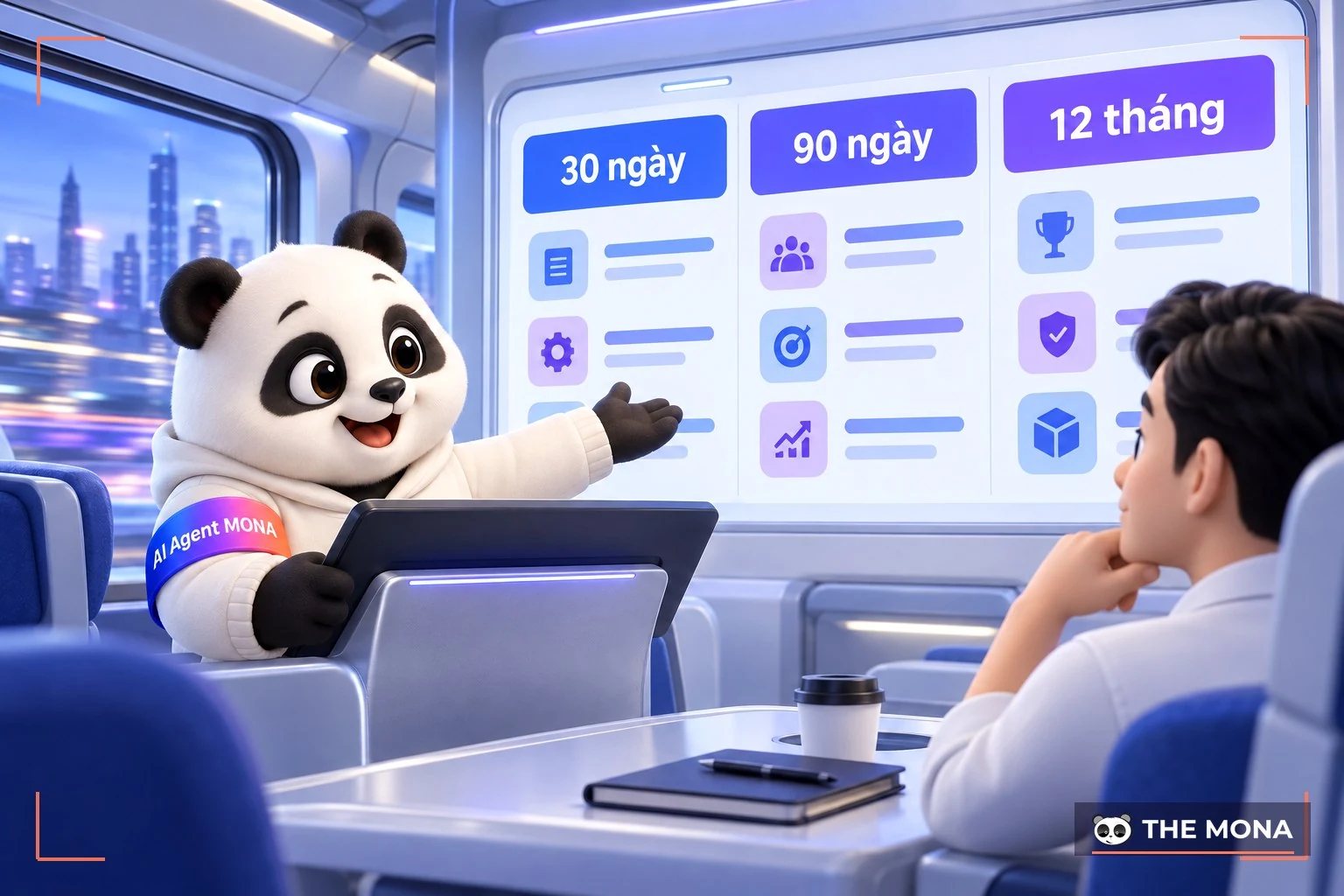
This is the schedule we hand customers at the foundation review, rewritten as a table so you can use it right away without calling us.
| Milestone | What must be done | Number you must have | Who is responsible |
|---|---|---|---|
| 30 days | Foundation review: can AI read your website, how many places your customer data sits in; pick the 1 most repeated step; check the 100 most recent records; plug AI from a ready-made partner into that step | Clean records above 70%; 1 step already running with real customers | 1 person reviews AI output every day, signed off by the business owner |
| 90 days | Measure the 30 days with 1 number; fix the website so AI can read it; consolidate data into 1 piece of software; open steps 2 and 3 | 1 before-and-after number per step (hours to produce a quote, reply rate from past customers, repeat orders) | Head of each step’s department |
| 12 months | Foundation complete: website bringing in customers, data in one place, workflows clearly drawn; 3 to 6 steps depending on company size; AI agents connected to CRM or ERP | Hours saved and revenue by step each quarter | 1 person in charge of company-wide data |
The 30-day milestone is the most important one, because it separates the people who board the train from the people who watch it leave. The director of a pharmaceutical distributor with 30 sales staff hit exactly this milestone: 30 days plugging AI into the pharmacy quotation step, the time to produce a price list dropped from 2 days to 2 hours, price lists sent tripled, no extra hires, and because she already had 2,000 pharmacies in her system, the AI had something to multiply. The Binh Duong machine shop owner took the 12-month route differently: 8 months building the foundation, 4 months plugging in, and now a drawing-based quote comes out in 2 hours. Two people, two starting points, one schedule. Having said that, we owe you one honest point, because this article says “mandatory” quite a few times. There are exceptions.

Yes. Household businesses that live on regulars within a 2 km radius, motorbike repair shops, family restaurants, local crafts, and B2B companies with 5 large customers on annual contracts, where selling is about relationships rather than search. For these, AI in operations is not needed right away, and we say so plainly even though we sell it. Plugging AI into a 4-person shop with no data means AI multiplied by zero, exactly as in the previous article, and we do not want customers paying for zero.
But even those places still have exactly one thing to do, because their new customers are asking AI too. BrightLocal measured over 1 year that the share of people asking AI for place and service recommendations rose from 6% to 45%, while Google as a source for reading reviews fell from 83% to 71%; in Vietnam Google still holds 94.72% of searches according to StatCounter in August 2026, and Google itself now answers with AI summaries. So the one thing is this: let Google and AI find you when customers ask, meaning a complete Google Business profile, a website or intro page that AI can read, and real customer reviews posted. We have a small sports store as a customer. We visited in person and advised exactly that one thing, without selling anything else. Just one thing. If you are not in this group, keep reading, because we will tell you how MONA climbed aboard.

We caught the last train right on time, and slightly early. In 2019, when digital transformation was still just a phrase in the newspapers, MONA decided to make the website and SEO its main source of customers, spending on content before anyone was sure it would bring them in. To this day SEO is still our biggest source of customers, with marketing bringing in over 4,000 leads a month, most of them finding us on their own through search. That was an early ticket, and it has been paying us back for the 7 years since. We tell you this so you can see that this consultant is not talking about trains from the platform.
This time we are climbing aboard by plugging AI into each step of our own business, with each AI seated in exactly one car: Gấu Cười 24-hour chat and lead handling on the website and fanpage, a set of 21 tools SEO built in-house at congcuseo.mona.media for the SEO team, a content-writing machine with human review which this very article went through, and a way of building software that treats the spec as the asset where AI generates code and seniors review it. MONA founded in 2016, more than 14,000 projects, 85% of customers keep using our services, and in August 2026 we were accepted into the OpenAI Select Partner program. For customers, we follow exactly the schedule above: foundation review, one step, measure for 30 days, then AI transformation step by step with a custom-built team of AI agents: Gấu Báo Giá, Gấu Thức Khuya, Gấu Tuyển Dụng, Gấu Pháp Chế. AI transformation is mandatory, but the way we do it has nothing that has to be big: one step, one number, one quarter.
If you have read this far and are not sure whether you are on the platform or already on the train, we offer a 30-minute foundation review to answer exactly 3 questions: can AI read your website, how many places your customer data sits in, and which step can take AI in the next 30 days. We do not sell packages. Sometimes the answer is “not yet, go build the foundation first”, and we say so even if it costs us a contract. Call 1900 636 648, say “foundation review for AI” and we will schedule it. The questions we get asked most about the “mandatory” claim are answered briefly below.
How is AI transformation different from digital transformation?
Digital transformation makes work inside the company faster, while customers still find you the old way, so you can miss it. AI transformation changes how customers find suppliers (94% of B2B buyers use AI when buying, Forrester 2026), how competitors calculate their costs, and how good people choose where to work, so you cannot miss it.
Can a small company that hasn't gone digital jump straight to AI transformation?
You cannot jump ahead. AI multiplies what exists, and without data and workflows it multiplies by zero. The fastest way is to build a minimal foundation in 30 days (a website AI can read, customer data in one place, 100 clean records above 70%) and then plug AI into exactly one step, like the 40-worker machine shop that built its foundation for 8 months before plugging in.
Is “left behind for good” an exaggeration?
It's an exaggeration if it means you can never catch up. It's accurate if it means the gap widens faster than you can close it while the other side keeps moving: BCG 2025 measured the top 5% of leaders growing revenue 1.7 times faster and delivering 3.6 times the 3-year shareholder returns of laggards, and three years of data is something money can't buy in three months.
How much does the first 30 days of AI transformation cost?
It depends on the step and how much data has to be cleaned. For reference: VINASA 2025 reports that 30% of organizations spend under 50,000,000 VND a year on AI, which is not enough to plug in even one step properly. As of September 2026, the first step at a company of 10 to 50 people that we build usually runs from several tens of millions to over a hundred million VND, with the difference coming from data cleanup, not from AI.
Which industries don't need to rush into AI transformation?
Sole proprietors living off regulars within a few kilometers, local handicraft trades, and B2B companies with a few large customers on annual contracts. They still need one thing: let Google and AI find them, because the share of people asking AI for places and services rose to 45% in one year (BrightLocal 2026).
To sum up. The 2020 digital transformation was a train you could choose to board: the target of 20% of GDP measured only 14.02%, business websites stood still for 8 years, and most companies missed it and survived because regular customers and Zalo carried them. The AI transformation is mandatory, because three things happened before you could choose: customers ask AI before they ask anyone, competitors get cheaper thanks to AI, and good people move toward companies that have AI. Being left behind compounds, the gap widens every year, and 3 years of data cannot be bought in 3 months. Climbing fast means 30 days to get one step running with a number, not 30 days signing 5 contracts. Even General Secretary To Lam, at the year-end review conference on December 25, 2025, spoke about science, technology and digital transformation in exactly those terms: “no longer a choice but a mandatory requirement”.
This train has one odd feature: money cannot buy a first-class ticket. A large company can buy more cars, but it cannot buy back the time that has already passed, and a 12-person shop that boards this month with one step and a number will, 12 months from now, stand ahead of a 300-person company still in meetings choosing a vendor. The only ticket is boarding early. You missed one train and that is fine, we stood on the platform before 2019 too. But this time we are standing at the car door, and we can hold the door a little longer, not forever.
If you want to know which step in your company can take AI within 30 days, send a few lines describing the step that is drowning in work to info@themona.global, or call 1900 636 648. Within 2 working days, a MONA engineer will answer exactly 3 questions: can this step take AI yet, what data must be gathered first, and how long until you see a number, such as 2 days down to 2 hours like the pharmaceutical distributor. Remember the figure at the top of this article, 8 parts trial, 2 parts real use: this session is for getting you to part 2 without buying any more of the 8. If it cannot take AI yet, we will say not yet, along with what to do first. We do not take work blindly.
The MONA Group, founded in 2016, has delivered over 14,000 website and software projects, and 85% of clients keep using our services. Three main areas: Mona.Media (web design, SEO), Mona.Software (custom-built software) and Mona.Host (server infrastructure). Hotline 1900 636 648, email info@themona.global. If you believe AI transformation is mandatory but do not know which car to board first, call us. A 30-minute foundation review will tell you.

CEO & Founder · The MONA
Founder of The MONA, who built a services company of 60+ staff with 14,000+ projects delivered. Khánh Hùng shares how he thinks about building systems that run themselves, automating a business, and the real lessons from delivering projects at MONA.
 370




Professional website
design services
Own a website with a beautiful, 100% exclusive design and a lifetime warranty, with the ability
to expand features flexibly as your business grows, starting today!






 MONA will never sell your information or send you spam


 MONA will never sell your information or send you spam
