
 MONA OS 2.0
 Partner with MONA


 Tự động hoá doanh nghiệp
 Cẩm nang SEO
 Digital Marketing
 Kinh nghiệm thiết kế website
 Hạ Tầng Server
 Giáo dục


 VI
 EN






Message us on
Zalo Official


 ProductsNew

 ProductsProducts
 Mới ra mắtKHA AI 2027App tự edit video, tự đăng mọi mạng xã hội, 2 phút mỗi ngày










 Website designLooks good and wins customers over.
SEO servicesBrings in customers searching for exactly what you sell.
 Tư vấn digital marketingKéo khách từ nhiều kênh, đo bằng số thật.
Corporate video productionVideos introducing your company, factory and team.
 NewAI video productionCompany story films made with AI.
 Custom software developmentCRM, ERP and HRM built for your business.
 Viết AI Agent theo yêu cầuĐặt riêng một trợ lý AI cho đúng việc của mình.
 Tư vấn chuyển đổi AIĐưa AI vào vận hành của cả công ty.
NewMONA LMSManagement for centers and schools.
MONA SkillHubInternal training for company staff.
 NHTQ systemEnd-to-end China–Vietnam shipping operations.
MONA JMSManagement for gold, diamond and pawn shops.
 MONA E-LearningA website with every feature you need to sell courses.
 How to sell online courses (course)More than 30 free lessons on selling courses on autopilot.
 MONA Cloudmonacloud.vnServers to get your apps and websites running.
 MONA Basemonabase.vnPostgres database, sign-in and file storage.
 MONA Mailmonamail.vnSend OTP, order and invoice emails from your software.
 MONA Paymonapay.vnAccept bank transfers via VietQR and notify your software when the money arrives.
 MONA eInvoiceComing soonIssue e-invoices that meet tax standards.
Gấu CườiTrả lời khách 24/7 trên web, Fanpage, Zalo và thu lead cho sale.
 Gấu TeleSalesGọi điện tư vấn, chăm khách như tổng đài viên thật.
Dê CườiTư vấn và chốt đơn cho shop ngay trong khung chat.
Gấu WebmasterNhắn nhóm Zalo là website được sửa xong.
 Gấu Pháp ChếSoạn hợp đồng, rà điều khoản trong vài phút.
 Gấu Báo GiáLên báo giá đúng mẫu và gửi khách ngay.
 AI chăm sóc khách hàngTheo dõi và giữ chân khách hàng cũ.
 Gấu Tuyển DụngLọc hồ sơ, hẹn lịch, phỏng vấn ứng viên.
 Mới ra mắt
KHA AI 2027
Xây kênh chuyên gia 2 phút mỗi ngày
Quay bằng điện thoại, AI tự edit video, tự đăng lên 16 nền tảng và tự trả lời bình luận, tin nhắn.
882.681lượt xem trên kênh CEO MONA sau 36 ngày
 Anh Khánh HùngCEO MONA đang dùng mỗi ngày
Xem app làm được gì
 AI
Gấu Cười MONA ĐANG TỰ XÀITrả lời khách 24/7 trên website, Zalo OA, Messenger và thu lead về cho sale.
Dê CườiChốt đơn bán lẻ và sàn: Shopee, TikTok Shop, web. Chăm cả khách sỉ, đại lý.
Gấu WebmasterCập nhật nội dung, tối ưu SEO website mỗi ngày.
Gấu TeleSalesGọi điện tư vấn, chăm khách như tổng đài viên thật.
Gấu Tuyển DụngLọc hồ sơ, hẹn lịch, phỏng vấn ứng viên tự động.
AI chăm sóc khách hàngGiữ khách cũ, cứu lead đã rớt cho phòng kinh doanh.
Gấu Pháp ChếSoạn hợp đồng, rà điều khoản trong vài phút.
Gấu Báo GiáLên báo giá đúng mẫu, gửi khách ngay khi có yêu cầu.
 Chuyển đổi AI toàn phầnGiải pháp tổng cho doanh nghiệp, 3 lớp triển khai.
 Viết AI Agent theo yêu cầuĐặt riêng một con AI gánh đúng nghiệp vụ của bạn.
 Custom softwareCRM, ERP and HRM with built-in AI automation.
 SEO & AEO thời đại AIĐược Google lẫn AI trích dẫn, không chỉ xếp hạng.
 Kiến thức AI cho doanh nghiệpBài phân tích, hướng dẫn ứng dụng AI vào vận hành.
 Free AI courses
 AI tools at work
App mới · KHA AI 2027
Xây kênh 2 phút mỗi ngày
AI tự edit video, tự đăng mọi mạng xã hội
Free consultation, 8am–10pm every day

18 May, 2026

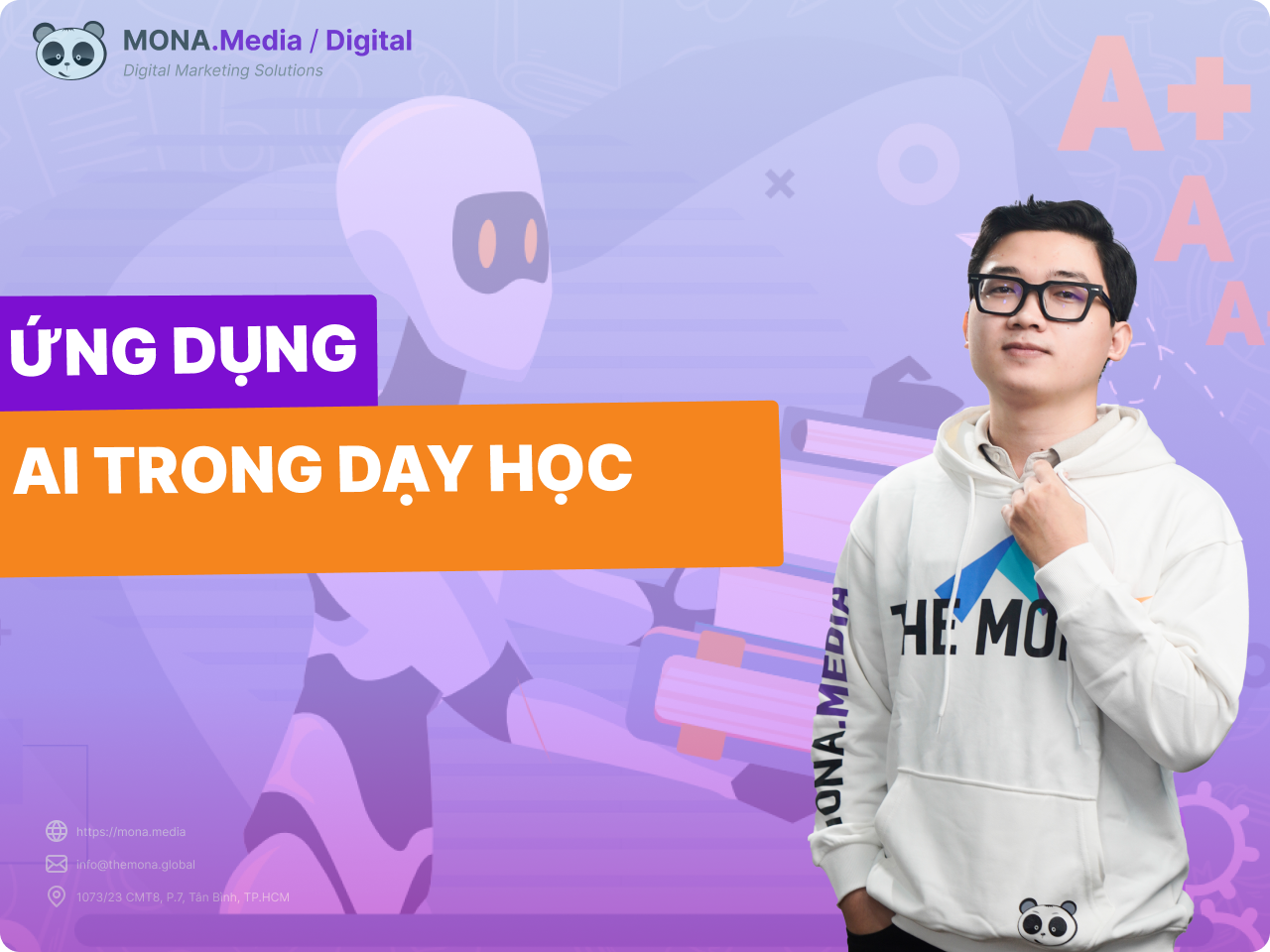
77.1% of students aged 13 to 18 used generative AI in 2024, up sharply from 37.1% just a year earlier. This is no longer a trend forecast. It is happening in classrooms and in young people's everyday study decisions. AI in education is no longer an experiment. It has become part of the structure of modern teaching.
This article from MONA Media will give a full analysis of AI in education, from the core definition and 7 standout practical applications to measurable benefits and the challenges that schools, teachers and parents have to face.
AI in education is the use of artificial intelligence, including machine learning, natural language processing and data analysis, in teaching, management and school operations in order to personalize learning, automate processes and raise the quality of training.
The fundamental difference from traditional education technology is real-time adaptation. Instead of delivering the same content to a whole class, an AI system analyzes each student's responses, identifies individual strengths and weaknesses, and adjusts the learning path on its own, with no need for teachers to step in case by case.

Today, AI in education is deployed in several directions, including:
The AI in education market reached $5.44 billion in 2024 and is forecast to exceed $55.44 billion by 2030, a compound annual growth rate of 47.2%. It is one of the fastest-growing AI application areas worldwide.
Below are 7 applications of AI artificial intelligence in education that are widely deployed and deliver the clearest practical value, from a single classroom to an entire school system.

Every student absorbs material at a different speed, with a different learning style and different knowledge gaps. AI systems solve this by continuously analyzing learning data to build an individual path for each person.
Specifically, an adaptive learning system tracks every answer a student gives, pinpoints the concepts that are still unclear, then automatically suggests extra exercises or adjusts the difficulty. A student who makes many mistakes on a topic gets more material on that topic instead of simply following the shared curriculum.
Results from schools that deploy adaptive AI learning show that students can progress 20 to 30% faster than with traditional one-size-fits-all teaching, especially average students who are easily left behind in large classes.
AI combined with virtual and augmented reality is creating entirely new learning environments. AI-driven simulation platforms let students run chemistry experiments in a safe virtual setting, practice surgical skills through medical simulations, or experience historical events through interactive role-play.
AI orchestrates the scenario, reacts to the student's choices and adjusts how complex the situation is in real time. This application is especially valuable in higher education and vocational training, where hands-on skills decide the quality of the outcome.

Students often struggle outside class hours, but teachers are not always available. Chatbot AI and virtual tutors fill this gap by answering questions, suggesting materials and giving feedback on any assignment at any time.
The system remembers a student's entire learning history, never loses patience, and explains at different levels until the student truly understands.
Many international universities have built AI chatbots into their student support systems and report a clear rise in satisfaction, especially among international students who face language barriers when approaching lecturers.
Teachers spend an average of 5 to 10 hours a week on administrative work such as grading, progress reports and managing assignments. AI can handle most of this, giving teachers time back to focus on teaching and supporting students.
Today, 47.7% of teachers used generative AI tools at work in 2024, up from 31% in 2023. The most commonly automated tasks include:
More importantly, 75.3% of teachers say they want more training on using AI effectively in their work, which points to a real need that schools and education authorities have to meet.

Building an effective curriculum means analyzing large volumes of data on learning outcomes, labor market trends and the latest education research. This is exactly where AI is strong.
AI in education helps educators analyze results module by module to find where students are weak and need improvement. It also suggests content updates based on the latest skill demands from the labor market, and pulls together global education research so schools can design curricula on real evidence rather than personal experience alone.
The result is a curriculum that updates faster and stays closer to reality, which matters most in fast-changing fields such as technology, healthcare and finance.
Students with disabilities, learning disorders or language-minority backgrounds are often poorly served by one-size-fits-all teaching. Technology for AI in teaching and learning is changing this in very concrete ways.
AI supports students with special needs in several ways, most commonly real-time captions for deaf and hard-of-hearing students, text-to-speech tools for students who struggle to read, adaptive interfaces that adjust fonts and colors for different visual impairments, and automatic translation tools for students learning in a second language.

Education management decisions such as assigning teachers, scheduling classes, allocating classrooms and forecasting enrollment often rely on experience and manual data. AI replaces this with comprehensive data analysis and more accurate forecasts.
AI systems analyze enrollment history, dropout rates, teacher performance and learning outcomes to recommend the best use of resources. Schools can then decide on evidence from the numbers rather than gut feeling, which is especially useful for spotting students at risk of dropping out early enough to step in.
AI in education delivers different value depending on each stakeholder's point of view. Below is a closer look at the two main groups.

The biggest benefit for schools is not just lower operating costs but better decisions at every level of management. With rich learning data and instant analysis, education leaders can spot problems sooner, adjust strategy faster and allocate resources more effectively.
Specifically, schools and teachers benefit from the following:
Students benefit most directly from the personalization AI brings. Instead of adapting to the pace of the whole class, each student learns at a rhythm and in a style that suit them.
The specific benefits students get include:
Despite the clear potential, applying AI in education comes with real obstacles. Understanding the challenges and having a concrete plan to handle them is a prerequisite for success. Below are the 5 biggest challenges and suggested ways to address them.

Educational AI systems collect large amounts of sensitive student data, including results, behavior, and even emotions and attention levels. Questions about what the AI can access, where the data is stored and how it is protected are serious legal and ethical issues.
To handle this, schools need a clear data policy before deploying any AI system, covering how student data is collected, stored, used and deleted. Choosing technology vendors with international security certifications that comply with data protection regulations is also a requirement that cannot be skipped.
Many schools, especially in rural areas and developing countries, lack stable internet, capable devices and an IT team to run complex AI systems. This barrier widens the education gap instead of narrowing it.
A workable solution is to roll out in phases, starting with lightweight AI tools that run on ordinary devices and slow internet connections before investing in heavier infrastructure. In parallel, digital skills training for teachers and technical staff is essential to keep the system sustainable.
Quite a few teachers and education managers see AI as a threat to their jobs, or are simply uncomfortable with major technological change. If this resistance is not handled carefully, it will derail the rollout no matter how good the technology is.
The key is to position AI as a support tool rather than a replacement for people, and to put teachers in an active role during rollout. Hands-on training programs, plus room for teachers to give feedback and suggest improvements, build acceptance from inside the organization.
AI algorithms make decisions based on training data. If that data is biased by gender, ethnicity or socioeconomic background, the AI will reproduce and amplify those biases in education. An AI system that predicts student success from postal code, for example, may unintentionally reinforce educational inequality instead of solving it.
At a minimum, schools must audit the training data of any AI system before adopting it, and set up independent oversight to detect and correct bias during operation.
As AI takes over more teaching tasks, human-to-human interaction in the classroom may shrink. Students may develop machine-learning skills but lack communication, critical thinking and teamwork, abilities that only a human learning environment can fully develop.
82% of teachers agree that students need to be taught to use AI critically, not just how to use it. This means teachers need to decide proactively which learning moments call for purely human interaction, especially discussion, debate and group collaboration, which AI cannot replace.
Knowing AI in education not only helps students and teachers use technology more effectively but also helps educational organizations make the right investment decisions for the future. From personalized learning to automated operations, AI in education is reshaping the whole teaching ecosystem in unprecedented ways.

AI is gradually changing how people access knowledge, from personalizing learning paths to helping teachers refine their methods. With data analysis, automation and intelligent interaction, AI not only improves teaching and learning but also opens new opportunities for innovation in education in the digital age. However, using AI in education effectively takes a balance between technology and the human element. AI will be a powerful assistant, but the teacher's role in guiding, inspiring and developing students' thinking cannot be replaced.
If your organization is looking for a way to build the digital foundation for educational AI tools, from an SEO-ready e-learning website to a learning management system (LMS), the specialists at MONA Media on more than 15 years of experience and over 13,500 customers can support you from strategy through delivery. Contact us now via HOTLINE 1900 636 648 for a free consultation.

CEO & Founder · The MONA
Founder of The MONA, who built a services company of 60+ staff with 14,000+ projects delivered. Khánh Hùng shares how he thinks about building systems that run themselves, automating a business, and the real lessons from delivering projects at MONA.
 1,5K




Professional website
design services
Own a website with a beautiful, 100% exclusive design and a lifetime warranty, with the ability
to expand features flexibly as your business grows, starting today!






 MONA will never sell your information or send you spam


 MONA will never sell your information or send you spam
