
 MONA OS 2.0


 Tự động hoá doanh nghiệp
 Cẩm nang SEO
 Digital Marketing
 Kinh nghiệm thiết kế website
 Hạ Tầng Server
 Giáo dục



 VI
 EN
















Message us on
Zalo Official


 Products

 ProductsProducts










 Website designLooks good and wins customers over.
SEO servicesBrings in customers searching for exactly what you sell.
 Tư vấn digital marketingKéo khách từ nhiều kênh, đo bằng số thật.
Corporate video productionVideos introducing your company, factory and team.
 NewAI video productionCompany story films made with AI.
 Custom software developmentCRM, ERP and HRM built for your business.
 Viết AI Agent theo yêu cầuĐặt riêng một trợ lý AI cho đúng việc của mình.
 Tư vấn chuyển đổi AIĐưa AI vào vận hành của cả công ty.
NewMONA LMSManagement for centers and schools.
MONA SkillHubInternal training for company staff.
 NHTQ systemEnd-to-end China–Vietnam shipping operations.
MONA JMSManagement for gold, diamond and pawn shops.
 MONA E-LearningA website with every feature you need to sell courses.
 How to sell online courses (course)More than 30 free lessons on selling courses on autopilot.
 MONA Cloudmonacloud.vnServers to get your apps and websites running.
 MONA Basemonabase.vnPostgres database, sign-in and file storage.
 MONA Mailmonamail.vnSend OTP, order and invoice emails from your software.
 MONA Paymonapay.vnAccept bank transfers via VietQR and notify your software when the money arrives.
 MONA eInvoiceComing soonIssue e-invoices that meet tax standards.
Gấu CườiTrả lời khách 24/7 trên web, Fanpage, Zalo và thu lead cho sale.
 Gấu TeleSalesGọi điện tư vấn, chăm khách như tổng đài viên thật.
Dê CườiTư vấn và chốt đơn cho shop ngay trong khung chat.
Gấu WebmasterNhắn nhóm Zalo là website được sửa xong.
 Gấu Pháp ChếSoạn hợp đồng, rà điều khoản trong vài phút.
 Gấu Báo GiáLên báo giá đúng mẫu và gửi khách ngay.
 AI chăm sóc khách hàngTheo dõi và giữ chân khách hàng cũ.
 Gấu Tuyển DụngLọc hồ sơ, hẹn lịch, phỏng vấn ứng viên.
 KHA AI 2027
Xây kênh chuyên gia 2 phút mỗi ngày
Quay bằng điện thoại, AI tự edit video, tự đăng lên 16 nền tảng và tự trả lời bình luận, tin nhắn.
284.904lượt xem trên kênh CEO MONA sau 16 ngày
 Anh Khánh HùngCEO MONA đang dùng mỗi ngày
Xem app làm được gì
 AI
Gấu Cười MONA ĐANG TỰ XÀITrả lời khách 24/7 trên website, Zalo OA, Messenger và thu lead về cho sale.
Dê CườiChốt đơn bán lẻ và sàn: Shopee, TikTok Shop, web. Chăm cả khách sỉ, đại lý.
Gấu WebmasterCập nhật nội dung, tối ưu SEO website mỗi ngày.
Gấu TeleSalesGọi điện tư vấn, chăm khách như tổng đài viên thật.
Gấu Tuyển DụngLọc hồ sơ, hẹn lịch, phỏng vấn ứng viên tự động.
AI chăm sóc khách hàngGiữ khách cũ, cứu lead đã rớt cho phòng kinh doanh.
Gấu Pháp ChếSoạn hợp đồng, rà điều khoản trong vài phút.
Gấu Báo GiáLên báo giá đúng mẫu, gửi khách ngay khi có yêu cầu.
 Chuyển đổi AI toàn phầnGiải pháp tổng cho doanh nghiệp, 3 lớp triển khai.
 Viết AI Agent theo yêu cầuĐặt riêng một con AI gánh đúng nghiệp vụ của bạn.
 Custom softwareCRM, ERP and HRM with built-in AI automation.
 SEO & AEO thời đại AIĐược Google lẫn AI trích dẫn, không chỉ xếp hạng.
 Kiến thức AI cho doanh nghiệpBài phân tích, hướng dẫn ứng dụng AI vào vận hành.
 Free AI courses
 AI tools at work
 App mới · KHA AI 2027
Xây kênh 2 phút mỗi ngày
AI tự edit video, tự đăng mọi mạng xã hội
Free consultation, 8am–10pm every day

18 March, 2023

Open your company website, click the contact button and send a test message, then check your inbox to see if it arrives. This test takes less than two minutes. It is the first thing we do whenever someone asks us to look at their website, and forms that send and then go nowhere are so common that we made form checks a fixed weekly task in our the website management service in the market.
Say your website gets 3,000 visits a month. This is just an example, so open Google Analytics and use your real number. Of those 3,000 visits, if only 2% click through to the contact page, that is 60 people, and if half of them fill in the form, that is 30 people who really want to talk to you. If the form is broken for a single month, those 30 people do not go anywhere. They go to someone else.
The bigger loss is the one nobody sees. Deloitte worked with Google on a study of retail, travel and lead generation sites in Europe and the US. A site that was just 0.1 seconds faster saw retail conversion rise 8.4% and average order value rise 9.2% (Milliseconds Make Millions, Deloitte). A neglected website gets a little heavier every month: images pile up, missed updates pile up, and the customers you lose never show up in any report where you could see them and regret it.
In online business today, website management plays a key role in keeping an online platform running and growing. From content management to technical maintenance, the website management service offers a range of ways for a business to keep its online presence strong and effective. Let's MONA Media explore how to manage a website well in this article.
Businesses now hand the repetitive work to AI website manager so the website stays fast, secure and SEO-ready.

A broken contact form makes no noise. It still looks fine, customers still click send, they still see the thank-you message, and the message simply never reaches anyone. The cause is usually small: the inbox that receives notifications belongs to an employee who left last year, or a plugin update broke the mail sending, or the mail provider changed its policy and now blocks messages sent from the web server.
Then there are things right in front of customers that nobody has checked in a long time: the hotline printed on the site is the old number, the Zalo button points to an account nobody monitors, the chat widget lost its connection so it just spins when clicked. Customers who run into this do not call to ask what is going on. They close the tab.
A new website feels light on any device the day it is handed over. Then every month a few dozen product photos shot on a phone go straight up, each 4-5 MB, one more plugin for a promo pop-up, tracking code from three different ad platforms. If nobody measures it again, nobody knows the homepage has doubled in weight since launch.
Portent measured lead generation websites and found that a page loading in 1 second converts 3 times better than one that takes 5 seconds (Portent, research on speed and conversion rate). You can check your own number in a few minutes, and we have a separate guide in how to check website speed, while the metrics Google uses for ranking are covered in What are Core Web Vitals.
A blog post or service page sitting on page one of Google does not stay there forever. Next to you are four or five companies in the same industry adding posts every month, rewriting titles and adding new price tables, while your page is still the version written on opening day with prices from two years ago. Google reads both sides and reorders the results by itself, with no warning and no reminder email.
What makes this loop nasty is how slow it is. Dropping one or two places a month shows up as nothing in a report, and by the time it is obvious you have fallen off page one and winning back the spot costs many times more than holding it. That is why, in our management work, we put the weekly keyword ranking check on the same level as website security and data backups, and not as something to do when there is time.
When did you last test your website form?
The calculation at the top uses example numbers, but the way to check is the same for every website: test the form, measure speed, and see whether keyword rankings have held. Doing these three by hand every week is tiring and easy to forget, so MONA packaged them into an AI Agent that lives in your company's Zalo group. It runs the check every week and sends your boss a report at the start of each month.
See how Gấu Webmaster checks your site each week → Or call 1900 636 648 and we'll take a look for you
In the rest of this article we start from the basics: what website management involves, who does it, how often it gets done each month, and which parts you can hand to a machine to save on staff. To see how far AI can go with this work, also read AI-powered website management.
Watch the full version on YouTube: GEO: what content your website needs to be recommended by ChatGPT, Gemini and Claude.

What is website management? Website management means managing and maintaining a website so that it runs professionally and effectively. The main job is to keep the site updated, secure and constantly improving, while organizing and running content marketing and distribution strategies flexibly and sensibly.
Managing a website takes solid knowledge of programming and content, to build and maintain posts that attract and hold users. The tasks include maintaining servers, fixing code errors, designing content and logos, monitoring traffic, building and managing website content, and reviewing and optimizing SEO.
- Quảng Trọng Hy – Website Department Manager at MONA Media
Business website management also means working with other teams such as design, content and development, so that the site's content and operation always match the company's direction and policies. That gives users a consistent and better online experience.
A website is not only a tool for attracting customers. It also reflects your brand and reputation online. Building and developing it properly not only brings more traffic but also widens your target market. A professionally designed site with engaging content attracts more users. If the content is engaging, people can also share it on social networks such as Facebook and Instagram, which brings more visitors to your site.
Compared with traditional business, managing a business website takes only one or two skilled people, which cuts the cost of premises, interior fit-out and sales staff. It also lets you reach customers effectively without limits of space or geography, so you can widen your target market flexibly. That is why website management matters more than ever for businesses today.

A professionally managed website with fresh, engaging content not only draws a large number of potential customers to your business but also makes it easier to interact with them and respond to their requests quickly.
Website management also helps a business build an online community where customers share information and experiences with each other. That raises engagement with your brand and improves your chances of reaching new customers.
When a potential customer looks for information about the products or services you offer, your website is the first place they visit. A well-managed website makes a strong first impression and shows your business is professional and trustworthy.
It is not just updating information. It is also improving the user experience, keeping the site interactive and keeping everything running smoothly. That helps attract and retain customers, and supports your business's growth and success.
Managing a business website takes expertise and skill to solve technical problems and optimize the site's functions. As a result, a business can fix website errors thoroughly, from tracing error codes on pages and handling pages that no longer exist to clearing the cache. It protects your reputation, improves the user experience, lowers the risk of data loss and gives you more chances to reach customers.

Website management means organizing and managing information systematically, so users can find what they need quickly. It also improves a business's productivity through modern tools and features such as a content management system (CMS), data analytics and user experience optimization. With these benefits, website management helps a business keep a professional site and create a good online environment for communication and sales.
By focusing on building and managing a professional website, you not only save on traditional advertising costs but also gain an effective marketing channel with low management costs. Analytics tools also help you understand customer behavior better and optimize your site, so you attract and retain customers more effectively.
Website management also improves the user experience, increases interaction and builds trust in your brand. That raises your chances of reaching potential customers and boosts sales.
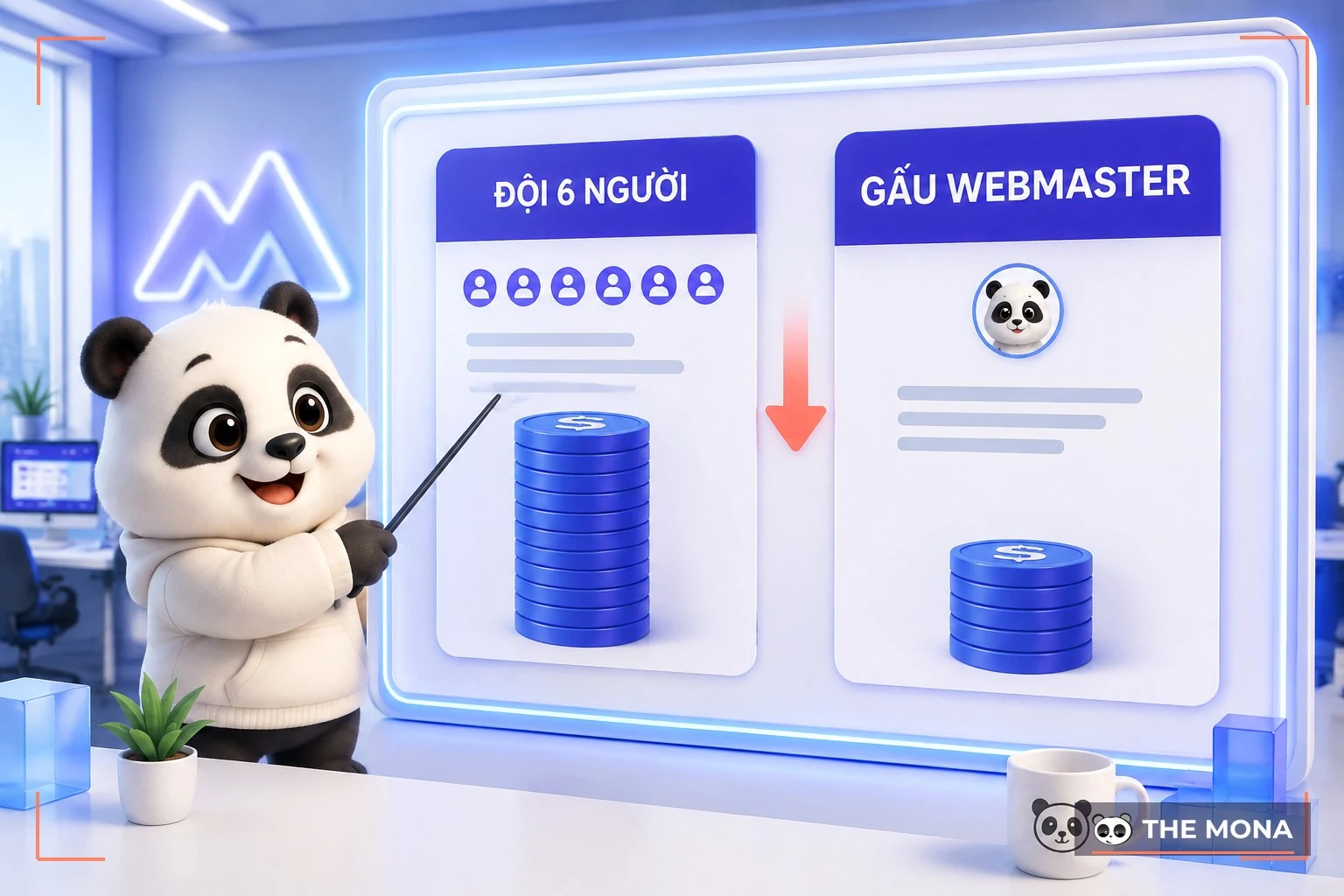
A company of fifteen rarely has anyone with the exact title of website administrator. The website lands on the marketing person, who calls a designer for a banner, messages the old web developer when something technical breaks, and posts a blog article whenever they remember. It looks like it costs nothing extra, because those people are already on payroll.
We listed the six roles that actually touch the website each month, with reference salaries. A fair warning up front: these are typical advertised salaries in Ho Chi Minh City and Hanoi that we use as the default numbers for the calculator on the page a website management AI Agent, not your company's numbers. When you read the table, swap in the real salaries at your company.
| Vai | Reference salary | Website-related work |
|---|---|---|
| Marketing lead for the website | 15,000,000 VND | Takes requests from the boss, briefs the team, keeps track of deadlines |
| Content writer | 10,000,000 VND | Writes blog posts, product descriptions, page copy |
| Designer | 13,000,000 VND | Banners, product images, post thumbnails, landing page graphics |
| Web developer | 12,000,000 VND | Puts content on the site, edits the layout, fixes technical errors |
| SEO specialist | 15,000,000 VND | Keyword research, post optimization, ranking tracking |
| Monitoring and reporting | 11,000,000 VND | Sets up tracking codes, reads Analytics, builds reports for the boss |
| All six roles, monthly salaries | 76,000,000 VND |
The web developer salary in the table is an entry-level figure. IT industry data compiled by RMIT Vietnam shows web developers ranging from 10 to 47 million VND a month, with people at one to three years of experience at roughly 12 to 22.5 million. Anyone who has hired for this role knows that cheap hires need coaching, and people who know the job cost more than the table shows.
In practice, companies with fewer than thirty people usually run leaner: one marketing person covers the website and the content, and technical work is outsourced job by job. Using the table above, that is about 27 million VND a month for two roles. The number sounds lighter, but the cost is elsewhere. When one person carries four jobs, the website is always the one pushed to the bottom of the list, and any busy week is a week nobody checks the site.
One more thing is often left out when people add up the cost. Not all of those salaries go into the website. The marketer also runs ads, and the content writer also writes for social media. When we advise clients, we usually count about 40% of this group's time as repetitive website work: editing text, checking images, publishing posts, adjusting menus, installing tracking codes, patching small bugs, writing reports. 40% of 76 million is 30.4 million VND a month; for the lean two-role team it comes to about 10.8 million. That is the number worth comparing, and it still leaves out insurance, desk space, equipment, software licenses, hiring costs and the time to train a new person.
| Approach | Per month | Includes |
|---|---|---|
| Repetitive website work for the lean two-role team | ~10,800,000 VND | 40% of the time of a marketer who also covers the site, plus outsourced technical work |
| Repetitive website work for the full six-role team | ~30,400,000 VND | 40% of the time of all six people |
| Gấu Webmaster base plan | 2,000,000 VND | Edit content, images and menus; switch on extra features as you need them |
| Gấu Webmaster Full plan, billed monthly | 15,000,000 VND | Edit anything: SEO-ready posts, image sets, landing pages built and edited with no per-page charge |
| Gấu Webmaster Full plan, billed yearly | ~6,500,000 VND | Same as the Full plan, at the founding price of 78 million VND a year |
The prices in the table are the ones we list publicly on the product page. Click through to the pricing calculator and tick your options to get your own number, no need to call. The founding price only runs during the early period, and we say so on the page rather than hide it.
Adding an AI Agent does not mean someone loses their job the next day. We have never advised a client to do that, and no company could run that way. What happens in practice is that your people get their time back: the content writer stops losing a whole afternoon to publish one post, the marketer stops waiting on the designer to finish a banner, and the technical person stops getting called over a crooked image. That time goes back to what a machine cannot do: planning campaigns, calling existing customers, negotiating with partners.
Here is what the Bear cannot do yet, so you do not expect the wrong thing. It will not sit in a strategy meeting for you, it does not understand your industry and your customers the way your own people do, and it cannot take responsibility when something goes wrong. It does what it is good at: carrying that load of repetitive work seven days a week, at a fixed cost, with no leave, and no gaps in handover when staff change.

A website administrator plays an important role in keeping the site running effectively and reliably. So what does website management involve? MONA has listed the detailed tasks below:
For a website to grow, updating its layout is a necessary step to attract and keep users. The layout is not just how the site looks. It is where users and the site interact. A daily task in website management is not only building but also updating the layout on a regular schedule so it fits the company's business goals, and optimizing it for the people who use it, to give them the best possible experience.
Continuously checking and fixing problems with images, links and code keeps the layout looking good, with working features and smooth interaction. That builds satisfaction and loyalty from your users.
Google keeps stressing how important it is to give users fresh, valuable information. That sets a big challenge for website management: how do you create content that is engaging and holds the attention of your target customers?.
This takes not only solid knowledge of technology platforms and web design but also a deep understanding of what customers need and want. By expressing your company's mission and business philosophy through content, you build a strong brand image and earn users' trust.
To stand out and attract users, optimizing your website to SEO standards is essential. SEO optimization not only raises your position in search engines but also gives you more chances to reach potential customers. By optimizing your site, you improve your ability to attract and keep customers, and you also improve the look and performance of your website.
>> See our professional full-scope SEO service at MONA

Hosting is the foundation a website runs on, so managing it means controlling and maintaining the stability of the server. Backing up the data on your hosting is also an essential part of this. With regular backups, you are protected against unexpected problems such as data loss from a system fault or a hacker attack. Careful backups also make it easy to restore your website if something goes wrong.
>>> See the MONA hosting service
To attract a significant number of customers and drive strong sales, you need to run website advertising effectively. Advertising not only increases traffic but also gives you more chances to reach potential customerspotential customers. With tools such as Google Ads, you can bring your website to the top of search results and catch users' attention.
>>> See MONA's Google Ads service
In any project, evaluating performance is an important step to make sure all work is done well and delivers the best results. Website management is no exception. Evaluating a website's performance identifies its strengths and weaknesses, so you can optimize the management work to improve the user experience and the site's performance.
In short, website management plays an important role in raising a business's online standing and creating the best possible user experience. In this article, MONA Media we have shared an overview of website management. If you are looking for a professional partner in this area, contact MONA. Our team is always ready to “take care of” and upgrade your website in the best way.
How long will you keep looking after your website by hand?
Read through the four groups of tasks an administrator handles above and the difficulty is clear: it is all work that must be repeated every week, and skip one week and something on the site starts to break without anyone knowing. Hiring someone full time costs salary, and giving it to the marketing person means the website always comes last.
MONA has packaged exactly this workload into an AI Agent that lives in your company's Zalo group. Send one message and a site edit is done in a few minutes. Every week it checks for broken forms and dead links by itself, and at the start of each month it sends your boss a report on traffic and keyword rankings.
See the website management AI Agent (Gấu Webmaster) → From 2,000,000 VND/month · cancel anytime

CEO & Founder · The MONA
Founder of The MONA, who built a services company of 200+ staff with 14,000+ projects delivered. Khánh Hùng shares how he thinks about building systems that run themselves, automating a business, and the real lessons from delivering projects at MONA.
 1,6K




Professional website
design services
Own a website with a beautiful, 100% exclusive design and a lifetime warranty, with the ability
to expand features flexibly as your business grows, starting today!






 MONA will never sell your information or send you spam


 MONA will never sell your information or send you spam
