
 MONA OS 2.0
 Partner with MONA


 Tự động hoá doanh nghiệp
 Cẩm nang SEO
 Digital Marketing
 Kinh nghiệm thiết kế website
 Hạ Tầng Server
 Giáo dục


 VI
 EN















Message us on
Zalo Official


 ProductsNew

 ProductsProducts
 Mới ra mắtKHA AI 2027App tự edit video, tự đăng mọi mạng xã hội, 2 phút mỗi ngày










 Website designLooks good and wins customers over.
SEO servicesBrings in customers searching for exactly what you sell.
 Tư vấn digital marketingKéo khách từ nhiều kênh, đo bằng số thật.
Corporate video productionVideos introducing your company, factory and team.
 NewAI video productionCompany story films made with AI.
 Custom software developmentCRM, ERP and HRM built for your business.
 Viết AI Agent theo yêu cầuĐặt riêng một trợ lý AI cho đúng việc của mình.
 Tư vấn chuyển đổi AIĐưa AI vào vận hành của cả công ty.
NewMONA LMSManagement for centers and schools.
MONA SkillHubInternal training for company staff.
 NHTQ systemEnd-to-end China–Vietnam shipping operations.
MONA JMSManagement for gold, diamond and pawn shops.
 MONA E-LearningA website with every feature you need to sell courses.
 How to sell online courses (course)More than 30 free lessons on selling courses on autopilot.
 MONA Cloudmonacloud.vnServers to get your apps and websites running.
 MONA Basemonabase.vnPostgres database, sign-in and file storage.
 MONA Mailmonamail.vnSend OTP, order and invoice emails from your software.
 MONA Paymonapay.vnAccept bank transfers via VietQR and notify your software when the money arrives.
 MONA eInvoiceComing soonIssue e-invoices that meet tax standards.
Gấu CườiTrả lời khách 24/7 trên web, Fanpage, Zalo và thu lead cho sale.
 Gấu TeleSalesGọi điện tư vấn, chăm khách như tổng đài viên thật.
Dê CườiTư vấn và chốt đơn cho shop ngay trong khung chat.
Gấu WebmasterNhắn nhóm Zalo là website được sửa xong.
 Gấu Pháp ChếSoạn hợp đồng, rà điều khoản trong vài phút.
 Gấu Báo GiáLên báo giá đúng mẫu và gửi khách ngay.
 AI chăm sóc khách hàngTheo dõi và giữ chân khách hàng cũ.
 Gấu Tuyển DụngLọc hồ sơ, hẹn lịch, phỏng vấn ứng viên.
 Mới ra mắt
KHA AI 2027
Xây kênh chuyên gia 2 phút mỗi ngày
Quay bằng điện thoại, AI tự edit video, tự đăng lên 16 nền tảng và tự trả lời bình luận, tin nhắn.
883.362lượt xem trên kênh CEO MONA sau 36 ngày
 Anh Khánh HùngCEO MONA đang dùng mỗi ngày
Xem app làm được gì
 AI
Gấu Cười MONA ĐANG TỰ XÀITrả lời khách 24/7 trên website, Zalo OA, Messenger và thu lead về cho sale.
Dê CườiChốt đơn bán lẻ và sàn: Shopee, TikTok Shop, web. Chăm cả khách sỉ, đại lý.
Gấu WebmasterCập nhật nội dung, tối ưu SEO website mỗi ngày.
Gấu TeleSalesGọi điện tư vấn, chăm khách như tổng đài viên thật.
Gấu Tuyển DụngLọc hồ sơ, hẹn lịch, phỏng vấn ứng viên tự động.
AI chăm sóc khách hàngGiữ khách cũ, cứu lead đã rớt cho phòng kinh doanh.
Gấu Pháp ChếSoạn hợp đồng, rà điều khoản trong vài phút.
Gấu Báo GiáLên báo giá đúng mẫu, gửi khách ngay khi có yêu cầu.
 Chuyển đổi AI toàn phầnGiải pháp tổng cho doanh nghiệp, 3 lớp triển khai.
 Viết AI Agent theo yêu cầuĐặt riêng một con AI gánh đúng nghiệp vụ của bạn.
 Custom softwareCRM, ERP and HRM with built-in AI automation.
 SEO & AEO thời đại AIĐược Google lẫn AI trích dẫn, không chỉ xếp hạng.
 Kiến thức AI cho doanh nghiệpBài phân tích, hướng dẫn ứng dụng AI vào vận hành.
 Free AI courses
 AI tools at work
App mới · KHA AI 2027
Xây kênh 2 phút mỗi ngày
AI tự edit video, tự đăng mọi mạng xã hội
Free consultation, 8am–10pm every day

03 August, 2021
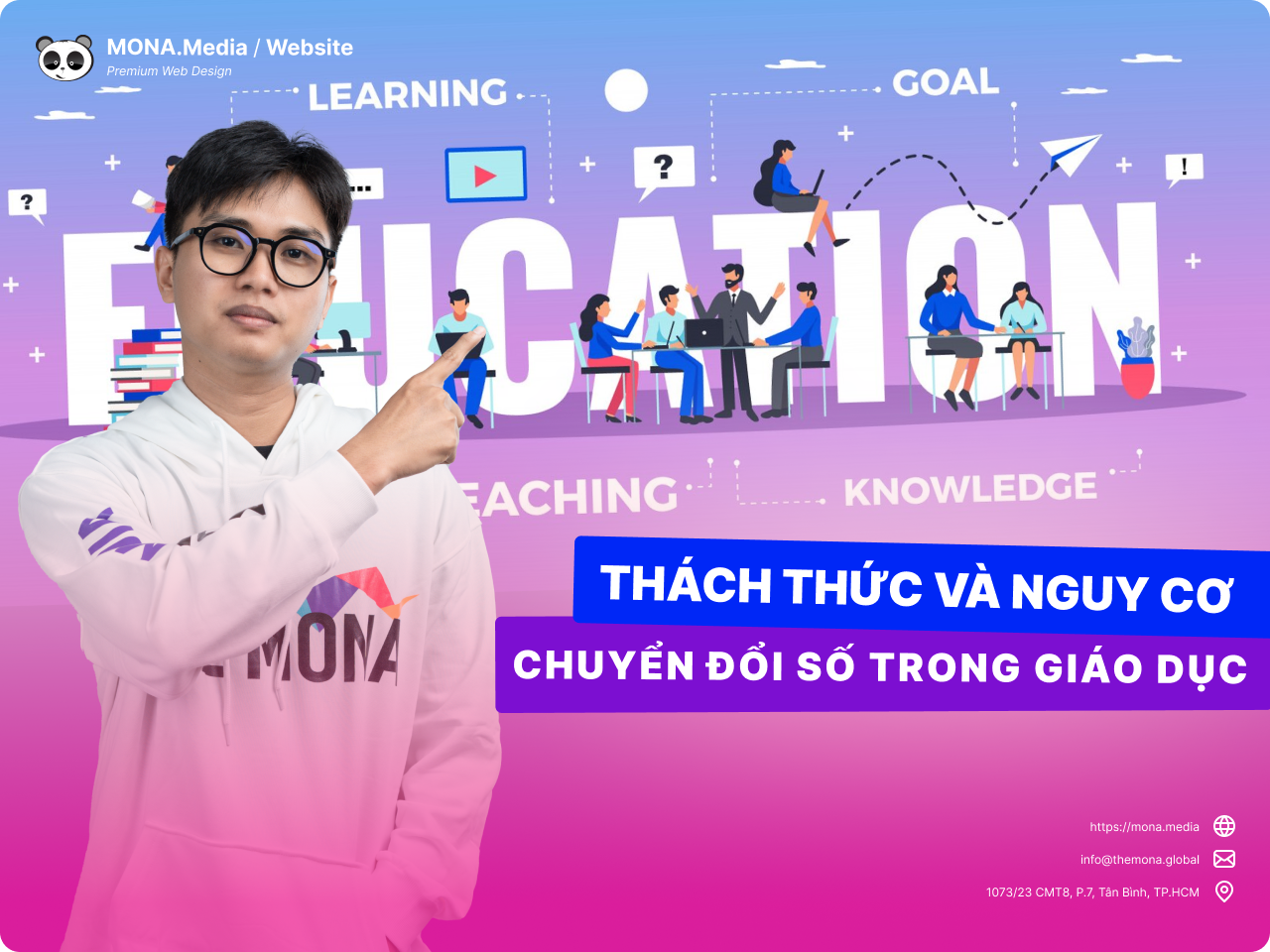
Digital transformation is becoming a driving force for the Education 4.0 improving teaching and learning quality and narrowing the gap in access to knowledge between regions, especially remote areas. Despite many advances, the process still faces quite a few challenges. In this article, MONA Media will help you explore the details of the state of digital transformation in education and propose solutions to develop this field in the future.
Digital transformation in education is the process of integrating digital technology and the internet into the education system to improve teaching, learning and management. It includes updating teaching methods, using advanced learning support devices and improving the learning experience.
That is why digital transformation has created a learning environment where everything is connected, narrowing geographic gaps and strengthening interaction.

Examples of digital transformation in education include:
Digital transformation is gradually changing the face of education, creating a diverse, flexible and highly interactive learning environment. Let's explore why the digital transformation model in education is increasingly important and urgent today.

In the 4.0 era, the internet has become a rich source of information on countless topics. As a result, the reality of digital transformation in education requires pupils and students to choose information wisely. At the same time, access to diverse, high-quality information helps learners broaden their knowledge.
Online classes via Zoom, Teams, Google Meet,… let pupils and students learn flexibly, interact and discuss anytime, anywhere. This convenience also encourages learners to be more active and proactive in their studies.

Mobile learning apps (Mobile Learning) and other social networks let learners connect and exchange around the world. They can broaden their horizons and pick up new information and knowledge quickly.
As technology keeps advancing, solid digital knowledge is essential for students, because they will become the main workforce of the future. That is why the digital transformation model in education, or digital transformation consultation for language centers, plays an important role in developing learners' skills.

E-learning technology lets pupils and students adjust their learning pace and choose content to match their interests and abilities. This gives learners a better-fitting experience by combining diverse learning resources.
Teachers can use digital tools such as tablets, projectors, chatbots, AR/VR and AI-assisted software to create a more engaging, interactive learning environment, helping students absorb new information more effectively.
Under Decision 131/QĐ-TTg on the project “Strengthening the application of IT and digital transformation in education for 2022 to 2025, with orientation to 2030”. The specific goal is for 100% of education institutions in Vietnam to manage on digital platforms, and to develop a digital learning ecosystem and an open learning resource library shared across the whole education sector.

In addition, The Ministry of Education and Training (Bộ GD&ĐT) has also collected information from 63 provincial departments and 710 district education offices, and built and completed a database system managing school information from preschool to general education. The system includes databases for schools, classes, students, teachers, facilities, finance and other related factors.
In addition, the digital transformation of education has helped promote “lifelong learning” from digital materials. About 5,000 quality e-lectures have been used for online teaching, creating an open learning resource library shared across the sector. The digital resource library also includes nearly 7,000 theses and 31,000 digitized multiple-choice questions shared widely in the community.
From this, it is clear that the state of digital transformation in education in Vietnam is steadily gaining momentum. Applying technology in education has already brought clear benefits to management, teaching and quality control. Digital transformation is not only an "inevitable trend" but also a "fitting solution" for raising the quality of Vietnamese education, especially as education becomes more integrated and competitive in the international market.
Digital transformation is fast becoming a key lever for improving and developing education, especially in the context of Industry 4.0. Specifically, the opportunities digital transformation brings to educationare what MONA will share in the sections below.
Digital transformation in education lets students reach learning resources well beyond the library and printed materials of the past.

As a result, information already available in digital libraries, on websites and on the internet costs less or is completely free, and can be shared among students, university students and teachers in a single click.
Digital technology in education also lets a person keep learning throughout life while still handling their own work and caring for their family, and so on.
To speed up digital transformation in education, teachers, and even students, get access to customization benefits and can build curricula that use big data to shape future learning and teaching.
To recommend suitable courses and surface more related information and data, this technology uses big data (Big Data). It also gives students a chance to tailor their learning process so they progress faster, more accurately and more steadily.

Thanks to the opportunities digital transformation brings to education, learners can study and access different content at home, at school or anywhere, with just an internet-connected device.
Beyond students, working adults benefit especially: they can study wherever they need to, reach richer and more varied information, and save time and money.
Educators can prepare their programs and courses using the best content already developed by other colleagues.
With this digital content, educators can create many effective materials. Digital tools also help educators measure how students learn best and adjust learning modules based on those measurements.

Modern education technologies such as smart interactive whiteboards, education management web apps, mobile apps, chatbots and AR/VR contribute greatly to more interaction and creativity in learning.
And that's not all: applying information technology in teaching They also open up new opportunities with personalized learning systems, data analytics and support for teachers in the classroom.
Digital transformation in education is the "soil" that grows a generation of high-quality lecturers. To keep up with high-tech teaching, lecturers must keep learning, build up their knowledge and develop their skills, in order to raise the quality of their teaching, and so on.
In addition, education businesses and centers are actively choosing digital transformation consulting solutions for language centers and teaching centers to modernize their processes and give learners the best learning environment.
Digital transformation in education and training is not an easy process and will certainly meet considerable challenges. Let MONA take a closer look at the difficulties and challenges of digital transformation in education and training.

Many educational organizations worry that technology could replace traditional teaching, which makes teachers hesitate to change. In practice, though, technology is a tool that eases the pressure of preparing and delivering lessons, making learning livelier and more effective.
In remote areas, the lack of internet and technology infrastructure hampers digital education. This is a difficulty in educational digital transformation that must be solved to develop online education across the country.
During digital transformation, many educational organizations have no detailed plan or do not know where to start when integrating technology into their teaching systems.

Without a clear roadmap and expert support, adopting technology becomes hard and ineffective. This creates a need for support and advice from experts in education and IT to build and carry out digital transformation strategies for the education sector effectively and sustainably.
Why should we be careful with digital transformation in education? Because this trend is moving fast in practice, especially in technology. We need to apply digital technology in education to raise and develop skills. Yet tools and facilities are still outdated and in short supply, and do not yet support education's transformation well.

Digital transformation in teaching requires connections: separate programs and software must be compatible, integrated and "accessible" on the same platform. That allows teaching, management, learning, assessment and testing to interact between learners, teachers and the school.
In addition, the internet is what makes this process work. This can be a challenge for digital transformation in education, because the education and training sector is used to operating independently.
Digital learning materials today are poorly controlled, inconsistent and sometimes unverified. This makes it hard to deliver quality knowledge and costs time and budget.
Current regulations on digital education do not yet meet requirements for intellectual property and information security. This slows digital transformation and creates many legal and management problems in the education sector.
The content above has laid out the advantages and difficulties of digital transformation in education. And todrivedigital transformation in education in Vietnam, you need to apply the digital transformation solutions in education below to raise the quality of teaching.

To carry outdigital transformation in education and training, the first thing to do is raise awareness of how important this process is. Teachers, lecturers and administrators need to be informed about the benefits and necessity of digital transformation, so they take part actively and work together to build a digital environment in education.
At the same time, focus on guidance and on raising digital skills for those who teach, so they can apply digital technology effectively in teaching and learning.
Digitizing materials in education is one solution you should not overlook. It means converting paper documents into electronic ones, building network infrastructure and investing in equipment for digital education, which is critically important. This not only creates equal learning conditions for everyone but also streamlines management and information sharing.
Shared digital learning repositories for the education sector and international cooperation should be developed so that knowledge is updated and shared effectively, while narrowing the knowledge gap between regions.

Upgrading network infrastructure and technology equipment is an essential step inthe digital transformation of education. In areas with poor internet connections especially, this is all the more urgent.
In addition, applying advanced technologies such as AI, Big Data, IoT and Blockchain in the education system will improve learning quality and effectiveness. This process also brings applications and online teaching software that fit the needs of each group of students and university students.
In the context of digital transformation in teaching, raising training quality has become an urgent requirement. That includes updating and renewing educational content and integrating creative, interactive teaching methods through technology.

Modern technologies such as AI, machine learning (Machine Learning) and online learning platforms create flexible, personalized learning environments, helping students develop well-rounded knowledge and skills.
Training teachers and building their teaching skills in the digital environment is also an important part. It helps them use digital education tools and resources effectively, raising teaching quality and supporting learners better.
In the process of digital transformation in education, using management software is not only a smart choice but also an essential and timely solution that training centers and schools should prioritize.
This software not only manages data on students, teachers and teaching activities but also creates a flexible, easily accessible online learning environment. By integrating technology into education management, institutions can optimize resources and costs and focus on raising teaching quality.
MONA LMS is one of the English center management software is among the most highly rated today. The system is designed to handle up to 99% of all education-sector operations. MONA LMS will be a capable assistant that meets every requirement of today's education centers and training institutions.

Notable features of MONA LMS include:
Overall, MONA LMS fully removes the fear of not being tech-savvy, and so helps language centers and education institutions go digital. What are you waiting for? Hurry and TRY IT FREE try all the software's features or call HOTLINE 1900 636 648 to get consulting support right away!

1- What is digital transformation in preschool education?
Digital transformation in preschool education and training means integrating digital technology into the preschool curriculum. For example, using learning apps, educational e-games and interactive tools to support young children's skills and knowledge.
2- What is the goal of digital transformation in education?
Technology activities such as digital transformation consulting for language centersand education institutions all aim to raise the quality and effectiveness of education, offer personalized learning methods, improve access and improve education management through digital means.
3- What is the best digital transformation software for teaching today?
The best digital transformation apps for teaching today include MONA LMS, Google Classroom, Moodle, Canvas and Blackboard.
4- What conditions are needed to apply digital transformation in schools?
You need good network and technology infrastructure, training and support policies for teachers, an investment budget and a clear management strategy.
5- How do you keep students and teachers interacting in digital education?
Use highly interactive online platforms and organize group learning activities to enable two-way exchange.
6- How do you keep information secure in digital education?
Apply strong security measures, use trustworthy software and follow data security standards.
In short, it is clear that state of digital transformation in education faces quite a few difficulties, yet this process still opens great opportunities for an advanced, well-rounded future of education. To overcome the challenges of digital transformation in education and training, an organization needs teaching method innovation, along with effective management and operating processes. Only then can digital transformation realize its full power and take education to new heights.

CEO & Founder · The MONA
Founder of The MONA, who built a services company of 60+ staff with 14,000+ projects delivered. Khánh Hùng shares how he thinks about building systems that run themselves, automating a business, and the real lessons from delivering projects at MONA.
 1,7K




Professional website
design services
Own a website with a beautiful, 100% exclusive design and a lifetime warranty, with the ability
to expand features flexibly as your business grows, starting today!






 MONA will never sell your information or send you spam


 MONA will never sell your information or send you spam
