
 MONA OS 2.0
 Partner with MONA


 Tự động hoá doanh nghiệp
 Cẩm nang SEO
 Digital Marketing
 Kinh nghiệm thiết kế website
 Hạ Tầng Server
 Giáo dục


 VI
 EN











Message us on
Zalo Official


 ProductsNew

 ProductsProducts
 Mới ra mắtKHA AI 2027App tự edit video, tự đăng mọi mạng xã hội, 2 phút mỗi ngày










 Website designLooks good and wins customers over.
SEO servicesBrings in customers searching for exactly what you sell.
 Tư vấn digital marketingKéo khách từ nhiều kênh, đo bằng số thật.
Corporate video productionVideos introducing your company, factory and team.
 NewAI video productionCompany story films made with AI.
 Custom software developmentCRM, ERP and HRM built for your business.
 Viết AI Agent theo yêu cầuĐặt riêng một trợ lý AI cho đúng việc của mình.
 Tư vấn chuyển đổi AIĐưa AI vào vận hành của cả công ty.
NewMONA LMSManagement for centers and schools.
MONA SkillHubInternal training for company staff.
 NHTQ systemEnd-to-end China–Vietnam shipping operations.
MONA JMSManagement for gold, diamond and pawn shops.
 MONA E-LearningA website with every feature you need to sell courses.
 How to sell online courses (course)More than 30 free lessons on selling courses on autopilot.
 MONA Cloudmonacloud.vnServers to get your apps and websites running.
 MONA Basemonabase.vnPostgres database, sign-in and file storage.
 MONA Mailmonamail.vnSend OTP, order and invoice emails from your software.
 MONA Paymonapay.vnAccept bank transfers via VietQR and notify your software when the money arrives.
 MONA eInvoiceComing soonIssue e-invoices that meet tax standards.
Gấu CườiTrả lời khách 24/7 trên web, Fanpage, Zalo và thu lead cho sale.
 Gấu TeleSalesGọi điện tư vấn, chăm khách như tổng đài viên thật.
Dê CườiTư vấn và chốt đơn cho shop ngay trong khung chat.
Gấu WebmasterNhắn nhóm Zalo là website được sửa xong.
 Gấu Pháp ChếSoạn hợp đồng, rà điều khoản trong vài phút.
 Gấu Báo GiáLên báo giá đúng mẫu và gửi khách ngay.
 AI chăm sóc khách hàngTheo dõi và giữ chân khách hàng cũ.
 Gấu Tuyển DụngLọc hồ sơ, hẹn lịch, phỏng vấn ứng viên.
 Mới ra mắt
KHA AI 2027
Xây kênh chuyên gia 2 phút mỗi ngày
Quay bằng điện thoại, AI tự edit video, tự đăng lên 16 nền tảng và tự trả lời bình luận, tin nhắn.
883.362lượt xem trên kênh CEO MONA sau 36 ngày
 Anh Khánh HùngCEO MONA đang dùng mỗi ngày
Xem app làm được gì
 AI
Gấu Cười MONA ĐANG TỰ XÀITrả lời khách 24/7 trên website, Zalo OA, Messenger và thu lead về cho sale.
Dê CườiChốt đơn bán lẻ và sàn: Shopee, TikTok Shop, web. Chăm cả khách sỉ, đại lý.
Gấu WebmasterCập nhật nội dung, tối ưu SEO website mỗi ngày.
Gấu TeleSalesGọi điện tư vấn, chăm khách như tổng đài viên thật.
Gấu Tuyển DụngLọc hồ sơ, hẹn lịch, phỏng vấn ứng viên tự động.
AI chăm sóc khách hàngGiữ khách cũ, cứu lead đã rớt cho phòng kinh doanh.
Gấu Pháp ChếSoạn hợp đồng, rà điều khoản trong vài phút.
Gấu Báo GiáLên báo giá đúng mẫu, gửi khách ngay khi có yêu cầu.
 Chuyển đổi AI toàn phầnGiải pháp tổng cho doanh nghiệp, 3 lớp triển khai.
 Viết AI Agent theo yêu cầuĐặt riêng một con AI gánh đúng nghiệp vụ của bạn.
 Custom softwareCRM, ERP and HRM with built-in AI automation.
 SEO & AEO thời đại AIĐược Google lẫn AI trích dẫn, không chỉ xếp hạng.
 Kiến thức AI cho doanh nghiệpBài phân tích, hướng dẫn ứng dụng AI vào vận hành.
 Free AI courses
 AI tools at work
App mới · KHA AI 2027
Xây kênh 2 phút mỗi ngày
AI tự edit video, tự đăng mọi mạng xã hội
Free consultation, 8am–10pm every day




Book a FREE demo
18 March, 2023

What is elearning? Put simply, it is a set of pre-recorded videos played back for learners, usually with online exercises, online tests, downloadable materials or some other form of support. That's the whole definition. There's no need to pile on complicated concepts that only make things harder for you.
What matters more is what elearning does for teachers and learners. Teachers can sell their knowledge without trading all of their time for each live class. Learners can pick the way of absorbing knowledge that fits their own schedule.
This article is a fuller explanation from the point of view of MONA, which runs Khánh Hùng Academy and MONA Academy directly. We cover both the strengths and the limits so you can see this model for what it really is.
The video above is the short version. If you want a quick listen to CEO Khánh Hùng's take, you can watch it right here or open the video on YouTube. If you want to understand each part in more depth, let's keep going below.
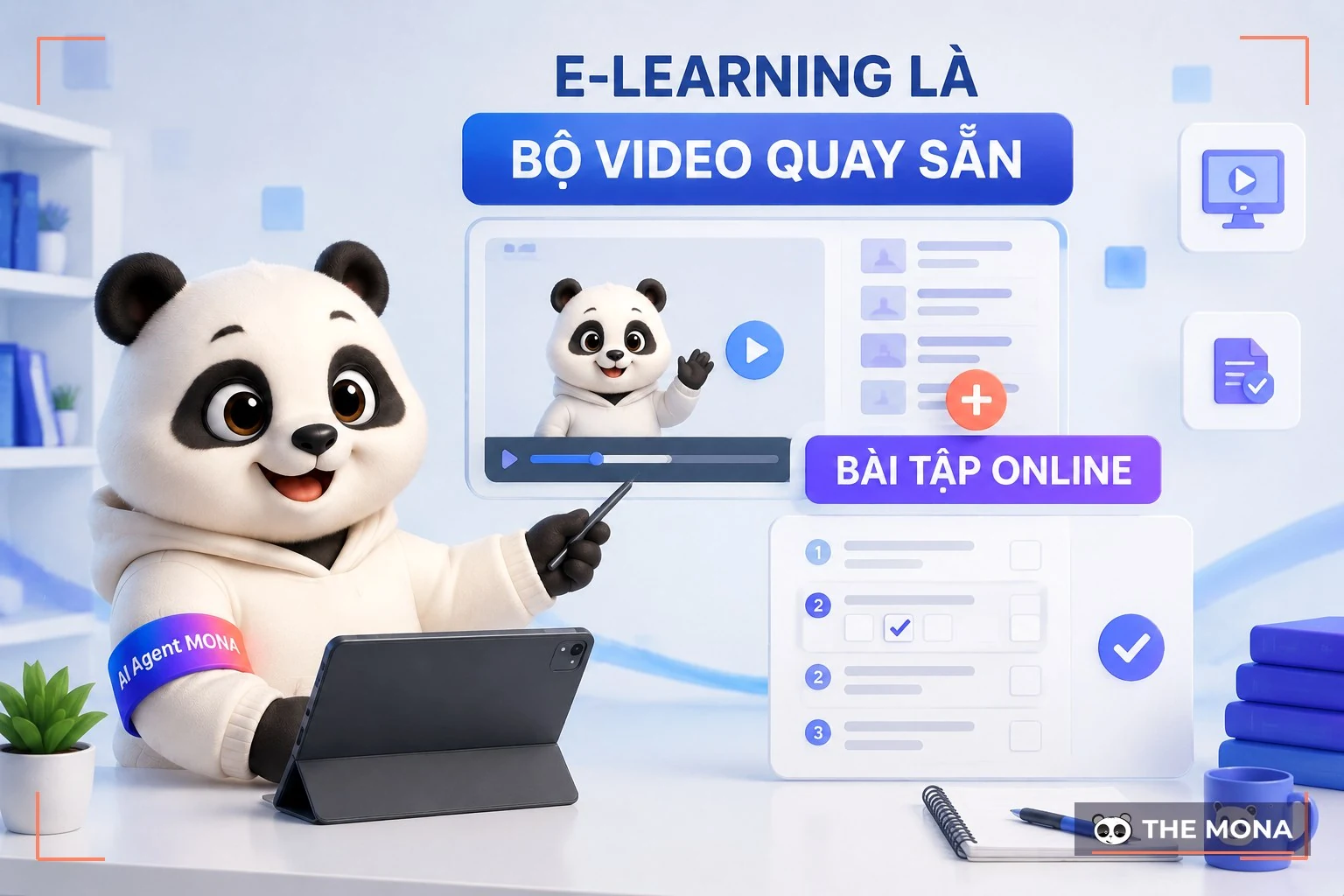
What is elearning? A good enough answer: it is a set of pre-recorded videos uploaded to a system, where learners buy or are granted access, then watch and study at their own pace.
Elearning is really a digital product. The buyer receives nothing physical: no warehouse, no packaging, no shipping. They buy access to an account, log in to the system and use content that has already been prepared.
This model combines two strengths. The teacher owns an intellectual product of their own. And selling that product can happen online, just like many other kinds of goods.
An elearning course can start with just a few videos. The teacher then adds online exercises, quizzes, sample files, reference materials or a private discussion area. These additions give learners something to do after watching, instead of just listening and letting it sit.
Many people hear "elearning" and assume it is something highly technical. Some think you need an online school, complex software or a huge training operation before it counts. In reality, its roots are very close to how we already watch content online every day.
A real example so you can see it for yourself: the channel Scott Yu-Jan on YouTube, run by a teacher of design and 3D modeling. He opens a members-only area right on his channel: a tier of about 100,000 VND per month unlocks in-depth tutorial videos labeled "Members only", a tier of about 250,000 VND adds project files for practice, a tier of about 350,000 VND lets members download the videos, and for private advice through messages the top tier costs about 5 million VND per month.
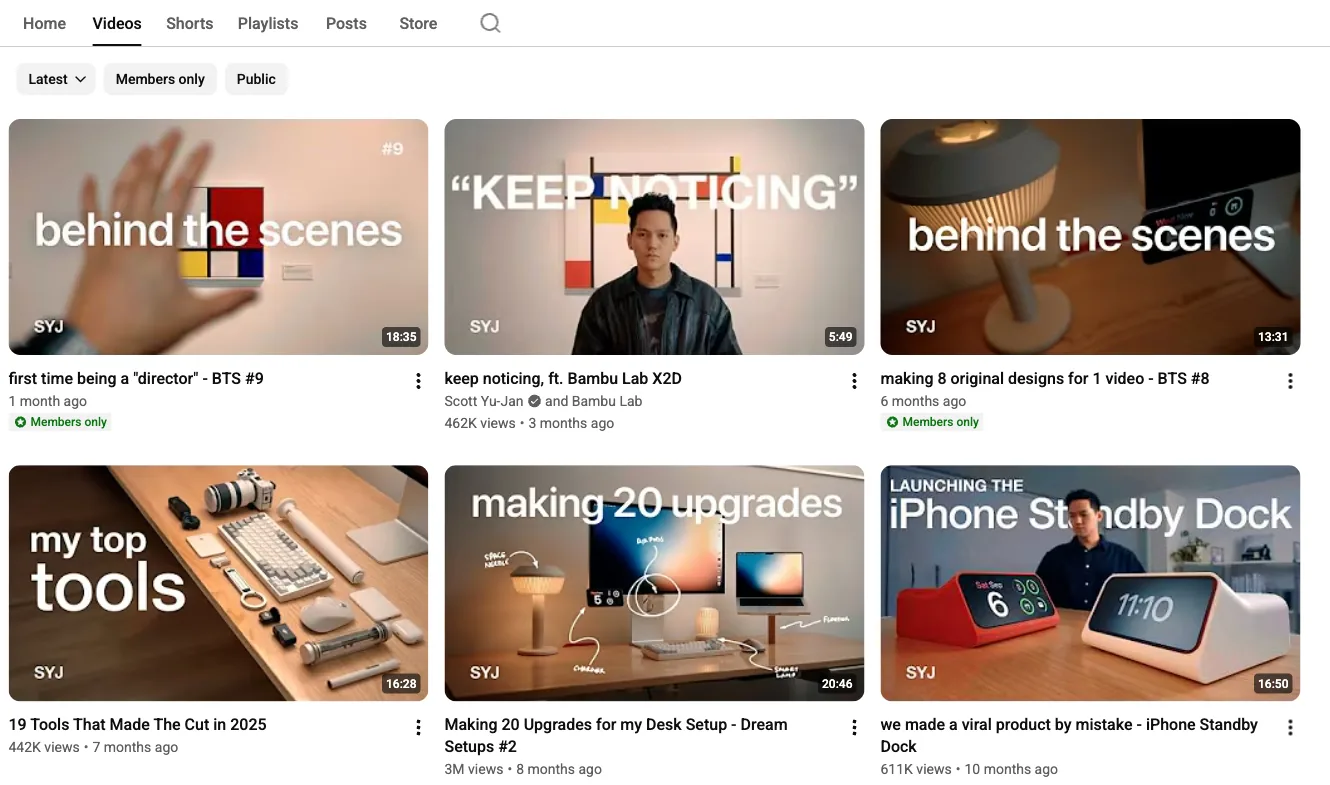
At its core, this model sells a set of pre-recorded videos. The added value sits in the exercise files, sample files, documents or private access to the teacher.
Picture someone skilled in 3D modeling, design, marketing, sales or any field where they have real experience. Instead of opening many identical classes every week, they record the knowledge once. Learners can then buy it and study from it.
This is also how many experts turn their knowledge into a product that can be sold again and again. If knowledge stays in the teacher's head, the number of people who can benefit is capped by that one person's time.
Once the knowledge is packaged into an elearning course, learners can reach it at any time. The teacher also gains another option alongside live teaching.
At MONA, we run this model through Khánh Hùng Academy and MONA Academy. Seeing it in practice is easier than reading too many definitions.
Many people also mix up LMS and elearning. An LMS is software for managing learning. Elearning is the model of learning through digital content, and an LMS can be one part of it, used to manage learners, lessons and progress.
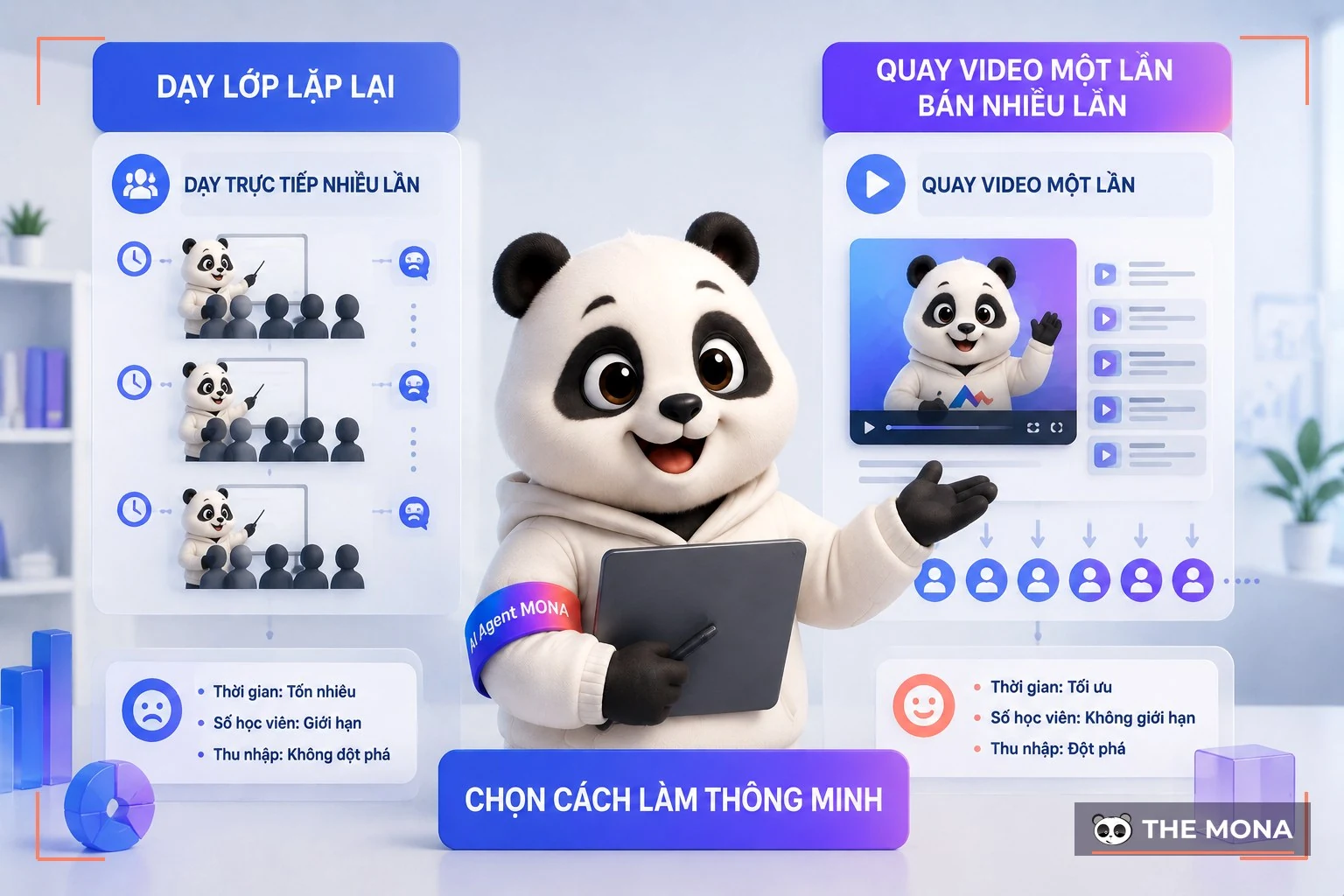
For teachers, the biggest benefit of elearning is how it turns knowledge into a product. A person with real experience can bring their knowledge to far more people without having to show up in every single session.
Think of a familiar situation. A business owner has 10 years of experience in operations, hiring or sales. Every time someone asks how it's done, you have to explain from scratch. If you want to open a class, you have to set a schedule, rent a venue or give up many evenings to teaching.
Teaching classes, teaching over Zoom or coaching all have their own value. This is a service model, where learners get direct interaction with the teacher. But it has three limits that many long-time practitioners run into.
The first is the boredom of repetition. Someone who runs 5 to 10 classes a year may have to say the same material many times. After a few years, the content is the same but the energy left for delivering it has dropped.
The second is the busywork behind each session. A 2-hour class usually drags along many other tasks: grading, sending reminders, collecting tuition, rescheduling for busy students, supporting weaker learners or giving private advice. The real time spent can be much longer.
The third is the limit on how many people one teacher can serve. Even a great teacher has only so many hours in a day. Many end up with people who want to learn but no time left to take them on.
This is why some very good teachers stay at around 100 to 200 students for years. They have the knowledge and there are people who need it, but the service model makes it hard to scale. The problem lies in how the knowledge is packaged, not in the teacher's ability.
For in-depth courses, a video set is even more valuable. Some knowledge isn't fully understood the first time. After a few months on the job, learners return to an earlier section and notice a lot they missed before.
Carefully prepared videos can sit there for learners to rewatch many times. The teacher can also add new versions when the explanation needs to change or new knowledge needs to be added.
Our advice: knowledge worth selling should be sold. Not everyone with experience has to give everything away for free. A process that took years to build has its own value.
The teacher doesn't have to be a professional educator either. A strong salesperson, an expert in a trade or someone with a special skill can all create a course if they know how to package what they know.
What most people care about is still money. Elearning has one key difference from a traditional class: costs don't rise at the same pace as the number of learners.
With offline or Zoom classes, more learners usually means more sessions, more support time or more staff. As revenue grows, working hours tend to grow with it.
With an elearning course, the videos are created in advance. Fixed infrastructure costs can sit at around 2 million VND per month. Whether you sell one course, a few courses or many more in a month, that cost doesn't rise in step.
If you aren't running paid marketing yet, profit margins can be very high because the product is already recorded and packaged. Selling one more course doesn't mean the teacher has to open one more class.
Of course, selling many courses still takes good content, the ability to introduce your product and the market's trust. A finished video won't produce revenue by itself if nobody needs to learn from it.
Beyond direct revenue, a course can also become a channel for building a personal brand. Experts who share well-structured knowledge are more likely to be noticed by customers, partners or training organizations.
We have also seen many course owners in the MONA ecosystem gain new collaboration opportunities after building training content. They get invited to speak, connect with learners and open up new business relationships.
There are many ways to deploy the same content. Some people sell the whole course as a package. Others use the course to build a paying community of learners on a monthly plan. What they share is that the knowledge has been recorded as an asset that can be used again and again.
If you'd like to see how to build an online course business, read experience in selling online courses effectively. MONA also shares its operating perspective at Khánh Hùng Academy so you can see a model that is running in real life.
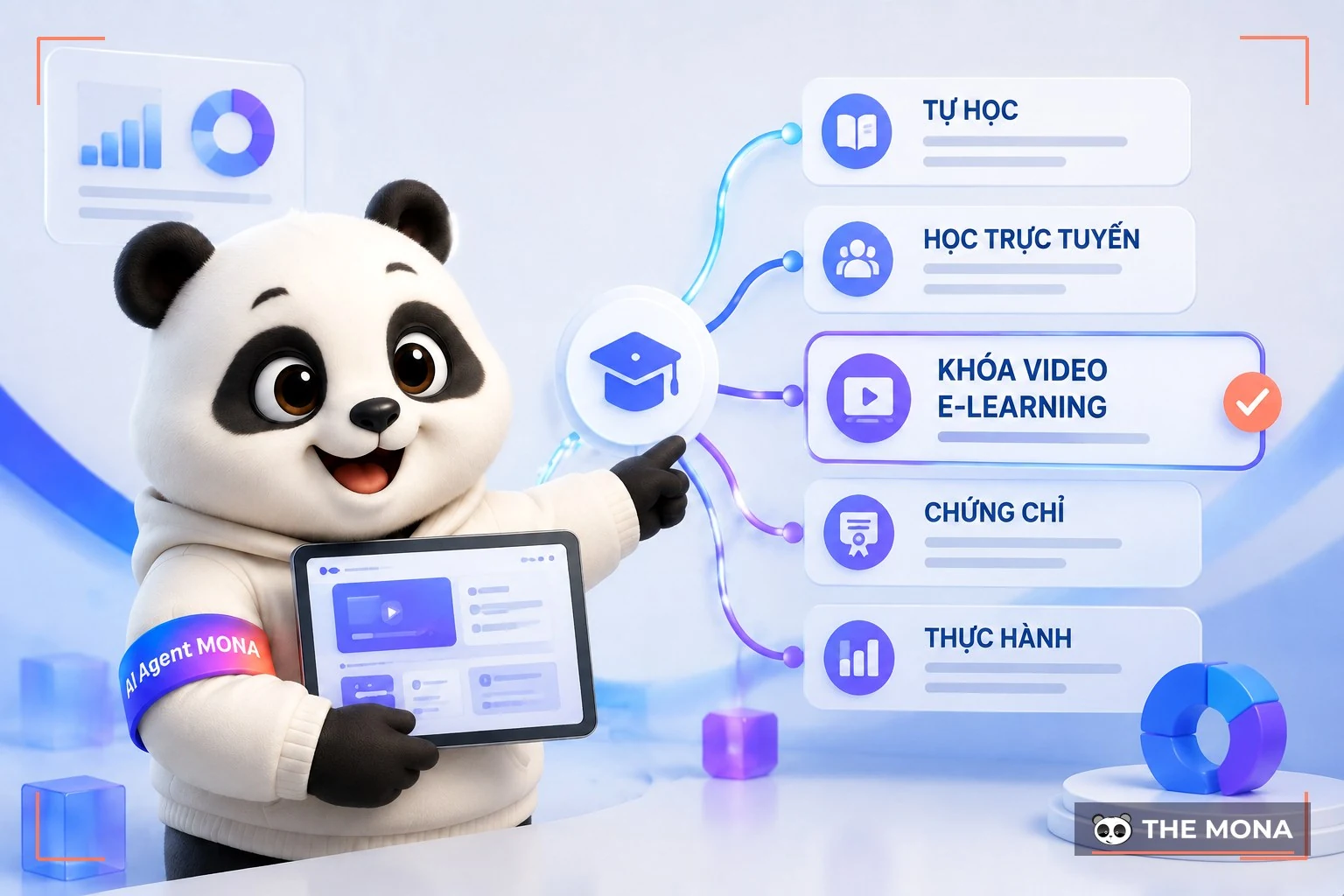
Elearning is one of many ways to reach knowledge, standing alongside other learning paths.
Someone can study at a university in Vietnam or abroad. Someone can go to college or a vocational school. Someone can learn on the job, follow an experienced person or buy books and study on their own. Each way suits a different group of people.
Elearning's strength is self-direction. Learners don't depend on a fixed class schedule.
You can open a lesson at 11 p.m. or midnight if you like. People who are busy at work, have a family or don't want to travel much get one more option.
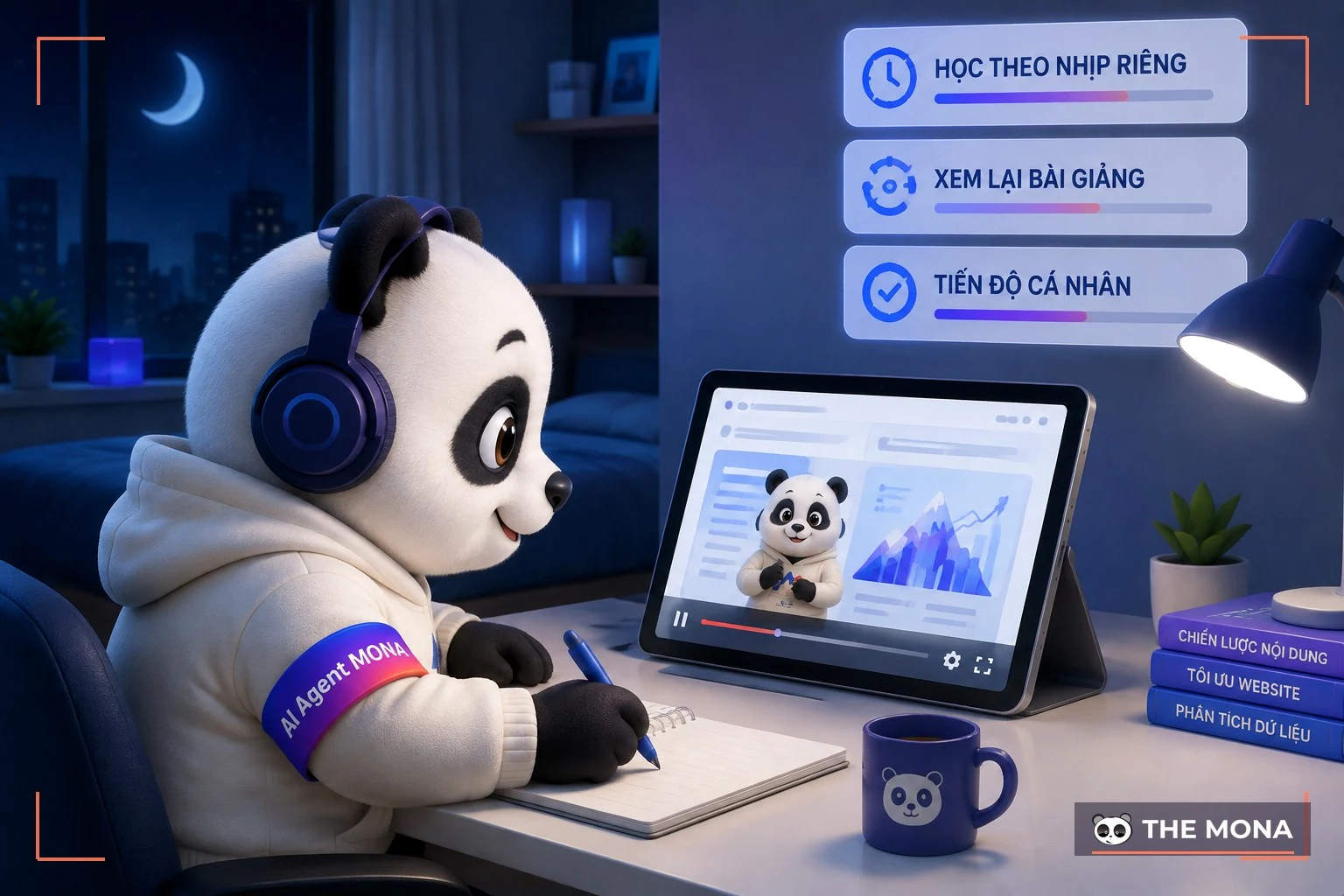
One thing we saw clearly while running internal training at MONA is the value of carefully prepared videos. In our internal sales training series, individual videos got around 200 to 300 views, while only a dozen or so staff were taking the training.
This shows that a video with a prepared lesson plan and a clear presentation can be rewatched many times. Everyone can go back to exactly the part they need to review, instead of searching through a long meeting recording or a 2-hour class.
By contrast, a recording of a meeting or a live class is usually hard to revisit. The content may be complete, but viewers spend a lot of time finding the part they need.
Elearning lets learners set their own speed. They can speed through what they already know. For the hard parts, they can pause, rewatch many times or practice more before moving on.
Another benefit is that content can be updated. The teacher can re-record an old lesson, fix an explanation or add new knowledge. People who already bought the course keep receiving the updates in their own account.
Some people like the classroom because there are classmates and an instructor who keeps reminding them. Others prefer to study alone, arrange their own time and move at their own speed. Elearning serves the second group very well.
Another reality is that learners today often combine several ways of learning at once. They may study formally, read books, join a supplementary course and look for a mentor in their field.
Even fields that require formal study still have demand for supplementary courses. In the elearning system MONA built, one customer selling supplementary medical courses is among the top sellers.
This shows that elearning doesn't replace every form of training. It fills the needs that traditional classes struggle to meet, like relearning, extra study or learning at your own pace.
We see elearning as a tool that supports learning. It suits people who want to be self-directed, learn at their own rhythm and have a clear goal.
If you'd like to see more on the differences between ways of learning, read online training versus traditional teaching. Each format has its own strengths; what matters is choosing the one that fits your learning goal.
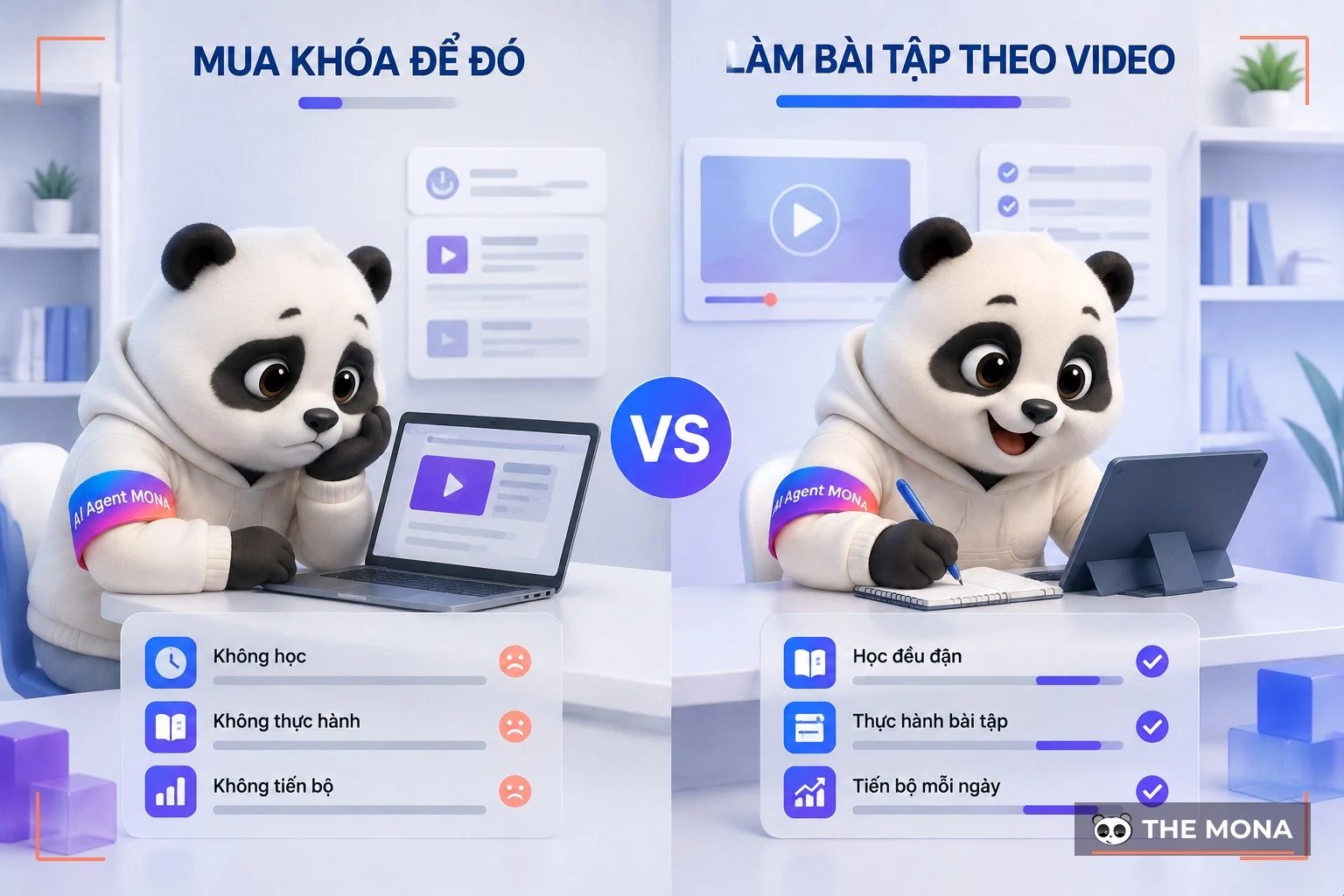
Many people exploring elearning ask a very practical question: does learning from pre-recorded videos actually produce results? It's a fair question, because paying for a course and still not being able to do the work afterward is a real waste.
From what we see running Khánh Hùng Academy and MONA Academy, the effectiveness of elearning depends on two sides. One is how the teacher builds the content. The other is how the learner turns knowledge into action.
There are 3 common groups of learners when they approach elearning.
The first group likes direct interaction. They need someone close by and need to ask the moment they hit a problem. This group usually finds live classes easier to follow because there is a fixed schedule and someone pushing them along.
The second group likes learning from a clearly organized set of videos. They want to choose their own study time, rewatch the hard parts and go at their own speed.
The third group cares most about the teacher. They may learn through live classes, videos, books or other formats, as long as they trust the experience of the person sharing.
In practice, the second and third groups usually make up most learners once a course has built a reputation. Some people who first preferred live classes also get used to learning from video once they see the content is well prepared.
Teaching in person doesn't guarantee knowledge sticks either. Some people finish a two-day course and a week later remember very little. The reasons lie in their foundation, how they take information in and whether they practice after the session.
The format is only one part. How the teacher designs the lessons and how the learner applies them determine the final result.
The first part belongs to the course creator. A long video isn't necessarily a good lesson. The teacher needs to know what learners are missing, which steps to follow and where to check so they don't misunderstand.
For example, a hands-on course differs from one that only conveys concepts. If you're teaching a tool, learners need to see every action clearly: which equipment to buy, where to click, which step comes first and what result to aim for. When the instructions are specific enough, learners can copy them after watching and produce a real result.
On the other hand, if the teacher simply records what they know without thinking from a beginner's view, learners get overwhelmed. They hear a lot of information but don't know where to start.
This is why preparing the lesson matters more than just putting videos online. You can read more on building content in designing elearning lectures and digital lesson plans.
An in-depth course needs this style of presentation even more. Some knowledge isn't fully understood on first listen, but after a few months at work, learners return and finally connect the pieces. A well-built video stays there for them to look things up when needed.
The second part belongs to the learner. Elearning lets you study at any time, but it doesn't turn knowledge into skill on its own. Someone who buys a course and leaves it untouched gets zero results.
It's like buying a book on architecture. Someone who has never studied the trade won't become an architect just by finishing the book. Knowledge has to go together with practice, correcting mistakes and repetition.
This is exactly why we think elearning should be judged fairly. It is a useful way to learn for the right group of people. It doesn't replace every other way of learning.
If you like to study at 11 p.m., want to rewatch a hard section many times, or want to learn from a skilled person who doesn't run live classes, elearning solves that very well. If you need someone close by every day, classmates to keep you motivated or the chance to ask the moment you get stuck, a live class may suit you better.
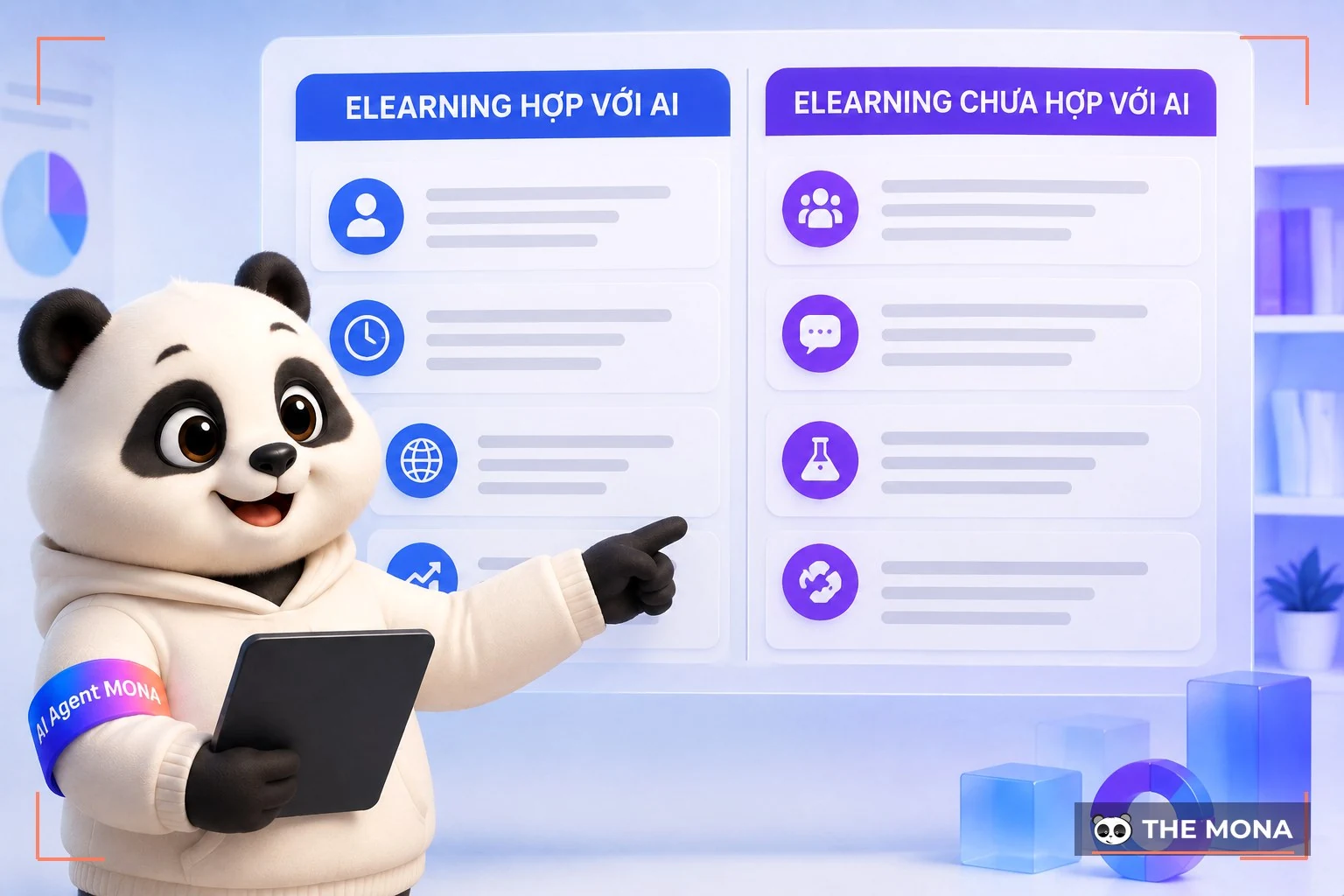
Elearning works best when the teacher has real knowledge and wants to share it in a way that can scale. A long-time businessperson, a professional expert or anyone with experience in a specific field can build a course.
You don't need the title of lecturer to sell knowledge. What learners pay for is experience they can apply. If a piece of knowledge helps others save time, avoid mistakes or work better, it has value.
For teachers, elearning suits those who have been stuck in the small-class model for years. Have you ever found yourself teaching the same content class after class?
Teaching classes, Zoom sessions or coaching are service models. When you open many classes a year, you have to repeat the same material again and again.
Beyond class hours, there is a long list of administrative work such as grading, sending reminders, collecting tuition, rescheduling for busy students, helping weaker students catch up and giving private advice. A two-hour session can trigger many hours of work behind the scenes.
This is where many skilled people hit an uncomfortable limit. They have customers who want to learn but no extra time to serve them. They want to sell more but have no additional product to offer.
Many teachers stay stuck at a few hundred learners for years. The problem isn't their expertise. The old operating model turns their time into the ceiling.
Elearning lets teachers separate sharing knowledge from the number of hours spent in class. A well-prepared set of videos can serve many learners. The teacher still needs to update content, look after learners and build a reputation, but doesn't have to repeat the same lecture over and over.
A course can also become a channel that makes the teacher better known. When someone has good content, learners, partners or businesses may come to them because they see the expertise through the course.
For learners, elearning suits people who know what they need, have a clear goal and are ready to set aside time to practice.
| Best for | Not yet a fit |
|---|---|
| People who want to study on their own schedule and have a clear goal | People who buy a course but don't set aside time to practice |
| People who need to revisit the same content many times | People who need someone beside them every day, step by step |
| People who want access to experts who don't run live classes | People who like a crowded classroom to stay motivated |
| Teachers who want to sell knowledge, not just trade time for money | Teachers who only enjoy direct interaction and don't want to record content |
As you can see, each form of learning serves its own set of needs. Those who enjoy interactive classroom teaching can keep doing it. Those who want to build a knowledge product they can use for the long term get one more option with elearning.
We apply the same thinking when building MONA's education products. Systems such as MONA Academy and Khánh Hùng Academy focus on making content easier for learners to reach, instead of just posting videos and leaving learners to fend for themselves.
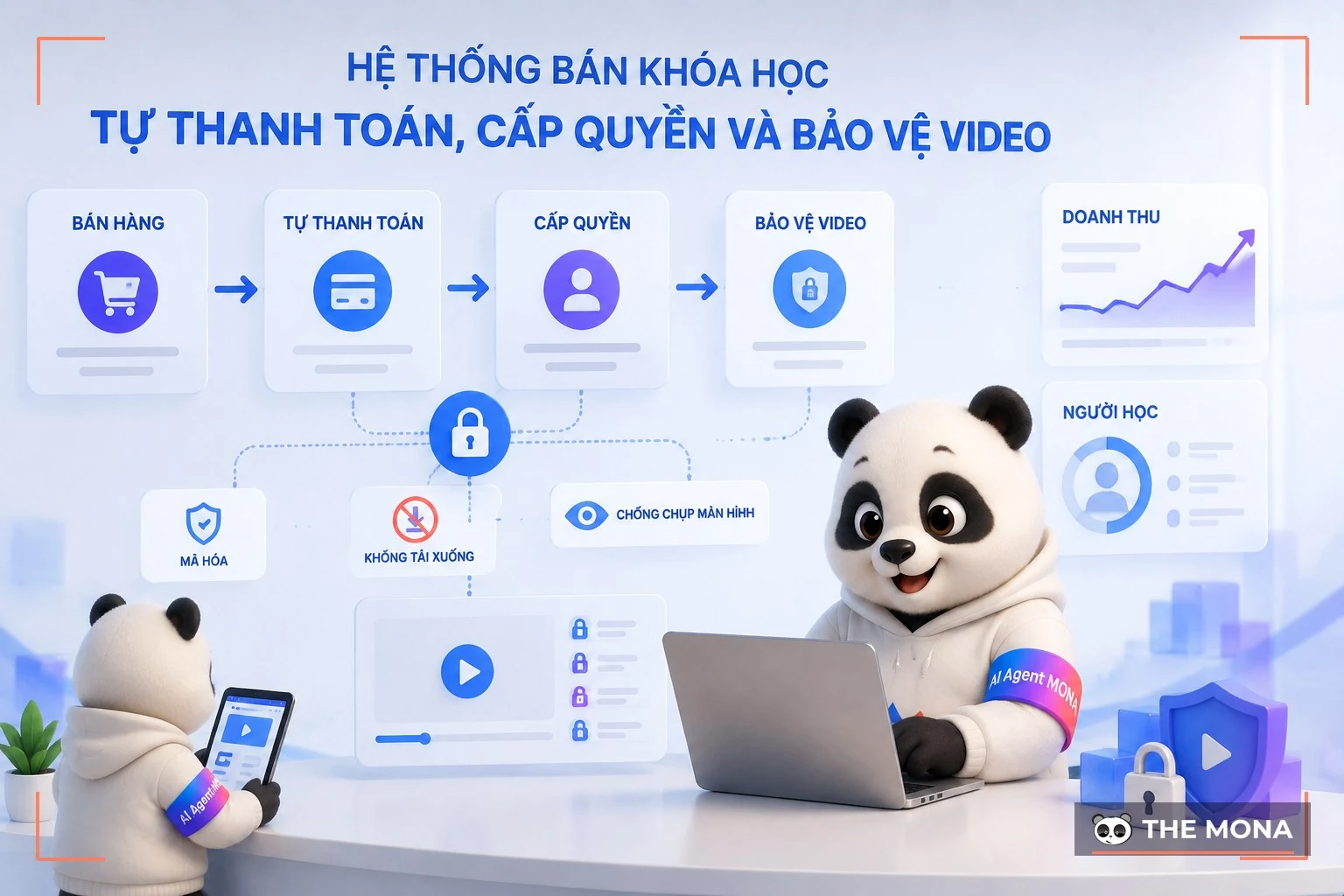
Many people think starting an online course business requires a very complex system. In reality, the foundation is still content, a place to sell and a way to run your learners.
First is the content. You need a set of videos, materials, exercises or instructions clear enough that buyers know what they're getting. The section on elearning lectures has more detailed guidance for people new to preparing content.
Second is a place to sell and grant access. Once a learner has paid, the system needs to open the right course, send the necessary details and help the buyer start learning right away.
Third is stable storage for your content. Paid videos need protection to limit sharing outside the platform.
Fear of being copied makes many people hesitate to sell courses. That feeling is understandable, since someone who spent months filming, editing and packaging their knowledge won't want it taken easily.
But that isn't a reason to stop sharing knowledge. Zoom classes can be recorded. Live classes can have their materials photographed. Even in the world's major lecture halls, students use phones and laptops during class.
People hunting for pirated courses at very low prices are usually not the customers a course creator wants to serve anyway. A good product still needs to focus on content quality, learner care and long-term reputation.
On the technical side, the system MONA deploys for paid video has layers of protection such as split streams with per-session codes, plus DRM to limit copying. The goal is to reduce risk for course businesses when they put their product online.
This is also how we think about building an elearning platform. There's no need to build many things just to have more features. What matters is that the flow runs reliably, from the moment a learner finds the course through payment and access to learning.
When we ran Khánh Hùng Academy, there were times learners bought a course at night. With a good process, the system can handle payment, grant access and send a notification on its own so the buyer can start right away.
You can read more on how to build the platform in online course website design and online teaching software.
Elearning is a model of learning through an online environment, including the content, how learning is organized and what learners do. An LMS is software for managing learning that handles accounts, courses, progress and data.
In simple terms: an LMS is the operating tool, while elearning is how teaching and learning are organized. We explain more in What is an LMS.
Yes. Pre-recorded video is the core of many elearning courses. When you add online exercises, online tests, materials or a discussion area, the learning experience becomes more complete.
There's no single answer for everyone. Effectiveness depends on how the teacher builds the course and whether the learner practices.
A course made seriously is judged by its content, the results learners get and how the teacher takes responsibility for their product.
People who slap on a negative label as soon as they hear about it usually haven't looked closely at the curriculum, the teaching style or the real value inside the course. A course with solid content, careful production, after-sale care and regular updates helps the teacher build professional credibility.
In the MONA ecosystem, some course owners choose elearning to grow their personal brand. After building their content, they get more invitations to speak, connect with partners and expand their business.
The biggest cost is usually the time spent creating content. On the infrastructure side, this model can start with fixed costs of around 2 million VND per month for the essentials.
As the number of courses sold grows, infrastructure costs don't rise at the same pace as the number of learners.
You can sign up for a free account at Khánh Hùng Academy. The platform currently has about 50 free videos so learners can sample the teaching style before deciding to continue.
People with practical knowledge and experience who want to share it with many others are the right fit. A businessperson, a long-time professional or an expert in their own field can all start, as long as the content is valuable enough.

Elearning opens two clear paths.
If you are a learner, start by watching a free course, judge the teaching style and how the lessons are organized, and see whether this way of learning suits you. Khánh Hùng Academy gives you a free account with about 50 videos to try before you decide to continue.
If you have knowledge and want to sell a course, we can go through the whole operating flow with you, from the sales page, payment and access to the system MONA builds and runs for education platforms. Register to talk with us at book a consultation or call 1900 636 648.
What is elearning? Put simply, it is a set of pre-recorded videos played back for learners, usually alongside online exercises, online tests and support materials. Once you understand what elearning is, you'll see it fits many different needs, as long as the content is good and learners actually get to work. For teachers, it is a way to sell knowledge without selling time; for learners, it is a way to choose a teacher they trust and study at their own pace.

CEO & Founder · The MONA
Founder of The MONA, who built a services company of 60+ staff with 14,000+ projects delivered. Khánh Hùng shares how he thinks about building systems that run themselves, automating a business, and the real lessons from delivering projects at MONA.
 1,8K




Professional website
design services
Own a website with a beautiful, 100% exclusive design and a lifetime warranty, with the ability
to expand features flexibly as your business grows, starting today!






 MONA will never sell your information or send you spam


 MONA will never sell your information or send you spam
