
 MONA OS 2.0
 Partner with MONA


 Tự động hoá doanh nghiệp
 Cẩm nang SEO
 Digital Marketing
 Kinh nghiệm thiết kế website
 Hạ Tầng Server
 Giáo dục


 VI
 EN













Message us on
Zalo Official


 ProductsNew

 ProductsProducts
 Mới ra mắtKHA AI 2027App tự edit video, tự đăng mọi mạng xã hội, 2 phút mỗi ngày










 Website designLooks good and wins customers over.
SEO servicesBrings in customers searching for exactly what you sell.
 Tư vấn digital marketingKéo khách từ nhiều kênh, đo bằng số thật.
Corporate video productionVideos introducing your company, factory and team.
 NewAI video productionCompany story films made with AI.
 Custom software developmentCRM, ERP and HRM built for your business.
 Viết AI Agent theo yêu cầuĐặt riêng một trợ lý AI cho đúng việc của mình.
 Tư vấn chuyển đổi AIĐưa AI vào vận hành của cả công ty.
NewMONA LMSManagement for centers and schools.
MONA SkillHubInternal training for company staff.
 NHTQ systemEnd-to-end China–Vietnam shipping operations.
MONA JMSManagement for gold, diamond and pawn shops.
 MONA E-LearningA website with every feature you need to sell courses.
 How to sell online courses (course)More than 30 free lessons on selling courses on autopilot.
 MONA Cloudmonacloud.vnServers to get your apps and websites running.
 MONA Basemonabase.vnPostgres database, sign-in and file storage.
 MONA Mailmonamail.vnSend OTP, order and invoice emails from your software.
 MONA Paymonapay.vnAccept bank transfers via VietQR and notify your software when the money arrives.
 MONA eInvoiceComing soonIssue e-invoices that meet tax standards.
Gấu CườiTrả lời khách 24/7 trên web, Fanpage, Zalo và thu lead cho sale.
 Gấu TeleSalesGọi điện tư vấn, chăm khách như tổng đài viên thật.
Dê CườiTư vấn và chốt đơn cho shop ngay trong khung chat.
Gấu WebmasterNhắn nhóm Zalo là website được sửa xong.
 Gấu Pháp ChếSoạn hợp đồng, rà điều khoản trong vài phút.
 Gấu Báo GiáLên báo giá đúng mẫu và gửi khách ngay.
 AI chăm sóc khách hàngTheo dõi và giữ chân khách hàng cũ.
 Gấu Tuyển DụngLọc hồ sơ, hẹn lịch, phỏng vấn ứng viên.
 Mới ra mắt
KHA AI 2027
Xây kênh chuyên gia 2 phút mỗi ngày
Quay bằng điện thoại, AI tự edit video, tự đăng lên 16 nền tảng và tự trả lời bình luận, tin nhắn.
896.519lượt xem trên kênh CEO MONA sau 37 ngày
 Anh Khánh HùngCEO MONA đang dùng mỗi ngày
Xem app làm được gì
 AI
Gấu Cười MONA ĐANG TỰ XÀITrả lời khách 24/7 trên website, Zalo OA, Messenger và thu lead về cho sale.
Dê CườiChốt đơn bán lẻ và sàn: Shopee, TikTok Shop, web. Chăm cả khách sỉ, đại lý.
Gấu WebmasterCập nhật nội dung, tối ưu SEO website mỗi ngày.
Gấu TeleSalesGọi điện tư vấn, chăm khách như tổng đài viên thật.
Gấu Tuyển DụngLọc hồ sơ, hẹn lịch, phỏng vấn ứng viên tự động.
AI chăm sóc khách hàngGiữ khách cũ, cứu lead đã rớt cho phòng kinh doanh.
Gấu Pháp ChếSoạn hợp đồng, rà điều khoản trong vài phút.
Gấu Báo GiáLên báo giá đúng mẫu, gửi khách ngay khi có yêu cầu.
 Chuyển đổi AI toàn phầnGiải pháp tổng cho doanh nghiệp, 3 lớp triển khai.
 Viết AI Agent theo yêu cầuĐặt riêng một con AI gánh đúng nghiệp vụ của bạn.
 Custom softwareCRM, ERP and HRM with built-in AI automation.
 SEO & AEO thời đại AIĐược Google lẫn AI trích dẫn, không chỉ xếp hạng.
 Kiến thức AI cho doanh nghiệpBài phân tích, hướng dẫn ứng dụng AI vào vận hành.
 Free AI courses
 AI tools at work
App mới · KHA AI 2027
Xây kênh 2 phút mỗi ngày
AI tự edit video, tự đăng mọi mạng xã hội
Free consultation, 8am–10pm every day

13 June, 2023
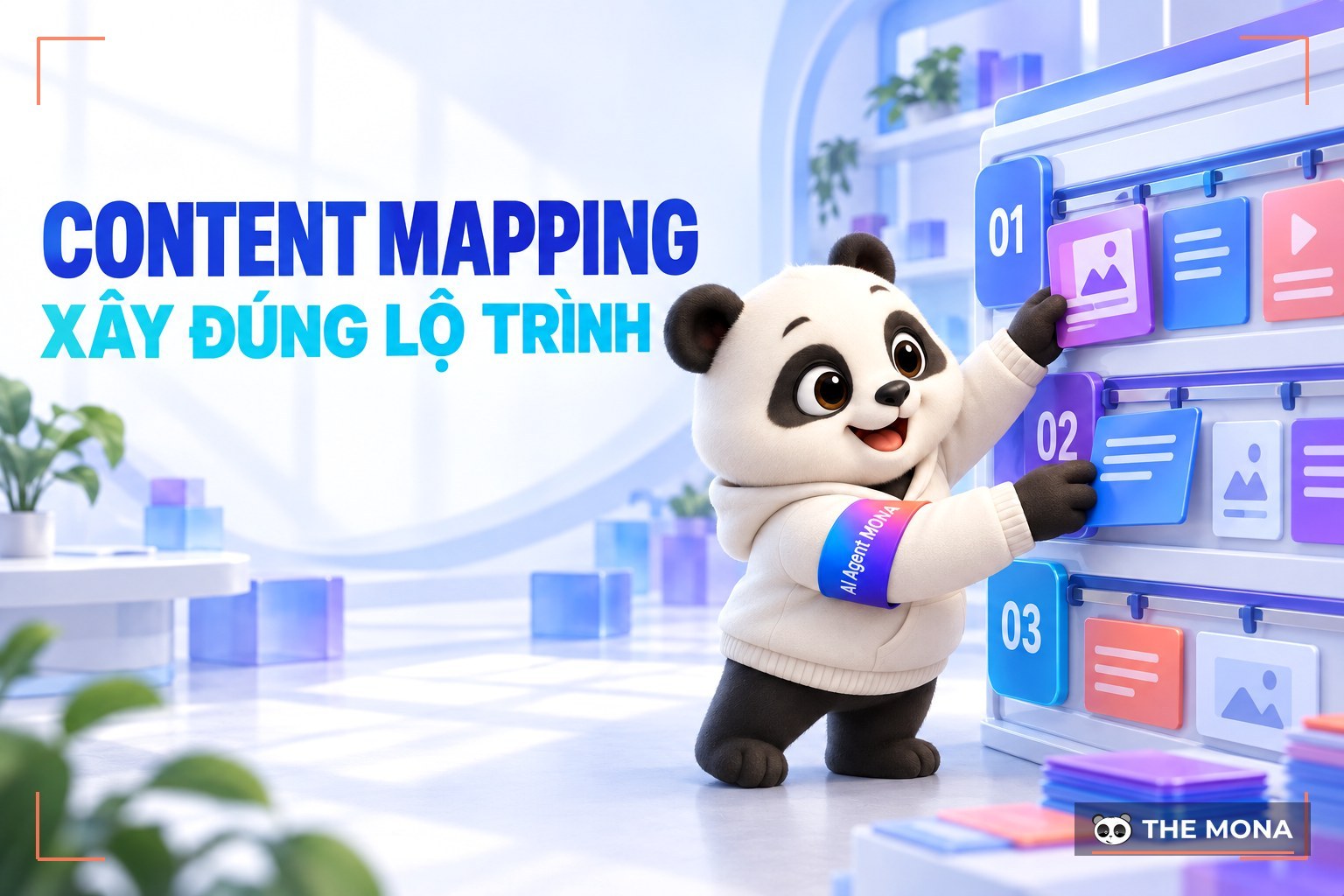
Any content marketer knows how important it is to plan content production. It saves time, and it keeps marketers from producing content aimlessly and without direction. But how do you build a unified content plan that fits each stage of the consumer's buying process? In this article, MONA Media will show you how to build Content Mapping effectively. Read on.
Content Mapping, also called a content map, is a strategic tool that helps content marketers build a logical content production plan based on the target audience's buying journey. Instead of creating content by gut feeling, scattered and rambling, Content Mapping helps you define your potential customers clearly, along with their needs and wants at each stage of the decision process. You can then create content that fits each moment and each distribution channel.

Specifically, Content Mapping includes:
Content Mapping not only helps a business understand its target customers better. It also improves the user experience, fills content gaps and builds a consistent, coherent content strategy, which raises marketing performance and increases sales.
Before building Content Mapping, marketers need to focus on 2 key factors to make the content map work well: Buyer Personas (customer profiles) and Life Cycle Stages (customer journey).
Customer persona are sketches of the target customers your business is aiming for, including the specific traits, needs and wants your business can meet. When you understand this profile well, it is easier to plan and create content for each stage of the buying journey, which attracts and converts customers more effectively
The more complete the customer profiles, the easier it is to create different pieces of content that match their needs and awareness at each stage of the buying journey. With a variety of customer profiles, you can tailor content to each specific customer group, which improves personalization and communication results. So each business should build 10 to 20 customer profiles. In the early stage, though, 3 representative profiles are enough to start Content Mapping effectively.

To build accurate customer profiles, base them on demographic and consumer behavior data, including:
Demographic information: age, gender, location, occupation, income, education and so on.
Behavior and habits: daily routine, how they shop, the information channels they usually use.
Needs and pain points: the problems customers face and how your product/service solves them.
Interests and priorities: what matters to them in life and what they prioritize when choosing a product.
Negative feedback: what customers are unhappy with, or the barriers that keep them from choosing your product.
A target customer profile is a sketch of the ideal customer your business is aiming for. From it, we can see the key characteristics a business needs to know about its customers, such as:
Beyond the above, use a detailed template to build clearer, more detailed customer profiles.
Once you have sketched the customer profile, the business is halfway to building a content map that helps it understand customers better. The other half is the customer journey, a tool that shows exactly which stage of the buying journey the customer is in. From there, you can build content and strategies that reach, nurture and convert them effectively. The main goal at this stage is to move customers from hearing about you, to seeing, to trusting, and finally to converting.

The customer journey passes through 3 main stages:
The time a customer takes at each stage also depends on the type of product/service. For everyday necessities the awareness stage is usually very short, and they decide to buy within seconds. For complex services such as website design, SEO or web hosting, customers need more time to consider and check before deciding.
Sometimes customers skip the awareness stage if they already have prior experience. For example, when you plan to buy a phone, you immediately think of a familiar brand like Cellphones or The Gioi Di Dong, because you have shopped there before and had a great experience. You then go straight to the consideration or decision stage without going through the initial awareness step.
→ A detailed guide to SEO for your website that works
Content Mapping helps a business understand its potential customers better and develop content that fits and works along the buying journey. It makes it easier to build a varied content strategy, distribute it to the right audience at the right time, and optimize for each stage, which helps raise the conversion rate.
Understanding the target customer is something every marketer needs to aim for. Every marketing campaign needs an analysis of the customer journey, which is the key starting point for building a complete and effective content map.

With Content Mapping, marketers can draw valuable insights from specific customers, such as their needs, wants and pain points at each stage. They can then produce fitting content and improve the quality of products and services.
Today consumers are more diverse than ever, with many customer segments, each with its own behavior and needs. Alongside looking after existing customers, a business must also spend resources and time nurturing potential customers, to lift the conversion rate at the right moment.
That is why a suitable Content Mapping strategy helps marketers segment their audience more clearly and identify each group's pain points. They can then plan content that raises the chance of conversion.
A good map gets you to your destination quickly, without detours or getting lost. In the same way, once you have defined your Content Mapping, you know which content you can develop effectively. You also avoid gaps in content, or the opposite problem of producing so much that it overlaps and becomes redundant.

You might think that producing a lot of content will catch customers' attention. That is only true when the content reaches your target audience and meets their needs. Content needs quality, and it also has to link closely together and point toward a shared goal, so that the reader's journey through the information is smooth, logical and effective.
On the customer's buying journey, content marketing plays a key role in building awareness, nurturing trust and driving conversion. So carrying out content marketing cannot be done carelessly, without a clear and long-term plan.

Let the MONA team work with you to build a content strategy that is high quality, consistent and fits each stage of the customer journey. We help your business make its mark in digital transformation, and also improve your reach and grow your conversion rate in a lasting way. Contact with the MONA team to get an SEO pricing and plan a stronger digital brand strategy together.
To plan an effective Content Mapping strategy, follow these steps:
Customer profiles are built on the consumer behavior, interests and specific traits of the target user group. Defining the profile clearly lets a brand picture exactly who its ideal customer is, and how they come to the brand and stay with it.

From there, the business can follow each step the customer takes, from first becoming interested in the product, to deciding to buy, and even coming back after the purchase.
A Customer Persona usually includes the following elements:
Once you understand the target customer profile, the next step is to recreate the journey they go through before, during and after buying your product/service. This is the foundation for carrying out Content Mapping accurately and effectively.

A customer's buying journey usually goes through these stages:
At each stage, customers come into contact with different channels, run into their own problems and want to receive suitable information. So the journey map needs to be detailed and close to reality, so that content can be built for the right moment and the right need.
Once the customer journey map is done, you will know each important touchpoint in how they interact with the brand. This step helps you decide which content should appear where and when for the best results.

Specifically, content should be layered by stage as follows:
Before building a new strategy, take time to review all the content you currently own. This step helps you:

List your current content by criteria such as title, topic, publishing channel, publish date, goal, and so on. That makes it easy to see what needs improving and how to optimize the content you already have.
After sorting and classifying, review how the content is spread across each stage of the customer journey. Make sure that:
If any content is unsuitable or unclear, note it down and review it later for editing or replacement.
In the final step, go back over the whole content map and add content where touchpoints are missing or content is thin and lacks depth.

More importantly, you can reuse old posts and optimize them for more depth without writing new ones. You can also research competitors or collect insights directly from customers to add quality content without spending too much time.
Why is Content Mapping important?
Content Mapping helps you organize and manage content effectively. It makes sure the right content reaches the right audience with the right message, distributed through suitable channels. Content Mapping also helps you see gaps in your content campaign and create new content to fill them.
How do you use a content map effectively in a marketing campaign?
A content map can serve as a guide during content development and marketing. It helps you track and manage content production progress, define goals and audiences, and make sure content is delivered to the right audience on the right channel. Content Mapping can also be shared with team members so everyone understands and follows the content strategy.
That is our detailed guide to Content Mapping. We hope it gives you one more effective template for building your content plan, or your wider marketing plan. A compass like Content Mapping helps your content develop in an orderly and well-optimized way.

CEO & Founder · The MONA
Founder of The MONA, who built a services company of 60+ staff with 14,000+ projects delivered. Khánh Hùng shares how he thinks about building systems that run themselves, automating a business, and the real lessons from delivering projects at MONA.
 1,5K




Professional website
design services
Own a website with a beautiful, 100% exclusive design and a lifetime warranty, with the ability
to expand features flexibly as your business grows, starting today!



NHẬN TƯ VẤN SEO MIỄN PHÍ !






 MONA will never sell your information or send you spam


 MONA will never sell your information or send you spam
