
 MONA OS 2.0
 Partner with MONA


 Tự động hoá doanh nghiệp
 Cẩm nang SEO
 Digital Marketing
 Kinh nghiệm thiết kế website
 Hạ Tầng Server
 Giáo dục


 VI
 EN













Message us on
Zalo Official


 ProductsNew

 ProductsProducts
 Mới ra mắtKHA AI 2027App tự edit video, tự đăng mọi mạng xã hội, 2 phút mỗi ngày










 Website designLooks good and wins customers over.
SEO servicesBrings in customers searching for exactly what you sell.
 Tư vấn digital marketingKéo khách từ nhiều kênh, đo bằng số thật.
Corporate video productionVideos introducing your company, factory and team.
 NewAI video productionCompany story films made with AI.
 Custom software developmentCRM, ERP and HRM built for your business.
 Viết AI Agent theo yêu cầuĐặt riêng một trợ lý AI cho đúng việc của mình.
 Tư vấn chuyển đổi AIĐưa AI vào vận hành của cả công ty.
NewMONA LMSManagement for centers and schools.
MONA SkillHubInternal training for company staff.
 NHTQ systemEnd-to-end China–Vietnam shipping operations.
MONA JMSManagement for gold, diamond and pawn shops.
 MONA E-LearningA website with every feature you need to sell courses.
 How to sell online courses (course)More than 30 free lessons on selling courses on autopilot.
 MONA Cloudmonacloud.vnServers to get your apps and websites running.
 MONA Basemonabase.vnPostgres database, sign-in and file storage.
 MONA Mailmonamail.vnSend OTP, order and invoice emails from your software.
 MONA Paymonapay.vnAccept bank transfers via VietQR and notify your software when the money arrives.
 MONA eInvoiceComing soonIssue e-invoices that meet tax standards.
Gấu CườiTrả lời khách 24/7 trên web, Fanpage, Zalo và thu lead cho sale.
 Gấu TeleSalesGọi điện tư vấn, chăm khách như tổng đài viên thật.
Dê CườiTư vấn và chốt đơn cho shop ngay trong khung chat.
Gấu WebmasterNhắn nhóm Zalo là website được sửa xong.
 Gấu Pháp ChếSoạn hợp đồng, rà điều khoản trong vài phút.
 Gấu Báo GiáLên báo giá đúng mẫu và gửi khách ngay.
 AI chăm sóc khách hàngTheo dõi và giữ chân khách hàng cũ.
 Gấu Tuyển DụngLọc hồ sơ, hẹn lịch, phỏng vấn ứng viên.
 Mới ra mắt
KHA AI 2027
Xây kênh chuyên gia 2 phút mỗi ngày
Quay bằng điện thoại, AI tự edit video, tự đăng lên 16 nền tảng và tự trả lời bình luận, tin nhắn.
925.105lượt xem trên kênh CEO MONA sau 41 ngày
 Anh Khánh HùngCEO MONA đang dùng mỗi ngày
Xem app làm được gì
 AI
Gấu Cười MONA ĐANG TỰ XÀITrả lời khách 24/7 trên website, Zalo OA, Messenger và thu lead về cho sale.
Dê CườiChốt đơn bán lẻ và sàn: Shopee, TikTok Shop, web. Chăm cả khách sỉ, đại lý.
Gấu WebmasterCập nhật nội dung, tối ưu SEO website mỗi ngày.
Gấu TeleSalesGọi điện tư vấn, chăm khách như tổng đài viên thật.
Gấu Tuyển DụngLọc hồ sơ, hẹn lịch, phỏng vấn ứng viên tự động.
AI chăm sóc khách hàngGiữ khách cũ, cứu lead đã rớt cho phòng kinh doanh.
Gấu Pháp ChếSoạn hợp đồng, rà điều khoản trong vài phút.
Gấu Báo GiáLên báo giá đúng mẫu, gửi khách ngay khi có yêu cầu.
 Chuyển đổi AI toàn phầnGiải pháp tổng cho doanh nghiệp, 3 lớp triển khai.
 Viết AI Agent theo yêu cầuĐặt riêng một con AI gánh đúng nghiệp vụ của bạn.
 Custom softwareCRM, ERP and HRM with built-in AI automation.
 SEO & AEO thời đại AIĐược Google lẫn AI trích dẫn, không chỉ xếp hạng.
 Kiến thức AI cho doanh nghiệpBài phân tích, hướng dẫn ứng dụng AI vào vận hành.
 Free AI courses
 AI tools at work
App mới · KHA AI 2027
Xây kênh 2 phút mỗi ngày
AI tự edit video, tự đăng mọi mạng xã hội
Free consultation, 8am–10pm every day

10 June, 2026

| Criterion | Claude | Gemini |
|---|---|---|
| Tool type | AI assistant / chatbot | AI assistant / chatbot |
| Strengths | long-form writing and coherent reasoning | Google integration, multimodal |
| Best for | drafting long documents and analysis | working inside the Google ecosystem |
| Free version | Yes (limited) | Yes (limited) |
With AI technology developing at breakneck speed, choosing the right tool is a key factor in optimizing a business's performance. Many business owners and team managers face the decision of whether to use Claude or Gemini in their daily operations. We know that each platform has its own strengths, and choosing wrong can waste time and resources. In this article, MONA will walk you through a comparison of Claude and Gemini, share practical tips to get the most out of each tool, and help you make the wisest choice for your team.
Choosing the right AI tools decides performance. You need a clear view. We have put together a comparison table of Claude and Gemini. It focuses on practical features. It helps you quickly judge which one is the best fit for your business.
| Key feature | Claude (Anthropic) | Gemini (Google) |
|---|---|---|
| Text processing ability | Excellent for long, complex documents. Deep understanding of context. | Good for many kinds of text. Fast and lean. |
| Multimedia ability | Mainly focused on text. Newer versions have improved image handling. | Very strong with images, video, and audio. Integrated multimedia. |
| Context window length | Very large. Handles hundreds of thousands of tokens. Suits huge documents. | Fairly large. Enough for most everyday tasks. |
| Response speed | Fairly fast and stable. Optimized for accuracy. | Very fast. Prioritizes instant replies. |
| Security and AI ethics | Strong commitment to safety and ethics. Reduces bias. | Google security standards. Ethical factors considered. |
| Integration | Through API. Easy to connect with many systems. | Deeply integrated into Google ecosystem. Convenient. |
| Pricing (commercial versions) | Usually by token. Many flexible plans. | Multiple tiers. A limited free version is available. |
Claude stands out for handling long text. It reads and understands in-depth documents very well. This is a big advantage for market analysis reports. Claude helps you summarize and synthesize complex information. It is also useful for drafting contracts and internal policies. Claude reduces the risk of errors in information. Marketing teams use Claude to create long-form content. Industry blog posts and white papers become easier. Customer survey data is also analyzed quickly. Claude delivers high accuracy. It is a capable assistant for tasks that need deep logical thinking.
Gemini shows its strength in multimedia. It handles images, video, and audio very effectively. Your website gets richer content. Gemini writes image captions automatically. It quickly comes up with video script ideas. Gemini's response speed is impressive too. It helps you interact with customers fast. Social media management becomes more flexible. Gemini is also deeply integrated into the Google ecosystem. This is a big advantage for businesses already on Google Workspace. It streamlines workflows. Gemini boosts creativity and productivity instantly.
Brand voice is a core element of a business. We need AI to understand this. The content it produces must stay consistent with your own style.
Role-based prompting (persona prompting) is the key. It helps you shape the AI's replies.
From there, every text the AI produces is in your company's tone.
For the AI to work well, you need to give it a specific role. The AI will take on the persona of an expert.
Think about an ideal member of your team. What traits would this person have?
For example, you can ask the AI to play a "marketing expert with 10 years of experience in F&B". Or a "customer care specialist who is always warm and solves problems quickly".
This is the foundational step. The AI adjusts how it expresses itself. The results will be far more natural.
This helps Claude and Gemini understand the context. They will produce content that fits your expectations.
After assigning the role, we need to set the "rules of the game" for the AI. These constraints shape the writing style.
Describe it clearly. For example, the tone should be "professional, friendly, but not too formal".
List the words to use. These phrases often appear in your company's marketing materials.
At the same time, we also need to name the words to avoid. This removes wording that does not fit.
We at MONA regularly guide customers in building a brand keyword set. That makes sure the AI stays on track. As a result, all documents are consistent.
MONA has distilled an effective 4-layer prompt formula. This formula steers the AI accurately.
We apply it to many different tasks. The formula makes sure the AI produces the best content.
Example of a complete prompt: "You are an SEO expert with 7 years of experience. Your task is to write 3 compelling headlines for a blog post about 'marketing trends 2024'. Headlines must be under 60 characters, use energetic language, and avoid the word 'hot'. Return them as a list."
Try applying this formula. We believe the quality of your content will rise noticeably.
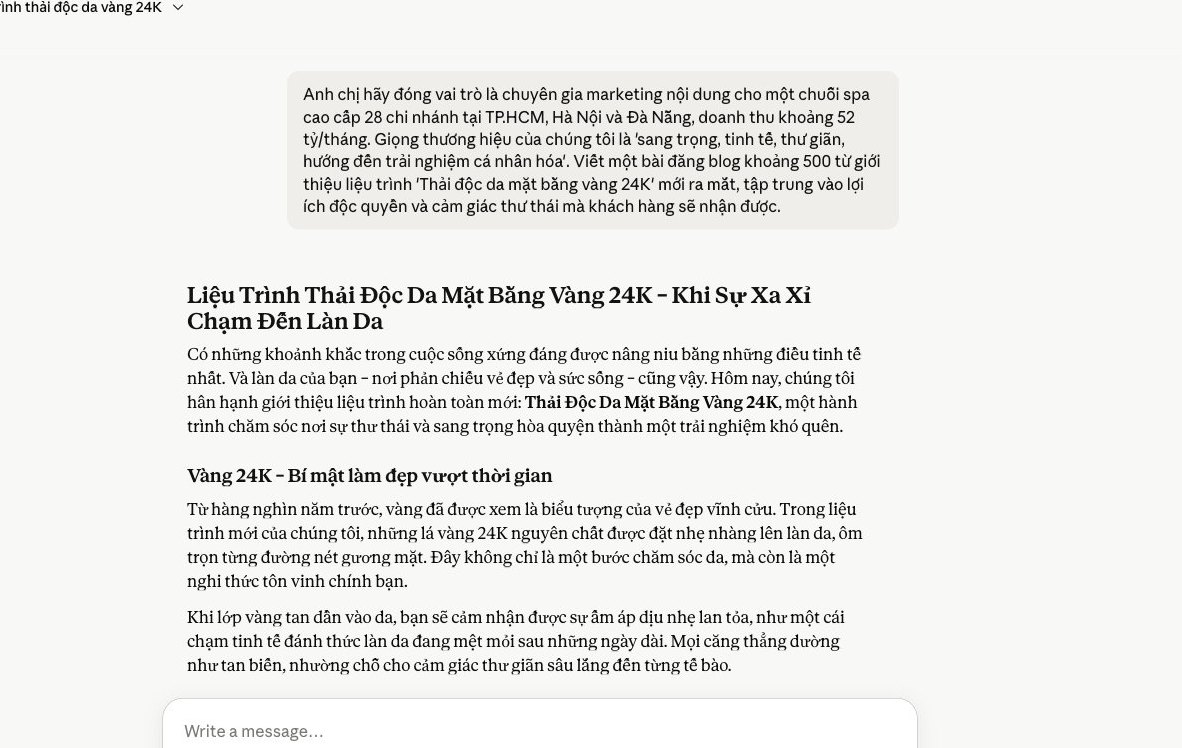
Businesses need more and more multichannel content. Marketing teams often face heavy pressure. We need to produce constantly for many platforms, from Facebook and Zalo to TikTok and Instagram.
This pressure can cause quality to slip. Or worse, the team gets overloaded. We have built a practical process. You can use Claude and Gemini to speed things up. The goal is to produce 30 social media posts in just one working hour.
This is how you keep up output while keeping posts varied and suited to each channel. Let's take a look.
The first step is to shape the content. Give this task to Claude. Claude stands out for handling long context. It is also very good at tight reasoning.
We will ask Claude to analyze the main topic. Then Claude will create a detailed outline for the series. The outline should cover different angles. It also needs a core message for each sub-topic.
For example, you can enter this prompt: "I need to create a series of social media posts about [Product/service name] for next month. The target audience is [Audience description]. Please analyze 5 main sub-topics. Each topic needs 3-5 key points and a core message. Also suggest related hashtags." Claude will provide a solid structure. This is the foundation for all the content that follows. It works very well.
Once we have the outline from Claude, we move to Gemini. Gemini is strong in multimodal work. It is very quick at producing creative ideas.
Use Gemini to sketch image ideas. At the same time, it will write scripts for short videos. Every post needs its own appeal. Gemini does this very well.
For example, for each key point in Claude's outline, you can ask Gemini: "For the topic [Sub-topic name] and the message [Core message], suggest 3 unique image ideas for Facebook and Instagram. Also sketch a 15-second TikTok video script. The script needs dialogue and a description of the action." Gemini will give visual, creative suggestions. It helps the team move faster.
To reach 30 quality posts in one hour, we need to automate the small adjustments. This is the key step. It keeps the content from repeating itself. It also makes sure each post fits its channel.
You can reuse Claude or Gemini for this step. Create one general prompt. The prompt asks the AI to adjust the tone. It also changes the length, or adds emojis. All based on the specific channel.
For example: "Based on the original post [Existing content], please rework it for: (1) Facebook (friendly, highly interactive), (2) Zalo (short, direct), (3) Instagram (hashtag-focused, with a call to action), (4) TikTok (energetic, trend-aware)." The AI will produce different versions. This saves a lot of time. It also keeps the content fresh. This process is very effective.
Using AI tools like Claude and Gemini brings high efficiency. However, they are still only support tools for individual tasks. When your business needs a fully automated content management system that connects seamlessly with internal data and keeps security high, custom software is the answer. MONA specializes in building software such as spa management software hay sales management software. We integrate AI into the core of the system. MONA has over 10 years of experience and a team . We have served 14,000+ projects. Our customer retention rate is 85%. We make sure the solution is designed specifically for you. It fits your processes and goals exactly.
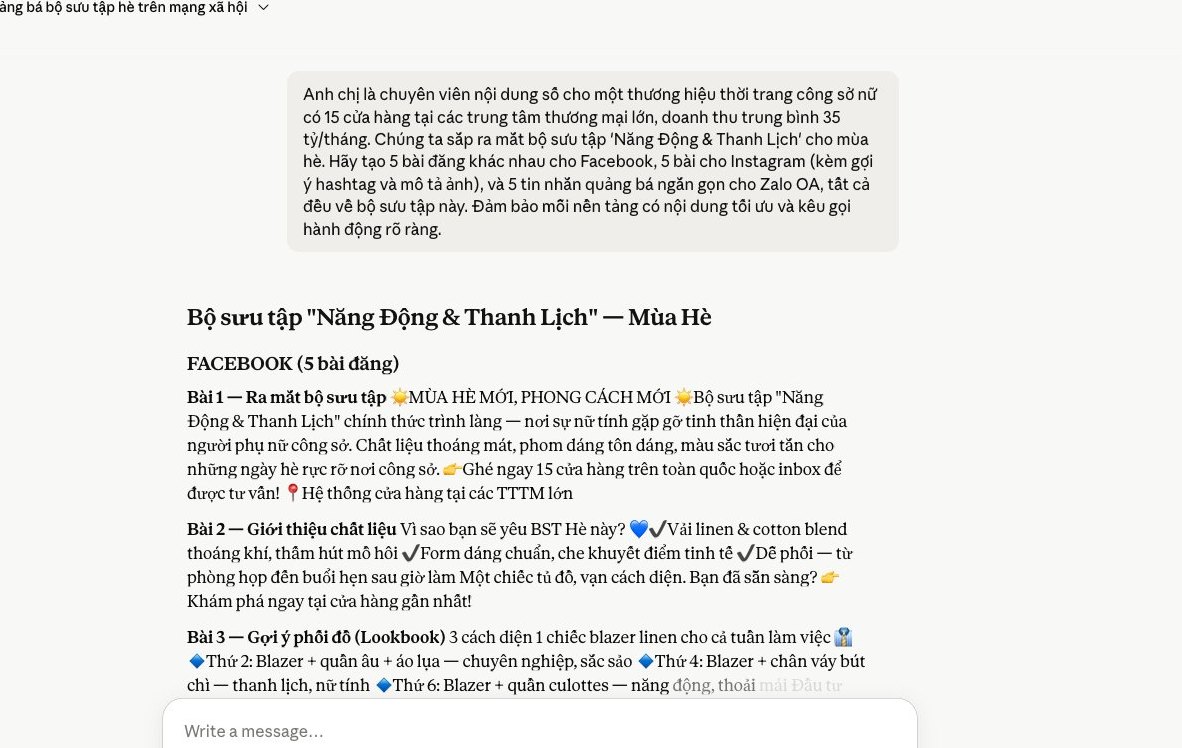
High-quality content is key to every business activity. We always need accuracy. However, manual review takes a lot of time, especially in large volumes. You can train Claude or Gemini to check, evaluate, and edit their own output. This technique raises content quality while clearly reducing errors. Quality improves noticeably.
For the AI to critique itself, you need to give it a specific role. Ask Claude or Gemini to analyze the content as an expert. For example, a demanding editor or a sharp critic. Then instruct the AI to point out weaknesses, errors, or places that need improvement. This is an important step. It could be grammar mistakes, inaccurate information, or a tone that does not fit.
We usually use a prompt like this: "Please read this passage. As an SEO expert, point out the 5 biggest weaknesses to fix to optimize for search engines, with a brief explanation for each." Making the role specific helps the AI focus. The results will be better.
Each type of content has its own standards. For the AI to evaluate well, we must give it clear criteria. This takes care. For blog posts, the criteria might be clarity, originality, SEO readiness, and how engaging it is. For product descriptions, focus on persuasiveness, complete information, and a call to action.
List these criteria as bullet points in the prompt. For example: "This product description must meet these criteria: (1) Concise, under 100 words; (2) Emphasizes 3 main benefits; (3) Has a clear call to action; (4) Uses no exaggerated wording." The more specific the criteria, the more accurate the AI's evaluation. This helps the AI understand the goal.
Training AI is a repeat process. There is no one-time fix. At first, the AI may make mistakes or judge things loosely. Use the AI's own feedback to refine your original prompt. Then ask the AI to revise the content based on those same comments. Keep repeating this cycle.
Each loop helps Claude and Gemini learn. They gradually understand your expectations better. When the AI revises a draft, review it carefully. Then give more guidance if needed. This is an effective way to raise quality over time. The improvement is continuous.
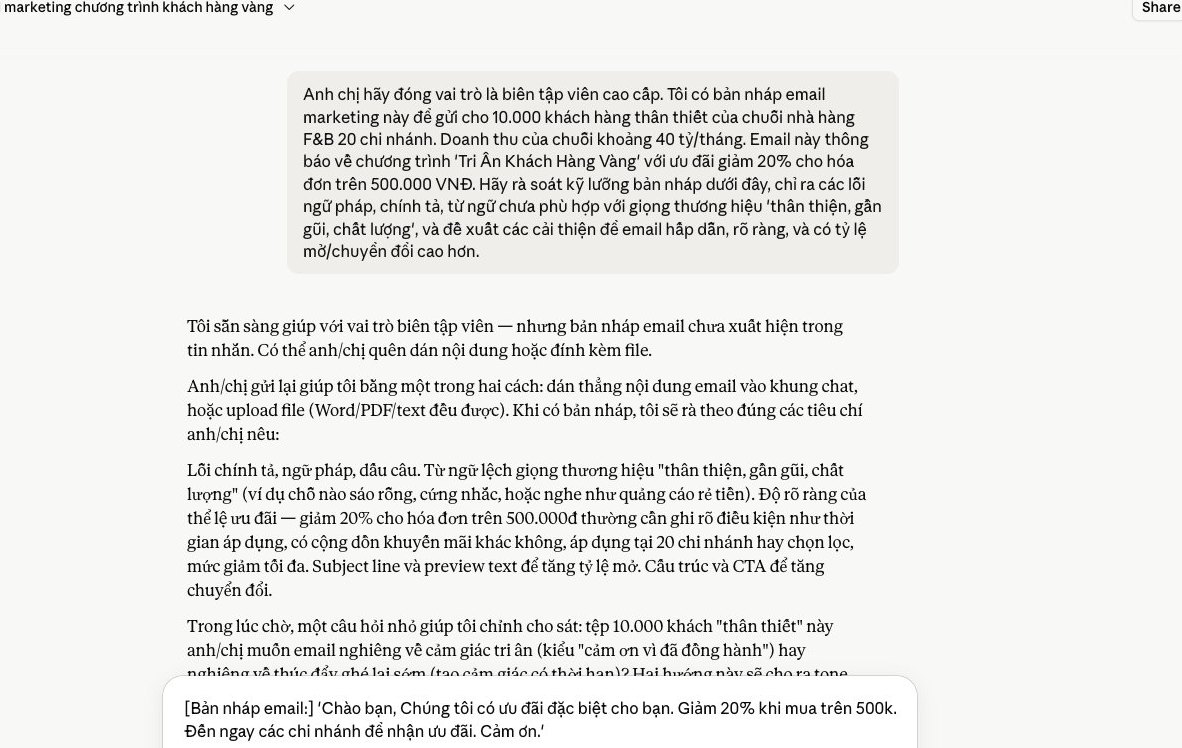
In business, fast and accurate replies to customers are what matter most. Our customer care team often works under heavy pressure. We have to handle hundreds of requests every day. That leads to long waiting times and uneven reply quality.
Sorting requests by hand takes a lot of time. Writing each personalized email also takes real effort. With Claude and Gemini, you can get past these challenges. These two powerful AI tools automate and personalize the customer support process. Efficiency improves noticeably.
Gemini stands out for its stronger natural language analysis. You can use Gemini to automatically sort customer requests. Gemini reads each message, email or comment.
The tool identifies the main topic. It helps spot the priority level. Then Gemini automatically tags the request and routes it to the right department. This happens instantly.
For example, an email complaining about product quality gets the label “Product complaint” and goes to the QA team. A question about the warranty policy goes to customer support. Gemini handles this very fast. This lets our team focus on solving problems. Initial response time drops significantly.
Once a request is sorted, Claude takes over. Claude can write detailed replies with their own nuance. You just give Claude the customer data and the specific situation. The more complete the information, the more accurate the reply.
Claude can pull together purchase history, past interactions and personal preferences. Then it drafts a fitting answer. The tone of the message is adjusted too. It could be a sincere apology, detailed instructions, or a related product suggestion. Replies stay consistent. Customers feel heard and understood.
We use Claude internally to support MONA EduCenter customers. The result is faster replies. Customers are happier. That is a big advantage.
Combining Claude and Gemini creates an efficient automated chain. This process cuts customer waiting time significantly. Requests are sorted accurately. Replies are produced quickly. You can set up modules so Gemini receives and sorts requests. Then Claude uses that to draft a reply. The customer care team only needs to review and send.
This doesn't just raise capacity. It also improves overall service quality. Staff have more time for complex cases. We can build loyalty with customers. They will appreciate the professionalism of your business. A smooth customer experience is a solid foundation.
We also regularly train customers on how to use AI tools like Claude and Gemini. This helps you run things more independently. Hands-on knowledge always comes first. MONA stays with your business every step of the way.
Claude and Gemini are genuinely powerful. They help staff handle more work faster. However, using each tool on its own creates a big limit. At this point, a business needs to look further ahead. We need a seamless system. That brings full automation, not just small pieces of it.
You can easily see how managing information gets complicated. Valuable data is scattered across many separate tools. Security risk goes up. That makes us worry about customer information leaking. A disconnected system is hard to control.
We understand how important data is. It is a core asset. MONA has been building custom software systems. They bring AI modules together on a single platform. This keeps data centralized and safe. All information is tightly protected.
The result is business information that is safer and easier to manage. You cut legal risk considerably. This is a solid base for every business decision.
Even when staff use AI to help, many processes are still manual. Coordination between departments gets delayed. You will see time wasted on repetitive tasks. Errors happen easily. The business's overall performance is not yet optimized.
We need a complete view. MONA designs end-to-end automation chains. We build AI into core processes. Software modules work together seamlessly. As a result, work moves along automatically.
This makes operations leaner. The whole team's productivity rises noticeably. Staff can focus on work that needs strategic thinking.
Every business is different. Standalone AI tools can't meet every need. Off-the-shelf software often doesn't fit. You need a solution that truly matches your business model.
MONA specializes in automation software production-grade systems. These are custom-coded systems, a closed chain of modules. We study your process closely. Then we design a solution just for you. AI technologies are used as the means to unlock results. Machines can handle complex sets of tasks. Your business management software will be fully customized.
This solution delivers better results. Your business gains a lasting competitive edge. It is an important step toward real automation.

CEO & Founder · The MONA
Founder of The MONA, who built a services company of 60+ staff with 14,000+ projects delivered. Khánh Hùng shares how he thinks about building systems that run themselves, automating a business, and the real lessons from delivering projects at MONA.
 425




Professional website
design services
Own a website with a beautiful, 100% exclusive design and a lifetime warranty, with the ability
to expand features flexibly as your business grows, starting today!






 MONA will never sell your information or send you spam


 MONA will never sell your information or send you spam
