Quick summary: Thin content, put simply, is content that is thin and poor, offering readers little useful information.
Getting an article to the top of Google is no longer as easy as it used to be. Google is increasingly “demanding” when it evaluates content, and only truly high-quality articles have a chance of holding high positions. One of the most common mistakes businesses and SEOs make is thin content: articles that are thin, low in quality and give readers no real value, which leads to the website being rated poorly and losing points with Google.
So what is thin content, and how do you spot and fix it to improve your SEO? Find out with MONA Media walks you through the details below.
What is thin content?
Thin content, put simply, is content that is “thin” and poor, offering readers little useful information. Google tends to rate this kind of content low, and it rarely earns high positions in search results.
That said, a short article is not automatically thin content. Music-listening or image-download sites, for example, have little text but meet the user's need and give a good experience.
So when you build content for a website, the most important thing is to understand the user's search intent and create content with real value rather than writing just to fill space.
5 common types of thin content today
To fix thin content, the first and most important step is to identify the types of thin content that Google commonly detects and rates low. Recognizing them helps you deal with current problems and also prevents similar mistakes in the future.
Automatically generated content
This is a typical form of thin content that many websites fall into. It is most often seen in articles mass-produced with software, AI or scripts without human editing. AI helps a lot these days, but if you just let the machine “run on its own,” the content usually shows easy-to-spot traits:
Unnatural: Awkward, clumsy wording, repeated words and disjointed logic.
Low value: It doesn't solve any real problem and just gathers keywords for the sake of it.
Not original: It usually pulls together several sources with no point of view or experience of its own.
For example, an article titled “Benefits of SEO” whose body just lists a few generic bullet points, with no in-depth analysis, real examples or original insight, is exactly the kind of automatically generated content that Google doesn't rate highly.
Copied content (scraped content)
Copied content is a common form of thin content, where a website takes articles from elsewhere word for word without adding new value. Google detects this easily, especially when the original page is established and has been around for a long time.
Some common traits of this kind of content:
Copied Content:Copying all or most of the content from another website.
Scraped Content: Tools that pull content from several sources and stitch it together, with nothing new or original.
For example, an e-commerce website that copies product descriptions word for word from the manufacturer's or a competitor's page, without adding its own detailed information, reviews or real photos, is publishing copied content that Google doesn't rate highly.
Gateway pages
Gateway pages are a form of thin content, usually created only to send users on to another page and not to give any real information or value. These pages are often over-optimized for one specific keyword but have no useful, standalone content.
Traits that make gateway pages easy to recognize:
Little content: Usually just a few lines of text and a link to another page.
Single purpose: They provide no information and exist only to manipulate rankings or redirect users and search engines.
For example, a page titled “Buy cheap” that contains only a link to the main product page, with no description or other details.
Low-quality content
Low-quality content is a common form of thin content. It refers to pages that don't meet Google's quality standards, regardless of length. This content gives users no real value, so it has little chance of ranking high.
Some traits that make this content easy to recognize:
Superficial content: Too short, just a simple list, with no analysis or explanation.
Inconsistent: Content unrelated to the title or the purpose of the page.
Not useful: It doesn't solve the reader's problem and lacks practical value.
For example: an “About Us” page with only a few short lines, a blog post of just a few words with no illustrations, or a product category page that lists product names with no detailed descriptions.
Duplicate content
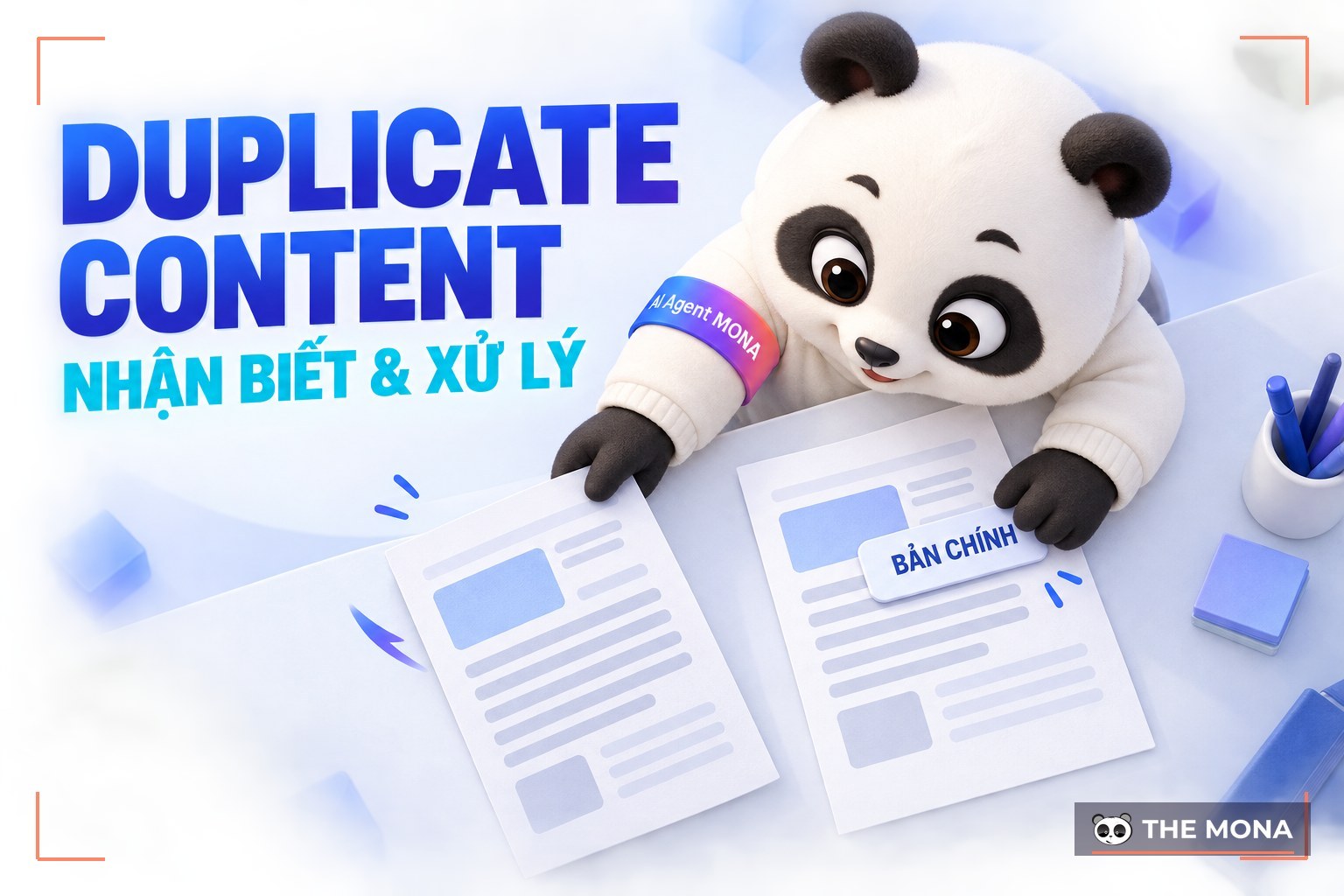
Duplicate content is a form of thin content that occurs when several pages on the same website, or on different websites, have the same or nearly the same content. This makes it hard for Google to choose which page to rank, so all of them lose ranking.
Common traits of duplicate content:
Within a website: Caused by technical errors or poor management, for example one product reachable through several URLs, or two articles on the same topic with almost identical content.
Between websites: When one site reuses content from another without a canonical tag or the owner's permission.
For example: a news site that posts the same event under two different URLs, or an e-commerce site that creates many nearly identical product pages that differ only in color.
Quality content is not only for ranking on Google, it also builds your brand and a business's credibility. That is why MONA puts content quality at the center when doing SEO for clients. A typical example is the SEO project between Woku Shop x MONA.
From the start, the MONA team researched the market closely, analyzed customer insight and built a SEO-standard contentsystem that was technically correct and also gave readers real value.
At the same time, we kept up with trends in SEO AI to refine the strategy. After 4 months, more than 91% of keywords reached the Top 20, of which 53% of keywords beat the Top 5 KPI. This is clear evidence that investing in quality content can deliver lasting SEO results. See the SEO case study in detail here.
How does thin content affect SEO?
How does thin content affect your SEO strategy? Content is the core factor Google uses to evaluate and rank websites. When a site has too much thin content, Google reads it as a negative signal, which over time lowers rankings and directly hurts the results of your SEO strategy and your business goals.
Lower search engine rankings
Thin content makes search engines rate your website as low quality and lacking credibility. When there is a lot of thin content, the algorithm treats it as a negative sign, which reduces your overall SEO performance and makes it hard to hold high positions in search results.
For example: a site with many copied or automatically generated articles is likely to be treated by Google as spam content. Your website will then rank below competitors whose content is high quality and gives readers real value.
High bounce rate
When users land on a page and the content is thin and doesn't answer their question or need, they naturally leave right away. This bounce rate rises, and in Google's eyes it signals that your site isn't good enough or doesn't match search intent. Over time, a high bounce rate hurts your SEO and makes it hard to keep good positions in the rankings.
Risk of a Google penalty
Google is increasingly strict about content quality, especially through algorithms such as Google Panda. If your site has too much thin content, you risk not only lower rankings but also a heavy penalty from Google, even removal from the search index.
That means your site almost “disappears” from Google, losing organic traffic and directly hurting revenue. It is a serious risk that any SEO strategy needs to avoid.
In today's fiercely competitive digital environment, quality content is not just something Google ranks on. It is also the “bridge” that helps a business keep customers and turn them into prospects. An article that follows SEO standards, is easy to understand, has depth and is practical will directly contribute to your website's business results.
With more than 10 years of experience doing SEO for more than 2,000+ projects across many different fields, MONA Media is a reliable partner for building an SEO-standard content system that delivers lasting value for your business.
Highlights of MONA's SEO content service:
Practical expert advice: We don't just write articles on request. Our experienced SEO team analyzes your site and advises on a content strategy that fits each stage of its growth.
Professional content creation: We apply the Topic Clustermodel and build a tightly structured body of content that boosts full-scope SEO and strengthens brand credibility.
A hands-on delivery team: Experience across industries, optimizing everything from wording to images, to meet SEO standards and match users' search intent.
If you are looking for a complete and lasting solution for SEO content writing, contact us today at MONA Media for detailed advice and to start work on your website.
How to identify and fix thin content
To find out whether your website has a thin content problem, you first need to identify which type of thin content it has. Then you can choose the right fix. Here are the steps to identify and fix thin content:
Step 1: Collect data on the whole website
To collect data on the whole website, use SEO tools such as Screaming Frog or DeepCrawl. Then gather your SEO metrics, including impressions, conversion rate and bounce rate, through Google Analytics and Google Search Console.
Next, move the data you've collected into Google Sheets and add a column for the “main keyword.” This column is the basis for judging whether the content gives readers enough useful value.
Step 2: Evaluate the article pages and main keywords
This is an important step for working out which type of thin content your articles have and need fixing. For a more accurate assessment, ask yourself a few questions as you analyze the data, for example:
Does the site have many articles targeting the same specific keyword?
Does the site have posts unrelated to your keywords or your brand's field?
Does the site have any articles with a very low word count?
Which posts have low impressions or get little traffic?
Which category pages have too few articles?
Step 3: Fix the thin content
Once you've identified the pages and articles with thin content, fix them as soon as possible. There are 3 common fixes that the MONA team regularly applies to its own websites:
Delete the content completely
For articles that are outdated, no longer give readers value or are unrelated to the field your website serves, the simplest fix is to delete them entirely. Note, however, that if an article once ranked well on Google, deleting it also means losing the related keywords.
So before you delete, think it over carefully and plan to rewrite higher-quality content for the same keyword if it still benefits the website. This removes the thin content while keeping your rankings and organic traffic.
Merge content
In many cases a website has several articles aimed at the same keyword or a similar topic. This causes duplication and also dilutes your SEO strength. An effective fix is to merge these pages.
Pick the best-ranking page as the main page, then add and refine content from the other articles so the main page becomes richer, more detailed and more useful. This avoids thin content and also strengthens your credibility and ranking potential on Google.
NoIndex trang
Not every page on a website needs to appear in search results. For landing pages with little content, such as about, contact or other supporting pages, consider adding the NoIndex.
tag. Google can still crawl and recognize these pages, but won't show them on the SERP. That way you avoid Google judging your site as having a lot of thin content, and keep your SEO strategy focused on the pages that really matter and have value.
Update the article with better content
You don't always need to delete or merge content. Sometimes you only need to refresh an article to make it more valuable. For articles that lack depth, start by re-analyzing the target keyword, clarify the user's search intent, then build a more detailed outline.
Then add information, real examples, illustrations or statistics to make the content richer and more trustworthy. This update not only fixes thin content, it also gives readers a better experience and noticeably improves your SEO ranking.
This MONA Media article has given you everything you need to know about what thin content is and how to identify and fix it in detail. We hope it is useful to you.
Frequently asked questions about thin content
What is thin content?
Thin content, put simply, is content that is thin and poor, offering readers little useful information.
About The MONA Group: Founded in 2016, with 60+ staff, MONA has delivered 14,000+ projects with an 85% client retention rate. MONA provides website design, full-scope SEO, custom software and AI automation solutions for businesses. Consultation hotline: 1900 636 648. Explore MONA SEO services and AI tools at work.
MONA has a podcast: listen instead of readingEpisodes on AI, automation & SEO for Vietnamese businesses
Founder of The MONA, who built a services company of 60+ staff with 14,000+ projects delivered. Khánh Hùng shares how he thinks about building systems that run themselves, automating a business, and the real lessons from delivering projects at MONA.
Own a website with a beautiful, 100% exclusive design and a lifetime warranty, with the ability
to expand features flexibly as your business grows, starting today!



 MONA OS 2.0
 Partner with MONA










































 Free AI courses
 AI tools at work

 Tự động hoá doanh nghiệp
 Cẩm nang SEO
 Digital Marketing
 Kinh nghiệm thiết kế website
 Hạ Tầng Server
 Giáo dục


 VI
 EN