
 MONA OS 2.0
 Partner with MONA


 Tự động hoá doanh nghiệp
 Cẩm nang SEO
 Digital Marketing
 Kinh nghiệm thiết kế website
 Hạ Tầng Server
 Giáo dục


 VI
 EN
















Message us on
Zalo Official


 ProductsNew

 ProductsProducts
 Mới ra mắtKHA AI 2027App tự edit video, tự đăng mọi mạng xã hội, 2 phút mỗi ngày










 Website designLooks good and wins customers over.
SEO servicesBrings in customers searching for exactly what you sell.
 Tư vấn digital marketingKéo khách từ nhiều kênh, đo bằng số thật.
Corporate video productionVideos introducing your company, factory and team.
 NewAI video productionCompany story films made with AI.
 Custom software developmentCRM, ERP and HRM built for your business.
 Viết AI Agent theo yêu cầuĐặt riêng một trợ lý AI cho đúng việc của mình.
 Tư vấn chuyển đổi AIĐưa AI vào vận hành của cả công ty.
NewMONA LMSManagement for centers and schools.
MONA SkillHubInternal training for company staff.
 NHTQ systemEnd-to-end China–Vietnam shipping operations.
MONA JMSManagement for gold, diamond and pawn shops.
 MONA E-LearningA website with every feature you need to sell courses.
 How to sell online courses (course)More than 30 free lessons on selling courses on autopilot.
 MONA Cloudmonacloud.vnServers to get your apps and websites running.
 MONA Basemonabase.vnPostgres database, sign-in and file storage.
 MONA Mailmonamail.vnSend OTP, order and invoice emails from your software.
 MONA Paymonapay.vnAccept bank transfers via VietQR and notify your software when the money arrives.
 MONA eInvoiceComing soonIssue e-invoices that meet tax standards.
Gấu CườiTrả lời khách 24/7 trên web, Fanpage, Zalo và thu lead cho sale.
 Gấu TeleSalesGọi điện tư vấn, chăm khách như tổng đài viên thật.
Dê CườiTư vấn và chốt đơn cho shop ngay trong khung chat.
Gấu WebmasterNhắn nhóm Zalo là website được sửa xong.
 Gấu Pháp ChếSoạn hợp đồng, rà điều khoản trong vài phút.
 Gấu Báo GiáLên báo giá đúng mẫu và gửi khách ngay.
 AI chăm sóc khách hàngTheo dõi và giữ chân khách hàng cũ.
 Gấu Tuyển DụngLọc hồ sơ, hẹn lịch, phỏng vấn ứng viên.
 Mới ra mắt
KHA AI 2027
Xây kênh chuyên gia 2 phút mỗi ngày
Quay bằng điện thoại, AI tự edit video, tự đăng lên 16 nền tảng và tự trả lời bình luận, tin nhắn.
938.878lượt xem trên kênh CEO MONA sau 43 ngày
 Anh Khánh HùngCEO MONA đang dùng mỗi ngày
Xem app làm được gì
 AI
Gấu Cười MONA ĐANG TỰ XÀITrả lời khách 24/7 trên website, Zalo OA, Messenger và thu lead về cho sale.
Dê CườiChốt đơn bán lẻ và sàn: Shopee, TikTok Shop, web. Chăm cả khách sỉ, đại lý.
Gấu WebmasterCập nhật nội dung, tối ưu SEO website mỗi ngày.
Gấu TeleSalesGọi điện tư vấn, chăm khách như tổng đài viên thật.
Gấu Tuyển DụngLọc hồ sơ, hẹn lịch, phỏng vấn ứng viên tự động.
AI chăm sóc khách hàngGiữ khách cũ, cứu lead đã rớt cho phòng kinh doanh.
Gấu Pháp ChếSoạn hợp đồng, rà điều khoản trong vài phút.
Gấu Báo GiáLên báo giá đúng mẫu, gửi khách ngay khi có yêu cầu.
 Chuyển đổi AI toàn phầnGiải pháp tổng cho doanh nghiệp, 3 lớp triển khai.
 Viết AI Agent theo yêu cầuĐặt riêng một con AI gánh đúng nghiệp vụ của bạn.
 Custom softwareCRM, ERP and HRM with built-in AI automation.
 SEO & AEO thời đại AIĐược Google lẫn AI trích dẫn, không chỉ xếp hạng.
 Kiến thức AI cho doanh nghiệpBài phân tích, hướng dẫn ứng dụng AI vào vận hành.
 Free AI courses
 AI tools at work
App mới · KHA AI 2027
Xây kênh 2 phút mỗi ngày
AI tự edit video, tự đăng mọi mạng xã hội
Free consultation, 8am–10pm every day

24 August, 2026
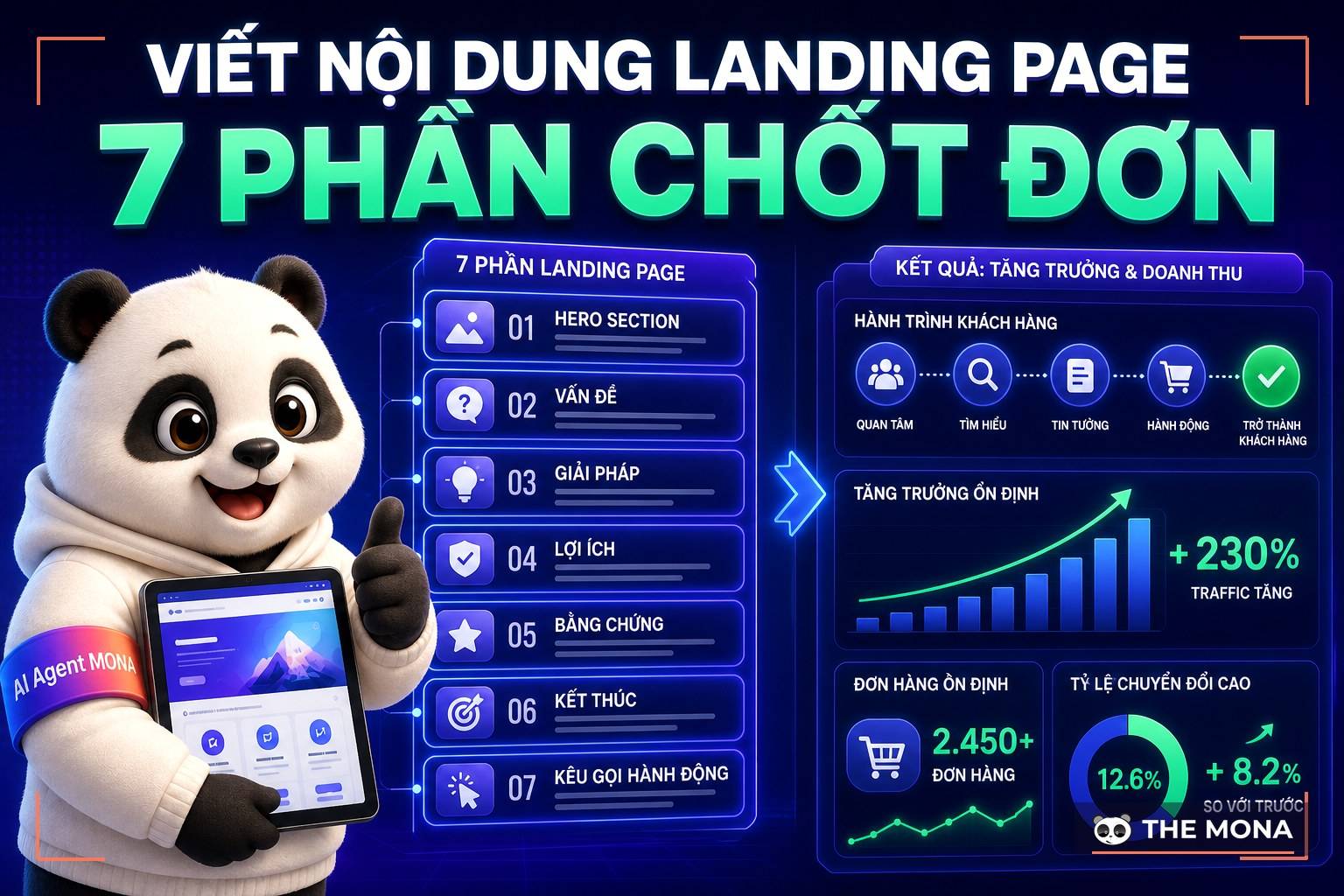
Customers coming to MONA often bring a nearly finished interface with the text still temporary, the kind of “you write the content later” situation, and then the whole project waits 2 weeks for copy. We settle the content first. To write landing page content, start from what customers ask sales in the first 3 minutes of a call, then go through 7 parts from benefit to call to action. The design then follows the right thread.

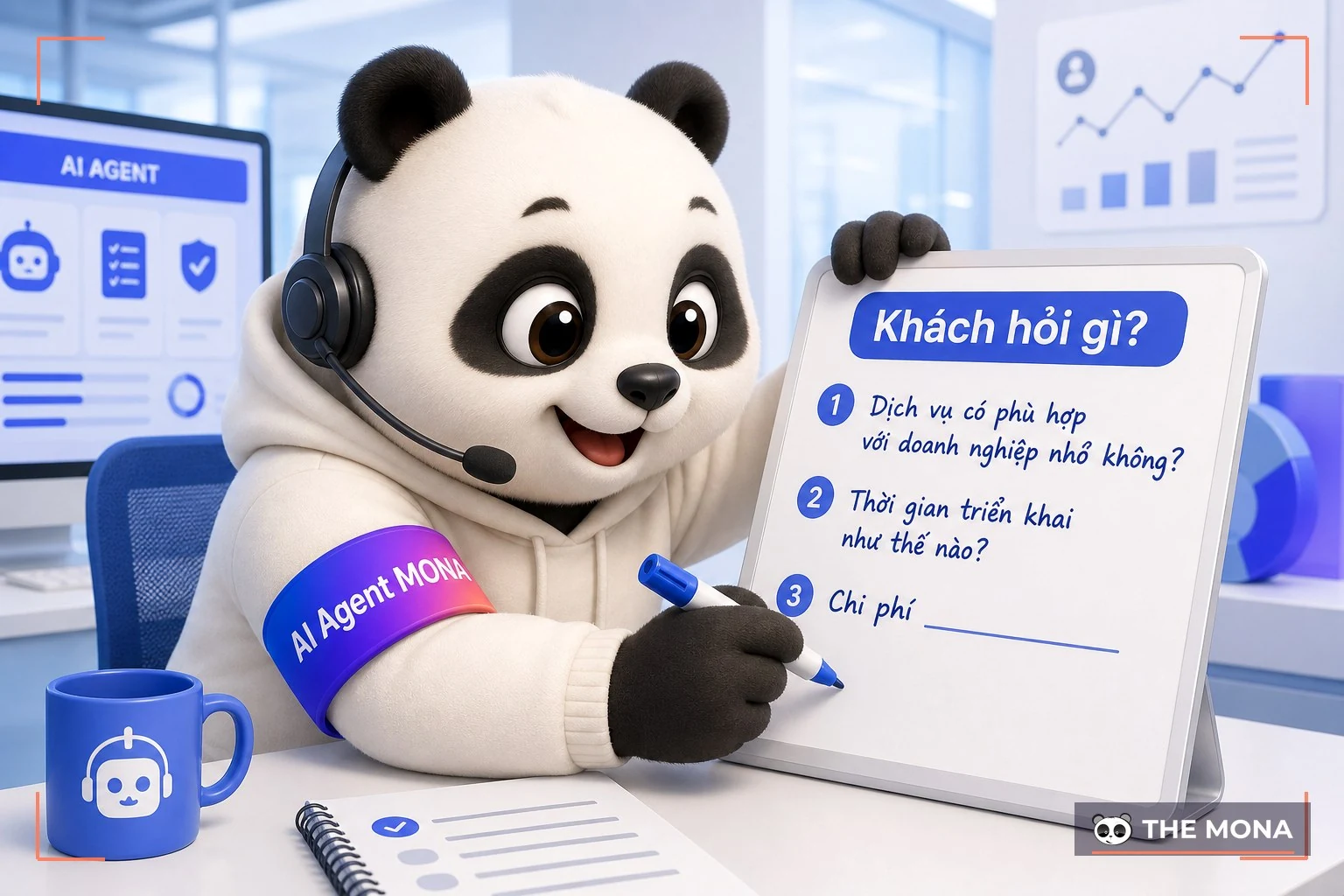
Start from the questions customers usually ask sales before buying. When we sit with the person answering the phone, the questions that repeat in the first 3 minutes usually show which information must go in the opening section of a page. Start there.
Suppose you sell English courses: parents often ask whether the schedule fits pick-up times, what the tuition covers and how outcomes are measured. For furniture, customers ask about real materials, build time and how late delivery is handled. For real estate, they ask about legal status, payment schedule and the actual route there. MONA gathers these questions before splitting them into 7 content parts.
A 10-year company introduction still doesn't answer the worry that makes customers hesitate.
We usually ask for call recordings, chat logs and sales notes from the last 2 weeks. Just reading the phrases customers repeat, you can see the order of priority. The most-asked questions go first. Questions that only serve the internal team go to the bottom or get cut. The page becomes much leaner.
After the gathering round, read the opening section for 30 seconds and ask yourself: does a visitor understand what they get, who it is for, and where the proof sits? MONA only moves on to design once the answer is clear. That way the headline, the image and the button all serve one goal instead of each telling its own story.
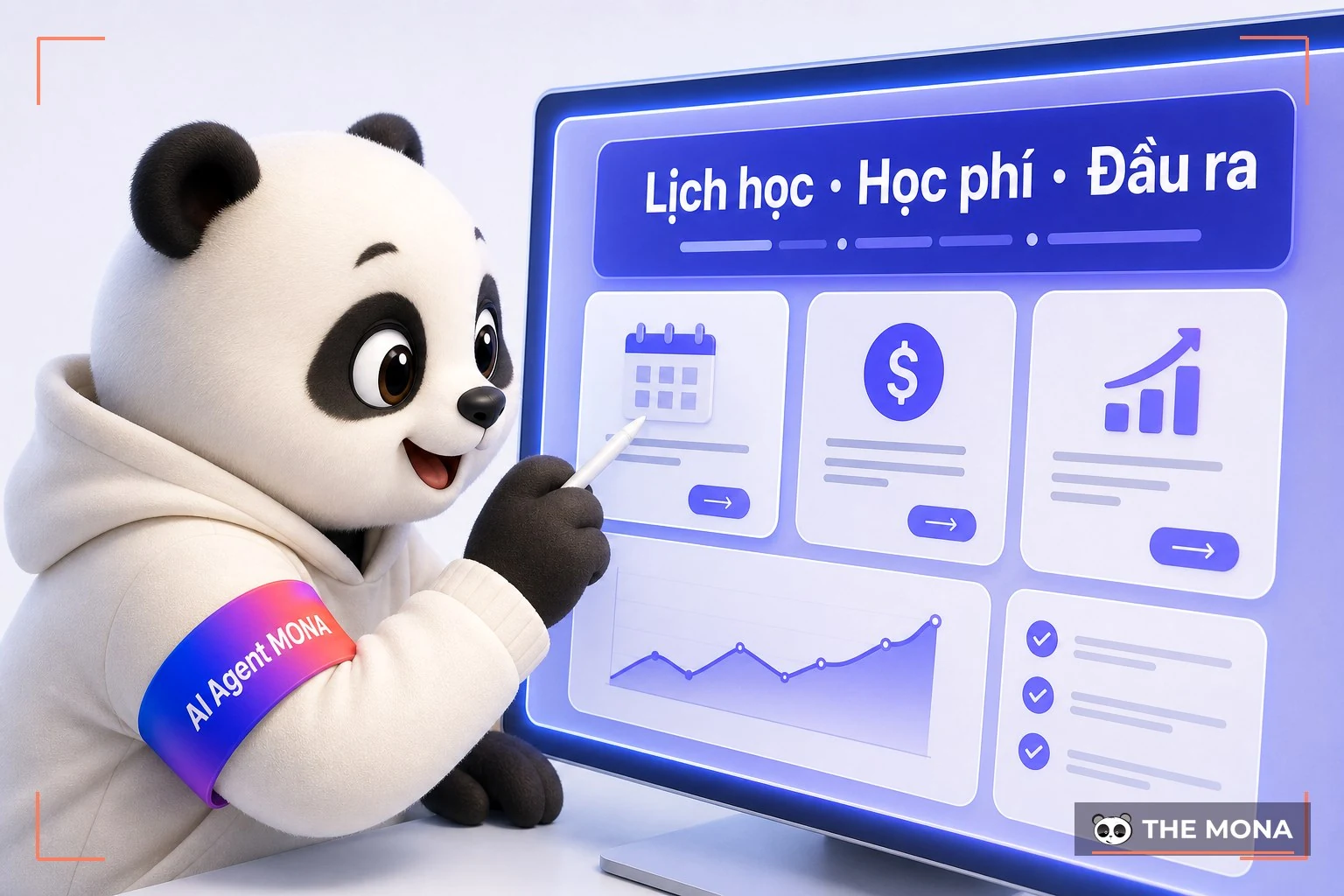
An English center had been running ads steadily, but its landing page made parents hunt for the class schedule, tuition and outcome guarantee on their own.
The top of the page talked a lot about "10 years of experience" and the center's pride in itself. The schedule sat deep below. Tuition appeared after a long introduction. The outcome guarantee was vague, so sales staff still had to explain everything from scratch on every call.
The desk calendar in the consulting room still showed last month, and the classroom photo had been taken on a rainy day. Those two details did nothing for the writing, but they make us remember that content review session with the center very clearly. MONA asked the sales team for the 3 questions parents raised most, then rewrote the opening section in exactly that order.
The ad creative stayed the same.
When we rewrote the landing page copy for this case, the number of calls in the first 2 weeks rose clearly compared with the 2 weeks before. We do not credit the whole change to the wording, because enrollment season and the sales team's response speed still affect the result. What is worth keeping is that the same ad creative now led readers to a page that answered faster. Sales repeated the basics less. Parents joined calls with more specific questions.
That is also why MONA looks at the number of calls, the quality of the questions customers bring to the conversation and the step where they drop off the page, instead of looking only at visits. A good-looking number has to be read in context. If you want to go deeper on measuring after a page fix, read more about optimizing the conversion rate. A copy change needs to be set next to real behavior over 2 weeks with the same ad conditions.
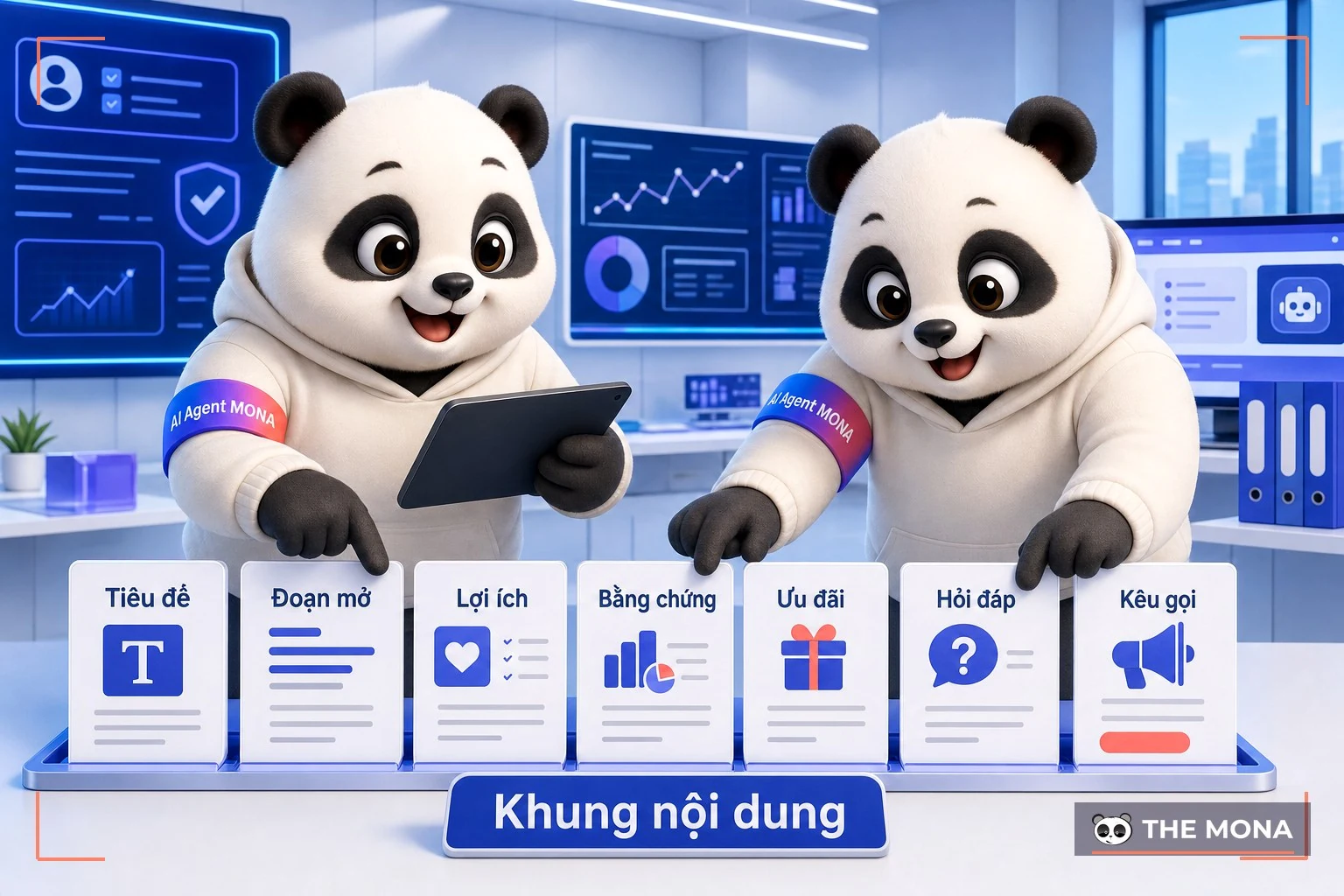
The frame we use has 7 parts, running from the main benefit to the frequently asked questions and the call to action. This is the landing page content frame for settling information, while the 7 interface blocks of a landing page explains how that content is presented on screen. The two layers need to match.
On a single page, every part must push the reader closer to a decision. MONA still changes the order when the industry's buying behavior calls for it, but the first draft always lists all 7 parts so the project team can see where proof is missing. If something is missing, we add it before designing.
The headline needs to name the exact result and the exact audience. Write 3 options, each keeping only 1 promise backed by facts. A common mistake is cramming the company name, history, offers and self-praising adjectives into one line. We cut until the reader understands the benefit within the first 3 seconds.
The opening paragraph should describe what the customer is facing in the words they actually use, then say which part of the problem this page helps solve. MONA usually keeps it to 3 sentences so it does not drift into company history.
The benefits block should have 3 to 5 points tied to real work. Each point covers the result, how it is delivered and the conditions that apply. Do not just rename features as benefits and stop there. "Has reports" is still a feature. "A manager sees the orders of 20 stores on one screen" is what shows the user what they get.
Proof should sit right next to the claim it supports. MONA prefers real photos, processes, warranty terms, valid certificates, sourced quotes and results the customer has allowed us to publish. A figure like 30% is only used when the records say what was measured, over how long and against what baseline.
If the records are missing, state the exact scope. Do not fill the gap with praise.
An offer must tell the reader what they receive, when they receive it and the conditions attached. If there is a price, state the scope of work behind that price. If there is a deadline, use a date that has been approved. A common mistake is putting a huge discount line up front while hiding the conditions in small print, which forces sales to deal with the wrong expectations from the very first call.
A short FAQ should come from real calls, usually focused on price, timing, warranty, process and fit; we pick the 5 questions that directly affect the decision instead of collecting every question ever asked.
The call to action must describe exactly what happens after the click. "Get a consultation slot" is clearer than a button that just says "Submit". If the form needs 5 fields, explain why each one is needed. MONA keeps 1 main goal on the page and repeats the call to action at points where the reader has just enough information. A landing page for sales with a clear persuasion flow usually helps the sales team receive requests with the right context.

When you write landing page content, keep the company's familiar voice and make sure the numbers have records behind them. MONA asks for the source of each figure, cuts absolute promises and trims sentences short enough to read on mobile. Numbers must be checkable. Adjectives cannot save a page.
For claims with numbers, state the metric, the measuring period and the comparison baseline; if the documents only confirm 10 years in operation, the copy stops there and does not infer service quality or satisfaction.
We also read each paragraph aloud. A sentence over 30 words is still usable when it needs to link a condition, a cause and a result, but the sentences around it must be short so readers on a phone do not run out of breath. Proper names, place names, currency units and Vietnamese diacritics are checked one last time before handover. A wrong diacritic still has to be fixed.
For headlines, HBR's guide to A/B testing helps you see why you should change 1 variable at a time and define the metric in advance. Do not change the headline, image and offer in the same round and then conclude the wording won. MONA usually keeps a hypothesis log for each test, and each run lasts a full 2 weeks before we draw a conclusion.
Search needs the same care. Ahrefs' landing page SEO guide gives an outside reference point, while the article build an SEO-friendly landing page explains how MONA ties search intent to content structure. A page must still sound like a real person. Intent comes first.
You can also look at Backlinko's landing page data roundup to identify the variables commonly tracked, then go back to your own page's numbers. We use reference data to ask questions, not to copy an outside rate into a promise to a customer. The article on the link between design and closing ability follows the same principle.
AI is a good fit for supporting landing page copy at the draft stage, producing headline variations and trimming sentences to a required length; the person in charge still keeps the facts, the voice and final approval. We use it for exactly that part of the work. It saves 2 to 3 hours per draft.
The input should include 1 buyer persona, the 3 questions they ask most, a list of verified benefits and the banned promises. After the first generation, about 5 minutes later, the writer marks which sentences have facts behind them, which need to be checked with sales and which sound foreign to the business. MONA only keeps paragraphs that have passed this cross-check. Every draft needs a source.
Pasting AI output onto the page as is usually produces a voice that sounds like everyone else. Openings tend to bloat, benefits tend to repeat and the proof section tends to be filled with adjectives; you can see the process in the article making a landing page with AI, then limit the machine to the part it does quickly.
With 3 headline variations, AI gives the content team material to argue over. With a legal document or a real price list, the owner must read the original. We do not let the model guess missing numbers. One wrong number and sales has to explain it all over again. Credibility is lost immediately.
If the landing page needs to connect data into custom software, the MONA Software team handles the technical part after the content and the business flow are settled. Separating the draft, the facts and the build work lets the 3 sides, content, design and development, know who is responsible at each step. Nobody has to guess.
If you want to try this frame right away, do one small thing first: ask sales for the recordings of the last 5 calls and underline the sentences customers repeat. Send us that list along with the link to your running page, and MONA will check whether the opening of the page answers those exact questions. Call 1900 636 648 to send it.
Each industry needs a different kind of proof because the buying risk differs. MONA keeps the 7 parts so the reader never lacks information, then changes the proof material to match the questions sales hears every day. Same frame, different records.
For an education page, parents need the class schedule, how outcomes are assessed and documented teaching ability. For cosmetics, buyers need ingredients, usage instructions, origin and the return policy. We will not take a crowd photo from one industry and drop it into another as proof. Records lead.
These 5 groups do not need equal length. A real estate page with many legal documents will give the proof section more space than a fixed-schedule trip; an interior design page needs detailed photos and material captions, so we allocate text by how much the customer needs to verify.
Once the content is settled, it usually takes 3 to 4 working days before MONA works out the placement of images, the form and load speed. Infrastructure at MONA Host fits when you need a technical team to watch the operation of your website, but fast hosting cannot fix a vague promise. The content still has to do its job first. Speed supports the words, it does not replace them.

The five questions below help you settle the scope, length, SEO and call to action before handing over to design. MONA uses these same questions when reviewing a new draft. Short answers first.
Long enough for buyers to understand the benefit, proof, conditions and next step. A service that needs a lot of explaining will run longer than a familiar offer, so MONA measures by questions answered instead of forcing a word count. If the 7 parts are clear, stop. Don't stretch it to fill space.
You can write it yourself when sales has time to gather questions, records and figures, while a hired writer helps order the points and make sentences easier to read. Either way, 1 person inside the business must take responsibility for approving the facts; we don't accept a promise that has no source.
Yes, if the page needs lasting search traffic and content that matches search intent. MONA still puts the answer for the reader first, then checks the title, description, headings, links and load speed; for a page that has to run long term, SEO services handle the keyword side. A keyword must never spoil the voice.
A page should have 1 main CTA goal, repeated at points where readers already have enough information to act. There is no fixed number of positions. We only add a repeat when the paragraph right before it has just removed a reason to hesitate. Repeat along the reading flow.
Yes. The landing page design package at MONA from 7 million VND already includes us building the content with you before moving to the interface; the exact scope is settled by 1 page, the input documents and the integrations needed.
A good draft lets you see the promise, the proof and the next step before you spend effort fixing the design. We start from the sentences sales hears every day, group them into 7 parts, then check each figure with the person responsible. When landing page copy is written along this flow, design has a clear base to follow and sales receives inquiries with the right context. MONA is ready to review your current draft with you.
The English center's page in this article never lacked words; it was too busy talking about itself at the moment parents wanted to hear about their child: schedule, tuition, outcomes. Changing that order is cheaper than any ad budget increase that many marketing teams tried before turning to the copy.
MONA writes content in exactly this 7-part frame within the landing page design package from 7 million VND: we interview your sales team, collect real questions, write a copy draft with a source for every figure and only then move to the interface. Call 1900 636 648, and set aside a 30-minute session with the person who answers your phone, and that is enough material to start.
MONA Media founded in 2016 (over 10 years), has delivered 14.000+ projects and has 85% of clients coming back. Hotline: 1900 636 648. Website: https://mona.media.
This article explains how to write landing page copy with the 7-part frame MONA uses when working with customers.

CEO & Founder · The MONA
Founder of The MONA, who built a services company of 60+ staff with 14,000+ projects delivered. Khánh Hùng shares how he thinks about building systems that run themselves, automating a business, and the real lessons from delivering projects at MONA.
 474




Professional website
design services
Own a website with a beautiful, 100% exclusive design and a lifetime warranty, with the ability
to expand features flexibly as your business grows, starting today!






 MONA will never sell your information or send you spam


 MONA will never sell your information or send you spam
