
 MONA OS 2.0
 Partner with MONA


 Tự động hoá doanh nghiệp
 Cẩm nang SEO
 Digital Marketing
 Kinh nghiệm thiết kế website
 Hạ Tầng Server
 Giáo dục


 VI
 EN
















Message us on
Zalo Official


 ProductsNew

 ProductsProducts
 Mới ra mắtKHA AI 2027App tự edit video, tự đăng mọi mạng xã hội, 2 phút mỗi ngày










 Website designLooks good and wins customers over.
SEO servicesBrings in customers searching for exactly what you sell.
 Tư vấn digital marketingKéo khách từ nhiều kênh, đo bằng số thật.
Corporate video productionVideos introducing your company, factory and team.
 NewAI video productionCompany story films made with AI.
 Custom software developmentCRM, ERP and HRM built for your business.
 Viết AI Agent theo yêu cầuĐặt riêng một trợ lý AI cho đúng việc của mình.
 Tư vấn chuyển đổi AIĐưa AI vào vận hành của cả công ty.
NewMONA LMSManagement for centers and schools.
MONA SkillHubInternal training for company staff.
 NHTQ systemEnd-to-end China–Vietnam shipping operations.
MONA JMSManagement for gold, diamond and pawn shops.
 MONA E-LearningA website with every feature you need to sell courses.
 How to sell online courses (course)More than 30 free lessons on selling courses on autopilot.
 MONA Cloudmonacloud.vnServers to get your apps and websites running.
 MONA Basemonabase.vnPostgres database, sign-in and file storage.
 MONA Mailmonamail.vnSend OTP, order and invoice emails from your software.
 MONA Paymonapay.vnAccept bank transfers via VietQR and notify your software when the money arrives.
 MONA eInvoiceComing soonIssue e-invoices that meet tax standards.
Gấu CườiTrả lời khách 24/7 trên web, Fanpage, Zalo và thu lead cho sale.
 Gấu TeleSalesGọi điện tư vấn, chăm khách như tổng đài viên thật.
Dê CườiTư vấn và chốt đơn cho shop ngay trong khung chat.
Gấu WebmasterNhắn nhóm Zalo là website được sửa xong.
 Gấu Pháp ChếSoạn hợp đồng, rà điều khoản trong vài phút.
 Gấu Báo GiáLên báo giá đúng mẫu và gửi khách ngay.
 AI chăm sóc khách hàngTheo dõi và giữ chân khách hàng cũ.
 Gấu Tuyển DụngLọc hồ sơ, hẹn lịch, phỏng vấn ứng viên.
 Mới ra mắt
KHA AI 2027
Xây kênh chuyên gia 2 phút mỗi ngày
Quay bằng điện thoại, AI tự edit video, tự đăng lên 16 nền tảng và tự trả lời bình luận, tin nhắn.
938.878lượt xem trên kênh CEO MONA sau 43 ngày
 Anh Khánh HùngCEO MONA đang dùng mỗi ngày
Xem app làm được gì
 AI
Gấu Cười MONA ĐANG TỰ XÀITrả lời khách 24/7 trên website, Zalo OA, Messenger và thu lead về cho sale.
Dê CườiChốt đơn bán lẻ và sàn: Shopee, TikTok Shop, web. Chăm cả khách sỉ, đại lý.
Gấu WebmasterCập nhật nội dung, tối ưu SEO website mỗi ngày.
Gấu TeleSalesGọi điện tư vấn, chăm khách như tổng đài viên thật.
Gấu Tuyển DụngLọc hồ sơ, hẹn lịch, phỏng vấn ứng viên tự động.
AI chăm sóc khách hàngGiữ khách cũ, cứu lead đã rớt cho phòng kinh doanh.
Gấu Pháp ChếSoạn hợp đồng, rà điều khoản trong vài phút.
Gấu Báo GiáLên báo giá đúng mẫu, gửi khách ngay khi có yêu cầu.
 Chuyển đổi AI toàn phầnGiải pháp tổng cho doanh nghiệp, 3 lớp triển khai.
 Viết AI Agent theo yêu cầuĐặt riêng một con AI gánh đúng nghiệp vụ của bạn.
 Custom softwareCRM, ERP and HRM with built-in AI automation.
 SEO & AEO thời đại AIĐược Google lẫn AI trích dẫn, không chỉ xếp hạng.
 Kiến thức AI cho doanh nghiệpBài phân tích, hướng dẫn ứng dụng AI vào vận hành.
 Free AI courses
 AI tools at work
App mới · KHA AI 2027
Xây kênh 2 phút mỗi ngày
AI tự edit video, tự đăng mọi mạng xã hội
Free consultation, 8am–10pm every day

24 August, 2026

Customers who come to MONA often ask whether creating a landing page yourself with a drag-and-drop tool is enough to run for real or only good for testing. The short answer: you can build one in 1 evening when the goal is clear and the content is ready, then move to a custom-written page when the campaign grows.
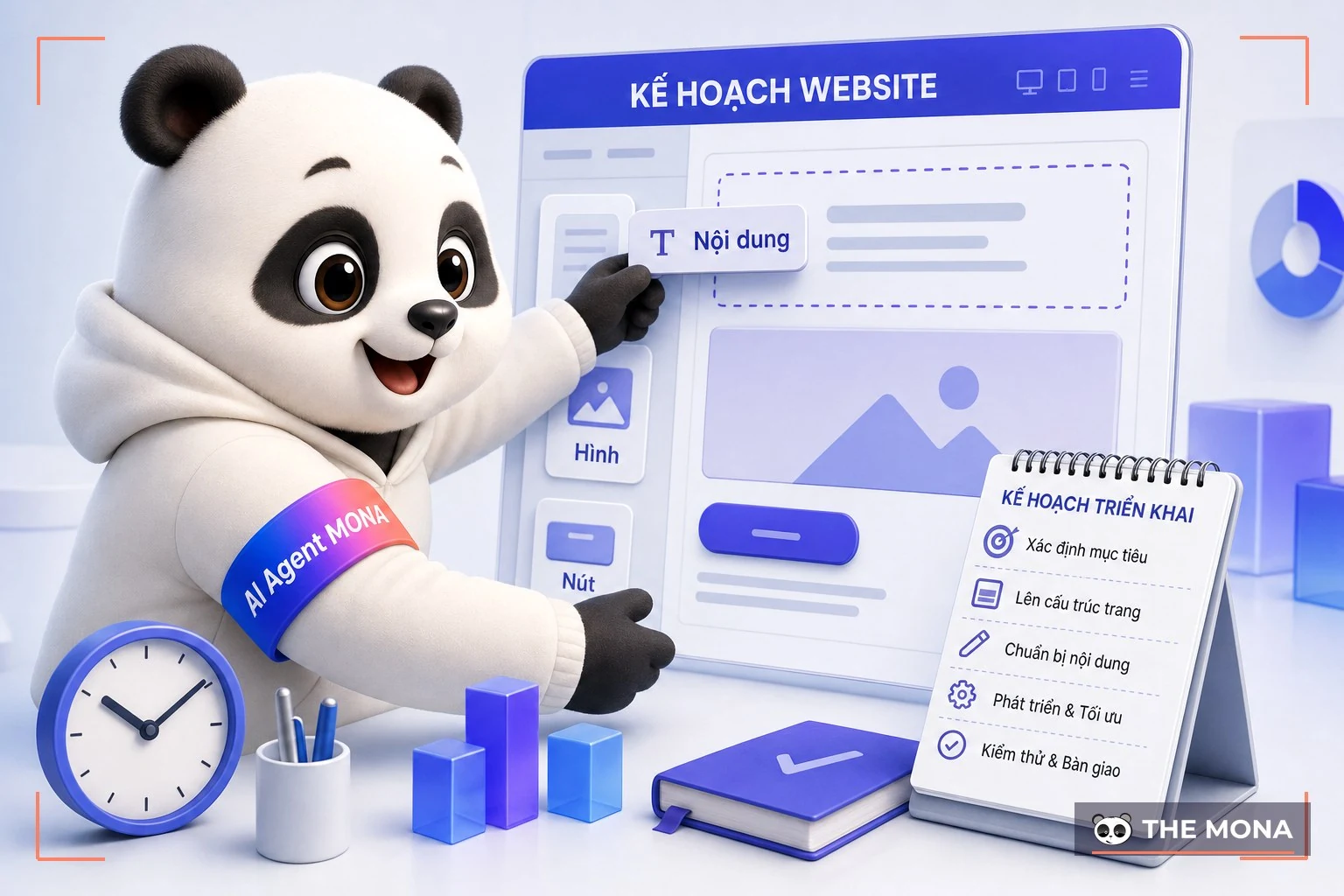

It is not hard: creating a landing page yourself with a drag-and-drop tool and AI suggestions has lowered the barrier to the point where someone who has never written a line of code can still build a complete page in 1 evening, as long as the goal is settled from the start and the content, images and prices are already in hand.
We see that most beginners who create a landing page themselves get slow because they build and think up the message at the same time. They try many headline styles, swap images and add blocks to make the page look full. The tool keeps working fine, but the goal keeps changing. By the end of the evening, the visitor still does not know where to click.
Keep it tight.
Before creating a landing page with a drag-and-drop builder, write down 1 action you want the visitor to take, 1 benefit they receive and enough content to answer their usual doubts. The headline should be understood in 5 seconds. The form should only ask for data that is truly needed. If you are still unsure whether to put the content on one page or a whole cluster of pages, the explanation of how a landing page differs from a website will help you choose right from the start.
MONA sees that people who create a landing page themselves still get real orders. The page owner knows the customers, has product photos and speaks to the real need, so a drag-and-drop tool does the job well. Code is not the priority at this point. A clear goal is what lets a short page sell.

A gift shop owner once created a landing page herself to sell Tet gift baskets in 1 evening, then used that same page for an ad campaign of 20 million VND and received real orders.
She already had the basket photos, the prices, the delivery area and the order phone number. While dragging each block, she also had to watch her child do homework. Where an image sat crooked, she skipped it to write the delivery date clearly. Late at night, she tied a bow on a sample basket and photographed it with her phone.
The page was not fancy.
The next morning, the ads went live with the fixed budget of 20 million VND for the Tet season. Visitors saw the product, the price, the delivery deadline and the order button. Orders came in for real. MONA tells this case because we want you to know there are stages where hiring a dedicated team only makes testing a sale heavier.
The shop owner won because she understood the product and decided very fast, while creating a landing page herself only helped put that thinking on screen in 1 evening. If she had waited for a page full of effects, the short selling season would have passed. If photos were missing or the price was not settled, the best tool would still have had to wait. The sufficient condition is still having the content ready.
Our honest advice: for a small campaign, a thin budget and a short testing time, create the landing page yourself. Save the money to check whether the product gets asked about for buying. Once the page has produced data, the decision to invest further will be on firmer ground.

Creating a landing page yourself needs 7 basic blocks, each serving one question from the visitor and all leading to the 1 action you have chosen.
We have boiled the check for creating a landing page yourself down to the 7 tasks below. The list is based on the structure in the article what is a landing page. We have tightened it so you can build and check at the same time. Every task can be verified right away.
After creating a landing page, open it on your phone as if you were a new visitor. In the first 5 seconds, that person needs to understand what is being sold. After seeing the button 3 times, they should still get the same call to action.
Kho landing page templates by industry help you find a layout. The case of a Tet sales page fits seasonal campaigns closely. We also collect the elements of a page that looks good and helps close orders so you avoid getting lost in decoration. Learn the order of the blocks, the proof and the button position.
Then measure again.
MONA checks the results of a self-made landing page in this order: quick to understand, clickable, loads fine, records correctly. A 3-field form must receive complete data. A button repeated 3 times must lead to the same action.

Creating a landing page yourself with drag and drop starts hitting its ceiling when the campaign needs constant edits, deep data connections and a long enough life for maintenance costs to add up month after month.
We often see a self-made landing page that starts with a single product, then has to add regional pricing, offers, many customer groups and data transfer rules. Stacking those requirements, the old structure has to be patched in many places. Whoever edits it later is afraid to touch a running block for fear of breaking something else.
Patching more gets harder still.
A third-party platform keeps the right to change prices or limit features. You pay for 1 month, and when needs grow you must upgrade the plan or drop some tracking. When you need to know which ad a customer came from, whether they were advised and whether they bought, a CRM connection like MONA Software needs a deeper structure.
A self-made landing page can still support SEO if the content is clear, the speed is steady and the structure is reasonable. The right to edit code, structured data or internal links is often locked by the tool. We use the guide Ahrefs' landing page SEO guide as a reference list. The limits show gradually after a few months. If you want a page that pulls organic traffic long term, also see SEO services package from MONA?
The cost of creating a landing page yourself sounds light when counted per month, but a long-running campaign brings platform fees, add-ons, a domain and manual fixing time. You can look at Backlinko's landing page statistics collection to set your page's performance beside a reference level. MONA still puts your own campaign data first.
Measure first, then fix the right thing.
When the form count rises but revenue is unclear, you should first review how to optimize conversion rate . Sometimes a page only needs a message fix. Once the data proves customers buy, the old system is the next thing to look at.

Creating a landing page with drag and drop clearly wins on starting cost and build speed, while a custom-written page is worth choosing when the campaign needs data, SEO, control and long-term maintenance.
MONA does not rank the two options as good and bad, because each was made for a different stage of the same business: when you need to test, speed matters more than depth; when you need to operate, depth matters more than speed. With 1 evening and content already in hand, drag and drop gets an idea to market far faster than a custom design process. You can also edit it yourself without waiting for the technical team.
Drag and drop wins two rounds.
| Item | Drag-and-drop tool | Custom-written page |
|---|---|---|
| Starting cost | Low, uses ready-made templates | Higher |
| Build speed | Fast, edit directly | Needs testing |
| Deep data tracking | Enough for basic tracking | Connects to CRM and revenue |
| SEO structure | Limited editing rights | Full control of code and structure |
| Long-term maintenance | Hard to manage as it grows | Has a clear owner responsible |
If you create a landing page yourself for a short season, drag and drop is reasonable. When the budget reaches 30 to 40 million a month, this table is worth reading again. We will count the editing effort and the data that gets cut off as well.
The 7 million VND level of a custom package is not automatically a better fit than creating a landing page yourself. If the page is bringing in orders, is easy to edit and tracks enough, keep it. MONA only suggests a rewrite when the new requirements are clear.

You should move from creating a landing page yourself to a custom build when ad spend has passed a few tens of millions of VND a month, data has to connect to another system or the page needs to live long term.
The first sign is ad money. A campaign that has spent 20 million VND and is growing needs to know which source brings orders, which ad pulls the right customers and what the closing cost is. MONA will connect the source to the result after consultation.
The second sign is data that has to keep moving. The form needs to reach the CRM and be assigned to staff. Results must flow back into reports. We design the access rights and the handling for when a connection drops.
The third sign is the page's lifespan. If 1 page runs all year, takes new content and ranks on Google long term, a custom structure gives maintenance a responsible owner. The infrastructure must also match the load; you can look at MONA Host to understand this part.
With all 3 signs, it is time to count.
MONA has packages starting from 7 million, 15 million and 40 million VND for different depths. See the scope at landing page design services, then compare it with your real requirements. The article making a landing page with AI explains how to keep speed at the content stage. We still settle the architecture by the data that needs to connect.
If you have not hit the signs above, keep creating the landing page yourself. After some time running for real, the list of pain points will show which part deserves investment. We will also say so plainly if your old page is still working well.
If you are stuck between the two options, send us the page you are running along with your monthly ad numbers. MONA will check it against the 3 signs above and answer plainly: keep the drag-and-drop page running, or has it come time to build custom, even if the answer costs us a contract. Call 1900 636 648 and someone will look at it with you.

Creating a landing page yourself usually stays suitable longer for retail, F&B and local campaigns with a short selling rhythm, while spa, travel and education are three groups that soon need to connect appointment calendars, multi-step consultation flows or student data, so they hit the ceiling much faster.
For retail, creating a landing page yourself fits well when the flagship product has a clear price and delivery area. A Tet gift campaign running 20 million VND like the case above does not call for a heavy architecture. Only when the catalog and stock grow does MONA think about connecting systems.
F&B suits drag and drop for a new dish or an opening campaign. Visitors need to see the dish, the price, the location and how to order within 5 seconds. When branches use different menus, the problem changes completely. Manual edits on 1 page become costly.
Spas hit the ceiling early because appointments, branches and follow-up care tie directly to revenue. We find 3 form fields still enough to capture the initial need. What comes after the form is what needs careful writing.
Travel needs departure dates, seat counts, prices and multi-step consultation. A short tour can still be done yourself in 1 evening if the information is settled. With many routes on sale at once, MONA will prioritize the seat-holding flow.
Education needs a long-lived page, updated enrollment seasons and data passed on to the advisory team. You can see how to build a landing page for education to learn which layers of information are needed. As the number of campuses grows, schedules, tuition and content rights should have their own structure.
Industry is only a hint.
MONA settles the time to switch by operational depth. Two retail shops still differ if one takes orders by phone and the other needs stock synced. The more systems involved, the sooner the page needs a custom build.
The simple path is to create a landing page yourself to test fast, measure with real data, then invest in a custom page when operational requirements exceed what the platform can do.
We advise you to start with 1 goal and one page that is good enough. Note down the spots you have to fix by hand, the data you have to copy and the questions customers keep asking. After some time running for real, that list becomes the brief for the upgrade.
Do not upgrade out of worry.
A self-made page that is generating orders on a 20 million VND campaign has value because it has already answered whether customers are interested and which message made them act. MONA takes that data to write the new structure, keeping what works and dropping the passages few people read.
When the budget passes a few tens of millions of VND a month, recheck the 3 signs above. Deep data connections or a page that lives all year give a basis to discuss the 15 million or 40 million VND package. If the need is still small, drag and drop still fits the job.
Doing it yourself first helps you learn what customers ask, which group clicks the button and which part causes friction. The custom team then gets a real brief instead of guessing. MONA works faster when the incoming data is clean.
Below are answers to 5 questions we often get from MONA customers before they decide to build in 1 evening themselves or hire a custom build.
Every question comes back to the goal, the data and the lifespan of the page. Just remember the 3 form fields and the 5-second mark for understanding the content. The other details can be added later. That is enough.
Yes, you can use a free plan to build and test the initial content. This plan suits testing an idea in 1 evening, but it usually limits the domain or the tracking features. We advise reading the publishing terms carefully.
You do not need to code to build a basic page by drag and drop. You only need to understand the goal and prepare the content. Check the page on a phone. MONA suggests bringing in engineering when the page has to connect to data in depth.
Yes, a drag-and-drop page can still do SEO if the content fits the need, loads steadily and has a clear structure. Limits appear when you need to edit the code in depth or add internal links for a page that lives many months. We will measure before suggesting a rewrite.
Someone who does not know code can still finish a basic version in 1 evening. The images, price and headline need to be ready. It takes longer when you build and change the goal at the same time. MONA asks you to settle 1 action before opening the tool.
You should hire when ad spend passes a few tens of millions of VND a month, the page has to connect to a CRM or it needs long-term operation. Those three signs show that the cost of patchwork fixes is already high. Customers who come to MONA are still advised to keep the old page if it is still doing its job.
The creating a landing page yourself, the right decision is very practical. Drag and drop yourself when you need a quick test, then go custom when ad spend, data and the page's lifespan have grown. We want you to pay the right cost at the right time. MONA is ready to look at what is running before discussing what needs to be built.
The Tet gift basket story at the start is worth remembering for one reason: the shop owner won by understanding her product and deciding fast, while the tool only put that thinking on screen in 1 evening. Creating a landing page yourself is the cheapest test you have. Use it for all it is worth.
But if your page is already past the testing stage, meaning ad spend is over a few tens of millions, the form has to reach a CRM and the page lives all year, then every month of hesitation is another month of paying platform fees, manual patching and broken data. MONA starts from exactly that point: rebuilding the structure on the data your old page has already proven, packages from 7 million VND, with the scope settled before signing. Call 1900 636 648, and we will look at your running page first before discussing what needs to be built.
MONA Media founded in 2016 (over 10 years), has delivered 14.000+ projects and has 85% of clients coming back. Hotline: 1900 636 648. Website: https://mona.media.
This article explains how to creating a landing page yourself with drag and drop, the limits when the campaign grows and when to move to a custom-written page.

CEO & Founder · The MONA
Founder of The MONA, who built a services company of 60+ staff with 14,000+ projects delivered. Khánh Hùng shares how he thinks about building systems that run themselves, automating a business, and the real lessons from delivering projects at MONA.
 486




Professional website
design services
Own a website with a beautiful, 100% exclusive design and a lifetime warranty, with the ability
to expand features flexibly as your business grows, starting today!






 MONA will never sell your information or send you spam


 MONA will never sell your information or send you spam
